
Exes and Woes of the Nineteen-Teens
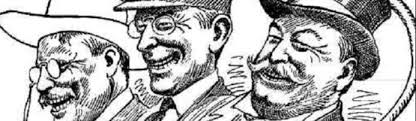
Theodore: Fore and Aft
It stands to reason that our youngest and most vigorous President would have strong relationships with his predecessors and successors. But by the time TR ascended to the Presidency in 1901, the only living “ex” was Democrat Grover Cleveland. Both being New Yorkers, they had been well acquainted for nearly twenty years.

Interestingly enough, despite differing political parties, they liked each other and got on amicably from the start, even when brash and rash TR was only a 23-year-old Assemblyman, and gruff, no-nonsense Cleveland was more than twice his age. But when TR was POTUS, Cleveland’s health was already failing. He died in 1907. TR was on his own.
For such a young chief executive, it also stands to reason his relationships with Presidents would be with him as the ex-POTUS. And TR being TR, he gave them agita.
Roosevelt impulsively pledged not to seek a “second term” in 1905. But at barely 50 in 1909, he was much too young – and far too antsy to retire. Instead, he coaxed William Howard Taft, his Secretary of War, to accept the nomination in 1908.
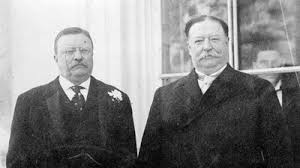
The Taft Traumas
Theodore Roosevelt and Will Taft had been close friends for more than twenty years, and both were genial, outgoing and positively lovable, according to many who knew them both. Their pedigrees, backgrounds and educations (Harvard/Yale) were similar. Their dispositions, however, were congenial, but different. TR, the reformer, was “go-go-go,” and Taft, the jurist, was more “wait a sec…”
Taft did not want the Presidency. His dearest wish was a seat on the Supreme Court. It suited him better, and he knew it. But the Taft family was a powerful unit. His parents and brothers recognized his capabilities and potential from the start. When he married Helen Herron, Nellie tapped him as her ticket to the White House.
Poor Will was no match for Roosevelt and the family. His decision to run for the presidency was as reluctant as TR’s decision not to run was impulsive.
So he ran, with the active help and support of everybody, and won.
TR immediately left the country for a hunting safari in Africa, partly to give Taft some maneuvering room in the Oval Office. TR had hoped his successor would continue his progressive initiatives; Taft picked ones he preferred, but followed a more conservative policy. TR’s political supporters tattled back to the ex-POTUS, and TR was disappointed. He threw his hat back in the ring, ran for the Presidency in 1912, splitting the Republican Party, and insuring the election of a Democrat. Woodrow Wilson.
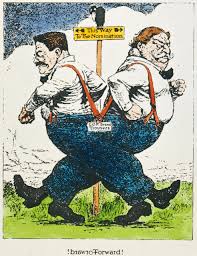
It was heartbreaking for Taft. He had loved TR like a brother, and felt the loss deeply.
Happily for both, their rift was mended at least somewhat, a few years later. More personally than politically.
The Wilson Tug-o-War: Taft
Woodrow Wilson, middle-class, but highly pedigreed among Presbyterian clergy, was just as intelligent as Taft and TR. He was the only US President with an earned PhD.
His election in 1912 placed another intelligent and educated fellow (Princeton) in the presidency. Wilson had been a scholar, a professor and the President of Princeton. He was a strong moralist like his predecessors, but he was a Southerner, Virginia born and SC/GA raised to a prestigious clerical Presbyterian family. Nevertheless, most of his adult life was spent in the north.
While he was or would be respected and reasonably popular, Wilson had developed sufficient chops of his own as a strong President of Princeton. His religious upbringing strengthened his core to a point that he believed he was “destined for greatness.” But he also had a polarized psyche: if you weren’t with him, you were against him. He expected his friends to be absolutely loyal. There was no room for differences of opinion. “Treachery” was his adjective of choice.
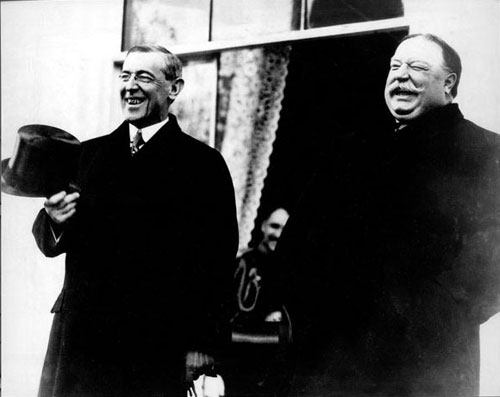
Following WW’s inauguration in 1912, he hosted a luncheon at the White House for his family, friends and close political associates. As a courtesy, he invited his predecessor. To his complete surprise, the genial Taft accepted the invitation, and the start of a pleasant and mutually respectful relationship between the 27th and 28th Presidents began. Taft liked most people, so that was no issue; Wilson, the pickier intellectual, discovered that the better he came to know Taft, the better he liked him.
While they were never close friends, and Taft supported Justice Charles Evans Hughes, the Republican candidate in 1916, the relationship was still cordial. Once the USA entered WWI, Wilson appointed Taft to co-chair the National War Labor Board, to mediate labor/production disputes in war related industries. Taft also supported the League of Nations, with a few reservations.
The Wilson Tug-o-War: Roosevelt
That was a clash of strong personalities, neither of whom took well to being second-fiddle.
Wilson had admired TR years earlier, and TR found a few kind words to say about the Princeton professor. But that was years earlier – with a world generally at peace.
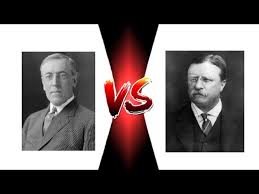
But once the Great War was underway in Europe – four years before the USA became embroiled – their philosophies clashed with an epic bang. Wilson believed that peace/neutrality (a la George Washington) was always better than war. How can anyone argue that? Roosevelt believed that a strong country must always be prepared for war, as a deterrent to potential enemies. How can one argue that?
It became a battle of “Warmonger” against “Nabby-pamby.”
It was complicated and bitter, and it split the country as much as the election of 1912, and took hard tolls on the lives of both of them.
In January, 1919, Theodore Roosevelt died. Wilson had a crippling stroke that September, and would never be the same.
Sources:
Anderson, Judith Icke – William Howard Taft – W.W. Norton, 1981
Chace, James – 1912: Wilson, Roosevelt, Taft & Debs: The Election that Changed the Country – Simon & Schuster, 2004
Morris, Edmund – Colonel Roosevelt – Random House, 2010
https://nationalinterest.org/legacy/teddy-roosevelt-taft-the-odd-couple-9648

