Nabby Adams and the Royall Tyler Affair

It wasn’t an affair. It was mostly a meddle-muddle.

The Enigmatic Miss Nabby

Abigail (Nabby) Adams (1765-1813), the only daughter of John and Abigail Adams was a hard one to figure. By her mid-teens (considered courtin’-age, if not actually marriageable), she was considered a fine looking young woman, well dressed and well mannered. Most people commented on her good sense, combined with a formidable reserve, which tended to keep people at a distance.

Even her mother, a formidable woman herself, recognized Nabby’s “apparent coldness and indifference”, and perhaps almost “wooden” traits. Tainting with faint praise, Abigail commented on Nabby’s prudence and lack of Sensibility. In AA’s time, “Sensibility” connoted more emotional softness of manners.

While some sources comment on Nabby’s closeness to her mother, others conclude that the young teenager was happy to escape Abigail’s overwhelming presence whenever she could. When Nabby visited Mercy Warren (on her own), it was noted that she not only enjoyed herself, but was reluctant to return to Braintree. Her visits to her Aunt Mary Cranch also afforded her time away. Some sources claim she missed her brothers John Quincy and Charles dreadfully when they went to Europe with their father; others note that she seldom wrote to them. 

The formidable mother.

As the older sister to three younger brothers, Nabby, like her mother, was not unaware of the marvelous opportunities destined to fall in her brothers’ laps, and lack of them in her own. She may also have suspected her own lack of intellectual genius, or “curiosity.” She kept most of her thoughts to herself. Definitely enigmatic.

Mr. Royall Tyler

Royall Tyler (1757-1826), was Boston born and raised in a wealthy family, educated at Boston Latin School and Harvard University. When his parents died, young Tyler inherited a considerable estate, but gossip had it that he dissipated it substantially while “sowing his wild oats” at Harvard, which may (or not) have included fathering a child with a serving girl. 

He served briefly in the militia during the early days of the Revolutionary War, studied law, passed the Massachusetts Bar, and, as a “reformed rake” with more maturity and purpose, moved to Braintree to open an office and pursue a legal career. 

Royall Tyler

When Nabby first heard of the new fellow in town, she warned her cousins Betsy and Lucy Cranch  against Tyler’s “artfulness,” since he boarded with the Cranches. Nabby also resolved to avoid him completely, since “our sex cannot be too careful of the characters of the acquaintance we form.”

Naturally Tyler became acquainted with Abigail Adams, ostensibly requesting to borrow some law books. He was invited to call. Attractive, well dressed and mannered, witty and very amiable, he met young Miss Adams, eight years his junior. Notwithstanding her reservations at sixteen, Nabby appears to have been smitten, although she was not easily wooed. 

Mr. Tyler however, was definitely smitten, and proceeded to call at the Adams home regularly.

As soon as Mamma Abigail noticed a budding romance, she wrote her husband, (who responded to his daughter’s situation much faster than he did to his wife’s other letters), indicating his displeasure. Despite the pater-familias mindset of his generation, John Adams was sincerely an affectionate and caring parent. His disapproval of Nabby’s “courtship” was partly due to her youth, and partly due to whatever character defamation gossip Abigail included in the letter. He had little faith that a “reformed rake” could mend his ways. 

The formidable father

John also disapproved of “courting the mother.” Mr. Tyler seems to have enjoyed his conversations with Mrs. Adams – perhaps even more than Nabby’s company. And there is no indication that Nabby was writing to her father, desperately wanting to marry…

Mary Cranch, Abigail’s sister (where Tyler was boarding) continued to add indignant aspersions to Tyler’s character, (although his conduct was above reproach in Braintree, and he continued to build his law practice). Interestingly, Abigail, who seldom altered her opinions or resolve, had grown not only to like Mr. Tyler, but had begun to regard him favorably as a potential “relation.”

Nevertheless, Abigail, Aunt Mary, Aunt Betsey, John’s aged mother, Abigail’s aged father, and even her uncle Cotton Tufts were all chiming in with opinions on the match!

Abigail was also in the process of planning to join her husband in Europe by this time, and expected to take Nabby with her. Her daughter offered no objection. Europe would be nice, and she would never marry without her father’s consent. John was conflicted about Tyler, but perhaps wavering.

Change of Heart, Change of Mind

By the time the Adams women sailed for Europe in 1784, an engagement between Nabby (now seventeen) and Tyler was at least tacit, if not actually formalized. The couple had exchanged miniature portraits.

Both John and Abigail believed that an ocean of separation would either strengthen the bond, or weaken it. Either way, it was a good thing. Again, Nabby said little, but her serious nature had always masked her “Sensibilities.”

Abigail Adams Smith

John was coming around; Abigail was certain that Nabby and Tyler would marry in time. But the letters were few. More letters seem to have been exchanged between Tyler and Abigail, rather than with Nabby. Reports from relatives suggested that his conduct had lapsed.

Then unsettling rumors abounded that Tyler had returned to Boston, living in a boarding house run by a niece-by-marriage to Mary Cranch. Even more rumors abounded that he fathered another child, this time with his landlady. Hmmm.

Nabby eventually wrote to end their engagement, which did not seem devastating to either of them. Or to the senior Adamses.

She was now being courted by Col. William Stephens Smith, former ADC to General Washington and now private secretary to her father. John and Abigail approved, and were pleased to give their blessing. Nabby also seemed pleased, but again left the matter with her parents and fiancée. 

An Ironic Epilogue

Not long before the Adams family returned from Europe, relatives strongly suggested that they required a better house than their little salt box cottage. After all, JA was A-listed for an important position in his fledgling country.

A fine house not far away had recently come on the market, and Abigail had visited there on occasion. She asked her Uncle (via power-of-attorney) to purchase it for them if he believed it was suitable. It was, and it became “Peacefield,” the Adams house for four generations, and “the country’s” to this day.
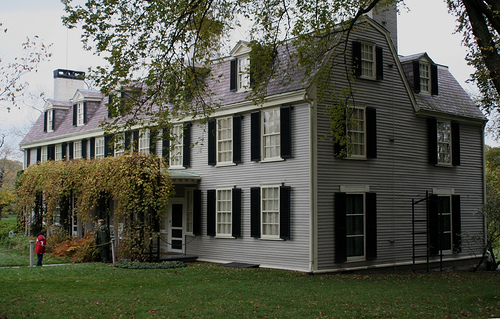
Peacefield

The house had previously been owned by Royall Tyler.

Sources:

Akers, Charles W. – Abigail Adams: A Revolutionary American Woman – The Library of American Biography – Pearson Longman, 2007

Gelles, Edith B. – Abigail and John: Portrait of a Marriage – William Morrow, 2009

Levin, Phyllis Lee – Abigail Adams – St. Martin’s Press, 1987

https://www.mountvernon.org/library/digitalhistory/digital-encyclopedia/article/william-stephens-smith-1755-1816/

https://www.nps.gov/adam/learn/historyculture/places.htm

Posted in A POTUS-FLOTUS Blog, John Adams, Nifty History People | Tagged , , , , , , , , , , , , , , , , , , , , , | Leave a comment

Eliza Monroe Hay, the Irony of Good Feelings

Most people liked President James Monroe well enough – but not his womenfolk.

The Era of Good Feelings

The Monroe years 1817-25, are commonly referred to as “The Era of Good Feelings,” with fair reason. The country was at peace, following a military and economic misery known as the War of 1812. The Democratic-Republicans were in high political ascendancy; the old Federalist Party was practically moribund, with little political leadership or clout. The country was growing by leaps and bounds, both in land and population. The economy was strong, and anyone who wanted to work could find it easy to find a job – or a piece of cheap land for the taking. Times were good.

James Monroe

And James Monroe (1758-31), sometimes considered the last of the Founding Fathers, perhaps more like an older brother, was a man well known to the electorate, and one who came with long list of public offices on his resume. 

Born and raised in Virginia, he attended the College of William and Mary just prior to the American Revolution, and served as scout and officer to General George Washington himself. Recuperating from serious wounds, he returned to Virginia to read law with its Governor Thomas Jefferson. Preferring public service to mundane law practice, he held various offices in Virginia’s Legislature plus a couple of terms as its Governor. He served via the Articles of Confederation and was named to the Constitutional Convention, and knew just about everyone who counted.

Monroe had a stellar resume

Once the USA became officially the USA, served as Virginia’s Senator. President George Washington assigned him to high diplomatic post in Paris. Once Thomas Jefferson became President in 1803, more diplomatic assignments followed. Once James Madison became President in 1809, cabinet positions followed. Monroe was a sure winner in 1816. 

The Distaff Monroes

The tall Senator serving in then-capital New York, saw and fell in love and married a pretty and petite daughter of a former British soldier (French-Indian War) who stayed in America. In early 1786 when they married, Monroe was twenty-seven. His bride, Elizabeth Kortright, was seventeen. In a difficult to document relationship (they were seldom apart), it appears to have been a happy marriage of more than 40 years, despite her frail health, which modern history believes to include recurrent seizures: epilepsy. Her condition was downplayed. It bore a stigma kept from public knowledge.

The young Elizabeth Monroe

Their first child, a daughter named Eliza, was born within the year. 

When Eliza was about six or seven, the Monroes were sent to Paris by President George Washington. The French Revolution was already underway, but the upstart USA (who understood Revolution pretty well) needed to maintain diplomatic ties with its former friend and ally – without getting too involved or alienating any other country.

Little Eliza was placed at the Maison d’education de la Legion de Honneur, run by the aristocratic Henriette Campan, who had been a lady-in-waiting to Marie Antoinette. But the former French Monarchs had been deposed and indeed executed. The “Reign of Terror” was giving way to the Age of Napoleon. 

Eliza Monroe Hay, the most disliked woman in Washington

One of little Eliza’s school chums was Hortense de Beauharnais, the daughter of Josephine, the stunning widow who became Napoleon’s wife. The friendship between the two little girls lasted the rest of their lives. They continued to correspond regularly, and in later years, when Eliza (now Mrs. George Hay) bore her only child, she named her Hortensia. Hortense de Beauharnais (now the wife of Louis Bonaparte) was the Queen Consort of Holland, happy to stand godmother to the daughter of her American friend.

The imperial connections also colored the image and behavior of both Elizabeth and Eliza Monroe permanently, and both mother and daughter were indelibly stamped with the formality of diplomatic Europe, and maintained those remote “aristocratic airs” permanently. 

Hortense de Beauharnais, Queen of Holland

When Monroe became President in 1817, his wife and daughter considered themselves equal in status to the crowned heads in Europe.

President Monroe’s Social Headache

Undoubtedly the First Lady’s predecessor Dolley Madison was a social entity unto herself. Confident, sincerely outgoing and accessible to all, she was a hard act to follow. The Monroe mother and daughter had no intention of even making the effort. 

The beloved Dolley

From the outset, they announced that in the European style, they would neither pay or return calls. Claiming poor health, Elizabeth Monroe generally declined many of her First Lady social duties, allowing “Mrs. Hay” to substitute. It did not set well in the new democracy.

Believed to be in a contentious marriage with attorney and legislator George Hay, Monroe’s elder daughter had neither charm nor diplomatic skills. Her pretensions and tactless comments alienated much of social Washington, making White House dinners and receptions formal, icy and stag affairs, devoid of society’s matrons. 

Even when she arranged her much-younger sister’s wedding (the first Presidential daughter to be married in the White House), Eliza Hay further estranged much of official Washington, limiting the guest list to only family and very close friends. The new couple, Maria Hester and Samuel Gouverneur, were overpowered by the domineering Mrs. Hay, and said to have moved to New York as soon as possible to disassociate themselves from their officious relative and her imperious manners.

The other Monroe daughter, Maria Hester

One story about the bickering Hays’ comes from a diary entry of one Egbert Watson“I do not think I heard them agree on one subject since I am here…I think I heard him tell her today at dinner 3 distinct times “that she talked too much and should talk less.”

Later….

When her mother, father and husband all died within a year, Eliza Hay moved to Paris, where she had enjoyed her happiest times. She converted to Catholicism, and became a nun. She did not have to socialize.

Sources:

Caroli, Betty Boyd – First Ladies: An Intimate Look at How 38 Women Handled what may be the most Demanding, Unpaid, Unelected Job in America – Oxford University Press, 1995

Unger, Harlow Giles – The Last Founding Father – DeCapo Press, 2009

Wead, Doug – All The Presidents’ Children: Triumph and Tragedy in the Lives of America’s First Families – Atria – 2003

https://www.whitehousehistory.org/bios/james-monroe

First Ladies Never Married to Presidents: Eliza Monroe Hay

Posted in A POTUS-FLOTUS Blog, George Washington, James Monroe, Nifty History People, Thomas Jefferson | Tagged , , , , , , , , , , , , , , , , , , , , , , , , , , , , , , | Leave a comment

Abraham Lincoln and The Prince

Spoiler alert: Abraham Lincoln never met Prince Albert or Queen Victoria….but….

The Protocol of Nations

In the earlier days of the country, long before “the hot line” existed, direct communication between heads of state was not considered proper. Written communication (and even most face-to-face conversation) pertaining to diplomatic situations went through the channels of designated intermediaries, i.e. the Secretary of State or ambassador or similar officialdom.

In addition to the proper channels, protocol was rigid. Who was presented first, who entered first, who sat where, right side vs. left side, etc. Lapses of these formalities could create an international incident.

Abraham Lincoln: New President

Abraham Lincoln’s first months as POTUS in 1861 were fraught with crises upon crises, and most historians (and his contemporaries) believe that AL was perhaps not at his most effective in those early days. Several months passed before he began to grow into his new challenges, which seemed to change daily.

When it came to foreign policy, he had little experience, spoke no foreign languages, and his knowledge of the ins-and-outs of diplomacy was still to be learned. For many months he relied on his Secretary of State, William Seward, who had far more expertise in those areas.

Secretary of State Wm. Seward

Prince Albert: Queen Victoria’s Consort

Albert, Prince Consort of England, was a German man, a decade younger than the US President, but he had been given a superb classical education and a background of European protocol. Only twenty when he married the Queen of Great Britain, he was obliged by their constitution to remain above all politics. He also grew into his position – that of advisor to the Queen, and counselor to a succession of Prime Ministers, Foreign Secretaries, and similar high ranking officials – of all parties. Most historians concur, that while Albert was not warmly regarded in his adopted country, the populace had come to respect his considered advice, which was usually excellent.

Prince Albert and Queen Victoria

In personality, the Prince was far more like Jefferson Davis than like Abraham Lincoln. Both were formal in bearing, invariably polite but cool, and generally humorless, narrow and rigid in their ways and opinions.

But in the early days of the American Civil War, while the British people were very much opposed to slavery (which they had abolished decades earlier), they appreciated Southern manners, and most of all, the benefit of American cotton which had become a mainstay of their textile economy.

The Southern Plan

Jefferson Davis was not a stupid man, and realized from the outset that seceding from the Union to form a “new” country was fraught with problems on many levels: economic, transportation, manufacturing, manpower, etc.  Gaining diplomatic recognition would go a long way to alleviate many of those problems.

To initiate some of those plans, James Murray Mason and John Slidell were sent as envoys to Britain and France to press the Confederacy’s case for diplomatic recognition, and to lobby for financial and military support. Both men were widely respected in the South, with solid credentials in foreign affairs. They were also prepared to run the blockade that the Union had immediately put into effect from Maine through the Gulf of Mexico.

Emissaries Mason and Slidell

Cutting to the Chase

It was a complicated scheme, and Union intelligence was well aware of their intentions, as well as the potential diplomatic dangers. After a convoluted path of embarkation plans and vessels, Mason and Slidell finally boarded the RMS Trent, a British mail packet ship, in Havana. They were bound for St. Thomas, and then to England. Captain Charles Wilkes of the USS San Jacinto immediately gave chase.

San Jacinto Capt. Charles Wilkes

According to Prince Albert’s diary on November 28, 1861 “An American warship holds up our mail packet Trent on the high seas and boards her, and removes by force four gentlemen from the Southern States, who were to have gone to London and Paris as envoys. They are carried off to New York. General indignation. The Law Officers declare the act as a breach of international law.”

Lord John Russell, British Foreign Secretary drafted a bellicose memorandum for the British ambassador in Washington, “threating to recall” our man in Washington.” It was tantamount to a declaration of war. A copy was sent to the Prince Consort.

On November 30, desperately ill with only two weeks to live, Prince Albert drafted an amended version for the Queen. It was firm, but lacking in the belligerence of the original. He noted that [the Queen] should have liked to have seen the expression of a hope, that the American captain, did not act under instructions, or, if he did that he misapprehended them, that the United States Government must be fully aware that the British Government could not allow its flag to be insulted, and the security of her mail communications to be placed in jeopardy; and Her Majesty’s Government are unwilling to believe that the United States Government intended wantonly to put an insult upon this country…”

Without knowing it was Prince Albert who suggested this form of response, Abraham Lincoln was like minded in sentiment. Although a relative novice in both foreign relations and maritime law (he would improve with time), he obviously knew it was a definite breach of international law.

Engraving of the Trent “incident”

Seward and Lincoln

Secretary of State Seward, who was far more knowledgeable in those matters that the President, saw a foreign incident as an opportunity to divert attention and possibly even reunite the country.

Lincoln disagreed, claiming “One war at a time.”

Both men agreed however, that the aggressive Captain of the San Jacinto had exceeded his authority, and in due time, quietly permitted Mason and Slidell to be released. No apology, no explanation. And the British government continued to maintain its neutrality.

Lincoln likely never knew that it was Prince Albert who suggested the “plausible out.”

It was the last memo the Prince ever wrote.

He died on December 16.

Sources:

Bough, Richard – Victoria and Albert – St. Martin’s Press, 1996

White, Ronald C. Jr. – Lincoln: A Biography – Random House, 2009

https://millercenter.org/president/abraham-lincoln/key-events

https://www.history.com/topics/american-civil-war/trent-affair

https://www.britannica.com/biography/Albert-Prince-Consort

Posted in American Civil War, Nifty History People | Tagged , , , , , , , , , , , , , , , , , , , | Leave a comment

Old Hickory’s Headache: Andy Jr.

Spoiler alert: Andrew and Rachel Jackson had no children of their own…

Andy Junior

Plus…

Andrew Jackson had no blood relatives of his own. Two months before Andy was born, his father died. His mother and two older brothers had all died (likely tuberculosis) by the time Andy was fourteen. His last remaining blood kin, an uncle, died when Andy was seventeen or eighteen. 

As might be expected, Andrew Jackson felt a deep need for family.

Fortunately, Rachel Donelson, who became his wife, came from a large and prolific family.  She was one of ten, and her nine siblings all married and had numerous progeny. AJ now had “family.” Most lived in close proximity. The emptiness that Andrew and Rachel Jackson felt from their childlessness was somewhat offset by the number of nieces and nephews (many named Rachel or Andrew or Jackson) running around their home at will. Both Jacksons were very fond of children.

Andrew and Rachel Jackson

Surrogates

Andrew Jackson had come to Nashville, TN when he was twenty-one, a new attorney who had recently passed the bar. In the late 1780s, Tennessee was growing by leaps and bounds, and there was property to buy and sell, businesses to buy and sell, partnerships to cement or dissolve, and all sorts of petty arguments to settle. Ergo, lawyers were a solid commodity, and Andrew Jackson fit hand-in-glove. Tennessee loved him. They always would. 

When Tennessee was about to gain statehood, AJ was elected as a delegate to help draft its constitution. Then he was elected as its first Congressman.  He was still in his twenties. 

Thus, as one of the State’s best known worthies, many of AJ’s associates asked him to serve as foster parent or guardian to their children – if necessary. He was happy to do so, although most of these “fosterings” were without actual “paperwork.” Some sources claim that some three dozen children lived at the Hermitage at some time in their childhood, but it is hard to document. Rachel Jackson’s motherly heart was always open to the babies and children she would never bear. 

The Adoption

In 1808, when the Jacksons were around forty, and had given up on parenthood, Rachel’s brother Severn and his wife had twin sons. They already had a large brood. Their property was barely supporting them. And his wife, already weakened by her many offspring, had become frail. 

Thus Andrew and Rachel offered to adopt one of the twins and raise him as their own, and the offer was gratefully accepted. They named the baby Andrew Jackson Jr., the only one who bore the “Jackson” name. By this time, AJ (Senior) had been “elected” as General of the Tennessee Militia. It was considered an honorary position, but Jax took it very seriously, learned military strategies and practices, called regular drills, and it is said, never practiced law again. 

By the end of the war of 1812, General Jackson was a well-seasoned soldier with his “Old Hickory” nickname, and an indelible mark on history at the Battle of New Orleans. 

Andrew Jackson Junior

In brief, Jax Junior as an adolescent, was sent to Davisdon Academy and later the University of Nashville with his personal body servant, his own horse, a very generous allowance, fine clothing including silk hose and imported handkerchiefs. He also accumulated a debt of more than $300 to a posh Nashville merchant. It is said that the princely sum could support of family for a year. 

Young AJ Jr, painted by Ralph Earle

Junior’s extravagant tastes were lifelong. While he seemed to be satisfactory academically, he was without ambition or discipline, and usually failed at whatever enterprise he attempted. According to Jackson biographer Robert Remini, he was a constant disappointment to his father, who time and again bailed him out, frequently selling off pieces of his property to pay his son’s debts.

On the plus side, however, Andy Junior was a convivial fellow, good looking, pleasant in temperament, and truly devoted to his parents. He was also a “ladies’ man.”

By the time Old Hickory was elected President, “Junior” was a considered a “man about town,” and hugely eligible.

Junior: S.O.P. (Son of POTUS)

Andrew Junior had no “official” position early in the Jackson administration. Formal assignments went mostly to Andrew Jackson Donelson, Andrew and Rachel’s favorite nephew who had married his cousin Emily, who assumed the hosting responsibilities for the newly-widowed President. Both had been particularly close to “Aunt Rachel,” who had died only weeks before the inauguration.

But “Junior,” handsome, well mannered, immaculately dressed, and with an engaging personality, was popular, and usually welcomed everywhere, usually with a different lady on his arm. 

Sarah Yorke Jackson

A few years later, after prodding from Papa Hickory, he married Sarah Yorke (1805-87). The President was thrilled, and always considered Sarah as a daughter. He provided them with property of their own, but insisted they consider the Hermitage their primary residence. In fact, he assigned AJ Jr. as the plantation manager, and Sarah as the mistress of the Hermitage. 

After a devastating fire at the hermitage, the Donelsons returned to Nashville, partly due to Emily’s failing health, and Andy Junior and Sarah were now installed at the White House with official duties, usually mismanaged.

In Old Hickory’s retirement and old age, he continued to bail his son out of the financial woes caused by Andy Junior, whose poor judgement and extravagance nearly ruined the elderly man. Despite the financial grief, and the joy at being a grandfather of five (only three lived to adulthood), he never stopped loving or forgiving his adopted namesake.

The Hermitage

The Hermitage was willed to Andrew Jr., but due to overwhelming debts, it was sold to the State of Tennessee as an historical site.

Sources:

Burstein, Andrew – The Passions of Andrew Jackson – Borzoi/Knopf, 2003

Remini, Robert V. – Andrew Jackson 1767-1821 – Vol. 1: American Experience – History Book Club, 1998

https://thehermitage.com/history-of-the-hermitage#following-jacksons-death

https://www.whitehousehistory.org/bios/sarah-yorke-jackson

Posted in American Civil War | Leave a comment

Abraham Lincoln and Grace Bedell

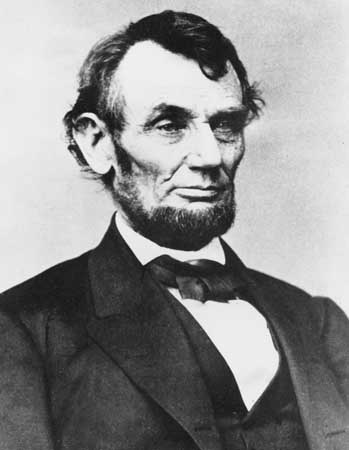
The iconic Lincoln

Lincoln and the Fair Sex

Abraham Lincoln had comparatively little personal involvement with women – or even young girls. His mother died when he was nine. His sister Sarah, older by two years, died in childbirth at age twenty. While he had two older stepsisters, Matilda and Sarah Elizabeth (Betsey), there is little to suggest close companionship with them.

As he grew to young manhood, his tall, lanky physique was topped by a homely head. One story purports that a woman remarked that he was the homeliest man she ever saw, and suggested that he might at least stay home. While that incident is likely apocryphal, the essence holds. Lincoln was no Adonis, and he knew it. But it couldn’t be helped. 

The beardless Lincoln

Ergo, while he was always polite and respectful to the ladies, his main social companionship was masculine. Fellow townsmen. Fellow attorneys. Fellows who passed a little time sitting around the cracker barrel in the general store. They didn’t care about Lincoln’s lack of handsome. They liked him.

Between his plain looks and gangling appearance, he was also dirt poor, which inhibited his social skills in the “female” department. He did not marry until he was nearly 33. Still homely, still gangling and still poor. And as a father, he was very much in the early Victorian mold: boys were to be educated and trained to a purpose; girls were to be pampered and petted. And Lincoln was the father of four sons, but no daughters.

The Political Rise and Prominence

Lincoln the lawyer was a very good one. Diligent, fair minded, and with a warm and engaging sense of humor.  He found politics agreeable to his personality, and beneficial to his pocketbook. Joining with his peers “riding the circuit” he met nearly every prominent politician in Illinois – and even in neighboring states.

When his politics “jelled” to the point of serious national candidacy, he was around fifty. Still homely, still gangling. Not quite so poor, but far from wealthy. 

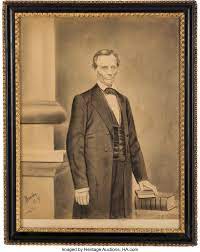
The Brady photo

The Lincoln photograph taken by Mathew Brady just prior to his 1860 Cooper Union speech in New York City was widely circulated. Lincoln himself credited that photograph in helping secure his election. 

In another photograph, taken later in 1860, with Vice Presidential nominee Hannibal Hamlin of Maine, Lincoln was still homely and gawky looking. 

Miss Grace Bedell

In an age long before women could vote, the fair sex were still wildly interested in politics! Many of them believed they wielded considerable influence with their significant menfolk. Maybe. But political crowds were seldom off limits to women!

The 1860 campaign poster

In Westfield, a little town in Chautauqua County, NY, (near Lake Erie) population not-a-lot, there was a local fair in the fall of 1860. It was political season, and 1860 was arguably the most polarized and vocal political election ever held in the US to that date. FOUR candidates were in the running. Vice President John Breckinridge was the candidate for the southern Democrats; Senator Stephen A. Douglas, for the northern Democrats. Former Congressman Edward Bates represented the old Whig party, now on its last legs. And Abraham Lincoln, an attorney from Illinois with little national exposure, was the Republican candidate. It was only the second election fielding Republicans. 

As such, handouts, posters and ribbons were dispersed generously at the fair. Norman Bedell, a strong supporter of the Republican Party, had gone to the fair, and brought home one of the posters featuring Lincoln and Hamlin. His daughter saw it, and believed the Presidential candidate’s physiognomy could be be improved, perhaps to balance the triangulation between broad forehead and tapering chin – if he grew a beard.

Grace Bedell was eleven years old. But she was bright and articulate, and daring enough to write a letter to the Republican candidate. She suggested that he grow whiskers. They were very popular with the ladies.

An amused, paternal Lincoln responded, thanking her for the suggestion, but wondered if it might be too much of an affectation. Nevertheless, he took her up on it.

Growing the beard.

Enroute to the Presidency

After Lincoln won the election in 1860, he embarked on a circuitous journey from Springfield IL to Washington for the inauguration. One of his stops was in Buffalo, the second largest city in New York. It is also about an hour (today’s drive) from Westfield, and was scheduled for a brief stop at the station, which was jam packed with supporters hoping to get a glimpse of the POTUS-elect. With a beard.

While he was there, he remarked that he was pleasantly “acquainted” with one of its residents, and asked if Miss Grace Bedell was in the audience. A small hubbub arose, and a man leading a 12-year-old young lady to the train came forward. Lincoln was pleased to introduce her, explained the occasion of the acquaintance, admitted that he took her advice, and gave her a kiss. Later, they spent a few minutes in private conversation.

Grace Bedell

Epilogue

While the “occasion” was a charming human-interest story in the press, the Bedell family fell on harder times not long afterwards. In January1864, Grace, now 16, penned another letter to President Lincoln, explaining the family misfortune, and hoped the POTUS might recommend her for a position in the Treasury Department to help support her family. When her letter was never answered, she suspected that perhaps the President never received it, and wrote another. That letter was definitely not received. It eventually turned up in Treasury Department archives – in 2007!

Grace Bedell married a few years later, moved to Kansas and had one son. She lived to be two days shy of her 88th birthday. By then, the story of Grace, Lincoln and his beard had become part of American lore.

A statue commemorating the famous “meeting” was erected in 1999 – in Westfield, NY. With the beard.

Sources:

David, Donald Herbert – Lincoln – Simon and Schuster, 1996

Widmer, Ted – Lincoln on the Verge: Thirteen Days to Washington – Simon and Schuster, 2020

https://www.abrahamlincolnonline.org/lincoln/speeches/gracebedell.htm

https://www.abrahamlincolnonline.org/lincoln/sites/bedell.htm

Posted in A POTUS-FLOTUS Blog, Abraham Lincoln, American Civil War, Nifty History People | Tagged , , , , , , , , , , , , , , , , , , , | Leave a comment

James Madison and the Next Generation

James Madison was the youngest of our presidential Founding Fathers.

The Great Little Madison

Many historians include numerous worthies in the category of “Founding Fathers,” i.e. those men in mid-eighteenth century America who rose to prominence as the country established itself as a sovereign nation. Patrick Henry, Samuel Adams, George Wythe, John Hancock, and even Aaron Burr are frequently included. 

But the sifting of greatness usually winnows the “Founding Fathers” to six (in order of age): Benjamin Franklin, George Washington, John Adams, Thomas Jefferson, James Madison and Alexander Hamilton, whose birthdate is sketchy, but a few years Madison’s junior. Franklin, old enough to be everyone’s father, if not grandfather, died first, at a ripe old age. Washington was second to die, suddenly and not as ripe in age. In one of the rarest coincidences of history, Adams and Jefferson died simultaneously, of old age, on the same day – exactly 50 years after the Declaration of Independence was signed. 

Alexander Hamilton, the youngest, died in his 40s, in a duel.

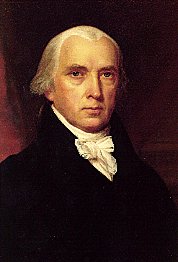
That left James Madison, who is generally credited with shepherding the United States Constitution through a dedicated process-of-compromises, and through ratification by thirteen sovereign states. Even in his own lifetime, he was considered the Father of the Constitution. He also lived a long life, and served for eight years as President in the early decades of the nineteenth century.

It was during the Madison Administration, 1809-17 that several younger men, all children or even babies during the Revolution, rose to political prominence, and dominated the next forty years of history.

John Quincy Adams

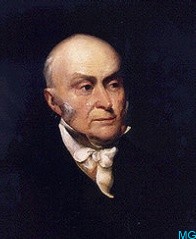
John Quincy Adams, son of a bona fide “Founding Father” was born in 1767, and at eight, was an eye-witness to the Battle of Bunker Hill. Smart and intellectually diligent, he spent another eight formative years in the great capitals of Europe, mastering several languages, and inhaling the culture of the Old World.

Statesman and 6th POTUS

President George Washington himself recognized the young man’s talent, shortly after JQ finished Harvard and had passed the Massachusetts Bar. The young man, somewhat disenchanted with the mundane practice of law, penned a series of prescient newspaper “letters” (under a conventionally assumed name), and drew favorable notice as someone of growing importance. GW appointed him as Minister to the Netherlands. JQ spoke excellent Dutch.

After being recalled by his now-president father, the mature JQA became involved on and off in elective Massachusetts politics. Then President Madison appointed him Minister to St. Petersburg, Russia. He was later named Chief American negotiator to end the War of 1812. And then was named Minister to Great Britain, Sec/State, et cetera. He was a heavyweight.

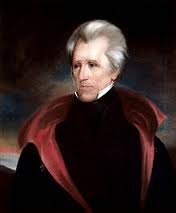
Andrew Jackson

AJ: 7th POTUS

Andy Jackson was a few months older than John Quincy Adams, and aside from both becoming attorneys, they were polar opposites. JQ was cultured, educated and disciplined New Englander. AJ was raw, poorly educated, and a completely undisciplined “westerner.” But as a “man of the people” he had leadership, brash courage and magnetism gushing from every pore. He bought and sold property and businesses, ran for and resigned from public office, raced horses, fought in duels, and was beloved throughout Tennessee.

Once he discovered the personal satisfaction of military command, as General of the Tennessee militia, he never practiced law again. 

His technically-too-late victory at the Battle of New Orleans in early 1815 Andrew Jackson cemented his reputation as a man to be reckoned with, and followed by hordes of admirers. All the way to the White House.

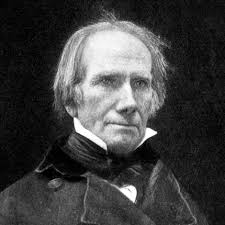
Henry Clay

A decade younger than Adams and Jackson, Henry Clay was a Virginian who emigrated to Kentucky. Educated, smart, and outspoken, he was cut from the same cloth as Jackson: he lived a hard aggressive life, drank (albeit never to huge excess), gambled, and was usually coming home from a night of carousing about the same time as Adams was greeting the dawn. 

Clay. The wannabee.

Clay was elected early to public office, made his mark as a man on the rise, and rose as a man who could wrangle out compromises to make everyone happyish, at a time when political parties had not completely jelled. By the time of his death, he had been a Congressman, Speaker of the House, a diplomat, senator, Secretary of State, and candidate for President three times. He lost each time, but he definitely made his mark.

Daniel Webster

A half-generation younger than John Quincy Adams and Andrew Jackson, Daniel Webster was another New Englander (NH/MA), who became the embodiment of the urbane, well-educated (Dartmouth) and superb attorney who eventually argued more than 200 cases before the Supreme Court.

Webster: Another wannabee

But most of all, he was as an orator, in an age when compelling oratory drew crowds from afar. He was considered the finest in the country.

He served as Congressman and Senator, eventually becoming Secretary of State in the Harrison/Tyler administrations. His eye was on the Presidency till the day he died, but never achieved that goal, perhaps being tainted by the same stand-offishness as JQA. But no one surpassed his command of the podium.

John C. Calhoun

A suave South Carolina lawyer with a Yale education, John C. Calhoun was the same age as Webster, and just as fiery and eloquent. He also had the magnetism of Jackson and the tenacity of JQA. Suave and cunning, he was the wild card in every deck. An ardent nationalist in his early career, he gravitated to the principles of states’ rights and never veered thereafter. Congressman, senator, cabinet member (War/Monroe) and a vice president under both Adams and Jackson, he was detested and mistrusted by both “his” Presidents for the rest of their lives. 

John C. Calhoun

His views on tariffs and slavery and the right to secede became the linchpins of Southern political thinking, and a generation of nascent “confederates” took him as their mentor two decades before the Civil War.

And all five: John Quincy Adams, Andrew Jackson, Henry Clay, Daniel Webster and John C. Calhoun, came of political age and renown when James Madison was president.

Sources:

Brands, H.W. – Heirs of the Founders: The Epic Rivalry of Henry Clay, John Calhoun and Daniel Webster, the Second Generation of American Giants – Doubleday, 2018

Peterson, Merrill D. – The Great Triumvirate: Webster, Clay, and Calhoun – Oxford University Press, 1987
https://www.britannica.com/topic/War-Hawk

https://www.ushistory.org/us/30c.asp?srsltid=AfmBOopeqJmApKgRkbk9XZenKAQBKYjbOGNabwcD0-HvodvILInHcMnx#google_vignette

Posted in A POTUS-FLOTUS Blog, Andrew Jackson, George Washington, James Madison, John Adams, John Quincy Adams, Nifty History People, Thomas Jefferson | Tagged , , , , , , , , , , , , , , , , , , | Leave a comment

Presidents and Exes: Part III

Exes and Woes of the Nineteen-Teens

Entire books have been written about this!

Theodore: Fore and Aft

It stands to reason that our youngest and most vigorous President would have strong relationships with his predecessors and successors. But by the time TR ascended to the Presidency in 1901, the only living “ex” was Democrat Grover Cleveland. Both being New Yorkers, they had been well acquainted for nearly twenty years.

Cleveland and TR

Interestingly enough, despite differing political parties, they liked each other and got on amicably from the start, even when brash and rash TR was only a 23-year-old Assemblyman, and gruff, no-nonsense Cleveland was more than twice his age. But when TR was POTUS, Cleveland’s health was already failing. He died in 1907. TR was on his own.

For such a young chief executive, it also stands to reason his relationships with Presidents would be with him as the ex-POTUS. And TR being TR, he gave them agita.

Roosevelt impulsively pledged not to seek a “second term” in 1905. But at barely 50 in 1909, he was much too young – and far too antsy to retire. Instead, he coaxed William Howard Taft, his Secretary of War, to accept the nomination in 1908. 

TR picked his successor

The Taft Traumas

Theodore Roosevelt and Will Taft had been close friends for more than twenty years, and both were genial, outgoing and positively lovable, according to many who knew them both. Their pedigrees, backgrounds and educations (Harvard/Yale) were similar. Their dispositions, however, were congenial, but different. TR, the reformer, was “go-go-go,” and Taft, the jurist, was more “wait a sec…”

Taft did not want the Presidency. His dearest wish was a seat on the Supreme Court. It suited him better, and he knew it. But the Taft family was a powerful unit. His parents and brothers recognized his capabilities and potential from the start. When he married Helen Herron, Nellie tapped him as her ticket to the White House.

Poor Will was no match for Roosevelt and the family. His decision to run for the presidency was as reluctant as TR’s decision not to run was impulsive. 

So he ran, with the active help and support of everybody, and won.

TR immediately left the country for a hunting safari in Africa, partly to give Taft some maneuvering room in the Oval Office. TR had hoped his successor would continue his progressive initiatives; Taft picked ones he preferred, but followed a more conservative policy. TR’s political supporters tattled back to the ex-POTUS, and TR was disappointed. He threw his hat back in the ring, ran for the Presidency in 1912, splitting the Republican Party, and insuring the election of a Democrat. Woodrow Wilson.

The old pals fell out.

It was heartbreaking for Taft. He had loved TR like a brother, and felt the loss deeply. 

Happily for both, their rift was mended at least somewhat, a few years later. More personally than politically.

The Wilson Tug-o-War: Taft

Woodrow Wilson, middle-class, but highly pedigreed among Presbyterian clergy, was just as intelligent as Taft and TR. He was the only US President with an earned PhD. 

His election in 1912 placed another intelligent and educated fellow (Princeton) in the presidency. Wilson had been a scholar, a professor and the President of Princeton. He was a strong moralist like his predecessors, but he was a Southerner, Virginia born and SC/GA raised to a prestigious clerical Presbyterian family. Nevertheless, most of his adult life was spent in the north.

While he was or would be respected and reasonably popular, Wilson had developed sufficient chops of his own as a strong President of Princeton. His religious upbringing strengthened his core to a point that he believed he was “destined for greatness.” But he also had a polarized psyche: if you weren’t with him, you were against him. He expected his friends to be absolutely loyal. There was no room for differences of opinion. “Treachery” was his adjective of choice.

Wilson and Taft got on!

Following WW’s inauguration in 1912, he hosted a luncheon at the White House for his family, friends and close political associates. As a courtesy, he invited his predecessor. To his complete surprise, the genial Taft accepted the invitation, and the start of a pleasant and mutually respectful relationship between the 27th and 28th Presidents began. Taft liked most people, so that was no issue; Wilson, the pickier intellectual, discovered that the better he came to know Taft, the better he liked him. 

While they were never close friends, and Taft supported Justice Charles Evans Hughes, the Republican candidate in 1916, the relationship was still cordial. Once the USA entered WWI, Wilson appointed Taft to co-chair the National War Labor Board, to mediate labor/production disputes in war related industries. Taft also supported the League of Nations, with a few reservations.

The Wilson Tug-o-War: Roosevelt

That was a clash of strong personalities, neither of whom took well to being second-fiddle. 

Wilson had admired TR years earlier, and TR found a few kind words to say about the Princeton professor. But that was years earlier – with a world generally at peace. 

Their basic philosophies were in conflict.

But once the Great War was underway in Europe – four years before the USA became embroiled – their philosophies clashed with an epic bang. Wilson believed that peace/neutrality (a la George Washington) was always better than war. How can anyone argue that? Roosevelt believed that a strong country must always be prepared for war, as a deterrent to potential enemies. How can one argue that? 

It became a battle of “Warmonger” against “Nabby-pamby.” 

It was complicated and bitter, and it split the country as much as the election of 1912, and took hard tolls on the lives of both of them.

In January, 1919, Theodore Roosevelt died. Wilson had a crippling stroke that September, and would never be the same. 

Sources:

Anderson, Judith Icke – William Howard Taft – W.W. Norton, 1981

Chace, James – 1912: Wilson, Roosevelt, Taft & Debs: The Election that Changed the Country – Simon & Schuster, 2004

Morris, Edmund – Colonel Roosevelt – Random House, 2010

https://nationalinterest.org/legacy/teddy-roosevelt-taft-the-odd-couple-9648

https://www.smithsonianmag.com/history/why-teddy-roosevelt-tried-bully-way-onto-wwi-battlefield-180962840/

https://www.whitehousehistory.org/bios/woodrow-wilson

Posted in A POTUS-FLOTUS Blog, Grover Cleveland, Theodore Roosevelt, William Howard Taft, Woodrow Wilson | Tagged , , , , , , , , , , , , , , , , | Leave a comment

George Washington’s Boyhood Home: Ferry Farm

Fredericksburg Roots for George

GW and Father: An old illustration

George Washington was born on Pope’s Creek, perhaps 45 minutes (today’s drive) from Fredericksburg. When he was four, the family moved to a lovely piece of land along the Potomac River, even closer to Fredericksburg. Originally called Little Hunting Creek, it is now called Mount Vernon.

When GW was around six, his father Augustine purchased 580 acres just across the Rappahannock River in Fredericksburg, built a house and out-buildings, and the family of five (by his second wife, Mary Ball) moved in.

Images of Augustine and Mary Ball Washington

Since accurate statistics are unavailable circa 1740, the best that can be suggested is that Fredericksburg was already a substantial town with perhaps 500 residents. The entire Virginia colony boasted less than 200,000 and was the largest and most populous of the thirteen colonies at that time!

Fredericksburg was thriving, with shops and stalls, schools and churches, traveling theatricals and entertainment, and a fine river to carry goods and necessities for miles around.

Augustine Washington was a prosperous man, with a substantial farm, plus a partnership in an iron foundry not far from their home. The move to Ferry Farm was a good decision.

Growing Up George

GW’s two older half-brothers were older by a decade or more, and his earliest memories of them were fuzzy. They were in England for the formal education that was commonplace for prosperous sons.

A recreation

As the “oldest” of the second batch (four younger siblings), George was expected to pull his weight. He did chores. He fed the chickens, pulled the weeds, and as he got bigger and stronger, carried water up from the river (not far away), chopped firewood, and tended to the animals. He learned horsemanship. And how to use tools. And swordsmanship and how to dance.

The family owned perhaps ten or a dozen laborers and house servants. GW worked alongside, and likely learned the essence of “plantation.”

But when GW was eleven, his father died. Whatever hopes or expectations George had for an education abroad were not in the cards. His mother was set against it.

Not a recreation.

Augustine’s will left his oldest son Lawrence the property on the Potomac that is today Mount Vernon. His second son, Augustine Jr., inherited Pope’s Creek, along the Rappahannock. To George, his eldest by his second wife, he left Ferry Farm, once he reached his maturity. Other bequests did not include large acreage.

Without formal education, or even a commission in the British military, GW needed another avenue of advancement. By his mid-teens, he discovered surveying: a fine, respectable profession for a young man of quality. Even better, he was good at it.

The earliest known survey by GW

With active mentorship from his brother Lawrence, and his brother’s neighbors, the wealthy and titled Fairfax family, surveying projects in “western” Virginia were forthcoming. And one of GW’s earliest surveys and maps, done when he was still in his teens, were for Pope’s Creek, at the behest of his brother Augustine.

By twenty, GW had parlayed his surveying skills and knowledge of the land itself into a commission in the Virginia Militia. He definitely owned Ferry Farm, where he stayed periodically, but he never lived there again.

Young GW

Mary Washington’s Ferry Farm

Mary Washington continued to live at Ferry Farm for more than twenty-five years after her husband’s death. She raised Betty, Samuel, John and Charles. When they married/left for homes of their own, she still continued to live there and work the farm.

GW spent eight years in the Militia before he married and took up permanent residence at Mount Vernon, which was left to him after Lawrence died. He dutifully visited his mother periodically, and was always on good terms with his siblings.

But by 1772, Mary Ball was past sixty. Running the farm on her own (with a few servants) was becoming difficult for her. GW was 40, well past his maturity. He agreed that his mother needed a smaller house.

He purchased a fine house-with-fine-garden for her in Fredericksburg, already familiar surroundings, and within walking distance to his sister Betty’s home – and the grandchildren! She lived there for the rest of her long life. The house still remains, and is open to the public.

Mary Washington house

Ferry Farm was put on the market – but it took a while before it was purchased in 1774 by Hugh Mercer, a physician and general in the Revolutionary Army – and a friend of the now Commander-in-Chief of the Revolutionary forces.

Ferry Farm: Later

Wooden frame houses tend to burn. They tend to rot. They tend to suffer the slings and arrows of weather and time. Ferry Farm was no different. There were other owners and ravages of nature.

By the Civil War, while the property was always known to be GW’s Boyhood Home, little remained of any of its original structures. There was no actual fighting on the property (that was left to Fredericksburg itself) but Union soldiers encamped on the land, and there were a few skirmishes.  

But in the early 20th century, with a 200th birthday of The Great George near approaching, and Mount Vernon, having been lovingly cared for and enshrined, serious thought was given to restoring Ferry Farm as well.

John D. Rockefeller, Jr., who poured his money, his time and his love into recreating Colonial Williamsburg, sent some of his leading scholars and engineers, archaeologists and scientists to revive and restore both Pope’s Creek – and Ferry Farm.

The land is there, of course, but the site is a re-creation. The furnishings are period pieces or reproductions. (The good stuff always goes to Mt. Vernon!) But there is a nifty museum and the ubiquitous gift shop. A few relics like buttons and wig-curlers and pieces of pottery have been traced to GW’s Ferry Farm.

And yes, some cherry pits have been found, too.

Sources:

Bish, Jim – I Can’t Tell A Lie: Parson Weems and the Truth about George Washington’s Cherry Tree, Prayer at Valley Forge, and Other Anecdotes – 2023

Chernow, Ron – Washington: A Life – Penguin Books, 2010

https://www.smithsonianmag.com/history/washingtons-boyhood-home-7113627/

Posted in A POTUS-FLOTUS Blog, Nifty History People | Tagged , , , , , , , , , , , , , , , , , , | Leave a comment

Jeanette Rankin: The Lonely, Only Congresswoman

Even before the Constitutional Amendment granting women’s suffrage, Jeanette Rankin was elected to Congress. From Montana.

A Foot in Two Centuries

Jeanette Rankin was born in 1880 in Missoula, MT. It was still the Wild West. There were less than 40,000 settlers in the entire (very large) territory. It did not achieve statehood for another decade. 

The Rankins were a prosperous family, Jeanette being the eldest of six siblings – but only one brother. She was raised as a pioneer woman. She cleaned and sewed, cooked and did farm chores, and helped raise the younger children. She also became familiar with the farm machinery, and even built a wooden sidewalk by herself, so her family could rent out a house they owned. And…she was sent to school, and excelled. 

The Rankin family

But by the mid 1890s, once Montana became the 41st state, Jeanette was old enough to realize that while pioneer women were valued – and expected to contribute side by side with their menfolk to the harsh life required, they were not permitted to have a say in the running of political affairs.

But she went on to a college education, earning a degree in biology from the University of Montana, and explored various career options. After helping to raise her younger siblings after her father died, she moved to San Francisco (for better opportunities), and found a position in a brand new and growing field: social work. She had discovered her true calling – and the doors were thrown wide open for her. 

She went to New York City and enrolled for a year in the NY School of Philanthropy (now Columbia University’s School of Social Work). She worked briefly in Spokane, and then went on to study further at the University of Washington in Seattle.   

Rankin found her calling.

It was 1909. Theodore Roosevelt had just pulled the country into the 20th century. Jeanette was nearly thirty, strong, smart, energetic, and ready to join the new cadre of friends she was making in the Women’s Suffrage movement.

The Suffragist

With her worthy background, Jeanette Rankin became a leader in the Women’s Suffrage movement, first (briefly) in Seattle, when Washington State became the 5th state to permit women to vote. Then, perhaps due to her time and education in New York, was sent back to the Big Apple to organize their movement.

She was not a loud or forceful woman, i.e. the type to chain herself to fences, or dare authorities to send her to jail. Rather, she organized her own thoughts and concepts extremely well, and her oral delivery was compelling. Women’s suffrage had become her passion, but it was as much intellectual as it was emotional.

By 1911, she had returned to Montana, where she was becoming well known and admired, and helped that state in its quest for women’s suffrage. She became the first woman to address the Montana State Legislature. Her arguments were strong. In 1914, Montana granted women the right to vote; the 10th state to do so.

Woman of the House

The Congresswoman

It is only a small step between the right to vote, and the right to hold office. Ms. Rankin firmly believed that the problems of corruption and dysfunction in the US government was due in considerable part to the lack of women’s influence in its governing bodies.

With the strong encouragement and financial help from her brother Wellington, who had become a leader in Montana’s Republican Party, Jeanette decided to run for an at-large seat in the US Congress – on the Republican ticket.

She plied all her energies into the campaign, traveling through the third largest (at that time) state in the Union. She drove her car hundreds of miles, made hundreds of speeches on various issues, shook thousands of hands, and proved her competence and dedication to Montana (and the country’s) greater good.

She came in second in a field of eight candidates, and won a seat in 1916.

She was the first Congresswoman – and the only one elected even before the Constitutional Amendment granting women the right to vote was formally ratified.

The Pacifist

When Jeanette Rankin was elected in late 1916, the Democrats (she was a “progressive” Republican) won the election because President Woodrow Wilson “kept them out of war.” He had been an ardent believer in keeping the USA neutral in the Great War that was toppling empires abroad – and claiming literally millions of lives. The country, as a whole, supported neutrality; after all George Washington himself cautioned posterity against involvement in conflicts that did not concern us. At the same time, the country as a whole also supported preparedness, including military preparedness, as a deterrent. It was a complicated and complex situation.

TR: “Be prepared!”
Wilson “kept us out of war.”

But European events, particularly Germany’s continued U-Boat aggression on the high seas, was conspiring against the USA’s “better angels.” The Zimmerman letter, dangling bait for Mexico to enter the War allied to Germany, was the last straw.

Congresswoman Rankin’s women’s suffrage priorities were forced to shift. In her own phrase, “I wish to stand for my country, but I cannot vote for war.” It was a hard choice, and years later she added that “the first time a woman had the chance to say ‘no’ to war, she should say it.”

She was not alone. Fifty Congressmen – and a few Senators of both parties also voted against the declaration of war. But as the first Woman in Congress, she was singled out for particular notoriety. She was not re-elected. But she would be heard from again. And again.

By the time her term ended, however, a constitutional amendment to allow women to vote had passed both Houses of Congress and was well on its way to passage and ratification.

She was the only woman to actually vote for the 19th Constitutional Amendment.

Sources:

Englund, Will – March 1917: On the Brink of War and Revolution – W.W. Norton, 2017
Smith, Norma – Jeanette Rankin, America’s Conscience – Montana Historical Society Press, 2002

https://awpc.cattcenter.iastate.edu/directory/jeannette-rankin

https://www.archives.gov/education/lessons/woman-suffrage

Posted in A POTUS-FLOTUS Blog, Nifty History People, Theodore Roosevelt, Woodrow Wilson | Tagged , , , , , , , , , , , , , , , , , | Leave a comment

Franklin D. Roosevelt: Stamp Collector

Franklin D. Roosevelt was a collector of all sorts of stuff from boyhood.

The Budding Philatelist

Franklin D. Roosevelt (1882-1945) was the only child of a middle-aged father and his much younger second wife. It had been extremely difficult for Sara Delano Roosevelt, and the doctors advised the couple that more children would not be forthcoming. Sara plowed all her maternal energies into raising her son. Despite the Roosevelt (and Delano) wealth and prominence, the new mother insisted on performing most of the child-rearing tasks rather than delegate to the nurses and nannies popular with their upper crust social set.

FDR and parents

As an only child, the young boy was raised in an “adult” environment with very few available children of his own age to play with regularly. His education was via tutors. His vacations were accompanying his parents abroad. He learned early on to amuse himself – by himself.

By the time he was seven or eight, he had developed an interest it stamp collecting – a popular hobby then and even now. Philatelist is the “official” or “fancy” term they use for the pastime. FDR acquired the proper albums and magnifying glass, scissors and paste supplies, and whatever “instructional” materials were available. Visits to the local post office were frequent. 

It is said, (generally by himself) that he learned geography primarily from his stamp collection. By the time he was a lad, circa 1890, sending and receiving mail all over the world required a stamp. Each time FDR discovered a new stamp from a new part of the world, he eagerly checked the encyclopedia and atlas to learn as much as he could about the particular nation. 

At his death, he had a collection of about 1 million stamps, but according to stamp collecting experts, FDR’s collection was not particularly exotic or rare. He seldom sought hard-to-find or mint-imperfect additions for his hobby. He was content to occupy himself with generally available products, and found his pleasure in being a happy hobbyist. He loved learning about where they came from and the people/events they commemorated – rather than the details of the stamp process itself.

The Polio Hobby

Roosevelt was nearly 40 when he contracted infantile paralysis, better known as polio. Despite the best available care and treatment, the disease took a huge toll on his health. He would never walk again without heavy braces and similar aids. His self-designed wheelchair was always nearby. 

FDR’s stamp collection was always nearby.

Once the acute throes of pain and infirmity had abated, the former Assistant Secretary of the Navy and losing Vice Presidential candidate of 1920 needed to find other outlets for his energies. His health came first, of course. He spent the better part of the 1920s on long therapeutic trips to warm climates with warm waters. Swimming was considered the most successful treatment for polio victims. It would be a part of his regular routine for the rest of his life. As a side benefit (since he never regained the use of his legs) the upper part of his body was considerably strengthened. 

Collecting stamps is a pastime that one can do sitting at a desk. And even when FDR was “living” on a boat, or in a cottage in Warm Springs, GA, stamp albums and related “equipment” was packed along with his clothing and books. He found it restful. Some believe that he found time everyday to “play with his stamps.”

By the time he reactivated himself in politics and became the Governor of New York, stamp collecting had become an extremely popular hobby. King George V of Great Britain was known to be an avid collector, albeit of the more exotic ephemera. His son, who later became King George VI, was also a stamp collector. And when FDR became US President, its popularity reached its height. 

George V
George VI

The Postmaster General made sure the President received the latest stamp issues, and FDR personally sketched out new ideas for stamps.

The Philatelists were happy to endorse him!

The Presidential Philatelist

Once WWII started in Europe, Roosevelt’s stamp collection played a dual role. Naturally, the old hobby relaxed him, and his closest aides understood its importance in channeling his thought processes. Then again, his interest and knowledge of geography became even more acute. 

Historian Paul Boller tells a story that in 1940, FDR was cruising on the Presidential Yacht and learned of an Allied air raid bombing of a small Mediterranean island called Taranto. His aides, including some military brass, had never heard of the place. But Roosevelt, having stamps from that island, and having checked the atlas and reference books, knew exactly where it was. He also knew the distance between Taranto and Malta and Gibraltar, ergo why it was an important strategic location.

After the Japanese Attack on Pearl Harbor, tiny obscure islands in the Pacific Ocean were in all the headlines. He had obtained stamps from many of those places years earlier, and the knowledge of them became a great benefit, especially when he talked to the American public in his “fireside chats.” 

The Collection

After his death in 1945, FDR’s stamp collection was sold at auction. It was valued at $80,000, which would be about $1.5 million today. 

Documented provenance!

But it was not sold as a unit. Serious collectors of anything are seldom interested in purchasing a large ready-made collection. They want what they don’t have. 

Lotsa FDR stamps!

Therefore, it was sold in pages. Naturally, with the provenance of the President, including an authenticated note stating “from the collection of President Franklin D. Roosevelt”, the stamps brought many times that amount. The parts vastly outweighed the whole!

One can still obtain items from the collection. And more than 80 countries have issued their own stamps honoring U.S. President Franklin D. Roosevelt.

Sources:

Boller, Paul – Presidential Diversions: Presidents at Play: From George Washington to George W. Bush, Harcourt, 2007.

Davis, Kenneth – FDR: The Beckoning of Destiny – Putnam, 1971

Lippman, Theo. Jr. – The Squire of Warm Springs – Playboy Press, 1977

https://www.fdrlibrary.org/presidential-hobbies

https://postalmuseum.si.edu/fdr-stamp-collecting-president

https://www.apfelbauminc.com/fdr-stamp-collection/?srsltid=AfmBOopMFQUzF5d1cygl73A0mAPIjLz0yUJMmVESR2UDOrU0aqzF_VV1

Posted in A POTUS-FLOTUS Blog, Franklin D. Roosevelt, Nifty History People | Tagged , , , , , , , , , , , , , , , , , | Leave a comment

The Presidents and the Exes: Part II

Everything was different after the Civil War

Money, Corruption, Business, Reconstruction, Immigration…

The thirty years leading to the Twentieth Century presented opportunities and problems our Founders would have never imagined! Railroads were crisscrossing the country in a week. Industry was booming. New inventions like electric light and the telephone, the typewriter and the elevator made cities rise high. And new jobs were created that had never been heard of before!

President Andrew Johnson

General, and now President Ulysses S. Grant was arguably the most famous person in the country if not the world when he was elected in 1868. Millard Fillmore, Franklin Pierce and Andrew Johnson were still living.  (Buchanan had died shortly before the election). Pierce died a year later, and would have been no help anyway. The once-genial New Hampshire man was now a cranky alcoholic. Millard Fillmore died a year after Pierce.

The Great General

That left Andrew Johnson, a man who Grant heartily disliked. During Johnson’s turbulent administration, he had courted the Hero of Appomattox assiduously, hoping to win his support. Grant obliged pleasantly at first, believing that a smooth transition was essential. The relationship soured quickly, and politics aside and personalities aside, Grant resented that he (and his post-war office as General in Chief) was being used to bolster the unpopular Johnson. 

President Grant

When Johnson died in 1875, Grant spent the rest of his second term with no living former President, not that he gave it a thought. Both his terms were fraught with scandals and corruption – some leading to the President himself, via close personal ties. (USG was always an honest man, and slimy money in his pocket was anathema.) Nevertheless, despite some genuine achievements, his administration was tainted, and he retired under clouds. He opted out of active political campaigning for his successor and focused on his round-the-world tour for two years. But he did provide a gracious, quiet White House dinner for the incoming President.

Rutherford B. Hayes, his successor, was an Ohio Republican of a reform-liberal (rather than spoils-system-patronage) sort, winning in a suspiciously corrupt election. He insisted on a squeaky-clean one-term administration. He vowed to remove troops from “unreconstructed” states (which he did), and banned spirits in the White House which gained him even more notoriety. He was decent enough, but none too popular; reformers seldom are. His White House was definitely squeaky-clean – but no fun. He returned to Ohio and devoted himself to veterans’ affairs and education pursuits and opportunities.

R.B. Hayes

When Grant returned from his long vacation, he discovered he was more popular than ever, especially among the politicians. Only 58, in need of a job and an income, he was coerced to become a candidate for another presidential term in 1880. He reluctantly agreed – and lost in a long, surprising nominating convention. 

James G. Garfield, another Ohioan of modest repute, was the surprise nominee, along with New Yorker Chester Arthur – of no repute. Garfield, POTUS for a brief 6-months fraught with political headaches, had an additional headache he did not expect: ex-President USG, his rival for the nomination. It was complicated, and neither the POTUS nor the “ex” were happy. Then Garfield was assassinated, and Chet Arthur finished the term, surprising most with his administrative abilities. But by the time his term ended, Grant was on his deathbed. So was Arthur. 

The Only Democrat…

Between the failed administration of James Buchanan and the three-way election in 1912 that elected Woodrow Wilson, there had been only one Democratic President in 65 years! (Andrew Johnson doesn’t really count, despite his lifelong association as a Dem; both he and Lincoln were elected on the “Union” ticket.) 

Interestingly enough, the five long decades dominated by Republican administrations, are essentially lopsided numbers. The actual elections were remarkably close! In some, the popular vote actually went to the Democrats; but the electoral vote was heavily Republican. The populous Northern cities “waved the bloody shirt”… i.e. responsible for the Civil War. Somebody had to take the blame. “Not all Democrats were Confederates of course, but all Confederates were Democrats”. The Solid South voted as one. And lost. 

Grover Cleveland, the only Democrat for decades!

Grover Cleveland won two non-consecutive terms (1885-9 and 1893-7) separated by Benjamin Harrison, of famous name-lineage, limpid personality and fairly decent accomplishments. Cleveland, a upstate-New Yorker, might have availed himself of Hayes’ experience, particularly since the conservative Democrat was always widely supported by the GOP. But he did not. The gruff, business attorney from Buffalo steered a straight business policy and never veered otherwise. And Hayes was happy in retirement.

The Benjamin Harrison sandwich

Of course, since the “sandwiched” Cleveland-Harrison-Cleveland elections meant that the ex-presidents actually campaigned against each other twice, any serious camaraderie other than good manners, would have been difficult. 

When Ohioan William McKinley led the Republican ticket in 1896 and in 1900, he faced 36-year-old William Jennings Bryan, an unlikely and unknown populist-leaning midwestern Democrat, who campaigned vigorously on a radical “free silver” monetary policy. By that time, former President Rutherford B. Hayes, long time and close friend and mentor of McKinley, had died.

The Democratic platform of that time was far to the left of even the mainstream Democrats, and positively petrified most of the Republicans. McKinley benefited from not only from the nod of Benjamin Harrison, but from a benignly “quiet” Grover Cleveland, who much preferred the genial and sound-money Republican candidate.

The genial William McKinley

After the scowly Cleveland and the icy Harrison, McKinley was a popular man and President. The country won a mercifully brief war with Spain. The bi-metal “free silver” issued had dissolved, and McKinley was a shoo-in for reelection. William Jennings Bryan opted to try again, and ex-POTUS Cleveland opted to keep a benign distance again.

William McKinley was elected to a second term – with even a bigger majority!

Sources:

Ackerman, Kenneth D. – The Dark Horse: The Surprise Election and Political Murder of President James A. Garfield. Carroll & Graf Publishers, 2003

Chernow, Ron – Grant – Penguin Press, 2017

Jeffers, H.Paul – An Honest President: The Life and Presidencies of Grover Cleveland – William Morrow, 2000

Rehnquist, William H. – Centennial Crisis: The Disputed Crisis of 1876 – Knopf, 2004

https://www.whitehousehistory.org/bios/ulysses-s-grant

https://millercenter.org/president/cleveland

https://mckinleymuseum.org/william-mckinley/

Posted in A POTUS-FLOTUS Blog, American Civil War, Andrew Johnson, Benjamin Harrison, Chester Arthur, Grover Cleveland, James Garfield, Rutherford Hayes, William McKinley | Tagged , , , , , , , , , , , , , , , , , , , | Leave a comment

Washington, Lafayette and the Bastille Key

George Washington was born to gentry. Lafayette was not.

Gentry George

The Father of our Country was born into a prosperous Colonial Virginia family in 1732. His father owned substantial acreage plus successful business enterprises, but it paled compared to the thousands of acres of the much wealthier planters.

Augustine Washington died when GW was eleven, the eldest son of his second wife. While young George was left comfortable property upon his maturity, the bulk of Augustine’s estate went to his two elder sons (by his first wife). Whatever dreams or aspirations he may have had for the classical London education his half-brothers received were dashed. 

Father and son illustration

Instead, GW was encouraged to train as a surveyor, then a respectable career for his social status. That in turn introduced him to the western part of the state, which in turn launched his military career in the Virginia Militia. 

Having been thwarted for advancement in the British Army several times over several years, and having inherited some nice property along the Potomac River, he was ready for a career change. As a planter. As soon-to-be ex-Colonel Washington, he also met and married Martha Custis, one of the wealthiest young widows in Virginia.

The Marquis

…Was born a Marquis – one of the highest ranks of French nobility. His father, died when young Gilbert-with-a-lot-of-middle-names-Motier, was a baby. Born in 1757, the orphaned child inherited the title of Marquis de Lafayette, plus enormous wealth, and became a ward of the King. He received an excellent education, heavy in military training.

The dapper Marquis

For reasons best known to himself, the nineteen year old Marquis became enthralled by the passions and politics of American Independence. With perhaps mild encouragement from Benjamin Franklin (then a minister to France), and persistence pleading his case to the French authorities, Lafayette used his own funds to recruit a regiment of soldiers and purchase/equip a sailing vessel to volunteer in the very-new United States army. 

Once Congress learned that the Marquis and company were willing to serve sans pay, they were happy to ship him off to General Washington, now 45, and in charge of the Continental Army. It took a little time, but young Lafayette a) endeared himself personally to Washington, and b) more importantly, proved himself a fine soldier, and a particularly able officer. And GW did not suffer fools gladly.

And as far as the Marquis was concerned, General Washington would be the father he never had. In fact, when the Frenchman’s first son was born, he named him Georges Washington Lafayette, and asked the General to be godfather. GW was honored. 

France: The Worsening of Times

When Lafayette returned to France in the mid-1780s, the contagion of revolution had taken hold in Paris, more mob-ruled upheaval than systematic political change. The monarchy of King Louis XVI, was teetering. The King, more inept than evil, finally agreed to revive the Estates General, a parliamentary assembly that had not been summoned for nearly 200 years. It was hailed as a great benefit to Frenchmen; all classes would be represented. 

French King Louis XVI

The Marquis was elected as a member of the nobility, but he was still infected with the cause of liberty, fraternity and maybe a little more equality. 

He renewed his American friendship with Thomas Jefferson (who he met superficially in Virginia), now sent by Congress to “succeed’ the aging Dr. Franklin. Lafayette was not yet 30, Jefferson, in his mid-40s. “The Rights of Man” are usually credited to the input of both men. 

Jefferson

King Louis also appointed Lafayette to take charge of the Paris National Guard, with responsibilities including the safety of the royal family. It was considered both an honor – and a practical move. Lafayette’s military and “revolutionary” credentials were impeccable. 

1789: The USA and France

No disrespect to Mr. Dickens, but the situation between the USA and France in 1789 was also “the best of times, the worst of times.”

Eighteen months earlier, the failures of the Articles of Confederation, designed to govern the new country, had been scrapped in favor of a completely new constitution. Within a year, a majority of States ratified the document; the rest followed accordingly. One of the provisions called for the election of a President as the country’s Chief Executive, along with a Congress (legislative) and a Supreme Court (judiciary).

No American was more respected and regarded than George Washington, the former General who had voluntarily relinquished his commission in order to return to his beloved Mount Vernon plantation. Even King George III, when he heard the news, said that Washington would be the most famous man in the world.

That he would also be his country’s first president was practically a given; his election was unanimous. Peacefully. Twice. 

Alas in France, the fond wisps of hope via the Estates General and even the seriously weakened King Louis strained to the point of breaking. The have-nots of mob rule demanded off-with-their-heads punishment for the nobility, who had taxed them to death to pay for their private luxuries. 

The Bastille

…was an old fortress-prison in the middle of Paris, and on July 14, 1789, it held only seven scraggy prisoners, mostly defective or indigent. It was already slated for demolition, but it was a mighty symbol of oppression.

The mob, armed with farm tools and whatever could do damage, assaulted the prison and released the prisoners. Then they tore it down, brick by brick. The Marquis de Lafayette, as head of the Paris National Guard managed to obtain its key, and helped prevent mob panic. 

The key to the Bastille

Believing that the symbol of the “we-the-people” French Revolution would find no better home in posterity, he sent the key to the Bastille to his beloved “father” George Washington. 

It remains at Mount Vernon to this day.

Sources:

Brookheiser, Richard – Founding Father: Rediscovering George Washington – The Free Press, 1996

Malone, Dumas – Jefferson and the Rights of Man (Vol. 2) – Little, Brown, 1951

Unger, Harlow Giles – Lafayette – John Wiley & Sons, 2002

https://www.history.com/this-day-in-history/february-4/first-u-s-president-elected

https://www.britannica.com/biography/Marquis-de-Lafayette/The-French-Revolution

https://www.monticello.org/research-education/thomas-jefferson-encyclopedia/marquis-de-lafayette/

https://www.mountvernon.org/library/digitalhistory/digital-encyclopedia/article/marquis-de-lafayette

Posted in A POTUS-FLOTUS Blog, George Washington, Nifty History People | Tagged , , , , , , , , , , , , , , , , , , , , , | Leave a comment

The Presidents and the Exes: Part I

Pals, Foes and No-Shows

Ex-Presidents in General: The Early Fellows

It’s lonely at the top. Just about every President has said so. Most come with their own agendas and plans, and all will quickly learn that they can go awry quickly. Some wonderful intentions can be changed in a moment. Think Pearl Harbor, or September 11th. It is imperative to be able to change course, play by ear, or dissolve into analysis-paralysis. 

A former President can offer good advice. Or concrete suggestions. Or moral support.  If requested. Some sitting POTUSes, like John Adams, actively sought support and input from a somewhat reluctant George Washington (who alas, had no former President to turn to). Nevertheless, GW was happy to oblige – however he could.

Thomas Jefferson and Adams had fallen out after a long friendship, but later Presidents James Madison and James Monroe, long-time personal and political friends of Jefferson, frequently consulted him on various issues. Mostly as a sounding board. Jeff was more than happy to weigh in as he saw fit. JA was left out.

The Virginia Triumverate

All President are aware of, and usually basically acquainted with their immediate predecessor(s). But some don’t like them – personally or politically. Acerbic John Quincy Adams got along well with Madison and Monroe, his predecessors, but equally testy Andrew Jackson loathed John Quincy Adams, the man who previously sat in his chair. The feeling was mutual. JQA did not even attend Jackson’s inauguration, ostensibly because he did not want to shake his hand. Jax wasn’t wild about Monroe either.

John Quincy Adams was an anomaly. Some time after retiring from the Presidency, he was elected to Congress – a different branch of government – where he served till his death 17 years later. He couldn’t be involved with his successors, and had little regard for any of their abilities anyway.

John Quincy Adams

Martin Van Buren, Jax hand-picked successor, reaped the whirlwind (and blame) for much of Jackson’s banking policies, but the two men remained cordial enough. 

John Tyler’s immediate predecessor, William Henry Harrison, died after only a month in office. He might have benefited by some presidential guidance, but the Harrison-Tyler ticket had challenged Van Buren, and there were cool feelings. Tyler also disliked Jackson and JQA – and it was mutual. 

Andrew Jackson

James Knox Polk was disinclined to ask anyone for input, except perhaps Andrew Jackson, his lifelong mentor. But Jax was elderly and died shortly after Polk took office. Martin Van Buren, once he got over his miff that he wasn’t chosen as Democratic candidate instead, is said to have vigorously supported Polk, but was re-miffed when he did not receive high appointed office. 

General Zachary Taylor did not like his predecessor, period, but Polk died just months after he left office. Then Taylor died, leaving poor Millard Fillmore with only two ex-Presidents to turn to: Martin Van Buren, a fellow New Yorker, and John Tyler. They didn’t even agree with each other, let alone with Fillmore-the-Whig. There was no significant relationship between them. Ol’ Mill was on his own. He no doubt tried his best and meant well…

Millard Fillmore

On the Eve of Civil War

The 1850s were tough times destined to get worse. Franklin Pierce was also on his own and a “dark horse” like Polk. The New Hampshire Democrat had long standing pleasant relationships with both Van Buren and Tyler, but by this time, slavery had become front-and-center on the national agenda. Both Van Buren (now a Free Soil nominee) and Tyler (a Southern slave owner) kept a polite-but-cool distance. Millard Fillmore was pleasant at the inaugural, but his wife died soon afterwards, and MF went abroad for a while.

Aging Pennsylvania Democrat James Buchanan, elected in 1856 mainly because he had spent the last four years abroad in a diplomatic post, had known all Presidents from Monroe forward. Van Buren, Tyler, Fillmore and Pierce were still living. Pierce had gone abroad for a while, as did Van Buren and Fillmore. Buck, with a long political resume, had known Tyler for a long time, but they were not closely allied. Nevertheless, in 1861, prior to Lincoln’s inauguration, a Peace Conference, a last ditch effort to present options to avoid the looming “irrepressible conflict” was held in Washington. Aging Ex-President John Tyler was named Conference President, and met with President Buchanan to present the committee’s recommendations. Buchanan was cordial, but non-committal. He preferred that his successor make those decisions. Tyler was later elected to the Confederate Congress, but died just prior to taking office.

James Buchanan

Abraham Lincoln had five living former presidents to advise him. Tyler was still living (briefly), as were Van Buren, Fillmore, Pierce and Buchanan. He made a courtesy call to Buchanan shortly before his inaugural. It was pleasant, but Buck had no advice – other than to suggest that the new POTUS take advantage of a pleasant cottage at the Soldier’s Home a few miles from the capital. It was much cooler in the heat of summer. At least that was good advice.

Lincoln had paid a courtesy call to Fillmore en route to Washington, and Pierce disliked both Lincoln and his policies, and was vocal about it. There is indication he suggested that the living ex-Presidents be summoned to co-run the country. Nevertheless, he did send a heartfelt condolence letter when eleven-year-old Willie Lincoln died. It is very likely that Lincoln sent a graceful acknowledgment, but that letter has never surfaced. 

Lincoln

When Andrew Johnson took his subdued private oath of office after Lincoln’s assassination, Tyler and Van Buren had already died. As a long-time Tennessee Senator, Johnson had a poor opinion of aging James Buchanan, who he considered weak and timid. “Buck” died shortly after Johnson’s term. VP-turned-POTUS Fillmore was supportive of Johnson’s reconstruction policies. He would have been happy to meet with him, but there is no indication that AJ ever asked him.  

Stay tuned.

Sources:

Gutzman, Kevin R.C. – The Jeffersonians: The Visionary Presidencies of Jefferson, Madison, and Monroe – St. Martin’s Press, 2022

Shafer, Ron G. – The Carnival Campaign: How the Rollicking 1840 Campaign of “Tippecanoe and Tyler Too”: Changed Presidential Elections Forever – The Chicago Press, 2017

https://www.britannica.com/biography/Andrew-Jackson

https://www.britannica.com/biography/James-Buchanan-president-of-United-States

https://www.loc.gov/resource/mal.1479200/?st=text

Posted in A POTUS-FLOTUS Blog, Andrew Jackson, Andrew Johnson, Franklin Pierce, George Washington, James Buchanan, James K. Polk, James Madison, James Monroe, John Adams, John Quincy Adams, John Tyler, Martin Van Buren, Millard Fillmore | Tagged , , , , , , | Leave a comment