
An invitation to perform at the White House is a coup! It looks very good on ones resume!

The American Beethoven
Anthony Philip Heinrich (1781-1861), was a Bohemian-born American composer. Born to a prosperous Czech family, he came late to his professional musical career. The family business was a thriving one, and as its scion, he was expected to carry it on, which he did. Alas, it was lost during the Napoleonic Wars. His plans changed.
Finding himself stranded and near-penniless in Boston in 1810, and primarily self-taught, he decided to pursue his lifelong passion in music. Within a few years, he took a 700-mile journey through Pennsylvania, all the way to Kentucky, and discovered the new musical sounds of the American frontier. Perhaps like Aaron Copland more than a century later, he translated those “natural” sounds into a body of original work, including birds and Indian chants, amalgamating them with the traditional European models of musical composition. By 1822, he was being hailed as the “American Beethoven,” since, it is said, he introduced the composer’s symphonies to a new audience. Then he parlayed his own growing prominence and talents into performing his compositions on the pianoforte.

By the 1840s, he was a celebrated and dominant figure in concert circles, with a wide range of prominent lawyers, judges, writers and poets in his circle. His musical reputation was made!
His tour de force circa 1840, was a suite of compositions, celebrating the growth of his adopted United States of America, from the Mayflower on forward. By the early 1840s, John Tyler was President, having succeeded to the office after the death of William Henry Harrison.
The American President
John Tyler was a Virginia of prominence. Born in 1790, his was a well established family of the “triple” professions: planter, lawyer and political statesman. His father, also a John Tyler, served as Virginia’s Governor.
The younger Tyler was given an excellent education. He studied at the College of William and Mary, became an attorney, and by the time he was in his late twenties, was a Congressman. He had also studied music, a common requisite for most well-born Colonial youngsters. In Tyler’s case, it was the violin. It is also said he had a pleasant singing voice.
His musical tastes were prosaic, and perhaps even more so by the time he was President. To him the newfangled “waltz” was “seductive” and the wild “polka” was unbecoming. Both types were banned in the early Tyler White House.
By the time he was President (1841-45), he had married and sired eight children, seven living to maturity. His wife, the former Letitia Christian, had suffered a debilitating stroke, and died by 1842.

Since inviting gifted professional musicians and composers to perform for a select audience at the White House has been a time honored event since George Washington, it stood to reason that the POTUS would offer invitations periodically to provide entertainment for his guests.
Anthony Philip Heinrich was delighted to perform.
The Concert
Heinrich wore his best formal attire, including his hat, his walking stick, his gloves, and his portfolio of music, including the most recent sections.
He sat at the pianoforte, and proceeded to perform his tour de force – with all the passion and enthusiasm that a composer brings to the composition. “It is said” that his head bobbed up and down, and his shoulders heaved with each crescendo, as the chords rose and fell.
This was a musical style or genre that was likely unfamiliar to the more pedestrian tastes of Tyler and his guests. They were accustomed to the old Scottish ballads. And the lively reels and folk dances. Maybe a little Mozart or Schubert. Heinrich’s compositions – and performance style – while original and creative, was eccentric and strange to them.
Perhaps sensing the lack of response from his guests, Tyler approached the pianist and gently and respectfully (he was a very respectful southern gentleman) suggested that maybe “you could play a good old Virginia reel.”
Heinrich was incensed. “I never play dance music,” he is said to have commented, as he rose, rolled up his music, took his hat, cane and gloves – and portfolio, and departed abruptly.
It is further said, that he commented to a friend who had accompanied him to the White House, that “the American electorate should be hanged,” since their President had no more musical taste than an oyster.”

Perhaps. Heinrich was obviously not happy.
Epilogue 1:
Tyler’s first wife, the former Letitia Christian had suffered a severe and debilitating stroke some time before he became President. After her death, Tyler married a woman much younger (30 years!), much more sophisticated (world traveled), and much wealthier ($$$) than he was. Nevertheless, it was a happy and fruitful union, since they also had seven children together. John Tyler was 70 when his last child was born, about a year before he died.
Julia Gardiner Tyler had some musical talents herself. She played the guitar, and was said to have a pleasant singing voice.
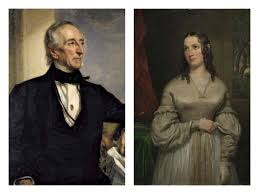
In their post-Presidential retirement lives, many an evening was spent in their parlor, he playing the violin, she the guitar, and both singing duets – likely the old Scottish ballads and lively reels!
Epilogue 2:
Anthony Philip Heinrich, alas, did not fare as well. He was prolific, but his American audience and the American orchestras were lacking in their appreciation. Before the Civil War, he found himself performing in Europe, where he was treated with more artistic regard.
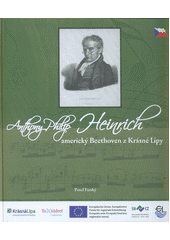
Nevertheless, he died at 80 in New York, not long before John Tyler died in Virginia. In poverty.
But occasionally his works are performed today. He would be pleased.
Sources:
Boller, Paul – Presidential Diversions: Presidents at Play: From George Washington to George W. Bush, Harcourt, 2007.
Kirk, Elise – Music at the White House – University of Illinois Press, 1986
https://firstladies.org/home/first-ladies/julia-tyler
https://www.whitehousehistory.org/bios/john-tyler


Very interesting! I’d never heard the story of Heinrich’s performance at the White House.
A story I’d not heard before, and very charmingly told! Thank you. I’ve just found a few tracks of his to listen to – very intriguing!