Dolley Madison: Medium Payne

John Payne Todd, Dolley’s son, showed such promise…

The Promise of Payne

Payne Todd had no memory of his natural father who died in a yellow fever epidemic when his toddler son was a year old.

Aside from the fact that his mother remarried a year later to one of the most important men in the brand-new United States…

Aside from the fact that his stepfather came from a wealthy family and Payne grew up on a huge estate…

Aside from the fact that his parents were happy to provide the very best for the youngster…

Montpelier was a huge estate

And aside from the fact that he was destined to be an only child…

Payne had a lot going for him on his own. 

He was a good looking youngster, and grew up to be a six-footer, towering above James Madison, his benevolent stepfather, more grandfatherly than fatherly. He had crystal blue eyes like his mother Dolley, said to be one of the best looking women in Washington. He had fine taste in clothing and accessories and art. Payne was exposed to the cream of society since early childhood. He developed impeccable manners, made graceful bows and genial small-talk. He spoke fluent French. Doors were always open to him. And like his mother, he had charm enough to bottle and sell. Most who knew him, liked him.

Despite his advantages, Payne was a wastrel. An alcoholic. A gambler. A womanizer. A total failure at everything he tried, and usually listed at the bottom of the list of Presidential “children.”

Educating Payne

Like most children growing up at the end of the 18th century, his early education was at home. Partly via his mother, partly via his Aunt Anna, and even briefly by his scholarly stepfather. Payne showed little interest in learning; he was much happier playing with some step-cousins, or the children on the Madison plantation. He liked to ride his pony. He liked to shoot his musket. He did not like books. 

When Payne was eight, Thomas Jefferson became President, and Madison, his closest friend and political advisor, was appointed Secretary of State. The family moved to Washington. Payne needed proper schooling. 

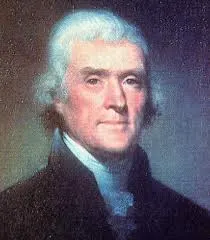
Jefferson appointed Madison to be Secretary of State

On the recommendation of friends, he was enrolled at St. Mary’s, a Roman Catholic boarding school in Baltimore, close enough to Washington for his mother’s peace of mind. He was an average student, his teachers found no real fault. And the fellows liked him.

His stepfather planned to send him to the College of New Jersey (Princeton), his own alma mater, but it would never happen, partly due to situations that deferred his attendance, but mostly due to Payne’s disinclination. Madison may have been disappointed, but his mother was ambivalent. She loved him. He was a good son. 

Crown Prince Payne

By the time Payne finished at St. Mary’s, James Madison had been elected President and his mother was considered the most popular hostess in Washington. With the social season in full throttle, Payne was invited everywhere.

Now near twenty, he was a prime matrimonial catch, and his mother and aunts and friends of the Madisons wasted no opportunity to introduce him to eligible young ladies. Payne went to all the parties, charmed everyone, but Cupid was unsuccessful.

For a very short while, Payne served as a substitute when his father’s secretary was ill. With no talent for paperwork and administration, he was quickly replaced. But by that time, the Czar of Russia presented an opportunity: he offered to mediate the growing problems between the USA and Great Britain. President Madison was happy for any help he could get, and agreed. He sent a small delegation to St. Petersburg, and Payne Todd, the President’s stepson was assigned as a diplomatic secretary.

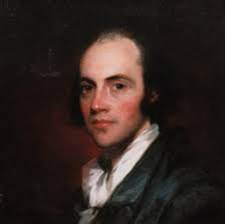
The only image of Payne Todd

Madison insisted on paying Payne’s “salary” privately, and gave him a very generous allowance as well. He would want for nothing. 

Dolley was thrilled, hoping a diplomatic career would inspire her social-minded son to more serious occupation. And traveling is an education too. Some sources indicate that the young maybe-diplomat-to-be was not thrilled about going abroad, preferring to socialize in the capital, where he was well known and liked. Nevertheless, he went. 

Europeans, and particularly Russians, a socially backward country, did not understand democracy or republics. All they had known for centuries was monarchy/royalty of some kind. Young Payne Todd was the US President’s stepson. That made him akin to a Crown Prince in their eyes. 

Czar Alexander I

Payne Succumbs to Vice

Payne was invited everywhere, particularly to parties where drink flowed copiously and cards were played with reckless abandon. Payne developed a thirst, which would never be slaked. And even though he lost more than he won, the thrill of gambling spread from cards to dice to business speculation. Instead of returning to Washington, he went to Paris – till his money ran out.

By his late twenties, his debts were chronic and considerable. Dolley sent money. James Madison sent money plus paid his outstanding hotel bills. Even friends of the Madisons were solicited by Payne to “help him out.” Coercing friends of his parents for financial assistance and embarrassing his parents would become a lifelong habit with Payne Todd. He even spent time in debtor’s prison.

James Madison sold off large tracts to pay his stepson’s debts. Dolley knew about her son’s insolvency and vices – but her husband did not tell her the extent of the money it cost.

He loved her and knew it would hurt her – and he couldn’t bear that. 

Sources:

Anthony, Kahtharine – Dolley Madison: Her Life and Times – Doubleday & Co., Inc. 1949

Ketcham, Ralph – The Madisons at Montpelier: Reflections on the Founding Couple – UVA Press, 2009

Moore, Virginia – The Madisons: A Biography – McGraw Hill, 1979

Wead, Doug – All The President’s Children – Atria, 2003

https://www.whitehousehistory.org/the-bad-boy

https://founders.archives.gov/documents/Madison/04-03-02-0659

Posted in A POTUS-FLOTUS Blog, James Madison, Nifty History People, Thomas Jefferson | Tagged , , , , , , , , , , , , , , , , , , , | Leave a comment

Civil War Divas: Mary & Julia Part II

After the initial “how-do,” Mary Lincoln and Julia Grant did not meet again for a year.

Mary Lincoln: 1864-5

Mary Lincoln took a long time to emerge from her deep grief over her son Willie’s death in early 1862. Custom dictated an 18-month mourning period but Mrs. L. extended her own bereavement for two full years. Mourning clothing, cancelling entertainment and social events. But by mid-1864, she was easing back into her FLOTUS role. 

The political situation looked grim for Abraham Lincoln. The war was going poorly; Union casualties had been staggering, and new problems were overwhelming. It was an election year, and a second term was not favorable.

Willie Lincoln death was devastating

Mary Lincoln spared no effort. She hosted her receptions and soirées and private luncheons with renewed purpose, inviting all the movers and shakers in Congress on a regular basis. She had a secret agenda: she had been extended unlimited credit by New York and Philadelphia merchants, and had spent recklessly unbeknownst to her husband. If Lincoln lost the election, they would be ruined.

Lincoln won. She got breathing room, and promised herself to be thrifty.

Julia Grant: 1864-5

Putting Ulysses S. Grant in charge of the entire army in the spring of ’64 was not a popular decision. General Grant was a fierce fighter who had become The Butcher of the Battlefield. Wherever he went, he left dead soldiers. Mrs. Lincoln was not his admirer.

General and Mrs. Grant

Julia Grant was in her late thirties, plain, not stylish, not particularly clever or intellectual, but a nice lady whose husband adored her. Mrs. was a soldier’s wife, and it took a little time to grow into her role as a “prominent woman.” But the prominent women in Washington took her under their collective wing.  

In mid-March, 1865, spring came early. USG had laid siege to nearby Petersburg, VA for several months. Everyone knew the War was coming to an end. More sooner than later. President Lincoln newly- re-inaugurated, decided to visit the Army at City Point at the confluence of the James and Appomattox Rivers, a huge supply depot for the Union Army. He brought his wife. 

City Point became the 10th largest city in the North by 1864-5.

The Carriage Incident

Mrs. Lincoln and Mrs. Grant had only brief and inconsequential previous contact, but the savvy First Lady had seen the “General’s Wife” as a threat to her “position” from the start. Mrs. G. was not particularly political, but she was learning, particularly under the tacit tutelage of the Congressional Wives.

The Army had planned a tour or the front lines near Petersburg, but since there were some skirmishes in the area, all women were sent to the rear. That included Mrs. Lincoln and Mrs. Grant, who were placed in a carriage together, escorted by Col. Adam Badeau, Grant’s military secretary and aide-de-camp, and an eye-witness to all that occurred. It started out pleasantly enough.

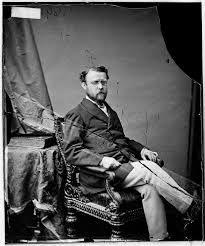
Adam Badeau

But Sarah Griffin, the wife of General Charles Griffin was said to have been given a special pass to ride closer to the front. Mary Lincoln learned that she had obtained a special pass from the President.

Mrs. L. went ballistic! “Do you mean to say that she saw the President alone? I never allow the President to see any woman alone?”

But Mary would not be pacified. “Let me out of this carriage at once. I must ask the President if he saw that woman alone.” Mrs. Grant tried to calm her, as did Col. Badeau, but she would not be mollified. Finally, General Meade personally took the First Lady aside and told her that Mrs. Griffin’s special pass had come from the Secretary of War, not the President.

The Ambulance Wagon Incident

It gets worse.

The following day, the Army had planned a big parade for the President’s review. This time Mrs. L. and Mrs. G. were seated in an ambulance wagon. Col. Badeau having refused to be alone with them, asked Col. Horace Porter to join their escort to the review area. 

Horace Porter

This time General Edward Ord’s wife, said to be an excellent rider, accompanied her husband. According to Col. Badeau, She was mounted, and as the ambulance was full, she remained on her horse and rode for a while by the side of the President, and thus preceded Mrs. Lincoln.

As soon as Mrs. Lincoln discovered this her rage was beyond all bounds. “What does the woman mean,” riding by the side of the President? And ahead of me? Does she suppose that he wants her by the side of him?”

Here is where the story is…

The incident was further compounded by Secretary Seward’s nephew, an officer on Grant’s staff, who unknowingly quipped, “The President’s horse is very gallant. He insists on riding by the side of Mrs. Ord.”

The First Lady exploded. “What do you mean by THAT, sir? Julia Grant likely didn’t know what hit her. But she liked Mrs. Ord, and did her best to calm the First Lady. It did not go well.

Then the FLOTUS suggested that Mrs. Grant was just standing in the wings waiting to take her place. The astounded and embarrassed Mrs. Grant calmly replied that she was quite satisfied with her current position, which was far more than she had ever hoped.

When they reached the President’s party, Mary created a horrible scene, calling Mrs. Ord “vile names” in front of the generals and the President. Mrs. Ord was reduced to tears. Lincoln, his eyes filled with pain, tried to quiet her, calling her “Mother” and speaking gently. It was public, and everybody was shocked and horrified.

The Upshot

The two women never saw each other again after their “visit” at City Point. Only weeks later, the war drew to a close. President and Mrs. Lincoln invited the Grants to join them at the theater. Mrs. Grant declined, saying they were going to see their children in Burlington, NJ. She likely did not wish to be in Mary Lincoln’s company.

Nearly twenty years later, after the Grant presidency, when the retired General and his wife made a world trip, the stopped briefly in Pau, France. Mrs. Lincoln had been living there for a few years. They did not come to call or invite her to call on them.

But Julia Grant, when she wrote her own memoirs, obviously learned her political lessons well. She mentioned nothing about the incidents.

Sources:

Badeau, Adam – Grant in Peace – Penguin Books (reprint)

Grant, Julia Dent – The Personal Memoirs of Julia Dent Grant: (Mrs. Ulysses S. Grant) – 1975, G.P. Putnam’s Sons

Ross, Ishbel – The General’s Wife – Dodd, Mead, 1959

Posted in A POTUS-FLOTUS Blog, Abraham Lincoln, American Civil War, Nifty History People, Ulysses S. Grant | Tagged , , , , , , , , , , , , , , , , , , , , , , , , | Leave a comment

Jefferson, Madison and Mellimelli

Piracy was not new in 1800. It had been around for centuries.

Demanding tribute.

The Barbary Pirates

For centuries, North African countries then part of the Ottoman Empire, augmented their respective economies by state-sponsoring rogue pirates to plague commercial shipping on the Mediterranean. They boarded merchant vessels, carried off cargo, burned ship, and killed, captured or imprisoned sailors, holding them for ransom. Or, they made deals with European countries to pay huge sums of “tribute” (extortion) to protect their commerce. Wealthy mercantile countries opted to pay. It gave them near monopoly on the Mediterranean. 

The USA and the Pirates

When the USA was a British colony, American trade in the Mediterranean was covered by the British, who paid the tribute. Once we opted to be on our own, the situation changed.

George and John had little choice.

Presidents George Washington and John Adams were aghast. Such unmitigated behavior was, in a phrase “un-American.” But they held their respective noses and paid. They reasoned that a) it was/is incumbent upon a national government to protect its citizens, and that includes their legitimate commerce and trade; and b) we did not have the military and/or naval capacity to deal with it in those early days. It was cheaper to pay – even though it was a hefty percentage of our annual budget.

Early in the Jefferson Administration, USA naval and marine forces ostensibly put an end to the pirates on “the shores of Tripoli,” but the Tunisians did not seem to get the message. Their Bey (head honcho) fumed and threatened to go to war unless we paid up. The commodore of a formidable US squadron anchored in Tunis harbor and demanded to know the Bey’s “intentions.” The attitude changed to diplomatic suavity. The Bey sent an ambassador to the President (at the USA’s expense) to come to an “agreement.”

TJ did not subsidize piracy.

Sidi Soliman Mellimelli

Sidi Soliman Mellimelli, along with an eleven-man retinue, was the first Muslim envoy to the USA, and his appearance alone enlivened the capital. He was a sight to behold! Fifty years old and a giant of a man, with a full, thick beard, dressed in crimson and gold robes and shoes of bright yellow. His huge white turban was said to be made of yards and yards of fine muslin. (They would later learn that it was mostly plaster of Paris.) According to lore, one of his servants came just to carry his four-foot pipe.

President Jefferson, “small-r” republican to the core, set little store by fancy dress, and while courteous, was generally unimpressed by his diplomatic guest, foisting him off on his Secretary of State James Madison as much as possible. (One could imagine the amused disparity between the six-foot-a-lot Tunisian and the five-foot-not-much Madison!) The Mellimelli’s mission became the talk of the town.

An ‘illustration” of Mellimelli

The man was genuinely religious. In one of his first conversations upon arrival, he demanded (via interpreter) of some Creek natives who were also visiting Washington, to know who they believed in: Abraham, Mohammed or Jesus? Through the interpreter he was told that “We worship the Great Spirit without an agent.” “Vile heretics,” sneered Mellimelli ferociously. 

The Secretary of State

When the Secretary of the Navy called on the Tunisian, he found him on his knees, on a prayer rug, facing Mecca and chanting his prayers.

And as a courtesy to the Muslim, Jefferson changed the time of the dinner he was hosting for the new envoy. Told it was Ramadan, a holy observance, instead of dining at the usual three-thirty, he waited until sundown, in accordance with Mellimelli’s religious custom. 

It seems like the huge Tunisian got on well with Secretary Madison however. He presented Dolley Madison with a scarlet velvet caftan said to be weighed down with 30 pounds of gold bullion. He had also brought some Arabian stud horses sent by the Bey as a gift to the President. 

Sec. Madison had arranged accommodations for Mellimelli and his entourage at Stelle’s hotel, which was undergoing bankruptcy, and delighted to be rented. The Tunisians seemed pleased with their quarters.

Ah, But…Resolving a Couple of Problems

Mellimelli was happy, except there were no concubines. James Madison, a cerebral man by nature, was also a worldly fellow with a wry sense of humor. The services of “Georgia, a Greek” were enlisted so the North African could enjoy all the comforts of home. Madison charged the bill to the State Department, listing her fee under “appropriations to foreign intercourse.” 

Then there was the hotel bill that the US agreed to pay. The North Africans were living extremely well. They enjoyed their stay so much that a few of them “broke” Ramadan with strong drink and raucous behavior. It was quickly determined that the “gift horses” (who were enjoying American oats) should be put to good purpose, and a couple of mares were found as quickly as “Georgia, a Greek.”

According to lore, on the night the Madisons hosted a reception for Mellimelli, the Tunisian opened a door to discover “a large fat negress preparing coffee.” The ambassador grinned and threw his arms around her, saying in translated Turkish, “You are the handsomest woman in America!” He insisted she looked like “one of his most expensive wives – a load for a camel!” 

He was the hit of the social season and invited everywhere! But the excitement ran its course and died out.

Goodbye Mellimelli

All good things must end. Poor Mellimelli was chagrined that the USA had no intention of paying tribute, and feared that when he returned to Tunis he would be put to an unpleasant death for his failure. He took a very long time to depart the country, making grand appearances in various locales. Some members of his retinue actually chose to remain here permanently.

And within a couple of years, an American fleet of frigates was permanently assigned to the Mediterranean. Goodbye pirates.

SOURCE:

Moore, Virginia – The Madisons: A Biography – McGraw Hill, 1975

Wright, Louis B. and Macleod, Julia H. – MELLIMELLI: A Problem for President Jefferson in North African Diplomacy – The Virginia Quarterly Review, Vol. 20, No. 4 (Autumn 1944),

https://www.jstor.org/stable/26441882

Posted in A POTUS-FLOTUS Blog, George Washington, James Madison, John Adams, Nifty History People, Thomas Jefferson | Tagged , , , , , , , , , , , , , , , | Leave a comment

Mary Lincoln’s Bad Hat Story

First the source.

When she was a very old lady in 1931, Julia Taft Bayne published a slim volume called Tad Lincoln’s Father. It was her personal memoir of 1861-2, when, as a teenager, she spent a good deal of time in the Lincoln White House.

When President-elect Lincoln and family arrived in Washington in late February, 1861, dozens of women came to call on Mrs. Lincoln. One of them was Mrs. Horatio N. Taft, society matron and wife of the Chief Examiner in the Patent Office. In conversation, Mrs. Lincoln learned that Mrs. Taft’s two sons, Bud and Holly, were the same ages (around ten and seven) as Willie and Tad Lincoln. She invited Mrs. T. to bring the boys to come and play with her sons. It was a godsend! They kids it off brilliantly, relieving Mrs. L. of the big problem of getting her sons adjusted to their new life.

Holly and Bud Taft

Their older sister Julia, then around fifteen, was their designated chaperone, and it was she who regularly accompanied the boys to the White House.

The “hat” story was told to her by her mother, several years later.

Mrs. Lincoln: Fashionista

Willie Lincoln

No question about it, Mary Lincoln wanted to be the social – and fashion leader of Washington society. During her upbringing in Lexington KY and later in Springfield IL, she was at the top of the pecking order: well bred, well educated, and a “Todd.”

The society doyennes of Washington were disdainful and considered her “southern” and provincial. When they called on her, they offered to help her navigate “the social shoals.” They were perhaps a little snarky, but they meant well. Mrs. L. was offended and let them know she didn’t need their help.

It was likely traumatic to the new First Lady. She developed a deep-rooted need “to show them,” and in its way, it lasted a lifetime.

Tad Lincoln

As First Lady, Mrs. Lincoln was expected to entertain regularly. Mrs. Horatio Taft was on her guest list, and the relationship had been pleasant. In addition to their commonality-through-children, they also shared a milliner, said to be the best in Washington.

Purple Ribbons

Mary Lincoln had recently purchased a new gown, with large purple flowers. She wanted the ribbons on her new hat to match that shade of purple. Her milliner was very eager to curry favor with the new FLOTUS and tried his best to obtain ribbons in that exact shade.

Julia Taft, baby-sitter

Alas, he confessed, there were not available. He even contacted the manufacturer, who said it was impossible: the dye lot had been exhausted for that exact color. No proposed alternatives were acceptable to the very picky Mrs. Lincoln.

She was not a happy customer.

The Request

Not long thereafter, Mrs. Taft came to one of the First Lady’s receptions wearing a new bonnet – with exactly the same shade of purple ribbon that the First Lady had been seeking. Mary made a beeline for her, remarking excitedly about her beautiful new hat, especially the gorgeous purple ribbons.

Then she continued her tale of woe – about her needs for purple ribbons, and that their milliner claimed no more of that shade were available.

Mary Lincoln, fashionista

Then she demanded that Mrs. Taft cut the ribbons off her hat and give them to Mrs. Lincoln.

Obviously she believed that her exalted position as First Lady entitled her to take such liberties, but Mrs. Taft was affronted, and declined.

Mrs. Lincoln’s milliner came to the rescue – sort of. He promised to make a brand new hat for Mrs. Taft free of charge, in an attempt to mollify the First Lady, whose patronage was truly important for his business. Thus Mrs. Taft was seduced into handing over her purple ribbons for Her Maryness’ pleasure.

Needless to say, Mrs. Taft’s opinion of Mrs. Lincoln cooled considerably but the Taft boys remained best friends, White House-schooled classmates and boon companions to the Lincoln boys.

Bonnets, circa 1860. Lots of ribbons.

Later

About a year later, Willie Lincoln sickened and died. It was devastating to the President and First Lady, who was prostrate with grief. She put aside all her new gowns and hats, including the one with the purple ribbons.

Then Mrs. Lincoln wrote to Mrs. Taft, instructing her not to send Bud and Holly to play with Tad at the White House anymore. It would be too upsetting for her.

The grieving President softened the boys’ distress by personally inviting them to see their dear friend Willie, now in his coffin. He escorted them into the room himself for a final farewell. But he could not lift Mary’s ban on seeing the Taft boys. Eight-year-old Tad never saw his old playmates again.

Nevertheless, Mrs. L’s colossal gall, the extorted purple ribbons and her mother’s disdain aside, Julia Taft Baynes wrote in her book that she remembered Mrs. Lincoln warmly, and liked her.

Sources:

Bayne, Julia Taft – Tad Lincoln’s Father – Little, Brown, 1931

Foster, Feather Schwartz – Mary Lincoln’s Flannel Pajamas and Other Stories from the First Ladies’ Closet – Koehler Publishing, 2016

Notable Visitors: Julia Taft

Posted in A POTUS-FLOTUS Blog, Abraham Lincoln, Nifty History People | Tagged , , , , , , , , , , , , , , , | Leave a comment

John Tyler’s Sherwood Forest

Sherwood Forest, home of President John Tyler

Nestled in the northern part of Virginia’s Tidewater Peninsula, midway between its original capital of Williamsburg, and Richmond, its capital since 1780, is the retirement house of John Tyler, 10th President of the United States. It has been in the Tyler family since 1862.

President John Tyler

The property dates back to 1616, and the house itself to 1720, although it went through several evolutions and owners until President John Tyler purchased it in 1842, shortly after Letitia Christian, his first wife died after a lengthy illness. It was originally called “Walnut Grove.”

Letitia Christian, the first Mrs. Tyler

It was Tyler who renamed it “Sherwood Forest,” the legendary home of Robin Hood, an English outlaw of the Middle Ages. Elected Vice President under William Henry Harrison in 1840, Tyler became President when Harrison died, only a month after their election.

The Outlaw Part

The political atmosphere of the 1820s and 30s was a convulsion of emerging philosophy and parties. The Democratic-Republicans had emerged as a dominant entity by 1800, but by the 1820s, particularly during Andrew Jackson’s administration, it was primarily called Democrats. Various factions were also gaining (and losing) support.

Julia Gardiner, the Second Mrs. Tyler

When the Whig Party, a motley assortment of regional and factional sectors, began taking shape, William Henry Harrison appeared to be the strongest candidate among four – all fairly weak, but poised to strengthen the next time around: 1840. John Tyler, a lifelong Virginia Democrat and supporter of states’ rights, had a credible history as legislator and congressman but he had a long-standing political antipathy to Jackson. When the Whigs approached him for support, he was amenable. 

Amenable did not last long, and once the VP became POTUS, Tyler stood practically alone against the Whigs who attempted to exert more control than Tyler a) believed appropriate and b) liked. He became “a president without a party.” Thus the Outlaw, and the name for his plantation.

The New House

Tyler had always lived in Tidewater Virginia, but his wife of nearly thirty years died after a lengthy and crippling illness. He was left with seven children, the youngest only eleven. He had also become acquainted with a wealthy young New York socialite, and at 54, wished to remarry. New wife. New home.

The house itself is the longest frame house in the country: more than 300 feet, to include a 68’ long ballroom which skilled plantation laborers built with hand tool. Tyler built it in 1845, to accommodate the popular dancing craze, the Virginia Reel. The new Mrs. Tyler, née Julia Gardiner, albeit a Northerner, was an accomplished hostess who adapted effortlessly to Southern hospitality. 

In addition to the ballroom, a long colonnade with a “whistling walk” connects the main house to the kitchen and laundry room, and five additional storage rooms. It follows the “modern” style of Tidewater plantations: Big House, Little House, Colonnade, Kitchen. Once the Tylers moved in 1845, Grecian-Revival style cornices, pilasters, porches and ornate architectural accoutrements were added. 

Along with several dependency outbuildings, the grounds feature twenty-five acres of terraced gardens, based on the designs of Andrew Jackson Downing of New York. 

Sherwood Forest Becomes a Home

The new bride Julia Gardiner Tyler was determined to take her place as a leader of society in her newly adopted state. Happily for her, the prominent families of Tidewater Virginia were welcoming to the very young Northern woman who married the President – one of their own. 

With the deep Gardiner pockets, she arranged for her mother, sister and brothers, all still living in New York City, to help her furnish their new home. Wish-lists of chairs of all descriptions, tables of all sizes, fabrics and accoutrements regularly made their way to her family, and they would shop accordingly in the big city. Even Richmond, Virginia’s capital, claimed less than 30,000 inhabitants. Minuscule in comparison to New York.

Built to accommodate the Virginia Reel!

Her table was a feast of nature’s bounty, all served on elegant cloth, silver tureens, trays and flatware, the finest porcelain and crystal goblets.  

The Tylers entertained often, taking their turns to host the barbecues and dances common to their social set. They traveled regularly to the fashionable waterholes. With their property abutting the James River, the steamship between Richmond and the Chesapeake Bay stopped regularly to take them to events in Williamsburg or Norfolk.

In addition to their new home, the Tylers welcomed seven more little Tylers before the Civil War wreaked havoc on the country. This included the death of John Tyler at 71, only a year after their last child was born.

An older John Tyler

It also wreaked havoc to Sherwood Forest itself. Once Julia and the children finally vacated their home to take refuge with her mother in New York, the plantation was left to the mercy of marauding soldiers – and deserters. While it was never burned (although a small fire was detected and quenched by some loyal servants), it had been badly vandalized, and the fields and gardens were left in ruins. 

Older Julia Tyler

When Julia and her children were able to return, her own finances had become precarious, and far too much for her to repair/recreate the estate’s former glory. That part took years – and future generations. Her grandson (at this writing, still living and well into his nineties), was the last Tyler resident. 

The grounds are open to the public. The house itself is lovingly cared for via a Family Foundation, and open by appointment only.  

It is well worth seeing. 

Sources:

Seager, Robert III – And Tyler Too, McGraw Hill, 1963

https://www.whitehouse.gov/about-the-white-house/presidents/john-tyler

Posted in A POTUS-FLOTUS Blog, American Civil War, John Tyler, William Henry Harrison | Tagged , , , , , , , , , , , , , , , , | Leave a comment

Poems by Presidents: The First-Ever Anthology

A Book Review

Roses are red,

Violets are blue,

POTUSES, Politics.

Poetry too?

What a surprise! Editor Michael Croland has amassed a charming little array of actual poetry (ok, plus a few limericks and light verse) written by some of our Presidents. 

There are a few Chief Executives with some talents and skills in the fine arts. Harry Truman and Bill Clinton had a few occasions to show off their musical flair. Both Ike and George W. Bush found hitherto unknown gifts with paint and brush. Even big guys, like George Washington, William H. Taft and Lyndon Johnson could whirl partners on the dance floor with some agility.

Of course most Presidents had considerable experience with the written word long before the Presidency was on their horizon. It is also important to note that in long-past times, the language of the written word was considered near-separate from the language people used in personal speech. Written classical language (with mandatory thee and thou) was what was taught in school, rather than picked-up in childhood. 

A few of our Presidents were especially gifted with graceful prose. Thomas Jefferson… “We hold these truths….”. Abraham Lincoln… “With malice toward none… Franklin D. Roosevelt… “A rendezvous with destiny…”

Many of our Presidents were prolific in their writing. Theodore Roosevelt penned about 30 separate volumes, and a gazillion magazine articles, etc. Woodrow Wilson also was a prolific writer, churning out a book a year during his academic career – mostly to augment his meager salary. 

Modern Presidents are expected to write their memoirs (or at least collaborate in their writing). Most of them make a lot of money with it. Some, like Jimmy Carter, has a pen that won’t quit!

And, as one would expect, some are better writers than others. 

But poetry? 

Croland’s well researched slim volume of POTUS versifying is a wonderful treat for Presidential aficionados who also appreciate poetry. And, again, as one would expect, some POTUSes were better than others. 

One surprise, is a tidbit about Thomas Jefferson. Most biographies include an 83-year-old TJ on his death bed, sighing to his daughter Martha, “the last pang in life is in parting from you.” A poignant phrase. But it was actually part of a brief verse he wrote…

Then farewell, my dear, my lov’d daughter, adieu!

The last pang of life is in parting from you!

Jefferson’s pal Madison, a brilliant mind, but pedantic wordsmith, has a couple of entries in the anthology, but they are “youthful” attempts from his student days – and his endless couplets pale in comparison to Jefferson’s eight lines. 

The poet-est of them all, is the unlikely John Quincy Adams, whose acerbic nature does not spring to mind as a fellow of gentle feeling. But… JQ famously confided to his diary, “I have been a lawyer for bread, and a Statesman at the call of my Country…” but in truth, if he’d had his “druthers,” he would “druther” have been a poet. And he was pretty good at it, albeit he seldom varied from his rhythm and form. They all tended to sound like they could have been set to hymns. He was a religious fellow by nature, and thee’d and thy’d a lot. (Most of the old POTUSes did that. It was part of the classical “school” format.) And perhaps the depth of JQ’s intellect had a secret partnership with his heart.

One of JQ’s poems stands out – and in fact, according to Croland, Ralph Waldo Emerson was impressed enough to include it in an anthology. Titled The Wants of Man, it is a 19th century version of “If I Were A Rich Man”: A litany of very secular pleasures. To wit. And to smile.

What first I want is daily bread,

And canvas backs and wine;

And all the realms of nature spread

Before me when I dine.

Four courses scarcely can provide

My appetite to quell,

With four choice cooks from France, beside,

To dress my dinner well.

And the man can punctuate poetry too!! 

Abraham Lincoln was also known to stroll the “triplingly on the tongue” path, waxing poetic about a couple of long-past memories or thoughts that evoked deep personal feelings. Maybe deep feelings, but it didn’t evoke Lincoln. He was in his milieu in the John Greenleaf Whittier fashion. It suits him perfectly. His The Bear Hunt is a delightful story-poem, including a little humorous twist at the end. 

Then of course, there is a little versie about Gettysburg… visual, too!

In eighteen sixty three, with pomp,

   and mighty swell,

Me and Jeff’s Confederacy, went

   forth to sack Phil.del.

The Yankees they got arter us, and

   gin us partic’lar h_ll,

And we skedaddled back again,

   and didn’t sack Phil.del.

Ah. Warren G. Harding. A newspaperman. A wordsmith by profession. And a lover by inclination! He was a hopeless romantic – and rather prurient and sly with his double entendres in verses written to his long-time inamorata Carrie Phillips. A trove of love letters he wrote to her (rhyming or not) were published more than 75 years after his death, after decades of legal hassling by Harding descendants trying to tidy up WGH’s private life. Maybe not etched for eternity, but definitely worth the read!

Editor Croland graciously and generously acknowledges poetry-lovers among our Presidents. After all, poets need appreciators, too. Perhaps the most important of the “lovers,” was Theodore Roosevelt, a great appreciator of all sorts of talent. He was “introduced” to the the poetry of a young-and-starving Edwin Arlington Robinson by his teenaged son Kermit. POTUS TR liked and appreciated the poetry, and arranged a federal clerical position for Robinson. Not demanding. Pay-the-rent. Write the poems. 

Poems by Presidents is a wonderful book for every POTUS-lover’s shelf. Buy it. You’ll have an enjoyable read!

Michael Croland

www.doverpublications.com

ISBN: 978-0-486-85153-2

$14.95

Posted in A POTUS-FLOTUS Blog, Abraham Lincoln, Franklin D. Roosevelt, George Washington, James Madison, John Quincy Adams, Nifty History People, Recommended Reading, Theodore Roosevelt, Thomas Jefferson, Warren G. Harding | Tagged , , , , , , , , , , , , , , | Leave a comment

James Madison: Quarantined by a Hat

Young James Madison

Hats Circa 1776

James Madison is seldom connected to a amusing (somewhat) story, so here is one to treasure!

Head coverings for both men and women have always held an important place throughout history. Some religions demand them inside a place of worship. Or even a special head covering for only inside a place of worship, Some traditions insist they be worn at all times – even in one’s own home.

Then there is the tradition of removing one’s hat. In a restaurant, for example. Or at a funeral. Or in a theater (ladies please remove your hat).

The styles and variations of said head coverings of course, change with the times. So do price tags.

The basic trimmed tricorn.

In Colonial America, the traditional male hat was the tricorn: a three-cornered hat you will see in most portraits, re-enactments, movies, or historical sites of the 18th century. The hat itself offers a few variations, depending on the status/wealth of the wearer. 

George Washington’s hat was usually the priciest!

Country-folk wore a different style called a Long Hunter Hat, with a rounded crown and a broad circular brim. The style lasted for decades – even through the Civil War. They were mostly for woodsmen and farmers and connoted little affluence. Then, some folks wore coonskin caps, made wildly popular when Benjamin Franklin went to Paris and wished to appear distinctively “American.”

Ben Franklin wanted to make an “American” statement.

But the plain black (or occasionally gray) tricorn shown in 18th century portraits of men was practically universal in towns and cities. Some had variations in brim shape. Some were adorned via braid in varying degrees, and possibly a cockade or feather. Or both. White braid was gentry; gold braid was wealthy. Cockades usually designated substantial prestige and wealth. They were usually for the highest echelon.

James Madison, Colonial Councillor

James Madison (1751-1836) was the antithesis of imposing. Both small and slight in stature, he was somewhere between 5’ and 5’6” depending on source. Since the average man’s height circa 1776 was 5’7”, and Madison was invariably identified as a small fellow, 5’4” is likely more accurate. Or even generous. No source ever identified him as more than 125 lbs. Ergo, his physical appearance was far from commanding, a la General George Washington, and JM was always happy to remain in the background.

He was also a quiet man, not given to dramatic oration a la his fellow Virginian (and then-Governor) Patrick Henry. He preferred the comfort of the small table, and it is said, under less formal conditions, he was a delight. Insightful, witty, worth engaging in conversation. And definitely worth listening to.

Patrick Henry was imposing – even without a hat

His large family were well-to-do planters in Orange County VA, at the foothills of the Blue Ridge Mountains. JM also possessed of very impressive brain, honed well at the College of New Jersey (Princeton). According to most historians, he was the best educated of all our Founding Fathers, with an equivalent of a Masters Degree (or better) in what was then called governmental studies. Political science today.

Study, philosophy, research and deep thinking came naturally to him, as did the admiration and respect of those who knew him. Upon his maturity, Madison was easily elected to Virginia’s Assembly. It did not take long before his genius for astute political philosophy was recognized and he was named to the Governor’s Privy Council. 

But by 1778, the British Army evacuated Philadelphia, then capital of thirteen erstwhile colonies “DBA” the United States of America. They sailed down the coast poised to harass Virginia and points south. A Redcoat Army led by the traitor Benedict Arnold made the situation all the more loathsome as their southern campaign quickened.

The Purloined Hat

One day (according to a story said to be related to young Nicholas Trist by the elderly Madison himself many years later), Councillor Madison’s hat was stolen! Some thief broke a window in the boarding house where he was staying. 

Small and youthful, Governor’s Councillor James Madison could not appear in public without a head covering.

An embargo had been placed several years earlier on any British import goods, and none of the local hatters had the goods to replace it. 

It was, of course, UNTHINKABLE for a gentleman, let alone a young member of the Governor’s Privy Council to be caught outdoors without his hat.

So Madison stayed in his rooms for two days. He could/would not be seen in public.

A replica Long Hunter Hat of course.. but JM’s was too small, too tight and too ill-fitting. Or be-fitting!

Finally a French merchant who dealt in snuff sold him (at an enormous price), a coarse hat – likely similar to the Long Hunter Hat. But the crown was entirely too small, and the brim was entirely too broad. Poor Jemmy. It was laughable. His friends and co-councillors had much merriment from the situation.

But Madison had the disposition and good nature to be able to laugh at himself, and wore that ill-fitting and ill-appropriate hat for the rest of the session. And he was respected all the more.

Sources:

Brookheiser, Richard – James Madison – Basic Books, 2011

Moore, Virginia – The Madisons: A Biography – McGraw Hill, 1975

https://millercenter.org/president/madison/life-before-the-presidency

https://www.montpelier.org/learn/the-life-of-james-madison

Posted in A POTUS-FLOTUS Blog, James Buchanan, Nifty History People | Tagged , , , , , , , , , , , , , , | Leave a comment

Mary Lincoln and Julia Grant: The CW Divas Part 1

The similarities were apparent; the dissimilarities were intrinsic.

Mary Todd Lincoln (1818-1883) was seven years older than Julia Dent Grant. From Kentucky and Missouri respectively, they were both considered “westerners” in the early part of the 19th century. They both grew up in large families. Both families were affluent enough (Mary more so), and were slave holders. They were both finishing-school educated.

The earliest photo of Mary Todd Lincoln

But Mary’s childhood was desolate, according to her. She was the 4th of 6 children born to Kentucky banker-legislator Robert Smith Todd and his first wife. He owned a house in town plus and a plantation outside Lexington. When Eliza Todd died in childbirth, her widowed husband, perhaps overwhelmed by six children under twelve, remarried 18 months later. Betsey Humphreys was a strict, remote woman by nature, who nevertheless produced eight more little Todds.

Mary and her full-siblings were overlooked, neglected and criticized. They could not wait to escape. Mary, arguably the most intellectually inclined, went to finishing school when she was around twelve. Even though the school was only a mile from their town house, Mary boarded during the week, returning only on the weekends.

When her older sister married, moved to Springfield IL, and sent for her full-sisters, Mary jumped at the opportunity. She was just shy of 24 when she married Abraham Lincoln, ten years her senior. And poor.

The Diva Grant

Julia Dent (1826-1902) was the 4th of eight: four boys and four girls in that order. (One daughter died in infancy). Her father Frederick Dent was a merchant and plantation owner in St. Louis MO, a bustling port city.  They had a house in town for the winter. 

An early photo of Julia Dent Grant

But Julia’s childhood was a loving one, with memories, according to her memoirs written in her elder years that glowed brighter every year. But she was a plain child, with an eye condition from birth. Today, people call it cross-eyed, easily and successfully corrected in infancy. In the 1820s, it could not be repaired.

She was petted and spoiled by her parents and brothers but was blessed with a warm and affectionate personality that always won her many friends. Because her eye condition produced understandable eyestrain and headaches, she was permitted to be relaxed in her academic achievements. In the nineteenth century, education for women was never essential. And Julia would never be a scholar. Or pretty. 

She met a recent West Point graduate, her brother’s academy roommate, when she was barely 18 and he 21. It was love at first sight, but their marriage did not take place for four years, punctuated by his military obligations, youth and financial strains. 

The Mary Surprise

For 18 years, Mary Lincoln had been a middle-class housewife in Springfield, the capital of Illinois. It was a successful enough union, despite a decade of single-parenting while AL rode the judicial circuit to earn his modest living. His rise in politics was a long haul, but by 1860, he had reached national attention in the new Republican Party and became its Presidential nominee. A Civil War loomed on the horizon. When he was elected, war became a foregone conclusion. 

When the Lincolns arrived in Washington a few weeks prior to the inauguration, Mary was traumatically blindsided. She had three strikes against her from the start that she did not expect. First, while most people knew that AL came from humble roots, they assumed Mrs. Lincoln was also from that social class. She was not – by a longshot. Secondly, she was also a Kentuckian from a slave holding family, and thus perceived to be a Southern sympathizer. True about the Kentucky-slave holding part, but Mary was opposed to slavery since childhood, and was devoted to the Union. And third, as a “westerner,” she was purported to be of “low taste.” Untrue. Mary was particularly well educated and believed herself to be equal to her upcoming social tasks.

Mary and her children

When a delegation of Congressional wives came to call on the FLOTUS-elect, they offered to “guide her” through the shoals of society. They likely were a little condescending, but they meant well. Mary was offended and let them know it. In its own way, she was traumatized, and her sense of “I’ll show them,” began to take root. She would insist on the best, and would tolerate no peers. 

They shunned her.

The Julia Surprise

While Julia Grant always loved and believed in her husband, Ex-Captain Ulysses S. Grant was a sad case for the first fifteen years of their marriage. His military career ostensibly ended, and his attempts to find suitable work in St. Louis non-existent, the Grants barely got by. He finally wound up as a clerk in one of his father’s tanneries in Galena IL, a position he hated. But USG was not an ambitious man past providing for his family.

When the Civil War began in 1861, Grant’s military career was resuscitated, and his rise, while not meteoric, was steady – and at a high level. Within a year, he was a Brigadier General with solid success on the battlefield. 

By early spring 1864, President Lincoln had finally found his man and promoted him Lt. General of the Army – top dog. All of a sudden, Mrs. General Grant, was becoming a person of interest. 

Julia and her children

Meeting of the Divas

USG, honored in a modest White House ceremony, had sent for his wife to witness the occasion, and to find suitable housing. She was introduced to the President, who invited her to one of Mrs. Lincoln’s receptions a few days later. Of course she went! Lincoln recognized her, and personally introduced her to the First Lady. They smiled, shook hands and murmured the usual “glad to meet you.”

That was it – for about a year. Meanwhile, the Congressional wives who snubbed/were snubbed by the First Lady, descended upon Mrs. Grant, and made her the same offer: help her through the shoals of society. Perhaps knowing that she probably could use the help, Julia Grant, true to her plain image and pleasant unassuming nature, said thank-you-very-much. 

They loved her.

Sources:

Clinton, Catherine – Mrs. Lincoln: A Life – Harper Collins, 2009

Grant, Julia Dent – The Personal Memoirs of Julia Dent Grant: (Mrs. Ulysses S. Grant) – 1975, G.P. Putnam’s Sons

Helm, Katherine – MARY: Wife of Lincoln – Harper and Brothers – 1928

Ross, Ishbel – The General’s Wife – Dodd, Mead, 1959

https://www.mtlhouse.org/biography

https://www.whitehouse.gov/about-the-white-house/first-families/julia-dent-grant

Posted in A POTUS-FLOTUS Blog, Abraham Lincoln, American Civil War, Nifty History People, Ulysses S. Grant | Tagged , , , , , , , , , , , , , , , | Leave a comment

Dolley Madison: Little Payne, Little Pain

The Young Widow Dolley

In many ways, Dolley Payne Todd Madison had a (1768-1849) charmed life. A loving childhood, her essential wants and needs met, and an exposure to the excitement of Philadelphia – the largest and most cosmopolitan city in the USA.  

John Todd, who she married at twenty-one, may not have been her beau ideal. All indications are that she was fond of him, but did not love him. He was a fairly prosperous Quaker attorney and had been kind to her family in their time of need. It was her father’s dying wish that she marry him. He loved her however, and was very good to her. 

When she lost her infant son and her husband to cholera, it was a rough time, but Dolley still had her mother and siblings, and many friends. John Todd had left her financially comfortable. And she had her little toddler, John Payne Todd. She was devoted to him, perhaps excessively. He was all she had of “her own.”

A few months later, the Widow Todd met Congressman James Madison, seventeen years her senior, already well known and light years ahead of her in education. He too, like her first husband, was no Adonis. He was a couple of inches shorter, slight of build, and reticent – until he got to know you. He fell in love with Dolley from the outset; it took her a little longer, but she did grow to love him dearly, and the marriage was happy and very successful for both.

Little Payne

James Madison was 43 when he married Dolley and became stepfather and “kind protector” of her little boy, who was only two and a half when his mother remarried. He knew no other father, called him “pappa,” and received only kindness and affection, albeit more grand-fatherly. 

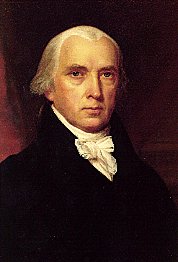
James Madison

There is a letter handed down from the Hite family (Madison’s sister Nelly married a Hite), indicating that after the wedding between JM and Dolley, the newlyweds did not “enjoy” a honeymoon for a while. Little Payne was accustomed to sleeping with his mother, and it took some time to wean him to his own bed. 

Then the newlyweds hired a coach to take them from what is now West Virginia (where they were married in Dolley’s sister’s home) to Montpelier, Madison’s family home in central Virginia. Along with Jemmy and Dolley and little Payne, were Anna Payne, Dolley’s teenaged sister, and Harriot, the kid sister of George Steptoe Washington, Dolley’s brother-in-law. It would be several days before Mr. and Mrs. Madison had any time alone.

An early image of Montpelier

Naturally a toddler needs attention and care, one additional reason for Anna Payne joining their household. Dolley, ten years older, was her sister-mother, and had been since she was born. Now Anna would help to raise Payne. 

From the start, Payne was cute as a button and a charmer like his mother, but a handful. Eighteenth century parents were seldom indulgent; child rearing was a serious business. Educating them (particularly a boy) was even more serious. Basic lessons started at three or four. 

When George Washington declined a third term in 1796, Congressman Madison decided to retire as well – at least for a while. Thus Payne’s early childhood was spent at Montpelier, a sprawling and thriving plantation in Virginia’s Blue Ridge, not far (in today’s transportation) from Jefferson’s Monticello. JM channeled most of his energies into the plantation, including a major house renovation, adding a separate wing for his aging parents (who were delighted that their eldest son had finally married), and plenty of room for himself, his new bride and “their” son, which included the hope that brothers and sisters would join Payne in the nursery. 

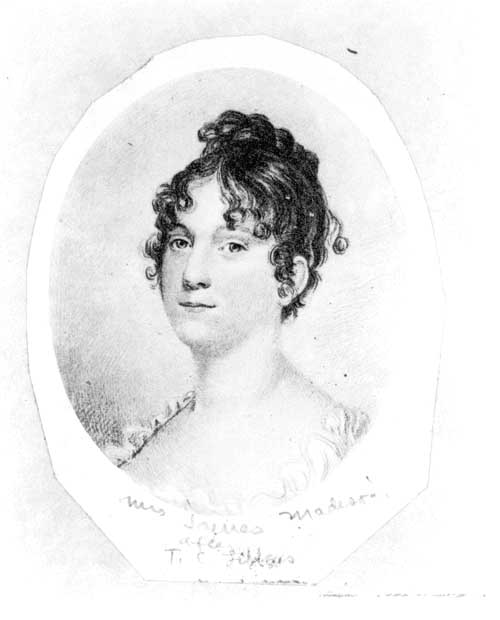
Dolley Madison was a good lookin’ lady.

One of their biggest disappointments was that their own family did not expand.

Medium Payne

It became obvious soon enough that Payne Todd did not like studying. Period. He was much happier running free on the grounds, particularly down in the slave-quarters, where he played with little children his age. They liked him. He liked them. He did not like books and lessons. He didn’t like them when him mother tried to teach him, or his Auntie Anna, or even when his patient stepfather took on the tutoring responsibilities himself. 

Aunt Anna (Cutts) helped raise Payne.

Meanwhile, his stepfather’s many plantation activities also included high level political and social activities. Little Payne was surrounded by elegant and important people from the beginning. He learned to make courtly bows and charm everyone. But since the Madisons entertained frequently and their social obligations increased, it likely eroded the attention and time to spend with Payne. 

When Payne was about eight, Thomas Jefferson was elected President and sent for Madison, his closest political and personal friend. Jemmy and Dolley were thrilled to move to the new Washington City and stay at the uncompleted White House for a brief time. Between buying a new house for themselves, the moving, the responsibilities of Secretary of State, helping Widower Jefferson with occasional social events, hosting their own frequent social events, the parents Madison had even less time (and perhaps inclination) to devote to Payne. 

Nevertheless, his education was becoming essential. Madison had hopes of sending him to the College of New Jersey (Princeton) in due time. It was his alma mater, and his memories of those days were not only happy, but vital to the man he became.

The only known portrait of Payne Todd

They were advised that St. Mary’s Academy in Baltimore might be the perfect boarding school for a likable but lazy and inattentive student. While it was a Catholic school, and the Madisons were not Catholic, it was not an obstacle. Both Quaker Dolley and Episcopal James Madison were ecumenical in religion. Boarding schools were commonplace for young men of means. Baltimore was not that far from Washington. And a Catholic school education was always considered excellent. 

Both Madison and Dolley believed that Payne could benefit from a peer atmosphere, hoping that their diligence and good habits would rub off on their son.

It was wishful thinking.

Sources:

Gerson, Noel B. – The Velvet Glove: The Life of Dolley Madison – Thomas Nelson Publ., 1975

Mattern, David B. and Shulman, Holly C. (Eds) – Selected Letters of Dolley Payne Madison, University of Virginia Press, 2003

Moore, Virginia – The Madisons: A Biography, 1979, McGraw Hill

http://www.whitehouse.gov/about/first-ladies/dolleymadison

http://rotunda.upress.virginia.edu/dmde/bio-intro.xqy

https://www.womenshistory.org/education-resources/biographies/dolley-madison

Posted in A POTUS-FLOTUS Blog, James Madison, Nifty History People, Thomas Jefferson | Tagged , , , , , , , , , , , , , , , , , , , , | Leave a comment

George Washington: I Can’t Tell A Lie: A Book Review

Stories and legends are vastly overlooked and an under-regarded part of history. They have been around since the beginning of time. Bible stories (and indeed stories connected with all religions) abound and are treasured. Aesop’s Fables predate Empires, and are never out of print. 

Nobody seriously believes the “absolute truths” of Noah collecting a male-and-female everything, Greek gods meddling in the Trojan War or rabbits running foot races with turtles. Nevertheless, these stories, these legends and fables have withstood the test of time for a reason: they contain life-lessons, truths and moral decisions that guide our lives even today. If we look for them.

Mason Weems (1759-1825) or “Parson” Weems, as he was known in his own time), was medically trained as a youth, relinquished medicine for the pulpit, and then relinquished that in part, to become a book seller and author. He wrote an effusive biography of George Washington, which in the very early 19th century consisted of a collection of recollections and anecdotes connected with the famous man who died in 1799. It became a best-seller for three generations. Abraham Lincoln was known to have read it when he was a youngster.

Most importantly, Weems compiled the book from recollections of people he interviewed, and the unquestioned purpose was to to tell the “story” of a fine man, worthy of emulation.

Weems was mildly connected to Washington via his wife, the former Fanny Craik, a niece of Dr. James Craik, one of GW’s oldest friends. They had met when they were in the early twenties – even before the French and Indian War. The friendship was a close one, and Dr. Craik was in attendance when the Great General died. 

According to Author Jim Bish, whose book I Can’t Tell A Lie: Parson Weems and the Truth About George Washington’s Cherry Tree, Prayer at Valley Forge and Other Anecdotes, is an exhaustive search into the lineage of practically everyone GW ever said hello to. Truth? Well perhaps like everything else, pieces of truth.

Bish is a dedicated and relentless pursuant of genealogy, and those who relish that pursuit will seldom find anyone more meticulous and knowledgeable. His challenges are formidable. First and foremost, the huge distances and primitive transportation options in the 17th and 18th century. Five or ten miles of travel was a journey. Then there were the convoluted family “connextions”. Life expectancy was short, especially among women. Birth control was non-existent (except for the obvious). Thus multiple marriages and inter-family marriages between widows and widowers resulted in a plethora of step- and half- siblings, inlaws and “removals” with an even larger plethora of surnames. You definitely need the scorecards that Bish is happy to provide.

The care and detail that Bish has taken in creating the minutiae of family trees and map locations in the Virginia of Washington’s youth is truly outstanding, albeit a little mind-boggling. Dedicated genealogists owe him a round of hearty applause.

Of course there are “ah, buts” involved, as one might expect, since modern historians and biographers look with amusement at the good Parson and his effusive verbiage. Author Bish can verbiage himself very nicely as he tries to bolster bits and pieces into “surely,” “likely” and “must have” connections.

Much of the youthful George Washington connections come via his mother, Mary Ball, who married Augustine Washington, a much older widower, when she was in her twenties. Poor Mary had a rough childhood. Her mother (a second-or-third wife of a much older man) was widowed when little Mary was still a toddler. She remarried shortly thereafter, and died when Mary was twelve or so. The bottom line was that she was the decades-younger step- or half-sister, or ditto niece-cousin in a family that paid scant attention to her. She had no full-blood-kin of her own. 

Author Bish relies on various visits Mary Ball made to her distant kin as a young mother. Making occasional visits “back then” was an ordeal, especially with small children in tow. That “Little George” played with some of his Ball-relatives (with a variety of surnames, by the way) is likely enough. That their childhood memories are spot-on some sixty years later does leave room for pause. And since GW, personally, was not around to confirm or deny some of the famous stories, we need to acknowledge the ah-but-pause.

Bish also relies on the equally effusive recollections of George Washington Parke Custis, GW’s step-grandson, written when GWP was elderly and Weems was long dead. Washington died when GWP was 18. He never met Weems. Grain of salt needed here.

While it is well documented that the mature Planter-General-President Washington was a genial Mount Vernon host to a variety of his relatives (as well as his wife’s), most of those relationships were mainly via siblings. A few stray cousins and their descendants pop up on occasion, either in person or through correspondence, but GW is equally well-known for his polite-but-aloof nature. Familiarity was not in his persona. And he “likely” would have cringed at speculation into his personal life. 

Did little GW take a whack out of his father’s cherry tree? We know for a fact that he was a little boy at some point, and that a child-sized tool was a common gift in the 18th century. But we have no indication that GW ever talked about it. “Is possible.”

And was he seen on his knees in prayer at Valley Forge? GW was a conventionally religious man, a church goer and a vestryman, true enough. But the Age of Enlightenment was different than the Second Great Awakening. More salt needed. Weems’ contributing sources were “probably” looking to perpetuate glory (via their own inclinations).

Anyone who has ever attended a class reunion some twenty or thirty or more years after graduation will “undoubtedly” recognize the amazing-but-common truth: no two people remember the same event the same way.

I Can’t Tell A Lie may be too complicated for the casual reader. But the serious devotees of genealogy, whether their own or their “American” forefather ancestry, will find it fascinating and worth their time! Well done, Mr. Bish!

I Can’t Tell A Lie: Parson Weems and the Truth about George Washington’s Cherry Tree, Prayer at Valley Forge, and Other Anecdotes – 2023 – $24.95

ISBN-13 ‏ : ‎ 979-8376943281

Posted in A POTUS-FLOTUS Blog, George Washington, Nifty History People, Recommended Reading | Tagged , , , , , , , , , , , , , , , | 1 Comment