Woodrow Wilson Proposes to Edith Galt

President Woodrow Wilson proposed to the Widow Galt only two months after they met.

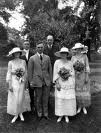
the happy couple

Woodrow Wilson fell madly in love with Edith Bolling Galt, an attractive widow he met eight months after his first wife died.

The Wilson Secret Engagement

Woodrow Wilson had adored his wife of thirty years, and was understandably devastated and depressed when she died, only fifteen months after his inauguration as president. Eight months later, the grieving husband met Edith Bolling Galt, an attractive widow, fifteen years his junior. Within days after meeting her, his mood had lifted dramatically.  Invitations to luncheons and dinners and carriage rides followed, all properly chaperoned.  Edith may have been overwhelmed by the attention, but she realized early on that she was being wooed, and Woodrow Wilson was a very ardent wooer. He telephoned her daily. He wrote passionate letters. He sent flowers. He was also a stubborn man, determined to get what he wanted, and he wanted Edith.  He persisted.

Edith had been a widow for several years, but she had never been truly wooed before. Her four year courtship with Norman Galt was pleasant, but hardly romantic. She had been fond of him, but the marriage was more friendship than romance. Edith was no match for the President’s persistence. Besides, she was falling in love with him.

Politics and Remarriage

It was still the Victorian Age, even though the old Queen died more than a decade earlier. Custom still demanded long mourning periods. President Wilson did not care about mourning traditions. He was in love and marriage was the only option. He proposed. She finally consented – but it would be kept a secret.

President and Mrs Wilson

President Wilson and his fiancee were seen everywhere together. He could not bear to be apart from her.

Private citizens can do whatever they want when it comes to love and marriage, but the President of the United States is something else. Another election was due in 1916, and Wilson was a shoo-in for re-nomination, if not re-election. The rather dour schoolmaster had become surprisingly popular. Meanwhile, war had already erupted in Europe with repercussions around the globe. Political stability at home was essential.

A second marriage “so soon” would be political suicide, they said. He would be defying convention. The public-at-large would never condone such a scandalous action. Silly as it seems today, in 1915, these matters were very important. Edith Galt was a savvy woman. Even though she had no background in politics or government social circles, she intuitively understood that the morals of a society directly affect their ballots. Women still did not have the vote, but they exerted subtle influence on their husbands’ votes. If they were outraged at the President’s disregard of social custom, he would never be re-elected. She offered to wait until the end of his second term.

Wilson had no intention of waiting. He wanted Edith more than he wanted to be President.

The President Announces the Engagement

Four months after he had met Edith, Woodrow Wilson let it be known that he planned to remarry. It was barely a year after the first Mrs. Wilson’s death.

EdithWilson

Edith Wilson was a stylish woman, and her cartwheel hats and orchid corsages became her trademark.

His three grown daughters had met Mrs. Galt, and if it made their father happy, they would be happy for him. Edith’s family was understandably thrilled to have the President as an in-law. The big surprise was the country. They were not the least bit scandalized. They were happy for their President. President Grover Cleveland had married a girl barely out of her teens thirty years earlier – well within memory of many Americans – and the country had been delighted!

But the politicians sniffed potential trouble. They believed Mrs. Galt had entirely too much influence with the President, and he, according to some of them, was besotted by her. She, on the other hand was becoming suspicious of the politicians who she believed were trying to come between her and her beloved. Time would prove them both right.

Nevertheless, Woodrow and Edith went everywhere together. She was attractive and stylish. Her big cartwheel hats and ever-present orchid corsage were becoming to the statuesque woman. The President became a snappier dresser himself. They went to baseball games and vaudeville shows. They went on daily carriage rides. Wherever the President went, she went. Their photographs were printed in the newspapers. She was photogenic and enjoyed the publicity. She could not sit beside him at official functions, since they were not yet married, but he insisted that she be nearby, so the White House staff made suitable arrangements.

Woodrow Wilson and Edith Galt Marry

The President had no intention of waiting until the next election – a whole year away. He was only fifty-seven, and love made him feel a lot younger. Besides, they were both mature adults who knew their own minds. There was no need to wait other than politics, and he didn’t care.

happy woodrow

Woodrow Wilson was a happy man when he married for the second time.

With minimal fanfare, President Woodrow Wilson married Edith Bolling Galt in her Washington town house on December 15, 1915. There were barely fifty people in attendance, only family and a few close friends. No political associates were invited.  It was only fifteen months after Ellen Wilson’s death.

The bridegroom was now a happy man! The morning after their wedding, an aide accompanying them on their honeymoon train reported seeing President Woodrow Wilson dancing a little jig, and whistling “Oh You Beautiful Doll.”

Sources:

·         Hatch, Alden – Edith Bolling Wilson: First Lady Extraordinary, 1961, Dodd, Mead

·         Levin, Phyllis Lee – Edith and Woodrow – 2001, Lisa Drew Book

·         Schachtman, Tom – Edith and Woodrow – 1981, GP Putnam’s Sons

·         Wilson, Edith Bolling – My Memoir – 1939, Bobbs Merrill

Posted in A POTUS-FLOTUS Blog, Woodrow Wilson | Tagged , , , , , , , , , , , , , , , | 3 Comments

Jefferson Davis: The Petticoat Story

Jefferson Davis’ reputation will forever be tainted by foolish innuendo.

Jeff Davis-petticoat

Few newspapers resisted the temptation to print their rendition of Davis’ “escape” efforts.

Jefferson Davis: CSA’s Flawed Leader

The Confederate president was a man of polarities.  Jefferson Davis (1808-1889) had some excellent character traits.  He was a courteous and surprisingly generous Southern gentleman.  He was steadfast and loyal. He was a man of unflinching personal courage and integrity.  He was tireless in whatever he undertook.  He was a compelling speaker, and a voice of reason.

On the flip side of that coin, his unfailing courtesy was perceived to be aloof and cold; his loyalty became favoritism; his integrity, unbending rigidity.

csa pres

Jefferson Davis, President of the Confederate States of America

He rose to political leadership quickly and steadily.  As a protégé of his personal hero, John C. Calhoun, he was assimilated into the world of movers and shakers of Washington from the start.  As a bona-fide hero of the Mexican War, the West Point-trained Davis became a major figure in his home state of Mississippi.  As a former son-in-law of President Zachary Taylor, the widowed (and remarried) Davis had family access to the White House.  And as the capable Secretary of War under Franklin Pierce, administrative skills only added to his impressive resume.

Jefferson Davis:  The Confederate Presidency Calls

By the late 1850s, Jeff Davis had become the “Voice of the South.”  He spoke often and passionately against secession, realizing from the start that it could not succeed without a bloody war they were unequipped to fight.  Conversely however, he was a firm proponent of states’ rights, which included the Constitutional right to secede.

He was considered a moderate; a man of reason in the South, and a far cry from some of its rabble-rousing fire-eaters.  His unanimous election as Confederate President was no surprise but his acceptance was not without trepidations.

As he long suspected, the Confederacy would prove to be a major headache.  Just as the states’ rights leaders rebelled against perceived Northern control, they held firm against Confederate control, which Davis knew was essential if they were to have their own “country.”  His hands were full, and usually tied trying to unite eleven separate “countries.”   If the state governments were unruly, the Confederate military hierarchy, most of whom he had known personally for decades, were even more cantankerous.  Davis was in the middle of everything, with little of Abraham Lincoln’s humor or political skills.

Jefferson Davis: The Fall of Richmond

Davis kids

Jefferson Davis had sent his wife and their four children South shortly before Richmond fell. His meeting up with them later was purely accidental; he did not know where they were.

For four arduous years, Jefferson Davis tried to hold the Confederacy together, but outnumbered, outsupplied and exhausted by war, their “country” was dissolving.  Davis pledged that as its President, he had a solemn obligation to preserve whatever fragile elements were possible.  He made arrangements to escape Richmond in early April, 1865, and form a capital-on-wheels, continuing the fight as best as possible.

For nearly three weeks, with on-again, off-again military escorts, Davis traveled south and east, to find a ship to take him to relative safety.  He also needed to reunite with his wife and four children under ten who he had dispatched South a few weeks earlier.

Jefferson Davis:  The Raincoat Affair

Completely by accident, Davis encountered his family and their small party of escorts three weeks after Robert E. Lee had surrendered at Appomattox Court House.  Lincoln had been assassinated.  Davis, who had learned of the assassination only recently, quickly realized that he was a wanted – and hunted – man.  He was also prepared for his fate.

Jefferson Davis was fifty-seven years old in April, 1865.  He was gaunt, blind in one eye, and in chronically poor health.  Any escape attempt would be weak, with little physical resistance.  But he was still President of the Confederate States of America, and he had an obligation to make the effort.

Coincidentally, Union soldiers were closing in by accident as well.  They were completely unaware that their prime target was under their very noses.

It had been a damp and rainy spring, and Davis’ health, always iffy, was prone to chill.  As he tried to slip unnoticed into the nearby woods, he picked up his wife’s oilcloth raincoat by mistake.  Both Jeff and Varina Davis had identical mackinaws, and Varina was a large woman, nearly as tall as her husband.   She hastily threw a shawl over his head for added warmth, as he quietly approached the nearby trees.

jeff in drag

The cartoonists had a field day describing the ex-Confederate President trying to escape in “his wife’s clothing.”

jeff skirt

The fact that he had picked up his wife’s raincoat made no impression on the newspapers: “His wife’s clothing” was the important part.

The soldiers quickly caught up with the aging man who did not resist.  In their ensuing written reports, Union soldiers noted, almost parenthetically, that Davis was wearing his wife’s clothing.  That it was merely a raincoat picked up by accident was of no matter.  “His wife’s clothing” made a titillating story.  The newspaper cartoonists had a field day.  The papers and magazines all had drawings of ol’ Jeff in hoopskirts and pantaloons.  And what the papers said, the people believed.  They wrote songs about it.  Showman P.T. Barnum was even eager to buy the clothes purported to be the ones Davis was wearing when he was captured.

Jefferson Davis:   Perpetuating the Story

petticoat songsheet

Even a song was written to commemorate “Jeff in Petticoats.”

Jefferson Davis spent two years imprisoned in Fortress Monroe.  He was finally released on bail, but never brought to trial.   Despite his poor health, he lived to be eighty-one.  Confederate Civil War veterans would vilify him and extol him – depending on what mood they were in at the time.  He would become their Symbol of the Lost Cause, but General Robert E. Lee would be their hero.

In the North, however, the story of Jefferson Davis escaping in his wife’s petticoats continue to this day.  He would refute the story privately, but he had the soul of a martyr.  His public facade would not permit him to stoop to that level of indignity.

Ridicule, rumor and innuendo sometimes can do more damage than anything else, and in this case the poisoned dart had hit home.  The essence of the story was undoubtedly false, but it was perceived to be true.  It created a life of its own.

Sources:

Johnson, Clint – Pursuit – Citadel Press, 2008

Swanson, James – Bloody Crimes: The Chase for Jefferson Davis – William Morrow, 2010

http://www.civilwarhome.com/jdavisbio.htm

Posted in American Civil War, Nifty History People | Tagged , , , , , , , , , , , , , , , , , , , | 2 Comments

TR’s Sister Anna Roosevelt Cowles

Anna Roosevelt Cowles (1855-1931) was closer to Theodore Roosevelt than anyone.  And he respected her more than anyone.

  Anna Roosevelt:  A First-Born Syndrome

bamie

Anna Roosevelt Cowles was Theodore Roosevelt’s older sister, and a remarkable woman in her own right. Despite physical infirmity, she maintained a fashionable political salon in Washington.

Anna Roosevelt, nicknamed “Bamie” was the eldest of four remarkable Roosevelt children born to Theodore (Sr.) and his wife Martha Bulloch.

Afflicted in early childhood with an illness that affected her spinal cord, she would wear a metal brace throughout her youth, and her physical growth would become one of obvious deformity.   Despite her health issues, Bamie had the oversized Rooseveltian intelligence, personality and energy that so marked her younger brother – himself a sickly asthmatic child.

It would be easy to claim that Bamie was prematurely mature: middle-aged from the time she was a child, and obviously destined to remain single.  There would never be a family crisis, when she wasn’t summoned to provide her uncommon common sense, leadership, and active assistance. She would become the dependable go-to person that her siblings, and even the second generation would rely on for the rest of her life

Home-schooled through the early years, then broadly educated at the Allenswood School in Paris and London, she had a fine and receptive mind, despite her frail body .  Her upbringing would provide the foundation for becoming one of the best known salon hostesses in high governmental circles.  She kept the aches and pains of her physical shortcomings it to herself and presented an image to the world at large that far surpassed any handicaps.  She would always have many friends and admirers.

Alice’s “Auntie Bye

On February 14, 1884, Theodore Roosevelt endured the most tragic day of his life.  His mother died of typhoid fever.  In another room of the same house, Alice Lee, his young wife of only three years, died having given birth the previous day.

The twenty-five year old new father was overwhelmed with grief, incapable of caring for an infant daughter, name Alice for her deceased mother.  Instead, TR entrusted the baby’s care to his older sister, who was delighted to be foster-mother.  Alice would live with Auntie Bye (her siblings called her “Bamie;” the second generation called her “Bye”) until she was three, but the bond between them would be lifelong.

baby lee roosevelt

“Baby Lee” as Alice Roosevelt was called, was raised by “Auntie Bye” for the first three years of her life. They would always remain close.

Three years later, Theodore Roosevelt married Edith Carow, a childhood friend of the family.  TR had decided to have Bamie formally adopt “Baby Lee” as he called her, but Edith would not hear of it.  She is reported to have said, “She is your daughter, and now she will our daughter, and sister to whatever children we have.”  “Baby Lee” would now be called “Sister” in the family circle, and would prove to be a fine one to the five more Roosevelts who came along.

Alice Roosevelt had inherited her late mother’s good looks and her father’s rambunctious temperament.  Even as a child, she was a handful.  With Edith occupied with five more rambunctious Roosevelts, if Alice became too difficult, she would be packed off to Auntie Bye, who could balance both love and discipline.  She would also receive a subliminal education in sophistication and style that she would perfect in her mature years.  As a teenager, Alice packed herself off periodically.  She did not have to vie for attention with Auntie Bye.

Eleanor’s Auntie Bye

Alice was undoubtedly the niece nearest to Anna Roosevelt’s heart, but Eleanor Roosevelt was the niece who truly needed an Auntie the most.  She was the daughter of Theodore’s younger brother Elliott, whose alcoholism and morphine addition led to his early death when Eleanor was ten.

Eleanor’s mother, the beautiful Anna Hall, died of diphtheria when Eleanor was eight.  Thereafter she was raised by her somewhat eccentric Grandmother Hall and an assortment of equally dotty Hall aunts and uncles.

Auntie Bye would have her visit from time to time, as would Uncle Theodore.  Eleanor did not inherit her mother’s beauty, and was painfully shy and awkward, with none of the graces and verve of her cousin Alice, even though they were born only months apart.  The glitter of her aunt’s hosting and social skills did not make an impression.

young eleanor

At Auntie Bye’s suggestion, orphaned Eleanor Roosevelt was sent to the Allenswood School in London when she was in her mid-teens. It was a seminal experience for the young woman.

Perhaps the most important contribution Anna Roosevelt Cowles made to Eleanor’s life however, was the recommendation that she attend the Allenswood School – the same one she had attended – and run by the same redoubtable Mlle. Souvestre.  The English school was an awakening for the lonely and affection-starved Eleanor, and would be a seminal experience of her youth.

Mrs. Anna Roosevelt Cowles:  Hostess and Presidential Confidante

Anna Roosevelt was forty when she surprised herself (and everyone else) by falling in love and marrying Lt. Commander William Sheffield Cowles.   Two years later, she surprised everyone even further by having a baby.

The couple moved to Washington, DC, and their townhouse became a center for the movers and shaker of political life.  Her brother Theodore had emerged on the national scene, first as a Civil Service Commissioner, and later as Assistant Secretary of the Navy.  Mrs. Cowles was happy to open her home to her brother for both socializing and private conversation.

When TR was named Vice President under William McKinley in 1900, his sister’s house became his pied-a-terre, since The Vice Presidency did not warrant a physical move to the capital.  Six months later Theodore Roosevelt became President following McKinley’s assassination.   By virtue of her close kinship to the President as well as her formidable social skills, Anna Roosevelt Cowles was acknowledged as the premier hostess whose elegant “small table” was a mecca for the highest levels of political society.

Anna Cowles: The Later Years

Despite her infirmities, Anna Cowles lived to be past seventy-five, outliving her brother Theodore by more than a decade.  Arthritis further crippled her weakened bones.  She developed cataracts and severe hearing loss.  Nevertheless, her remarkable intellect, her buoyant spirit and unflagging energies remained.

In her advanced age she was faced with divisive family ties between the Republican Theodore Roosevelt side of the family (including Alice) and the up-and-coming Democrat side, headed by Franklin Delano Roosevelt, who had married his fifth cousin, Eleanor.

It would be Alice Roosevelt Longworth who would inherit her aunt’s mantle as Washington premier power broker.  Eleanor, of course, would emerge as First Lady and a political powerhouse in her own right.

Sources:

·         www.theodorerooseveltcenter.org/

·         http://www.xtimeline.com/evt/view.aspx?id=126729

·         Caroli, Betty Boyd – The Roosevelt Women – Basic Books, 1998

·         Cordery, Stacy A. – Alice Roosevelt Longworth – Viking, 2007

Posted in Nifty History People, Theodore Roosevelt | Tagged , , , , , , , , , , , , , , , , | 5 Comments

Bess Truman: The Family Secret

Few First Ladies hated the position more than Bess Truman.

Bess Truman becomes First Lady

Eleanor Roosevelt’s example was daunting enough for anyone, but for Bess Wallace Truman, all she wanted was to go in a completely different direction:  Back home to Missouri.

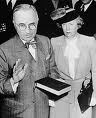
The First swear-in

When Harry Truman was sworn in as President immediately after FDR’s death, he said “it was like the moon, the stars and all the planets fell on me.”

It was a stunning shock when Franklin Delano Roosevelt died suddenly only a month into his unprecedented fourth term.  Harry Truman, a surprisingly good Senator, had been Vice President for barely six weeks, and now he was President of the United States. He would claim to feel like the sun, moon and all the planets had fallen on him. His wife Bess was just as unprepared for her responsibilities as the new First Lady.

Bess Truman Meets the Press

It had been Mrs. Roosevelt’s custom to hold a weekly press conference for the women journalists in Washington. After twelve years, it was expected. Mrs. R. was a very political woman, with wide ranging activities. She generously offered to guide Mrs. Truman through her first press conference. It would be Bess Truman’s last press conference.

wedding photo

When the Washington reporters submitted written questions for the new First Lady, all she replied to was her wedding date.

Sixty-year-old Bess was uncomfortable in the public eye. Other than her domestic activities, she had no outside interests except playing bridge. She insisted that all questions be submitted in writing. The journalists obliged. With the exception of indicating her wedding date, all questions were returned as “no comment.”

Bess Truman’s Family Secret

For nearly a half century, Bess Truman had a secret she had been guarding, and lived in fear that it would be rediscovered and cause her family distress, if not downright harm.

Bess Truman’s mother Madge Gates Wallace of Independence, Missouri, was a wealthy, headstrong and self-centered young woman who against her family’s better judgment had married David Wallace, the handsomest boy in town. They had four children. Bess was the eldest.

David Wallace had a long history of alcoholism, and as such, could never hold a job for very long. His wife consistently refused to acknowledge any problem, focusing only on herself and appearances, and was difficult to live with.

Finally, unable to overcome his situation, David Wallace stood in the upstairs bathtub and put a bullet in his head. Bess was 18. It was a huge scandal in turn-of-the-century Independence. The family response was the ubiquitous “business reversals.”

Bess Truman Assumes Family Responsibility

FL Portrait

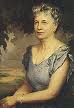
The formal portrait of Bess Truman, looking, as Harry Truman said, “exactly as a woman her age ought to look.”

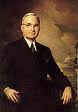
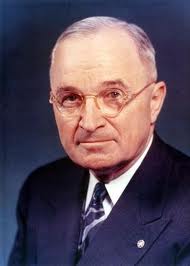
President Truman

The 33rd President was deplored during his nearly eight years in office. He lived long enough to see his reputation soar.

Madge Wallace had always been demanding, and after her husband’s suicide, she became even more eccentric. Psychologists today might call it a “personality disorder.” As such, she was and always would be difficult to live with. So any plans or hopes Bess had for further education or business school was ended. She would stay home, protect her mother from anxiety, and get her younger brothers educated and out of that toxic environment. Bess alone seemed able to live with her mother, whose peculiarities were becoming more and more pronounced.

Harry Truman Enters the Picture

Harry S Truman had known Bess Wallace since they were five. They were in the same class all through school but Harry was from the other side of the tracks, literally and figuratively. The Wallaces were well-to-do. The Trumans were farmers.

When they were in their mid-twenties, he re-met Miss Wallace (who he claimed to have loved since little tot Dancing School), and they courted for nearly a dozen years before they married.

Mrs. Wallace never liked or approved of “Farmer Truman,” who was never good enough for the daughter of Madge Wallace. She would never call him anything other than “Mister” Truman – even when Harry was President of the United States.

Harry and Bess married late – well into their thirties. It was decided from the start that they would live with Bess’ mother in the Gates mansion she had inherited when her parents died. If Harry had any objections (and one might suppose there were a lot them), they were never made public. He loved Bess very much. He bought the whole package.

Needless to say, it was now the Wallace Mansion and Harry was a sort-of guest-in-residence. Harry and Bess Truman never entertained in that house. Nobody other than family was invited. Their socializing was always “out.” The old lady was an embarrassment.

Truman’s friends would always claim Harry had “the original mother-in-law from hell.” He had no comment.

Bess Goes Back to Independence

By the time the Trumans were in the White House, “Old Lady Wallace” was truly an old lady, well into her eighties. The last thing in the world that First Lady Bess wanted was for the intrusive press to dig up the old suicide scandal and cause her mother any more grief. It could kill her.

The elderly woman could not live alone, nor could anyone other than Bess live with her, so Mrs. Wallace moved into the White House with them. Bess would always be torn between seeing to her husband’s needs, or her mother’s self-absorbed demands.

Always a homebody both by nature and long years of adjustment, Bess and her mother went back to the now-Truman Mansion in Independence for weeks at a time. The First Lady was annoyed by the White House aides and assistants and cabinet members and congressmen and just about everybody in Washington coming between the first couple. They had no time together. At least in Independence, she could play bridge with her old girlfriends.

As it turned out, the rather grumpy looking Bess Truman was poor copy for the newspaper journalists, and they quickly learned not to bother her. Her secret was safe – and by the time the secret was out in the open, nobody really cared.

Sources:

·         Truman, Margaret – Bess W. Truman, 1986, MacMillan

·         http://www.firstladies.org/biographies/firstladies.aspx?biography=34

·         http://www.trumanlibrary.org/bwt-bio.htm

Posted in A POTUS-FLOTUS Blog, Harry S Truman, Nifty History People | Tagged , , , , , , , , , , , , , , , , , | 3 Comments

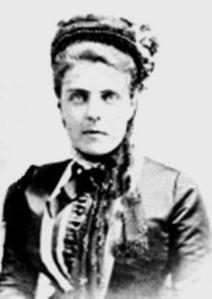
Edith Wilson, The Merry Widow Galt

Young Edith

When Edith Bolling Galt met President Woodrow Wilson, she was a forty-two year old widow. He was fifty-seven and had been widowed for about eight months.

At forty-two years old, Edith Bolling Galt embarked on a surprising role on the national scene. 

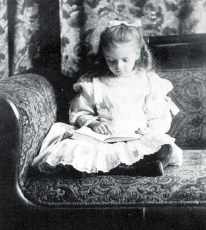
Miss Bolling

The Bollings are an old old Virginia family, dating back to Pocahontas.  Edith, the seventh of nine children, was born in 1872, a decade after the Civil War diminished the family fortunes, despite their gentry standing and the fact that Edith’s father was a Judge.

Being low in the birth order, and a girl, her education was average at best.  College was out of the question.  Her opportunities were even more limited.  An advantageous marriage was by far her best option.

Edith Bolling was an attractive young woman, but tall: five-foot-nine in her stockings.  With maturity, her figure would become what people would euphemistically term “statuesque.”  Suitable young men, in that generation decimated by war, were scarce.  At twenty, she met Norman Galt, several years her senior, and it would be a lukewarm, pleasant courtship.  Edith neither encouraged nor discouraged, but Norman persisted.  With no better prospects on the horizon, they married when she was twenty-four.

Edith Bolling as Mrs. Galt

Marrying Norman Galt had indeed been a very viable option.  He was a prominent Washington jeweler, whose shop had been around since Lincoln’s time.

Despite their childless marriage, it was a happy one, albeit not overly exciting or romantic.  Edith would claim that she and Norman Galt were “great friends.”  The best part was that Norman was well-to-do, and happy to spend his money on whatever would make Edith happy.

edith in car

When electric cars became fashionable, Edith Galt bought one and learned to drive.

She was always stylishly and expensively dressed.  Fine jewelry was a given.  They enjoyed a pleasant social life and traveled widely.  They went to dinners and the theatre.  When automobiles were introduced, Edith was the proud owner of her own electric car.  She was also able to help her aging mother and single siblings from time to time.

A dozen years later, Norman died.  Edith as his sole heir would be a very comfortable widow.  She continued to dress well, to travel regularly, and through her interest in the jewelry store, developed a good head for business management.  She also maintained relationships with a small but select group of friends.

One of those friends was Alice Gertrude (Altrude) Gordon, a twentyish young woman whose deceased parents had been Edith’s close friends.  She took Altrude under her wing and was like a second mother.  Altrude had a beau:  thirty-something Cary Grayson, a Navy doctor, and personal physician to President Woodrow Wilson.  Edith liked him.

Wilson Meets the Widow Galt

President Wilson was a widower whose wife Ellen had died a few months earlier.  It had been an uncommonly happy thirty year marriage, and the President was understandably devastated and depressed.  To help ease the social burdens and house management, he had invited his cousin, Helen Bones, to move in.  She was a single woman near in age to Edith Galt, and Dr. Grayson thought they might have interests in common.  The two women became friends, meeting frequently for lunch or walks or shopping trips.

According to Edith (maybe a little massaged….) after an outing one day, they were caught in a rainstorm.  Since they were close to the White House, Helen suggested they go there for tea.  Edith had never been inside the White House despite living in Washington for two decades.  Her first reaction was to decline – her boots were all muddy.  Assured that it wouldn’t be a problem, they proceeded inside, where they encountered the President at the elevator.  He promptly invited himself to their tea party, where Edith found him to be delightful and engaging.  She would later claim that if he was depressed, you would never have known it from his charm and wonderful sense of humor that afternoon.

The following day, the President sent Edith a note, enclosing a copy of a book they had been discussing.  Days later, she was invited to luncheon – as “Cousin Helen’s friend.”  Invitations to dinners and teas and afternoon carriage rides followed.   It didn’t take the forty-two-year-old Widow Galt long to realize that she was being wooed.

President Wilson, the Lover

Woodrow Wilson was a Southerner, born in Virginia and raised in the Carolinas and Georgia.  He understood the nature of charm.   A woman’s nurturing and care was vital to Wilson’s emotional well-being  and once he had determined that Edith Galt was essential in his life, he proceeded to lay siege to her heart.

Within a month of their meeting, he not only had fallen in love, but had fallen hard.   This was a completely new experience for Edith.   Her courtship with Norman Galt had been steady, but bland.   Fifteen years her senior, Woodrow Wilson was a brilliant man, a professor, college president and author of several books.  He was President of the United States.  He was a romantic and passionate courtier.  Edith was overwhelmed.

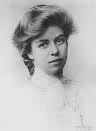
edith_wilson

This is the photograph of Edith Bolling Galt that President Wilson had framed and kept on his desk.

Her photograph sat on Wilson’s desk.  A private telephone line was installed between his office and her town house, only a mile away.  He called often.   Letters between them flowed as well, and he sent his private aide to the post office every day to circumvent the White House mailroom.  Wilson had been a gifted teacher, and now he was teaching Edith politics and government – a subject she knew little about.  She was a quick learner however, and began reading her way through his library.  Their letters seesaw between ardent sentimentality and serious and often remarkably confidential political discussion.

Edith Bolling Galt was subconsciously being prepared for a role that neither of them could have known was coming.

Sources:

·         Hatch, Alden – Edith Bolling Wilson: First Lady Extraordinary, 1961, Dodd, Mead

·         Levin, Phyllis Lee – Edith and Woodrow – 2001, Lisa Drew Book

·         Schachtman, Tom – Edith and Woodrow – 1981, GP Putnam’s Sons

·         Wilson, Edith Bolling – My Memoir – 1939, Bobbs Merrill

Posted in A POTUS-FLOTUS Blog, Woodrow Wilson | Tagged , , , , , , , , , , , , , , , , , , , | 1 Comment

Mary Lincoln’s Last Love: Lewis Baker

The widow of Abraham Lincoln was a pathetically lonely woman, with no one to love and no one to love her.

Mary Lincoln: The Lonely First Lady

Despite a large family of siblings-and-halves, by her own admission, Mary Todd Lincoln’s childhood was “desolate.” The few years she spent as the eligible Miss Todd, living in Springfield, Illinois with her married sister Elizabeth Edwards, were arguably her most carefree. She had her little coterie of friends and companions, and life was good.

Once she married, as customary for Victorian times, her husband became “her all.” As young Mrs. Abraham Lincoln, she devoted herself to her husband, her growing family and her home. Life was still good.

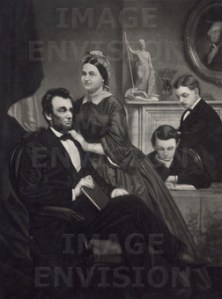
Lincoln Family

Mary Lincoln with her husband, her youngest son Tad, and her son Robert. Her middle son Willie had died in 1862.

Eighteen years later, Mrs. Lincoln was in the White House, where she was generally left to her own devices. President Lincoln had little time (and perhaps inclination) for domesticity. Her oldest son Robert was away at college. Her young sons Willie and Tad were old enough to rely on playmates. What might have been a glamorous social setting became a lonely island in many ways, due to the Civil War, and the fact that Mary had alienated much of Washington society with her imperious personality. Despite her exalted position, life was not quite so good.

Then disaster struck. Within those four years she lost her son Willie to typhoid and her husband was assassinated before her eyes. Life would never be good again.

Mary Lincoln:  Lonely Widow

During the next decade, Mary Lincoln would lose her remaining sons: Tad, to pleurisy at age eighteen, and Robert, by estrangement.

Robert Lincoln, man of the family at twenty-one, had inherited a particularly difficult situation with his mother. Their personalities were different by nature, and Mary by anyone’s calculation, was more than a handful.

After Tad’s death, the grieving Mary became so erratic and bizarre at times, that Robert felt compelled to have her sanity legally tried, resulting in a few months of involuntary residence at Bellevue House, an exclusive 19th century sanitarium.

Enter Lewis Baker

elizabeth edwards

Elizabeth Todd Edwards was Mary’s older sister by five years and the de facto “mother” figure.

Mrs. Lincoln, mostly by her own efforts, won her release from the rest home, and was pronounced “cured.” The proviso was that she would stay with her sister Elizabeth Todd Edwards, back in Springfield, in the very house where she had once lived as an eligible young woman.  The two sisters had been distant for several years. It seems that Elizabeth’s husband Ninian Edwards had been involved in some questionable dealings during the Civil War, and President Lincoln refused to run interference.

Edward Lewis Baker was Elizabeth Edwards’ grandson.  He was seventeen years old, and in a way, resembled the beloved Tad, who had died a few years earlier. Lewis’ father had a diplomatic position, and the Bakers were living overseas. The young man declined to go along, and was living with his grandparents. Lewis had some ambitions to become a journalist, and found particular delight in the company of his “crazy” great-aunt Mary, now also in residence.

lewis baker

Lewis Baker was the grandson of Elizabeth Todd Edwards, and thus Mary Lincoln’s great-nephew.

Mary Lincoln had always enjoyed the company of young folks, and Lewis’ obvious interest in her “Washington stories” and his complete disregard of the innuendos and gossip of her madness was endearing. She showered him with sincere affection and well-meaning advice for his future. Lewis, in turn, gave Mary a modicum of warm human relationship that had been gone from her life for more than a decade. She had someone to love.

Mary Lincoln and Lewis Baker in Lexington

Within a few months of living care/of Elizabeth Edwards, Mary decided to return to Europe. She had lived there for three years before Tad’s death, and it provided the solitude and privacy that she needed and claimed to want. She went alone – a frail, friendless woman in her late fifties.

Lewis Baker was her companion on the trip from Illinois to New York where she would board her ship. En route, there was a brief a detour to Lexington, Kentucky, where Mary and Elizabeth Todd were born and raised.

After more than forty years, the town had changed dramatically, mostly due to the Civil War. None of the Todd family still lived there. None of her Parker cousins remained.  Ellerslie, their old plantation, was a decaying ruin. Her childhood town house had been consumed by fire years earlier.

But Lewis Baker was the perfect companion for this you-can’t-go-home-again sentimental journey. He had known very little about his grandmother’s early life, and Aunt Mary was the consummate guide to a past long gone. The two of them would bond in a way that they both needed.

As far as we know, Mary Lincoln wrote very few letters those last years of her life, and even fewer “personal” letters. Most of those (at least the only ones that have surfaced) are to Lewis Baker. They are affectionate and full of motherly advice about his future plans and education. Lewis Baker seems to be the only one left that she really cared about.

Mary Lincoln: The Last Years

mary in mourning

When Mary died, she was only sixty-three – but an old woman.

Three years after she had gone to Europe, Mary Lincoln returned to Springfield, Illinois for good. Her health was failing precipitously.   She was losing her eyesight, probably due to cataracts, possibly complicated as some modern doctors suspect, by undiagnosed diabetes. She had also fallen in her room and may have broken some bones in her back, resulting in pain that would remain for the rest of her life.

Lewis Baker came to meet Aunt Mary in New York and escort her back to Springfield to live once again with her sister. By this time Lewis was a young man with his own life and his own responsibilities. While he still had true affection for his great aunt, he was going forward, and Mary Lincoln, now completely reclusive, would finish her days living in the past.

Sources:

Baker, Jean- Mary Todd Lincoln: A Biography – W. W. Norton & Company, 1989

Emerson, Jason – The Madness of Mary Lincoln – Southern Illinois University Press; Reprint edition (May 2, 2012)

Turner, Justin and Turner, Linda Turner – Mary Lincoln: Her Life and Letters – New York. Alfred A. Knopf. 1972.

Posted in A POTUS-FLOTUS Blog, Nifty History People | Tagged , , , , , , , , , , , , , , , , , | 4 Comments

The Remarkable Friendship Between Harry Truman and Herbert Hoover

In April, 1945, Franklin D. Roosevelt had died suddenly, and Vice President-now-President Harry S Truman, by his own admission, felt like the moon, stars and all the planets had fallen on him.

Harry Truman Makes A Friend

Harry Truman

Harry Truman assumed the Presidency at the death of Franklin D. Roosevelt. He had been Vice President less than two months.

 Only days after Roosevelt’s death, Truman sent a handwritten personal letter to Herbert Hoover, the only living former President, inviting him to “stop in” at the White House next time he was in town. Hoover wasted no time.  He was on the next train to Washington.The two men had never met, but Democrat Harry Truman had always admired Republican Herbert Hoover. Like many modern historians, Truman believed that the former president had gotten a raw deal from the Roosevelt administration. Truman’s note was the first time that Hoover had been invited back to the White House since he left it in 1933. The two men spent a few hours in conversation and found much commonality, not the least of which was being poor Midwestern farm boys who came up the hard way. The fact that they were from opposing political parties did not matter. It also did not matter that Hoover had become a wealthy mining engineer, and Truman was never more than middle class. They liked each other, and Hoover was the only man in the country who truly understood what Truman was facing.

Some weeks later, President Truman made an extraordinary personal gesture of friendship. The formal portrait of Mrs. Hoover had been languishing in a White House storeroom for a dozen years. Truman offered to host a private luncheon for the Hoover family and guests. They would make a little ceremony of hanging the portrait in the gallery of First Ladies.

This was a kindness that touched the former President deeply. Mrs. Hoover had died only months before.

HST Continues His Friendship

pres_hoover

Herbert Hoover was the only living former president when Truman was in the White House. Truman would come to respect his advice – and his friendship.

Now that the bonds of a sincere friendship had started, President Truman knew he could count on his friend “Bert” to provide another service for their country. Europe was devastated following World War II, just as it had been after the First World War. A monumental effort was underway to feed millions of starving souls. Who better to head the project to feed the hungry than the man who rescued a starving nation a generation earlier?

This was a mutual kindness. Truman needed someone experienced, and with irreproachable integrity. Hoover needed to be useful. Still fit and energetic in his early seventies, he jumped at the opportunity to resuscitate his crippled reputation, having been saddled with the unfair personification as the cause of the Great Depression.  Bringing the “Great Humanitarian” out of an enforced retirement would be a triple-win: A win for Truman, a win for Hoover, and most importantly, a win for starving Europeans.

The Friendship is Cemented

Herbert Hoover had become a bona-fide self-made millionaire as a world-renowned mining engineer during the early decades of the Twentieth Century. As Secretary of Commerce in the 1920s, planning the construction of the Hoover Dam on the Nevada-Arizona border was especially dear to his heart. It was designed to bring hydroelectric power to the entire Southwest, and had he not been a Cabinet officer, it is very likely that he would have been engaged as an expert consultant. He knew every aspect of the project. His input and advice was substantive. From the start, the project was to bear his name.

hoover-dam

When Hoover Dam opened, it was the largest man-made construction project ever undertaken.

Early in the Roosevelt Administration, the dam was formally opened, but the project was consistently referred to not as Hoover Dam, but as the dam in Boulder – and Boulder Dam it slyly became. It was a deliberate effort to undermine the former President and keep his name associated with the Depression – with Hoovervilles – rather than be attached to a monumental engineering project. True to Herbert Hoover’s modest and reserved nature, he never complained, but it had hurt him deeply.

Harry Truman publicly re-named the Dam to honor the man most responsible for its construction. It was not only a personal gesture of kindness, but an intensely private one.  As Truman would remark, “I feel that I am one of his closest friends and he is one of my closest friends.”

Herbert Hoover Returns the Kindness

truman_hoover

Harry Truman and Herbert Hoover became close personal friends at the onset of Truman’s presidency. They would remain close friends till the end of their lives.

Harry Truman had never been a wealthy man. When he retired in 1953, he had no income other than a tiny pension as a World War I veteran. He had saved little from his Presidential salary. Knowing that the American people do not want their former Presidents to be impoverished, Congress authorized a modest (at that time) pension for ex-Presidents, so they should not suffer basic comforts or go into debt.

Since he was a former President, Herbert Hoover was also eligible to receive the same pension.

Herbert Hoover was also a very wealthy man. He had become a millionaire by the time he was thirty. At the start of World War I, he renounced professional engineering in favor of Humanitarianism with a capital “H”. He never took a cent of salary, and frequently paid his own expenses as well. As a cabinet officer and President, he quietly turned his monthly check back to the Treasury. As was his way, he did not make this action public knowledge.

Herbert Hoover obviously did not need the new presidential pension, but he accepted it. As a man seldom given to opening his private soul, he had told Truman that “Yours has been a friendship which has reached deeper into my life than you know.”  The pension was the only public money Herbert Hoover ever accepted from the government, or indeed, from any of his humanitarian projects. It is said that he gave the pension money to charity. To return it, or to decline it, would have been unforgiveable. He did not wish to embarrass his “good friend Harry.”

Sources:

http://www.trumanlibrary.org/hoover/documents.php?page=4

http://hoover.nara.gov/

Posted in A POTUS-FLOTUS Blog, Harry S Truman, Herbert Hoover | Tagged , , , , , , , , , , , , , | 6 Comments

George Washington: An All-American Uncle

The Father of our Country, George Washington was step-father to Martha’s children and always a concerned and affectionate uncle to his numerous nephews and nieces.

george and martha

George and Martha Washington generously opened their Mount Vernon home to their numerous nephews and nieces, and frequently served as guardians to them.

 The Washington-Dandridge Connections

George Washington was the oldest of five children born to Augustine Washington and his second wife, Mary Ball.  From his first marriage, Augustine had two sons, several years senior to George, but who remained close to him throughout their lifetime.  George’s half-brother Augustine (sometimes called Austin) married and had surviving children.  Lawrence married, but died young, and his wife and child survived him by only a few years.  That was the connection that brought Mount Vernon into George Washington’s possession.

George’s full siblings were Samuel, John, Charles and Elizabeth (Betty), his only sister.  All of them married and had children who reached maturity.  George, however, survived all his siblings, but had no children of his own.

Martha Dandridge (Custis was the name of her first husband), was also the eldest of five who lived to maturity: two sisters, Anne (Nancy) and Elizabeth (Betsy), and two brothers, William and Bartholomew.  They likewise were fruitful and multiplied.  And, as might be expected, one of Martha’s nieces married one of George’s nephews.  Intermarriage between family connections was rampant in Colonial times.

George Washington’s Home at Mount Vernon

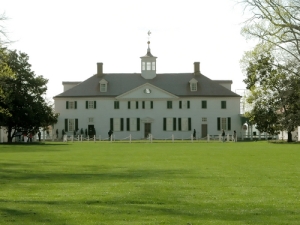
mount vernon

Washington’s Mount Vernon estate would be a second home to a good many of George and Martha’s nephews and nieces.

From the start, George and Martha Washington and her two babies, Jackie (aged four) and Patsy (aged two) lived at George Washington’s estate at Mount Vernon.  At the time, it was a relatively small plantation, but beautifully situated on the banks of the Potomac River, not far from Alexandria.  Over the next forty years, Washington would add to his acreage and improve the house and dependencies which would become the magnificent estate we know today.

Niece and nephews, and later great-nieces and nephews would visit Mount Vernon – sometimes for extended periods of time.  After Patsy Custis died at age seventeen, the visits became more frequent.  The motherly Martha found great comfort in a house filled with young people.

Then the Revolutionary War took Washington away from his beloved Mount Vernon for the better part of eight years.  He relied heavily on some of those relatives to manage the plantation in his absence.

The Nephews of George Washington

Lund Washington, George’s cousin, had served ably as manager for Mount Vernon for nine years, but was older than George and wished to retire midway through the Revolutionary War.  Brother Charles’ son George Augustine Washington (1759-93), had served capably during the War, but his health was poor, and Washington wanted his favorite nephew to consider taking the post.   General Washington was all the more hopeful for his nephew’s acceptance, since he had married Martha’s niece, Fanny Bassett.   The position came with perks:  they could make Mount Vernon their home for as long as they wished.  A year later, he told his nephew that he planned to leave them two or three thousand acres of property, “not a hint for you to prepare another home,” he wrote, but because of the double family bonds, and the good opinion he had of them both.  The legacy would not happen.  George Augustine Washington, tubercular in health, would die shortly thereafter.

bushrod washington

Bushrod Washington served in the Virginia Assembly after the American Revolution, and eventually went on to serve on the Supreme Court.

Bushrod Washington (1762-1829, Brother John’s son) was another nephew that the General could depend on to assist with plantation affairs, but more in a public venue.   After the Revolutionary War, Bushrod became a member of the Virginia Assembly and had made his home in Richmond, the new state capital.  “Uncle” George asked him for several small favors:  a copy of recent ordinances, checking on Washington’s taxes, placing an ad in the newspapers.  “Uncle” George was also generous with good advice for the young legislator – advice learned from his own experience:  “speak seldom, but…make yourself perfect master of the Subject.”

GeorgeSteptoeWash1

George Steptoe Washington was a youthful headache to “Uncle” George. When he got older, he married Lucy Payne, one of the sisters of Dolley Madison.

Samuel Washington’s sons, George Steptoe (1771-1809) and Lawrence, were a headache.   Samuel had died, and his sons were young and needed care and guardianship.  Washington’s brother Charles was a semi-alcoholic and was unreliable.  It would be General Washington, now retired and returned to his Mount Vernon plantation, who would assume responsibility for their education and upbringing.

Education (particularly for the boys) was vitally important to Washington, whose lack of formal education always made him sensitive on that subject.  He had the boys placed in school, and kept close check on their progress.  He wrote to one of their schoolmasters, “tho I do not desire they should be deprived of necessary and proper amusements, yet it is my earnest request that they may be kept close to studies.”  George Steptoe and Lawrence Washington would be enrolled and withdrawn from several schools.  It was an age of “spare the rod, spoil the child,” and it appears that while some of the punishments meted out by various pedants was indeed excessive, the young boys were behaving like young boys do.  Samuel’s sons were never particularly attentive to their education.  And, to his sincere dismay, none of Washington’s kin were scholars.

Lawrence_lewis

When young Lawrence Lewis married Nelly Custis, Martha’s granddaughter, the Washingtons were delighted.

Sister Betty Lewis’ children were also looked after by “Uncle” George, especially once Betty was widowed.  Her son Robert would become one of President Washington’s secretaries.  Nephew Lawrence Lewis (1767-1839) gave him the most personal pleasure.  Not long before Washington’s death, Lawrence married Eleanor (Nelly) Custis – Martha’s granddaughter.  Everyone was delighted!

George Washington may have been somewhat formal and remote, but he was a devoted uncle to his many relatives.

Sources:

·         http://www.infoplease.com/t/history/true-washington

·         http://www.mountvernon.org/

·         Bourne, Miriam Anne, First Family: George Washington and his Intimate Relations, W.W. Norton & Co., 1982

Posted in A POTUS-FLOTUS Blog, George Washington | Tagged , , , , , , , , , , , , , , , , , , , , , , , , , , , , | 2 Comments

Seasons Greetings from the Eisenhowers

No United States President took more personal interest in the annual White House Christmas cards than the Great General Ike himself.

ikeandmamie

Ike and Mamie Eisenhower were enormously popular White House occupants, and took great pleasure in everything to do with “seasonal greetings!”

Dwight Eisenhower: The President-Artist

 Dwight Eisenhower (1890-1969) was a man of many hobbies – poker, bridge, fishing, golf – and he was very good at all of them.  Perhaps his most relaxing avocation, which he came by fairly late in his career, was painting.  He would become a fine amateur artist.

Ike was introduced to painting by Winston Churchill, a fair amateur painter himself, and the General took to it rapidly and enjoyed the restfulness of art.  Public regard for his talents (like those of Churchill) were perhaps enhanced by his other achievements, but they were still worthy endeavors.  He himself had little pretensions and was sincerely modest about his artistic efforts, and was always pleasantly surprised when friends eagerly requested one of his canvases.

 The Eisenhower Christmas Cards and Gifts

 White House Christmas cards from the Presidential family had been around for decades, as were gifts to the presidential and White House staff.  Since the list was a large one and growing, and the President paid for them personally, the gifts were usually photographs of the First Couple or the White House or its treasures.  This still applies today.  Photos are apropos and relatively inexpensive to reproduce in large quantities..

It was Joyce C. Hall, a fellow midwesterner who became a personal friend, who suggested that reproduction prints of Ike’s own paintings might make a fine gift and/or greeting card.  Hall was an expert on that subject, since his company, Hallmark, was preeminent in that field.

ikes gw

A reproduction of one of Ike’s paintings, like the Gilbert Stuart “George Washington,” was placed in a presentation folder with an accompanying greeting card as a Xmas gift for high level staff and government officials.”

Hall’s idea was to reproduce one of Ike’s paintings and enclose it in a specially crafted presentation folder with an accompanying card.  These could be given to senior level White House staff members as well as to cabinet officers and high-ranking government associates.  Extra “accompanying” greeting cards, featuring the Presidential seal and printed greeting, would be sent to Ike’s larger list of officialdom.  His first order, in 1953, was for 1100 keepsake folders and an additional 1100 engraved cards.

There would also be an order for 500 “Mamie and Ike” cards for their personal friends.  (Their bill, by the way, was $139.50.)

 The Growing Christmas List

lincoln and gw

Ike’s interpretation of Alexandre Gardner’s Lincoln photograph – and his version of Gilbert Stuart’s most famous George Washington.

 The reproductions of Ike’s paintings was a huge hit, and with the exception of two Christmases (when he was ill), would continue through both his terms.  The first two cards featured his predecessors Lincoln and Washington, which he copied from the famous Alexander Gardner photograph and the Gilbert Stuart painting.  Subsequent Ike paintings were landscapes.

In addition to the “official” cards and presentation folders, Ike gave his thumbs-up to a complete novelty as far as Presidential greetings went:  Hallmark artists created informal cartoon-ish “Mamie-bangs” cards for their growing list of private friends.  The cartoons were based on the trademark hairstyle of Mamie Eisenhower, the popular First Lady.  It was a total departure from the formal Christmas cards of past presidents – and future ones.  No other President would do so with his White House greetings.

ike-and-mamie-eisenhower-christmas-card-1957

The “informal” Mamie-bangs Christmas Cards were used for personal friends and and family. They were wildly popular! A new design was produced every year.

The “Ike and Mamie” cards would also be hand signed (in those days before the autopen), and frequently a personal note was added by the President or First Lady.  By 1960, the last year of the Eisenhower administration, the official list had nearly tripled.  The order was for 3100 cards.  In the eight years that Ike was in office, Hallmark produced 38 different Christmas cards and gift prints for the First Couple.

 The White House Christmas Cards Today

 Sending Christmas cards from the White House today is a huge enterprise.  Dozens of volunteers spend a month or more hand-addressing the tens of thousands of seasonal greetings that the current President and First Lady (whoever they may be) need to send.  These include officialdom the world over, politicians great and small throughout the country, hundreds of personal friends and thousands upon thousands of citizen well-wishers who will treasure a return greeting.

There are “President and Mrs.” cards, just plain “President” cards, just plain “Mrs.” cards – and probably even cards from Presidential children.  Then there are just plain “first names” of the President and First Lady for their families and close friends.  Most are printed signatures.  Many are auto-penned.  Some are staff-signed, and a rare few (percentage-wise) are authentically hand signed.

The entire Christmas card task usually falls to the First Lady.  She is the one who will work with the chosen manufacturers and designers and photographers to select the “perfect” card and all its ingredients.  Plans start immediately after the previous Christmas, and are well under way by spring.  It is a major big deal.

Good manners dictate that all White House greetings be acknowledged.  If you, private citizen, send a card to the President, you may not get a return card this year, but you will likely get one next year. In today’s digital world, however, some of these returned greetings may be digital (if you provide an email address).

It is very unlikely that the Christmas card “spirit” will ever equal that of Ike and Mamie however.  It has grown much too complex.  And the cost is a LOT more than $139.50.

Source:

 Seeley, Mary Evans – Seasons Greetings from the White House: The Collection of Presidential Christmas Cards, Messages and Gifts – 1996, MasterMedia Book

Posted in A POTUS-FLOTUS Blog, Dwight D. Eisenhower | Tagged , , , , , , , , , , , , , , , , , | 1 Comment

The Hidden White House: A Book Review

The Hidden WHite House
The Hidden White House, by Robert Klara

There is an old saying that if somebody asks for the time, you don’t need to tell them how to make a watch.

And so it is with The Hidden White House: Harry Truman and the Reconstruction of America’s Most Famous Residence.  Author Robert Klara has taken what is basically a construction plan and has made it read like an adventure story.  This is no mean accomplishment, since it would be very easy to fall into a trap of blueprints and specifications, T-squares and slide rules.  This book does not.

The supporting cast of players runs a gamut of the high and low, starting with Harry S Truman, President of the United States, and an assortment of White House staff members, offering their insights of nearly seventy years ago.  Then there are Congressmen and Senators, some decidedly less than anxious to oblige a President with a thirty-something-percent approval rating (slated to fall even lower).  They would change their minds.  Then, of course, there were assorted architects, consultants and building contractors in a variety of disciplines, each with egos and agendas.  And workmen whose sense of history did not preclude a strike.  Then there were the commission members – since every government big-budget item needs a commission.  Klara treats them all well and with great respect.  They were, after all, the very best in the business.

There are no real villains here, unless it’s the earlier renovators with poor foresight as to the White House’s future needs, and who overloaded the amount the old place could bear.

The star of the show, of course, is the Great Lady herself, the White House, and according to Klara, she was not a “silent star.”  By 1946 or 7, the old place was showing its age and its moans and groans were being heard – and seen, a la swaying and tinkling chandeliers and portraits askew.  The Executive Mansion being what it has always been, a house of benevolent ghosts, its occupants were skeptical at first.  Maybe it was just Jefferson and Lincoln pacing up and down.  Actually, it was the stress and strain of generations of past presidential gerrymandered add-ons.

The scoffing did not last long, particularly when Chief Occupant Truman noticed slanting floors and sizeable gaps between woodwork and wall.  The thought that a little shoring up ought to do was immediately scratched by even a cursory inspection.  The problems were massive.  Massive enough to give rise to suggestions of demolishing the old house and putting up a new mansion.  That, in the eyes of HST, himself an ardent and knowledgeable history buff, was totally unthinkable.

The bottom line was more or less a complete gutting of the innards.  The walls of the house that George Washington planned would remain the landmark it had become.  The old façade was still strong, and with a little coaxing, promised to stand proud for centuries longer.

The gutting was like a surgical transplant:  consultations, “prep,” (including moving the Trumans out for three years), building a semi-sheltered work area on the adjacent grounds, erecting a huge life-support system to keep the patient alive, and removal of the ancient and crumbling.

Along the way, relics and treasures were discovered: burnt timbers, souvenirs from the British soldiers who torched the place in 1814, old mantel pieces, including a few that weren’t very old at all, and some old stones with odd markings.  According to Klara, they were thousands of years too young and on the wrong continent.  Master Mason Harry Truman recognized those marks as Masonic symbols, carved into the stones by the craftsmen who built the original foundations.  They were kept and reused in one of the kitchen hearths.

Then Klara delights us with the souvenir stories.  What to do with the 200,000 bricks and the nails, boards and chunks of plaster that were unreusable?  There were tons of debris.  An assortment of memento packages were created at various levels.  All were free, except for shipping and handling.

Add to the mix of a whopping good story, the momentous coinciding decisions of atomic energy, rebuilding a devastated Europe, fighting for a renomination, fighting even harder for re-election, an attempted assassination, a scary new war in Korea, and the usual trials and triumphs of life at the top.

Were mistakes made?  Of course.  Did it run over budget and over many deadlines?  Foolish question.  Might some discarded “relics” have been saved.  Don’t be silly.  But a three-year multi-million dollar project to restore a true national treasure was at stake.  They did the very best they could with no computers, calculators or pizza-to-go.

All historians might take a lesson from Bob Klara: tell the story through the window, not the keyhole.  Future generations will thank them for making history come alive.  The Hidden White House is a great read!  Harry would be proud.

The Hidden White House:  Harry Truman and the Reconstruction of America’s Most Famous Residence

Thomas Dunne Books, 2013

Posted in A POTUS-FLOTUS Blog, Harry S Truman, Recommended Reading | Tagged , , , , , , , , , , , , | 1 Comment