The Death of Tad Lincoln

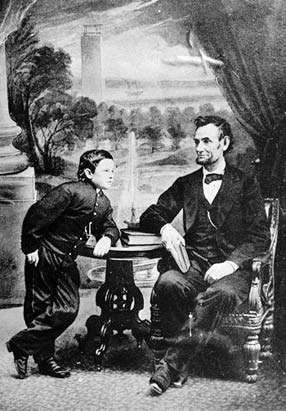
Tad Lincoln and his Father, President Abraham Lincoln.

Tad Lincoln had just turned 18 when he died.

Tad in Springfield, IL

Tad Lincoln when he was around three.

Thomas Lincoln, (1853-1871) named for his paternal grandfather, was called Tad from the outset.  It was a hard birth, and Tad was born with a cleft palate and its resulting speech impediment.

His early years were happy. His brother Robert was older by ten years.  Three-year-old Eddie died six years before Tad was born. But Willie, older by only two-and-a-half years, was Tad’s best friend and boon companion.

The Taft Brothers, Lincoln playmates and best friends.

Abraham and Mary Lincoln were loving parents, considered permissive for the Victorian Age. Keenly aware of Tad’s handicap, and perhaps some (unknown to them) childhood dyslexia that kept him from learning at the usual pace, the parents Lincoln encouraged him to “remain a boy” as long as possible.

Tad in the White House

Tad Lincoln was only seven, the youngest presidential child to live in the White House up to that turbulent time.

Union soldiers were camped in and around the White House – a heady sight for young boys.  Willie and Tad made friends; the staff loved them, the soldiers loved them, they had the run of the White House and a grand time of it!

But in 1862, 11-year-old Willie died, and the Lincolns were devastated. Tad was eight. He lost his brother, best friend and playmate. He could barely deal with his own loss or grief. His distraught parents, distracted by their own problems, had little time to comfort him.

Tad Lincoln in his “soldier’s uniform” when he lived in the White House.

Three years later, Abraham Lincoln (the boy’s new best friend) was assassinated, and Tad, just twelve, somewhat babyish and still unable to read, had to grow up quickly.

Tad in Chicago and Europe

Tad’s mother, the Widow Lincoln.

Barely able to cope, former First Lady Mary Lincoln refused to return to Springfield and its memories. Instead, she and her two remaining sons went to Chicago. Despite her own cares, she realized Tad’s education had been woefully neglected, and it became a priority.

Tad was also approaching puberty. While he was unschooled and still juvenile, he definitely understood that he was an ordinary boy now.  He had to learn to do things for himself. Mary enrolled him in school, but since he was so far behind  other boys his age, private tutoring was essential. His speech impediment made things even harder. But he tried.

In 1868, Robert Lincoln, now 25, got married. Mary and Tad went to Washington for the wedding – and then sailed to Europe.  Pathologically concerned about finances, the Widow Lincoln believed it was cheaper to live abroad and Germany offered the best educational opportunities in the world. They remained off-and-on there for three years, with Tad either with tutors and classes, or as companion to his mother.

Then Robert and his wife, also named Mary, had a baby daughter – yet another Mary Lincoln.

Tad Comes Home to Die

Tad Lincoln as a young man.

Tad was delighted with his new title: Uncle. He always idolized his big brother, but the ten years between them had been a chasm. Now the chasm was closing. He wanted to go home. Mary booked passage in mid-May, 1871.

The arrival of the Widow Lincoln in New York was of modest interest, and one of the newspapers sent a reporter – none other than John Hay, who had been one of Lincoln’s private secretaries, and who knew the family intimately. Hay was particularly interested in seeing Tad, who he remembered as a somewhat spoiled child. He was delighted by the progress of young “Mr. Thomas Lincoln”, including his improved speech, albeit now with a German accent.  Even before he filed his story, Hay wrote his good friend Robert Lincoln with glowing praise for Tad, who had made such great strides.

Robert Lincoln was ten years older than Tad.

Robert was now ready to be a big brother. Married, a father with a growing law practice, he wanted to help guide Tad in his future plans.

But Tad had caught a cold en route, and when they reached Chicago, it had worsened. Their stay as guests of the young Mr. and Mrs. Lincoln was brief, and also worsened. The two Mary Lincolns saw their once-cordial relationship deteriorate to a point that Robert’s wife packed up the baby and left to care for her own ailing mother.
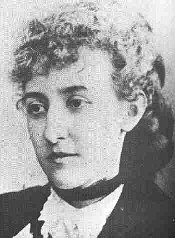
Robert’s wife – another Mary Lincoln. This one was Mary Harlan Lincoln.

The tensions created sufficient turmoil for the Widow to pack up as well, and move with Tad to the Clifton House Hotel on Wabash Avenue.

Tad’s Decline and Death

Tad’s cold had become serious and required Dr. C.G. Smith’s medical attention. He had trouble breathing, and was feverish. The diagnosis was (by various sources) dropsy, or pleurisy, or tuberculosis. Whatever the actual cause, all aforesaid possibilities were extremely serious without modern antibiotics.  He suffered horribly, and was confined to a chair with an iron bar across it to prevent him from falling forward or lying down, a position that made breathing impossible.  Mary Lincoln hovered by his side. Robert came daily.  Doctors came daily.  So did a few old Lincoln friends who could extend words of sympathy, but little more. Tad died on July 15.

According to the obituary in the Chicago Tribune (generously provided by Jane Gastineau of the Allen County Public Library, Ft. Wayne, IN), a private funeral service was held at the home of Robert Lincoln, but Mrs. Lincoln (Sr.) was too distraught to attend. Mrs. Lincoln (Jr.) was still with her mother. The small service, officiated by Dr. Everts of the First Baptist Church, was attended by some Lincoln friends, and some of Tad’s old Sunday School classmates.

Once again Robert Lincoln rode a train with a coffin to Springfield, along with his father-in-law Senator James Harlan of Iowa, Judge David Davis, and other Lincoln friends. Another private service was held at the home of his aunt and uncle, Elizabeth and Ninian Edwards, Jr. before final interment in the Lincoln Tomb at Oak Ridge Cemetery, where his father and two older brothers had been laid to rest. There were a few obituaries in the newspapers marking Tad’s passing.

Thomas Tad Lincoln

Tad Lincoln is buried in the family crypt.

In honor of the son of Abraham Lincoln, the flag at the Illinois State House in Springfield was flown at half-mast.

Sources:

Epstein, Daniel Mark – The Lincolns: Portrait of a Marriage, 2008, Ballantine

Painter, Ruth Painter – Lincoln’s Sons, 1955, Little, Brown

The Chicago Tribune, July 16 and July 17, 1871, generously provided by Jane Gastineau, Lincoln Librarian, Allen County Public Library, Ft. Wayne IN
 

Posted in A POTUS-FLOTUS Blog, Abraham Lincoln, Nifty History People | Tagged , , , , , , , , , , , , , , , , , , , , , , , , | 6 Comments

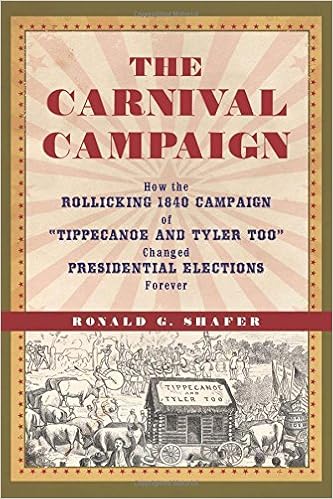
The Carnival Campaign: A Book Review

A professional writer who chooses to write about history (as opposed to a professional historian who chooses to write) probably knows intuitively that picking the right subject is half the battle.

Author Ronald G. Shafer, a long-time Wall Street Journal editor and (ahem) Pulitzer Prize nominee, hit a bonanza of a subject matter when he elected to treat the world to the campaign of 1840. The Carnival Campaign: How the Rollicking 1840 Campaign of “Tippecanoe and Tyler Too” Changed Presidential Elections Forever may be a mouthful of a title, but it is a rollicking romp, full of fun, silliness, mud-slinging, name-calling mayhem and a pile of historical firsts – easily called the grand-daddy of political campaigns as we know them.

Democrat Martin Van Buren was President in 1840, looking to keep his palatial address. Alas, he was unpopular and fairly colorless. How the Whigs (a new party) came to choose an elderly (68), mostly forgotten, second-rate ex-military leader and perennial office seeker as their standard bearer is not the real point; superb qualifications have seldom ranked high among candidate choices.

But how William Henry Harrison, a bland Virginia aristocrat, became whipped into a frenzy of man-of-the-people is one of those truth being stranger than fiction tales.

Author Shafer is an experienced journalist, blessed with a journalistic sense of order and sequence, and a wry sense of humor. He has deftly arranged his book into appropriate sections of campaign activity, as opposed to mere chronology, usually favored by the more didactic historians.

He begins naturally enough with Matty Van “the used-up man” and the resuscitated William Henry Harrison, whose derring-dids nearly thirty years earlier were buffed and polished till he came out looking like Lochinvar in a 10-gallon hat. How his supporters foisted a log cabin and hard cider image on this First Family of Virginian was a master stroke of public relations, as well as an outright lie! But nobody cared whether it was true or not. It sounded terrific!

According to Shafer, the campaign for WHH, a compromise candidate at best, was not faring well, and the Democrats were painting a portrait of a feeble old Harrison, saying “give him a barrel of hard cider… and he will sit the remainder of his days in a log cabin.”

A Harrisburg, PA publisher and Whig supporter were indignant, and sowed the seeds of turning a negative slur into a symbol of vital youth and true Americanism. After all, most Americans of 1840 had a log cabin of some kind in their family histories – and hard cider was drink of choice, cheap and readily available (or do-it-yourself-able).

Log cabins and hard cider took – albeit not the way the originators planned. The “positive” slogan spread like wildfire, and presidential campaigns would be changed forever.

Shafer delights us not only with old timey politicking that does not seem to have changed much, but introduces the reader to all the stuff and nonsense of campaigns: rallies, banners and parades, tall-tales and half-truths, songs, slogans (“Tippecanoe and Tyler Too” being the first of the memorable ones), women as campaign participants, stump speaking and free drinks for everyone, keeping the candidate quiet as much as possible, slurs and slanders, and all the rest of the huzzah and hiss.

Parades and rallies and torchlight parades were held in big cities and small villages alike, usually accompanied by bands, banners, candidate-promoting kerchiefs and lots of singing and slogan chanting. Newspapers sprang up practically overnight, blazing their Whig headlines with the virtues of Old Tip, or Tip and Ty, or lambasting the horrible Democrats. And the Dems gave as good as they got.

Float wagons mounted with miniature (and sometimes larger-than-life) log cabins were a mainstay of every parade. Barrels of hard cider were donated and generously poured – for free! Early in the campaign some partisans had fashioned a ten-foot high steel-ribbed ball, plastered it with pro-Harrison signs, and rolled it from town to town for the the next rally, thus giving rise to the expression “Keep the ball rolling.”

It was more than a presidential campaign, it was truly the “carnival” of Shafer’s title. It was a grand party for the entire country, and everybody came. They could cheer and brawl and drink and parade, and let their emotions and coarse frontier spirit run amok while poor old General Harrison was trotted around to pontificate from time to time. He was definitely a pontificator from the old school, generously peppering windy speeches with classical references that few frontiersmen understood or cared about, but it was the first time a presidential candidate actually participated in person. The former “aristocratic” candidates, far superior to tooting their own horns, wrote letters – and let others speak for them.

The carnival campaign of 1840 changed history. Hoopla would become a permanent part of politics.

Ron Shafer is a very engaging writer with a strong narrative style and a whimsical sense of humor. This in no way denigrates his well-researched venture into part of Americana’s electioneering history! The Carnival Campaign is a super read about small-d “democratic” participation on the grandest of grand scales!

The Carnival Campaign: How the Rollicking 1840 Campaign of “Tippecanoe and Tyler Too” Changed Presidential Elections Forever, by Ronald G. Shafer

Chicago Review Press

Hard cover and ebook available: The Carnival Campaign: How the Rollicking 1840 Campaign of “Tippecanoe and Tyler Too” Changed Presidential Elections Forever

  • ISBN-10: 1613735405
  • ISBN-13: 978-1613735404


Posted in A POTUS-FLOTUS Blog, Recommended Reading, William Henry Harrison | Tagged , , , , , , , | 1 Comment

William McKinley: The Sneezing Fit

William McKinley was one of the best liked Presidents.

President William McKinley was a genial and popular man. He had a long list of personal friends.

William McK: Mister Nice Guy

William McKinley (1843-1901) was a nice fellow – and a good fellow. At 18, he enlisted in the Union Army and served the entire four years, rising from private to major.

A devout Methodist, young Billy did not smoke, drink, play cards, gamble, dance, swear or chase women. Despite this absence of the vices of camaraderie, he was immensely popular with the soldiers, who liked and respected him.

As a young attorney, he joined all the fraternal and civic societies, along with the Republican Club, the Grand Army of the Republic (Veterans all!) and the Methodist Church.  He was welcome everywhere.

Ida Saxton McKinley, “the prettiest girl in Canton, Ohio, according to McKinley.

At 27, he married Ida Saxton, the daughter of the town banker, and “the prettiest girl in Canton, Ohio,” according to the bridegroom. For four years they were a happy couple, and proud parents of little Katie, born a year after their marriage.

That Horrible Year.

Ida’s second pregnancy was difficult. Her mother died.  Their baby was born sickly and died weeks later. Childbirth left Ida with phlebitis. And epileptic seizures. Then little Katie sickened and died before her fourth birthday.

Katie McKinley died shortly before her fourth birthday.

This year of relentless woe plunged Ida into a deep and understandable depression and transformed the pretty young woman into a demanding semi-invalid, whose focus on herself and her husband became (according to contemporaries) “strangulating.”

Phlebitis. And Epilepsy.

In the 1870s, both phlebitis and epilepsy were known to the medical community – but treatments were vague, and cures did not exist.

Phlebitis is not an uncommon residual of childbirth. It is basically blood clots, usually formed around the knee. It is serious to the point of fatal, even today; but now it can be effectively treated. The only treatment available then was rest, elevation, a compress, and perhaps something for pain. At 27, Ida McKinley walked with a cane.

Epilepsy has been known since Biblical times, but it was a word that bore a stigma. The McKinleys spared no expense seeking medical treatment, and even traveled to Philadelphia and New York, where the best doctors in the country were said to practice.

THe McKinleys spared no expense to find treatment for Ida’s “condition.”

No doubt the doctors recognized Ida’s problem, but it was never mentioned by name. It was couched in such euphemisms as a “nervous condition” or “fainting spells.” Some people still whispered about the “falling down” sickness.

Doctors could offer nothing other than powerful barbiturates for severe symptoms, and recommendations for a rigid routine: no excitement, no surprises – and no stress.

Bottom line. Ida McKinley had become a petulant semi-invalid, whose husband doted on her every whim, petrified that if she did not get her way, it could precipitate an attack.

H.H. Kohlsaat

H.H. Kohlsaat, Chicago newspaperman and friend of William McKinley.

Herman H. Kohlsaat (1853-1924) was a Chicago businessman and newspaper publisher of the Chicago Times Herald and the Chicago Evening Post. In the 19th century, long before movies, radio, television and the internet, newspapers were the mainstay of disseminating news – and forming public opinion. All the major cities had several papers. Some were devoted to promoting partisan politics, much like today. By 1890, Kohlsaat had converted his newspapers from Democratic to Republican viewpoints.

One of his “pet” interests was maintaining the “sound money” gold standard, as opposed to the free-silver issues of the Midwestern Democrats. McKinley was an ardent “sound money” man.

During the twenty years William McKinley spent on the national scene, as long-time Congressman and then Ohio Governor, he made scores of friends, Kohlsaat among them.

It was no secret that Ida McKinley was a semi-invalid; and most McKinley intimates were generally tolerant of her obsessive absorption of his time and energies. Despite his sincere cordiality with dozens of men, McKinley kept a distance when it came to his private/personal life. There are only a few instances when he acknowledged the constant strain he was under from worrying about Ida’s health.

The Sneezing Fit.

Ida McKinley was a frail semi-invalid as First Lady, and was the primary concern of her devoted husband.

William McKinley became President in March, 1897, and by the end of that year, was confronted by growing tensions in Cuba, where long-time harsh Spanish rule was fomenting violent reaction among the Cubans. Freedom-loving Americans were sympathetic to the Cubans who were trying to shed their Spanish oppressors.

Fanned by a jingoistic press, many Americans were eager for a war with Spain. President McKinley was not.

The thought of war with Spain was particularly upsetting to McKinley, who had experienced war first hand.

In need of a frank discussion with a good friend, he wired Kohlsaat, and asked him to come to Washington. The Chicagoan took the next train, but it was delayed, and he reached the White House hours after he was expected.

He was then ushered into the East Room, where a musical entertainment was in progress. McKinley caught his eye and slipped off to greet his friend. He told Kohlsaat to wait for an appropriate lull in the program, pay his respects to Mrs. McKinley, and then join him in a nearby room.

When Kohlsaat entered the room, he found a distraught President, who unburdened himself about the threat of possible war. He had spent four years in the Union Army. He had seen the carnage at Antietam. He dreaded the thought of sending American soldiers to fight – and die – in Cuba. He admitted that he hadn’t slept more than three hours a night for weeks.

Then he burst into tears, confessing that he was also sick with worry because Mrs. McKinley was “doing far too much,” recklessly scheduling luncheons and teas and musicales, without care to her delicate health. It was a very rare admission of his preoccupation with his wife.

Having unburdened himself, the President regained his composure and said he needed to rejoin his wife, because “she was among strangers.”

Herman Kohlsaat then advised his friend to blow his nose hard, and dab his eyes when he rejoined the gathering. This way, he could tell Mrs. McKinley that he had a severe fit of sneezing – which caused his eyes to water.

That’s what friends are for.

Sources:

Leech, Margaret, In the Days of McKinley – Harper & Brothers, 1959

Morgan, H. Wayne – McKinley and His America – Syracuse University Press, 1964

https://www.whitehouse.gov/1600/presidents/williammckinley

https://millercenter.org/president/mckinley

https://www.whitehouse.gov/1600/first-ladies/idamckinley

Posted in A POTUS-FLOTUS Blog, William McKinley | Tagged , , , , , , , , , , , , , , , , , , , | 2 Comments

Harriet Lane and the James Buchanan Statue

Portrait of James Buchanan by G.A. Healy.

James Buchanan has been the cellar dweller among Presidents for more than 150 years.

JB: The Balance Sheet

The asset side. Pennsylvania’s James Buchanan (1791-1868) came to the presidency in 1857 with a forty-plus-year resume of solid achievement: successful attorney, state legislator, congressman, senator, cabinet member, foreign diplomat. He was popular with his peers and short-listed for the Democratic presidential nomination for more than a decade. He was considered industrious, honest and a man of good will.

The debit side. Buchanan was a man of good will, but not of strong will. He could and did dither and waffle. In 1856 he was 65, the second-oldest President to date, and indeed for another century. His energy was starting to flag. In those 40-plus years on the national scene, he had made his closest friendships with southern counterparts. While he was never in favor of slavery, he was perceived to be, and likely was, sympathetic to the “peculiar institution” and believed it to be constitutionally protected. Thus the dither-waffle problem. He also made some disastrous decisions.

President Buchanan and his niece Harriet Lane.

It is thought by some historians that Buchanan was nominated and elected in ‘56 because he was out of the country, serving as Minister to England during the turbulent four years of the Pierce Administration. He had been away from the fray, and could legitimately duck the big issues.

Harriet Lane, Devoted Niece

James Buchanan was a lifelong bachelor, brother of several sisters, and uncle/guardian/benefactor to several orphaned nieces and nephews.

Harriet Lane, de facto First Lady during Buchanan’s Administration.

Harriet Lane (1830-1903), completely orphaned before her teens, became his ward. She lived with him, was sent to the best schools and favored by his sincere paternal devotion. In turn, she adored “Nunc,” as she called him, and enjoyed the advantages he generously provided, which included spending three years in England, wining and dining in royal-ish circles as the official escort to the American Minister.

When Buchanan became President, Harriet, then in her mid-twenties, was his de facto First Lady, capably managing a glittering social scene in Washington, as it danced on the precipice of Civil War.

As niece-of, rather than wife-of President, and forty years younger than the POTUS, her influence was social and filial, rather than political or even peer – but she enjoyed his confidence. It must have been painful for her to see his previously fine reputation falter.

Mrs. Johnston

Although Harriet Lane was young, attractive and hugely eligible during her four years in the White House, she did not marry until after the Buchanan presidency, and indeed, not until she was 35.

Harriet Lane Johnston, a wealthy widow.

Her choice was Henry Johnston, a wealthy Baltimore attorney-businessman her own age, and one she had known for many years. “Nunc,” whose health was failing by then, was thrilled at the match.

Harriet’s life as a happy matron lasted only fifteen years. Her two sons, James and Henry, died of rheumatic fever in adolescence. Then her husband died. She had outlived her siblings, her uncle, her children and her husband, and was entirely alone at fifty.

But she had inherited a considerable amount from Buchanan, and an enormous fortune from her husband. She was well fixed for life, and despite her losses, was able to live on her own happily and in great comfort.

The Statue of James Buchanan

The James Buchanan memorial statue in Washington, DC

Harriet Lane Johnston died at 73. She was a generous woman with no kin, and made several substantial bequests in her well-planned will. One of them was the sum of $100,000 (more than $1 million today) for Congress to erect a statue to the memory of her uncle, James Buchanan. The provisions specified that it was, to wit (and groan), a “statue of limitations”: Twenty years – or the monies would revert elsewhere.

Congress, used to dithering and dickering, was less than enthusiastic. There were few monuments in Washington then. The Lincoln Memorial hadn’t been built yet. There had been no monuments to Adams or Jefferson or Madison. In more than fifty years, Buchanan had never risen in anyone’s estimation. Why should a failed president be so honored? The vote in Congress reflected the country’s division or disregard, although it passed in both the Senate (51-11) and the House (217-142), mainly because they did not have to pay for it.

Architect William Gordon Beecher and sculptor Hans Schuler were commissioned and designs submitted. There was more dickering. The design and the plans were impressive – far more impressive than the Buchanan presidency, according to the congressional committee assigned to oversee the project.

Schuler planned a bronze and granite work of substantial size: Buchanan seated and loo0king “presidential.”  It was a conventional “Victorian” work of art: lifelike, heroic and filled with symbolic images. Exactly what Harriet Lane had envisioned. A few appropriate words of praise would be etched.

Its location at Meridian Hill Park met the terms of the bequest, yet it was far enough away from the “historic” center of town (although the city would grow exponentially during the next century.)

Dickering and Dithering

James Buchanan, Fifteenth President

The nineteen-teens was a troublesome time, with World War I looming and pressing problems far more important than honoring a long-dead president of dubious distinction. There were some powerful senators, like Henry Cabot Lodge (R-MA), who considered Buchanan downright treasonous, and argued against the project from the start.   (Interestingly enough, nearly a century earlier, Congress dickered and dithered over accepting a huge bequest from James Smithson, an Englishman, and it was largely because of the yeoman efforts of John Quincy Adams that the Smithsonian Institution was even built).

But the bottom line was the expiration date for the bequest. Use it or lose it. Time was running out and Congress was loath to lose such a large amount of money. The statue was finally approved in 1918 – under the limitation wire.

It was finally formally dedicated in 1930. It remains there today, but Buchanan’s reputation has never risen.

Sources:

Anthony, Carl Sferrazza –First Ladies 1789-1961, William Morrow,1990

Caroli, Betty Boyd – First Ladies: An Intimate Look at How 38 Women Handled what may be the most Demanding, Unpaid, Unelected Job in America – Oxford University Press, 1995

James Buchanan Memorial

https://www.whitehouse.gov/1600/presidents/jamesbuchanan

Posted in A POTUS-FLOTUS Blog, James Buchanan, Nifty History People, Presidential Sites | Tagged , , , , , , , , , , , , , , , , , , , | 2 Comments

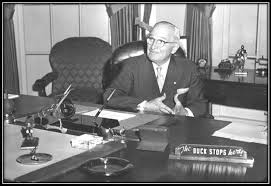
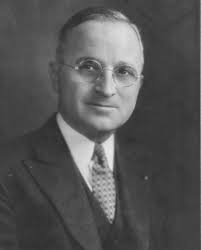
Harry Truman, Poker and The Buck Stops Here

President Harry Truman’s desk sign “The Buck Stops Here” is usually construed as an assumption of responsibility.

The Origin of “The Buck”

The saying, however, derives from a poker term (and HST was a long-time poker player). In the wild west days, a buckhorn was passed around the table, signifying whose turn it was.

Exactly when Harry Truman learned to play poker is always open to some conjecture, since historians are usually fastidious about documenting everything. He may have learned the game when he was an adolescent in Missouri. A deck of cards is cheap enough.

Captain Harry Truman in WWI. Most soldiers played cards when they had a little time.

In his twenties, he was known to play poker from time to time with some friends. In his thirties, as “Captain Harry” during the First World War, poker was likely on his agenda during soldierly down-time. Practically every soldier played cards then.

He married Bess Wallace when they were both in their middle thirties, and they made their home with her mother, Madge Wallace, a difficult woman on her best day. While it was not the ideal situation for either of the newlywed Trumans, they accepted their “responsibilities” as graciously as possible, and learned to adapt.

Part of the adapting was to find their social entertainment outside the house. Bess had some old school chums that she maintained for life. They played bridge a couple of times a week, rotating hosting duties.  Harry, on the other hand, played poker with the guys.  Out.

The Poker Games of Independence

Madge Wallace, HST’s “mother-in-law from hell,” according to his friends.

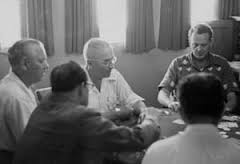
There were a bunch of fellows in and around Independence, Missouri, who struck a blow for their own independence by having a weekly guy-night: playing poker and enjoying a couple of drinks at one of the local hotels.

They came from all walks of midwestern life. Some were army buddies, some were local merchants, several were political-types, a few were farm boys come to town. Some were old pals that Truman had known since grammar school. The stakes were modest. Nickels and dimes. Nobody lost or won a great deal of money, but they had a good time and enjoyed each others’ company. Bess Truman, knowing that an evening at the Wallace-Truman home could be tedious, encouraged Harry to enjoy himself with the fellas. He never lost much money, and he never came home drunk.

When Harry Truman became active in politics, serving for several years as County Supervisor, his poker pals expanded to include more politicos. But the games themselves, despite the usual chatter about current events and the political goings-on, were always friendly and a source of relaxation.

The Poker Games of Washington

Senator Harry S Truman of Missouri

In 1934, Harry S Truman was elect to the U.S. Senate in a surprising upset. (Even he was surprised!) The first session saw him going to the Capital alone. Bess did not want to leave her mother, and their daughter Margaret was still a schoolchild.

Harry rented a small apartment, made friends, and was soon invited to a regular political poker game. Literally. He seemed to be good company and a pretty fair poker player. He maintained many of his card-playing buddies throughout his long life.

As an aside, both his predecessor FDR (fair) and successor Eisenhower (excellent) were poker players who enjoyed the game – but there is no indication Harry was invited to play at their tables.

Bess began to “visit” Senator Truman in Washington, and decided she liked it. Harry took a larger apartment (which also accommodated Mrs. Wallace), but his poker games continued. Bess, a pretty snappy bridge player herself, found like-minded Congressional wives and had regular games as well.

Bottom line. Playing cards was an important part of both Trumans’ social life, albeit sexually segregated.

Poker and the President

Few Presidents came to office with a more momentous agenda.

Few Presidents ever assumed office under more stress than Harry Truman, following the sudden death of Franklin Roosevelt, and World War II approaching mop-up stages. The momentous events that became a part of the Truman agenda were arguably some of the weightiest issues ever to face a President – particularly one who had little training for the position.

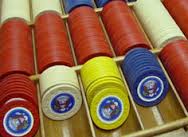
President HST had special poker chips made with the Presidential Seal.

Maintaining physical and emotional equilibrium is an important part of a President’s schedule – any President. Truman was no exception, and the sixty-year old chief executive was cognizant of his need for periodic relaxation.

HST loved his poker games in Key West.

Time and weather permitting, a cruise down the Potomac on the Williamsburg, the Presidential yacht, was a leisure trip with the guys. (Mrs. T. did not care for boats.) He organized a bunch of his pals, stocked the galley with plenty of whiskey, snacks, a few decks of cards and a set of poker chips that featured the Presidential seal. The stakes were a little higher, but still considered relatively modest.

HST’s Little White House in Key West was one of his favorite places.

Then there were the marathon poker games in Florida. HST had discovered the pleasures of Key West, where deep-sea fishing, one of his other delights, was readily available. His Little White House was a modest place, fixed up to Secret Service snuff. It was another venue that Bess Truman did not care for, so the President usually made those visits into a giant stag-affair, and his favorite poker pals came along for the fun.

It is said some of those games lasted for days.

Poker and the Ex-President

The Trumans went back to Independence, Missouri in early 1953. Old Mrs. Wallace had died by then, and the house was finally the Truman house. Both Harry and Bess picked up the threads of their old life, reconnected with many of their old friends, and were commonly seen on the streets and in the shops of their home town.

Mrs. Truman resumed her 50-year bridge club. And Harry still periodically met a bunch of the guys to play poker.

Sources:

McCullough, David – Truman – Simon & Schuster, 1992

Truman, Margaret – Harry S Truman – William Morrow – 1972

https://www.archives.gov/publications/prologue/2003/spring/truman-poker.html

https://www.whitehousehistory.org/harry-s-trumans-little-white-house


Posted in A POTUS-FLOTUS Blog, Harry S Truman | Tagged , , , , , , , , , , , , , , , , , | 1 Comment

Dolley Madison Sends A Telegram

The venerable Dolley Madison, the most popular woman in Washington, if not the entire country, in the 1840s.

As “The Widow Dolley”, Mrs. Madison was the most famous woman in the country.

Mrs. Madison: Dowager Washingtonian

When James Madison died at 85, Dolley was 68, and still in good health. Montpelier, their Virginia plantation was failing however, due to Madison’s declining years and ability to oversee, to the vagaries of farming in general, and mostly to the huge debts run up by Payne Todd, Dolley’s son from her first marriage. The Widow Madison was in sorry financial straits.

Since it was obviously far more than she could handle, she sold the plantation and moved back to Washington, a place she hadn’t seen for two decades. It had changed enormously. Nevertheless, her reputation as the leader of society was still intact, with dozens of old friends who were thrilled at her arrival. It is said that when she moved into her small rented house, there were more than 100 calling cards waiting for her.

Despite the fact that her finances were meager and she could only entertain once a month, she was invited everywhere – and she went. Washingtonians said no party was “official” unless Mrs. Madison was in attendance. That included the White House, where she was happy to serve as de facto social advisor to the Van Buren, Tyler and Polk administrations.

Bottom line: Dolley Madison was a national treasure, dearly loved by all.

The Multi-Talented Samuel F.B. Morse

Samuel Finley Breeze Morse (1791-1872) was a very talented man born in Massachusetts, and Phi Beta Kappa from Yale University. By the 1840s he had made a solid name for himself as a portrait artist, and could claim a growing A-list of clients. Today, his works hang in fine museums, and are considered worthy.

Samuel F.B. Morse in his older years: portrait painter and inventor.

In the competition between science and art, it is usually science that becomes the profession and art the hobby. But occasionally, like other multi-talented men such as Benjamin Franklin, Thomas Jefferson, and even Theodore Roosevelt, Morse had made a hobby of scientific pursuit.

His inventive mind imagined transmitting sound over vast distances. The means of human voice-sound was not available in the early years of the 19th century, but sound does not need to be human voice. Morse’s “avocational” experiments led him to devise a means of carrying sound through metal wire. The tap-tap-tap could actually be received at a fair distance.

Inventive minds usually keep inventing. Morse determined (after several years of experiments) that actual messages could be sent over those same wires if the tap-tapping could be arranged in a way that was easily understood, thus the Morse Code. He devised an alphabet of short and long taps that equated to letters of the alphabet. With a little practice, real messages not only could be sent, but received and “read.”

The Morse Code caught on like wildfire. Kids loved it!

It was nothing short of revolutionary. The telegraph and the Morse Code would become one of the greatest inventions of the 19th century, would change history, make Morse’s fortune, and spawn scores of other inventions. A young Thomas Edison eagerly learned Morse Code as a stepping stone to his own fame and fortune.

Unveiling the Revolution

Morse usually gets credit for “inventing” the electro-magnetic telegraph, but in reality, the actual product was a combination of several designs by several inventors. Patrick Feaster, one of the better historians seriously dedicated to the telegraph offers some fascinating details! The code, however, was Morse’s alone.

With help from other scientists and inventors, his first two-mile transmission of sound-via-wire occurred in New Jersey in 1838. Determined to expand this promising accomplishment to longer distances, Morse went to Washington to solicit assistance (financial and otherwise) from Congress. As expected, they dithered and dallied. Morse then went to Europe, where he learned to his dismay, that other scientific “competitors” had beaten him to the general punch.

Samuel Finley Breeze Morse – one of the great inventors of the nineteenth century.

Returning to the US in late 1842, he gained Congressional sponsorship by stringing wire between two committee rooms, and sent messages back and forth. Congress was impressed, to the tune of $30,000 to string wire between Washington and Baltimore, nearly forty miles away.

By May, 1844, the wire had been strung and tested, and the grand “unveiling” was scheduled.

“What hath God wrought,” was a Biblical quote sent over the wire from the Capitol Building to a Baltimore railroad station and into history. The telegraph, and just as important, its method of transmitting messages, was a huge success. It was clocked that 30 characters (dots and dashes) could be sent per minute. By the following year, New York City had telegraph wire strung to Philadelphia, Boston, Buffalo and parts westward. By 1850, more than 12,000 miles of telegraph wire had been strung between large cities.

The Dolley Connection

Even though the public “unveiling” of this experiment in 1844 was considered important in Washington, only a modest number of witnesses actually attended the transmission – or its receipt at the other end. But when (and this gets fuzzy) a “personal” message was to be sent via telegraph, opening the way to making it a means of public/personal communication, the venerable Mrs. Madison, was summoned for the honor. Some had suggested that President John Tyler have the distinction, but he was very unpopular – and Dolley was beloved. Nobody could object.

Legends abound of course, and zealous historians can nitpick a delightful story into a bland and coma-inducing footnote. Only the intrepid truly care about exactly which date Dolley’s personal message – sending her love to Mrs. John Weathered in Baltimore was sent. It may have been the same day, the following day or even a week later. But it was sent, and Dolley sent it, by personal invitation. Further, it was sent (and received) within a few days of “What hath God wrought.”

Thus one could claim Dolley Madison, as the first to be onboard with “social media.”

Sources:

Anthony, Carl Sferrazza – First Ladies: The Saga of the Presidents’ Wives and Their Power 1789-1961, 1990, William Morrow

Allgor, Catherine, – Parlor Politics: In Which the Ladies of Washington Help Build a City and a Government, 2000, University of Virginia Press

Dolley Madison Sends a Telegram

https://www.nwhm.org/education-resources/biography/biographies/dolly-payne-todd-madison/


Posted in A POTUS-FLOTUS Blog, James Madison, Nifty History People | Tagged , , , , , , , , , , , , , , , , | 2 Comments

Lincoln and Sherman: Plugging the Hole

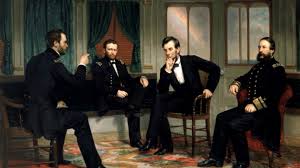
When Abraham Lincoln became President, he knew very little about the military. He learned quickly.

The Bull Run Debacle

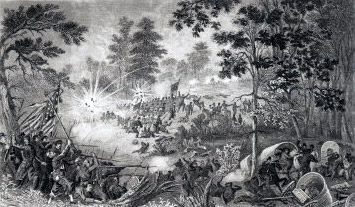
The first Battle of Bull Run was a disaster for the Union Army.

The Battle of Bull Run on July 21, 1861, was an eye-opener on many levels. The Union forces, mostly short term volunteers, had little training or experience, perhaps too much hoo-rahing, and a belief that one big brouhaha would be fought, the Rebs whipped, and the so-called “war” would be over, to be resolved peacefully.

It was a bigger brouhaha than any believed possible, with casualties numbering in the thousands. It was a total humiliation for the Union, as the “green” soldiers were routed in disarray – while the cream of Washington society, with binoculars and picnic baskets, were there to witness what they thought would be an easy victory. Now it was scorned as “the great skedaddle.”

The Hole in the Dike

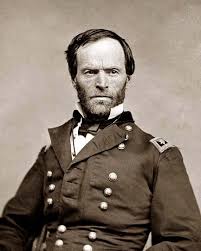
Only a few days after the Bull Run fiasco, Colonel William T. Sherman was greeted by a Captain on his staff, who came to “say goodbye,” adding that he was going to New York. Sherman was puzzled, since he did not recall signing a pass for him.

Taken when Colonel Sherman was a General.

The Captain said he was “going home,” and that he had enlisted for 90-days, which, by the way had expired several days earlier. He was leaving. Permanently.

Colonel Sherman, West Point trained, with experience in running a military academy, immediately recognized the tip of an iceberg: There were perhaps 75,000 volunteers who had signed on for 90-days. If one up and left, a dangerous precedent would be set, and the entire Army could collapse.

Without batting an eye, he told the wayward Captain that if he left, Sherman would send soldiers to bring him back – and would have him shot for desertion the next day. End of subject.

The Colonel Meets the President – Again

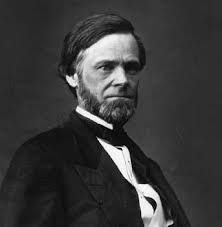
Ohio Senator John Sherman. The resemblance is strong.

William T. Sherman had met Abraham Lincoln shortly after the firing on Fort Sumter, courtesy of his brother, Ohio Republican Senator John Sherman. The meeting was brief. At Sherman’s request, he was reinstated into the Union Army, and also by his specific request, as second-in-command.

A few hours after his skirmish with the New York Captain, Colonel Sherman was riding far out around his lines and noticed an approaching carriage. He rode closer, and saw that its passengers were none other than President Lincoln and Secretary of State Seward. Sherman rode up and asked if he could be of service. Lincoln recognized him and asked for directions, remarking that he thought “the boys” could use a few words from their Commander-in-Chief to boost their morale.

The Colonel offered to guide them into camp, adding that the soldiers would indeed like hearing a few words from the President. But, he added, they’ve already had enough of the huzzahs, and it got them nowhere. What the soldiers needed to hear, was some firm encouragement toward hard training and obedience to military order.

Lincoln’s Remarks to the Soldiers

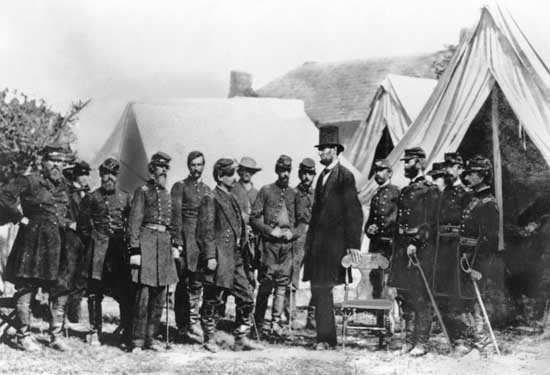
President Lincoln visited soldiers in the field many times during the Civil War.

Abraham Lincoln was a well-practiced speaker, but seldom liked to speak off-the-cuff. But a few words to the soldiers was a different matter. They did not expect a long-winded oration, or deep philosophical thought.

In the memoirs he wrote several years later, Sherman said that Lincoln’s “speech” was exactly right. He began by commiserating with their disappointment at Bull Run. Then he exhorted them to be mindful of their purpose: to preserve the Union and to renew their efforts and commitment.

Then he continued, perhaps remembering Sherman’s wise counsel, stressing the need for the volunteer soldiers to devote themselves to their new trade: soldiering – and how it involved discipline, training and obedience to military order.

Then he ended with encouragement, believing that “better days” were sure to come. All in all, according to Sherman, it was a dandy of a morale booster. The men were happy.

Lincoln Plugs the Hole in the Dike

After he finished his brief remarks, Lincoln went on to say, that as President he was also responsible for the soldiers’ welfare and to see that they were treated fairly. In that regard, he continued, if any soldier had a grievance, he would be glad to hear him out.

Seeing a perfect opportunity, the Captain from New York came forward with his grievance. He told Lincoln that just that morning, Colonel Sherman threatened to shoot him. The President looked at Sherman, who nodded in acknowledgement.

The next – and last time Sherman saw President Lincoln. It occurred only a few weeks before the assassination.

Military discipline is essential if order and respect is to be maintained. Sometimes harsh examples must be enforced. Even a non-soldier and kind-hearted man like Lincoln knew that. And he likely knew that if Sherman threatened to have the Captain shot, there was a good reason.

In his inimitable way of seeing both sides of a thorny situation and finding that ray of light that diffuses it, Lincoln took a breath, and in a confidential-sounding stage whisper – loud enough to be heard several feet away, he said to the Captain, “Well, if Colonel Sherman threatened to shoot you, I would not trust him.” Then he paused, adding, “for I do believe he will do it.”

The soldiers roared with laughter. The President had grasped the crux of the matter, and the warmth of his humor turned a nasty precedent into a light but effective warning.

Four years later, General Sherman – would meet Lincoln once more, only a few weeks before his assassination, just when the Civil War was coming to its end. He would later write of the sixteenth President, that Lincoln was “a great and a good man,” and perhaps the best he ever met.

Sources:

Botkin, B.A. (editor) – A Civil War Treasury of Tales, Legends & Folklore – Promontory Press, 2006

Davis, William, Lincoln’s Men: How President Lincoln Became Father to an Army and a Nation, (Free Press, 1999).

Sherman, General William Tecumseh – Memoirs of General William Tecumseh Sherman – Penguin Classics (reprint), 2000


Posted in A POTUS-FLOTUS Blog, Abraham Lincoln, American Civil War, Nifty History People | Tagged , , , , , , , , , , , , , | 2 Comments

Martha Johnson Patterson: First Daughter

Martha Johnson Patterson served for nearly four years as de facto First Lady to an unpopular president.

Martha Johnson Patterson, elder daughter of Andrew and Eliza Johnson.

The Johnson Family of Greeneville

Andrew Johnson (1808-75) was seventeen years old when he pushed a cart across the North Carolina border into Greeneville, TN. It is said that the day he came to town, sixteen-year-old Eliza McCardle (1810-76) saw him and remarked to a friend, “that is the boy I am going to marry.” Whether or not Eliza actually said it is immaterial; within months they did get married. At 18 and 16 respectively, Andrew and Eliza Johnson were the youngest-married First Couple.

Andrew Johnson’s two-room cabin.

Eliza, a shoemaker’s daughter whose father had recently died, needed a provider. Andy, a dirt-poor uneducated tailor-apprentice needed someone to manage a household. They moved into a tiny two-room cabin. One room was their bedroom, the other their living room-dining room and Johnson’s tailoring shop.

Soon enough, babies came along – four born within the first seven years. Martha, Charles, Mary and Robert. A fifth, Andrew Jr. (always called Frank in the family) was a surprise – born when Eliza was past forty.

Eliza could read and write and do basic sums. In the evening, while Andy sewed, she read to him and rocked a cradle. Johnson had no formal education. He could write his name, and knew some of his letters, but not much more. It was Eliza who taught him to read and write more fluently. It is also said that she helped him develop oratory skills.

The Family Prospers

The tailor shop prospered. Andrew Johnson was considered a valuable asset to the town. He began to attend town meetings, and by twenty-five, was active in local Democratic politics, becoming alderman and then mayor.

Johnson became successful and bought a bigger house.

When their first child (Martha) was still a toddler, the Johnson purchased a six-room house in town, with whatever niceties were considered essential for an up-and-coming family. Johnson was soon elected to the Tennessee legislature, and finally, in 1843, to the House of Representatives. Considered a quiet, serious girl, it was Martha who helped tend to the younger children and the house.

Moving to Washington, at least part time, Martha Johnson and her siblings received a fine education in Georgetown. One brother became a doctor, the other, a lawyer.

When Martha Johnson was twenty-seven, she married attorney David Patterson, and had two children. Her sister Mary, four years her junior, married Daniel Stover when she was twenty, and had three children.

The 1850s was a notoriously turbulent decade, and Tennessee was in the middle of the ruckus. Many of the Tennesseans were slave owners, and had been for decades. Many of them were strongly opposed to slavery, and had been for decades. The Johnsons, however, were ambivalent about slavery per se, but they were strongly in favor of the UNION. Now-Senator Andrew Johnson was making a name for himself in the Democratic Party (and not necessarily a good name). His manner and demeanor had always been, and always would be, pugnacious.

One of the very few images of Eliza Johnson.

Meanwhile, Eliza Johnson, a grandmother, now had a change-of-life baby herself and began having her own pile of troubles. She developed tuberculosis that drained her energy for a quarter century. Having Martha Patterson and Mary Stover nearby, raising babies of their own, was a godsend.

Johnson, His Women and the War

Next to Virginia, Tennessee suffered the most, with towns and cities ravaged, a populace violently divided, and dozens of battles and skirmishes fought.

The pugnacious Andrew Johnson.

Andrew Johnson was the only southern Senator who did not resign when his state seceded in June, 1861. Lincoln assigned him substantive duties to restore and/or maintain law and order in his troubled state. The Johnson women, wife and daughters and in-laws remained steadfast.

Nothing was kind to the Johnson daughters. In addition to a severe decline in their mother’s health, they lost their property, were shuttled from place to place, exchanging rudimentary shelter for the Governor’s Mansion, and back again.

Andrew Johnson was a cautionary tale and an odd choice as a running mate with Lincoln. Lincoln was not universally popular with his co-Republicans; Andy Johnson was a lifelong Democrat. A similar problem in 1840 between Whig William Henry Harrison and Democrat John Tyler might have raised a flag, but in 1860, other factors were in play. The Lincoln-Johnson ticket was a “Union” party ticket: neither Republican nor Democrat. As in 1840, it proved politically disastrous.

Within the space of six weeks, new-VP Andrew Johnson managed to embarrass himself badly at the inauguration, Lincoln was assassinated and died, and Andrew Johnson became president.

Mrs. Patterson, First Daughter-Lady

Martha Patterson was plain in dress and demeanor.

Now confined to her chair, the invalid Eliza Johnson was unable to participate in active First Lady duties. Placing the widowed Mary Stover in charge of the six small children who were now White House residents, Martha Patterson assumed the housekeeping and hostess management, along with being the wife of now-Senator David Patterson, elected to Johnson’s old seat.

Mary Stover, the younger Johnson daughter, was also plain in style.

The House itself was in poor condition. During the six weeks following the assassination, thousands of people marched through with little security. Rugs and furniture were trampled, curtains and draperies shredded by souvenir hunters, and the mansion that the Johnsons inherited was in sore need of repair and refurbishing. Both Martha and her sister (it is said) donned aprons and kerchiefs and worked along side the hired staff to clean and polish. “They were plain folks,” according to Martha, accustomed to hard work, which included milking the cows.  Her clothing was always simple and classic, and she wore little or no jewelry.

During the next four years, more than $100,000 would be periodically appropriated and spent to repaint, repaper, recarpet, repair and replace damaged walls, floors and furnishings. Mrs. Patterson spent wisely, and focused on the public rooms, keeping within her budget. That included collecting and hanging portraits of previous Presidents.

Despite the bitter animosity between the President and Congress, including impeachment proceedings, entertaining at the White House was done tastefully and appropriately. The last Johnson reception in 1869 is said to have attracted more than 5000 attendees.

In “retirement,” Martha Patterson returned to Tennessee and cared for her aging parents during their last years. Generally reclusive, she died in 1901, at the age of 73.

Sources:

Anthony, Carl Sferrazza –First Ladies 1789-1961, William Morrow,1990

Caroli, Betty Boyd – First Ladies: An Intimate Look at How 38 Women Handled what may be the most Demanding, Unpaid, Unelected Job in America – Oxford University Press, 1995

https://www.whitehousehistory.org/martha-johnson-patterson-hostess-of-the-andrew-johnson-white-house

http://www.firstladies.org/biographies/firstladies.aspx?biography=18


Posted in A POTUS-FLOTUS Blog, Andrew Johnson, Nifty History People | Tagged , , , , , , , , , , , , , , , , , , , , , | 2 Comments

The Hoovers Rescue Americans: 1914

Lou and Herbert Hoover. They spent half their lives as Humanitarians.

When World War I began in August, 1914, Herbert and Lou Hoover were living in London’s posh Mayfair section.

The Hoovers.

Young Herbert Hoover. He was a millionaire a few times over by the time he was thirty.

Herbert Hoover was a 40-year old mining engineer and consultant in 1914. He had offices in six countries and was a millionaire several times over.  It was a far cry from his poor-Iowa-farm-orphan upbringing.

By his own talents, diligence and innate leadership, he parlayed a tuition-free Stanford University education into a series of positions, usually far above what his youth and inexperience would demand. He did not disappoint.

His wife of fifteen years, Stanford educated Lou Henry Hoover had a busy life for herself in London. In addition to raising two sons, she had become active in various social and civic outlets.

Bottom line: The Hoovers had a happy and substantial social life.  While they did not travel in “royal” circles, they entertained frequently and counted as friends several high-level business and government officials.

The European Money Crisis 1914.

Lou Henry Hoover was a degreed geologist from Stanford University in her own right.

Bert Hoover had no idea that his life as he knew it, was coming to an abrupt end. Europe had been a tinderbox for more than a decade, and in midsummer, 1914, it ignited with the assassination of Archduke Franz Ferdinand, heir to the throne of the Austrian-Hungarian empire. The flames spread rapidly, consuming the continent.

There were more than 100,000 Americans in Europe that summer. Some had lived there for years, some were on business, some on vacation – and many with families. When the great armies mobilized, their one thought was to get home as quickly as possible. England was a key terminus for ships bound for America.

The huge problem was money, or more precisely, the availability of spendable money. Most of them had American dollars in their pockets; some had substantial letters of credit from well-known banks. But each belligerent country only accepted its own currency. In those pre-euro days, that meant that France only accepted francs; Germany the deutschmark, Italy the lire, etc.  That also included the British pound.

Lou Henry Hoover and their two sons, John and Herbert Jr., about the time World War I erupted in Europe.

As thousands of Americans poured into the London train stations, they could not get so much as a cup of coffee or a place to stay for the night while they were trying to make travel arrangements.  They did not have (and could not get) pounds and shillings.

One of the British officials assigned to manage this “surprise” crisis was a friend of the Hoovers. He called Bert and asked if he might come and help sort out the sprawling mess. Hoover did not hesitate.

The Quick Fix

It did not take Herbert Hoover very long to determine what his fellow Americans needed: a small “loan” to get them food and lodging until they could settle their passage reservations. It was considered a “temporary” problem, but an immediate one that needed to be resolved.

Within the hour he telephoned his wife to bring all the money they had in the house – 500 pounds (the equivalent of about $2500).

Then, with nothing more than pen and paper, he began lending Americans two or three or five pounds – enough to bridge the gap. All he required was a hand-signed note to secure the “loan.” The following day, he went to the bank and withdrew several thousand pounds, and continued his home-made remedy.

Years later, Hoover wrote that he personally “lent” around $300,000 of his own money in dribs-and-drabs. He added that perhaps only $300 went unpaid, and suggested that some people may have died in the interim.

Meanwhile Mrs. Hoover…

Having been made aware of the huge influx of Americans descending upon the London train stations, Lou Henry Hoover determine upon her own “quick fix.” She called several of her woman friends to help relieve some of the most pressing problems.

They contacted various restaurants and hotels to send sandwiches and coffee and milk for the children – to be distributed free of charge to the stranded travelers.

Then they arranged to have a section of the station cordoned off for a make-shift day-care area. Cribs and cookies, tables and chairs, and games and toys were quickly collected, plus dozens of volunteers to be “nannies-for-an-hour.” This way infants, toddlers and restless youngsters were supervised and occupied for a little while so their parents could stand in line to make travel arrangements.

Both Hoovers adored children, and they would mentor them for the rest of their lives.

The Hoovers Change Careers

Within the first months of World War 1, neutral (!) Belgium was overrun by the German army, and millions were left homeless.

The American cash crisis was resolved fairly quickly, but no sooner than that crunch was over, a new crisis began. Belgium – a neutral nation – was overrun by German soldiers who trampled through and practically destroyed the country. Thousands of Belgians were made homeless; even more were starving, and winter was coming on.

The opportunity to be of service ignited the imaginations and consciences of both Herbert and Lou Hoover.

He would never again work as a mining consultant, and within the year, arranged for his business interests to be divested.

From that time on, he became a Humanitarian with a “capital H”, channeling all his energies and immense organizational talents into philanthropy on a grand scale.

And he never took a dime of public money in compensation for any of his services.

Ever.

Sources:

Mayer, Dale M. – Lou Henry Hoover, A Prototype for First Ladies – Nova History Publications, 2004

Smith, Richard Norton – An Uncommon Man: The Triumph of Herbert Hoover – Simon and Schuster, 1984

Pryor, Dr. Helen B. – Lou Henry Hoover: Gallant First Lady – Dodd Mead, 1969

http://www.firstladies.org/biographies/firstladies

https://hoover.archives.gov/exhibits/Hooverstory/gallery02/index.html


Posted in A POTUS-FLOTUS Blog, Herbert Hoover | Tagged , , , , , , , , , , , , , | 2 Comments

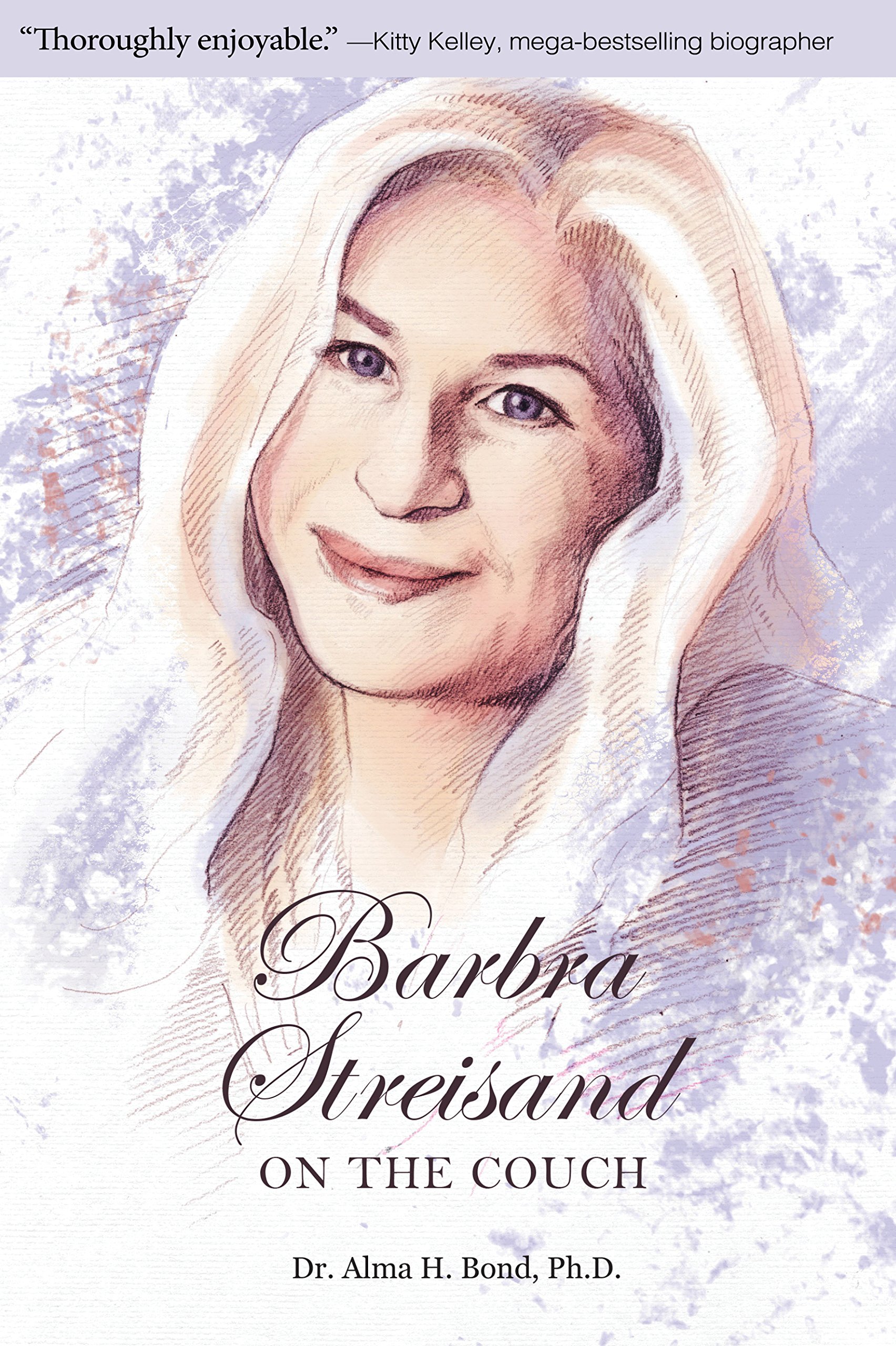
BARBRA STREISAND: On the Couch: A Book Review

In the introductory remarks, author Alma Bond noted that of the twenty-some books she has written during her long career, Barbra Streisand: On the Couch is her favorite. This is easy to understand. Dr. Bond, psychoanalyst with scores of years’ experience, is as natural as pie, with an unerring ear for style, cadences and voices.  It is an enjoyable and easy read!

As with her other “On the Couch” series of books, Dr. Bond, aka Darcy Dale, invents a thin ruse to bring the subject to her office for analysis. In the case of Barbra Streisand, the ploy is gossamer-thin: that she has spent a gazillion years and dollars in analysis and nobody has “helped her.” Helped her what? The truth is, of course, that Barbra Streisand needs “help” about as much as a corpse needs a transfusion. But hey, no ploy, no plot.

So in comes La Babs, a genuine star of the first magnitude, in the public eye for six decades mind you, with phenomenal talents on many fronts. So what is the overwhelming “problem” that brings her to Darcy Dale’s couch? We have no idea, other than the fact she likes to talk about herself. (This is generally indigenous to the high egos of stars of the first magnitude.)

Her Jewish childhood in Brooklyn was one step above miserable:  A distracted and distant mother, the usual poverty and the-kids-don’t-like-me, and a nasty and humiliating step-father (for a while).  Then there is her relentless focus on the natural father who had the temerity to die when she was a toddler. It has consumed her. Of course she know this; she is not stupid.

She is also not lacking in courage or insight. It takes huge insight (as well as musical gifts) to craft the phrasing for the songs she sings so well. She makes you believe every word of them. She also has near perfect-pitch in selecting the songs she sings.  Like Sinatra, she has had very few “oops” choices (and she likely knew it as she was choosing it).  This is no small accomplishment.  And the perfectionism with which she sweeps in and rules everything in her life is practically guaranteed to keep the kids from still not liking her.  More common to women than men, as we know.

Barbra Streisand soared to stardom by the time she was twenty, and never loosened her hold on the diva-role. Her hold on personal relationships is a different matter, and has never appeared to cause her internal angst or anything more than a temporary whine.

Her first marriage to fellow New Yorker Elliott Gould was an up-and-down love-hate story for a decade, and, as Barbra suspects (on the couch), under other circumstances, they might still be together. They are/were cut from the same New York-Jewish-kinda-tough cloth. They understand each other. Her current husband, James Brolin is also of that cloth. Their marriage in now into their second decade.

But between Elliott and Jim, The Divine Miss S. has had a string of fly-by-guys, boy-toys and assorted pals for a time. Few (scratch that to none) have been her equal in terms of talent, whether singing or acting or directorial or production. Or money. Their ability to maintain the relationship was more whether they could put up with her initials.

Her only absolute relationship (other than her work and fixating on the long-deceased father-with-a-halo) is her son Jason Gould. She seems obviously proud and delighted that he is gay and promiscuous, worrying only slightly because he is HIV positive and who knows what else. His father Elliott seems to have had little to do with his upbringing.

Then there is the political Barbra, outspoken and passionate about those issues she cares about. And, in her behalf, she is willing to put her money where her mouth is. Whether anyone really cares what she thinks (other than a candidate in need of cash) is open to conjecture. She is, of course, entitled to her various opinions. Listeners are, of course, entitled to tune out if desired.

The one thing Dr. Darcy Dale does not tackle, nor does Barbra herself, is dealing with her public confession of stage fright, which has kept her body of work (i.e. concerts, live theater and appearances) extremely small, considering nearly 60-years of fame and sincere talent. Unlike Judy Garland, another star of the first magnitude who thrived on live performances, Barbra shuns the stage or the arena.  She is a bona fide control freak by her own admission. She has an exacting and usually on-target sense of perfection. She obviously doesn’t wish to lose control for a moment, and you can’t reshoot a live performance. And she does not need the money.

If she wants to keep looking for the father she never had and imbuing him with sainthood according to Rabbi Barbra, she is also entitled. But it does get tiresome. One could picture Barbra and Pops meeting up by the Pearly Gates, where she is crushed to see that he has no halo, no harp and does not walk on water.

Barbra Streisand needs no shrink. She is the 600-pound gorilla. She can do what she wants. And Alma Bond, with her string of credits behind her, obviously knows this.

But Dr. Bond is a nifty and gifted writer, and long may she continue to find willing subjects for her always-delightful couch!


Barbra Streisand: On the Couch

Dr. Alma H. Bond

Bancroft Press, October 2017

ISBN-10: 1610882113

$25.92, Hardcover

Posted in Recommended Reading | Tagged , , , , , | 1 Comment