FDR and Crown Princess Martha of Norway

A month before the famous visit between Franklin Delano Roosevelt and King George VI of Great Britain, the Crown Prince and Princess of Norway visited the US.

The Young Norwegians

Prince Olav V and Princess Martha at the time of their wedding.

In 1939, Norwegian Crown Prince Olav V and his charming wife, the former Swedish Princess Martha came to the USA on a semi-official visit. They had the pleasant opportunity to meet President and Mrs. Roosevelt, but they mostly spent time out west – skiing. Both were superb athletes, who had originally met at the 1928 Olympics.

Olav and Martha were a real love match, delighting both Swedes and Norwegians, cementing the amicable dis-union between the two Scandinavian countries some 25 years earlier. 

Martha was not only a devoted wife, mother of three and hostess, but embodied many of the qualities that would endear her to her adopted country: happy to lend her name, energies and prestige to various charitable, cultural and historical organizations. 

But 1939 was a European tinderbox, and the Norwegian Storting (their parliament) had deep concerns for their country’s safety and security against Germans on the march. Olav became a symbol of national resistance to the invading German army in 1941, holding out with his father and other government officials in the north woods. Nevertheless, the Norwegian politicians insisted on evacuating their monarch and leadership to England as government in exile. Olav, a naval officer, became a secret emissary to the US, making several trips to meet with President Roosevelt. 

King Haakon and Olav needed to remain in London, but to secure his family’s safety, and protect the royal succession, Martha and the children were sent to the United States, care/of President Roosevelt.

The Royal House Guest

The Norweigian Royals’ house in Bethesda, MD

FDR was happy to welcome his Royal visitors, and offer the hospitality of the White House, which became their “second home” in the US. Shortly after their arrival, Princess Martha obtained a suitable house (on 140 acres) on Pook’s Hill, in Bethesda, MD.

Franklin Roosevelt always enjoyed feminine company and companions. If they were young and attractive, so much the better. If they were intelligent – another plus. And if they were gentle tempered, non-demanding and content to bask in the President’s limelight, it was the epitome. Martha not only embodied all the above, but one additional plus: like FDR (who was twenty years her senior), she had a marvelous sense of humor, according to those who knew her.

The Norweigian Royals in the 1940s

FDR and the Princess became fast friends. She was regularly invited to White House functions, and even private luncheons and dinners for selected guests. She was the President’s guest at his home at Hyde Park, and also at Shangra-La, the presidential retreat in Maryland (now called Camp David.) He, in turn, was invited to visit her Bethesda home – particularly on those occasions when Prince Olav had slipped quietly into the country for a brief visit.  

Martha championed Norwegian causes and charities throughout her four year stay in the US. She traveled tirelessly throughout the US and Canada, happy to lend her name, make appearances and speeches, and do whatever she could to be useful to her country’s sovereignty.

“Look To Norway” 

The “Look to Norway” appearance.

In April, 1940, the Nazi Army invaded Norway, a neutral country. Despite the valiant heroism of Prince Olav and others, many in the USA perceived Norway to be indifferent to the advancing Germans, and that foreign aid and support would be futile. Princess Martha did much to dispel that notion. Norway was obviously no match for the Germans, however they were not, nor ever were acquiescing, and indeed were deserving of American assistance.

By 1942, the US was actively supporting Norway, and supplied them with a naval vessel, rechristened the King Haakon VII, to “hunt U-boats.” When it was launched at the Washington Navy Yards, the President and Mrs. Roosevelt, accompanied by Princess Martha, did the honors. FDR made one of his most noteworthy speeches, saying, “If there is anyone who is still wondering why this war is being fought, let him look to Norway. If anyone has any delusions that his war could have been averted, let him look to Norway; and if anyone still doubts the democratic will to win, again I say, let him look to Norway.”

The Princess added a few comments, thanking the President, saying “…everywhere on this globe…Norwegian men and women are praying and working and fighting to regard the free and happy Norway.”

Wagging Tongues

Prince Harald (the present King of Norway) played with Fala.

As historians evaluated and re-evaluated FDR over the past decades, leaving nothing to privacy, some biographers unearthed several close female relationships in his life. Including Princess Martha. The guest logs of the White House include her name dozens of times, leading some to believe in an intimacy between the crippled President and the attractive Princess.

Perhaps the definitive response lies in the recollections of Diana Hopkins, daughter of Harry Hopkins, FDR’s closest advisor, who lived in the White House. Diana recalls her mother Louise telling her, how after an exhausting day volunteering at the Washington hospitals, she came home to a message from the president, requesting her to be a chaperone for his visit to Pook Hill to have tea with the Princess. Still in her uniform, she drove over with the President to visit Martha. 

The likelihood that anything improper was going on is probably just gossip. She was very happily married, and FDR was genuinely fond of both Martha and Olav. But they were definitely great pals! 

Epilogue

Martha never became Queen of Norway. She died of cancer in 1954 at age 53.

Prince Olav became King Olav V in 1957. He died in 1991. He never remarried.

Their youngest child, Prince Harald (the little boy who played with Fala) became King of Norway in 1991, and is still living.

Sources:

Davis, Kenneth – FDR: The War President: 1940-43 – Random House, 2000

Morgan, Ted – FDR: A Biography – Simon & Schuster, 1985

https://www.presidency.ucsb.edu/documents/remarks-the-transfer-naval-vessel-norway

https://historylink.org/File/10974


Posted in A POTUS-FLOTUS Blog, Franklin D. Roosevelt, Nifty History People | Tagged , , , , , , , , , , , , , , , , , , | 5 Comments

TR and the Bull Moose Assassin

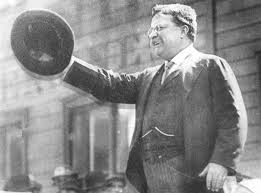
Former POTUS Theodore Roosevelt in 1912 – in Milwaukee.

TR: Ex-POTUS

When Theodore Roosevelt retired after seven-and-a-half years of the presidency, he was only fifty. Too young. Too vigorous. Too antsy. In a phrase, Too Theodore.

POTUS Wm. H. Taft

He had hand-picked his successor and good friend, William Howard Taft, to carry on his progressive Republican policies, but Taft was a jurist by profession and disposition – and politics was never his strong suit. The “Old Guard” Republicans, a very conservative bunch, were happy to see TR spend a year or more hunting big game in Africa, so they could revert to their old style and old ways and firm control. Will Taft, nice moderate fellow that he was, was no match for them.

Within two years of his ex-Presidency, Theodore had been inundated by complaints from his loyal followers: his progressive policies and ideas were systematically being dismantled.

Roosevelt, whose greatest political mistake (so say many) was “shooting himself in the foot” in November, 1904, when he was elected to a term of his own. As Vice President, he had come to the White House when popular William McKinley was assassinated only six months into his second term. Thus, on election night, TR formally announced (while his friends winced audibly) that he would not run for a “third term.” He kept his word, even though he quickly realized what a mistake it was.

John Flamming Schrank: Assassin-to-Be

By 1912, political assassinations had become all too common in the US. It has been suggested that presidential assassins are usually insane, at least in some way. Note “usually,” and not always. John Wilkes Booth had some political warping of his mind, but no one ever suggested insanity. Charles J. Guiteau, James Garfield’s assassin was a certifiable lunatic (no matter what the old history books claim). Leon Czolgosz, the man who assassinated McKinley was an anarchist, perhaps tainted with the same political warping that consumed Booth. In the case of Schrank, he was unquestionably insane.

John Flamming Schrank, the assassin

John Flamming Schrank was born in Bavaria, but emigrated to America when he was nine. His parents died shortly thereafter, and he was foster-raised by an aunt and uncle, a saloon keeper and owner of several properties in New York City. Schrank worked for his uncle for several years, and when he died, he was their heir, with a considerable inheritance. It was expected the young man would have a good start in life.

Losing his aunt and uncle hit Schrank hard. He became depressed, sold the properties, and drifted from place to place. He became extremely religious, and was known to wander around the city parks at night – but never causing any disturbance.

1912: A Pivotal Year

By 1912, with Republicans fraying at the political edges between the “Stand Pat” wing and the “Progressive” wing, most party members knew that there would be a battle – especially if Theodore Roosevelt was involved. He was.

With the backing of young, vigorous and forward-thinking Republicans, he stumped the country, and counted at least a dozen state governors in his corner. He challenged the voting electorate at the Republican nominating convention, but was denied a huge percentage of electors that he believed were his – fair and square. Calling the convention “rigged” he marched out with scores of followers, and formed the Progressive Party – nicknamed the Bull Moose Party, for posterity. They nominated Theodore Roosevelt by acclaim.

Meanwhile, with the Republicans split, the Democrats believed they could regain the White House after a twenty year gap, and kept their own infighting to a quiet minimum.

Schrank the Stalker

Schrank waiting to be arrested.

In 1912, TR was fifty-three and an indefatigable campaigner, traveling all around the country, shaking hands, kissing babies and making dozens of speeches.

In 1912, John Schrank was thirty-five, and had become decidedly peculiar. He was having strange dreams, insisting he was visited by the ghost/spirit of William McKinley, who wanted to be avenged by having Theodore Roosevelt killed. He wrote several accounts of these “visitations.”

For several weeks, Schrank followed TR’s campaign train from New Orleans all the way to Milwaukee, looking for his opportunity. With only a few old Rough Riders as “security escort”, and knowing he was personally popular, TR had no inkling that he was being stalked.

But on October 14, the newspapers reported that TR was dining at the Gilpatrick Hotel, and scheduled to speak afterwards at the Milwaukee Auditorium. Schrank was waiting. As Roosevelt left the Hotel, he entered an open car, whereupon Schrank pumped a bullet into his chest. It hit a steel eyeglass case, and a 50-page speech folded in half – before it entered the ex-President’s chest. TR stumbled, but regained his composure.

The bullet punctured TR’s metal eyeglass case…

The Next Two Hours

The Rough Rider escort, and other close associates immediately surrounded, wrestled and subdued Schrank.

…and went through a 50-page speech – folded in half!

One of them asked TR if he was all right. “He pinked me, Harry,” said TR. Then he coughed. As an experienced natural scientist, TR noticed there was no blood, and ascertained correctly that his lung had not been punctured.

He insisted the assailant be brought to him face to face. “Poor creature,” TR said, and ordered the crowd to hand the man over to the police – and “see there is no violence done to him.” Schrank was hustled into the hotel kitchen until the police came.

The bullet was never removed.

Meanwhile, TR insisted on continuing to the Auditorium and making his speech. He told the huge crowd they must be very quiet, since he could not speak loudly, You see, I have just been shot. But it takes more than that to kill a Bull Moose.”

The bloody shirt.

He went on to speak for an hour and a half, then opened his suit jacket to show everyone his blood-stained shirt. It was only then that he agreed to be taken to a hospital.

Epilogue:

TR’s doctors determined that it was too dangerous to remove the bullet. It remained in his chest till his death several years later.

John Schrank was never tried, but was declared insane and committed to a mental hospital where he remained until his death in 1943.

Sources:

Brands, H.W. – TR: The Last Romantic – Basic Books, 1977

Morris, Edmund – Colonel Roosevelt – Random House, 2010

https://www.theodorerooseveltcenter.org/Learn-About-TR/TR-Encyclopedia/Law-and-Justice/John-Flammang-Schrank.aspx

https://www.thoughtco.com/bull-moose-party-104836

https://www.history.com/news/shot-in-the-chest-100-years-ago-teddy-roosevelt-kept-on-talking


Posted in A POTUS-FLOTUS Blog, Nifty History People, Theodore Roosevelt | Tagged , , , , , , , , , , , , , , , , , | 1 Comment

Abigail Adams: On Virtue, Duty and Manners

Abigail Smith Adams was a Puritan born and raised.

Abigail Adams: Intellectual Puritan

Abigail Smith (1744-1818) was born to William Smith and Elizabeth Quincy of Weymouth, MA, a family peppered with Congregational clergy. Her father was a minister of solid repute, and also an educator with a fine library.

Church services and long sermons exhorting congregants to exemplary behavior, and pious thought and deeds through reason and morality, was part of her unquestioned upbringing. While Abigail was taught the domestic arts of cooking, sewing and housekeeping, it was not her strongest suit. She was intellectually inclined and a conceptual thinker. She relished difficult, thoughtful books on government and philosophy, on history and political theory. Perhaps most important, she treasured the precepts of moral behavior and a sense of upright duty.

John and Abigail Adams, Puritan parents.

At nineteen, she married John Adams, and for the next fifty-four years enjoyed a particularly happy and well-balanced union. He was fortunate with a wife whose knowledge and good judgment made her an intellectual companion. She was fortunate with a husband who appreciated her brilliance and encouraged her to speak her mind. They were cut from the same moral cloth.

Thus when it fell mostly to her, to raise their children, Abigail Adams believed it was her bound duty to raise/influence the younger generation according to the moral teachings of her own youth, including apropos quotations. She and John expected the highest virtue from them and lost no opportunity to guide – and chastise them as needed. They both may have been a little more chastising than understanding. But again, they were Puritans, and that is how Puritans behaved.

AA: The Maternal Correspondent

Young John Quincy Adams

Abigail and John were separated on and off for the better part of a decade. She remained home with the children while he was in Philadelphia, but when her husband was dispatched for diplomatic service in Europe in 1778, he took John Quincy, their ten-year-old son with him. In 1780, Abigail wrote to her brilliant twelve-year-old son, as she would an adult:

“I cannot fulfill the whole of my duty towards you…without reminding you of a failing which calls for a strict attention and watchfull [sic] care to correct. …You must curb that impetuosity of temper, for which I have frequently chid you, but which properly directed may be productive of great good. …  It will be expected of you, my son, that, as you are favored with superior advantages under the instructive eye of a tender parent, your improvement should bear some proportion to your advantages. Nothing is wanting with you but attention, diligence and steady application…. If you indulge yourself in the practise [sic] of any foible or vice in youth, it will gain strength with your years and become your conqueror…. you will not swerve from her dictates, but add justice, fortitude and every Manly Virtue which can adorn a good citizen, do Honour to your Country, and render your parents supreemly [sic] happy, particularly your ever affectionate Mother.”

Charles Adams disappointed his parents.

A year later, father and son returned home briefly. When they departed again, he took nine-year-old Charles along. The parting of Mother and son was hard, and Abigail obviously understood the differences between the intellect and maturity of her two young sons.  She wrote them both in early 1781:

“My dear sons … I fear you will think Mamma is unmindful of you if she does not write… I hope you are both well and very good children which is the best News I can possibly hear from you.” 

It was decidedly a letter to children (rather than the adult letter she wrote to 12-year-old John Quincy.) It was maternal and obviously loving. She mentioned the mild weather and asks how it is in Holland and if they learned to skate well. But invariably, she was always exhorting them to be “good.”

So did Thomas Boylston Adams

Thomas Boylston (1772-1832) barely knew his father, who was serving in Philadelphia’s Continental Congress when Tom was a baby. Then John left for a decade in Europe. By the time he returned as Vice President in 1789, Tom was at Harvard. In 1796, the young man left for Europe to serve as secretary to his brother John Quincy.

Always mindful of her duty, she wrote him: “As I consider it one of my chief Blessings to have Sons Worthy of the confidence of their Country So I hope in imitation of their Father they will serve it with honor and fidelity, and with consciences void of offense, and tho they may sometimes,{sic] meet with ingratitude, [sic] they will have, “The souls [sic] calm Sunshine and the Heart felt Joy.”

Abigail’s nephew William Shaw was brilliant – but an alcoholic like his cousins.

The ever-vigilant Abigail also believed it her duty to “lecture” her nephew, William Shaw, who at twenty-one became President John Adams’ secretary. He was a caustic, misanthropic fellow, brilliant, but a chronic alcoholic, like many in the Smith-Adams family.

“… it would be well for the Youth of our Country to attend with the veneration due to an oracle to the following eloquent observations of the late mr Burk [Edmund Burke] upon Manners –  ‘… Manners are what vex or sooth, [sic], corrupt or purify, exalt or debase, barbarism or refine by a constant, steady, uniform, insensible opperation [sic] like that of the air we breathe in. They give the whole form and contour to our Lives. According to their quality, they aid Morals, they supply them or they totally destroy them.”

Nevertheless, despite vigilant guiding or lecturing, Abigail’s four children did not always fare well. Only John Quincy rose to his parents’ exalted expectation (although he became “chastising” as well).

The Senior Adamses wound up providing a home for their son Charles’ wife and two daughters when he died from chronic alcoholism. They provided a home for two of their daughter Nabby’s children, when her husband proved improvident. Ditto a home for Abigail’s niece, the daughter of her alcoholic brother William. And eventually home for their alcoholic and improvident son Thomas, along with his wife and seven children.

Reads the letters of Abigail Adams. THey may be a little lecturing or chastising, but oh, the substance!

Sources:

Butterfield, L.H. (ed.) – The Book of Abigail and John – Harvard University Press, 1975

Levin, Phyllis Lee – Abigail Adams – St. Martin’s Press, 1987

Massachusetts Historical Society – Letters from Abigail to John Adams, 13-14 July, 1776

https://founders.archives.gov

https://www.biography.com/us-first-lady/abigail-adams


Posted in A POTUS-FLOTUS Blog, John Adams, John Quincy Adams | Tagged , , , , , , , , , , , , , , , | 1 Comment

Eleanor Roosevelt: The Bonus Army

In 1933, when Franklin and Eleanor Roosevelt became the First Family, the Great Depression was strangling the country.

The USA: 1933

After the stock market crash in October, 1929, it took some time for the economy to be seriously felt across the country. People were concerned of course, but the deep, deep troubles did not become readily apparent for several months.

Then people started losing jobs. Factories were closing. Mines were closing. Farmers, who already suffered for a decade, were failing badly, now hit by dust storms that decimated property. Unemployment was at an all-time high. Starvation threatened entire communities – literally.

The country had undergone economic troubles several times during the past century. People suffered and belts were tightened, but within a couple of years, it turned itself around.

This time was different. Belts were tightened and re-tightened. The Hoover Administration seemed paralyzed as they faced situations never seen before. There were strikes. There was violence. There was widespread unrest, with fears of anarchy and subversiveness.

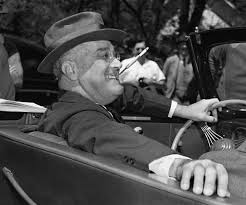
FDR in car

FDR and his cheery smile!

Hard times seek change, and a cheery Franklin Delano Roosevelt provided a confident grin to assure the country we could weather the storm.

He was easily elected in 1932.

The Bonus Army

Fifteen years earlier, as the United States reluctantly entered the Great War (as it was called prior to WWII), a million soldiers signed up to fight “over there.” Thousands never made it home. Tens of thousands had been permanently injured physically and/or mentally.

In 1924, a grateful Congress voted to grant the veterans a bonus of $500-650 (depending on service), redeemable in 1945, twenty five years after the end of the war. In 1932, $500 was enough to feed a family for a year – or more. Struggling veterans who had lost their jobs clamored to have that bonus redeemed immediately – when the need was so great.

The Bonus Marchers in Washington

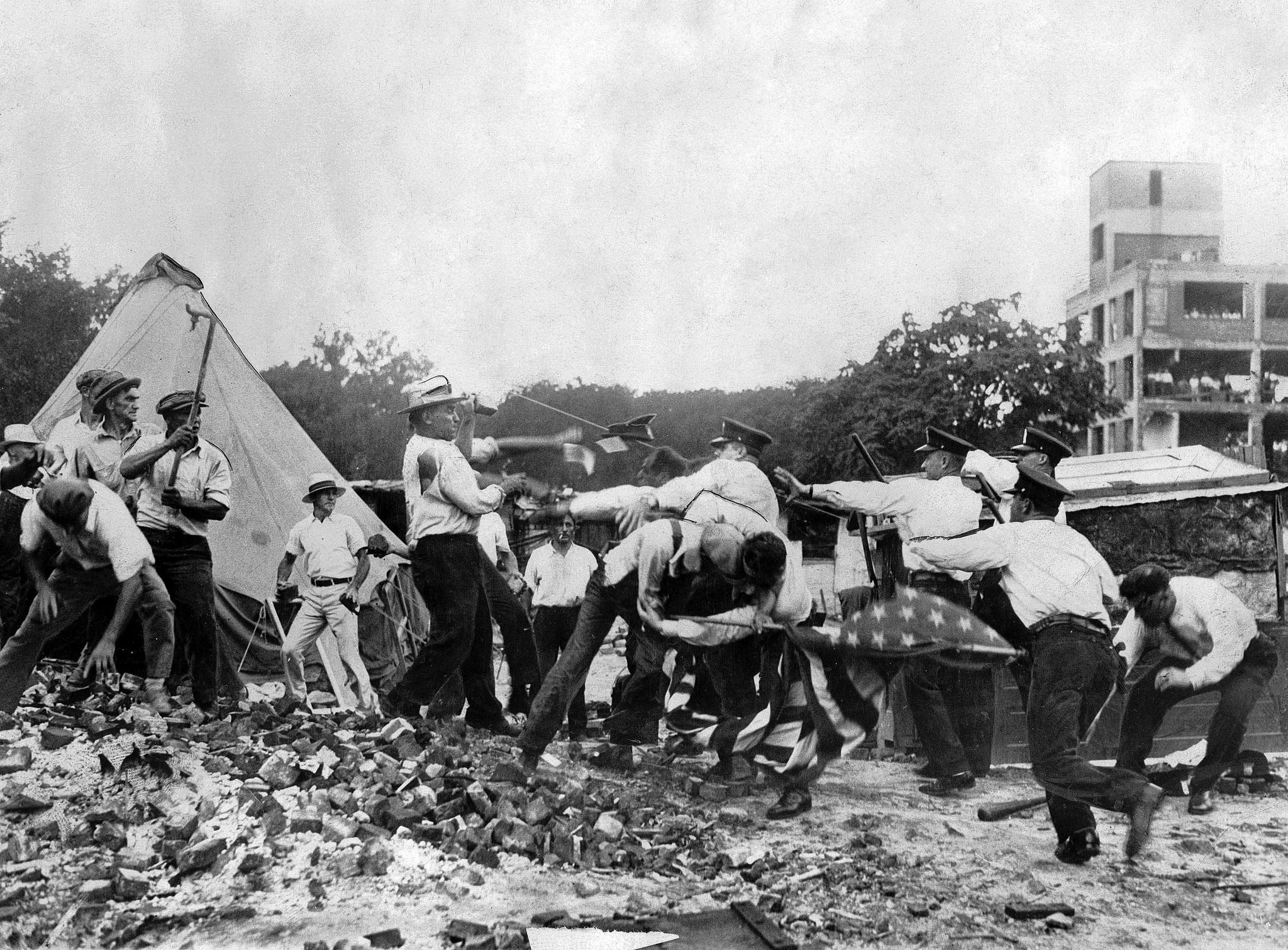
In 1932, more than 15,000 veterans, some with families, marched to Washington to demand those bonuses. Calling themselves the Bonus Army, or Bonus Marchers, they built a tent-city at Anacostia Flats, near the White House. President Hoover was personally sympathetic to their distress, but believing it to be a bad precedent, would not meet with them. A Congressional delegation did meet with them, debated the crisis in Congress, and passed an appropriation of around $2 billion.

The Senate rejected the demands since the country did not have that kind of money in the treasury.

As might be expected, some disturbances arose, along with suspicions that subversive interests were afoot. The military – with gas masks and tanks – was sent in to intervene and clear out the rabble, which only exacerbated the situation and left a very bad taste in everyone’s mouth. It also helped account for FDR’s overwhelming victory in November, 1932.

Mrs. FDR

Eleanor Roosevelt in her younger days.

Long before “social work” had become a profession, Eleanor Roosevelt (1884-1962) had been dedicated to helping where help was needed. As a young debutante, she volunteered at the settlement houses on New York’s Lower East Side. She loved being “useful.”

Once her children were of school age, she reactivated her socio-political interests, and joined numerous organizations where her growing political clout could be “useful.” As her husband’s focus during the 1920s was centered primarily on regaining his health, after contracting polio in 1921, it was Eleanor who kept the “Franklin Roosevelt name” in the public eye.

When FDR became Governor of New York, Eleanor was happily surprised when her husband encouraged her to be his eyes and ears. And legs. She traveled extensively, gathered fact-finding information, spoke publicly to a broad range of audiences, and was “useful.”

By the time FDR became President, Eleanor Roosevelt had found a niche – the only problem was how the country as a whole would perceive it. First Ladies were expected to be much more ladylike and not quite so “useful.”

Louis Howe and The Eleanor Visit

FDR didn’t have government money for the Bonus Army any more than Hoover did, nor did he wish to give them preference over thousands and thousands of other needy citizens, but he had perhaps a better personality. Instead of clearing them out with bayonets, he offered them jobs with the newly-created Civilian Conservation Corps. He also relocated them to a better site with decent sanitation and three meals a day. Most of the marchers went back home, but a few thousand stayed and were still bitter.

Louis Howe, indispensable friend and advisor to both Roosevelts.

Louis Howe was a New York newspaperman who first met FDR when the young patrician with a famous name was elected to the NY State Senate. Detecting latent greatness, Howe appointed himself his political “Jiminy Cricket,” and was his devoted aide for the rest of his life. FDR, detecting Howe’s own political brilliance and loyalty, was equally devoted. By the 1920s, with FDR fighting for his health, Howe began grooming and mentoring Eleanor, having detected her own considerable  – and useful – value.

Eleanor Roosevelt and the veterans.

Believing that a visit from Mrs. Roosevelt could be beneficial, The President and Howe looked to their best asset. Eleanor and Louis drove over to their camp, and he suggested she go in. Alone. Always happy to mingle freely with people, she wandered into their camp, oblivious to the mud on her shoes, and told the questioning ex-soldiers she “wanted to see how they were getting on.” She added that while she truly regretted that she could not help monetarily, she was sincerely interested in their welfare.

She stayed for an hour, toured their quarters and the makeshift hospital, and was happy to listen to their reminiscences, and sing Pack Up Your Troubles in Your Old Kit Bag and some of the other war songs that had become a part of everyone’s repertoire. She told them she would always be grateful to those who had served, and “hoped the country would never have to ask such service again.” The veterans then accompanied her back to the car, and waved as she drove off.

One veteran was reported to have said, “Hoover sent the troops, but Roosevelt sent his Missus.”

Sources:

Anthony, Carl Sferrazza – First Ladies 1789-1961, William Morrow,1990

Cook, Blanche Wiesen – Eleanor Roosevelt: Volume One 1884-1933 – Viking Press, 1992

Foster, Feather Schwartz – The First Ladies: An Intimate Portrait of the Women Who Shaped America – Sourcebooks, 2011

http://www.firstladies.org/biographies/firstladies.aspx?biography=33

https://blogs.weta.org/boundarystones/2014/09/08/eleanor-roosevelt-and-bonus-marchers

Posted in A POTUS-FLOTUS Blog, Franklin D. Roosevelt | Tagged , , , , , , , , , , , , , , , , , , , | 1 Comment

Tippecanoe and Lincoln: Coalitions

In 1804, the office of Vice President devolved into one of geopolitical accommodation.

Geopolitical Accommodation:

After the tie between Thomas Jefferson and Aaron Burr in the Presidential election of 1800, Aaron Burr became Vice President, according to the premise that the presidential runner-up would be VP.  A Constitutional Amendment was created shortly thereafter, mandating that voting for the office of VP would be separate from that of the President.

The office of VP was devalued with Aaron Burr.

Meanwhile, Burr proved to be a difficult and divisive Vice President, and the office would be devalued precipitously. There were instances when months and even years passed with no Vice President, a situation by the way, that would continue up till the time of Lyndon Johnson!

While the office of President was an important one, the office of VP became honorable, ceremonial, but a generally empty position. The only ameliorating factor seemed to be balancing the geography of the country, i.e. a North-South or East-West Presidential-Vice Presidential ticket. Or vice-versa.

The Rise of the Whigs

There is no mention of parties in the Constitution; our Founders were vehemently against them, believing them to be detrimental to the country’s well being.

But of course that is an impossibility. There will always be opposing opinions and politics. Parties began forming even before President George Washington retired. By the country’s 30th birthday, the old Federalist Party was on its last legs, and everyone was a Democratic-Republican. Problem was, many of the core Federalist issues, i.e. a strong national government, was being opposed by those favoring more power to the individual states. In a country growing in area and population, those differences and needs were readily apparent.

andrew jackson 1

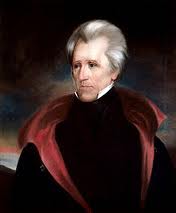
President Andrew Jackson

henry clay

Whig candidate Henry Clay

By the time of Andrew Jackson’s Presidency (1828-36), there was strong opposition to a) his various policies, and b) the divisive Jackson himself. The opposition was not cohesive, however; it was factional, and thus weak. Calling themselves the National Republicans (vs. the Democratic Republicans), Henry Clay, their standard bearer in 1832, Jackson’s most formidable opponent, was trounced.

In 1836, they adopted a new name: the Whigs. They were still a motley assortment of factions, and wound up running four regional candidates. Their rationale: they were sure to lose, and this way maybe they could find a future front runner to nominate. They did: William Henry Harrison.

“Tippecanoe and Tyler Too”

WH Harrison-2.jpg

POTUS Wm. Henry Harrison

In 1840, it appeared that other than Henry Clay (as divisive as Jackson), the best candidate for the Whigs was William Henry Harrison. Long in the tooth at 68, his best days were far behind him, and even at that, his claim to fame as General in the War of 1812 was limited to Indian skirmishing at Tippecanoe Creek – out West. More flamboyant than consequential. But he was in reasonably good health, came from a well-established family, and had no powerful enemies. He was born in Virginia, but lived for decades in the Ohio Territory.

john-tyler-color

VP-POTUS John Tyler


In a coalition effort to balance the ticket, Whig politicians chose a lifelong Democrat, Senator John Tyler of Virginia, whose conversion was primarily due to his disdain for Jacksonian politics and his willingness to call himself a Whig. The two men sat by as their supporters ran a hullabaloo campaign with a great slogan – and they won.

It says “Tyler” – but no portrait!

No one ever dreamed that a month later now-President William Henry Harrison would die. But he did, and VP Tyler assumed the office. He got on very poorly with his Whig supporters, reverted to his long-time Democratic principles, and since the Democrats no longer trusted him, became “a man without a party.” His 30-days-short-of-a-four-year term was fraught with difficulties, political and otherwise, and few friends or accomplishments. He was not even nominated for a term of his own. PS – There was no VP for nearly four years.

Tippecanoe….and Lincoln-Two:

President Lincoln

Abraham Lincoln

Abraham Lincoln, a long time Whig, converted to the Republican Party by 1856 and supported its first national candidate, John Charles Fremont. He lost, but his substantial showing boded well for subsequent victory. In 1860, Abraham Lincoln of Illinois was its candidate, and he won. As a geopolitical accommodation, the Republicans selected Maine Senator Hannibal Hamlin as Vice President. He was pleasant, but had very little to do. The office had been an empty suit for a half-century.

lincoln-johnson poster

Campaign poster from 1864

By 1864, the Civil War was on, and Lincoln’s reelection was far from certain. As a political maneuver, the Republicans didn’t even field a candidate. They merely changed their name to the Union Party, hoping to draw from disaffected Democrats as well as from disaffected Republicans.

Maine was a “safe” Union state. It was also small and relatively unimportant. Hannibal Hamlin was expendable. Lincoln needed someone with more political chops. He personally chose Andrew Johnson of Tennessee, a lifelong Democrat like Tyler, and an irascible-tempered man who was the only Southern Senator who did NOT resign his seat when his state seceded. Johnson was implacably a Union man, and did yeoman service in Tennessee as its Military Governor. By 1864, Tennessee was mostly in Union hands, and Lincoln needed its votes. Abraham Lincoln the Republican, and Andrew Johnson the Democrat, joined political forces and ran on the semi-coalition Union ticket. They won.

VP Andrew Johnson

Lincoln had aged and was definitely tired at his second inaugural in 1865, but he was only 56, and in generally good health. No one could have predicted that six weeks later, he would die from an assassin’s bullet. But he did.

VP Andrew Johnson now assumed the office. He got on very poorly with his Republican supporters, reverted mostly to his long-time Democratic principles and irascible temperament, and became “a man without a party.” His six-weeks-short-of-a-four-year term was fraught with difficulties, political and otherwise, and few accomplishments. He was impeached, barely escaped conviction, and was not nominated for a second term – by anybody. PS – the office of VP remained empty for nearly four years.

The Moral (if there is one): American coalitions have won elections, but the vagaries of history show that they have not been able to sustain them.

Sources:

Craypol, Edward P. – John Tyler: The Accidental President – UNC Press, 2006

Shafer, Ron G. – The Carnival Campaign: How the Rollicking 1840 Campaign of “Tippecanoe and Tyler Too” Changed Presidential Elections Forever –The Chicago Press, 2017

Waugh, John C. – Re-electing Lincoln (1864) – Crown Publishing, 1997

https://www.whitehouse.gov/about-the-white-house/presidents/john-tyler/

https://www.battlefields.org/learn/articles/election-1864


Posted in A POTUS-FLOTUS Blog, Abraham Lincoln, Andrew Johnson, John Tyler, Nifty History People, Thomas Jefferson, William Henry Harrison | Tagged , , , , , , , , , , , , , , , , , , , , , , , , , | 1 Comment

Dolley Madison: Some Evicted Evening

Dolley Madison’s reputation as the most popular First Lady is enshrined for all times…except

Washington: The Summer of 1814

Whether he wanted it or not, President James Madison found himself embroiled in the War of 1812, in essence, the “second” war of independence from Great Britain.  England had been committing serious outrages on American shipping, impressing American sailors, and a host of other “crimes” that were enraging the populace. Armies were raised and English soldiers were once again poised to reclaim their erstwhile colonies.

President James Madison

Two years after hostilities began, the “war” was still being fought, and was coming dangerously close to Washington City itself. Things did not bode well.

The decidedly un-warlike sixty-three-year-old President Madison believed it was his duty to follow the lead of George Washington, and assume personal command of the army. He mounted his horse, and rode off toward Baltimore, less than a hundred miles from Washington. 

Prior to that decision, he and his wife Dolley had taken precautions to protect the physical treasures of the White House. They packed the important documents (before the National Archives, those papers were entrusted to the President), as well as the silver and other items of value, and sent them to places of safety.


One of the earliest images of the  White House

Madison further instructed his wife to remain in the White House until further notice. Believing evacuation was indeed inevitable, they arranged to meet at a friend’s home, several miles away in Virginia – once he sent word. Then he left for Maryland.

Dolley Leaves the White House

From the time Dolley Madison first came to Washington in 1801, when the widowed Thomas Jefferson became President, she became its social leader. As wife of Secretary of State Madison, their house was open for luncheons, teas, receptions, dinners and suppers nearly every day. She had a naturally gregarious disposition and a warmth that assured hospitality to all guests. 

When she became First Lady in 1809, hosting was magnified several times over in the White House. All officialdom – as well as visitors to the capital city – were welcome at her Wednesday Evening Soirées. No invitations needed. Just come!

On August 24, 1814, the day after Madison left for Baltimore, a luncheon was scheduled at the White House. The table had been set; food had been prepared. Nevertheless the tone was ominous, and residents (official and otherwise) were vacating in droves. Several sent servants to the White House with “regrets;” they would not be able to attend lunch. Some of the Madisons’ close friends sent a carriage and driver, urging Mrs. M. to join them.

Meanwhile, a concerned (but never panicky) Dolley Madison ran up and down the stairs to the White House roof every hour, looking through her spyglass down the road to Baltimore, hoping to see either her husband – or his messenger. She had checked and re-checked all the valuables that could be carried away – including the painting of George Washington that had been cut from its fame and entrusted to some passing merchants from New York.

The famous portrait of George Washington by Gilbert Stuart.

Finally word came for Dolley to leave the White House, and proceed to their appointed meeting place. Her carriage and driver was waiting; her personal satchel was packed. They left. 

The White House in flames: 1814

Not long afterwards, British soldiers marched into Washington, and proceeded to torch the White House, and other federal buildings. En route, Dolley could look back and see red skies above a burning structure.

And The Rains Came

Providence, in the form of a hurricane (or at least a mega-storm) came later that day to quench the fire.

Having crossed the Potomac into Virginia, Dolley was spared the wrath or indignity of facing British soldiers – but not the wrath of God. The carriage and driver were pelted and soaked by the drenching rains, and nightfall impaired their view and bearings. They were lost.

The story continues (and there are several versions, by the way), that sometime later, as night had fallen, they spied a small farmhouse. Smoke from the chimney indicated it was occupied. Dolley’s soaking wet coachman knocked at the door and asked the woman if she might give some shelter to “his lady,” who was in the carriage. 

The rains came – hard and furiously!

The farmer’s wife agreed, and wet, tired, and likely disheveled Dolley was escorted inside, and invited to warm herself by the fire, and have a cup of  hot coffee. The grateful First Lady was happy to accept the hospitality. The two women spent a pleasant hour chatting away like old friends.

The Eviction of Dolley

After a time, the farmer’s wife introduced herself, and asked the name of her newfound friend. Dolley admitted that she was Mrs. Madison. “The Mrs. Madison that everyone is talking about?” asked the stunned farm wife. “I suppose so,” replied the FLOTUS.

The farmer’s wife became indignant. Obviously times had been tough for her, what with the war. She went on to complain vociferously that Mrs. Madison’s husband had HER husband out fighting instead of farming, leaving HER to muddle by the best she could – and she would not offer Mrs. Madison the hospitality of HER house!

She handed Dolley her wet cloak and sent her away. It is likely the only time that the popular Mrs. M. was asked to leave!

In due time, Dolley and her coachman found their way again and arrived at their “safe house,” to meet up with the President. It is said that when she told her husband of her run-in with the farmer’s wife, they both had a good laugh about it.

Sources:

Boller, Paul F., Jr. – Presidential Anecdotes, Oxford University Press, 1981

Gould, Lewis L. – American First Ladies: Their Lives and Their Legacy – Routledge Press, 1996

Moore, Virginia – The Madisons: A Biography, 1979, McGraw Hill

http://www.whitehouse.gov/about/presidents/jamesmadison

http://www.biography.com/people/dolley-madison-9394952

Posted in A POTUS-FLOTUS Blog, James Madison | Tagged , , , , , , , , , , , , , | 1 Comment

James Garfield’s Tea House

The last physical relic of President Garfield’s death in Long Branch, NJ

The Beleaguered President

President James Garfield

James A. Garfield (1831-81) was a surprise candidate in 1880, mostly due to the vicious political infighting among various factions of the Republican party. Despite having been the youngest Major General in the Union Army, and having served for seven terms as an Ohio Congressman, he was virtually unknown outside of Washington – or Ohio.

The election was a squeaker. Less than 10,000 votes separated the candidates.

With all the trauma and drama of a fractured party, poor POTUS Garfield spent his first three months trying to fill his cabinet posts and other senior political appointments. It wasn’t easy, generally rancorous and alien to Garfield’s more accommodating disposition. It was also coupled with his wife’s severe case of malaria, only six weeks into his term.

Many depictions were etched of Garfield’s assassination…

Thus on July 2, he was eagerly looking forward to a summer vacation in New England. He had earned the rest.

Within minutes of his arrival at the Washington train station, he was shot by an assassin. He was taken back to the White House, and never left his bed again.

The Long Branch Connection

By 1880, Long Branch, NJ had become one of the premier summer watering holes in the US – along with Saratoga Springs (NY) and Newport (RI). Located in central NJ, it was an easy commute to both Philadelphia and New York, and it attracted a host of wealthy business industrialists. By the late 1860s, the attraction was magnified a thousandfold when General (and President) Ulysses S. Grant became a summer resident. To cement the drawing card, magnificent Monmouth Racetrack was built. Grant, while never a serious gambler, was a great appreciator of fine horses!

…And many depictions etched of his sickroom.

Meanwhile, Garfield languished for several weeks that summer of ’81, as infection set in on the wound from the bullet in his side that no one could locate.

By the end of an especially hot August, and despite the exhortations of hope and prayer, the POTUS (who always maintained his reason) had no illusions about his prognosis. He was dying and knew it.

He wanted to return to his Ohio home near Lake Erie – and “see the old folks” again. In rare consensus among his truculent medical team, they absolutely forbade the move: too far (500 miles), over the Appalachian Mountains – and most of all, it would be excruciatingly painful.

First Lady Lucretia Garfield

It was Lucretia Garfield who suggested Long Branch. The Garfields had been before and enjoyed it. Moreover, she had spent a month there recuperating from malaria, and extolled the curative powers of the ocean breezes. It was a shorter trip (250 miles), and no mountains, ergo doable – and if nothing else, the President would be cooler and more comfortable.

An old postcard of the Francklyn Cottage.

Arrangements were made. The Pennsylvania Railroad was happy to put a special train at his disposal. Charles Francklyn generously made his opulent “cottage” available. Every consideration was given to making the trip as comfortable as possible.

When a rough, rutted road, nearly a mile long, separated the train station from the Francklyn cottage, the Pennsylvania Railroad sent a special crew-cum-equipment to build a spur track right down Lincoln Avenue to the cottage’s front door – overnight. The entire town turned out to help however they could.

(top) Garfield’s last days; (bottom) The train at the Francklyn Cottage.

Despite all, Garfield died twelve days later. The train holding his coffin, now draped in black crepe, retraced it way along the spur track, to make the long slow trip to Washington.

Then the track was torn up.

The Tea House Connection

The Tea House is the only physical link to Garfield’s death in Long Branch, NJ

Oliver Byron was a resident of Long Branch. He was also a stage actor on Broadway. He obviously did well enough to live and own property in affluent Long Branch. Not long after Garfield’s death, for reasons known only to himself, he purchased spikes and ties and planks as souvenirs.

Then he engaged a local carpenter named William Presley to build a small cabin (about 10’x10’) from the planks, and painted it red, white and blue. Brown was sometimes quoted as commenting that since President Garfield was born in a log cabin, it was a fitting tribute. He put a couple of small tables and chairs inside, and occasionally served tea and pastry to “customers” willing to pay a small fee.

When Byron died, he willed it to Presley, who in turn willed to his son, and his son after him.

As might be expected, it became a rundown, faded and weatherbeaten eyesore.

By the 1920s, the Francklyn house burned, but later, a very small commemorative stone plaque was placed on the site. Another building stands there now.

The little Elberon train station on Lincoln Avenue, which was linked by the spur track to the Franklyn cottage, is still there, but has been remodeled many times over. Long Branch itself has undergone major renovations in the past two decades.

But Garfield’s Tea House still exists.

The Church of the Presidents is undergoing massive restoration.

It has been repaired after years of weather and neglect, kept freshly painted, and is properly and respectfully installed on the property of one of the last relics of 19th century Long Branch – The Church of the Presidents, which is presently undergoing its own restorations.

James Garfield and his wife had attended services there, before his lingering demise. So did General and Mrs. Grant – and a few other presidential visitors.

Garfield’s Tea House has finally found a suitable and permanent home. You can go and see it, but alas, no tea or cake is available. Yet.

Sources:

Ackerman, Kenneth D. – The Dark Horse: The Surprise Election and Political Murder of President James A. Garfield. Carroll & Graf Publishers, 2003

Brown, E.E. The Life and Public Services of James A. Garfield, D. Lothrop & Company , 1881

Peskin, Allan. Garfield, The Kent State University Press, 1978

The Writers Project, WPA State of New Jersey – Entertaining A Nation: The Career of Long Branch – The American Guide Series, 1940

Posted in A POTUS-FLOTUS Blog, James Garfield, Presidential Sites | Tagged , , , , , , , , , , , , , , , , , , , , , | Leave a comment

Grace Coolidge and Helen Keller

First Lady Grace Coolidge and Helen Keller

Nearly 100 years ago, First Lady Grace Coolidge met a truly exceptional woman.

GC: Special Ed Teacher

Grace Goodhue Coolidge (1879-1957), a Vermont New Englander born to a middle class family, was the First FLOTUS who earned a full four-year college degree – from the University of Vermont in Burlington, where she graduated in 1901.

By the beginning of the 20th century, higher education for women was no longer the fringe issue it had been a generation earlier. Teaching, then as now, was one of the most popular (and socially acceptable) course of studies for women.

Grace Coolidge always maintained her interest in teaching the deaf.

Thus, by the time she graduated, Miss Grace Goodhue had opted to become a teacher, but had become interested in what today would be called “special-ed.” Perhaps influenced by Dr. Alexander Graham Bell, the inventor of the telephone, who had pioneered the cause of teaching the deaf, Grace was fascinated by its needs and challenges.

Grace Coolidge mastered American Sign Language.

Once graduated, she began working at the Clarke School for the Deaf in Northampton, Massachusetts.  The curriculum for the deaf at that time mostly focused on developing proficiency in American Sign Language. Young Miss G. had mastered ASL, and became a popular teacher – mostly for younger children. She maintained her skills and her interest in the deaf throughout her life.

Helen Keller, Inspiration

Helen Keller (1880-1968) was the same age as Grace Coolidge, an Alabama Southerner born to a middle-class family. Born healthy and particularly bright, by eighteen months she was toddling around exploring everything and could form dozens of words.

Then she became very very sick. Many modern sources believe it may have been a form of meningitis. She survived, but was left blind and deaf. Hers would be a permanently dark and silent world.

Helen Keller and her magnificent teacher, Anne Sullivan

Arthur and Katherine Keller were naturally devastated by the crushing blow to their little girl, and spared no expense trying to find ways to help her. It became obvious early on, that while her sight, sound and speech capabilities were destroyed, her brain remained intellectually intact. She could learn – if there were some way, and someone, who could penetrate her disabled senses.

When Helen was around six, the Kellers became aware of Laura Bridgman, a young girl similarly afflicted, but who had made prodigious strides to lead as normal a life as possible. Mr. Keller was determined to find a means to unlock his little girl’s potential. He took Helen to consult doctors or specialized schools that could provide direction. This included an introduction and visit to Dr. Bell, considered the foremost exponent and devoted advocate for the deaf.

One road led to another and another, until finally it led to Anne Sullivan, a young woman recently graduated from the Perkins Institute for the Blind in Massachusetts. Miss Sullivan came to Alabama, and began what would become a 50-year relationship with Helen Keller. It took several months as the patient “Teacher” tapped finger patterns into the little girl’s hand. Then there was the miracle breakthrough when Helen realized that those finger games were words – and words had meanings. The door to her bright and inquisitive mind had been unlocked.

She learned Braille. Now she could read. She learned to use a typewriter. Now she could communicate. By touch-sensing a person’s lips and breath, she learned to speak fairly intelligibly.

Helen Keller was Phi Beta Kappa at Radcliffe University.

Around the same time Grace Goodhue was attending the University of Vermont, Helen and her indispensable companion, Anne Sullivan, went to Radcliffe College in Massachusetts. She was the first blind-deaf student to earn a college degree – and was inducted into Phi Beta Kappa.

While in college, she wrote The Story of My Life. Her achievements and accomplishments made her famous. The book became a worldwide perennial best seller, reprinted in dozens of languages. Helen Keller would be on every “most admired woman” list for the rest of her long life – and she lived to be 88.

The iconic Miss Keller

Following her college education and her book publication, Helen became a star. She traveled extensively and lent her name and prestige to worthy causes from labor unions and woman suffrage to anti-militarism.

A Meeting of Consequence

The lovely Mrs. Coolidge

The rise of Calvin Coolidge, mediocre lawyer, Massachusetts politician and husband of Grace, was in many ways, a fluke. As Governor of Massachusetts (from the western part of the state) following WWI, he was thrust into prominence during a crippling Boston police strike. It earned him the VP spot on the Republican ticket in 1920. The unexpected death of President Warren Harding in 1923 made the unassuming Coolidges the most famous couple in the country.

The Coolidge time in the White House coincided with the Roaring Twenties and the rise of pop culture as we know it today. Throngs of newly minted celebrities – vaudeville stars, recording artists, moving picture actors, sports figures, etc., flocked to the White House to shake hands with the POTUS and FLOTUS – and maybe stay for lunch.

Helen Keller and President Coolidge

The much-regarded Helen Keller, now in her mid 40s (the same age as Grace Coolidge), was far better known, and when the opportunity arose for her to visit the White House, Mrs. C., a long time advocate for the deaf, was delighted to meet her.

Helen Keller touch-reads the First Lady’s lips

Helen placed her fingers on the FLOTUS’ lips as Grace spoke words of pleasant greeting. A short film (silent) was made of that occasion. https://dcmp.org/learn/521-helen-keller

If the two women kept in subsequent touch, it is unknown, but certainly not unlikely.

Helen Keller continued to make appearances, write articles and lend her name to a variety of causes for the rest of her long life.

And after her tenure in the White House, Grace Coolidge reactivated her association with the Clarke School and served on their Board of Trustees for the rest of her life.

Sources:

Anthony, Carl Sferrazza –First Ladies 1789-1961, William Morrow,1990

Wikander, Lawrence & Ferrell, Robert (eds) – Grace Coolidge, An Autobiography, 1992, High Plains

https://www.biography.com/activist/helen-keller

http://www.firstladies.org/biographies/firstladies.aspx?biography=31

https://dcmp.org/learn/521-helen-keller

Posted in A POTUS-FLOTUS Blog, Calvin Coolidge, Nifty History People | Tagged , , , , , , , , , , , , , , , , , , | 1 Comment

The Lincolns and the Showman

1862 was a horrible year for the Lincolns.

The Bludgeon Blow

The Sixteenth President

When he was elected President in 1860, Abraham Lincoln knew that the challenges ahead, as he put it, were “greater even than those of George Washington.” Problems abounded from the start, with seven states already seceded from the Union, and Fort Sumter already under siege when he took his oath of office on March 4, 1861.

First Lady Mary Lincoln

Mary Lincoln, the new FLOTUS, born and raised as a Kentucky belle, was well educated, cultured and a little snooty, believing herself well suited to leading the Washington social scene. But even before they entered the White House, Mrs. Lincoln was out-snooted by a group of Congressional wives who insinuated (at least to her) that she was “western” which they equated with low taste and sophistication. Then, of course, there were those who erroneously accused her of having southern sympathies.

Both Lincolns were navigating through very rough waters. Both muddled through their first year, with few triumphs and many headaches. But one thing they adamantly believed, was that the White House should still function as the strong executive nexus, both politically and socially.

Willie Lincoln died at only eleven.

Thus, in early February 1862, with the Civil war slogging away and casualties far more than anyone imagined, the Lincolns decided to host a gala affair. But coincidental to their plans, their sons Willie (11) and Tad (8) had taken ill with the usual childhood flus and fevers. The doctor assured the worried parents that the boys would recover. Tad did, but Willie developed typhoid fever and two weeks later, he died.

The bereaved Lincolns, particularly the emotionally fragile First Lady, never fully recovered.

Phineas T. Barnum: Showman

P.T. Barnum (1810-91), about the same age as Lincoln, was already a household word by the time Lincoln married in 1842.

Phineas T. Barnum, one of the great showmen of his time.

Early in his life, he discovered his unique genius for razzle-dazzle and showmanship, along with a world filled with “curiosities” that could be hyped into appearing even more curious. He was a whopping success, and owned a New York museum on Broadway that drew a half-million visitors.

Barnum and “General Tom Thumb” – one of his biggest attractions.

One of those curiosities was Charles Stratton (1838-83), a 3’8” little fellow, smart, personable, and in tune with Barnum’s philosophy of moneymaking. The impresario and star joined forces, and drawing upon an old English fairy tale called Tom Thumb, Barnum renamed his great attraction “General” Tom Thumb. The name-and-rank stuck and he was a hit from the start.

Possibly to keep the hype hyped, Barnum scoured the country, and discovered Lavinia Warren, a few years younger than “the General,” and about the same height. Nature took its course, and they fell in love.

General Tom Thumb and his bride Lavinia Warren.

By 1863, both were of marriageable age, and the pot-of-gold opportunities of a wedding between Barnum stars was much too good to ignore. This time, sheer publicity and hype were not necessary. The affections were real. Nevertheless, Barnum pulled out all the stops as well as his wallet.

An elaborate wedding was held in New York’s Grace Episcopal Church, and it is said that more than 2000 guests were invited. Barnum and Co. planned to go to Washington as part of a three-year honeymoon-cum-ballyhoo.

The Lincoln Connection

P.T. Barnum knew his business better than anyone, and could not resist the juxtaposition of miniature bride and groom and President Abraham Lincoln – all 6’4” of him. He contacted the President, whose sense of humor and good nature was already legendary. The POTUS was amenable to hosting a small post-wedding gathering. Nine-year-old Tad would certainly enjoy it, and it might be a pleasant respite for still grieving Mary Lincoln.

Mrs. Lincoln was not only willing to attend, but even selected a lovely fire screen to give to the newlyweds. It is also said that she shed her black mourning clothing that night and wore a pink silk gown for the occasion. Perhaps she did not wish to throw a pall on the happy couple.

The Problem With Robert

Robert Lincoln, the oldest Lincoln offspring, was not blessed with a sense of humor.

Robert Lincoln, the President’s oldest son, was nineteen in 1863, home on break from his studies at Harvard, and staying at the White House with his family.

Robert was (and always would be) a serious fellow of great reserve, who inherited little of either parents’ humorous inclinations. Perhaps, at nearly twenty and at Harvard, he may have been just a bit overimpressed by his sense of personal dignity.

Robert believed that this level of crass showmanship was far below the President and First Lady’s august position. He is generally quoted as saying, “No, Mother, I do not propose to assist in entertaining Tom Thumb. My notions, perhaps, are somewhat different than yours.” The President’s eldest son remained in his room.

The Reception

Tad Lincoln had a grand time!

Robert or no Robert, the President was delighted to play host, and treated the event with great courtliness. One attendee remarked on how graciously he bent down to shake hands with the “General,” and to lift the new Mrs. Stratton’s tiny hand to kiss it.

The guest list for this unusual event at the White House was impressive. Along with the family (sans Robert) and staff members, Treasury Secretary Salmon P. Chase and Secretary of the Navy Gideon Welles were in attendance. So was General Benjamin Butler (never known to have much humor either).

Mrs. Lincoln enjoyed herself, perhaps having that brief respite from melancholy that her husband hoped for. Lincoln enjoyed it. And Tad had a grand time!

And of course, Barnum reaped the benefit!

Sources:

Conroy,James B. – Lincoln’s White House: The People’s House in Wartime – Rowman and Littlefield, 2016

Donald, David Herbert – Lincoln – Simon and Schuster – 1996

https://www.saturdayeveningpost.com/2013/02/general-tom-thumb-marries-lavinia-warren/

https://www.historynet.com/abraham-lincoln-greets-general-mrs-tom-thumb.htm

East Room: Reception for General Tom Thumb

Posted in A POTUS-FLOTUS Blog, Abraham Lincoln, American Civil War, Nifty History People | Tagged , , , , , , , , , , , , , , , , , , , , , | Leave a comment

Harriet Lane’s Bracelet Story

Harriet Lane served as de facto First Lady for her bachelor Uncle, POTUS James Buchanan.

Little Orphan Harriet

James Buchanan was a brother among many sisters. Having received a solid education, he became a successful Pennsylvania attorney, elected to Congress at a young age, and rose in Democratic political circles. Since he never married, he became guardian or semi-guardian to several nieces and nephews, all of whom he treated generously and affectionately. 

But when his niece Harriet Lane (1830-1903) became completely orphaned at nine, she became not only his ward, but as near a daughter as he would ever have. He adored her, and she was devoted to “Nunc,” as she called him, for the rest of her life. 

Young Harriet (second from left) with President and Mrs. Polk – and Dolley Madison (far right).(LOC)

In her early teens, Harriet came to live with him in Washington, and attended the finest schools. She was a superb student, with a keen interest in the political scene. By her mid-teens, she had become a pretty, impeccably dressed and mannered young lady, accustomed to meeting and greeting politicians at the highest level.

Whether she was aware of it or not, she was being groomed for the role she would eventually play: consort/escort for a prominent figure. 

The Years Abroad

President Franklin Pierce appointed Buchanan to the Court of St. James

In 1852, James Buchanan was on the short list for the top spot, as he had been for the past three elections. Nevertheless, Franklin Pierce was elected President – a complete surprise to the country; Most people had never heard of him. A high-level position was definitely in the offing for Buchanan, a Pennsylvanian. He was definitely a Northerner, but many of his closest friends were Southerners.

Minister to the Court of Saint James was practically made for him. Independently comfortable, his appearance and manners were impeccable. His tact and political skills made him popular in England. When he brought Harriet Lane with him, she was around 23, attractive, educated and the perfect “escort” for her bachelor Uncle. 

The Queen had nice things to say about Miss Lane.

So popular was she, that both Queen Victoria and her consort, Prince Albert, were very much taken with her – and Her Majesty was sparing with compliments. 

The White House Years

The 1850s was an extremely turbulent time, with slavery literally tearing the US apart. Finding an “available” (i.e. electable) Democratic candidate in 1856 was a challenge.

Buchanan, well-known to officialdom, was a) from Pennsylvania, an anti-slavery Northern state; b) well-liked and regarded by most of his fellow Democrats, who also knew of his close ties with many Southern counterparts (i.e. he could be reasoned with.) But perhaps most importantly, he had been out of the country for four years – far from the fray and the fracturing. 

Harriet Lane was a popular White House hostess.

The Democrats could nominate the aging politician (he was 65) with a sigh of relief. Despite a surprisingly strong showing by John C. Fremont, the Republican first-time-ever nominee, Old Buck, as he was nicknamed, won easily.

Harriet Lane came to live with him in the White House, assuming the house management and social responsibilities traditional to the First Lady. It was not difficult for her; she had been trained for it. 

Prior to taking office, the President-elect discussed Harriet’s role with her. She would have complete charge of the place and the social scene. All her wants and needs would be provided – by him. He gave her a generous personal allowance, and indicated she could come to him for anything extra that she needed.

One caveat: “Other than the nominal bouquets or chocolates, do not accept any gifts, Miss Harriet. It would reflect badly on me.”

Harriet Lane was a close companion to her uncle, President Buchanan

Harriet duly promised, and expensive gifts – and even inexpensive trinkets – were declined graciously.

But Harriet was 26 in 1856, with an attractive appearance. Her wardrobe was stylish, and every new fashion innovation she espoused was immediately popularized. She was also considered a pleasant young woman, with many friends. Being the highly eligible niece of the President assured her of numerous suitors. 

The Picnic

One old story (repeated numerous times, by the way) tells of Augustus Schell, a wealthy young beau who came to the White House numerous times to court her.

One spring afternoon, he suggested a picnic along the banks of the Potomac……

It was a beautiful day, and they had a fine time. After their luncheon, they went for a stroll along the river bank, and Harriet spied a pretty colored pebble, and picked it up.  Some yards later, she saw another colored pebble, and began a small collection. By the end of their picnic, she had a half dozen or so pebbles in her hand.

When they returned to the White House, her smitten suitor begged Harriet to let him have the pebbles – as a souvenir of their lovely afternoon. She agreed, and handed over the little colored stones. 

A Few Weeks Later

“Nunc” said she could keep the bracelet.

Schell brought the stones to Tiffany’s, suggesting they might be made into a bracelet. The jeweler fashioned a suitable design: a slim gold chain, containing a half-dozen or so little colored pebbles – with a discreet diamond in between.

Some time later, her admirer returned to the White House with his “gift,” and begged Miss Lane to accept it. Harriet definitely liked the bracelet, but she had promised to decline gifts, and insisted she had to ask permission from her Uncle.

She explained to “Nunc” that the bracelet was merely pebbles found on the riverbank, and obviously of no real value. Buchanan acquiesced. So Harriet got to keep her bracelet. 

She conveniently had omitted the part about the little diamonds included – and years later was said to remark that “diamonds are pebbles, too.” 

Sources:

Caroli, Betty Boyd – First Ladies: An Intimate Look at How 38 Women Handled what may be the most Demanding, Unpaid, Unelected Job in America – Oxford University Press, 1995

Henneman, John Bell (ed.) The Sewanee Review Quarterly – Longmans, Green & Co. 1905

Pryor, Sara Agnes Rice – Reminiscences of Peace and War – The Macmillan Co. – 1905

https://www.hopecharter.org/~johncooper@prodigy.net/john-cooper/substitute-first-lady-harriet-lane

http://www.firstladies.org/biographies/firstladies.aspx?biography=16

Posted in A POTUS-FLOTUS Blog, Franklin Pierce, James Buchanan, Nifty History People | Tagged , , , , , , , , , , , , , , , , , , , | 1 Comment