Surgeon Joseph K. Barnes: Epic History

Surgeon Generals are seldom associated with mega-events.

The Surgeon General

More than 200 years ago, the US Army created the position of Surgeon General, the ranking doctor of public health. 

By the time of the US Civil War, the position was a conglomerate of administrative duties along with active medical care. The S.G. was the one consulted on a multitude of matters of importance to the army as a whole, and the physician in charge of signing off on a multitude of medical details. 

In actuality, while many people were aware of the office, very few knew the name of the officer himself. 

Dr. Joe: The CV

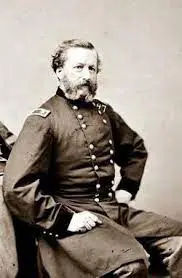
Joseph K. Barnes (1817-83) was a Pennsylvania fellow, born to a prosperous family happy to send their promising son to Harvard Medical School. Young Barnes withdrew for health reasons before graduation and returned to his family. Once recovered, he completed his studies at the University of Pennsylvania, joined the US Army, appointed assistant surgeon, and sent to Florida in 1840, where he served for two years in various locations.

Joseph K. Barnes, MD

Then he was sent to Louisiana, for four years – until the War With Mexico, where he served with both General Zachary Taylor and General Winfield Scott.

For the next twelve years, he was assigned to various posts, literally from sea to shining sea…Baltimore to San Francisco – and places in between. By the start of the Civil War, he was a Major, a full surgeon, and one of the highest ranking medical men in the Union Army.

Sent to Washington DC as the head medical officer in the capital, his introduction to Secretary of War Edwin M. Stanton was fortuitous. Stanton liked the young medical officer and promoted him to Lt. Colonel. Shortly afterwards, he was promoted to Colonel, and appointed Medical Inspector General. When the flinty Stanton had serious issues with his then-Surgeon General, he had him dismissed and Colonel-Dr. Joseph K. Barnes was appointed Surgeon General of the US Army in 1863. He was placed in charge of all the military hospitals, to include the military transport system and the medical boats.. He held the post for the next 18 years.

Barnes’ career would be punctuated by three sudden and monumental events.

The First Mega-Event

President Abraham Lincoln, his wife and their guests, had been enjoying an evening at Ford’s theater on April 14, 1865. A shot rang out, and within moments, the President was lying unconscious. A young doctor just graduated from his medical studies was the first to reach the stricken Lincoln and attended to the disaster, which included having him gently transported to the Peterson House across the street. The telegraph blazed the news immediately.

One of many period etchings of Lincoln’s death.

Of course Secretary of War Stanton was immediately alerted to both Lincoln’s assassination and the attempted murder of Secretary of State Seward. And naturally, Surgeon General Barnes was dispatched to the Peterson House as witness, consultant, and take-charge medical attendant to do whatever could be done. It was immediately determined that the wound was mortal and the President would not survive.

Four hours after Lincoln drew his last breath, an autopsy was performed, supervised by Surgeon General Barnes. Then he turned his attention to the wounds of Secretary Seward, and ministered to him, believing that he would recover.

With 24-hours of the assassination, it was discovered there had been a concerted plot against the senior Union political leaders, and the manhunt fanned out across several states.

The services for the slain President had barely been performed, and the long sad ride back to Springfield, IL had barely been completed, than the second mega event for Dr. Barnes came to pass.

The Secret Mega-Event

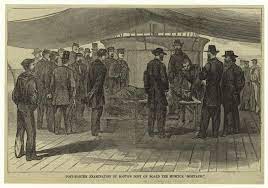
Less than three weeks after Lincoln was murdered, Dr. Barnes was instructed perform a secret autopsy aboard the steamship Montauk, which had just arrived at the Washington Navy Yard. The procedure would be under the most intense security.

The body itself was wrapped in blankets and practically unidentifiable. Gaunt, filthy, a bullet in his upper chest, a severely broken leg, and burns throughout. Dr. Frederick May, a Washington physician who had operated on the corpse two years prior was sent for, to provide positive identification. Maybe. Dr. May could barely identify the corpse. The man he had operated on earlier, removing a small tumor in his neck, was young, virile, in excellent health, and very handsome. But when the body was turned over, he recognized the scar from the surgery. It was distinctive, and undeniable.

John Wilkes Booth

The body was that of John Wilkes Booth, the prominent stage actor-turned-assassin. There would be no publicity for this autopsy, and scant information that the body was even retrieved. After the autopsy reports, the remains of Lincoln’s killer was buried in an unmarked grave on the grounds of the Old Penitentiary. Four years later, the Booth family had him buried in the Baltimore family plot.

The Pathetic Last Event

The Lincoln-Booth association guaranteed Surgeon General Joseph K. Barnes’ place in “footnote” history. Yet eighteen years later, he was once again called upon in what today is considered a medical travesty.

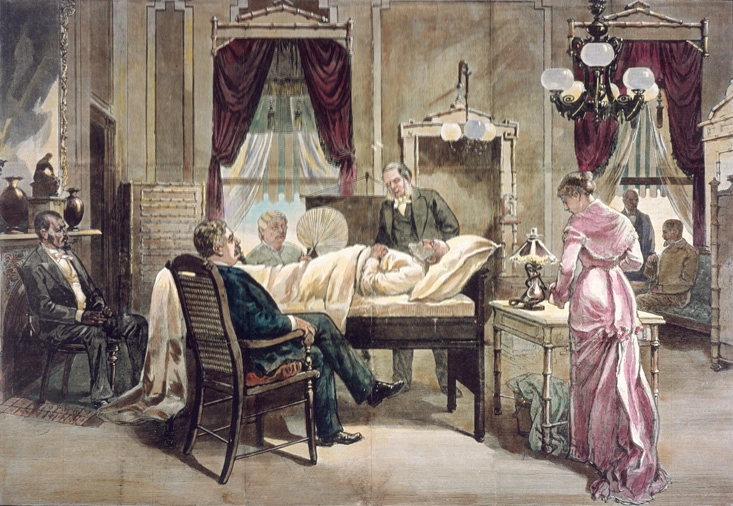
A period etching of the Garfield sick room.

In 1881, President James Garfield (1831-81), in office for only four months, was shot by an assassin. Charles Julius Guiteau, a certifiable lunatic and dissatisfied office seeker pumped two bullets into the body of the 49-year-old POTUS.

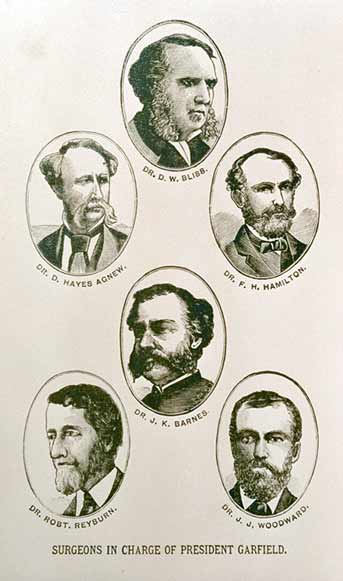
Garfield’s nomination, election, and brief presidency had been fraught with unceasing political turmoil, all within his own fractious Republican party. The pathetic part was manifold. Garfield did not die – right away. He lingered for ten weeks. Meanwhile the fractiousness of Republican politics paled in comparison with the fractiousness of Garfield’s “team of doctors.

Surgeon General Barnes was part of that team, although his role had been demoted to low-level responsibilities. Dr. Willard Bliss, a childhood acquaintance of the President, and once highly regarded Army surgeon during the Civil War, had become Physician-in-charge. A poor choice. His personal skills were domineering, rude and condescending to his colleagues. Their collective disregard of well-respected sanitary procedures invited infection.

Even the assassin asserted at his trial, that he merely shot at the President. “The doctors killed him.”

Sources:

Kenneth D. Ackerman. The Dark Horse: The Surprise Election and Political Murder of President James A. Garfield. Carroll & Graf Publishers, 2003

Pitch, Anthony K. – “They Have Killed Papa Dead!”: The Road to Ford’s Theatre, Abraham Lincoln’s Murder, and the Rage for Vengeance: Steerforth, 2009

Swanson, James L – Manhunt: The 12-Day Chase for Lincoln’s Killer – William Morrow, 2006

https://achh.army.mil/history/surgeongenerals-j-barnes

https://rogerjnorton.com/Lincoln83.html

Posted in A POTUS-FLOTUS Blog, Abraham Lincoln, American Civil War, James Garfield, Nifty History People | Tagged , , , , , , , , , , , , , , , , , | Leave a comment

Grant’s Tomb: A NY Icon

The Civil War could have been fought 3x over in the time it took for Grant’s Tomb to be erected.

We Love New York

Choosing New York City to be the site of Grant’s final resting place was not difficult. Grant was born and raised mostly in Ohio, but that location was never on his “eternity” agenda. Galena, IL, where he lived for less than a year, clamored for his earthly remains, but was so remote, and Illinois truly “belonged to Lincoln.” West Point was Grant’s natural preference, but there was a deal breaker: They would not accept women (then) and what mattered most to USG, was that his beloved wife Julia lay beside him forever.

New York was home to the Grants for the last five years of his life, and for the rest of hers. They loved living in New York, having the Vanderbilts as neighbors, with access to all the wonderments that make NYC the Big Apple – even then. In addition, despite the financial and medical heartbreaks that consumed Grant’s last year, New Yorkers had rallied to their beloved General with open arms. 

Within 24 hours of his death, the Mayor William Russell Grace sent letters to nearly 100 wealthy and prominent New Yorkers suggesting that a National Monument, i.e. final resting place be established, and invited them to a meeting a few days later.

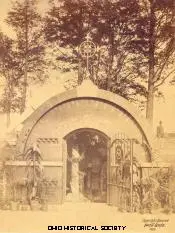
USG’s temporary vault in NYC.

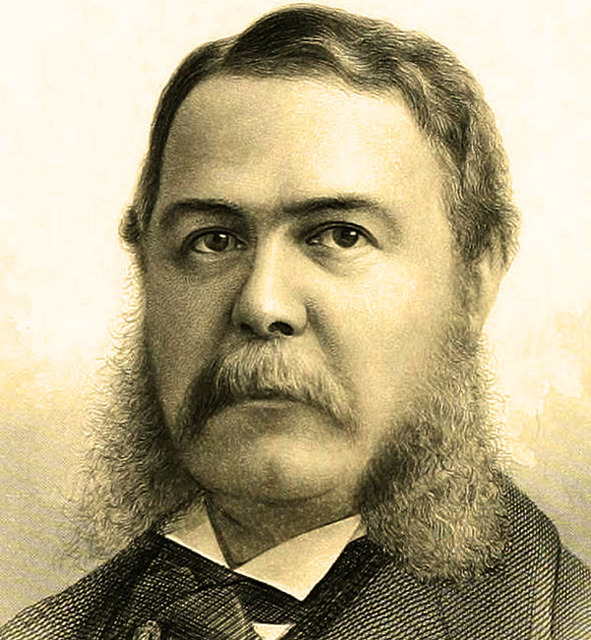
Eighty-five prominent New Yorkers attended that meeting, subscribed to the Grant Monument Association and elected former President Chester Alan Arthur, a New Yorker, to serve as chairman. Within 24-hours Western Union sent a check for $1000 to get the project rolling.

CAA: The first chairman.

Grant’s Tomb at a Snail’s Pace

Ex-President Arthur died within the year, and ex-NY Governor Alonzo Cornell assumed the responsibilities of leadership. Richard T. Greener was named as its Secretary. He had been the first Black graduate of Harvard University, and subsequently the first Dean of Howard University’s Law School. 

Richard T. Greener, GMA Secretary

Within the first year contributions were received amounting to around $100,000 – about 10% of their estimated goal. But there were no designs. No plans. Very little of anything “concrete.” People were grumbling, reluctant to sign on to something so nebulous. This was reflected the second year: only $10,000 dribbled in. 

Meanwhile, as with all projects then and now, there was the usual carping. People moaned about the choice of New York City – with its deep pockets and expected tourism. They wanted the General to spend eternity in Washington. So the gist was “you want it in New York, let New York pay for it.”

Mrs. G. knew her husband’s wishes.

Julia Grant (and the couple’s grown children), knowing of USG’s preferences, reiterated their desire to make New York their forever home. Julia added in a letter, that she planned to live in NYC for the rest of her days, and having his resting place nearby for frequent visits would be a comfort to her.

That helped.

But other than determining that Riverside Park was to be the site, years passed with still no real progress. The contributions were drying up.

Finally, nearly three years after Grant’s death, the committee held a worldwide competition for architectural firms to submit proposals and designs. The deadlines had to be revised three times. Sixty-five entries were received, two thirds of which were international. 

John H. Duncan: The Winning Architect

The committee winnowed the entries down to a sizeable five, and in 1890, five years after Grant’s death, John H. Duncan was finally selected to design the great structure. He had made his reputation in 1883, designing the Revolutionary War Centennial Monuments in Newburgh, NY. Money rolled in again, and eventually some 90,000 contributions were received.

According to David M. Kahn, a former curator of Grant’s Tomb, Duncan voiced his design’s objective: “to produce a monumental structure that should be unmistakably a tomb of military character,” the epitome of reverence and respect.  While the designs were based primarily on mausoleums from antiquity, it would have its own distinctive American style.

The 90’ square lower portion adorned with Doric columns, is capped by a cornice and parapet. The upper portion is crowned by a cupola 72′ in diameter, topped with a stepped pyramid. The completed structure in Riverside Park rises 280’ above the Hudson River. It was designed to be (and still is) the largest mausoleum in North America. 

Etched on the stone facade, are Grant’s words to the 1868 Republican nominating committee, and also the last words of Grant’s Memoirs: “Let Us Have Peace.”

So in 1890, with an architectural firm in place and designs submitted, budgeted and approved, the Grant Monument Association began to move forward. Ground was broken on April 27 (Grant’s birthday) 1891, and the cornerstone was laid by President Benjamin Harrison on April 27, 1892. 

The dedication ceremony featured a parade of 55,000, observed by an estimated 1 million, was held on April 27, 1897, Grant’s 75th birthday.

The mausoleum itself is a large, basically empty area, with murals of USG’s military achievements adorning the upper walls. Sculptures of his key aides were commissioned as part of Depression-Era WPA projects and inserted appropriately. 

The focal point however, is Grant’s sarcophagus – and the abutting matching one of his wife Julia, who died in 1902, and placed there shortly afterward.

The Roller Coaster of History

Ulysses S. Grant’s reputation, both as general and president, has yo-yoed drastically during the 140 since his death. For many years he was relegated to the bottom tier of Presidents, his failures outweighing his accomplishments. The tomb’s shameful neglect: disrepair, filth, weeds and trash reflected that disdain. There were rumors that the Grant descendants want him moved.

But during the past few decades, the importance and stature of General Grant has been reevaluated and resurrected. We are happy to note that Grant’s Tomb has had the substantial makeover it needed – and richly deserves.

Go see it. It’s free.

Sources:

Flood, Charles Bracelen – Grant’s Final Victory:  Ulysses S. Grant’s Heroic Last Year – 2012, DaCapo Press

Goldhurst, Richard – Many Are the Hearts – 1975, Reader’s Digest Press

Kahn, David (January 1980). General Grant National Memorial Historical Resource Study. Manhattan Cites

https://magazine.columbia.edu/article/battle-grants-tomb

https://www.nps.gov/places/mausoleum.htm

Posted in A POTUS-FLOTUS Blog, American Civil War, Nifty History People | Tagged , , , , , , , , , , , , , , , , , , , , , | Leave a comment

General Ike’s Last Mission

Former POTUS (and always General) Ike lived nearly a decade after his Presidency.

But The General’s Health…

…was not very good. He had suffered a few aches and pains and illnesses during his first six decades. But they were nothing out of the ordinary for a man his age, and with the great demands made upon him.

But at 62 when Dwight Eisenhower became President, his constitution had begun to slow down.

During his first term (1953-7), he suffered a serious heart attack while he was visiting his in-laws in Denver. In the middle of the night, complaining of some gastric discomfort, the doctor was summoned. (By this time, when a President traveled, his personal physician was always included in the accompanying party.)

Ike played down the seriousness of his issues.

It did not take long for Dr. Howard Snyder to diagnose the coronary attack. But Ike was conscious, and made the decision to downplay the incident, and keep the general knowledge from the general public.  The Cold War was going full blast, and any indication that the US POTUS might not be up to snuff was a more serious concern. Vice President Nixon was quietly summoned and apprised of the situation, and indeed assumed some responsibilities – without divulging the severity of the President’s condition.

Under doctor’s orders, Ike curtailed most of his activities for a sensible recuperation period. He recovered nicely. He ran for, and was elected to, a second term.

Not long thereafter, Ike suffered a painful bout of ileitis – a gastric condition, serious enough, but not associated with his previous heart attack. Now 65, he underwent surgery, and once again, recovered.

By the time he completed his second term, he was past 70. For twenty years, he had been at the pinnacle of influence and responsibility, and subject to a grueling pace of activity.

He deserved his retirement.

The Happy Place

Ike and Mamie Eisenhower came late to home ownership. From the time they began married life in 1916, they had Army housing. Usually modest. As he rose in rank, housing was appropriate to his leadership. It was not until they were about to move into the White House (another USA-subsidized residence) that they bought their first and only home: an old farm in Gettysburg, PA, only minutes from the great battlefield. The house needed work, as did the grounds, but by 1952, Ike was not only the highest military commander, but had written a best selling memoir of his war years. Money was no longer a prime concern.

They fixed it up a la Eisenhower.

Ike and Mamie loved their home, and throughout their White House years, Mrs. Ike made numerous trips to furnish and decorate the place they would spend the rest of their days. They even had a chip-and-putt area built for Ike’s golf enjoyment. He had is own golf cart, and had special “General Ike” golf balls made by the dozens. Some for play – but mostly as souvenirs for his guests.

As POTUS, they entertained at Gettysburg whenever “informal” enjoyment was apropos. Their guests were the cream of world leadership: Sir Winston Churchill, French President Charles De Gaulle, Field Marshall Bernard Montgomery and Soviet Premier Nikita Khrushchev. They also hosted three future Presidents: Richard Nixon, Gerald Ford and Ronald Reagan. Periodically they invited staff members.

Churchill
De Gaulle
Montgomery
Khrushchev

In 1961, they embarked on a retirement of relaxation and freedom from the stresses and responsibilities of decades, enjoying light suppers-for-two on tray tables while they watched television on their sun porch.

The Library

By the time Ike retired, building a Presidential Library had become an agenda item for ex-Presidents (and still is). Ike chose Abilene KS as the site, not far from the childhood home he always remembered with fondness.

And, like retired POTUSES, he was actively involved in its construction and content. He made several trips out to Abilene during the 1960s to check on the progress.

As President, he had made plans for his death and funeral during his very first days in office. Now, a decade later, he revised those plans, and arranged the special permissions necessary in order for him and Mamie to be buried on the Library grounds.

The Eisenhower Library & Museum

The Last, Secret Mission

But as the decade passed, Ike was visibly aging, and his health was not as robust as he might like. He also knew it. The doctors pulled no punches. His heart was failing.

One day in 1967, Dwight Eisenhower and his brother Milton charted a private plane and flew to Denver. He had told no one – not even Mamie – of his plans. He had made quiet arrangements for the coffin containing his son Doud Dwight, nicknamed Icky, to be exhumed after nearly a half century. Icky was only three and a half when he died of scarlet fever.

Their first-born son

His death happened quickly, and the little boy was buried in the family plot belonging to his in-laws. Ike and Mamie were devastated. Even though a second son, named John was born a short time later, the memory of Icky was never from Ike’s heart and mind.

His intimates knew it was his greatest tragedy. Now, with the Library consuming his time, and his knowledge that his own death was nearing, Ike’s thoughts were to reunite his little son with his parents. For eternity.

The coffin with Icky’s remains were brought to the Eisenhower Library in Abilene, and placed in a vault to await proper burial at a time to be determined.

Icky rests between his parents.

The Last Year

Ike’s health declined steadily during his last two years. There were several heart attacks. He was growing weaker. He voluntarily checked into Walter Reed Hospital in Washington, and spent his last year as a patient-resident. Mamie moved into a small suite down the hall, where she could visit daily.

He lived to see his former Vice President Richard Nixon elected as President in his own right. He was pleased. He was delighted, however, when his grandson David married Julie Nixon, the daughter of the new President-elect.

When Ike died and was buried at his Library, Icky’s small coffin was place beside it – waiting for Mamie’s coffin. She was interred there ten years later.

Sources:

Gellman, Irwin F. – The President and the Apprentice: Eisenhower and Nixon, 1952-1961 – Yale University Press, 2015

Gilbert, Robert E. – The Mortal Presidency: Illness and Anguish In the White House – Basic Books, 1992

Eisenhower, Susan – Mrs. Ike: Memories and Reflections on the Life of Mamie Eisenhower – Farrar, Straus and Giraux – 1996

Lester, David and Lester, Irene – Ike and Mamie – G.P. Putnam, 1981

https://millercenter.org/president/eisenhower/impact-and-legacy

https://www.gettysburgfoundation.org/eisenhower-national-historic-site

https://www.eisenhowerlibrary.gov/eisenhowers/post-presidential-years

Posted in A POTUS-FLOTUS Blog, Dwight D. Eisenhower, Nifty History People | Tagged , , , , , , , , , , , , , , , , , , , , , , , , , , | Leave a comment

Julia Grant’s Bad Hat Story

This is another Julia story, told in her memoirs.

Julia, The Plain Child

Julia Dent (1826-1902) was the fourth of eight children (one died in infancy) born to Frederick W. Dent and Ellen Bray Wrenshall. Four boys and four girls. In that order. Colonel Dent (an honorary title) was Pennsylvania born, but had migrated to St. Louis, MO as a young man. He became a merchant, bought property, married and raised a family.

Young Julia Dent Grant

Julia Boggs Dent was the eldest daughter. Growing up with four older brothers practically assured a tomboy upbringing, which she readily admitted throughout her life. She rode well, climbed trees, swam, ran races and enjoy the outdoors. 

She was also what was usually called, “plain.” She had mousy-colored hair, an average body build that promised stoutness with motherhood and age, along with an eye condition medically called strabismus, more commonly called cross-eyed. While it is routinely corrected in early childhood today, there were no remedies in the 1820s. 

Nevertheless, Julia had a warm disposition, and was never at a loss for friends and companions. That included beaux, once she reached the age when beaux were permitted. 

The Steady Beaux

Young Lt. Grant

When she graduated from finishing school in St. Louis, she returned to her family’s modest plantation outside of town. There she met Second Lt. Ulysses S. Grant, a West Point classmate and good friend of her brother. Grant was assigned to Jefferson Barracks, not far from the Dent home, and called on his friend’s parents as a courtesy. They liked him, insisting that he “not be a stranger.” 

The attraction between the 21-year-old Grant and 18-year-old Miss Dent was immediate. Grant was shy with the ladies, but Julia was someone he could talk to easily. He began visiting often to take Julia riding. Or walking, or picnicking, or just sitting on the front porch. Within a few months, he was reassigned – and in love. Reluctant to leave her, he proposed marriage.

The young couple decided to become engaged – in secret. They corresponded and waited for four years, separated by the War with Mexico before the brevet Captain Grant was reunited with his now-22-year-old fiancé.

The Unfashionable Mrs. Grant

The young mother

With the exception of having “the most beautiful wedding dress I ever saw,” a gift from a family member in St. Louis who was happy to mentor the teenaged Julia and expose her to the best St. Louis had to offer, Julia was never a follower of fashion. She was an Army wife. They moved around. 

Two years later, USG was assigned to the California-Oregon territories, and spent two lonely and miserable years that culminated in his resignation in disgrace. Back in St. Louis, the family Grant fell on hard times. For the better part of six years, he could not find work. His efforts in farming were unsuccessful. And with four small children, fashion and style were not part of Julia’s needs. She wore what she already had.

Hats

For centuries, head coverings of some kind were essential to a woman’s wardrobe. In the 19th century, no woman, rich, poor or anywhere in the middle, would think of leaving her home without a hat any more than she would leave without shoes. The styles changed often enough, but the premise was the same. You wore a hat.

Bonnets: brims and fancy ties

In the mid-19th century, “bonnets” became the dominant millinery style for decades. Whether various types of cloth or straw, BONNETS fit snugly around the woman’s head and tied under the chin. It usually featured a brim which framed the wearer’s face. Most women of reasonable means had several bonnets.

Better Times

Only months before Lincoln’s election in 1860, ex-Captain Grant moved with his young family to Galena, IL, to take a clerical position in one of his father’s tanneries. It was a job he had detested from his youth, but he was desperate.

General and Mrs. Grant

After the fall of Ft. Sumter in April, 1861, the Civil War began in earnest. Trained and experienced army officers were urgently needed. It was no secret in Galena that the tannery clerk was West Point trained and had fought in Mexico. He was the only citizen of Galena with military expertise. He was asked to train the dozens of young men eager to join the army. The ex-Captain agreed to his voluntary role, applied for reinstatement, and (it is said) never set foot in the tannery again.

Reinstated as a Colonel and quickly promoted to Brigadier General, he now had an officer’s pay to support his family.

Julia was instructed to pack up, take the children, and be prepared to go wherever USG directed. He wanted his family close by. For the next four years, according to Julia, “she was Penelope following her Ulysses,” staying with family or friends, in hotels or boarding houses, and frequently in camp with her husband.

The Bad Hat

Early in the war, Mrs. General Grant found herself in need of a new winter bonnet. Accordingly, she and a cousin went shopping in Cincinnati, right on the Ohio-Kentucky border – with a fair percentage of Confederate supporters.

Julia found a charming bonnet. It was nut brown, with red and white rosettes in cut velvet. It was within her budget. She bought it.

A typical CSA cockade

But the first time she wore it, she noticed passers-by snickering or staring at her. It made her uncomfortable.

What she didn’t know was that in 1861-2, nut brown with red and white cockades was a tacit symbol for Southern sympathizing women to show their support. Julia was indeed naive, but immediately realized that the wife of a UNION GENERAL could not be seen wearing a bonnet indicating favor to their enemies. Bad. Very bad.

Julia was mortified, and took her shopping companion to task for not advising her of the situation, but was countered with, “but I thought you knew….” They all say that.

Julia never wore that hat again.

Later…

When the Widow Grant was in her seventies, she penned her own memoir. It was never published, and indeed was buried in a trunk in a granddaughter’s attic. It finally was discovered and published – in 1975 – nearly 75 years after her death. She told this “embarrassing story” in that memoir.

She did not have to tell it. It happened some 35 years after it occurred. Nobody would have known. Or cared. That she opted to do so is very telling about Julia. She was confident enough in her own self to allow her oops moment to be made public. And you like her all the better for it.

Sources:

Foster, Feather Schwartz – Mary Lincoln’s Flannel Pajamas and Other Stories from the First Ladies’ Closet – Koehler Publishing, 2016

Grant, Julia Dent, (Simon, John Y. Ed.) – The Personal Memoirs of Julia Dent Grant – G.P. Putnam’s Sons, 1975

Ross, Ishbel – The General’s Wife – Dodd, Mead, 1959

Posted in A POTUS-FLOTUS Blog, American Civil War, Nifty History People, Ulysses S. Grant | Tagged , , , , , , , , , , , , , , , | 1 Comment

Andrew Johnson: The Kirkwood Inaugural

Andrew Johnson is one of the most unlikely US Presidents

The Unlikely POTUS

Beginning with Andrew Jackson in 1828, and into the 20th century, the White House was the home of some of the most unlikely men who ever rose to the office of President.

With rare exception, they came from undistinguished families; certainly far from wealthy, and in several cases, downright poor. Most of them had limited resources other than their own natural abilities and talents – and an intense desire to better their lot. And luck.

Andrew Johnson (1808-1875) would arguably be at the bottom of the barrel in a list of unlikely-undistinguished. His parents were uneducated menial servants in a tavern. His father died when Andrew was two. His mother remarried a man just as poor and uneducated as her first husband. In his youth, Andrew and his older brother were apprenticed out to a tailor as a kindness: it would provide the boys with food and lodging, and the opportunity to learn a trade to make their own ways in the world. 

Andrew Johnson

Andrew did become a tailor, considered a fine craftsman. He married at eighteen, opened a shop in working-class Greenville TN, made men’s suits and coats, and with his wife’s help, learned to read, write and cipher. By his early twenties, he attended town meetings and rose quickly in local politics. He remained in public life for the next 35 years. 

He held local and state offices before being elected to Congress. Then Governor of TN. And then to the Senate.

Andrew Johnson had done very well for such an impoverished beginning.

Andrew Johnson: The Civil War

By the onset of the Civil War in 1861, Andrew Johnson had been in Congress for nearly two decades. He was well known in its small universe of politicians. But while his peers acknowledged his daunting circumstances, he had few close friends. His personality was truculent and suspicious: more inclined to fight it out than to compromise and solve problems. 

Nevertheless, as the only Senator who did not resign his seat when his state seceded, he provided yeoman service to President Abraham Lincoln during his first term. Eventually AJ was appointed Military Governor of Tennessee, a position challenged by serious physical danger to himself and his family. 

No Republicans that year…

Those efforts led to his nomination as Vice President in 1864. The war had gone so badly for the Union, that the Republican Party used a nom de guerre, and called itself the Union party. Lincoln personally wanted Johnson. A repatriated Tennessee was important; ever loyal little Maine (home of VP Hannibal Hamlin) was expendable. 

Unfortunately for Andrew Johnson, his inauguration as VP was tainted. He had been ill and left a sick bed to come to the inaugural. The doctor, suspecting typhoid, had prescribed strong whiskey to avert chill, and the outcome became a scandal….

April 14-15, 1865

Andrew Johnson, Vice President for about six weeks, had taken up solitary residence at the Kirkwood House in Washington. His invalid wife and 11-year-old son had not yet moved to the capital. 

The recently renovated Kirkwood House

At 11 p.m. the night of Friday, April 14, Johnson was in bed in his rooms, awakened by a loud banging on his door. When the sleepy VP opened the door, he saw Leonard J. Farwell, the former Governor of Wisconsin and personal friend of Johnson. He was visibly agitated as he blurted out the news he had just heard: President Lincoln had been shot in Ford’s Theater, and was fighting for his life. 

Within the hour, Johnson had dressed. Soldiers to guard the VP had arrived, and they made their way over to the Peterson House where the dying Lincoln had been taken. He paid his brief respects to the various dignitaries who attended the vigil. Realizing that his presence was pointless, and perhaps easily misconstrued, he returned to his hotel.

Secretary of War Edwin Stanton had quietly informed him of the sketchy events that had taken place just hours earlier, indicating a conspiracy of some kind. Secretary of State William Seward had also been violently attacked and was near death.

At that point however, there had been no substantial indication that VP Andrew Johnson himself had been targeted for assassination in his rooms at the Kirkwood House. That would come within hours.

One of many artistic impressions.

By 8 a.m. Johnson received a note from Attorney General James Speed and signed by all the cabinet members (except the wounded Secretary of State Seward) informing him of Lincoln’s death, urging that he take the oath of office as soon as possible. Andrew Johnson agreed: 11 o’clock that morning at the Kirkwood House. 

I, Andrew Johnson….

Chief Justice Salmon P. Chase (former Secretary of the Treasury) was summoned to administer the oath. 

The Chief Justice

Joining him to witness the traumatic and monumental event was a small group of notables. Treasury Secretary Hugh McCullough, Attorney General James Speed, Francis P. Blair, Montgomery Blair, Sen. Solomon Foot (VT), Sen. Richard Yates (IL), Sen. Alexander Ramsey (MN), Sen. Wm. Morris Stewart  (NV), and Sen. John P. Hale (NH).

The ceremony, performed by the Chief Justice and the new President, was administered quickly, and Andrew Johnson made a brief speech. In it, he remarked, “…The best energies of my life have been spent in endeavoring to establish and perpetuate the principles of free government…The duties have been mine — the consequences are God’s. This has been the foundation of my political creed….”

Following solemn handshakes and sincere well wishing, the group departed. No fanfare. No parades. No banquets. Just overwhelming sorrow.

Sources:

Pitch, Anthony K. – “They Have Killed Papa Dead!”: The Road to Ford’s Theatre, Abraham Lincoln’s Murder, and the Rage for Vengeance: Steerforth, 2009

Trefousse, Hans L. – Andrew Johnson: A Biography – W.W. Norton, 1989

Hotels and Other Public Buildings: Kirkwood House

Posted in A POTUS-FLOTUS Blog, Abraham Lincoln, American Civil War, Andrew Johnson, Nifty History People | Tagged , , , , , , , , , , , , , , , , , , , | 1 Comment

The Booths: Collateral Damage

Lincoln’s assassin John Wilkes Booth sullied the family name.

The Booth Brothers

While Junius Brutus Booth Sr., the patriarch of the illustrious acting family had long been dead, three of his sons reached genuine stardom in the days preceding the Lincoln assassination.

Junius Brutus, Jr. (the eldest) was considerably older than his younger thespian brothers, (at least three in-between siblings had died as children). He was considered a fine actor, had enjoyed some success, but gravitated to the “business management” side of theater. He had gone west in his youth, and mostly stayed there. 

Junius Brutus, Jr.
Edwin Booth

Edwin was more than a decade younger, and considered the finest actor in the family. He reached success early, traveled and performed extensively, and by 1865, at 35, was the foremost Shakespearean tragedian in the country. He resided in New York City, and was a co-manager of the Winter Garden Theater. 

John Wilkes, the third surviving son, was by far the handsomest. Virile and athletic, he possessed the family gift of quick study and memorizing lines. He was devoted to his mother Mary Ann, and his sister Asia. 

JWB had boyhood friends, a reasonably good education, and like his brothers, gravitated to the stage early. But his acting was more physical, with sword fights and huge leaps and acrobatics. His colleagues smiled at the failings of his youth, but recognized his talents and expected him to mature with age. 

In 1864, the three Booth brothers performed onstage together for their first and only time: a single performance of Julius Caesar in New York. It was a benefit to raise money for a statue of Shakespeare in Central Park. It sold out. 

The Booth Brothers

An Important Political Aside 

When Abraham Lincoln became President in 1861, Maryland was a slave holding state, with a fair percentage of Confederate leaning citizens. Lincoln took immense care to keep them in the Union.

The Booths were ardent Unionists, and Lincoln supporters.

How and why young John Wilkes became obsessed by his southern sympathies and slavery is a subject for another time. But his passions were high and they escalated. The only “condition” he agreed to (supposedly) was promising his mother NOT to join the Confederate Army.

The Assassination and Its Aftermath: Short Version

Even as Lincoln breathed his last, John Wilkes Booth was identified as the assailant by many who were present at Ford’s Theater. Within hours, a conspiracy to assassinate other government leaders had become known.

The telegraph blazed the news across the country. By morning nearly every city-dweller in the country had learned of the horrific deed, whether by wire, newspaper or word of mouth. Throughout the east coast, police were alerted to activate all resources. 

Booth had escaped, as had some of his fellow conspirators. In two weeks, he would be dead. Others would be arrested. Many more were questioned and interrogated.

The Tragedy of Being Booth

John Wilkes Booth was well known, and scores of people knew him intimately. Secretary of War Edwin Stanton had taken charge of the manhunt immediately, and left few stones unturned. 

Sec. of War Stanton was relentless.

Some of those stones led to the Booth family of Maryland – and elsewhere. They were all horrified that their brother – black sheepish though he might have been – was capable of such a deed. 

Just days befor, JWB had committed himself to assassination and knew he might be on the run – or dead. He wrote affectionate letters to his mother and his sister Asia.

Edwin Booth, the “star” of the family, was living and performing in New York City the night of the assassination. The next morning, the theater manager told him the news, and that the theater was closed indefinitely. He suggested that Edwin Booth seclude himself.

He was devastated, and fell into a deep depression for several months. He had voted for Lincoln, and was a patriotic Unionist. His ties with JWB had always been cordial, and he could barely believe that his brother was responsible for such a heinous deed. It was also a blow to their profession. The actor was convinced he would never perform onstage again. It was nearly a year before he could he show his face publicly and resurrect his career.

Junius Brutus Booth, Jr. had been performing in Cincinnati the night of the assassination. He also learned of the deed the next morning, and secluded himself in his hotel room for three days before taking a night train to Philadelphia. Only a few months earlier, he saw JWB for the first time in ten years and had counseled him against joining the secessionists. Pleasant correspondence followed, and only two days before the assassination, Junius wrote a hurried note to JWB, hoping they might see each other in New York.

More Tragedy…

Mary Ann Booth had been in New York with her son Edwin on the night of the assassination. The following day, she was summoned to Philadelphia where her devastated daughter Asia and her husband John Clarke were living.

Mary Ann Booth

Later that night, Asia remembered that when she last saw her brother, he had given her a packet, saying “if anything should happen to me, open the packet alone, and send the enclosures as directed…” They carefully placed the packet in a locked safe.

Asia opened the packet – alone. She kept the envelope with her name on it, and gave her husband the rest of the correspondence, which included bonds and investments for his brother Junius Brutus and his younger sister Rosalie. There was a heart wrenching statement of his uncontrollable motivation and a confession to his dearly beloved mother, pleading for her prayers and forgiveness – and his belief in the rightness of his cause.

Asia Booth Clarke

The letters JWB had sent to his sister Asia was not incriminating other than her “knowledge” of JWB’s sympathies.

When Junius Brutus showed up in Philadelphia, it was a red flag. He was innocent of everything, but the brothers’ correspondence had been published in the newspapers. Junius was arrested and imprisoned at the Old Capitol Prison for eight weeks.

John Clarke, Asia’s husband was arrested and imprisoned for several weeks for little more than allowing his brother-in-law to come to their home – months before the assassination.

Asia eventually left the country and went to England. Her marriage had disintegrated because of the Booth connection. She remained stoic, and proud of the Booth name. She never returned to the US, but she eventually wrote biographies of her father, Junius Brutus Booth, Sr., and her brother Edwin.

Her biography of her brother John Wilkes Booth was not published until 1938.

Sources:

Pitch, Anthony K. – “They Have Killed Papa Dead!”: The Road to Ford’s Theatre, Abraham Lincoln’s Murder, and the Rage for Vengeance: Steerforth, 2009

Swanson, James L – Manhunt: The 12-Day Chase for Lincoln’s Killer – Mariner Books, 2007 (reprint)

https://www.britannica.com/biography/Edwin-Booth

https://www.britannica.com/biography/John-Wilkes-Booth

https://www.history.com/topics/american-civil-war/abraham-lincoln-assassination

Posted in A POTUS-FLOTUS Blog, Abraham Lincoln, American Civil War, Nifty History People | Tagged , , , , , , , , , , , , , , , , , , , , , , , , | Leave a comment

An Assassin in Utopia: A Book Review

An Assassin in Utopia: The True Story of a Nineteenth-Century Sex Cult and a President’s Murder, is one of those “you can’t make this stuff up” historical episodes, well documented and engagingly told by Susan Wels.

In 1881, Charles Julius Guiteau, considered a certifiable “lunatic” (possibly schizophrenic in modern terms) shot President James Garfield. He lingered in pain for ten weeks, and died. Guiteau was apprehended and jailed immediately following the shot, and a trial occurred some months later. He was found guilty and hung despite a plea of insanity (reasonable) by his legal counselor, a family member. (Americans in 1881 had no sympathy for presidential assassins.)

And herein lies the connection between Guiteau (the assassin) and the Oneida Community (utopia).

During the first half of the 19th Century, a wide range of ministries, collectives and cultish-communities began cropping up in pristine idyllic settings, promising a new Garden of Eden, where followers and worshipers could find eternal answers to their eternal problems. Or perhaps embrace spiritualism, mediums and mystics with all sorts of special effects.

These cults had become very popular. Some also included sex. Or maybe no sex. Your choice.

As one might imagine, these movements also attracted a variety of rogues, misfits, charlatans, and loners with borderline levels of sanity aching to find their place.

Arguably the flagship of those utopian communes was the Oneida Community in upstate New York, which opened its doors in 1841, and continued for decades. It had begun as a haven where members could live and work together in a communal spirit. Helping each other. Improving the soul. Finding elusive peace. Many well known people, including PT Barnum and Horace Greeley even came as day-tripping tourists, happy to purchase the cult’s crops and crafts.

The Oneida Community also espoused “free love.” Marriage was not involved. Love was not involved. “Shame” was not involved. But there were a lot of caveats. Their self-styled minister was in charge of who-joined-who in unholy un-matrimony, including when and where. He was very sparing with his blessings. Mostly it was older men (well into their 50s and 60s) who indoctrinated young pubescent women (serious jailbait). Older women introduced the very young bucks in the arts of physical pleasure. Except perhaps, consummation. It was a definitely a little peculiar. But it is an interesting snapshot painted in Susan Wels’ articulate word-pictures.

But the connection-du-jour of this eminently readable book, was Charles Julius Guiteau. He has long been adjudged by his contemporaries, historians, and modern medical/psychiatric experts, as high in the misfit, semi-rogue, and loner category. If he was a borderline “lunatic” during his few years in the Oneida Community, he unquestionably crossed that border by 1881, and most sources deem him as insane. Period. 

Guiteau had always been a little strange, according to those who knew him. At 20, claiming to be “attracted by an irresistible power,” he declared his ambition to become a medium. A short while later, he showed up in the Oneida Community.

Even then, he displayed an excitable oddness and quick temper. Sometimes he brooded, sometimes semi-violent, he claimed to feel like a slave “bound hand and foot.” He could not bear the mutual criticism espoused by the collective. Worst of all, since sex was very high on his wish list, he was utterly rejected by the women. After planning and dreaming of a vocation in journalism – or maybe the ministry, he left. Nobody there seemed to mind, and indeed helped him out the door.

He spent the next 15 years floundering through various career options. He had no source of income other than modest amounts family members sent periodically. He borrowed, but never repaid. He lodged, and skipped out without paying the rent. And through it all, his ideas of self-grandeur never abated.

By 1880, having decided that his true vocation was politics, he wrote a disjointed speech for James Garfield, and haunted the Republican Headquarters in NYC for an opportunity to make his oration. Once again, he was thwarted in his efforts, and as it later came out, most people who were acquainted (including several high level politicos) suspected there was something not quite right in his head. Nevertheless, when Garfield won by a squeaker, mostly due to factional in-party feuding, Guiteau believed he was instrumental to the victory, and deserving of a consular appointment in Vienna – or Paris.

He went to Washington, showed up regularly at the White House begging for an appointment, and buttonholing important political figures in the hotel lobbies where they gathered. He was readily recognized; everyone was polite, but believed him to be decidedly peculiar. Meanwhile, his “consulate” efforts were going nowhere. After he was banned from the White House, and Secretary of State Blaine warned him “never to speak to me again,” Guiteau’s “edginess” had been breached. He began hearing voices advising that his only hope was to remove Garfield in favor of Vice President Chester Alan Arthur, who would be grateful and reward him. His plans were now afoot. He bought a gun.

Guiteau was immediately arrested, as he expected. His trial was a circus. His brother-in-law served as his counsel, pleading that Guiteau was deranged. He tried to lay the blame on the Oneida Community, quoting the head physician of NY’s Utica Asylum “it was there developed … and laid the foundation for the after character of religious ranting, hypocrisy and dishonorable conduct.” Well, maybe not.

Throughout, Wels’ scenario switches from the Oneida community itself to various contemporary aficionados and back and forth between Guiteau and Garfield. After the assassination the rapid demise of the Oneida Community was forever tainted by the association with a presidential assassin.

An Assassin in Utopia is one of those readable histories that adds needed color and personality to people and events of the past. It is chatty and engaging and a welcome change from dry didactic professorial writing. You can enjoy this one!

Susan Wels: An Assassin in Utopia: The True Story of a Nineteenth-Century Sex Cult and a President’s Murder

Pegasus Crime (February 7, 2023)

ISBN: 1639363122

Available: Hardcover, Kindle and Audio

Posted in A POTUS-FLOTUS Blog, James Garfield, Nifty History People, Recommended Reading | Tagged , , , , , , , , , , , , , , , , | 1 Comment

Dolley Madison: Decorating the White House

Dolley Madison was 41 years old when she became First Lady in 1809…

But…

For eight years prior to 1809, she served frequently as de facto FLOTUS for President Thomas Jefferson, a widower. Even prior to the Jefferson Administration, Dolley Payne Todd, a young widow, served as hostess in her mother’s boarding house in Philadelphia – a place that housed the country’s elite lawmakers under the Articles of Confederation.

Once she married then-Congressman James Madison, she opened their Philadelphia residence for entertaining, and quickly became the most prominent hostess in government. And the most glamorous. Shedding the plain Quaker gowns and bonnets of her first twenty-five years, she dazzled the town with her style and good taste.

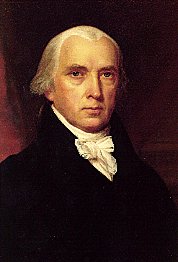
James Madison

Dolley knew all the movers and shakers along with their wives and distaff members of Washington society. Margaret Bayard Smith credited her with “all the elegance and polish of fashion” plus “the friendliness of her native character.” She was enormously popular. Everybody loved her.

The White House: 1809

As wife of Jefferson’s Secretary of State, Dolley Madison had opened their Washington home for elegant receptions, teas and dinners several times a week. Now, commandeering Wednesday evenings for her open-to-everyone soirées, the White House (called the Executive Mansion, then) became the center of social Washington.

Monticello
One of the earliest images of the W.H.

Alas for the Mansion itself, it needed work – and help. Thomas Jefferson, arguably one of our most domestically inclined Presidents, understood that the Executive Mansion was only temporary, and poured most of his decorating attention into his beloved Monticello in central Virginia.

That was about to change.

Conducting The Tour

Mrs. Madison was a savvy woman politically. She had made close friendships with diplomats from Great Britain and France and Spain, and knew that if the still-new USA expected to meet their continental peers as equals, they had to present the proper image. The White House (in its own way) was/is required to be on a par with European palaces and castles.

Dolly invited small groups of congressmen to luncheon, making sure that members of the Appropriations Committee were at each luncheon. Then she gave them a tour of the mansion, pointing out areas in need of repair and tactfully suggested, how some problems might be easily remedied by a coat of paint, or some new carpeting. Or draperies.

Dolley’s popularity was such that her “tactful suggestions” were followed, and $12,000 (about $305,000 today) was appropriated for needed repairs. An additional $14,000 (around $335,000 today) was assigned for household needs. Congress also purchased a piano ($458) for the White House, and a dinner service of blue Lowestoft china for state dinners.

Supervising the Fixer-Upper

Benjamin H. Latrobe (1764-1820) was the foremost American architect of his time. Born in Great Britain, and educated in various places throughout Europe, he had displayed distinct artistic talent for engineering and surveying. And architecture. And decor. They are all related.

The talented Benj. Latrobe

When he emigrated to the US, one of his first acquaintances was Bushrod Washington, nephew to then-ex-President George Washington. An invitation to Mount Vernon to meet the ex-President led to several commissions and opportunities for the talented Latrobe, particularly in design-construction of public buildings. His membership in Philadelphia’s prestigious American Philosophical Society led to an abiding friendship with Thomas Jefferson, and more opportunities in Washington DC – including supervising the building of the United States Capitol.

When the Madisons entered the White House, Latrobe was the Surveyor of Public Buildings in Washington, and a great many changes were underway. Even before Mr. Jefferson packed off to Monticello, the Madisons (who knew Latrobe well) consulted him to discuss some essential White House needs. He began shopping immediately for fabrics, mirrors (essential for good lighting) and accoutrements.

The Three Rooms

Any visitor to the White House is immediately impressed and charmed by three downstairs ceremonial rooms. The big East Room (where Abigail Adams hung laundry) was still unfinished, but according to Mrs. Madison, entertainment was still essential for the Presidential image – and for politics. It was those three adjoining rooms, with doors that could open into each, that were designated to accommodate some 200 or more guests.

Artist Peter Waddell’s image of a Dolley “squeeze”

What had been Jefferson’s office, was turned into the State Dining Room (and still is). It was not a huge room then, but it has been enlarged over time. (This is where the Gilbert Stuart portrait of George Washington was originally hung.)

The Oval saloon in the middle, became the President’s Reception room. The other room, previously a small dining room for Mr. Jefferson intimate guests, was turned into Mrs. Madison’s parlor.

The First Lady wasted no time. She opened the “people’s house” to the people as soon as possible. Since the Madisons understood the budget limitations on the monies Congress had appropriated, they insisted that Latrobe shop with a thrifty eye.

Latrobe also shopped with an “American” eye. While his education and taste was trained to European finery, and while the Madisons were partial to the French furnishings of the Ancien Regime, their architect-decorator convinced them to buy American, and designed chairs and sofas in a neoclassical Grecian style which he believed symbolized the American republic. They were made in Philadelphia.

Six Years Later

George now lives in the East Room.

Whatever lovely items the Madisons may have purchased for the house; whatever fine cornices and moldings; whatever carpeting and lush draperies… it all went up in smoke in 1814, when the British Army burned the city itself. Any vestiges from the fire were further drenched by a hurricane that serendipitously saved the structure from total ruin. Except for the rescued Gilbert Stuart portrait of George Washington, to the everlasting legend of Mrs. Madison.

It took more than two years for the White House to be habitable again – with white paint to cover the fire scars. More than twenty years passed before the Widow Dolley returned as a beloved guest in the House where she had welcomed and delighted thousands of visitors.

Sources:

Gould, Lewis L. – American First Ladies: Their Lives and Their Legacy – Routledge Press, 1996

Moore, Virginia – The Madisons: A Biography, 1979, McGraw Hill

Seale, William – The President’s House Vol. 1 – The White House Historical Association, 1986

https://www.aoc.gov/about-us/history/architects-of-the-capitol/benjamin-henry-latrobe

https://www.whitehousehistory.org/white-house-decorative-arts-in-the-1810s

Posted in A POTUS-FLOTUS Blog, James Madison, Nifty History People, Thomas Jefferson | Tagged , , , , , , , , , , , , , , , , , , , , , , , | 1 Comment

The First Burial of Willie Lincoln

Willie Lincoln was 11 when he died in the White House.

Willie.

In December, 1850, ten months after his sickly four year old brother Edward Baker Lincoln died, William Wallace Lincoln was born. He was the third son born to Abraham and Mary Lincoln, named for Mary’s brother-in-law, the local doctor who had been indispensable during Eddy’s final illness. 

Little Eddy.

According to nearly every source, Willie was a bright, caring and lovable child, with long legs that promised above average height. Elizabeth Grimsley, Mary Lincoln’s cousin, commented that he was “most like Lincoln except he was handsome.” 

Willie Lincoln was comfortable with people, whether they be his playmates, or the adult friends of his parents, or even important government officials. Even the lowliest servants in the White House remarked about the boy’s cheerfulness and sincere good manners to all.

Mary and the boys.

According to Lincoln secretary John Hay, Willie was prematurely serious and studious. He was also more receptive to religion than his brothers. There is some indication that he once told his Sunday School teacher that he might like to be a preacher. 

Typhoid the Killer

Typhoid is a water borne disease, serious even today. In the 19th century, its prevention was decades in the future. So was its treatment. More often than not, it proved fatal. In late January, 1861, both Willie Lincoln and his brother Tad, two-and-a-half years younger, became sick. The doctors said it was a bad cold and fever, and prescribed the usual treatments for childhood diseases, which were/are numerous and commonplace. 

Having already lost a small child, both Lincolns always worried when their sons were sick.

But Dr. Robert Stone was readily available, and not overly concerned. When the POTUS and FLOTUS considered cancelling a gala event, the doctors advised that the boys were strong and would recover. But while Tad seemed to rally and improve, Willie did not. He failed steadily, and by mid-February 1862, less than a year after Lincoln was inaugurated, Willie was in grave danger, diagnosed with the dreaded “typhoid,” and moved into what is today, the more spacious Lincoln Bedroom.

On February 20, he died.

Mourning Willie

When the end came, Lincoln tearfully announced to his secretaries, “Well, my boy is gone,” and disappeared into his office, to grieve in private. Mary Lincoln collapsed, and required medical sedation. Tad, still sick in bed, was only eight. The Lincolns’ oldest son, Robert, had been summoned from his studies at Harvard. 

Robert was summoned.

Willie’s body was washed and dressed by Elizabeth Keckley, Mary Lincoln’s dressmaker, who was quickly becoming indispensable to the First Family. Then he was brought downstairs to the Green Room to be prepared for embalming, and placed in a metallic casket, that looked like simulated rosewood. Flowers covered the coffin, and friends and dignitaries came to quietly pay their respects.

Elizabeth Keckley

The funeral services were scheduled in the White House East Room at 2 PM, February 24, a stormy and windy day. The mirrors were covered, and the gilt frames and windows were draped in mourning cloth. Shortly before the service the family spent some time in private farewell. Mary Lincoln was again so overcome, that she needed medical attention, and did not attend the service, or the burial. According to Elizabeth Keckley, Mary Lincoln “was an altered woman,” who never entered the room where Willie died, nor the Green Room, where he was embalmed. She was bedridden for three weeks, and did not appear publicly for months.

Mary wore mourning for 18 months – or more.

The President personally escorted Bud and Holly Taft, who had become the inseparable playmates of Willie and Tad, to say their own tearful goodbyes. Mrs. Lincoln was so overwrought, she had sent word to their mother not to send the boys to the White House: it would be too upsetting for her.

Congressmen and Senators, Cabinet members, foreign diplomats, military brass, including General George McClellan, filled the sorrowful room to pay their respects to the President and Robert. Finally Dr. Phineas Gurley, the pastor of the New York Avenue Presbyterian Church, where the Lincolns rented a pew, preached a heartfelt and tender sermon-eulogy. 

A Temporary Rest

It was a long procession in cold, wet weather that followed the hearse, pulled by two white horses. Next came two black horses pulling the President’s carriage. The train of mourners trudged to Oak Hill Cemetery in Georgetown, where there was another brief ceremony at the chapel. Then Willie’s coffin was placed in a temporary vault.

The “borrowed” vault

The vault was owned by Mr. And Mrs. William Carroll, whose three deceased young sons already occupied the structure. Carroll was the clerk of the Supreme Court, and graciously “lent” the space to the President, for Willie to rest in peace until such time as he would be removed to return to Springfield, IL with his family. 

It is said that President Lincoln visited the vault several times to mourn quietly – in private.

The Final Journey

Three years later, President Abraham Lincoln was assassinated. That funeral service was longer. The shock and mourning resonated across the continent. This time Robert Lincoln would serve as chief mourner, accompanied by Justice David Davis and Ward H. Lamon, longtime friends of the late President. The always emotionally frail Mary Lincoln was now permanently devastated; Tad, only 12, was still a child. 

The plans for the long ride back to Springfield retraced the 1700 mile railroad trip the President had taken to his inauguration in 1861. In each stop along the way, in the cities his journey had taken, there were more services, dirges and even re-embalming. More dignitaries paid their respects and more eulogies were proclaimed. 

The Lincoln tomb

But quietly and with little fanfare, prior to the homeward bound journey, Willie’s casket was removed from the Carrolls’ vault, and brought to the train and placed at the foot of his father’s coffin. They would go home together.

Eddie and Willie Lincoln

Both coffins were taken to Oak Ridge Cemetery in Springfield, and placed in another vault until 1871, when the Lincoln burial site was completed. Little Eddie’s coffin was also exhumed and he and Willie were moved to a permanent crypt in the wall. He remains there till this day, alongside his mother and his brothers Eddie and Tad.

Sources:

Bayne, Julia Taft – Tad Lincoln’s Father – Bison Books (reprinted) – 2001

Keckley, Elizabeth – Behind the Scenes: Thirty Years a Slave, and Four Years in the White House – Important Books, 2013

Randall, Ruth Painter – Lincoln’s Sons – Little, Brown & Co., 1955

https://www.abrahamlincolnonline.org/lincoln/education/williedeath.htm

Family: William Wallace Lincoln (1850-1862)

Funeral Train Route

Posted in A POTUS-FLOTUS Blog, Abraham Lincoln, Nifty History People | Tagged , , , , , , , , , , , , , , , , , , , , , , , , , , , , , | Leave a comment

Nellie Taft and the Philippine Band

Helen Herron Taft’s happiest years were in the Philippines.

The Manila Years

In 1900 Helen Herron Taft (1861-1943), married and mother of three, traveled to Manila, where she spent the next few years. Her husband of 15 years had been dispatched to the Philippines by President William McKinley to serve as Governor General to the strife-torn islands that generally unwanted, had become a protectorate of the United States after its war with Spain. 

William Howard Taft (1857-1930), a jurist by discipline and disposition, was ideal for the post. Originally sent as part of a fact-finding commission, he had become popular with the various factions of discontented Filipinos, who had been subjugated by various “conquerors” for centuries. Taft did not behave like a conqueror. He was patient, understanding, courteous and diplomatic with even the most radical sects. And wise. 

Judge Taft

When Nellie arrived, they moved into Malacanan Palace. They were surrounded by aides and servants to tend to everything from laundry to meal preparation to scheduling and diplomatic insights.

Perhaps born with a streak of discontent in her soul, Nellie always raged at the lack of opportunities available for women to achieve – whatever it was they wanted to achieve. When her family visited the White House, guests of President and Mrs. Rutherford B. Hayes, close friends of her parents, 15-year-old Nellie found her goal: she wanted to live in the White House – as First Lady. She found her “vehicle” in William Howard Taft, a big teddy bear of a man, with a fine pedigree, Yale education, and the disposition to accept and love the somewhat sharp-tongued Nellie. 

Now, as the wife of the Governor-General of the country, Helen Herron Taft of Cincinnati, OH, was First Lady of the Philippines. She would always refer to that time as a “dress rehearsal” for the White House and she began to make plans.

Luneta Park

Not far from Malacanan Palace, was a promenade park overlooking Manila Bay, called the Luneta. It was an oval drive, resembling a racetrack, with a bandstand at either end. It was sparse and somewhat lacking in the lush gardens and greenery that one might expect. Mrs. Taft was unimpressed at first, believing it must have seen better days. 

Nevertheless people of all races and social classes flocked there at dusk, to drive or walk about, enjoy the fresh air, mingle with friends, and above all, enjoy the music. And the magnificent sunsets.

The Luneta
Nellie in traditional Philippine costume (Natl. FL Library)

Two or three times a week, bands would assemble to play traditional Filipino music. Or light opera. Or the classics. Or the latest songs from America. 

It was open to all walks of life, and they all came. And it was free.

Always a music lover, Mrs. Taft began to change her mind about it. And she also made it a point to go to the Luneta frequently.

Walter Loving, Maestro

Walter Loving was a Virginia born American, the son of a slave. Displaying a rare gift for music (cornet was his main instrument), he eventually attended the New England Conservatory of Music. But his opportunities came as a young Lieutenant in the U.S. Army, given command of the 45th Volunteer Infantry Regiment Band. (He would later rise to the rank of Lt. Colonel.)

Walter Loving

Deployed to the Philippines, Loving came to the attention of Governor-General William Howard Taft, who had heard the regimental band perform. He asked him to form the Philippine Constabulary Band, which quickly rose to popularity and prominence both in the Philippines and in the US. Loving learned the Philippine language and bonded easily with the musicians, which at some point, numbered more than a hundred participants. 

The Constabulary Band quickly developed an international reputation, entered competitions, won awards, and invitations to perform around the world. They were superb, even earning praise from John Philip Sousa himself.

The Philippine Constabulary Band

Dreams to Plans to Dreams Come True

When Theodore Roosevelt became President after the assassination of William McKinley, the doors to prominence and position were flung wide open for William Howard Taft. He and Theodore had been close personal (and political) friends for more than a decade. When the opportunity to become Secretary of War arose, it was a siren song to the politically motivated Mrs. Taft. They moved to Washington.

Sensing that the White House (residence of choice) was actually in reach, Nellie began to form her agenda of activities and projects she hoped to undertake. Planning projects was nothing new to the ambitious Mrs. T. Seeing those plans to fruition was also nothing new to her. She had spent several years (prior to the Philippines) helping to shepherd the Cincinnati Symphony Orchestra into being.

When Taft was inaugurated President in 1909, Walter Loving and the Philippine Constabulary Band was invited to lead the inaugural parade. It was the first time that any band other than the Marine Band had done escort duty.  On the following day new First Lady Nellie Taft arranged to have them perform at the White House – the first band outside the USA ever to do so. It was also the first time a Black American band leader was invited to perform. Neither of the Tafts were given to racial prejudice. 

Then Nellie organized her pet project: creating an American Luneta: an open-to-everyone park with free band concerts. She had had her eye on a location since her years as Mrs. Sec/War.

The American Luneta

There was a decent sized spit of empty land along the Potomac River. Because it was swampy, it was unsuitable for structures that would hold people, i.e. housing or government offices. Today it a short walk to our dear memorial monuments.

Within a month, the land was expertly prepared for traffic, basic landscaping (more would follow) and a gazebo-like bandstand. It cost very little to build. A schedule was set, flyers and notices were sent to the newspapers announcing the FREE concerts. As was her nature, Nellie fretted over every detail, afraid nobody would come.

More than 10,000 people turned out for the first concert – headed by the Philippine Constabulary Band.

But only a month later, Nellie Taft had a serious stroke…. So sad.

Sources:

Ross, Ishbel – An American Family: The Tafts – 1964, World Publishing

Taft, Mrs. William Howard – Recollections of a Full Life – Dodd, Mead 1914

https://www.whitehouse.gov/about-the-white-house/presidents/william-howard-taft/

http://www.firstladies.org/biographies/firstladies.aspx?biography=27

https://millercenter.org/president/taft/life-before-the-presidency

https://www.whitehousehistory.org/first-lady-helen-tafts-luneta

Posted in A POTUS-FLOTUS Blog, Nifty History People, Rutherford Hayes, Theodore Roosevelt, William Howard Taft | Tagged , , , , , , , , , , , , , , , , , , , , , | Leave a comment