
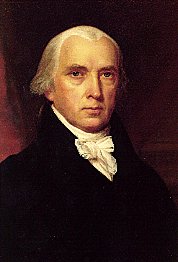
The Great Little Madison
Many historians include numerous worthies in the category of “Founding Fathers,” i.e. those men in mid-eighteenth century America who rose to prominence as the country established itself as a sovereign nation. Patrick Henry, Samuel Adams, George Wythe, John Hancock, and even Aaron Burr are frequently included.
But the sifting of greatness usually winnows the “Founding Fathers” to six (in order of age): Benjamin Franklin, George Washington, John Adams, Thomas Jefferson, James Madison and Alexander Hamilton, whose birthdate is sketchy, but a few years Madison’s junior. Franklin, old enough to be everyone’s father, if not grandfather, died first, at a ripe old age. Washington was second to die, suddenly and not as ripe in age. In one of the rarest coincidences of history, Adams and Jefferson died simultaneously, of old age, on the same day – exactly 50 years after the Declaration of Independence was signed.
Alexander Hamilton, the youngest, died in his 40s, in a duel.
That left James Madison, who is generally credited with shepherding the United States Constitution through a dedicated process-of-compromises, and through ratification by thirteen sovereign states. Even in his own lifetime, he was considered the Father of the Constitution. He also lived a long life, and served for eight years as President in the early decades of the nineteenth century.
It was during the Madison Administration, 1809-17 that several younger men, all children or even babies during the Revolution, rose to political prominence, and dominated the next forty years of history.
John Quincy Adams
John Quincy Adams, son of a bona fide “Founding Father” was born in 1767, and at eight, was an eye-witness to the Battle of Bunker Hill. Smart and intellectually diligent, he spent another eight formative years in the great capitals of Europe, mastering several languages, and inhaling the culture of the Old World.
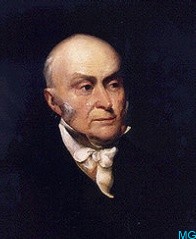
President George Washington himself recognized the young man’s talent, shortly after JQ finished Harvard and had passed the Massachusetts Bar. The young man, somewhat disenchanted with the mundane practice of law, penned a series of prescient newspaper “letters” (under a conventionally assumed name), and drew favorable notice as someone of growing importance. GW appointed him as Minister to the Netherlands. JQ spoke excellent Dutch.
After being recalled by his now-president father, the mature JQA became involved on and off in elective Massachusetts politics. Then President Madison appointed him Minister to St. Petersburg, Russia. He was later named Chief American negotiator to end the War of 1812. And then was named Minister to Great Britain, Sec/State, et cetera. He was a heavyweight.
Andrew Jackson
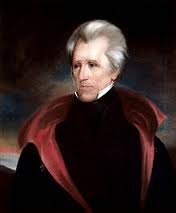
Andy Jackson was a few months older than John Quincy Adams, and aside from both becoming attorneys, they were polar opposites. JQ was cultured, educated and disciplined New Englander. AJ was raw, poorly educated, and a completely undisciplined “westerner.” But as a “man of the people” he had leadership, brash courage and magnetism gushing from every pore. He bought and sold property and businesses, ran for and resigned from public office, raced horses, fought in duels, and was beloved throughout Tennessee.
Once he discovered the personal satisfaction of military command, as General of the Tennessee militia, he never practiced law again.
His technically-too-late victory at the Battle of New Orleans in early 1815 Andrew Jackson cemented his reputation as a man to be reckoned with, and followed by hordes of admirers. All the way to the White House.
Henry Clay
A decade younger than Adams and Jackson, Henry Clay was a Virginian who emigrated to Kentucky. Educated, smart, and outspoken, he was cut from the same cloth as Jackson: he lived a hard aggressive life, drank (albeit never to huge excess), gambled, and was usually coming home from a night of carousing about the same time as Adams was greeting the dawn.
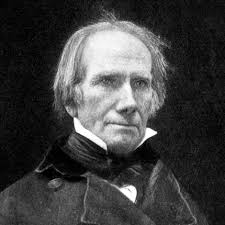
Clay was elected early to public office, made his mark as a man on the rise, and rose as a man who could wrangle out compromises to make everyone happyish, at a time when political parties had not completely jelled. By the time of his death, he had been a Congressman, Speaker of the House, a diplomat, senator, Secretary of State, and candidate for President three times. He lost each time, but he definitely made his mark.
Daniel Webster
A half-generation younger than John Quincy Adams and Andrew Jackson, Daniel Webster was another New Englander (NH/MA), who became the embodiment of the urbane, well-educated (Dartmouth) and superb attorney who eventually argued more than 200 cases before the Supreme Court.

But most of all, he was as an orator, in an age when compelling oratory drew crowds from afar. He was considered the finest in the country.
He served as Congressman and Senator, eventually becoming Secretary of State in the Harrison/Tyler administrations. His eye was on the Presidency till the day he died, but never achieved that goal, perhaps being tainted by the same stand-offishness as JQA. But no one surpassed his command of the podium.
John C. Calhoun
A suave South Carolina lawyer with a Yale education, John C. Calhoun was the same age as Webster, and just as fiery and eloquent. He also had the magnetism of Jackson and the tenacity of JQA. Suave and cunning, he was the wild card in every deck. An ardent nationalist in his early career, he gravitated to the principles of states’ rights and never veered thereafter. Congressman, senator, cabinet member (War/Monroe) and a vice president under both Adams and Jackson, he was detested and mistrusted by both “his” Presidents for the rest of their lives.

His views on tariffs and slavery and the right to secede became the linchpins of Southern political thinking, and a generation of nascent “confederates” took him as their mentor two decades before the Civil War.
And all five: John Quincy Adams, Andrew Jackson, Henry Clay, Daniel Webster and John C. Calhoun, came of political age and renown when James Madison was president.
Sources:
Brands, H.W. – Heirs of the Founders: The Epic Rivalry of Henry Clay, John Calhoun and Daniel Webster, the Second Generation of American Giants – Doubleday, 2018
Peterson, Merrill D. – The Great Triumvirate: Webster, Clay, and Calhoun – Oxford University Press, 1987
 Presidential History Blog