
Fredericksburg Roots for George

George Washington was born on Pope’s Creek, perhaps 45 minutes (today’s drive) from Fredericksburg. When he was four, the family moved to a lovely piece of land along the Potomac River, even closer to Fredericksburg. Originally called Little Hunting Creek, it is now called Mount Vernon.
When GW was around six, his father Augustine purchased 580 acres just across the Rappahannock River in Fredericksburg, built a house and out-buildings, and the family of five (by his second wife, Mary Ball) moved in.

Since accurate statistics are unavailable circa 1740, the best that can be suggested is that Fredericksburg was already a substantial town with perhaps 500 residents. The entire Virginia colony boasted less than 200,000 and was the largest and most populous of the thirteen colonies at that time!
Fredericksburg was thriving, with shops and stalls, schools and churches, traveling theatricals and entertainment, and a fine river to carry goods and necessities for miles around.
Augustine Washington was a prosperous man, with a substantial farm, plus a partnership in an iron foundry not far from their home. The move to Ferry Farm was a good decision.
Growing Up George
GW’s two older half-brothers were older by a decade or more, and his earliest memories of them were fuzzy. They were in England for the formal education that was commonplace for prosperous sons.

As the “oldest” of the second batch (four younger siblings), George was expected to pull his weight. He did chores. He fed the chickens, pulled the weeds, and as he got bigger and stronger, carried water up from the river (not far away), chopped firewood, and tended to the animals. He learned horsemanship. And how to use tools. And swordsmanship and how to dance.
The family owned perhaps ten or a dozen laborers and house servants. GW worked alongside, and likely learned the essence of “plantation.”
But when GW was eleven, his father died. Whatever hopes or expectations George had for an education abroad were not in the cards. His mother was set against it.
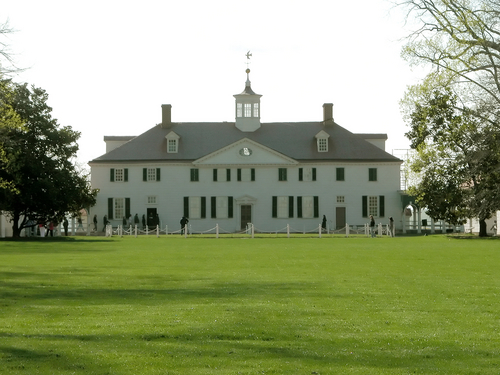
Augustine’s will left his oldest son Lawrence the property on the Potomac that is today Mount Vernon. His second son, Augustine Jr., inherited Pope’s Creek, along the Rappahannock. To George, his eldest by his second wife, he left Ferry Farm, once he reached his maturity. Other bequests did not include large acreage.
Without formal education, or even a commission in the British military, GW needed another avenue of advancement. By his mid-teens, he discovered surveying: a fine, respectable profession for a young man of quality. Even better, he was good at it.

With active mentorship from his brother Lawrence, and his brother’s neighbors, the wealthy and titled Fairfax family, surveying projects in “western” Virginia were forthcoming. And one of GW’s earliest surveys and maps, done when he was still in his teens, were for Pope’s Creek, at the behest of his brother Augustine.
By twenty, GW had parlayed his surveying skills and knowledge of the land itself into a commission in the Virginia Militia. He definitely owned Ferry Farm, where he stayed periodically, but he never lived there again.

Mary Washington’s Ferry Farm
Mary Washington continued to live at Ferry Farm for more than twenty-five years after her husband’s death. She raised Betty, Samuel, John and Charles. When they married/left for homes of their own, she still continued to live there and work the farm.
GW spent eight years in the Militia before he married and took up permanent residence at Mount Vernon, which was left to him after Lawrence died. He dutifully visited his mother periodically, and was always on good terms with his siblings.
But by 1772, Mary Ball was past sixty. Running the farm on her own (with a few servants) was becoming difficult for her. GW was 40, well past his maturity. He agreed that his mother needed a smaller house.
He purchased a fine house-with-fine-garden for her in Fredericksburg, already familiar surroundings, and within walking distance to his sister Betty’s home – and the grandchildren! She lived there for the rest of her long life. The house still remains, and is open to the public.

Ferry Farm was put on the market – but it took a while before it was purchased in 1774 by Hugh Mercer, a physician and general in the Revolutionary Army – and a friend of the now Commander-in-Chief of the Revolutionary forces.
Ferry Farm: Later
Wooden frame houses tend to burn. They tend to rot. They tend to suffer the slings and arrows of weather and time. Ferry Farm was no different. There were other owners and ravages of nature.
By the Civil War, while the property was always known to be GW’s Boyhood Home, little remained of any of its original structures. There was no actual fighting on the property (that was left to Fredericksburg itself) but Union soldiers encamped on the land, and there were a few skirmishes.
But in the early 20th century, with a 200th birthday of The Great George near approaching, and Mount Vernon, having been lovingly cared for and enshrined, serious thought was given to restoring Ferry Farm as well.
John D. Rockefeller, Jr., who poured his money, his time and his love into recreating Colonial Williamsburg, sent some of his leading scholars and engineers, archaeologists and scientists to revive and restore both Pope’s Creek – and Ferry Farm.
The land is there, of course, but the site is a re-creation. The furnishings are period pieces or reproductions. (The good stuff always goes to Mt. Vernon!) But there is a nifty museum and the ubiquitous gift shop. A few relics like buttons and wig-curlers and pieces of pottery have been traced to GW’s Ferry Farm.
And yes, some cherry pits have been found, too.
Sources:
Chernow, Ron – Washington: A Life – Penguin Books, 2010
https://www.smithsonianmag.com/history/washingtons-boyhood-home-7113627/
 Presidential History Blog