

Five Presidential Couples lived in the White House between 1920 and 1933: The Prohibition Years.
A Long Simmering Issue
Of course nobody is in favor of drunkenness! And a traditionally Puritan ethic made public intoxication a cause for shame and ridicule for centuries. By the Civil War, “prohibition,” and its softer companion “temperance” had become a potent issue: enough to encourage political action, especially once slavery had been abolished.

Women and clergy were usually at the forefront of banning liquor of all kinds, with the possible exception of ceremonial wine for religious purposes. And maybe for medicinal use. By the late 19th century, the Women’s Christian Temperance Union (still around!) had become a formidable bastion for moral causes, and “lips that touch liquor shall never touch mine” were on a great many pious lips.
With the huge influx of immigrants in the later decades of the century, thousands of saloons catered to the thirsts of tired and poor laborers, some of whom needed respite from a tenement full of underfed children and an exhausted wife, as well as from long hours in sweatshops.

It seemed that the poorer the neighborhood, the greater the imprint of John Barleycorn. Pastors were supportive of prohibition. Newspapers published sad tales of five-year-olds being sent to fetch their drunken father from the saloon. Politicians started to cater to the voters aligning in the new “moral crusade.”
Towns passed laws banning liquor. A few larger cities were joining the banned wagon. A Constitutional amendment was believed necessary to keep Americans sober. But enjoying a drink or two – or three, is a far cry from drunkenness!
By 1919, enough states had ratified the prohibition amendment to make it illegal throughout the entire country. Despite its piety, it was definitely NOT popular in either political party: You cannot legislate morality. They’ve been saying that for centuries!
And that included the five Presidential occupants entrusted to enforce it.
The Wilsons

Democrat Woodrow Wilson and his second wife Edith Galt had more pressing things on their plates than Prohibition. WW had tried very hard to keep the USA out of the Great War – for three years. When international matters became too intolerable for neutrality, it seemed more important than a beer. Besides, his own heart was completely subsumed in creating a League of Nations to prevent future wars.
Moreover, Wilson was not a teetotaler. Nor was Mrs. Wilson. They were both cosmopolitan, hardly drunkards, and both enjoyed a potable libation periodically. He actually vetoed the Volstead Act (as unenforceable), but Congress overrode it.
In January, 1920, the 18th Amendment was enacted into law, and WW had suffered a severe stroke, and next 18th months were focused on his health, and the extent of his disabilities, both temporary and permanent.
The Hardings
There was never going to be a way that Republican Warren Harding supported Prohibition, other than lip-service (required as President), and finagling around it, by putting a time limit on the “Noble Experiment.” They were social. They were political. Social and political is usually laced.
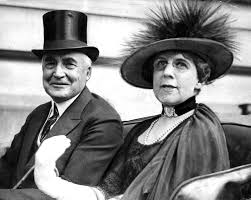
Florence Harding, much as she probably had once enjoyed a snort of something, was a sick woman with a chronic, life-threatening kidney ailment. Alcohol was verboten, and not an option. Nevertheless, back in Ohio, at the Hardings’ regular poker games, she was a player of poker (and politics) – and the sociable bartender for the gang.
As President, formal WH occasions were dry. But the upstairs private quarters were not. And when their bootleg-happy buddies came for a private visit, medicinal something-or-other was readily available.
The Coolidges

Republican Calvin Coolidge and his wife were descendants of New England puritan stock – sort of. As a local politician, Coolidge regularly stopped in where the men gathered, had a beer, smoked a cigar, and shook hands. His personal thrifty “entertaining” was more coffee and cake, but a bottle of whiskey was generally available – if someone wanted a drink. Refills were frowned upon – and he counted them.
As Massachusetts Governor, the Coolidges were invited everywhere – and went. And likely had a sip of something or other. But in the White House, they played by the new rules. But he was not in favor of Prohibition. He believed that it is a bad law if it makes law-abiding citizens disrespect the law, which was exactly what was happening. And it led to speakeasies, bootlegging, gang wars, and various other mayhem.

The Hoovers
Herbert and Lou Henry Hoover had spent most of their married life abroad. He had become a wealthy mining engineer, mixed in high-level society, and while neither were heavy imbibers, they kept a well-stocked bar for their numerous luncheons and dinners.

An unusually well-balanced couple, Hoover did mention that in forty year of marriage, their only real argument concerned Prohibition. As President, he was obliged to set the example and Mrs. H. insisted that they support the “Noble Experiment,” which was fine enough in the White House. But when she also insisted that he dispose of a cellar filled with excellent and expensive fine wines in their California home, he rebelled.
She won the argument. He obeyed. He didn’t like it. And he didn’t like the law either. But he said he was obliged to to live with Mrs. Hoover.
The F.D. Roosevelts

There was no question about where Franklin Delano Roosevelt stood on Prohibition. He was a “wet.” He had enjoyed a pre-dinner cocktail from the time he was old enough to have one. His wife Eleanor was more timid on the subject, especially since her beloved father was an alcoholic and died at 34, from its complications.
Happily for the FDRs, Prohibition was repealed (the only Constitutional Amendment with that distinction) shortly after he became President. And “happy hour” prior to dinner was the relaxing high point of many a day for FDR and close associates, and that included Eleanor. At least for one drink.
Sources:
Stoddard, Henry L. – As I Knew Them – Harper & Brothers, 1927
Sullivan, Mark – Our Times: The Twenties – Charles Scribners’ Sons, 1935
https://www.history.com/this-day-in-history/march-22/fdr-legalizes-sale-of-beer-and-wine
https://www.whitehousehistory.org/bios/woodrow-wilson
https://millercenter.org/president/harding/life-before-the-presidency
 Presidential History Blog