

The USA was never created for although its trappings and perks always piqued interest…
The Great General: The Future Generations
Ulysses S. Grant was as far from “royal” as possible. His middle-class Ohio parents were hardworking folks. So were the antecedents of Miss Julia Dent, the middle-class Missouri woman he married.

They had four children: Frederick Dent Grant, U.S. Grant Jr. (Buck), Ellen (Nellie) Grant Sartoris, and Jesse Root Grant II. None of them grew up in anything remotely resembling social or financial prominence. That came later.
The Civil War, of course, was the making of USG. He had a West Point military education and commendable service during the War With Mexico, but fared poorly during his long absence from his beloved wife and two babies. He resigned his commission in semi-disgrace, returned to his family, and struggled for a decade.
The only thing successful about Ulysses S. Grant was his marriage.
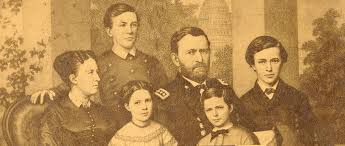
General Grant & Eldest Son:
The onset of the Civil War found Grant in Galena, IL, as a menial clerk at one of his father’s tanneries: a job he hated. But when the Civil War began in earnest, the Union Army was in dire need of trained and experienced officers. Ex-Captain Grant duly submitted re-enlistment paperwork, and within a short time was promoted to Colonel.
His son Fred was eleven. At his mother’s insistence (heaven only knows why!), he accompanied his father on-and-off during the next four years. The soldiers loved him!
So it was no surprise when a few years later, Fred chose a West Point education himself. By that time, Ulysses S. Grant, victorious General and Hero, was President of the United States.
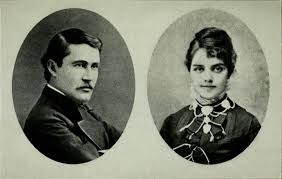
In 1874, Fred met and married Miss Ida Honore, the daughter of a wealthy and prominent Chicago businessman, said to be one of the most beautiful belles in Chicago. They spent the next two years living at the White House, where their daughter, Julia Dent Grant II (1876-1975) was born.
Julia D., Granddaughter
Fred and Ida’s little girl was the only one of President Grant’s grandchildren who had any memory of him; she was nine when he died.

Little Julia was an adorable child, favoring her beautiful mother Ida. In later life, Julia wrote of fond memories with her illustrious grandpa, sometimes riding with him in his carriage – at breakneck speed.
A year before Grant’s death, the General was urged to write his war memorials to provide for his family following a huge financial debacle when his business venture went bankrupt, and throat cancer was winning the final battle. Fred Grant (as well as his siblings) were also deeply affected by those losses. For several months, Fred and his family lived with the Senior Grants in Manhattan, while Fred assisted his father with the book.
In her early teens, Julia II accompanied her family to Vienna, where Fred Grant had been appointed Ambassador (modern term) to Austria-Hungary. They stayed for four years, and the radiantly beautiful Julia made her social debut. Not long after they returned to New York, Julia accompanied her wealthy aunt, Mrs. Potter Palmer (née Bertha Honore), one of the most prominent social doyennes in the country, on a tour of Europe.
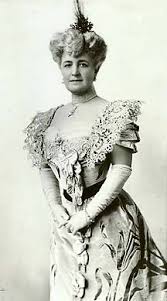
In Rome, Julia met Prince Mikhail Cantacuzène (Can-ta-cu-zini), also known as Count Speransky, then military attaché to the Russian embassy. The name and title was a complicated lineage via Russia and via Ukraine (where he was born). Some titles had been awarded generations earlier for services rendered; some were legitimate relationships with the Romanov family. Nevertheless, Michael (as he would be called) and Julia fell in love, courted briefly, and were married in Newport, RI in 1899, at one of Mrs. Potter Palmer’s homes.
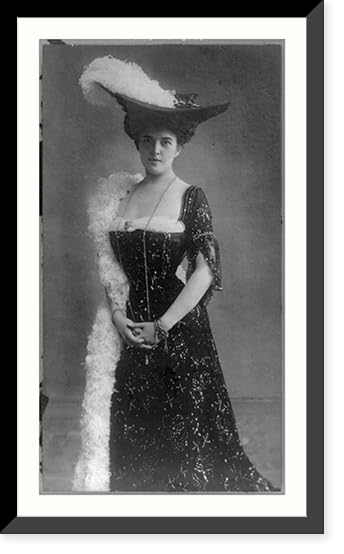
Julia in the Revolution
Shortly after their wedding, the Prince and Princess began a good life of bedecked and bejeweled parties, ping-ponging between St. Petersburg, Russia, where Michael was attached to the Imperial Court, and his huge hereditary estates in Ukraine, where their three children were born.

By the start of World War I, Prince Cantacuzène was a General with commendable service in the Russian Army – including wounds. Julia and the children remained in St. Petersburg. But following the violence, fear and anarchy of the Russian Revolution in 1917, the Speransky-Cantacuzènes escaped St. Petersburg (with the clothes on their backs, and Julia’s jewels sewn into her undergarments) first to Finland, and then to the USA, where they made their permanent home.
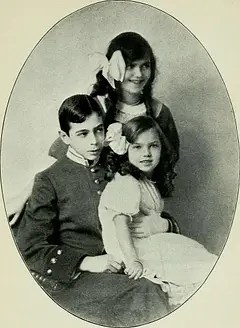
They lived briefly in Washington DC, hoping to support a counter-revolution, but after the assassination of the Imperial Romanov family, they decided to remain in America, and settled in Sarasota, FL, where Aunt Bertha Palmer had many business interests. Prince Mikhail needed to get a job and found a new career in a bank.
Princess Julia: Channeling Grandpa…
Ulysses S. Grant came late to his literary “career,” and had never fancied himself a writer. Nevertheless, Grant’s Memoirs was a mega-success, unquestionably the finest of the first-hand memorials of the Civil War, and a military standard even today. Now, in her middle years, his granddaughter, Princess Cantacuzène (or Countess Speransky) began writing some of her first-person observations of the Russian Revolution for various magazines, and subsequently elaborated as stand-alone books, published by Scribner’s in the 1920s.

They may not have had the legs of Grant’s Memoirs, but they were/are substantive.
Unfortunately, her marriage was failing, and she finally divorced Speransky in 1934, on grounds that he was “no longer interested in fulfilling his marital obligations.”
She remained primarily in DC, lunching frequently at the Sulgrave Club which she helped establish, reinstated her American citizenship – and name – now calling herself Julia Cantacuzène Grant. She relinquished the noble titles and never remarried.
She also lived to be nearly one hundred!
Sources:
Flood, Charles Bracelen – Grant’s Final Victory: Ulysses S. Grant’s Heroic Last Year – 2012, DaCapo
Englund, Will – March 1917: On the Brink of War and Revolution – W.W. Norton & Co., 2017
https://millercenter.org/president/grant/family-life
https://libguides.css.edu/usgrant/home
https://www.granthomepage.com/intcantacuzene.htm
https://www.britannica.com/biography/Bertha-Honore-Palmer
 Presidential History Blog