
Fallout from association could be traced to Adam’s and Eve’s friendship with a snake.

The Honest Ulysses
Hiram Ulysses Grant (1822-1885) was a mild mannered fellow, soft spoken, honest, and perhaps a bit naive in some regard. He had a middle-class upbringing in Ohio, surrounded by a domineering father, silent mother, and five younger siblings. At seventeen, Ulysses (who never used the name “Hiram”) was sent to West Point, where the Ulysses-part was well known, and the middle initial (“S”) was erroneously included due to his mother’s maiden name (Simpson). His “U.S.” initials, were likened to “Uncle Sam,” and his classmates usually called him Sam for the rest of his life. Except when they called him General.
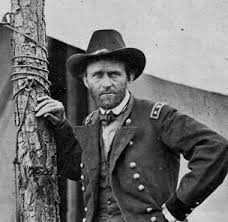
He was a middle-of-the-class student, noted only for his exceptional horsemanship.
Upon graduating, he served capably in the US Army for a decade, married, had four children, and fared poorly as a civilian. The Civil War rescued him. The Union Army needed trained, experienced officers. Once he had reenlisted, he was promoted fairly rapidly, each time proving his military worth via dogged leadership, ingenious strategies, and the ability to get along with underlings and superiors alike – including President Lincoln, who promoted him to the highest rank in the army. A little good luck helped.
But General Grant was never wealthy, and proved to be a poor businessman all his life. With no luck in business at all.
The Honest Man of the Hour
By the end of the Civil War, Grant was the Victor of Vicksburg, the Butcher of the Battlefield and the Hero of Appomattox, pretty much in that order. The “Butcher” part was quickly forgotten amid the end of the hostilities, the assassination of Lincoln and the rancorous and disastrous presidency of Andrew Johnson, who got along with nobody.

More and more citizens, veterans and politicians now looked to General Grant for leadership. He was an honest man. He readily admitted he knew very little (and cared very little) about politics. He was always honest, even while accepting the huge amounts of gifts from grateful admirers (with value ranging between boxes of cigars to horses and carriages), claiming that to refuse would be ungracious.
By the end of the Johnson Administration, General Grant was the most admired man in the country, and a shoo-in for the Presidency. While the Southern States didn’t cast many votes for him, they grudgingly liked him. He had always treated them fairly.
And as an honest man, USG was a loyal man. Loyal to the country, loyal to the Republicans who befriended him, and loyal to his military “band of brothers.” He therefore expected his “team” to be loyal to him.
The Naive President
There are some fine historians and biographers who suggest that the General was accustomed to making decisions himself, rather than utilizing collective counsel. In some ways it worked successfully; he planned his strategies and tactics carefully. In politics, however, it was disastrous. Politicians everywhere have huge egos that demand attention, respect and credit. From the start, Grant chose his cabinet without regard to the soft, all-important value that political expertise can provide. The political world was stunned by his mishmash of cabinet nominations.
Within months, several of these appointments were terminated.
The Open Door of Corruption
It was not Grant’s door that was open to corruption. General Grant was always an honest man. The “open door” was the door of opportunity for graft, bribery, malfeasance, finagling and out-and-out-theft that followed the overflow huge wealth after the Civil War. Great inventions were inundating the patent office daily. Great fortunes were being made and finding their way into the pockets of creative scoundrels. And President Grant was involved-ish, by association. Some of the implicated parties were very close to him – personally!

First out of the box was via Abel Corbin, his new brother-in-law. Corbin was a widower who had recently married Grants sister Virginia. “Jennie” was in her middle thirties, and the Grant family was likely grateful for her happiness. Taking advantage of the relationship, Corbin became acquainted with Jay Gould and James Fisk, who engineered a scheme to “corner the gold market.” In effect, they would buy “cheap,” drive the price to a dizzying height, sell it at a huge profit, and get out before it tumbled. Once USG was apprised of these shenanigans, he countered the scheme, but not before the Black Friday of 1869, which ushered in a serious nationwide recession.
Then the President’s private secretary Orville Babcock, a young West Pointer and valued aide to General Grant, became involved with a Whiskey Ring, which diverted taxes placed on spirits into private pockets, including his own. It was complicated, and ongoing for several years before it was discovered. Grant liked Babcock, and defended him rigorously, including a lengthy written deposition in his behalf.

Four cabinet secretaries were also connected in financial machinations.
Interior Secretary Columbus Delano (a far-distant relative of FDR) resigned after his son was implicated in hundreds of fraudulent land grants.
Treasury Secretary (one of many) William Richardson was forced to resign due to involvement with a private contractor profiteering from delinquent federal tax collection.
War Secretary William Belknap resigned due to Indian trading post kickback schemes – manipulated by both his wives! His first wife had concocted the scheme, and her sister (the second wife!) continued it.
Navy Secretary George Robeson received more than a quarter-million dollars plus a house from a supplier’s kickbacks.
There were five federal judges, a Minister to Great Britain, and several high-level customs officers implicated in bribery and chicanery.
And both Grant’s Vice Presidents (Schuyler Colfax, first term and Henry Wilson, second term) were implicated in the shady Credit Mobilier scandal!

There was a new scandal every week! President Grant didn’t know who to trust any more. Not even himself.
There were resignations, impeachment procedures, fines levied and reputations ruined. But very few went to jail.
Sources:
Chernow, Ron – Grant – Penguin Press, 2017
Schenkman, Richard – Presidential Ambition – Harper Collins, 1999
White, Ronald C. – American Ulysses: A Life of Ulysses S. Grant – Random House, 2016
https://millercenter.org/president/grant/life-before-the-presidency
https://www.whitehousehistory.org/bios/ulysses-s-grant
https://www.history.com/news/ulysses-s-grant-president-accomplishments-scandals-15th-amendment
 Presidential History Blog
Am happy to say that George Boutwell, a family member and Grant’s Treasury Secretary from 1869 to 1873, was scrupulously honest, one of Grant’s best cabinet picks, and a close ally of Grant’s in seeking to defend Reconstruction protections for Blacks and other American citizens.
Absolutely! USG was probably overjoyed to have Boutwell on board!