George Washington: The Trouble With Mama

Prof. Emeritus Peter Henriques says it perfectly: Complicated, Very Complicated

GW: The Humiliation

In 1781, General George Washington received a confidential letter from his old friend Benjamin Harrison V, then-Governor of Virginia. The Governor had quietly advised Washington, who at that time was poised to defeat and capture the British Army at Yorktown, that a scandal-in-situ was brewing. It concerned him – and it was very personal. 

(said to be) Benjamin Harrison V

His aged mother, Mary Ball Washington, had petitioned Congress for a pension, claiming she was in financial straits and had nowhere else to turn.

Naturally her General-son, a wealthy Virginia planter, quickly squelched that potential bombshell, and personally intervened. Quickly and quietly. His mother was not, nor ever had been, in financial straits, although she complained of near poverty regularly.

George’s Mother

Mary Ball definitely had a complicated upbringing, and likely far from happy. She was born into reasonably comfortable circumstances in colonial Virginia circa 1708, but was fatherless by three and motherless at twelve. According to her mother’s will, she was semi-foster-raised by a guardian, George Eskridge, and also spent some time with a half sister. At twenty, she was introduced to Augustine Washington, a friend of Eskridge, and recently widowed. 

Older Mary Ball Washington

Whether it was a great romance is questionable, but it was a satisfactory arrangement. Augustine Washington, eighteen years Mary’s senior, already had two teenaged sons by his first wife Jane Butler. Nevertheless their union was fruitful: Five surviving children would be born to them, George being the eldest.

Augustine Washington died when George was eleven, and the seeds of rift between mother and eldest son were sown. Any hopes or dreams for himself were thwarted by the formidable Mary Ball, who, for all intents and purposes, believed her eldest son should devote himself to her care. And always deeply religious, she seemed far more interested in preparing for an afterlife than for the one she lived in. 

Augustine’s will left her comfortable, albeit not as comfortable as when he lived. Perhaps that accounted for her frugality and fear of poverty. Nearly half his estate was reserved for his two elder sons. The balance was hers and their children’s. Their plantation “Ferry Farm,” outside Fredericksburg, was left to George – upon his maturity. But Mary Ball lived and worked Ferry Farm until 1772. By that time George was forty, and well past his maturity. 

Ferry Farm (still there)

For the rest of her life, the relationship between George Washington (dutiful) and his mother (demanding) would be sparse. Existing documents suggests that Mary found it easier to criticize than to praise, and her eldest son was not up to her expectations. Time would show that she was slovenly, and certainly not up to GW’s snuff, either.

No question about Mary Ball Washington. She was a formidable woman. There is also no question about George Washington either. He didn’t care for formidable women.

A Home for Mary

Shortly before the start of the American Revolution, with all her children grown and married, managing Ferry Farm was becoming too strenuous for Mary. GW, as the eldest son, and rightful owner of the plantation, had arranged to purchase a comfortable house for his mother in Fredericksburg, only a short distance from Ferry Farm, and very close to his sister Betty Lewis and her family. It had a lovely garden, something his mother always treasured.

Mary Washington House (still there)

But once GW was Commander-in-Chief, overseeing his mother’s care and comfort was impossible. Betty and her siblings did what they could for the increasingly petulant Widow Washington. 

The General

After the War, it became obvious that Mama Washington should not live alone, especially since she was well past eighty, and had developed breast cancer. The issue was where. Brother John had agreed to take her in. But he died. Samuel had already died, and Charles was in West Virginia.

George Washington’s Letter

In 1787, Mary again was pressing for money, and in a long letter, her eldest son tried to be of assistance and offered sound financial advice. Then, he offered a remarkable backhanded invitation…

…My House is at your service, & would press… you most devoutly to accept it, but… candour requires me to say it will never answer your purposes… for in truth it may be compared to a well resorted tavern, as scarcely any strangers… do not spend a day or two at it

This would, were you to be an inhabitant of it, oblige you to do one of 3 things, 1st to be always dressing to appear in company, 2d to come into in a dishabille or 3d to be as it were a prisoner in your own chamber. The first yould [sic]not like, indeed for a person at your time of life it would be too fateiguing [sic]. The 2d I should not like because those who resort here are… people of the first distinction. and the 3d, more than probably, would not be pleasing to either of us—nor indeed could you be retired in any room in my house; for what with the sitting up of Company; the noise and bustle of servants…you would not be able to enjoy that calmness and serenity of mind, which in my opinion you ought now to prefer to every other consideration in life.

So Mary Washington stayed in her house – close to Betty.

But when GW was en route to his inauguration, he stopped off for a final farewell, his “last act of personal Duty.” And when she died, a few months later, the Washington family and staff wore mourning ribbons for several months.

Sources:

Bourne, Miriam Anne: First Family: George Washington and his Intimate Relations, W.W. Norton, 1982

Craig, Shirley – Mary Ball Washington: The Untold Story of George Washington’s Mother – HarperCollins, 2019

Henriques, Peter, Professor Emeritus, George Mason University – “Complicated, Very Complicated” – Colonial Williamsburg Magazine, Trend & Tradition, winter 2019.

https://virginiahistory.org/research/collections/garden-club-virginia-historic-restorations-project/house-sites/mary-washington-house

https://www.mountvernon.org/library/digitalhistory/digital-encyclopedia/article/mary-ball-washington/

Posted in A POTUS-FLOTUS Blog, George Washington, Nifty History People | Tagged , , , , , , , , , , , , , , , , , , | 1 Comment

General Joe Hooker: The Man, The Myth and the Legend

Joe Hooker was a pretty interesting fellow any way you look at it…

Joseph Hooker, Making of a Soldier

Joseph Hooker (1814-79) was Massachusetts born, and perhaps genetically destined for the military. His grandfather had been a Captain during the American Revolution. His upbringing was generally unexceptional, but he was sent to West Point as a teenager, and graduated in 1837, mid-range in his class. Notable among his classmates was John Sedgwick, a Union Major General who fought at Gettysburg and died at Spotsylvania. On the “Gray” Side, was Braxton Bragg and Jubal Early, also Generals.

Even at West Point, Joe Hooker was notable for his good looks, and kindly disposition toward the ladies – as well as for John Barleycorn.

Nevertheless, once graduated as 2nd Lieutenant of Artillery, he fought first in the Seminole Wars. Then, during the War with Mexico, he served under both Generals Zachary Taylor and Winfield Scott. During that time, he received three separate brevet promotions (the last to Lt. Colonel), for leadership and bravery. No doubt about it, he was a doer – and someone to be watched for the future.

General Winfield Scott

Alas but… There was a subsequent insubordination court martial trial for General Gideon Pillow (who most West Pointers had a low opinion of). Unfortunately, Joe Hooker provided testimony against General Scott. The court martial case was politically downgraded by President Polk to a court of inquiry and Pillow was exonerated. But Winfield Scott was not a man to be messed with, and he never forgot Hooker’s lack of support. The “handsome captain” as the Mexican senoritas called him, eventually realized that his career was not going anywhere and by 1853, he resigned his commission.

He went to California, where his years-at-large were boring for him. He couldn’t find a suitable career in the civilian world, and found his pleasures mostly with women, whiskey and some wagering.

General Zachary Taylor

He made a half-hearted attempt to re-enlist during the Buchanan Administration, but his efforts went nowhere. Winfield Scott was still General-in-Chief and had a long memory.

Back in the Saddle

But by the summer of 1861, after the Union defeat at Bull Run, the Civil War had passed from politics to all out warfare. Hooker contacted President Lincoln, who commissioned him as Brigadier General (Lincoln needed all the trained officers he could get), with a division under General George McClellan, in Washington DC.

Working with McClellan seemed to be an ideal assignment for Hooker. Both Generals were excellent administrators, innovators, and good at army-and-morale boosting. Both had overweening egos, too.

During McClellan’s Peninsula campaign in 1862, Hooker was commended several times by his C.O. but, as may have been his nature, he found fault with McClellan’s strategies and tactics. He believed Little Mac was too cautious. Still, he managed to keep the carping from reaching McClellan’s ears, and made a positive name for himself, which led to his promotion to Major General.

General George McClellan

His absolute devotion to the welfare of his men was cemented in the Union Army, and they grew to love him almost as much as they loved McClellan. Nevertheless, Hooker’s reputation as a heavy drinker with an eye for the ladies grew.

General Joe: The Myth

The hard drinking part was probably more myth than fact and Hooker never denied his occasional thirst. He was likely no more enamored of the bottle than General Ulysses S. Grant, but it never seemed to be detrimental to his career.

The “eye for the ladies” is only part of the myth. Hooker was a handsome, blue-eyed fellow, and definitely attracted to the fair sex – the more accommodating the better. The myth grew that female camp followers were particularly attached to Hooker’s Division, and happy to avail themselves to needy soldiers. Including Hooker. Some considered the gals as “Hooker’s Army,” and the phrase “hooker” came to connote a prostitute.

Ah, another but.. There are a few sources that claim the term “hooker” was coined long before and elsewhere. One source says it went centuries back to the Netherlands, where there was a lowland area, commonly called the Hook (because of its unique geographical shape), where prostitution flourished in the 16th or 17th century. Maybe.

More likely, however, it was an area down by the Manhattan wharves, called Corlear’s Hook, a jutting hooked piece of land. It also was a popular red light district for the sailors’ pleasure, giving its name to “hookers.”

Whatever the actual source, General Joe Hooker was the magnet for its attachment. He never denied his weaknesses. And history seems to like the General Hooker story better than it does old oddball bits of geography in places that nobody remembers today.

Fightin’ Joe: The Legend

During the Civil War, newspapers proliferated north and south. The major ones in the big cities with deep pockets were quick to dispatch their key reporters to the army (whichever one they chose) and ply their readership with the latest stories. Millions and maybe billions of words were written for the masses.

Fighting – Joe Hooker

During the Peninsula Campaign in 1862, there were several major battles, and practically daily skirmishes somewhere. It was customary for the journalists to follow the action by listing the corps/senior officer who was actually engaged, and telegraphing the information to their editors. Frequently the telegram would be headed: Fighting (comma, dash or colon) General Somebody.

One on particular occasion, the journalist (or telegrapher) neglected to use the punctuation, thus the headline read: Fighting Joe Hooker. This is a true story, perhaps massaged somewhat from time to time. But punctuation was definitely the key to the “Fightin’ Joe” sobriquet. It also sounded good. It stuck – even to this day.

But “Fightin’ Joe” was not happy about it. He believed it made him sound like a hothead, or a bandit, or even someone who could not control his soldiers. And he was none of those things.

Sources:

Henig, Gerald S. & Niderost, Eric – Civil War Firsts – Stackpole Books, 2001

Morris, William and Morris, Mary – Dictionary of Word and Phrase Origins – Harper and Row, 1971

https://www.history.com/topics/american-civil-war/joseph-hooker

Posted in Abraham Lincoln, American Civil War, Nifty History People | Tagged , , , , , , , , , , , , , , , , , , , , | Leave a comment

Millard Fillmore: The Insecure Politician


Millard Fillmore, 14th President, had little illusion about his own capabilities.

The Struggling Farm Boy

Millard Fillmore (1800-74) was the son of a minister-farmer, living not far from Buffalo, NY. Ministers are seldom rich, and farming is iffy at best. But Millard was a big, husky fellow, and by ten or twelve, could practically do a man’s share of work. Schooling was secondary. 

Like Lincoln, Fillmore never denied his humble roots, but never boasted of them. As he grew into young manhood, he had no desire to remain a farmer, so when an attorney-neighbor offered him the chance to ‘read law,” he jumped at the opportunity. But Fillmore lacked even the basic education to pursue that type of vocation. He was advised to consult Abigail Powers, the local schoolteacher, to be tutored in the basics. The two fell in love, and eventually married. 

Abigail Fillmore

As soon as he was financially able, he wanted to make the proper impression. His clothing was always the latest fashion and the best quality. He purchased a larger house and even joined a different Church. 

By the time Fillmore married, a 350+ mile canal linking the Hudson River to the Great Lakes had been completed, and proved to be a boon to the area. Within two decades, Buffalo became New York’s second largest city; the trade opportunities made many residents wealthy.

The Erie Canal made Buffalo great!

Fillmore was certainly not the most cosmopolitan attorney in Buffalo, nor the best educated. Nor even one with the greatest potential. But he was a hard and diligent worker. He was equally diligent about cultivating friends who could help further his career. This meant politics.

Law. Politics. 

Fillmore always found it easier to obtain political appointments than private clients. In the 1820s and 30s, the Federalist Party was dead and buried. Everyone was basically a Democratic-Republican, but even they were fraying. It was mostly sectional. And local. 

Like many insecure people about their social or intellectual abilities, Millard Fillmore found a home among the fringe that boost their own self-worth by being “against” rather than “for.” He joined groups that vented spleen against Catholics, Freemasons, foreigners, and even abolitionists. While he was never overly vocal about his biases, he was happy to accept their support for his nomination to office.

Thus he became a Congressman for a few terms, and enjoyed the prestige of the office. But once the Whig Party became viable in the 1830s and 40s, Fillmore was overlooked in upstate New York, and lost his base. They were supporting a formidable newspaperman, Thurlow Weed, and his protege William Seward. 

Thurlow Weed
Seward eclipsed Fillmore easily.

The now-jobless Fillmore opted for a mediocre position in New York State government, but was overlooked there as well.

Philosophy and Practical Politics

By the 1840s, slavery was the key issue, and everybody was lining up to take sides. Millard Fillmore always considered it an evil and said so, however he also believed that the government had no authority to obstruct it. As a New Yorker, the non-position made him viable to straddle a divisive country. 

He went back to Congress. This time, he actually had ambition. No pretensions for the Presidency, of course – way out of his league – but he wanted to be Vice President. An honorable position, very well paid at $5000/year (when the average was perhaps $500/year). He could control patronage and be a hero in his home state, with very little heavy lifting. He approached the aging perennial candidate Henry Clay in 1844 about the post, but Clay paid little attention.

By 1848, with Zachary Taylor, a hero of the War with Mexico leading the ticket, a southern slaveholder and a waffling northerner seemed like a good idea. He got the nomination, and the Whigs it was. With lackluster Lewis Cass running on the Democratic ticket, and most politicians disliking outgoing President Polk, this was about as good as the Whigs could muster.

The POTUS and the VEEP

It was only natural that VP Fillmore sought a comfortable political relationship with his new boss. Taylor, who wasn’t keen on the presidency to begin with, had the customary disdain for the vice presidency, and never heard of Millard Fillmore.  

Zachary Taylor

Taylor definitely was a slave holder with a good sized retirement plantation in Louisiana. He was also career military, accustomed to complete command. He was also a total novice in politics. He was a Unionist. He stunned his fellow southerners by opposing slavery in the territories, and supporting California as a “free” state. This wrecked the free-vs-slave state balance that had existed for thirty years.

The Henry Clay Factor

The Great Compromiser

Henry Clay, now past 70, had been a giant on the national scene. Along with John C. Calhoun and Daniel Webster, sometime in agreement, usually in conflict, the three dominated politics for a half century. Now, following his surprising defeat in 1844, he was coaxed out of retirement, and once again sent to represent Kentucky in the Senate. Clay also believed he was titular head of the Whig Party. 

The “Great Compromiser”, as Clay was called, once more cobbled-together an Omnibus Bill, known to history as the Compromise of 1850, purported to make everybody happy. But it didn’t.

Trouble was, Zachary Taylor didn’t like the Compromise, and didn’t like Clay. The feeling was mutual.

It left room for Vice President Fillmore to bond with his new boss. But it didn’t happen, likely due more to the differences in their personalities. Fillmore was shunted aside – like most Vice Presidents then. 

So Fillmore showed little inclination for national issues, and focused on patronage in his home state. Poor Fillmore. Weed and Seward owned NY patronage and ignored him too. 

The Fickle Finger of Fate

No one would have predicted that a previously healthy Zachary Taylor would die in July 1850. But he did. Millard Fillmore, bitterly resentful of being ignored, was now President of the United States. He cleaned house, tried to form a new cabinet (harder than it sounds), and supported the Compromise of 1850 (worse than it sounds).

But Fillmore’s insecurities never left him. When offered an honorary degree (in Latin, of course) from Oxford University in 1855, he declined, stating “no man should…. accept a degree he cannot read.”

Sources:

Cohen, Jared – Accidental Presidents: Eight Men Who Changed America – Simon & Schuster, 2019

Finkelman, Paul – Millard Fillmore – Times Books, 2011

Rayback, Robert J. – Millard Fillmore, Biography of a President – Easton Press (reprint) – 1986

https://millercenter.org/president/fillmore/life-before-the-presidency

https://www.senate.gov/senators/FeaturedBios/Featured_Bio_Clay.htm

https://www.battlefields.org/learn/biographies/william-h-seward

Posted in A POTUS-FLOTUS Blog, James K. Polk, Millard Fillmore, Nifty History People, Zachary Taylor | Tagged , , , , , , , , , , , , , , , , , , , , | Leave a comment

Abigail Smith: Becoming Mrs. Adams

Abigail Adams was the first “Second Lady” and the second “First Lady.”

Abigail: Third Generation

Abigail Smith Adams, born in 1744, was already the third generation born in Massachusetts Bay. If her forebears didn’t come on the Mayflower, they surely followed along on some later “midsummer flower.” They were all Englishmen (and women) of substance, numbering the ubiquitous clergy, lawyers and pillars of society. 

Abigail’s mother was a Quincy, a name that ranked highly then, and even today, in Massachusetts history. Elizabeth Quincy was a proud woman, who never forgot (or let her children forget) their Puritan heritage and stock. Her father had been the illustrious John Quincy, a Speaker of Massachusetts House of Representatives. Her cousin Dorothy became the wife of John Hancock, making Abigail a relative-by-marriage to the “first signer.” 

Abigail’s father was the Reverend William Smith (in a family peppered and confused with William Smiths), and at the time he preached, their Protestant sect was termed the Congregationalists. Rev. Smith was (according to his wife), a step or two below the Quincys in pedigree, but he was well educated and well regarded, with an active congregation. Interestingly enough, he was perceived to be a liberal minister, stressing reason and morality, place and perseverance, as opposed to the fire-and-brimstone pastors of an earlier generation. 

Abigail was the second of four siblings. Her sister Mary was elder, her brother another William, and her sister Elizabeth followed. It was a traditional family for its time, with one exception: while their son was tutored as he grew up, and was later sent to appropriate higher learning, the daughters, while home-schooled by their mother, had access to their father’s substantial library. They learned to read, and read they did.

Educating Abby

Abigail Smith was a sickly child. Exactly what her illness(es) were is difficult to determine, but suffice it to say that her health would always be compromised, and she would be subject to recurrent fevers and agues, but had a quick and curious mind.

Abigail…

In addition to her father’s excellent library, she also had access to her grandfather’s and uncle’s libraries, and in addition to the usual female reading-writing-ciphering, she learned Latin, some Greek, read poetry and Plutarch’s Lives, Shakespeare’s plays, and volumes on decidedly “unfeminine” subjects: philosophy, economics, politics and polemics. 

..and John (courtesy the Massachusetts Historical Society)

John Adams, Visitor

Nine years older than Abigail, John Adams first visited the Smiths as a young schoolteacher-lawyer, along with his friend Richard Cranch, soon to be affianced to the Smiths’ elder daughter Mary. The Reverend obliged with lodging and perhaps supper, and found young Mr. Adams a congenial guest. He suggested that whenever he was passing through Weymouth, he should stay with them. John took him at his word.

It is noted that in his first diary entry that mentions Abigail, JA remarked that the 14-year-old girl “had wit.” One story tells of her reading in a quiet corner when John Adams, then a frequent visitor to the Smith house, asked what she was reading. He was surprised to learn that she was engrossed by the speeches of Edmund Burke. 

But while he always found her company enjoyable and interesting, their courtship did not begin in earnest for a few years – when Abby was of marriageable age. And he adored her.

The somewhat pretentious Elizabeth Quincy Smith was none too pleased by her future son-in-law’s plain “farmer” antecedents, but the Reverend Smith was supportive enough, and officiated at the ceremony. 

John Adams and Abigail Smith 

John Adams (1735-1826) seldom receives sufficient credit for helping his wife evolve into the remarkable woman she became. If he had been “traditional,” in the sense that his wife’s place was completely domestic, it is not unlikely she would have followed that path with little objection other than some internal angst. 

As it was, they had four surviving children in the first ten years of their marriage, and ping-ponged between their small house in Braintree and a rented house in Boston, closer to John’s law opportunities. She did her own housework, with little more than a day-girl from time to time. She cooked, washed dishes, did laundry and taught the children their basic lessons.

Their house in Braintree where their children were born.

But John was not the traditional male. He appreciated a good mind where he found it, and if it was in the body of a woman, sobeit. He discussed his work with her, sought her advice and input, and valued the responses he received. Their marriage was a true partnership from the start, and both partners esteemed the influences of the other. It was also a deep and abiding love match. He was quick to publicly commend his wife’s abilities to all he encountered, including the cream of Colonial politicians via the Continental Congress. Forty years later, as President of the United States, she was the “best, dearest, worthiest, wisest friend in this World.”

Mrs. A. in Charge

Practically from the outset of their marriage, Abigail learned to function on her own, as it were. John traveled a lot for his law practice, albeit not terribly far. Nevertheless, 20 miles was still an overnighter. He was often gone for days at a time.

But when John was elected to represent Massachusetts in the Continental Congress, meeting in Philadelphia, everything changed. John was now gone for weeks and months at a time, leaving everything in the care of his wife. No other “man in the family” was put in charge, as would have been conventional in the 1770s. He appreciated her abilities as a good manager and businesswoman and wrote, “I know not what would become of me and mine, if I had not such a Friend to take Care of my Interests in my Absence.”

Not that Abigail would have wanted anything else (other than perhaps his presence.) She was fully capable to manage the house, the farm, the children – including their health and education, the family budget (never robust), the news of family – and politics, and most of all, the constant communication with her “dearest friend.”

Sources:

Abrams, Jeanne E. – First Ladies of the Republic: Martha Washington, Abigail Adams, Dolley Madison, and the Creation of an Iconic American Role – NYU Press, 2018

Ellis, Joseph – First Family: John and Abigail Adams – Alfred A. Knopf, 2010

Gelles, Edith B. – Abigail and John: Portrait of a Marriage – Wm. Morrow, 2009

https://www.smithsonianmag.com/smart-news/letters-abigail-and-john-adams-show-their-mutual-respect-180962347/

https://www.womenshistory.org/education-resources/biographies/abigail-adams

Posted in A POTUS-FLOTUS Blog, John Adams, Nifty History People | Tagged , , , , , , , , , , , , , , , , , , , , | Leave a comment

George Washington and Lafayette: The Gifts

The orphaned boy and a childless father.

The Orphaned Boy

Gilbert de Motier, with a long string of additional names, but primarily the Marquis de Lafayette (1757-1834), was orphaned as a toddler, and inherited a huge estate in Auvergne, France. His noble lineage assured him of the benevolent guardianship of the King of France himself, Louis XV. Part of that guardianship was receiving an excellent education, which included the family tradition of military training. He became an officer by the time he was thirteen.

The American Revolution, more than an ocean away, had just begun when Lafayette was still in his teens, but the essence of its cause – independence from Great Britain and liberty for itself as its own nation – was infectious to the young man, who by nineteen, had been commissioned a General, despite his youth and lack of combat experience. 

At his own expense, he outfitted a ship, recruited and subsisted a regiment, and sailed to the United States, determined to offer his services (and those of his men) gratis. He arrived in Philadelphia at the end of July, 1777, little more than a year after the United States of America claimed title to that name. 

The Marquis de Lafayette

Presenting himself and his self-styled mission to Congress was not difficult. When he advised them that he intended to serve with no pay, and indeed to provision his own troops, he had their attention. (Records indicate that Lafayette personally spent upwards of $200,000 on his men.) 

Congress duly commissioned him as a Major General, believing it to be “honorary.” General Washington was in Philadelphia at the time, and a few days later, the young Marquis was sent to meet his new “commander.” 

George Washington had no idea what to do with the gallant and likable, but totally unequipped  teenaged-officer. But he needed men. 

That the two men, a cool, aloof 45-year-old military General would become a devoted friend to the exuberant Frenchman – the same age as Jacky, his stepson, seemed unlikely. That he was also a Freemason like himself, was an unexpected bonus. 

Brandywine and Beyond

The battle of Brandywine, not long thereafter, provided the cement needed to build relationships. 

Washington originally planned to keep the young officer out of harm’s way, but the battle was not going well. Lafayette pressed hard to be sent into action, and was so ordered into battle – under General John Sullivan. The Frenchman demonstrated not only his courage, but that he understood the military commands, their purpose, and the business of the battle. He was wounded, but pressed on, refusing medical attention until after he had organized an orderly retreat.

Washington meets Lafayette

George Washington was impressed – and he did not impress easily. He gave the young Marquis a full command, and never regretted it. During the cruel winter of 1778 in Valley Forge, Lafayette wrote that [Washington’s] “trust in me is deeper than I dare say… Not a day goes by without talking to me at length or writing long letters to me. And he is willing to consult me on most interesting points.”

With Washington’s approval, the Marquis returned to France for a brief time, gaining an audience with King Louis XVI and his advisors, convincing them to send the French fleet north from the Caribbean. Since the French and the British were centuries-old enemies, it was not a hard sell. 

When he returned to the USA, he was a key participant in the Battle and Siege of Yorktown, which, for all intents and purposes, ended the War. 

The Generals

The Personal Connection

Despite nearly 300-year-old treasure troves of information available about George Washington, one is still hard pressed to find the separation between person and persona. The “marble man” sculpted by Houdon is etched in the hearts and souls of his countrymen. But elusive as it may be, and as challenged as the “evidence” may be, the deep friendship and regard between Washington and his young French “bon ami,” remains strong. Lafayette was a warm, affectionate and exuberant man his entire life. 

In George Washington, Lafayette found the father he never knew, and said so numerous times throughout his long life. If Washington considered the Marquis the “son he never had,” it was not in so many words, although the sentiment is not unreasonable. (GW surely cared for and about his stepson, but all indications point to a lack of esteem in Jack’s abilities and perhaps even character.) But he definitely grew to respect and admire the Frenchman. 

The Marble GW

The Gifts

After the War, the Generals kept in frequent touch. George Washington was a wealthy man. He had been born to gentry, certainly comfortable, but it was his marriage to Martha Custis that boosted the bank account. She was one of the wealthiest young widows in Virginia, and it was her inheritance that permitted Washington to give free rein to his business acumen and his skills as a planter. Despite all that, the wealth of the French Marquis dwarfed all that Washington had. 

Perhaps the greatest gift Lafayette gave to his “American father” was the one purely from the heart, and of no monetary value. He named his first son “Georges Washington Lafayette,” and asked the General to be his godfather. Washington was glad to accept the honor.

Lafayette sent some jackasses that he knew GW sought for his plantation; President Washington sent silver shoe buckles – made in the USA. Lafayette sent Christmas presents for The Washington grandchildren. The Washingtons reciprocated with a barrel of Mount Vernon bacon. Lafayette sent a portrait of himself and his wife and children. GW sent seeds from Kentuck[e]…

And when Lafayette became a major participant in France’s own Revolution, he “acquired” the key to the Bastille, the French prison whose overthrow is always associated with the end of their Monarchy. He sent that key to his Adopted Father George Washington.

It is still at Mount Vernon to this day.

Sources:

Chernow, Ron – Washington: A Life – Penguin Press – 2010

Clark, Harrison – All Cloudless Glory – Regnery Publishing, 1996

Flexner, James Thomas – George Washington in the American Revolution 1775-1783 – Little Brown, 1968

https://www.mountvernon.org/library/digitalhistory/digital-encyclopedia/article/bastille-key/

https://founders.archives.gov

https://www.washingtonpost.com/history/2022/07/14/bastille-day-key-mount-vernon/

Posted in A POTUS-FLOTUS Blog, George Washington, Nifty History People | Tagged , , , , , , , , , , , , , , , , , | 1 Comment

Calvin Coolidge: The Three Oaths

Calvin Coolidge

Succession Wars

Throughout history, and perhaps even to include Biblical times, if leadership does not pass to a successor freely and with general support, there is chaos. Perhaps civil wars. Some last a long time. Back then, wars were not uncommon when a king died, whether from natural causes, or helped along. The death of Julius Caesar brought huge battles fought over control of the growing Roman Empire. In the 15th century, the English Wars of the Roses lasted for three decades as vying factions fought for the Crown.

In the 17th and 18th centuries, the wars over the Spanish, and later Austrian succession to the Hapsburg thrones and the Holy Roman Empire, were more than mere civil wars. They engulfed half of Europe, with Louis XIV and a few other royal participants weighing in on who was going to be in charge. A lot of people died. 

Le Roi c’est him.

In the USA, when the Constitution was written, very few people cared about the office of Vice President. It was inserted almost as an afterthought, and few people (including the Vice Presidents themselves) thought highly of it. Nevertheless, it proved to be a prescient move. Nine of our Vice Presidents became President via the vacant presidency.

The 30th President

Calvin Coolidge (1872-1933), former Governor of Massachusetts, was one of those Vice Presidents nominated for geopolitical balance during a hot summer convention with no air conditioning. Everybody wanted to go home. 

An unassuming attorney and legislator (to augment his modest law practice), Coolidge once claimed he ran for Governor after WWI, because he believed being a former governor might help his law practice. If he ever indicated ambitions for higher office, he was his usual silent self about it.

Nevertheless, Governor Coolidge’s strong words about “no right to strike against the public welfare” made headlines. He was now a national figure. When the Republicans settled on Ohio Senator Harding as their Presidential nominee in 1920, Coolidge was named to balance the second spot. 

Harding was surprisingly popular…

Two and a half years later, President Harding died unexpectedly of a heart attack. The country was truly shocked and saddened. They liked him. He was handsome, outgoing, and very good at working the crowd. And now the taciturn New Englander was in the Oval Office. 

The First Oath

The painting of Calvin Coolidge taking the Presidential Oath of Office in the parlor of his father’s house in Plymouth Notch, VT at two in the morning, has been widely circulated – not merely because of the unusual setting, but because of the administration of the oath.

Since the beginning of US history, it has been the duty of the Chief Justice of the Supreme Court to administer the oath at a well-attended public ceremony. There have been a rare few exceptions.

Perhaps the rarest of all, was Coolidge’s ceremonial oath. 

…but died in office.

When he was awakened in the middle of the night and advised of the momentous news, his first thought was to kneel at his bedside with his wife, and offer silent prayer. But Coolidge was also an attorney, and knew time was off the essence. It would take hours to arrange a proper – and legal – transfer of succession out in the tiny village. The Coolidge farm lacked electricity, telephone or telegraph communication. So he asked one of the reporters who had made their way to the farm to race back to town and send a wire to the Court, asking what occupation was necessary for someone to “legally” administer the oath to assure immediate continuity. He was advised that all that was needed was a duly authorized “officer of the court.”

The famous inaugural scene

It so happened that the senior Coolidge, Calvin’s father, was a duly authorized notary public and justice of the peace. Thus eligible. He administered the oath in their small gaslit parlor, with an audience of perhaps twenty people crowded in. 

It is unlikely that a similar situation would ever happen again. 

The Second Oath

Calvin Coolidge was a cautious man who believed it is much better to prevent fires than to scurry around trying to put them out. He was basically sure that his father’s office as notary was sufficient, but he did not want the bothersome challenges. 

A few weeks later, he arranged a second “swearing in” in Washington, since the question of a state official administering a federal oath had been raised. At the request of then-Attorney General Harry Daugherty, Justice Adolph A. Hoehling Jr., of the District of Columbia, was asked to administer the oath in a private meeting at the Willard Hotel, surmised to remove any doubt as to the validity of state vs. federal jurisdiction. It was a complete secret for the next decade.  

Former AG Daughery

It was not until 1932, when Daugherty released that information – confirmed by Judge Hoehling.

Doubtful that keeping such a secret for so long will ever happen again.

The Third Oath

A year and a half later, in 1924, Calvin Coolidge had cut his teeth on the presidency, and had done an admirable job of it. He was completely disassociated from the scandals that were bubbling up from corruption within the Harding Administration. 

Former POTUS and CJ Taft

Not as good looking, nor outgoing, and certainly not a glad-handler like his predecessor, the unassuming New Englander had become popular in his own right. It also did not hurt that the country was enjoying a boom time of economic prosperity. “Keeping Cool With Coolidge” seemed like a good idea.

It was easy to nominate him for a term of his own. It was even easier to reelect him. He won by a landslide against John W. Davis of WV – a name lost to history. 

Democrat John W, Davis

But there would be another Inaugural Oath oddity this time. Chief Justice William Howard Taft was on hand for the official swearing-in ceremony. 

It was the first time that a former President administered the oath to another President.

And not likely to happen again. 

Sources:

Daugherty, Harry M., and Dixon, Thomas – The Inside story of the Harding Tragedy – The Churchill Company, 1932

Shlaes, Amity – Coolidge – Harper Collins, 2013

https://www.justice.gov/ag/bio/daugherty-harry-micajah

https://www.whitehouse.gov/about-the-white-house/presidents/william-howard-taft/

Posted in A POTUS-FLOTUS Blog, Calvin Coolidge, Warren G. Harding, William Howard Taft | Tagged , , , , , , , , , , , , , , , , , , , , , , , , , , , | Leave a comment

Andrew Johnson and Jefferson Davis: The Feud

Two Southern legislators, poles apart, bitter enemies.

This image has an empty alt attribute; its file name is andrew-johnson.jpg

Andrew Johnson: Mechanic

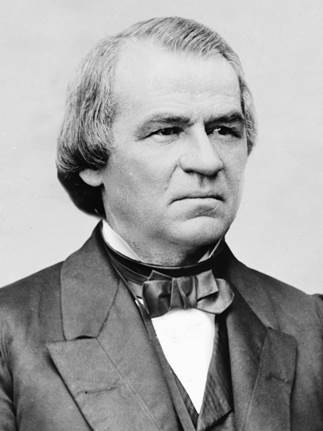
Andrew Johnson (1808-1875) was arguably the poorest of our Presidents, measured in family position (low) and wealth (even lower). His father, a porter for a small tavern-hotel in Raleigh NC, died when AJ was two. His mother, a maid at the same tavern-hotel, remarried a short time later to a man in even poorer circumstances. 

Young Andy Johnson

When Johnson was around ten, his parents apprenticed him to a tailor. It was a kindness. He would be housed and fed, taught a trade, and perhaps, a bit of schooling. Truculent by nature, Andy proved a difficult apprentice. The master-tailor was said to be stern and difficult as well. Likely enough faults to go around. At seventeen, AJ ran off over the state line to TN, where apprentice laws were not valid.

He arrived in Greeneville with little more than the clothes on his back, but within two or three years, had made a go of it. He married, opened his own shop, and with the help of his wife improved what little 3-R lessons he had learned. He did well enough to become politically active in town. Then he was elected to state office, and then to Congress.

Johnson’s first shop

But he never forgot where he came from, or the distance to where he arrived. Or that as a “mechanic,” a term used then for the working class, his bitterest enmity was to the “property” class.

Jefferson Davis: Patrician

There is little similarity between Johnson and Jefferson Davis, except for their closeness in age (1808-89), that they were born in the South, and were basically states’ rights Democrats. Davis’ family were Kentuckians of middle class means. Enough to send their youngest son (JD) to Transylvania College, and then to West Point. 

Young Jeff Davis

Following his education, Davis served as a junior officer in the US Army, and after completing his service commitments, he resigned to become a planter in Mississippi. He not only did very well, but was elected to public office: the United States Congress.

He was, essentially, a southern gentleman. And never forgot it. 

Dem’s Fightin’ Words

It was not slavery that caused the argument. It had to do with the military. Early in their careers, when both men were freshmen Congressmen, the War With Mexico had just begun. There had been a speech criticizing military science and training, with the objective to cut funding, downsize the army and eliminate West Point. As a former West Pointer and soldier, Davis staunchly defended the military, stating that “Arms, like every occupation, requires to be studied before it can be understood.” Davis asked them to consider if a “blacksmith or a tailor could have secured the same results” as General Zachary Taylor’s troops. He had praised Taylor, defended his profession and endeavored to protect future military appropriations.

The War With Mexico…a rehearsal for later.

But it was a red flag to a bull to angry Congressman Andrew Johnson, who perceived the remarks to be demeaning to blacksmiths and tailors. Johnson was insulted and reminded the House that Jesus Christ was the son of a carpenter and Adam a tailor who sewed fig leaves together. This “invidious distinction” Johnson railed, came from the “illegitimate swaggering, bastard, scrub aristocracy” of which Davis was both member and spokesman.

Congressman Jefferson Davis had many faults, but lack of manners was not on the list. He was an unfailingly polite man, and his defense of the military was never intended to be offensive. He apologized immediately. And profusely. Congressman Johnson would have none of it. He had come from nothing, and was proud of his accomplishments. And he always believed that the southern “property” class was most responsible for slavery.

The US Capitol – before 1865

Not that he was without racial bias himself… His basic attitude was that slavery, i.e. free labor, took jobs away from deserving “others.” He believed everyone should be paid wages, and the cream would rise to the top.

Later…

Congressman Davis resigned his Congressional seat to be come a Colonel of Mississippi Volunteers in the War with Mexico, served ably, was wounded severely, returned home to recuperate, and became Secretary of War under President Franklin Pierce.

Andrew Johnson served as Congressman, then Governor of Tennessee, and was finally elected to the U.S. Senate where he served commendably as an unflagging supporter of the Union.

By 1857, both men were U.S. Senators. Johnson had made a solid name for himself as a Unionist, completely opposed to secession, which had been rearing its ugly head for nearly a decade. Davis was now considered the titular leader of the South – despite the fact that he deplored secession.

The relationship between the two Senators was guarded. Davis as always, chilly and polite, and Johnson as always, glowering. Nothing was forgotten. Or forgiven.

Even Later…in 1865

Secession having happened, a Civil War having happened, Davis as Confederate President and Johnson as the only Southern Senator to remain in his seat having happened, Johnson elected Vice President, the war lost, and Lincoln assassinated having happened…

The older Johnson
The older Davis

Jefferson Davis was a hunted man, trying perhaps to consolidate remnants of his beaten army, or perhaps to escape the country. He only learned of Lincoln’s assassination a week after it had occurred. He was now positive that he would be hanged for treason. After all, Andrew Johnson, his long-time enemy, was now President. One story said he even remarked to a friend that he would have preferred to take his chances with the kind-hearted Lincoln than the bitter Johnson.

Interestingly enough, Andrew Johnson was kind to ex-CSA First Lady Varina Davis when she went to the White House to plead for her husband. He said his hands were tied. Nevertheless, he let the issue of what to do with Jefferson Davis lie and die.

Sources:

Johnson, Clint – PURSUIT: The Chase, Capture, Persecution and Surprising Release of Confederate President Jefferson Davis – Citadel Press, 2008

Means, Howard – The Avenger Takes His Place – Harcourt, Inc. – 2006

https://www.britannica.com/biography/Andrew-Johnson

https://www.battlefields.org/learn/biographies/jefferson-davis

Posted in A POTUS-FLOTUS Blog, American Civil War, Andrew Johnson, Franklin Pierce, Nifty History People, Zachary Taylor | Tagged , , , , , , , , , , , , , , , , , , , , | Leave a comment

Zachary Taylor: For Want of a Stamp

Zachary Taylor was arguably the most reluctant of our Presidents.

ZT: A Brief Run-Up

Zachary Taylor (1784-1850) was born in Virginia, but grew up near Louisville, when Kentucky was still part of Virginia. His family was relatively prosperous, but young Zachary, rather than opting for a classical education, preferred to learn from his frontier experience, and joined the very nascent US Military in 1804, about the time West Point was being established. He was commissioned a first lieutenant in 1808. 

When he married the former Margaret Mackall Smith, the two embarked on a life of frontier army living. They had four children; two died as babies. Like many other army officers with families, they kept their children with them until they were of schooling age – perhaps seven or eight. Then they were brought “east” to stay for their education, under the supervision of caring relatives.

Taylor would later say of his wife and lifelong companion, “she was just as much a soldier as I was.” Coming from him, it was a huge compliment. 

General Zachary Taylor

The Regular Army was small in the first half of the 19th century, and Taylor’s promotions were steady, rather than spectacular. Nevertheless, he commanded frontier forts, fought in periodic skirmishes, and earned a solid reputation as a good fighter, a good soldier and a good commander. But not spectacular.

The spectacular part came later – in Mexico.

The Trouble With Polk

By the mid-1840s, Texas, a former Mexican territory, fought for its independence, became its own country (briefly), and decided to annex itself to the United States. Statehood followed, but not without controversy.

By 1844, James Knox Polk, a little known former Congressman, former Speaker of the House, and former Tennessee Governor (forget about the political losses), was nominated for President. Texas – and the spread of slavery – had a lot to do with the controversy. It also had a lot to do with the pending War with Mexico two years later. That Polk won against well-known, aging and still formidable Henry Clay was a complete surprise to everyone.

President James Knox Polk

Modern historians rank Polk very highly for accomplishing all his ambitious goals in one brief four year term. But during his own time and presidency, he was far from popular. This was not merely political. It was personal. He was a cold, humorless, stern fellow, said to be a micromanager (in modern terms). He duly named a cabinet, nitpicked their every action, and seldom sought/heeded their advice or counsel. 

There was a fair amount of Congressional opposition to his policies as well, but Polk was also inclined to ignore them as much as possible. 

When hostilities finally began in Mexico in late 1846, his two main generals, Winfield Scott and Zachary Taylor, each had more than forty years of commendable military experience. Their commander-in-chief, had never been in the army. And while Scott and Taylor had a polite but weak personal relationship, they were united on one front: they both disliked Polk, considered him a meddler, and totally lacking in any sort of military acumen or judgement. 

That the war was won (albeit it took more than two years and cost some 15,000 American casualties), according to Scott and Taylor, it was believed to be no thanks to their C-in-C. 

General Winfield Scott

Perhaps the good news was that President Polk had announced at his inauguration that he would only serve one term – and he hadn’t changed his mind. He also died three months after he retired from office.

The Presidency was up for grabs. 

The Weak Whigs

The Democrats, squabbling all the way, had finally nominated one of the weakest candidates they had: Lewis Cass of Michigan. He had a commendable resume, but nothing to stir the imagination of the public. The squabbling Whigs saw an opportunity.

In the late-1840s, the Whig Party was still an amalgam of various unrelated sectional issues, but this time united by their opposition and personal dislike of Polk. Henry Clay still was “available” – but now past seventy, and already a three-time loser. They did not want to lose again!

They had won in 1840 with William Henry Harrison, an old, retired war hero, recycled from the War of 1812. Perhaps another war hero could win again!

General Zachary Taylor had won a couple of against-all-odds victories, making him a Hero. And he was far more malleable (according to the Whigs) than Winfield Scott, who also won a couple of victories. In a time of political crisis over slavery, Taylor, a slave-holder with property in Louisiana, seemed a better choice.

Problem Was…

Taylor wasn’t interested. He was past sixty, and wanted to retire. He had no political affiliations, and had never voted. The Whigs didn’t care. They wooed. They wooed harder and harder. Taylor kept refusing, but the popular undercurrent still persisted.

The retired General Taylor

Taylor, at home in Baton Rouge, began receiving a great deal of mail – not merely from politicians (who he generally disliked), but from interested citizens.

And in those days, sending a letter was usually free; receiving a letter cost money. Perhaps as much as ten-cents, depending on the distance. It was a substantial sum. The old general was a thrifty man, and the costs of accepting unsolicited letters was mounting. He told his local post office that he would not accept any mail that came postage due.

Meanwhile the Whigs were persistent, and Taylor’s hems and haws were weakening. They finally nominated him – and Whig Party Chairman John Moorehead sent a letter to notify him that he was now formally a Whig candidate. Weeks passed and there was no reply. Finally a month passed with no acknowledgement. The worried politicians sent a representative to investigate in person.

According to the National Letter Carriers Association, their letter, along with dozens of others had been consigned to the dead-letter bin. The presidential nominee had to pay some $7.50 to retrieve a huge pile of his unstamped mail.

The Whig nominee of 1848 didn’t accept his nomination until several weeks after the convention!

Sources:

Eisenhower, John S.D. – Zachary Taylor – Times Books, 2008

Merry, Robert W. – A Country of Vast Designs – Simon & Schuster – 2009

Zachary Taylor

https://www.battlefields.org/learn/biographies/winfield-scott

Posted in A POTUS-FLOTUS Blog, James K. Polk, Nifty History People, Zachary Taylor | Tagged , , , , , , , , , , , , , , , , , , , , , , | 2 Comments

Martha Washington, Lucy Knox and Kitty Greene: Revolutionary Pals

In late fall, 1775, Martha Washington joined her husband in Cambridge, MA.

The Continental Army General

It was never a secret that the bonds of affection between the American Colonies and Great Britain, the mother country, had been fraying for a decade. It was mostly about money, and specifically about taxes. The various wars that GB periodically engaged in (usually with France) for a couple of centuries had spilled over to the American continent. During the 1750s, what was called the Seven Years’ War (there) and the French and Indian War (here), was fought in a variety of places mostly north and/or west of the Appalachian Mountains. 

Wars cost money. Money must be raised. The Brits wanted the Colonies to help foot the bill. The Americans agreed – so long as we had a say in the matter. But Americans had no voice in Parliament. It was the primary bone of contention: taxation without representation. 

Matters came to a head in Massachusetts in April 1775, when shots were fired at Lexington and Concord. The Continental Congress in Philadelphia declared that colonial troops must be raised.

George Washington, a retired Virginia militia colonel, had fought during the French and Indian War, and was considered the most militarily qualified in the American colonies. Now 43, he was a wealthy planter, a decade-long member of the Virginia House of Burgesses, and a delegate to the Continental Congress. 

When he showed up at congressional sessions in his old uniform (which still fit), he was the obvious choice to create/lead an American army. They made him a general, and he departed immediately for Boston. 

Mrs. Washington Arrives in Cambridge

For months, there were rumors that British loyalists planned to kidnap Martha Washington at her Mount Vernon home, and hold the General’s wife for ransom. Other rumors spread that Mrs. W. was an ardent loyalist who planned to return to England by herself.

Of course neither rumor was true – but it was definitely unsettling to Washington, some 500 miles away, and in no position to protect his wife. In October, he asked her to come to Massachusetts.

An aside on wives encamped with the army: In the eighteenth century, war was seasonal. Battles were fought in spring, summer and fall. In winter, soldiers encamped to regroup, plan, assemble food, ammunition and supples, tend to their wounded – and drill. It was not unusual for officers with a) financial means, and b) sufficient relatives to care for their homes/children would have their wives join them. 

Martha Washington was 44 years old in 1775. Her only living son Jack was past 20 and married. The Mount Vernon plantation was in the capable hands of Lund Washington, the General’s cousin and farm manager. She packed up. Jack and Nelly served as her escorts. She arrived in December.

Shortly after her arrival, Mrs. Washington met two women, young enough to be her daughters, and they became devoted lifelong friends. 

Lucy Flucker Knox

The Knoxes were well matched…

Lucy Flucker (1756-1824) was born to wealthy and ardent loyalists. She had a fine education for her sex – and her time. She was a big gal with a good sense of humor and a healthy appetite. Still in her mid-teens, she met Henry Knox, with matching humor and girth. They were both ardent patriots, dedicated to the “American” cause. They fell in love and carried on a secret and flirtatious relationship for two years. Henry called Lucy “the animating object of My Life.”

But Henry Knox, three years her senior, was only a bookseller in the Boston area. The Fluckers’ disapproval is an understatement. A lowborn “bookseller” was a tradesman; unsuitable for their daughter, accustomed to wealth. But Lucy adored Henry, and they married secretly (she was only 18). When her parents found out, they disowned her. When Massachusetts loyalists had the opportunity to return to England, the Fluckers left. Lucy never saw them again. 

…especially at the table!

When hostilities began in Massachusetts, Lucy sewed his sword into her cape, and the couple escaped to Boston to await General Washington, who quickly became impressed with Knox’s military knowledge, particularly artillery, all learned from books.

By November, Knox had devised a plan to take a small party to Ft. Ticonderoga, 500 miles away, “liberate” several large cannons abandoned after the French and Indian War, and haul them back to Boston. It was dangerous, but audacious. Washington approved. 

Then Martha Washington showed up the. The motherly woman and the lively younger one spent their time sewing, mending, knitting and tending to the sick. And hosting lively entertainments.

Epilogue. Lucy and Henry had 13 children, but only 3 survived. She eventually reconciled with her family, and remained close to the Washingtons for life. 

Catharine (Kitty or Caty) Littlefield Greene

Kitty Greene

Kitty Littlefield (1755-1814) was a Rhode Islander, born to upper class Quakers. Her father was a member of the R.I. Legislature. Her mother died when Kitty was ten, and she lived with relatives, receiving an excellent education. Like Lucy, she was in her teens when she was wooed by Nathanael Greene, 13 years her senior. They married when she was 19.

When the Revolutionary War began in Massachusetts. Greene was put in command of the Rhode Island militia, among the first to sign up. Kitty disliked being separated from her husband, and joined him whenever possible, despite bearing five children during the war.

Nathanael Greene

Said to be lively, flirtatious and extremely intelligent, Kitty Greene was a welcome addition among the women who helped provide medical aid to the sick and wounded, sewed and knitted clothing for the soldiers, and added spirit to the lives of both officers and enlisted men. And a seemingly tireless dancing partner for General Washington!

She remained close to the Washingtons throughout her life, despite many ordeals once the war ended. When she remarried ten years after Nathanael’s death, President and Mrs. George Washington stood witness at her wedding in Philadelphia.  

Sources:

Brady, Patricia – Martha Washington: An American Life – Viking, 2005

Roberts,, Cokie – Founding Mothers: The Women Who Raised Our Nation – Harper, 2004

https://www.battlefields.org/learn/biographies/lucy-flucker-knox

https://wams.nyhistory.org/settler-colonialism-and-revolution/the-american-revolution/catharine-littlefield-greene-miller/

Posted in A POTUS-FLOTUS Blog, George Washington, Nifty History People | Tagged , , , , , , , , , , , , , , , , , | 4 Comments

FDR: Meeting on the High Seas

Every public person wishes to escape “privately” from time to time.

Caveat:

This does not mean to “hide” anything salacious, criminal or embarrassing. It may only mean to have the personal freedom to enjoy a good book, or a quiet dinner, or singing a loud ‘happy birthday’ at a family gathering. Without intrusive eyes and flapping lips.

Franklin D. Roosevelt: Dissembler

Long before FDR was crippled by polio and truly curtailed from many activities he long enjoyed, he was essentially a private fellow. His innermost thoughts, public and private, and especially his feelings, were his and his alone.

Always tight-lipped.

As an only child, surrounded by adults, with few opportunities to pal around with age peers, he began to zealously guard his private world, especially from his doting mother. When his elderly father had a heart attack, mother and son conspired to withhold anything that might upset Mister James and cause further suffering. 

When FDR went to boarding school, and then Harvard, the “withholding” tendency now included his mother. If he was lonely, or felt excluded, or wished to socialize more privately (i.e. lady friends), Sara Roosevelt did not need to know.

As time went on, his friends and associates, even the closest of them, called him “dissembling.” It is a fine word. FDR knew it, and frequently admitted that “he never let his right hand know what his left hand was doing.” And he liked it like that. Always would.

FDR: 1941: The Crucial Year

After eight years as President, Franklin D. Roosevelt despite all odds, was beginning to turn a slight corner in battling the worst economic depression the country, and indeed the world, had ever known. Some businesses had been closed for a decade, leaving millions without jobs, and families struggling for bare survival. Many people were literally homeless, camping in tar-paper shanty towns they called Hoovervilles, after FDR’s predecessor who was saddled with the blame. 

The Depression came first

By the end of 1939, there was another mammoth crisis on the horizon. Germany, under its brutal dictator Adolph Hitler, was rampaging through Europe, gobbling up whatever territory fancied him at the moment. By mid-1940, the Netherlands and France both fell within a few weeks. The only hope for Europe was maybe Great Britain, and that was a huge “maybe.” They were barely hanging on themselves.

Unbeknownst to just about everyone, Roosevelt and 65-year-old Winston Churchill, recently appointed British Prime Minister, had been engaged in confidential correspondence, both written and via telephone, for some time. They were like minded on many fronts, and FDR was always a sincere and sympathetic ear for the feisty Churchill. And they were both remarkably astute and canny politicians.

FDR and Churchill: Like-minded

But… FDR  was president of a country that was strongly isolationist. Americans had suffered quite enough during the First World War, only twenty years earlier, and sympathetic or not, did not wish to engage in another European conflict that was none of America’s business. Roosevelt’s hands were tied and he knew it. Even after his unprecedented election to a third term in 1940, any effort to aid GB, or other European nations fighting for their survival was certain to be met with massive resistance on the US home front. Americans were soundly non-interventionists. But there signs they might waver in their neutrality. Sympathy-ties leaned more and more against Germany.

One Non-Secret About FDR

While a huge percentage of the US population had no idea that their president was seriously crippled, many of them knew he was “lame.” (His word of choice.) Lame, i.e. requiring a cane for mobility, is not nearly as devastating to strong public leadership as being in a wheelchair. Or being carried about. There was a tacit conspiracy among government officials, and especially the press, to keep photos of his obvious infirmity from the public. Sitting in a chair was fine; a wheelchair was not. 

A non-wheel chair was fine

One thing FDR was happy to acknowledge openly, was his love for sailing. He had learned to handle a sailboat on the Hudson River in his youth. He loved being on the water, just being aboard and preferably handling the wheel.

The Left-Hand Vacation and the Right-Hand Meeting

In August 1941, President Roosevelt, under enormous pressure, let it be know that he was taking some time off. As usual, Washington was beastly hot, and air-conditioning was still in its infancy. Other than occasional trips home to Hyde Park, FDR had not been away for several months. An outing on the Presidential yacht, the USS Potomac, for a cruise up to New England was just what the doctor ordered, and according to his staff, put a gleam in the President’s eyes.

Perhaps he was glad for the outing. Perhaps he was even gladder because he was about to put one over on everyone!

Look-a likes, or body doubles, are not uncommon. Movies use them regularly to protect their valuable stars from injury – or to perform feats beyond said star’s ability. Doubles are occasionally used to allow people to be in two places at once. Size, coloring, similar clothing or mannerisms are all that is needed. That, plus enough space to blur the image.

So on August 5, the Presidential yacht sailed past the Massachusetts capes, where a crowd enjoying themselves on the beach was waiting along the shores to catch a glimmer of the President. FDR was aboard, relaxing in his captain’s chair, and waving to the crowd who waved back. 

The only hitch was that the POTUS was not on board at all. He had actually boarded the USS Augusta some time earlier, and was steaming ahead toward Newfoundland. He had planned a secret meeting aboard the HMS Prince of Wales with British Prime Minister Winston Churchill. It was the first face-to-face meeting between the two heads of state, which led to the Atlantic Charter. And FDR had managed to keep it a secret!

He confessed all to Congress on August 21.

History is made.

Sources:

Bell, Jack – The Splendid Misery – Doubleday, 1960

Davis, Kenneth – FDR: The War President 194043 – Random House, 2000

Meacham, Jon – Franklin and Winston – Random House, 2003

warfarehistorynetwork.com

https://www.fdrlibrary.org/polio

https://www.nationalww2museum.org/war/articles/great-debate

Posted in A POTUS-FLOTUS Blog, Franklin D. Roosevelt, Nifty History People | Tagged , , , , , , , , , , , , , , , | 1 Comment