The Family Life of Ulysses S. Grant

Ulysses S. Grant was unquestionably a great general.  He was also a great family man.

lg family

Ulysses Grant, surrounded by his wife Julia, and his four children: Fred, Ulysses Jr. (Buck), Nellie and Jesse.

Ulysses Grant: The Poor Family Beginnings

Financially, Ulysses S. Grant was not born to poverty.   It was the family dynamics that were decidedly peculiar.

His father, was a tanner of solid financial means, but he was a bombastic, opinionated man, considered a braggart and blowhard by his neighbors.   Hannah Simpson, his mother, was really peculiar.  She was a cold, emotionless, silent woman who spent her time tending to household chores and reading her Bible.  Dinner conversation was sparse.

Ulysses S. Grant: The Affectionate Dent Connection

When Ulysses Grant graduated from West Point, he was stationed in St. Louis, a common first deployment for new officers.  There he met the family of his academy pal, Fred Dent – and they welcomed him warmly instructing him “not to be a stranger.”

early photo of the grants

Ulysses and Julia Grant would be happily married for nearly forty years.

Some weeks later, Ulysses met Julia, the Dents’ oldest daughter, recently graduated from a St. Louis finishing school.  It was true love at first sight for both of them, and after a four years secret engagement, they would enjoy a particularly warm and loving marriage for nearly forty years.

The Grant Family: The Next Generation

Ulysses and Julia Grant had four children.  Fred, their eldest, was born when Grant was stationed in the Northeast.  When their second son, Ulysses S. Grant Jr. (called Buck from the start) was about to be born, it was a different story.  Grant had been sent to the California territory, and he went alone.   The trip across the Isthmus of Panama was much too arduous for a pregnant woman and a toddler.  Julia returned to her family in St. Louis, where she would remain for nearly two years.

Desperately homesick and lonely the family he had grown to love deeply, Grant foundered.  Shortly after Buck was born, Julia sent her husband a letter enclosing a tracing of the baby’s hand.  It is said that Grant wept, and Grant was not a weeper.

He resigned from the Army and returned to Julia.  Two more children would be born in short order:  Ellen (Nellie) and Jesse.

Ulysses and Julia: The Parents Grant

family in 1861

The Grant family circa 1861: l to r: Nellie, General Grant, Jesse, Fred, Julia Grant and Ulysses Jr. (Buck).

If Grant foundered in California, he failed even more as ex-Captain Grant, aspiring farmer or businessman.  It was not from laziness or fear of hard work.  It was that he had no direction or vocation.  He also had no luck.  For nearly ten years he struggled with little to show for it.  Nevertheless, surrounded by Julia and the children, he was king of his castle.  Both Grants were unusually permissive parents for Victorian times.  Their children were given great freedom of expression and activity – which included freedom from hard study.   His son Jesse remembered that during the Civil War, none of the Grant children had much schooling, and nobody named Grant seemed to mind.  None were destined to be scholars.

In early 1861, the family had just moved to Galena, Illinois, where Grant had taken a menial position in one of his father’s tanneries.    When the Civil War began, the ex-West Point Captain was reinstated in the Union Army, and his rise was the stuff of legends.

His attachment to his family was so strong however, that he insisted they stay near to wherever he was encamped.  For four years, Grant’s family were nomads.

The Grant Family: The War Years

Young Fred was eleven when the War began, and Grant took him along.  Strange as it may seem today, it was at Julia’s specific urging, Throughout the War, Fred encamped with the Army whenever practicable. Of course, if danger or a battle was imminent, he was dispatched back to his mother, who was never far away.

Julia and children stayed in camp with the General on several occasions and were well liked by the soldiers and staff.  Senior officers remember coming into their commander’s tent with the great man on the floor, engaged in horseplay with his sons.  They also commented (disapprovingly) of how the boys rummaged through his papers, spilled ink and otherwise behaved like little boys.  Nellie, of course, was the little china doll.  Neither parent seemed to mind.

The Grant Children:   A Postscript

The proof of the pudding is in the eating, so they say.

Fred Grant went to West Point, Ulysses Grant Jr. to Harvard and Jesse Grant(briefly) to Cornell.  None were exceptional students.

Nellie Grant married a “titled” Englishman at a lavish White House wedding.  She was only seventeen, and the marriage was not a happy one.

the whole family

Grant’s entire family was with him during the last months of his life when he suffered from terminal throat cancer. His published memorials insured that his family would be free of debt, and that his legacy and character would remain unimpeachable.

Fred married a beautiful Chicago heiress.  Both Buck and Jesse would also marry well-to-do women.  Being the offspring of a Great General and U.S. President was a substantial credential for a son-in-law.

It would be the last years of General Grant however, that would prove the character of all named Grant.   Grant’s post-presidential years had started well: a trip around the world, and then, at the behest of his son Buck, a partnership in an investment brokerage, which for a couple of years, boomed.

Grant’s business partner was a scoundrel who had manipulated a Ponzi-like scheme, and left Grant holding the proverbial bag.  He was financially ruined.  So were his sons and their families, since they had invested heavily.  Within months of that fiasco, the aging General was hit with another tragedy: terminal throat cancer.

Determined to repay the brokerage debts and to provide for his family – and to maintain his integrity and good name, he wrote his memoirs.  It would be race against the clock.  The entire family rallied around, helping with research and correspondence with old comrades.  They also greeted the well-wishers who came to pay respects, sparing their ailing father strain of trying to speak.

Julia was never out of earshot.  She would later claim she never cried in Grant’s presence.  Her tears would be private.  She had stood by him through good times and bad, some very good and some horribly bad.

All four Grant children, their spouses and the grandchildren were with him till the end – only a week after he had completed the galleys on his memoirs.

They are considered some of the finest war memorials ever written.  And the family made a fortune.

Sources:

GRANT, JESSE R. – In the Days of My Father General Grant – Harper & Brothers, 1925

GRANT, JULIA – The Personal Memoirs of Julia Dent Grant, G.P. Putnam’s, 1975

KORDA, MICHAEL – Ulysses S. Grant: The Unlikely Hero, Eminent Lives Series, Harper Collins, 2004.

McFEELY, WILLIAM S. –  Grant: A Biography, W.W. Norton & Co., 1981
Posted in A POTUS-FLOTUS Blog, American Civil War | Tagged , , , , , , , , , , , , , , , , , , , , | 7 Comments

The Senior Theodore Roosevelt

Did you know that Theodore Roosevelt, the icon of Mt. Rushmore, was a Junior?

TR SR

TR’s father, a Theodore Roosevelt, Senior, was arguably the most important influence in the future president’s life.

Theodore Roosevelt (1831-76) was descended from a long line of Dutch New Yorkers who settled along the Hudson not long after the Pilgrims planted roots in Massachusetts. Well into the fourth generation, TR Senior was a prominent and well-to-do member of the “Knickerbocker” class, whose glass importing business would insure a life of near-luxury for his family.

At twenty-two, he married Martha (Mittie) Bullock, a Georgia belle, and they would have four remarkable children:  Anna (called Bamie by the family), Theodore Junior, Elliott (Eleanor’s father) and Corinne.

TR Senior: Devoted Father

Little Theodore Junior unfortunately suffered from poor health nearly from birth, and by age three, was diagnosed with severe asthma.  A short life was expected. Theodore Roosevelt Senior spent his nights walking the floor with the boy in his arms, trying to ease the spasms. Some summer nights Father Theodore hitched the carriage at midnight, believing that fresh air and the gentle jog might lull his son into a restful sleep. Then there were the big black cigars that the five-year-old child was forced to smoke, since the doctors believed they had curative powers. (Our TR, by the way, would be a non-smoker all his life!)

Like his siblings, Theodore was an exceptionally bright child with unquenchable curiosity and a voracious appetite for knowledge. Despite poor eyesight, he learned to read early, and by five or six, had developed a true and lifelong passion for natural history. With his father’s encouragement, he collected and catalogued everything: flora, fauna, rocks, birds, fish and insects, and by twelve, he was a bona fide taxidermist.

TR Senior: Committed Father

Because of the family’s wealth, exotic travel was also on the agenda, and the young Roosevelts were exposed to languages, cultures, history, experiences and some exotic flora and fauna that few of their peers enjoyed. Theodore-the-child would practically inhale the benefits from this broad expanse of knowledge, and was blessed with a prodigious memory to summon it nearly at will.

Teenaged TR

Theodore Roosevelt, Junior, with the encouragement of his father, managed to work a frail asthmatic body into a strong advocate for physical fitness.

The story goes that as young Theodore Roosevelt approached puberty, still frail, puny and nearsighted, his father (an apparently robust man) said to him, “Theodore, you have the mind but you do not have the body. You must make your body.” Accordingly, he transformed an upstairs room into a mid-19th-century gymnasium, complete with assorted weights and barbells, punching bags and boxing gloves – and a 19th-century personal trainer to instruct. Thus equipped, TR (the one we know) embraced the strenuous life, and literally shaped up.

TR Senior: Exemplary Father

Physical training would be the second most important gift his father could give him – the first being the time, the care and the devotion the elder man gave to his family. Perhaps the third most important gift from TR Sr. was his splendid example of a fine, upright citizen. He was a firm believer in noblesse oblige, and that great privilege demanded great moral responsibility. He was considered one of the most generous men in New York, supporting dozens of charitable organizations worthy causes. As a founding member of the Newsboys Lodging House, he became a father of sorts to hundreds of young boys, usually orphaned, who hawked the city’s daily papers for pennies. He not only helped financially, but by counseling the boys and even arranging for some of them to find opportunities “out west.”

The only fly in this magnificent ointment of virtue, was his non-service in the Civil War.  TR Senior purchased a substitute. Perhaps he believed that his wife and four children (all in frail health, by the way) needed him more. Perhaps he did not wish to risk facing his wife’s ardent Confederate family on a battlefield. Perhaps both. But it was certainly not from cowardice or opposition to the Union cause. He served on several civilian committees, and was personally acquainted with President Lincoln. TR Junior was only a small boy during those years, but his father’s non-service would haunt him all his life. Time and again he would place himself in harsh physical danger, challenging fate and testing himself to the limit, trying (as some psychologists claim) to rectify his father’s omission.

college-age TR

Theodore Roosevelt, Jr. as he looked about the time his father died. After the Senior Roosevelt died, TR never used “Jr.” in his signature.

When Theodore was about to enter Harvard, his father asked him what he wanted to do with his life. “Natural history” was the obvious choice. TR Senior was encouraging, assuring his support and his belief that his son would achieve great prominence in that field. But, he counseled, it would be a life spent mostly in academic seclusion, and might not appeal to his son’s tapeworm for adventure. With that admonition, Theodore rethought his future, and placed natural history at the top of his list of best-loved hobbies.

TR Senior died when he was only forty-six. He had cancer, a secret kept from the family. Theodore Junior was still in college.

Theodore never used “Junior” in his signature after that time, but he devoted himself to measuring up to those large footsteps for the rest of his life. He would meet, and indeed be one of the greatest men of his era, but he would always refer to his father as “the best man I ever knew.”

Sources:

Posted in Nifty History People | Tagged , , , , , , , , , , , , | 6 Comments

Abigail Adams’ Sorrow: Like Uncle, Like Nephews

Medical science today provides substantial evidence that alcoholism can be a hereditary failing, but even back in Colonial days, people suspected that it ran in families.

abigail and john

Abigail and John Adams were not without their share of sorrows in their fifty years of married life.

William Smith: Abigail Adams’ Brother

Abigail Adams (1744-1818), always a credible witness to her times, had an alcoholic brother, albeit couched in common 18th century euphemisms.  (Alcoholism is a modern term.)  William Smith was the third of the four children of William and Elizabeth Quincy Smith, and their only son.  Reverend Smith was a well-regarded Weymouth, Massachusetts clergyman and educator who strongly believed that his daughters deserved an education as well as his son.

Perhaps it was being surrounded by four intelligent and unusually perceptive women; perhaps it was the old Puritan mantra of “steady adherence to the Path of Duty, however rigorous”; perhaps it was his early marriage yielding more daughters.  Whatever it was, by the time William was thirty, he was well down the Path of Destruction.  Intemperate and chronically in debt, he deserted his wife and four children.  Eventually he would be involved in questionable, if not criminal escapades relating to forgery or counterfeiting or passing phony notes, and died at only forty-two.

Abigail Adams, always a fond sister and ardent protector of all things family, would seldom mention his name in her letters to her sisters, but references to “the poor man” and his follies, or “unhappy connections” would bear the tone of her sympathy.  It was such a painful correspondence, that the three Smith sisters would put a code on the outside of the envelope, so they would know to keep its contents very private.

Poor Charles Adams (1770-1800) 

c-adams

Charles Adams, the second son of John and Abigail, died at only thirty, alcoholic and depressed.

If Abigail Adams believed her brother William to be possessed of a predisposition toward dissipation, it is unknown.  However there is one instance where she mentioned her hope that her own son Charles’ conduct would not “pain” his friends.  It was an intuition that would bear fruit.

Of the four children of John and Abigail Adams who lived to maturity, only John Quincy, their eldest son would achieve the prestige of a satisfied and even stellar life, in accordance with his parents’ fondest hopes and dreams.

Charles Adams, their second son, was always a weaker sort.  Even as a child, when Abigail had the family inoculated against smallpox, it was Charles who suffered the severe reaction when the rest of them had only minor symptoms.  Perhaps as some said, he was weaned too early; perhaps he was too attached to his mother.  John Adams had taken ten-year-old John Quincy to Europe with him, and the precocious boy flourished.  Wishing to do the same for his second son a few years later, the experience for both father and son would be sadly different.  A very reluctant nine-year-old Charles bade his mother a tearful farewell, and Charles was homesick thereafter.  He did not acquit himself either scholastically or socially, and in the end, his well-meaning but dispositionally impatient father sent him back to Abigail.

Charles eventually attended Harvard where he was expelled for some escapade that today would barely raise a stir.  He subsequently read law in New York and later married Sarah (Sally) Smith, the sister of his brother-in-law, a non-blood related William Smith (which always confuses the Adams genealogy tree) and had two daughters.

When George Washington appointed John Quincy as Minister to the Netherlands, the older brother entrusted Charles with his finances.  JQ had saved a moderate sum and wanted his nest-egg invested wisely for the future.  Charles, swayed by his double-brother-in-law Smith, who was always on the edge of a “good deal,” made a foolhardy speculation which cost his brother’s entire savings.

Perhaps overcome by guilt, by dread of confession, by weakness or all of the above, Charles began slipping into a repetition of his Uncle William’s depredation.  The slide would be precipitous, causing the darling of his mother’s heart to “blead at ever pore,” and his father’s heart to harden at his son’s character flaws.  His father’s heart would soften in time, but Charles died at only thirty, drunk and slovenly.

The Thomas Boylston Adams Story

Thomas Boylston Adams (1772-1832), the youngest Adams offspring, grew up in the tumultuous times of the American Revolution, and would barely know his father, who was away for months and even years at a time.

thomas adams

Thomas Adams would take to drink to combat his “Blue Devils.” Abigail and John Adams put his inheritance into a trust so he could not squander it.

Nevertheless, he too went to Harvard and read law, although according to his mother and brother John Quincy, it was “to force his inclination.”  Tom wasn’t keen on law, but he acquiesced to the family profession.

In 1794, when JQ went to the Netherlands, Tom went along as his brother’s secretary.  When he returned home in 1800, he practiced law in Philadelphia with mediocre success.  The “Blue Devils” of chronic depression that would afflict him for life had already begun to surface.  His father, the retired ex-President, urged his youngest son to return with him to Quincy, perhaps sensing Tom’s frailties, and hoping the Adams name might have professional coattails.

Tom half-heartedly entered politics and was elected to the Massachusetts legislature, but resigned a year later.  He married when he was past thirty and sired several children – seven of whom lived to maturity.  But due to his lackluster success, he was forced to make his home with his parents for several years.

While he would prove to be an affectionate son, husband, father, brother and uncle, he began to struggle with the same alcohol demons and melancholy that had destroyed his Uncle William and his brother Charles.  It is also hinted that he had begun to gamble as well.

Some years later, when the elderly John and Abigail made their wills, Thomas Boylston Adams’ share of the inheritance was put into a trust.  They did not believe their forty-five-year-old son could handle the responsibilities.

Sources:

Gelles, Edith B. – Abigail and John: Portrait of a Marriage – William Morrow, 2009

Levin, Phyllis Lee – Abigail Adams – St. Martin’s Press, 1987

http://www.firstladies.org/biographies/firstladies

Posted in A POTUS-FLOTUS Blog | Tagged , , , , , , , , , , , , , , , | 3 Comments

The Two Mary Lincolns Disaster

It was inevitable. Mary Todd Lincoln, mother-in-law, and Mary Harlan Lincoln, daughter-in law…

mary harlan
Mary Harlan, daughter of Iowa Senator James Harlan, became Mrs. Robert Lincoln.

 Mary Lincoln Meets Mary Harlan

young robert
Robert Todd Lincoln, about the time he married Mary Harlan. Both Abraham and Mary Lincoln had favored the match.

When the Lincolns came to Washington in 1861, they became acquainted with Senator and Mrs. James Harlan, Republicans of Iowa. In due course, Mrs. Lincoln met Mrs. Harlan’s young daughter, Mary Eunice.

Even though the young Miss Harlan was only fourteen or fifteen at the time, Mrs. Lincoln, with no daughters of her own, took a fancy to the pretty young girl. She always had a fondness for young people, and was romantically inclined. Her oldest son, Robert eighteen at the time, had just started Harvard. It is not unlikely that the social-minded Mrs. Lincoln may have had some future “notions.”

Lincoln’s Second Inaugural

When Abraham Lincoln was inaugurated for his second term in March, 1865, the mood was far different than the one in 1861. Everyone sensed that the end of the Civil War was near. The blood would be stemmed. The killing would stop.

Robert Lincoln was now twenty-one, and graduated from Harvard. He was presently a Captain on General Grant’s staff, home on leave. When he spent the entire evening at the Inaugural Ball waltzing the eighteen-year-old Mary Harlan around the dance floor, the Lincolns were delighted.

A few weeks later, the Harlans, including Miss Mary, were Mrs. Lincoln’s guests on her trip to Richmond, just as the Confederacy was at its last gasp. Captain Robert Lincoln was happy to see Miss Harlan again. If his mother had her hand in matchmaking, she was doing well.

Robert T. Lincoln Marries Mary Harlan

When Abraham Lincoln was assassinated only weeks later, Robert’s future plans  were abruptly changed. Instead of returning to study law at Harvard, he was obliged to “read law” with a Chicago firm, still an acceptable form of legal education.

Robert and his Mary corresponded regularly for the next three years with the understanding that once he passed the Illinois bar, they would marry.

Robert, only in his early twenties, was now the head of the Lincoln family. Mary Lincoln, deeply grieving for her husband, had developed a pathological fear of poverty, and the consequences of her emotional turmoil splashed regularly on her son. Only months before Robert’s wedding, Mrs. Lincoln had embarrassed herself, her son, and the country by attempting to sell some of her old clothing. Immediately after the wedding, the humiliated Mary left for Europe, accompanied by her teenaged son, Tad.

Mary Lincoln and The Happy Couple

The former First Lady had been delighted to welcome the new Mary Lincoln into the family, particularly since she knew how fond her late husband had been of the girl who was now their daughter-in-law.

While Mrs. Lincoln was abroad, she corresponded regularly and affectionately with her son’s bride. Mother Mary, the inveterate shopper, sent gift after gift back to the newlyweds in Chicago. When she learned of her impending grandmotherhood, she was understandably thrilled. Her letters were filled with well-meaning advice and suggestions for the mother-to-be, along with an assortment of presents for the baby-to-be.

But “Uncle Tad,” now seventeen, grew homesick for his brother, so the Lincolns came home. Mary was anxious to see her baby granddaughter, also named Mary, ostensibly in her honor. Robert and his Mary opened their home and hearts to them.

The Marys Part Ways

bobs kids
Mamie, Abraham Lincoln II (Jack) and Jessie Lincoln – Bob’s kids. Mamie is the only grandchild Mary ever met.

The former First Lady was unquestionably a difficult woman, who could be imperious and demanding, along with a hefty dose of self-pity. Now living in close quarters, those failings began to rile the young Mrs. Robert Lincoln. It did not take long before the young mother packed up, took little “Mamie” and went on an extended visit to her own parents. Exactly what that straw was (if indeed there was a single issue), has never been determined. It was obvious, however, that no house was large enough for two Mary Lincolns.

It was a bad time for everyone. Young Tad sickened and died before his eighteenth birthday. Once again, a grieving and hysterical mother was plunged into deep despair. Once again it would be Robert Lincoln who would accompany a casket back to Springfield, Illinois, and he would go alone. His mother was overcome and prostrate. His wife was unavailable. She had made it very clear that she would not return as long as her mother-in-law was there.

The Widow Mary, despondent and lonely, moved on and on. She had no place to call home. She would never again set foot in her son’s house. The two Marys would never correspond again. She would never see the two other grandchildren who would be born. Whenever Robert Lincoln attempted to help his distraught mother, it was a solo effort. His own personal anguish when he felt compelled to have her declared “insane” was never fully realized until a half-century after his death. If he received any personal comfort from his wife, it is undocumented.

The End of the Marys

The elder Mary Lincoln, half-blind and diabetic, spent her last year living with her sister in Springfield – in the very house where she had married Abraham Lincoln nearly forty years earlier. The rift between mother and son had mended somewhat, and Robert brought little Mamie (now about eight) to see her. He also brought his wife to see her. Perhaps they made their uneasy peace.

After Mrs. Abraham Lincoln was dead for forty years, an elderly Mrs. Robert T. Lincoln would deny any animosity between them. She would tell Robert’s cousin, Katherine Helm (and Mary Lincoln’s first biographer), that indeed, she loved her mother-in-law, thus sanitizing the record for historians.

But actions speak louder than words. Mary Todd Lincoln was never a part of their lives.

Sources:

  • Helm, Katherine, Mary, Wife of Lincoln, Harper & Brothers, 1928
  • Lachman, Charles, The Last Lincolns, Union Square Press, 2008
  • Neely, Mark E. Jr., & McMurtry, R. Gerald, The Insanity File: The Trial of Mary Todd Lincoln, Southern Illinois University Press, 1993
  • Randall, Ruth Painter, Lincoln’s Sons, Little, Brown, 1955
Posted in A POTUS-FLOTUS Blog, Abraham Lincoln, Nifty History People | Tagged , , , , , , , , , , , , , , , , , | 2 Comments

Winnie Davis: The Daughter of the Confederacy

Varina Anne Davis was a tragic story from the start.

Winnie Davis’ First Years

Jefferson Davis Papers

Mrs. Jefferson Davis holds baby Winnie, her last child and second daughter, who was born just as the Confederate efforts were beginning to decline rapidly.

“Little Pie Cake” as she was called for the first year of her life, entered the world in June, 1864, the second daughter and sixth child born to Confederate President Jefferson Davis and his wife.   Her birth was only six weeks after a freakish accident: her five-year-old brother fell to his death from a third story balcony at their home in Richmond.  Then too, the Confederate States of America was beginning its demise.

Months later and nursing, the still-unnamed baby made the long and harrowing flight south, as the Confederate capital at Richmond was crumbling.  By the time she was finally named, (Varina Anne for her mother), and forever nicknamed “Winnie”, her older siblings had been sent to Canada, care of her maternal grandmother, and her father was sent to Fortress Monroe, where he was chained and imprisoned.

Jefferson Davis, was in his late fifties, well old enough to be her grandfather.  He had always been frail in health, and now he was blind in one eye.  The strain of the past four years aged him far past his years.  Varina-the-mother, nearly forty and formidable, now embarked on her own campaign: to unchain the non-violent ex-Confederate President, and allow him more humane treatment.  She managed to succeed to a point that she and baby Winnie were permitted to join Jeff in his casement prison at Fortress Monroe in Virginia.  They stayed there for nearly two years.

Eventually freed, Davis was in dire straits.  The lands of the once-wealthy planter had been ravaged beyond repair.  His former occupations as soldier and statesmen were forever closed to him, and at sixty, Davis was a man without a country – and a man without an income.  He was also a man with four children under fifteen.

For the next dozen years, the Davis family traipsed back and forth across the ocean, never really belonging anywhere.  At an age and health condition when most men think of retirement, home would be wherever Jeff could get a job.   When she was twelve, Winnie was placed in school in Germany;  by the time she returned when she was around sixteen, her parents were living at Beauvoir, a pleasant shore-house in Biloxi, Mississippi that had been owned by a family friend .  Her sister Margaret, older by ten years, had married; and her two older brothers had died young of natural causes.  It would be just Winnie and her parents.   She would become her father’s constant companion.

The South “Discovers” Winnie

winnie davis

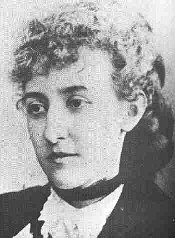
Winnie Davis would be permanently known as the Daughter of the Confederacy.

By the mid-1880s, a white-haired and elderly Jefferson Davis had become the symbol of the South’s “Lost Cause,” and was enjoying an Indian summer of popularity that he had never quite managed as CSA president.  He was invited everywhere!  His pretty daughter usually accompanied him.  It was at one of these appearances that Winnie Davis was introduced to the crowds as “The Daughter of the Confederacy” – a soubriquet that stuck.  She became an instant icon:  she was their daughter.  They loved her.   She was immediately adopted by the thousands of Southerners who saw in her the “Melanie” they longed for.

It would be a very mixed blessing for her.

The Romance of Winnie Davis

Prior to the Civil War, the Davises had many northern friends, and now some old friends in Rochester, NY invited Winnie to visit, and her tragedy began to unfold.

Young attorney Alfred (Fred) Wilkinson was a child during the early 1860s, but was born a Yankee, and even worse, had prominent abolitionists in his family tree.  Nevertheless he and Winnie fell deeply and sincerely in love, and they wanted to marry.   It would spell doom for the star-crossed lovers.  This would not be acceptable with her parents – let alone the entire South.

The emotional stress took a physical toll.  In her depression, Winnie fell ill, and finally confessed her heartache.  As expected, the Davises were not pleased.  But they also loved their daughter dearly, and wanted her to be happy.

winnie-davis

Winnie Davis was the idealized woman of the late Nineteenth Century, and her star-crossed romance with New Yorker Fred Wilkinson is the stuff of drama.

The Davises eventually consented to meet Fred, and, as expected, realized that he was not an ogre, and had he been born in the South, they would have welcomed the young man cordially.  Davis finally was persuaded to give his consent to an engagement, perhaps believing that his own prestige might soften the public reaction, which would be loath to accept their Daughter married to a damnyankee.   But before an engagement could be announced, Davis died.

So everything was postponed indefinitely; the strain of it wreaking havoc on poor Winnie’s health.  She had never inherited her father’s iron will or her mother’s intimidating personality.   Close to a complete breakdown, she returned to Europe, and began writing – an occupation for which she had a genuine flair.  She would write and publish several Victorian age romance novels.

But her own romance was faltering.  Fred always claimed it was Mrs. Davis who destroyed whatever slim chances the couple had for happiness.  Mrs. Davis said it was about money.  Maybe.  She finally relented, but it was too late.  Winnie’s spirit was broken.  Their engagement was broken.  She could not buck the public furor.  Fred could not buck the indomitable Varina Davis.

 A Sad Little Ending

Winnie returned home to live with her mother – in the North!  She continued to write, but became more and more dependent on Varina.  Poor Winnie died at only thirty-three.  They said it was gastric malaria.  Maybe it was also the Victorian broken heart.

Fred slipped into the church at her funeral, and sat alone in the back.  He never married.

Sources:

  • Cashin, Joan E. – First Lady of the Confederacy: Varina Davis’s Civil War, Bellknap Press, 2006
  • Rowland, Eron – Varina Howell: Wife of Jefferson Davis: Volume II (reprinted) Pelican Pub Co Inc., 2002
  • Ross, Ishbel – First Lady of the South: The Life of Mrs. Jefferson Davis, Greenwood Press, 1958
Posted in American Civil War, Nifty History People | Tagged , , , , , , , , , , , , , , , , , , | 9 Comments

The Herbert Hoover Presidential Site

It is not Paris. It is not even Mt. Vernon. But history lovers must not overlook the charmer of an understated and underrated Presidential Birthplace and Library in tiny little West Branch, Iowa.

 The Herbert Hoover Birthplace

hoover birthplace2

A tiny two-room cabin in tiny West Branch, Iowa is the birthplace of our 31st President, Herbert Hoover

Herbert Hoover was born in West Branch in 1874, the son of a struggling farmer-blacksmith and his wife. By the time he was ten, both his parents had died, and he went to live with relatives in Oregon. But for the rest of his long life (he lived to be ninety), Hoover would always regard West Branch and Iowa as his home. His memories might fade with age, but they were fond ones.

The house of his birth itself still stands, furnished with a few original pieces of the Hoover furniture. Other items are period pieces from the surrounding area. It is a small house, only two rooms in its 14-by-20 space, attesting to the humble beginnings of Hoover’s life.  The surrounding structures have been purchased and recreated to look like that tiny village of 350 people, much as it was a hundred and fifty years ago.

The site was purchased by Mrs. Herbert Hoover as “physical proof of the unbounded opportunity of American life.” She died in 1944, many years before the place she envisioned was properly developed. It was privately operated until 1965, when it became part of the National Park System. Both Herbert and Lou Henry Hoover are buried at the site.

The Herbert Hoover Presidential Library

Herbert Hoover Museum

The Hoover Library and Museum is a little gem in the middle of Iowa. Lots of great information and displays – and a rare glimpse into a President who is barely known, and some say, much maligned.

Compared to the massive and majestic buildings housing some of our modern presidential libraries, the Herbert Hoover Library could fit into a small corner. The building is not large or imposing. You can drive by and not even know it is there. In actuality, it is very much alike the shy man it honors. Not inclined to toot its own horn, but once inside, you are in for a surprising treat.

The Library is part museum, part archive, part historical site, and part gift shop. Scholars seeking academic materials for their projects are warmly welcomed by a small team of dedicated archivists, who are happy to direct your search into the life and times of the man whose amazing life can be summed up as a Horatio Alger story: poor boy makes good. In Hoover’s case, it was poor boy makes VERY good.

The Herbert Hoover Museum

The museum contents and story is a delightful peek inside the man who rose from a poor orphan to a multimillionaire by the time he was thirty. Herbert Hoover worked his way through Stanford University to become a mining engineer. Thanks to his enormous energy and capacity for work, an uncanny “nose for mines,” a genius for administration, and desire to get ahead, he was able to obtain positions far beyond his youth and experience.  By the time he was twenty-five (in 1900), he was earning more than $40,000 a year – equal to ten or more times that amount in today’s money. To put it in real perspective, the President of the United States only made $50,000/year!

The museum houses exhibits from his mining days in the Australian Outback, exhibits from being marooned inside a tiny enclave during China’s Boxer Rebellion where Herbert Hoover’s leadership became apparent to all, and exhibits from World War I, when he discovered his true calling: humanitarianism on a massive scale.

Then there are displays commemorating his inclusion in the cabinets of both Presidents Harding and Coolidge, and from his inauguration as President in 1929. It even includes a replica of the fishing cabin Mrs. Hoover had built in the Maryland mountains, so they could relax from time to time. There is also a full scale re-creation of Hoover’s retirement suite in the Waldorf Astoria Hotel in New York City and Mrs. Hoover’s collection of exquisite blue-and-white Chinese porcelain vases. The display cases are attractively designed. The accompanying text is easy to read and understand.

It is a treat to follow the fascinating career of the woefully neglected and much maligned man who became our 31st President. No other President with the exception of George Washington came to office with higher expectations for greatness. None left office with greater disappointments. The decade following his presidency found him enshrined as the face of the Great Depression, buried in ignominious failure. Most historians today readily acknowledge that Hoover has been given a raw deal, and deserves the respect and regard he is only now beginning to reclaim.

Visiting Information

The Herbert Hoover Presidential site is located just off I-80, at Exit 254. A single modest fee covers admission to all aspects of the site, and there is a gift shop with unique items and souvenirs for the history buff. The facilities are open daily from 9-5, closed only on Christmas, Thanksgiving and New Year’s Day. Parking is free.

If you are in the neighborhood – stop in.  It is well worth the time!

Posted in A POTUS-FLOTUS Blog, Herbert Hoover, Presidential Sites | Tagged , , , , , , , , , , , , , | 4 Comments

Julia Tyler: Fashionista

About five years before becoming a First Lady, a nineteen-year-old Julia Gardiner was featured in an actual advertising promotion.

Miss Julia Gardiner

Julia Gardiner was pretty, socially prominent, and very very rich.  Her father, Senator David Gardiner, was a “Gardiner of Gardiners Island”, off the tip of Long Island, New York.  He had served two terms as New York State Senator, and retained the title for life.  Her mother, Juliana McLachlan was the only child of a wealthy brewer.  Money flowed from both sides.

young julia

Julia Gardiner was still in her teens when this early photo was made.

In a household of two sons and two daughters, Julia was fashionably educated at a Manhattan finishing school for young ladies, and was seen in the best society.  Her dresses were expensive and fashionable, her furs and jewelry were expensive and fashionable, her carriage was expensive and fashionable.  Her choices of companions came from the most prominent residents of New York.  And they all went to the most expensive and fashionable vacation resorts of the early nineteenth century.

The Advertising Campaign

Bogert and Mecamly was a fashionable retail establishment that catered to the prominent New York social set.  Somehow (never completely ascertained) the merchants obtained a steel engraving of Miss Gardiner.  Many modern historians suspect that Julia, a saucy nineteen-year-old, was complicit in making the engraving available to the merchants.  In 1839 or 1840, those engraved likenesses were not mass produced; they were for private use.  It may be that Julia had visions of Messrs. Bogert and Mecamly plying her with the latest and most fashionable fans and ribbons, etc.

rose

Miss Julia Gardiner, the future Mrs. John Tyler, was positively identified as the fashionable demoiselle who was featured in the advertising handbill.

Nevertheless, whatever the reasoning or the procurement of the engraving, the result was a handbill depicting a well-dressed young society demoiselle holding a shopping bag.  The bag boldly advertised:  “I’ll purchase at Bogert & Mecamly’s, No. 86 Ninth Avenue.  Their Goods are Beautiful and Astonishingly Cheap.”  (Not that Julia cared about price tags.)  At the bottom of the flyer, the lovely young shopper was identified as “Miss Julia Gardiner, the Rose of Long Island.”

At nineteen years old, it is more than likely that Julia thought the situation was great fun; her society-minded parents took a dim view of the affair however.  This was an age where no respectable lady permitted her name to appear in the newspapers, let alone on an advertising handbill.  To complicate the situation, a few weeks later a love-poem appeared in a Brooklyn newspaper dedicated to Miss Julia Gardiner, the Rose of Long Island.  Her horrified parents, dreading a social scandal, whisked the family off to Europe to let the talk die down.

Julia Gardiner:  The Toast of Two Continents

The Gardiners, with their deep pockets and even deeper social aspirations, spent nearly two years in Europe.  They hobnobbed with minor royalty, up-and-coming wealthy industrialists and similarly situated officialdom.  They also purchased all the latest “stuff” that Paris, Rome and London had to offer.

When the Gardiners returned to New York, their four children (two older brothers and one younger sister) were all of marriageable ages, and Senator and Mrs. Gardiner decided to introduce their hugely eligible offspring to the movers and shakers of America.

They took rooms with parlor privileges in the best boarding house in Washington, and each member of the family was given a personal stack of calling cards, which they proceeded to dispense all over town.  The Gardiners left cards for congressmen, judges, generals, high ranking government officials – and, of course, the Tyler family in the White House.  In a few days, they were plied with invitations to teas, receptions, luncheons, dinners, card parties and whatever was popular on the social front.  They fit in perfectly – and were happy to use their parlor privileges to return the invitations.

Portrait Of Julia Gardiner Tyler

Julia Gardiner’s trademark tiara, which she wore across her forehead, caught the attention of the soon-to-be-widower President John Tyler.

Julia Gardiner, with youth and beauty and fashion savoir faire, including her unique trademark  tiara worn across her forehead, was an immediate hit.  Unfortunately, all the men vying for her attention were old enough to be her father.  She charmed and disarmed, but was cool.  She even received an invitation to the White House along with sincere admiration from President John Tyler himself (whose invalid wife was dying upstairs), but Julia disdained all suitors.  She claimed they were all much too old.

After the end of the social season, the Gardiners moved back to New York to flit and buzz at the fashionable watering places where they could see-and-be-seen.  But Washington society was never far from their sights.

By the following social season, the White House was in mourning.  Letitia Tyler had died, and a respectfully mourning President began to focus discreet and irreproachable attention on “The Rose of Long Island.”  Again she demurred.  But John Tyler, still slim, handsome and athletic at fifty-three, pursued.  He was a very persistent man.  He was also a Southern courtier of the highest order.  She began to waver.  It is very hard to say no to the President of the United States.

Within a year, Miss Julia Gardiner, the Rose of Long Island, would have a new title:  Mrs. Julia Tyler, First Lady of the Land, and the country hadn’t had such a fashionable First Lady since Dolley Madison.

Sources:

Posted in A POTUS-FLOTUS Blog, John Tyler | Tagged , , , , , , , , , , , , , , , , , , , | 3 Comments

Mrs. Adams Goes to Paris

Abigail Adams had never been farther from home than Boston, when her husband sent for her to come to Paris.

The Separations of Abigail and John Adams

abigail and john

Abigail and John Adams would endure long periods of separation for the first fifteen years of their marriage.

When the Adamses married in 1764, John Adams was a struggling attorney, riding a wide court circuit around  Boston, trying to earn a living. At that time, travel was either by foot, by horse, by horse and vehicle, or by ship. John would be gone for days at a time.

When the politics of revolution were filling the air in the 1770s, John Adams became one of its most prominent spokesmen, and as such was a delegate to the Continental Congress in Philadelphia, some five hundred miles away. It would take about two weeks for him to reach Philadelphia – and he and Abigail would now be separated for months at a time. The letters between John and Abigail Adams flowed.

Mr. Adams Goes to Paris

In 1778, the Continental Congress sent John Adams to Paris to help negotiate loans and trade and general French assistance for the struggling new country.  Their letters, which had been frequent during the Philadelphia separations, would dribble nearly to a halt across the Atlantic Ocean.  The separation between him and his beloved wife would now last for years.

Transatlantic crossings were infrequent. It was also a time of war, between the erstwhile colonies and  Great Britain, the world’s superpower. Ships were lost or taken as prizes.  Mail packets were ceremoniously dumped into the sea – after the important correspondence was confiscated. Whenever a ship from Europe arrived at Boston harbor, Abigail hurried into town and haunted the wharves, seeking out passengers and crew, trying to learn where and how her husband was. Months passed before Abigail even knew if her husband was still alive.

Abigail Adams Plans a Trip

nabby

“Nabby” Adams was around nineteen when she accompanied her mother to Europe.

Finally John sent for her. She was forty. Her two youngest children were old enough to be left with family. She took her nineteen-year-old daughter Nabby. And, since her husband held an important post in the new country’s government, she hired a married couple as servants, befitting his high status.

Traveling was a daunting challenge. The journey would take between a month and six weeks, depending on weather conditions.  Weeks of planning were essential; much was needed and collected.  Most ships were cargo rather than passenger vessels. They provided a means of travel – but little else.

There would be a cook on board, but passengers needed to supply their own food. Dozens of chickens would be brought for their eggs, and later butchered as they neared the end of the journey. If milk was wanted, a cow would be brought. Barrels of beer and ale, fresh water and wine would be brought.  Barrels of flour, of corn meal, of salted meats, of preserves, of sugar and lard. Abigail brought gallons of vinegar, and enough soap and candles to last for months. She did not know what to expect, other than the tales people had told about chronic mal-de-mer, so she also brought her medicine box of potions and powders to fend off the sea-sickness she justifiably feared.

Passengers were also expected to bring their own entertainment: knitting and sewing supplies, books and cards, chess boards and games. Abigail had purchased French grammar books, and her little party spent hours teaching themselves the language – from books. (She would manage to read French passably, but her conversational skills would be non-existent. No one was available to teach her pronunciation.)

The Adams party also had to bring their own bedding and linens. Abigail, Nabby and their woman servant were assigned to the best accommodations – a tiny cabin which they could separate from the rest of the crew by hanging a clothesline with a sheet over it for privacy.

Sanitation facilities consisted of a wooden bucket which was carried on deck each day, tied to a rope and thrown overboard for cleaning. No wonder Mrs. Adams had faced the voyage with dread. And she would be just as seasick as she had feared.

Then of course, the old ship came nowhere near Abigail Adams’ criteria of cleanliness, thus the gallons of vinegar. Abigail, Nabby and her servants would spend hours cleaning and scouring every inch of the vessel, to make conditions more acceptable.

Abigail Adams Arrives in France

parisian costumes 1785

Abigail Adams had never seen anything like the great cities of Europe before. She had never been farther from home than Boston, less than fifteen miles away, in her entire forty years.

Five weeks later, Abigail Adams finally arrived in Paris. It was an awakening like nothing she had ever imagined. She had never been in a large city before; tiny Boston only had a population of perhaps 15,000. Paris was a city of palaces and gardens, of magnificent buildings and avenues. She would see art and theatre, hear opera and concerts. She would meet world renowned people.

She had believed that two competent servants would be sufficient for the American diplomatic couple. She was overwhelmed to find herself living in a palace of her own, with more than a dozen servants already in place.

John and Abigail Adams would spend nearly five years abroad, first in France and then in London. Abigail would grow in scope and experience far more than she had ever dreamed.  Many of her preconceived notions of propriety and society would change. Her entire outlook would change. She would become more cosmopolitan. Her notions of culture would mature. When she became First Lady, her revolutionary spirit would be tempered by a deeper understanding of traditions and manners and the need for order.

Abigail Adams would always retain her essential Americanism, but after spending time in Europe, she would never be quite the same.

Sources:

  • Foster, Feather Schwartz – Mary Lincoln’s Flannel Pajamas and Other Stories From the First Ladies Closet – Koehler Publishing, 2014
  • Holton, Woody – Abigail Adams, 2009, Free Press
  • Levin, Phyllis Lee – Abigail Adams, 1987, St. Martin’s Press
  • Nagel, Paul C. – Descent from Glory, 1983, Oxford University Press
Posted in A POTUS-FLOTUS Blog, John Adams | Tagged , , , , , , , , , , , , | 6 Comments

The Polarizing Mrs. Lincoln

  Mrs. Lincoln is never viewed in neutral.  You either love her or hate her.

mary for suite

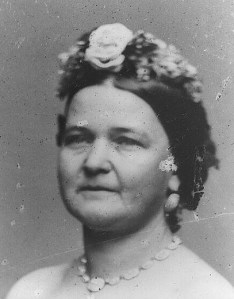
Mary Lincoln was always a polarizing figure during her own time, and forever after. One either is a great partisan or a great detractor.

Some historians evaluate Mary Todd Lincoln as a termagant who made Lincoln’s life a misery.  Some claim she is one of the most misunderstood characters who ever lived.  Her supporters usually are in a position of being apologists rather than devotees.

Mary Lincoln:  The Bad Press

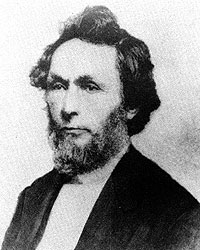
Much of the spate of hate about Mrs. Lincoln comes from William Herndon, Lincoln’s law partner of nearly twenty years.  There was no love lost between Mrs. L. and Billy Herndon, considered by many to be a notorious drunk and liar.  Much of his comments on Mary Lincoln were spiteful, and in some cases, outright fabrications.  The Herndon-Weik book (Herndon’s notes were given to Jesse Weik, and published after both Herndon and Mary Lincoln had died) was taken as gospel for generations.

Herndon

William Herndon, Lincoln’s law partner and later biographer, could not stand Mary Lincoln. She detested him in turn.

Mary, of course, did little to help her own cause.  She had a hair-trigger temper, and little control over her emotions.  What she felt in her heart went flying right out of her mouth – or her pen – bypassing brain entirely.  John Hay, Lincoln’s secretary, referred to her as “the Hellcat.”  Most people who knew her did not like her.  The incessant shopping and overspending were scandals while she was still in the White House;  the dozens of letters she sent to powerful political figures demanding money that she believed was “due to her” as the widow of the martyred president were tacky at best;  the later publicity of the Widow Lincoln trying to sell her clothing; and her trials for insanity that were printed in all the newspapers sealed her reputation beyond salvaging.

Mary Lincoln: The Better Press

Some forty-odd years after Mary’s death in 1882, her niece Katherine Helm, by then an elderly woman herself, wrote Mary’s biography.  It was the first biography devoted solely to Mrs. Lincoln.   Even adjusting for the glossy Victorian language, it provides a wealth of information about a woman who looms high in history for no other reason than association:  a reflection of Abraham Lincoln’s glory.

The assassination

Mary Lincoln was always emotionally fragile, but the assassination of her husband in 1865 traumatized her for life.

There are many historians and psychologists today who surmise that Mrs. Lincoln likely suffered from a bi-polar condition, or perhaps a “personality disorder,” or perhaps both.  Vital information about Mary’s childhood indicated that Mary was “either in the garret or the cellar,” or likened to a day in April, smiling and sunny one minute, then dissolving in tears the next.  The bi-polar suggestion obviously has merit.  So does a personality disorder.  They are not mutually exclusive, but in Mary’s time, diagnosis and treatment was practically nil.

Today, there are dozens of major biographies about Mrs. Lincoln, all with their own distinct points of view.  A collection of her letters, meticulously researched and annotated, has become an invaluable resource to biographers and historians.  They never fail to engage the reader with quick and lively wit, her easy dimpled smile, and her warm affection and generosity to those she liked.  Still, she never fails to be her own worst enemy.  It shows up in black and white, in her own words, and no matter how much one may try to “befriend” her, or even pity her.

Mary Lincoln:  Searching for Neutral Ground

One sad truth pervades the life of Mary Todd Lincoln: she was a deeply lonely woman.  As a child, she had playmates and classmates, particularly since she came from a large family.  But her relationships with her siblings were never especially close, either in childhood or adulthood.  As a young woman in Springfield, Illinois (prior to her marriage), Mary Todd was arguably at her peak of social happiness.   She was part of her little “coterie”, of young folks who went to dances and lectures and plays.

Once she married, however, her husband became “her all,” a common term and condition among Victorian women.  Old friendships faded as husband and children became central.   She had some pleasant neighbors and exchanged visits.  Once Lincoln became more prominent, his professional companions and peers entertained each other from time to time.  But there are few instances of her friendships, possibly because people moved away and letters were exchanged at rare intervals; possibly because the associations were superficial and paths diverge.

mary in mourning

After Lincoln’s assassination, Mary wore nothing but morning clothing until she died seventeen years later.

In the White House, she alienated society from the start.  First Lady Mary saw her position as superior, rather than equal.  Congressional or cabinet wives in her circle were few.   Most of those around her might be considered good, kind women who believed it to be their moral duty to befriend a generally friendless, and after her son Willie died, sorrowful woman.  What becomes obvious in any study of Mary Lincoln, is that there were very few people who genuinely liked her for herself, and who enjoyed her company.   Nothing is more telling than the conspicuous absence of family when Abraham Lincoln was assassinated.  Many had come for the first Lincoln inauguration, but no one rushed to Washington to be at her side in April, 1865.

There are and always will be those who make and keep friends easily.  There are and always will be those who never seem to find a home among people.  Was she mad, as some said?  Few psychologists today would classify Mary Lincoln as insane.  More likely, she was an emotionally fragile soul, permanently traumatized by loss, grief and one horrendous event.  Had she been married to anyone else, she would be completely overlooked by history.  But she wasn’t.  She was married to Abraham Lincoln, and if for no other reason, it is practically impossible to be neutral.

Sources:

Clinton, Catherine – Mrs. Lincoln: A Life, 2009, HarperCollins

Helm, Katherine – Mary, Wife of Lincoln, 1928, Harper and Brothers

Turner, Justin G. and Turner, Linda Levitt – Mary Todd Lincoln: Her Life and Letters, 1972, Alfred A. Knopf,

Posted in A POTUS-FLOTUS Blog, Abraham Lincoln, American Civil War | Tagged , , , , , , , , , , , , | 3 Comments

The Common Touch: Presidential Style

The Common Touch, like Common Sense, is anything but Common.

 The Elusive Quality of the Common Touch

The Common Touch is one of those rare qualities that must be inborn, natural and absolutely sincere. It can sometimes be affected, but it is usually perceived as such, and scorned.

the hero

Andrew Jackson had the gift of the Common Touch. His adherents would follow him to hell and back.

Andrew Jackson and Abraham Lincoln had the Common Touch; then again, few presidents came from a more common background. But wait! Andrew Johnson and Herbert Hoover both came from very similar poor and humble beginnings, yet neither of them were able to connect with the public.

lincoln

Lincoln could put conceptual thoughts into words the average person could understand. They would trust him.

But wait again! The Common Touch has nothing to do with background, wealth or upbringing. Both Roosevelts, Theodore and Franklin, had the Common Touch in abundance – and both were wealthy and pedigreed and privileged.

Moments of Common Touch

This is not to say that moments of the Common Touch have not notably been achieved.  Sometimes they are the stuff of legends. When George W. Bush came to New York City a few days after September 11, and one of the workmen hollered they couldn’t hear him, G.W. replied through his bullhorn, “That’s OK.  I can hear you.” It was natural. It was spontaneous. It was the perfect response. And it may have been his finest moment.

This, by the way, has nothing to do with the “modern” presidency either. Farm boy Harry Truman had the Common Touch – but it was perceived as a little too common for most people. Farm boy Jimmy Carter never had it, although he knew it existed and tried to make it work for him. He wanted to be photographed in jeans, and insisted that his Presidential documents were signed “Jimmy.” That was too common for most people, too, but Carter does not seem to have cared. The Common Touch was not natural to him. It was an affectation.

Richard Nixon did not have the Common Touch either. He knew he didn’t have it, and he also knew that when he tried, it was awkward and uncomfortable. But he always craved it.

George Washington’s Moment

Our first President was truly beloved and admired by all, but few Presidents were more remote in their one-on-one situations. George Washington was then as now, the “marble man,” seldom seen in his most human role.

Yet one of his finest moments was at the end of the Revolutionary War when his officers were threatening a mutinous march on Congress to collect back pay. They had called a meeting – without their Commander-in-Chief. General Washington got wind of it however, and spent an entire day drafting and redrafting his response to this crucial situation.

young GW

The Father of our Country preferred to be at arm’s distance. No one would dream of calling him “George.”

What he planned to say, however, did not move his officers nearly as much as the moment the fifty-year-old General put on his spectacles to read his remarks. He begged their indulgence for wearing his glasses (something they had never seen him do before), and said that “he had not only grown gray, but nearly blind in the service of his country.”

It was off-the-cuff. It was exactly what was needed. It moved the crowd to tears. It was remembered forever.

John Quincy Adams’ Moment

Few Presidents were more aloof than the acerbic John Quincy Adams. As a youth at Harvard, he was known to roister happily with his fellows in the taverns, but by the time he was in his twenties and President Washington sent him into diplomatic circles, the crustiness of his disposition had taken hold.

JohnQuincyAdams

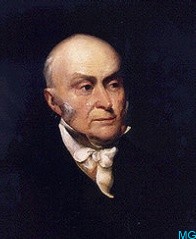
When John Quincy Adams took off his coat, the crowd cheered. He should have done that years earlier.

He was, however, a superb diplomat, and his foreign counterparts liked him and admired him. It was only at home where was always at arm’s length. He depended a great deal on the social skills of his wife to “endear” him to the public – efforts which were usually greeted with a resounding thud.

It was at the end of his disappointing Presidency that the sixty-year-old President had his “moment.” He had been invited to break ground for the new Chesapeake and Ohio Canal on the 4th of July. The ground was hard and resistant to the shovel.  J.Q. was a man dedicated to physical fitness, and swam a mile in the Potomac River every day – a hard exercise. Despite his age, he was physically fit.

After several attempts to break the hard soil, the aging President did the unthinkable: he removed his coat. (In those days, a man never appeared in public without his coat, no matter how hot it was!) But J.Q. took off his coat, put his shoulder to the shovel, and the ground yielded. The crowd broke into a roar of applause! Mr. Adams had bonded with them, for just a moment. He knew it too. He confided to his diary that “my casting off my coat struck the eye and fancy of the spectators more than all the flowers of rhetoric in my speech.” Perhaps he regretted not doing it years earlier.

Woodrow Wilson’s Moment

Woodrow Wilson was another remote man, scholarly and pedantic. He had been a very popular professor, and most of his students enjoyed his classes. He explained things well; his extracurricular seminars and lecture series were well attended. He loved teaching, he loved oratory, and he loved being in front of an audience. But he had about as much of the Common Touch as John Quincy Adams. He did not take well to familiarity.

President Wilson

Woodrow Wilson was a schoolmaster who could be admired, but seldom loved.

But one time when he addressed a large audience, one of the attendees hollered out his encouragement, i.e “You tell ‘em, Woody!” It was not a particularly momentous occasion. At least not to the public.

But it was a moment that Wilson never forgot. “They called me   ‘Woody’ he remarked to a colleague afterward, with a tone of pathetic joy. Nobody called him “Woody.” Not ever. Not even as a boy. And he wanted to be called “Woody” very very badly.

Sources:

Boller, Paul F. – Presidential Anecdotes – Oxford University Press, 1996

Unger, Harlow Giles – John Quincy Adams – Da Capo Press, 2012

Posted in A POTUS-FLOTUS Blog | Tagged , , , , , , , , , , , , , , , , , , , , , , | 1 Comment