The Tragedy of Tad Lincoln

When you think about it, Tad Lincoln’s short life was truly a tragic one.

Tad Lincoln:  The Early Years

tad

Tad Lincoln spent one happy year in the White House. The next three were lonely ones.

Thomas Lincoln, nicknamed Tad from the start, was the fourth and last child born to Abraham and Mary Lincoln.

It did not bode well from the beginning.  It was a difficult birth, with hours of labor, requiring two doctors to attend.  Whether or not birthing difficulties were responsible, Tad was born with a cleft palate, something routinely repaired today.  It wasn’t fixable in 1853, so Tad had a serious speech defect, making him hard to understand.  He also showed symptoms of what today might be classified as some youthful dyslexia, coupled with attention deficit.  But Tad Lincoln had a sunny, mischievous temperament, and was clearly not retarded, so his lenient parents encouraged him to be a boy as long as possible.

By Tad’s earliest memory, his brother Robert, older by ten years, was away at prep school.  Little Eddie had died years earlier, and Willie, older by two-and-a-half-years, would become his best friend and boon companion.  Abraham Lincoln had established himself as a fairly prominent attorney when the younger boys were growing up.  Now in his middle forties, with more time on his hands, Lincoln was truly able to discover the joys of being a father to little boys.

Tad Lincoln: The White House Years

Tad and Dad

Abraham Lincoln became Tad’s best friend after Willie died. The President kept his youngest son with him as much as possible.

When the Lincolns moved into the White House, Tad was not quite eight.  Since they were the first “First Family” to have young children, the permissive Lincolns gave the boys the run of the place.  Mrs. Lincoln had become acquainted with Mrs. Horatio Taft, Washington matron with two sons exactly the same age as Willie and Tad, and four fellows became inseparable.  While staff members grumbled about the usual lack of discipline associated with little boys at play, President and Mrs. Lincoln were delighted.  And those innocent adventures were arguably Tad’s happiest memories.

A year later, eleven-year-old Willie died of typhoid fever, and Tad’s tragedy began.  Mary, in her excessive grief, could not bear reminders of her dead son and banished the Taft boys from the White House.  Tad not only lost his brother and best friend, but he would never see his beloved playmates again.  If he ever had “pals” later in his life, it went unrecorded.

It was also impossible for the inconsolable Mary to “mother” her also-grieving son, so Lincoln himself, the grieving father, stepped into the breach, and became Tad’s new best friend.  Lincoln kept the boy close by, allowing him the run of his office.  Congressmen, cabinet members and other officials would sometimes find Tad asleep on Lincoln’s sofa, or under his desk.  If Abraham Lincoln had been lenient before, he now became indulgent.

Tad Lincoln had just turned twelve when his father was assassinated.  In the turmoil that followed, little attention was paid to a boy who had just lost his father.  It was wartime.  Thousands of boys lost fathers.  Tad began to adjust to the situation, and announced that he was no longer a “special” boy, but an ordinary one, now that his father wasn’t President anymore.  He told his mother he would no longer need a nurse to help him dress; he would dress himself.  He began to grow up.

Tad Lincoln:  The Tragedy Continues

Robert Lincoln, at twenty-one, was now man of the family, making decisions far beyond his years and experience.  He “read law” with a prominent Chicago firm, and had little time to devote to a babyish and spoiled kid brother who nevertheless idolized him.

Tad at 18

Tad Lincoln, about the time he left for Europe with his mother. He would spend three years abroad.

Mary Lincoln’s pressing concern now was Tad’s education, which had been woefully neglected.  She knew it.  Tad was on an educational par with six-year-olds, and that wouldn’t do.  He required aggressive private tutoring.

Perhaps puberty began to kick in, but Tad’s childishness abated somewhat.  Forced to concentrate, he began to make slow progress.  Mary Lincoln’s decision to move to Europe a few years later was in part predicated on the progressive educational methods they espoused – particularly in Germany.

Tad was surrounded by more tutors – including special speech instructors.   By this time, he had grown very close to his emotionally fragile mother, who relied on him heavily for comfort and companionship.  If he wasn’t with his tutors, he was with his mother.  If he had any schoolmates or close friends of his own, it has never been discovered.

By 1871, Robert Lincoln, was twenty-seven, an established attorney, married, and a father.  “Uncle Tad” had become homesick and wanted to return.  The ten year age gap between Robert and Tad Lincoln was beginning to close.  Robert wanted to counsel his young brother about his future plans, and believed that “Mr. Thomas Lincoln” was old enough to be consulted on family matters.

Robert would hardly recognize him.  Tad had grown and was still growing.  He also had Lincoln’s homely features.  His speech impediment was still obvious, but now he spoke with a vague German accent from imitating his tutors.  And while he would never be a scholar, he had made enormous strides.

Robert was ready and eager to be the big brother, but there was no time.  Tad Lincoln had caught cold on the voyage, and the cold lingered and worsened.  He barely had the chance to reacquaint himself with the brother he hardly knew.  Propped up in a special chair so he could breathe easier from the pleurisy that had developed, he finally breathed his last.

He was just eighteen.

·        Sources:

Cl  Clinton, Catherine –  Mrs. Lincoln: A Life, 2009, Harper Collins

·         Epstein, Daniel Mark – The Lincolns: Portrait of a Marriage, 2008, Ballantine

·         Keckley, Elizabeth – Behind the Scenes, or Thirty Years a Slave and Four Years in the White House, 1988 (reprint from 1868), Oxford University Press

·         Painter, Ruth Painter – Lincoln’s Sons, 1955, Little, Brown

Posted in A POTUS-FLOTUS Blog, Abraham Lincoln, American Civil War, Nifty History People | Tagged , , , , , , , , , , , , , , , , , , , | 5 Comments

Varina Davis: Queen of the South

In 1861,  Mrs. Jefferson Davis was hailed as the First Lady of the Confederacy.  Today she is virtually unknown. 

Varina Howell Davis: The Early Years

Even though Varina (pronounced Va-REE-na) Howell (1826-1906) was born and raised in Natchez, Mississippi, her Howell lineage had strong Northern roots.  Her grandfather, a Revolutionary War officer, had served four terms as Governor of New Jersey.

Her education was mostly via private tutoring, but her teacher, a retired Massachusetts judge, taught her well.  He recognized that the young girl had a bright, questioning and independent mind, and he encouraged her to think for herself.

wedding picture

Jefferson and Varina Davis at the time of their wedding. He was seventeen years her senior, and had been a widower for eight years.

At seventeen, she met Jefferson Davis, a widower eighteen years her senior.  The following year they were married.  Davis had just been elected to Congress.  From the start, Varina traveled in exalted political circles, and became a true helpmeet to her husband.   At first she merely handled clerical tasks, such as franking his “postage free” envelopes by signing his name.  Not long afterwards, she began serving as his amanuensis – taking dictation from him.  It would be a task she continued until Davis died.

Varina Davis: The Unpopular Confederate First Lady

Mary Lincoln was totally unknown when she became First Lady, but Varina Davis was very well know, both North and South.  She had been highly placed on the national-social scene for fifteen years, and had numerous friends above the Mason-Dixon line.  In the South, Jefferson Davis was its preeminent Senator and spokesman.  He had served for four years as Secretary of War under President Franklin Pierce.  Then he was elected Senator from Mississippi.  With so many years of high-level entertaining as both Cabinet and Senate wife, Varina was perfectly equipped to assume social leadership in Richmond.

But… Mary Lincoln was disliked and criticized in Washington; her Richmond counterpart was just as unpopular.

First and foremost, Varina Davis was a large woman.  Her admirers say 5’8”; her detractors say 5’10”.  Either way, she was tall, and the slim beauty of eighteen, was now a thirty-five year old matron with three children.  Two more children would be born during the war years.  If the South was looking for the epitome of delicate womanhood, the formidable Mrs. Davis was not it.

varina-2

Varina Davis was the First Lady of the Confederacy from 1861 until the end of the Civil War.

Her physical appearance was further compounded by the fact that she was outspoken, with a caustic, biting wit.  As her husband’s long-time confidante, she was completely familiar with the political issues, and just as savvy as the men who surrounded the Confederate President.  If she had an opinion, she had access to the top, and never hesitated to speak her mind.   This, of course, did not endear her to many.  Women said she put on airs.  Men claimed that she was domineering, and decried “petticoat government.”

And if Mary Lincoln was suspected of Southern sympathy if not downright disloyalty because of her Southern upbringing and kin, Varina Davis was also accused of divided political affections.  She knew and kept in touch with many of her Northern cousins – and even worse, her closest friend Minna Blair was the wife of Lincoln’s Postmaster General and member of his cabinet.

The Many Hats of Varina Davis

Varina Davis wore many hats in the Richmond White House of the Confederacy.   She entertained continually – even when shortages curtailed refreshments and the expected accoutrements of gracious Southern hospitality.  She nursed her husband on a routine basis – his health was always poor.  She sat up with him half the night reading to him, to coax the insomniac Davis into sleep.  Her hands were never idle.  She knitted and sewed for the soldiers, just like every other wife and mother in the South.  But first and foremost, Varina was mother to a growing family.  Jefferson Davis entrusted his capable and more than competent wife to care for their children, relieving him of worry about their welfare – especially since the Civil War was never far from Richmond.

Varina Davis and Mary Lincoln also shared a tragic experience.  The Lincolns lost a young son during those War years.  So did the Davises.  Five-year-old Joe Davis fell from a balcony on the third floor of the Confederate White House, and died immediately.  There was barely time for a proper funeral.  Varina was eight months pregnant with her last child.  She did not have the luxury of mourning.   Her grief – and the grief of Jefferson Davis – was private.

 Varina Davis:  The Ex-Confederate First Lady

Jefferson Davis Papers

Varina Davis and her baby daughter “Winnie” shared Davis’ incarceration at Fortress Monroe for two years after the end of the Civil War.

When the Civil War ended, Jefferson Davis was captured, chained and incarcerated in Fortress Monroe, near Norfolk, Virginia.  He was nearly sixty, blind in one eye, and frail.  It would be Varina who lobbied hard for improving his treatment (he was no threat to anyone) – and eventual release.  Having arranged for her children’s safety in Canada, she and her infant daughter spent nearly two years sharing his fortress prison.

Once released, with concerns about supporting their family, the Davises drifted back and forth for years between Canada, Europe and various points south.  They eventually ended up back in Biloxi, Mississippi in a shore house named Belvoir, along the Gulf of Mexico that had been owned by a family friend.

Despite his abysmal health, Jefferson Davis lived to be eighty-one, and Varina, eighteen years his junior, would have nearly eighteen years of widowhood.  She wrote Jefferson Davis’s biography, which in truth was just as much her own biography.  Its sales were disappointing.  The Davis fortune had been long gone and her income modest at best.  At loose ends, she accepted an offer from Joseph Pulitzer to write occasional columns for his newspaper.  She had always been a lively writer with an engaging style, and needing money, she accepted the offer and moved to New York City.  There she would meet and become friends with Julia Grant, the widow of Union General Ulysses S. Grant.

The South never forgave her.

Sources:

·      CASHIN, JOAN –  First Lady of the Confederacy, 2006, Belknap Press

·      ROSS, ISHBEL – First Lady of the South, 1958, Harper & Bros.

     WILEY, BELL IRVIN – Confederate Women, 1975, Greenwood Press

I


Posted in American Civil War, Nifty History People | Tagged , , , , , , , , , , , , , , , , , , , , , , | 2 Comments

Grover Cleveland: White House Bridegroom

Can you believe it?  Grouchy Grover Cleveland was a newlywed!   But it is true.  At age 49, long time bachelor President Grover Cleveland was married in the White House.

The Best Kept White House Secret

formal portrait

President Grover Cleveland, a 49-year-old bachelor, was no  Adonis.

When he was elected in 1884, the heavy-set (300 pounds!) mustachioed, jowly-scowly-looking President was the target of every Washington matron. He was considered the most eligible man in the country, eminently suitable for their widowed or spinster sister/daughter/niece or other relative.  Grover Cleveland (1837-1908) was not interested.

No one knew it, but he had been secretly engaged to Miss Frances Folsom (1864-1947), a twenty-one year old recent graduate of Wells College. The reasons for the clandestine plot were many. First and foremost, the President believed adamantly that his private life was nobody else’s business and furthermore, had absolutely nothing to do with his presidential duties. Secondly, he had had his fill of the “ghouls of the press” during his election campaign. They had discovered that several years earlier he had fathered an illegitimate child. He admitted the paternity, and documented his financial responsibility in the matter. The country forgave him. He, however, soured on reporters.

The young MRs. C

Frances Folsom, with dimples and a peaches-and-cream complexion, was everyone’s darling!

Perhaps most compelling was that he did not want himself or Frances to be scandalized. Not only was she young enough to be his daughter, an eyebrow raising tidbit of cradle-robbing by itself, but she had been his legal ward for several years. Her father, Oscar Folsom, had been Cleveland’s law partner and best friend. When Frances was born, “Uncle Cleve” provided the baby buggy. When Folsom was killed in a carriage accident some years later, Cleveland, as executor of the estate, assumed guardianship of the little girl and her mother. He managed their finances and was an integral part of their lives. He gave Frances her first bouquet, her first long gown and high-heeled slippers, and arranged for her college education. He was considered a quasi-relative. That was more than a raised eyebrow. The connotations could be just as scandalous as his illegitimate child.

The Secret is Out of the Bag

Almost immediately after Cleveland’s inauguration, Frances Folsom and her mother left for a European grand tour and an opportunity to purchase a trousseau. The secret held. Cleveland wasn’t talking. Frances did not even tell her closest friends. But about the time the Folsom women were due to return, the Washington newspaper reporters got wind of a big scoop. Exactly what triggered the speculation is still speculated. Perhaps it was the fact that the President had just purchased a large house in Georgetown, and was preparing to become a commuter. Bachelor Cleveland had never owned a house before.

Most of the conjecturing about a Cleveland marriage centered on Emma Folsom, Frances’ mother. It made sense. She and Cleveland were close in age. They had known each other for years. But when the truth came out that pretty young Frances, with the dimples and the peaches-and-cream complexion was going to marry Grover Cleveland, well into middle age and nowhere near an Adonis, the country was actually delighted! The bands started playing the latest hit song from The Mikado: “He’s Going to Marry Yum-Yum”.

cleve wedding 2

Since no photographers were allowed at the White House wedding ceremony, the artists had a field day trying to imagine the festivities.

Cleveland, President first, bridegroom second, had made all the White House wedding arrangements himself. It might have been the social event of the year, but it was minuscule. Less than fifty invitations were issued, all handwritten by the President. He engaged the minister and even made amendments to the vows. He planned the honeymoon. His sister, who had been filling in as acting-First Lady for a year, ordered the supper, chose the flower arrangements and sent for the Marine Band. All Frances and her mother had to do was purchase their gowns and show up.

The press was banned from attendance, or even from interviewing the bride. The White House windows were blacked out so they could not even get a glimmer. The details of the wedding and honeymoon were so shrouded in secrecy that it became a major challenge for the reporters to learn anything.

The Press Descends on the Honeymoon

President Cleveland and his new bride slipped away undetected, whisked off in a hidden carriage to the railroad station for a waiting train to take them on their honeymoon in the Maryland mountains. Newspapermen were on hot their trail, and followed them in a hired private train.

clevelands

The happy couple. Their marriage lasted for more than twenty years – until Cleveland’s death. They had five children.

Reporters surrounded the President’s cottage, and even climbed trees to keep watch with binoculars. They described every possible detail they could glean from waiters and housekeepers. Their breakfast and dinner menus were posted on the front pages. When they reported that “Mrs. Cleveland Plays the Piano for the President,” every piano manufacturer in the country began volunteering one of their instruments to the White House for the new First Lady’s pleasure – in return for the privilege of saying so. Cleveland declined the offers.

Grover Cleveland spent the rest of his Presidency grousing and grumbling in a futile fight against public intrusion. Frances, however, was the darling of the press. They adored her, and she never seemed to mind the glare of publicity, which was non-stop. After his term ended, the Clevelands retired in sort-of privacy for four years. Then he was elected again.  By this time they were parents, with another baby on the way.

Sources:

·       Brodsky Alyn – Grover Cleveland: A Study in Character. NY, St. Martin’s Press, 2000

         Foster, Feather – The First Ladies, Sourcebooks 2011

·      Means, Marianne – The Woman In the White House, Random House, 1963

Posted in A POTUS-FLOTUS Blog, Grover Cleveland | Tagged , , , , , , , , , , , , , , , | 4 Comments

PURSUIT: A Book Review

Chasing, Capturing and Releasing Confederate President Jefferson Davis is one exciting story!

Author Clint Johnson, North Carolinian journalist and re-enactor, does not care for Jeff Davis.  He is entitled.  Biographers and historians should have a point of view, and he is not alone.  For 150 years there have been long lists of people who disliked Jefferson Davis.

pursuit 2

PURSUIT: The Chase, Capture, Persecution and Surprising Release of Confederate President Jefferson Davis, by Clint Johnson

Davis’ virtues and his failings are basically the poles of the characteristic.  He was loyal to his friends (exclusionary), unfailingly courteous (aloof and remote), unflagging in his convictions (rigid and unbending), and above all, unyielding integrity (he could never admit to being wrong ).

History has not covered him in glory, but it does not smear him with garbage, either.  The fallacies of his efforts to escape seem to live on in our imaginations far more than the actual truths involved.  Whether author Johnson likes ol’ Jeff or not, he is fair; his judgments are insightful.  His research is excellent.

President Abraham Lincoln himself had told a few people, notably Generals Grant and Sherman, that he would personally prefer that Jefferson Davis (and some other top Confederates) “escape the country”, believing that it would shorten the time to heal the wounds.  Had Lincoln lived, that may well have been the case.  But Lincoln was assassinated only a week after Robert E. Lee surrendered at Appomattox Court House, and the chase was on bigtime.

Davis, sincerely believing he had obligations as the political head of the Confederate government, despite its obvious death throes, made efforts to create a government on wheels.  The falsehood that he absconded with the Confederate treasury is a half-truth.  He did fill a train car with the treasure, but it was meant to pay the soldiers.  Davis was insistent about that; he did not take a dime, nor would he.  It would have been totally out of the “good side” of his character.  He had lost all his fortune and property, but he still would not raid the till any more than Lincoln would have.

The Confederate President, and indeed most Southerners, did not learn of Lincoln’s assassination until days, and possibly weeks after the event.  Davis was shocked.  He was further shocked (but not surprised) when he, personally, was indicted as a co-conspirator.  This fallacy was widely believed in the North, given the tenor of the times.  It was blatantly false, and within a month, all evidence pointing to Davis dissolved into nothingness.  Nevertheless, the charges would linger.  Then, of course, there were the charges of treason.  A horrible war had just been fought.  Hundreds of thousands of men were now dead.  Someone had to take the blame.

Jefferson Davis’ escape route was basically a half-hearted effort to either a) go west, over the Mississippi River, and create a guerilla-type of sub-army to keep the war going; or b) reach Florida or some other coastal area where a ship might be found to take him out of the country.   He further had the personal need to reunite himself with his wife and four young children – ages ten down to less than a year old.  He had sent them to safety shortly before Richmond fell.

Reuniting with Varina and the kids happened somewhat by accident.  And it is that episode that lingers in historic fantasy: Jeff Davis trying to escape in woman’s clothing.  It was false as well, but it made a terrific story, and did more damage to Davis by ridicule than could possibly have been done elsewise.  The newspaper cartoonists had a field day.  But the truth of the matter was far more mundane.  He had picked up his wife’s raincoat by mistake (she was a large woman – nearly as tall as he was), and she had thrown a shawl over his head for added protection against the weather and the cold.  Not nearly as good a story as the pantaloons and hoopskirts that continues to this day.

Possibly the most interesting part of Pursuit (a very interesting book), is the long incarceration of Davis in Fortress Monroe under the weasly snot-nosed General Nelson Miles, the long list of prominent Northerners who volunteered to post bail and defend (pro bono) the ex-Confederate President, and finally – the real kicker – the reasoning behind his release and non-trial.

Davis himself wanted a trial.  That was part of his character: a chance to take the national stage and defend his position that secession was lawful under the U.S. Constitution.  (Charges that he was complicit in Lincoln’s assassination were dropped.)  The trial for treason never came.  After two years in prison, Davis was freed on bail, and his case was never pressed.  Why?  The country was ready to “Hang Jeff Davis from a sour apple tree.”   Maybe Lincoln had a hunch.

Author Johnson does a masterful job of making a complicated and difficult case understandable to the layman.  And it is a case worth reading about.

PURSUIT: The Chase, Capture, Persecution and Surprising Release of Confederate President Jefferson Davis, by Clint Johnson, Citadel Press/Kensington Publishing Company, 2008 – $24.98

Posted in Recommended Reading | Tagged , , , , , , | 2 Comments

Monticello and Sagamore Hill: Connected in Essence

Presidential homes usually provide the essence of the men who lived there, but none better than Monticello and Sagamore Hill.

Thomas Jefferson’s Monticello

monticello

Thomas Jefferson’s graceful Monticello sits atop a mountain in Virginia’s Blue Ridge.

Thomas Jefferson was a Renaissance man of the Enlightenment. He somehow managed to compress half a dozen careers into one lifetime – all simultaneously, but none guaranteed to provide him a fortune. He was a lawyer, a planter, an architect, an agronomist, an inventor and a political theorist. And a pretty fair writer with a particularly graceful way with words.

Jefferson was a long time widower when he finally finished building, rebuilding and tweaking his beloved Monticello situated on a mountaintop with a view of Virginia’s Blue Ridge. Although his married daughter and many grandchildren lived with him for decades, the classically structured mansion is pure Jefferson. He designed it himself. He labored over every inch and every detail of the Palladian structure. He claimed to be happier there than anywhere else on earth. Indeed, after he retired, he seldom left his home.

monticello dining room

The dining room at Monticello. Well ordered and intimate.

He surrounded himself with everything he loved. Even a casual visitor to the historic site can practically breathe in the spirit of Mr. J. His books filled the place. Not so many now, since he provided more than 2,000 during his lifetime to seed the Library of Congress. His inventions are visible throughout, mostly designed for his own convenience: the swivel chair, the auto-pen “copier,” the seven day calendar-clock, the dumb-waiter. His dining room was small, but it could be expanded. His wine cellar was considered one of the best in the country. His parlor contained sculptures and portraits of the people he admired or loved best. (Photographs were in the distant future.) His private gardens are a thing to behold. The kitchen garden alone is a football field of every type of vegetable. Flowers abounded. Jefferson the gardener planted, transplanted, grafted and experimented with his own garden of earthly delights.

But it is his entry hall that bespeaks the man in his breadth: the inquisitive intellectual reveling in the artifacts, the trophies, the specimens and relics, some from the ancients, and some from the Louisiana Purchase. One could easily picture the aging sage happily poring over every inch of the largesse he was sent from the Lewis and Clark Expedition.

Theodore Roosevelt of Sagamore Hill

sagamore hill

Theodore Roosevelt’s Sagamore Hill on Long Island.

Theodore Roosevelt did not like or admire Thomas Jefferson, and said so many times. (Jefferson, having died several decades before TR was born, had no comment).  In many ways, it is easy to understand. Their personalities and philosophies were diametrically opposed: TJ, the cool, intellectual deist with an idealistic view of humanity at its best; TR, the exuberant moralist, with a healthy skepticism of human nature. TJ the considered; TR the rambunctious. Interestingly enough, Theodore also was a Renaissance man, but one of the Industrial Age. He too enjoyed many simultaneous careers: prolific writer, natural scientist, cowboy, rancher, soldier, and above all, politician. None was guaranteed to make him a fortune, either.

If Jefferson physically and metaphorically is perched on his lofty mountaintop, Theodore Roosevelt is physically and metaphorically grounded. Sagamore Hill, is not far from the Long Island Sound in Oyster Bay, New York. Originally intended for his first wife who tragically died in childbirth at twenty-three, Theodore completed the sprawling late-Victorian mansion and moved in three or four years later, with his second wife. The family would include six children. Edith Carow Roosevelt had known Theodore since early childhood, and their tastes, though individualistic, were similar.

the great room

The Great Room at Sagamore Hill, is like the man himself: a clutter of exuberance..

Like Jefferson, Roosevelt’s home is a monument to the masculine. Its wrap-around porch is a perfect setting for raising a large family dedicated to the strenuous life: plenty of open ground for play, adventure, exploring and everything else essential to Rooseveltian enjoyment. Although Edith had her own space and inserted some feminine touches, the home itself was dedicated to TR. Books of all kinds were everywhere – in book cases, on shelves, above-doorway nooks, corner crannies, and at bedsides. They were all prolific readers. There are portraits and photographs of his favorite people. Most of all, the house oozes fun, and you can practically see the ghosts of interesting people with compelling conversation. Life lived there was life lived to the fullest.

The dining table, accommodated at least eight regularly, and usually more. Guests were frequent and always welcome. Dinner conversation went in every direction – mostly all at once. Hunting trophies from Roosevelt’s various expeditions bore witness. Souvenirs and artifacts are everywhere. Some came from foreign dignitaries, given during his White House days; some from his ranching days, some from his beloved Rough Riders.  Some from his childhood. The house is a testament not only to him, but to the Victorian penchant for personal clutter. Not an empty wall or a bare table. If one could imagine Jefferson inspecting the Lewis and Clark artifacts, one could just as easily imagine Roosevelt wishing he were Lewis and Clark.

TJ and TR: The Common Bonds

thomas jefferson

Sargeant Teddy The quintessential Jefferson and the quintessential Theodore Roosevelt.

In retrospect, TJ and TR have more in common than in disparity. Now, as forever-neighbors in that rarified company on Mount Rushmore, they have eternity to symbolically explain themselves to each other.

mount rushmore

Jefferson and Roosevelt: Forever neighbors with a good view!

Perhaps more than anything, they are bound by their love of natural science.  Both could easily have pursued it professionally with distinction. TJ documented a lifetime of planting in his Garden Books; TR was a bona fide taxidermist by the time he was twelve.  They both looked passionately at science as pure “dee-light.” TJ might tell TR about purchasing the land near Virginia’s Natural Bridge to keep that monument undisturbed by the intrusions of man. TR might tell of preserving millions of glorious acres for the same purpose. Had Jefferson known those places existed, he would surely have done the same.

But above all, they would share a great view of the America they both so loved.

Sources:

·         Hagedorn, Hermann, The Roosevelt Family of Sagamore Hill, 1954, The Macmillan Company

·         Howard, Hugh, Thomas Jefferson Architect: The Built Legacy of Our Third President, 2003, Rizzoli International Publications, Inc.

Posted in A POTUS-FLOTUS Blog, Presidential Sites, Theodore Roosevelt, Thomas Jefferson | Tagged , , , , , , , , , , , , , , | 2 Comments

Jackie O: On the Couch: A Book Review

Inside the Mind and Life of Jackie Kennedy Onassis by Alma H. Bond, PhD

The Fascination with Jackie O

Jackie O on the Couch

“Jackie O On The Couch” by Dr. Alma H. Bond

There have been dozens of books about Jacqueline Kennedy Onassis. The fascination with her has not ceased even though it has been more two decades since her death. Jackie O. On The Couch is one of those rare delicacies that walks the fine line between fiction (written in the first person) and fact – seriously researched. Done with a gentle humor and the classy style that one expects of its subject, it is a hard book to put down. Dr. Alma Bond does a masterful job of arranging her chapters in a sort-of chronology, but mainly in a series of relationships. It is as if Mrs. K-O were really talking to us – and she is a delight to hear.

There is an old saying that “where love is impossible, money is indispensable.” Put into context with Jackie Kennedy Onassis, that says it all. In twenty brief chapters, Jackie O. manages to present that poor little rich girl image she never stopped portraying: A flamboyant absentee father, a strict, cold absentee mother, a competitive and envious sister, a philandering husband in John F. Kennedy – scratch that to husbands and include Aristotle Onassis, a variety of in-laws who disliked her, and a paparazzi that hounded her. She claims to have loved both her husbands.  Maybe, maybe not. It seems that love was never returned.

Jackie O: A Class Act

Jackie O. was the supreme touch-me-not.  The epitome of classiness and style.  The American Queen.  Everything she wore was copied, and she wore only the best. She presented culture in an era where culture was dying. Dr. Bond devotes considerable space to Jackie’s sincere love of the arts, whether opera, theatre, poetry, ballet or visual arts. She also makes note of the fact that none of her relationships – including her relatives – shared those interests, until her last romance at the end of her life.

Most of the book is devoted to her marriage to John F. Kennedy and the Kennedy family. She includes courtship, early marriage, the White House years, and the assassination. It is what one might expect. In commenting on her televised program of the newly redecorated White House, author Norman Mailer is quoted as saying that Jackie Kennedy “moved like a wooden horse and sounded like an aspiring but totally untalented actress.” She didn’t like the comment, but it was (if anyone has ever seen the production) spot-on. The content and decor were wonderful, but she was indeed wooden, with a little girl voice. She would always prefer to be photographed rather than phonographed.

Jackie O: A Cool Lady

Dr. Bond is a psychoanalyst with many years of experience, both in her discipline and as an author. In 260-pages, Dr. Bond does her best to warm up that quintessential touch-me-not, but Jackie O. is still elusive. The author does not hesitate to present some of her bad qualities – a shopping habit that leaves Mary Lincoln in the dust, often done from spite. She does not hesitate to enter into romantic relationships with already-married men, and seems perfectly content in the betrayal mode. After all, it had been done to her routinely. That she never seemed to have real friends is evident. Social friends, pleasant acquaintances – but no close intimates.

The one relationship that seems to be missing in the book is Jackie O’s relationship with the American people. It appears they all related to her, but she preferred her ivory tower isolation to the hoi polloi. She refers to Jack Kennedy’s meat-and-potato preference and Onassis’ penchant for sausage and beer with obvious disdain. Even though she was happy to stand in line waiting for her turn at the copier at Doubleday in her bid for “hey, I am one of you,” nobody believed that for a minute.  She was unreachable.

She is famously quoted as not “wanting to freeze to death” on her pedestal, but she was always on that pedestal, and it was her own choosing. Like a Faberge egg, she is always beautifully crafted and decorated with the finest of everything. Unlike the Faberge egg, there is no surprise inside.

But Jackie O: On the Couch is not on a pedestal. It is a delight! It is readable! It is can’t-put-downable! Whether you like Mrs. K-O or not, this book is a winner and thoroughly enjoyable!

  • Jackie O: On the Couch
  • Alma H. Bond, PhD
  • Bancroft Press: ISBN 978-1-61088-021-3
  • Available hard and soft cover
Posted in A POTUS-FLOTUS Blog, Recommended Reading | Tagged , , , , , , , , , , , , | 2 Comments

George Washington, The Marble Man

The public image of the Father of our Country is one of regard, and some believe, awe.  Cool, reserved, aloof, distant – Houdon’s marble man stands in the Rotunda of Virginia’s State House.

George Washington: A Cultivated Persona

houdon washington

A lifesize sculpture of George Washington graces the rotunda of Virginia’s State House in Richmond.

George Washington (1732-99) was born into prosperous and propertied Virginia gentry. He was the oldest of five children born to Augustine and Mary Ball Washington, his second wife. Young George fully expected to follow in the footsteps of his older half-brothers, and sent to England for higher education.  Unfortunately, Augustine Washington died when George was only eleven. The fine classical education was not to be.

Laurence Washington, older by a dozen years, liked his half-brother, and took him under his wing. Mount Vernon, his fairly modest estate in northern Virginia would become a second home for George. The Fairfax family, Laurence’s propertied, pedigreed and very wealthy neighbors took an immediate liking to the young boy.

This was a whole new world opening for George Washington. While his own upbringing was certainly respectable and comfortable, he was deeply impressed by the elegance and sophistication of the cultured Fairfaxes. It was a lifestyle the young adolescent wished to emulate. He was acutely aware of his manners, his presence and his behavior in general.

The Rules of Civility

rules of civility

George Washington’s copybook list of Rules of Civility has been reprinted numerous times for posterity.

George Washington’s Rules of Civility, a notebook penned in his own hand, was not, as some people believe, doctrines of his own creation. The book, dated 1745 (when George was twelve), is merely a copybook exercise. The “rules” themselves had been around for generations. They covered a wide range of behavior such as modesty in conversation and prudence in arguments. They also covered less sophisticated items such as refraining from finger-tapping or public belching.

What gives these widely reprinted Rules of Civility such importance, other than the fact that they were in Washington’s own excellent handwriting, is the volume was kept. Childhood copybooks were then and are now, usually lost or destroyed. And when reading over these “rules,” it is easy to understand their importance in young Washington’s life. He kept them uppermost in his mind, since they truly were rules of civility and appropriate behavior in his time.

George Washington: Creating the Image

The lack of formal education would also be uppermost in Washington’s mind. Following some training as a surveyor, he joined the Virginia Militia, and by age twenty-five, had risen to Colonel, its highest rank. He aspired, however, to a commission in the British Army. Despite every effort on his part, the commission was not forthcoming. Impatient and resentful, George Washington decided to resign and become a planter. Mount Vernon had become his after the death of his older brother.

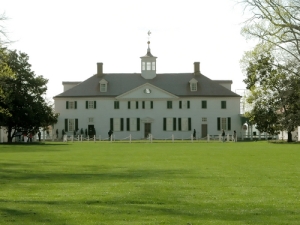
mount vernon

He had every intention to make the plantation a great estate, and taking his own place in Virginia society as a gentleman farmer and property owner. When he married Martha Dandridge Custis, one of the wealthiest young widows in the colony, that place was assured. Her property dwarfed his, and practically guaranteed him a seat in Virginia’s House of Burgesses.

In Colonial Virginia in the 1760s, the aura of noblesse oblige was pervasive. If a man had property and wealth, he was expected to take a position on the governing board of the colony. George Washington would not only be in the company of Virginia’s most propertied and pedigreed, but he would be included among its most learned, most broadly educated, and, as history would evaluate, its best and brightest.

George Washington:  Living the Image

If George Washington was daunted by the company he was keeping, it is unknown. Washington seldom tipped his private hand. What is known, however, is that he was always aware of his own dearth of formal education. He could not begin to compete with men like the classically trained Thomas Jefferson, or James Madison or John Adams. He lacked the natural wit of Benjamin Franklin. He did not have the verbal spontaneity of Patrick Henry.

Perhaps remembering some of those long-ago copied Rules of Civility, he spoke little, unless he was sure of his subject. He listened mostly, and paid keen attention. He always behaved as he believed was proper. He gained the respect and admiration of his fellows by his considered actions, rather than by the words that never came easily.

If he was aware that he was creating that aloof, touch-me-not, rise-above-it-all image, it is unknown. His remote attitude was never one of disdain for his fellow-men. Most of his contemporaries considered him a friend, albeit never a close one.

George Washington:  A Public Relations Marble Man

young GW

In life, in marble or in oils, George Washington was an imposing figure.

George Washington zealously guarded his reputation for the rest of his life. He always maintained a physical distance. One anecdote tells of a time in Philadelphia when one of its elite citizens boasted to his fellows that he was an intimate friend of the President. The next time he was in Washington’s company, he placed his arm around him in a gesture of camaraderie. The withering look he instantly received from George Washington spoke volumes. A handshake was proper. A pat on the back was not.

When the French sculptor Jean-Antoine Houdon was commissioned to create the lifesize statue of America’s first president, the artist in him absorbed that innate dignity of the man and transferred it to the monument. And while it is said to be sculpted exactly to Washington’s measurements, he is always perceived as larger than life.

Sources: 

Boller, Paul F. Jr.– Presidential Anecdotes – Oxford University Press, 1981

Chadwick, Bruce – The General and Mrs. Washington –Sourcebooks, 2007

Randall, Willard Sterne – Washington: A Life – 1997, Galahad Books

http://www.whitehouse.gov/about/presidents/georgewashington

Posted in A POTUS-FLOTUS Blog, George Washington | Tagged , , , , , , , , , , , | 1 Comment

Lincoln vs. Davis: A Paper Debate

For 150 years, historians have evaluated the presidential performance of Abraham Lincoln and Jefferson Davis.  Historians usually side with the winners, and Lincoln wins in a walk.

The Lincoln-Davis’ Experience Qualifications

jeff davis

By the time Jefferson Davis was thirty-five, he was one of the most respected leaders of the South.

By resume, Jefferson Davis had the huge advantage. Born within a year of Lincoln, and also from Kentucky, he was the tenth child of a middle class family. He was educated at Transylvania College (more of a high school), and then sent to West Point. He had served as an army officer with honor before becoming a Mississippi planter. His much older brother (by twenty-three years) was a bona fide millionaire, and Jeff’s lifelong mentor. His plantation thrived, making Davis one of the wealthiest men in the state.

Davis served in Congress for a term before re-entering the military during the War with Mexico, demonstrating leadership and distinction befitting a West Point graduate. The war over, he then served in the Senate, for four years as Secretary of War under President Franklin Pierce, and then back in the Senate again. All in all, he had fifteen years prominently placed on the national stage before the Civil War.

Abraham Lincoln’s qualifications on paper were slim. His education was conspicuous only by its absence – perhaps as little as one year of formal schooling.  Whatever he learned was on his own. He became a self-taught lawyer and served a single term in Congress prior to the Civil War. He had achieved a middle-class status only after years of hard work; any mentoring he received was not financial.

On paper, Davis leaves Lincoln in the dust.

The Lincoln-Davis Leadership Qualifications

young abe

Abraham Lincoln’s accomplishments prior to his election as President in 1860, were mostly limited to his home state of Illinois. He had no national reputation.

Prior to the Civil War, both Abraham Lincoln and Jefferson Davis had remarkably centrist attitudes.  Lincoln was not an abolitionist, and said so many times. Davis was not a secessionist and said so many times. They both felt strongly for the Union, although Davis believed it was constitutionally possible for a state to secede. Lincoln was against slavery, but he believed it should be contained where it was; Davis (known to be a particularly kind master), believed it was essential to the southern economy.

Jefferson Davis was a mellifluous speaker in the classical oratory style. He tried to be a voice of reason, and usually distanced himself from the rabble-rousing “secesh” rantings of other southern politicians. Little of what he said, however, was memorable. During the turbulent 1850s, Davis was considered the best presidential candidate the Democrats had to offer – except for being a southerner.

Thus when the South did secede, and when it elected a temporary President, Jefferson Davis was generally unopposed. Everyone looked up to him. A year later, when it elected a permanent President, Davis was still generally unopposed.

Abraham Lincoln’s leadership qualities were subtle, and to a large extent hidden. He was a stump speaker, rather than an orator. It is said that his voice was fairly high pitched for such a tall man. His contemporaries, particularly his fellow politicians, believed him to be little more than average as a speaker. He did not pontificate. His reasoning was deep however, and his way with words was elegant and often sparkled with humor. What he said and how he said it was usually memorable.

One tends to forget that Lincoln was a dark horse in 1860. All his Republican rivals were far better known, and had many years on the national stage. Lincoln’s political influence was limited primarily to his home state of Illinois – western and unimportant. The presidential ballots were split every whichway, and Lincoln won by plurality, rather than majority.  When he arrived in Washington, he was still an unknown quantity.

In pre-Civil War leadership, Davis still holds the edge. He had been a national political figure much longer. Everybody knew him and respected him. His military experience, both on the field and behind the Secretary of War desk, was second to none.

The Lincoln-Davis Bottom Line

csa pres

Tall, lanky, craggy-faced and bearded, Jefferson Davis sometimes bears a striking resemblance to Lincoln.

Both were undoubtedly men of character. Davis’ confederate oath was also “registered in heaven” and just as binding to him as Lincoln’s was. Both were honest men, and in another time and under other circumstances, Jefferson Davis might have made a decent president of the United States.

lincoln

It would be his elusive personal qualities that made Abraham Lincoln our greatest president.

The balance, however, lies in the intangible qualities: the ones that no one notices until they are tested. Lincoln’s fifty years of self-education had provided him with a capacity for broad conceptual thinking, and the ability to learn from all sources. He could and would change his mind, if he saw the error. He could and would be able to work with most people. He could and would grow. It would be because of his rare and elusive qualities rather than paper credentials that he ranks as our foremost president.

Davis, perhaps from a lifetime of being in command, was not flexible. He would remain rigid in his philosophies and attitudes throughout his life. He had favorites, and he had implacable enemies. He would never change. His leadership was flawed, and he pales in comparison.

Lincoln, of course, would become the martyr, but he did not have the martyr’s character. It would be Davis who truly had the martyr qualifications.

Sources:

  • DAVIS, VARINA – Jefferson Davis, Ex-President of the Confederate States of America: A Memoir by his Wife, 1890
  • DAVIS, W.C. – The Man and his Hour, HarperCollins, 1991
  • DONALD, David Herbert – Lincoln – Simon and Schuster, 1995
Posted in A POTUS-FLOTUS Blog, Abraham Lincoln, American Civil War, Nifty History People | Tagged , , , , , , , , , , , , , , , , , , , | 3 Comments

Charles Julius Guiteau: Garfield’s Assassin

The old history books claim that the assassin of President James A. Garfield was a disgruntled office seeker – but was that really the case?

guiteau_004

Charles Julius Guiteau, the assassin of President James Garfield, was tried and convicted – and hung.

President James Garfield was assassinated in July, 1881, but the trial of Charles Julius Guiteau was not held till 1882.  His attorney, a family member, entered an insanity plea.  The trial was a six-month long circus.

No question about it, the defendant was definitely “peculiar.”  He sang little songs to himself, behaved oddly and confused, threw tantrums, and gave every indication of the nineteenth century definition of “lunacy.”  He was convinced he would be acquitted.  His attorney brother-in-law presented evidence that Guiteau’s eccentricities were apparent even in early childhood.  He was a loner who never seemed to have friends.  Some said that the entire family was a little strange.

Nevertheless, Guiteau managed to read law and even pass the Illinois bar, but he never practiced the profession.  He also became a self-proclaimed evangelist minister, briefly affiliated with one of the popular religious cults of the day.  They disassociated themselves quickly when Guiteau’s abnormal behavior became too evident.  He married, but his wife divorced him.  He was never able to hold a job or earn a living.  He borrowed money continually, and never repaid the debts.  Still, he had an aggrandized opinion of himself.  Most psychiatrists today agree that Guiteau showed classic symptoms of schizophrenia.

The defense attorney produced a long list of prominent Washingtonians, including several Congressmen and Senators, and even a signed deposition from President Chester Alan Arthur, all alluding to the fact that while they were superficially acquainted with Guiteau, they were all of the belief that he wasn’t quite right in the head.

Guiteau:  The Disgruntled Office Seeker

Campaign poster

James Garfield won a squeaker of an election in 1880. Chester Alan Arthur, his running mate, was also the national campaign manager.

In 1880, thirty-eight year old Charles Julius Guiteau decided to support James A. Garfield, the Republican nominee for President.  He wrote a long rambling speech in praise of the candidate, and traveled to New York.  Day after day, he sat in the waiting room of the campaign headquarters, button-holing all politicians for a chance to deliver his speech.  People were polite in those days – even New York politicians, so Guiteau was generally turned “away” rather than turned “down.”  The politicians courteously said “good morning” or “nice day” or similar pleasantries, leading Guiteau to believe he had made a friend.  He had hope.  Eventually he was given a place on a podium in Brooklyn.  He blathered incoherently for about five minutes, left the stage abruptly and disappeared into the crowd.  His speech was never given, nor was it published in a paper or as a handbill.

James Garfield won the election – but it was a squeaker.  Guiteau believed that it was his speech that actually turned the tide, and thus was entitled to a political patronage job.  Had he wanted to be a postmaster in some small town, he might have gotten it.  After all, who really cares who sorts the mail in “Podunk?”  But Guiteau wanted a better position: a consulate in Paris or Vienna.

The Disgruntlement Continues

Immediately after Garfield’s inauguration, Guiteau went to Washington, checked into a cheap boarding house and prepared to collect the compensation due him.  He spent hours sitting in the White House waiting room, hoping to see the President and writing incoherent letters on borrowed White House stationery.  His evenings were spent in the popular hotel lobbies where congressmen gathered socially.  He badgered everyone he could corner about his “embassy appointment” trying to find allies to plead his case with the Secretary of State.

Again, the polite politicians turned him down in pleasant generalities, such as “The next time I get a chance…” or “If I see so-and-so…”  Again, Guiteau believed he had friends who were advancing his prospects.  He still had hope.

Hope Dies, All is Lost

An artist rendition of the assassination.

Finally Guiteau confronted Secretary James G. Blaine on the street.  He picked a bad day.  The Secretary was preoccupied with pressing matters, and gave the odd little man short shrift.  Guiteau suddenly realized that all was lost; his hopes, his chances, his consulate in Paris or Vienna.   His mind snapped.  He began to hear voices (a tell-tale sign of psychosis).

He came to believe that President Garfield was the one standing in his way; that if the President were eliminated, Chet Arthur would be President – and would owe it all to him.  Honors would surely follow.  From that point on, Guiteau plotted and planned, and began to stalk Garfield.  He bought a gun, took some target practice, and checked the daily papers for the President’s schedule.

dying garfield

President James Garfield lingered in pain for ten weeks after he was assassinated by Charles Guiteau.

His chance came a few weeks later, and he shot the President twice – wounding him in the arm (a minor injury), and in the side, which led to medical ineptness, infection and a painful death ten weeks later.  Guiteau, by the way, was immediately apprehended and jailed.

The Verdict: Disgruntled Office Seeker

Fifteen years after the assassination of Lincoln, that deed was still fresh in the American mind.  John Wilkes Booth had escaped the hangman’s noose (the usual judicial penalty) by opting for a fiery shoot-out with law officers.  There would be no way that the trial of  Charles Julius Guiteau was going to circumvent due process and due judgment and due hanging for assassinating the President of the United States.

Twelve men, good and true, took little time in determining that Charles Julius Guiteau was sane enough to know right from wrong.   The crime was premeditated.  He had planned it.  He readily confessed.  He would hang.  And since he was considered “sane,” he would be forever inscribed in the history books as “a disgruntled office seeker.”

Sources:

Posted in Nifty History People | Tagged , , , , , , , , , , , , , , | Leave a comment

Lou Henry Hoover: The Adventuresome Activist

Mrs. Herbert Hoover is arguably the least known among 20th century First Ladies – yet she was an amazing woman in her own right.

Lou Henry Hoover: The Early Days

Wedding day

When she married Herbert Hoover, Lou Henry was a bright, athletic young woman who had just graduated from Stanford University with a degree in geology.

Lou Henry Hoover (1874-1944) was way ahead of her time.  Born in Iowa and raised in California, she was one of the first women to graduate from Stanford University as a degreed geologist.

She decided early on to pursue an adventurous course, and married a Stanford upperclassman – a young mining engineer named Herbert Hoover.  Within a few years of his graduation, he would become one of the foremost experts in his field.  Within the next decade, Bert and Lou Hoover would travel to exotic locales in China, Burma, Japan and Australia, and circumnavigate the globe twice – with two babies in tow.

In 1914, at the onset of World War I in Europe, the Hoovers were living in London, where the exigencies of war changed their lives completely.  Herbert Hoover would sell his mining interests and embrace humanitarianism on a grand scale.   Lou would discover her own administrative talents and work with him – and on her own – for philanthropic and societal causes.

Lou Henry Hoover:  Woman of Varied Interests

Hoover had become a household word through his yeoman efforts abroad, and in 1917, President Woodrow Wilson had summoned him home, now that the United States America had entered the Great War.  He was put in charge of the Food Administration, to help conserve our food resources in order to supply our own troops and those of our allies.  Lou did her part as well.  She wrote magazine articles, gave interviews, spoke before countless organizations, and, like her husband, never took a cent in remuneration.

Lou as Girl Scout

Lou Hoover became active in the Girl Scouts long before she became First Lady.

Girl Scouts

The Hoover Birthplace and Library features a fine exhibit of Mrs. Hoover’s activities and memorabilia from the Girl Scouts.

Her passion, however, was the fledgling Girl Scouts of America.  She had been aware of the Girl Guides in London, and once home, she put her efforts and western upbringing to work for the Scouts.  She enlisted as a scout leader, but rose quickly through the ranks, to become its national president.  She held that post for a decade.  Under her leadership, what had started as an organization for a few thousand girls would grow to more than 150,000 by the end of the 1920s, and into the millions by the time of her death in 1944.

By the time Herbert Hoover was elected President in 1928, both Hoovers were well known throughout the country for their energy, their executive skills, their obvious abilities, and their devotion to public service.

Lou Henry Hoover: Active First Lady

Lou Henry Hoover came to the White House with two secretaries: one to manage her First Lady duties, and the other to handle the Girl Scouts’ affairs.  Both were paid privately by Mrs. Hoover.

Then the Depression changed everything.  From being a Presidential couple of huge promise and expectation, they found themselves mired in a situation not of their making, and on a near-Biblical scale.  They found themselves vilified because they could not control let alone solve the economic tsunami.

Both Herbert and Lou Hoover were intrinsically shy people and in this instance, their own personalities worked against them.  While their modesty had been charming and admired previously, it was now to their detriment.  They both believed that public service was a privilege, and they shunned rewards or public acknowledgement of their accomplishments, let alone generosity.  It would be those qualities – the refusal to toot their own horns or permit horns to be tooted on their behalf – that helped to damage their truly stellar reputations.

Mrs. Hoover’s Third Secretary

First Ladies have always received large quantities of unsolicited letters, and common courtesy demands that all respectfully written letters be acknowledged and answered.  The First Lady’s personal secretary was overwhelmed with the usual commitments and duties of the White House.  The secretary Mrs. Hoover hired for Girl Scout matters was, of course, entirely separate.

hoover-02

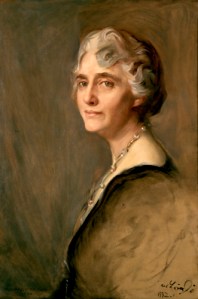
Lou Henry Hoover, as First Lady of the Land.

But as the dark days of the Depression refused to brighten, and indeed grew darker, First Lady Lou Hoover began receiving hundreds of letters every week asking for help.  She quietly engaged a third secretary specifically charged with looking into these needs, and provide whatever assistance possible.  Again, this was paid from her own funds.

Most of the requests were forwarded, with Mrs. Hoover’s card or note, to appropriate government agencies.  Some were sent to state and local officials.  Girl Scout troops were mobilized throughout the country to help conduct food drives and clothing drives, and to help shut-ins and the elderly.

But more often than not however, when need was determined and no other source was available, Mrs. Hoover would enclose a personal check for a few dollars, or send a pair of shoes or warm coat.  It was always done without fanfare, publicity or any expectations for repayment.

When White House personnel suggested that it would make a fine story that might boost their plummeting reputations, both Hoovers were appalled.  They believed that generosity was private, never to be used for their personal enhancement or benefit.  Decades would pass before their actions would speak louder than their critics’ words.

Mrs. Hoover’s Desk

During her retirement years, Lou Henry Hoover stayed active in various public and charitable organizations, far away from the public eye.

A few months before her seventieth birthday, she had a heart attack and died.  Her husband tidied up her affairs, and cleaned out her desk.  There he found hundreds of checks made out in her name, all for small sums that people – strangers to them – had sent in repayment for her kindness when it was needed.

She had never cashed them.

Sources:

Hoover, Irwin Hood – 42 Years in the White House – Houghton Mifflin Co. , 1934

Pryor, Dr. Helen B. – Lou Henry Hoover: Gallant First Lady – Dodd Mead, 1969

http://www.firstladies.org/biographies/firstladies

Posted in A POTUS-FLOTUS Blog | Tagged , , , , , , , , , , , , , , , | 3 Comments