Varina Davis as a New York Yankee

The last years of The First Lady of the Confederacy were spent as a New York Yankee.

Varina Davis:  A Northern Lineage

Although Varina Howell Davis (1826-1906) was born and raised in Natchez, Mississippi, she had prominent Northerners on her family tree. Her father’s people, the Howells, were Pennsylvanians. Her grandfather, Richard Howell, had been a Captain in the Revolutionary War. Then he served four terms as Governor of New Jersey.

Varina spent a year at a boarding school in Philadelphia when she was eight. She formed a strong bond with her Northern kin and stayed in affectionate touch for the rest of her life.

Varina Davis: Her Northern Friends

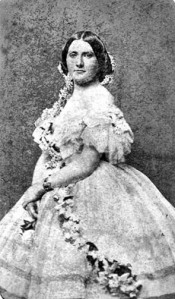
young varina

Varina Davis was a leader of Washington society during the 1850s, when her husband was Secretary of War and later Senator from Mississippi.

Varina was eighteen when she married Jefferson Davis, a widower twice her age. For most of the first fifteen years of their marriage, she lived at least part time, in Washington, DC. Davis was a well-regarded Senator, and served a four-year term as Secretary of War under President Franklin Pierce, a close friend – and a New Hampshire man. By the end of the 1850s, Davis had become the “voice of the South.”

Varina was a social woman by nature. Having come to Washington as an eighteen-year-old bride, she developed into a well-respected political wife and hostess. She was better educated and politically astute than most women of her era, and mingled with the cream of the law-making world from the start.

While many of her friends were the wives of Southern congressmen and senators, her closest companions were the wives of some Northern political leaders. They enjoyed her company, and she was considered one of the best conversationalists in Washington.

Because of these Northern “connections,” (both family and friends) many of the standard bearers of the “Lost Cause,” suspected that Mrs. Davis was not as sympathetic to the Confederacy as they preferred. Then too, the outspoken Mrs. D. was a formidable woman.  She had enemies.

The Poor (Literally) Widow Davis

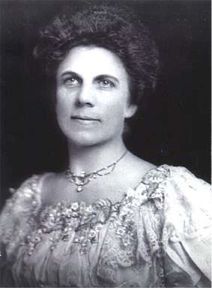
older varina-2

The tall and svelte Mrs. D. became matronly stout – after six children

The Post-Civil War years were not kind to Jefferson Davis. His health had been poor for years; his finances were now precarious.  He had been a wealthy man before 1861; after Appomattox, he was a man who had lost nearly everything except his dignity.

Their plantation in Mississippi had been ravaged during the war, and they lacked the funds to rebuild it. The Confederate ex-President held a series of modest positions after the War, but he was past sixty, the companies failed, and there was precious little to support his family. In his later years, he wrote a massive book about the Confederacy, but it was ponderous and not financially successful.

Despite chronically poor health, Jefferson Davis lived to be eighty-one. Varina, at sixty-two, was left with little income. A skilled writer herself, she tried her own hand at a biography of her husband. It was not a success either.

the elder davis family

Jefferson and Varina Davis with their daughter and grandchildren, shortly before the ex-Confederate President’s death.

Varina Davis: The Pulitzer Connection

Varina Davis had lived on and off in England during the 1870s-80s, and had become acquainted with young Joseph Pulitzer, who had married one of Jefferson Davis’ nieces.  The Pulitzers were enchanted by the ex-Confederate First Lady, and considered her delightful company. They kept up an active correspondence for several years.

When Jefferson Davis had died in 1889, Joseph Pulitzer was well on his way to becoming one of the foremost newspaper publishers in the country. Knowing that Varina’s income was precarious, he offered her a job – in New York City.

vhd-old

Varina Davis entertained modestly in New York, but her salons were always well attended.

Mrs. Davis had never been a popular First Lady.  The South wanted the quintessential Southern belle as their female role model and social leader. Varina was not in that mold. She was too intelligent, too outspoken, and far too large (she was 5’10”). While she was never accused of disloyalty (as was Mary Lincoln), she was suspected of weaker enthusiasm than they demanded. If she decided to move North, it would literally break all her Southern ties. She would never be forgiven.

But Varina needed the money, and Pulitzer’s offer of $1200 a year for an article every now and again, was more than generous. Living in a city was also very appealing to the woman who had spent most of her adult life in urban areas.

Varina In New York City

While the South turned from Varina, New York City welcomed her with open arms. Her conversational skills and seemingly endless supply of good stories were greeted warmly by the cultured set in the Big “Nineteenth Century” Apple. She made dozens of new friends who were delighted to attend her “salons.” She attended concerts and theatricals and exhibits. And from time to time, her articles were printed in Pulitzer’s New York World.

Older Julia

The Widow of Ulysses S. Grant

elderly varina

The widow of Jefferson Davis

One of Varina’s new friends during her golden years was a woman her own age, with a comparable (if not better) claim to pedigree. Julia Grant, former First Lady and widow of the iconic Union General, was also a New York resident, and lived only a few blocks away. The two most prominent women of the Civil War sincerely liked each other. They were seen publicly on carriage rides, nodding pleasantly to onlookers, or lunching together. Perhaps they helped close the gap between the North and South.

By the time Varina Davis died, her reputation as the one and only First Lady of the Confederacy enjoyed a brief flurry of semi-popularity. Aging Confederate veterans marched prominently in her funeral procession. The streets of Richmond were lined with bystanders as she was laid to rest beside her husband at Hollywood Cemetery.

Then she was promptly forgotten.

Sources:

  • Cashin, Joan E. – First Lady of the Confederacy: Varina Davis’s Civil War, Bellknap Press, 2006
  • Rowland, Eron – Varina Howell: Wife of Jefferson Davis: Volume II (reprinted) Pelican Pub Co Inc., 2002
  • Ross, Ishbel – First Lady of the South: The Life of Mrs. Jefferson Davis, Greenwood Press, 1958
  • http://ehistory.osu.edu/world/PeopleView.cfm?PID=94
Posted in American Civil War, Nifty History People | Tagged , , , , , , , , , , , , , , , , , , , , , , , | 4 Comments

President Garfield’s Doctors: A Keystone Tragic-Comedy Part II

 President Garfield spent two months after his assassination attempt, lying in bed at the White House during the hottest weeks in memory.

sickroom2

No photography was permitted in Garfield’s White House sickroom, but the newspaper artists all rendered their impressions of how it might look.

James Garfield, President for barely four months, had survived the night following an assassination attempt on July 2, 1881.  His wound from of the bullet in his side was exacerbated by the poking and the prodding by literally dozens of medical men – all with unwashed hands and unsterile instruments.  The decade-old recent discoveries of Pasteur’s microbes and Lister’s antisepsis techniques were still in the bah-humbug stage – at least in the USA.

President Garfield Receives Medical Advice

Despite the medical ineptness, James Garfield’s otherwise good health and physical fitness seemed to help the forty-nine year old president rally from his ordeal, and indeed for a few weeks, there was some hope for his recovery.

The bullet in his side, however, remained elusive and a concern to Dr. Willard Bliss and his medical team.  A nationwide avalanche of letters poured in almost immediately with prayers, good wishes, and suggestions for the President’s treatment.

The suggestion for an apparatus to cool the sickroom (which hovered around 90-degrees) had merit.  It was relatively simple and inexpensive to rig.  It was also successful;  the room temperature was lowered by fifteen degrees.

The letter from Dr. Alexander Graham Bell, offering to test his newly invented metal detecting device was enthusiastically received.  The President himself was interested in the experiment.  The test did not work, largely due to the metal bedsprings – but the concept would prove valid at a later date.

Then there was a letter suggesting that two strong men hold the President upside-down and shake him hard so the bullet would fall from his mouth.  That letter was filed away for the amusement of posterity.

Garfield’s Doctors Mis-Practice Medicine

garfield's doctors

Garfield’s doctors, led by the domineering and egotistical Willard Bliss, were daily visitors to the White House sickroom, frequently arguing at the President’s bedside.

Dr. Bliss was an egocentric martinet of a man, difficult to work with.  The medical team argued continually and vociferously, and often at the President’s bedside.  Not only did the doctors debate medical treatment, but they feuded constantly over precedence and authority, each zealously guarding his purview and opinion, most of which were wrong.  As word leaked out about the quarrelsome physicians, they became a laughing stock.

The doctors were also literally starving the poor man.   President Garfield was given nothing to eat but oatmeal, which he loathed.  He was losing a huge amount of weight, weakening him even more.  Trying to provide some nourishment, Dr. Bliss administered enemas of beef bouillon.  (This strange concept has some validity, given the modern usage of skin patches and nasal sprays to absorb medicines.   In Garfield’s case, it didn’t work.)

Every two hour, six burly men would come and lift the President by the bedsheets to turn him, thus preventing bedsores.  Through it all, the Garfield maintained his dignity and good humor.

Victorian bedside manners however, were designed to keep the patient and the patient’s family completely in the dark, most likely because the doctors had no answers.  They would “tsk” and “tut” and talk about things being in God’s hands, but they never discussed anything of consequence with either President or Mrs. Garfield.  The only way the President found out “how he was”, was when his wife read the newspapers to him.  They ran daily bulletins on his temperature, pulse and respiration rates.

Garfield’s Health Declines Rapidly

By late July, ominous signs appeared.  Pus-pockets were developing.  Infection had set in.  The doctors were still debating and arguing, although they knew infection when they saw it.  They just didn’t know how to treat it.  Garfield’s temperature rose.  He developed abscesses, which would be lanced and drained, and which would form again somewhere else, adding to the President’s pain.

By mid-August, things had declined to a point that Garfield’s innate good humor began to suffer, and he became understandably irritable.  He began to realize that he would not recover, and that his first thoughts about the assassination (“I am a dead man”), were probably prophetic.  He wanted to go home to Ohio and die in his own bed.  He wanted to see “the old folks” again.

This time, Dr. Bliss and his team did not argue.  They categorically refused.  It was 500 miles away, across the Appalachian Mountains.  It would be brutally painful, and they believed the President could not survive the trip.

Lucretia Rudolph Garfield

First Lady Lucretia Garfield tended to her husband as much as the doctors would permit. She read the newspapers to him – so they could find out his progress, or lack thereof.

It was Lucretia Garfield, the President’s wife, who suggested they take the dying man to Long Branch, New Jersey.  The ocean breezes had helped her to recover from a serious case of malaria.  It was only half the distance.  There were no mountains to cross.

The doctors finally agreed, and made plans in early September to move him to a borrowed cottage, where the sea breezes would provide some relief.  The Pennsylvania Railroad consolidated all its resources to take Garfield two-hundred-plus miles as comfortably as possible.  They even built a spur track right up to the borrowed cottage.

For the next two weeks, President Garfield lingered.  Then he expired.

James Garfield’s Autopsy Report

death

President Garfield died in a borrowed cottage in Elberon, New Jersey, only ten days after he had been brought there for the cool ocean breezes.

The doctors had debated the position of the elusive bullet for ten weeks.  An autopsy was performed, and they would finally find it.

To everyone’s amazement, they had all been grossly incorrect.  All their probing and poking had done was to create a false channel several inches long.  The bullet itself was lodged only an inch from where it had entered.

The bullet had also encapsulated itself, rendering it essentially harmless.   If they had done nothing, Garfield likely would have survived.  Thousands of Civil War veterans had lived for decades with bullets lodged somewhere in their bodies.  The insane assassin Charles Guiteau was right when he said at his trial, “I only shot at the President.  The doctors killed him.”

Sources:

  • Kenneth D. Ackerman. The Dark Horse: The Surprise Election and Political Murder of President James A. Garfield. Carroll & Graf Publishers, 2003
  • Brown, E.E. The Life and Public Services of James A. Garfield, D. Lothrop & Company , 1881
  • Millard, Candice – Destiny of the Republic: A Tale of Madness, Medicine and the Murder of a President, Doubleday, 2012
  • Peskin, Allan. Garfield, The Kent State University Press, 1978
Posted in A POTUS-FLOTUS Blog, James Garfield | Tagged , , , , , , , , , , , , , , , , | 2 Comments

Harriet Lane Johnston: The Unknown “First Lady”

photo posted on post-gazette.com

Harriet Lane, the belle of Washington during the Buchanan administration.

    Harriet Lane (1830-1903) was technically a Presidential “hostess.”  Nevertheless, she was “hostess” for four full years.

Harriet Lane:  A Basic Overview

buchanan

President James Buchanan was a bachelor, and invited his niece Harriet Lane to serve as his official hostess.

Harriet Lane (1830-1903) was orphaned at nine years old, and her bachelor Uncle James Buchanan, already a well-to-do Pennsylvania attorney and congressman, became her legal guardian.  He raised and educated her befitting his advancing status in national politics.  She had the best of everything, including an excellent-for-the-time education and his deep devotion..

harriet2

Harriet Lane’s modesty and decorum charmed everyone in England – including Queen Victoria and Prince Albert.

Harriet grew up to be accomplished, brighter than most, and considered very attractive – certainly fit to be the perfect political escort for her Uncle, who had groomed her for that position.  By eighteen, Harriet Lane had already mixed and mingled with Washington’s elite.  At twenty-one, she was the charming young lady on Buchanan’s arm while he served in London as Minister Plentipolentiary to the Court of St. James.

By 1856, when Buchanan was elected President, Harriet had become an acknowledged leader of whatever society she entered; ergo, a fitting de facto First Lady for the President.

While the four years of the Buchanan Administration were unpopular and often counter-productive, Harriet’s governance of the social scene of Washington was glittering.  Her fashions were copied, her invitations were sought, and her company welcomed.  Her name was a household word; ships and songs were dedicated to her.

Then Buchanan “retired,” and Harriet was out of the public eye.

Harriet Lane Johnston:  The Later Years

Harriet waited until she was thirty-five before she married.  She had enjoyed the attentions of numerous suitors, and if she waited, it was her choice.

Henry Johnston (1831-1884) was a wealthy and respected businessman from Baltimore.  By this time, James Buchanan was well past seventy and in failing health.  He was thrilled with the match, all the more so since his favorite niece would be well taken care of.  Uncle Buck died a year later; Harriet was his major heir.

Cutter Harriet Lane

A Coast Guard cutter was christened “Harriet Lane.” The name still exists on a current ship.

Mr. and Mrs. Johnston had two sons, James and Henry, in quick succession, but her years as a happy matron would not last long.  Both her sons died in their early teens from complications of rheumatic fever.  Not long afterwards, her husband died.

Mrs. Johnston: The Wealthy and Generous Widow

There have been wealthy widows among our First Families, but Harriet Lane Johnston stands uniquely.  As a widow in her mid-fifties, she had no immediate heirs.  Her uncle was gone.  Her sons had died.  Her husband had died.  She was the last survivor among her siblings.  She was alone.  Her personal needs were minimal, and she could live very comfortably (which she did) without making a dent in all that she had inherited.

What should she do?  What would be her legacy?

During her years as “escort” to Ambassador Buchanan in England, Harriet had developed a sincere love of art, and had begun collecting classical paintings.  As Presidential “Hostess,” she indulged her artistic side by extending the prestige and hospitality of the White House to American artists, and facilitating introductions between painters and would-be patrons.

Whether her tastes in art were exceptional is subject to opinion, but the essence is very clear:  she was a patroness.  Her interest was sincere.  While her choices may have been somewhat pedestrian, she definitely “put her money where her mouth was,” so to speak.  She encouraged, she purchased, she enabled and she enjoyed.

Harriet Lane had always been a generous person.  As her life drew closer to its end with no direct heirs for her large estate, she had a great deal of money to disburse.

Harriet Lane Johnstons Bequests:

First and foremost, she bequeathed more than $400,000 (in 1903 money) to the Johns Hopkins School of Medicine in Baltimore to endow a free pediatric medical center.  It would be a lasting legacy to the memory of her two young sons who had died prematurely.  It was the first medical center in the country dedicated specifically to the treatment of children.

harriet lane johnston

Harriet Lane Johnston as she appeared in later life.

Her art collection eventually found a home at the Smithsonian Institution, where it became the nucleus for what today is the National Gallery of Art in Washington, DC.

At the time of her marriage, Harriet Lane had joined the Episcopal church.  When the Washington Cathedral was chartered in the 1890s, Mrs. Johnston took an active interest.  Partly inspired by a concert by the Vienna Boys Choir in Austria, she envisioned its counterpart in America.  The St. Albans School for training and supporting a boys choir would require sizeable funds; Mrs. J. was happy to underwrite the project.  It still exists today.

Finally, Harriet Lane was deeply devoted to “Nunc” as she called James Buchanan, and it must have been painful for her to see his reputation falter so badly after his lifetime of high achievement.  Therefore, she left more than $100,000 to erect a statue in Washington, DC, commemorating the fifteenth President.  It is the only one in the country.

Harriet Lane’s Legacy Today:

Harriet Lane Johnston took great pains in making her will, which had many extensive and complex provisions.  The interesting part, however, is that more than a hundred years after her death, every major bequest still exists:  the pediatric medical center at Johns Hopkins (expanded exponentially over the century), the National Gallery, which houses her collection among its world-famous treasures, the St. Albans School for boys, and the monument to James Buchanan.

Her influence as a quasi-First Lady, merely niece-of rather than wife-of President, may have consigned Harriet Lane to a minor role in history, but her generosity and the substance of her bequests do her great, great honor.

Sources:

Anthony, Carl Sferrazza  – First Ladies 1789-1961, William Morrow,1990

Caroli, Betty Boyd –  First Ladies – Oxford University Press, 1995

http://www.firstladies.org/biographies/firstladies

Posted in A POTUS-FLOTUS Blog, James Buchanan, Nifty History People | Tagged , , , , , , , , , , , , , , , , , , , , , | 1 Comment

President Garfield’s Doctors: A Tragi-Comedy Part I

Charles Guiteau admitted that he shot the President, but “it was the doctors who killed him.”  The assassin was certifiably insane, but he wasn’t stupid.  Everybody in the country knew it was the medical men who botched the care of the dying President

President James A. Garfield is Shot

James Abram Garfield (1831-81) was a healthy, athletic, vigorous forty-nine-year old man in the prime of life – but he needed a vacation.  He spent his first four months in office slogging through an exhausting swamp of political infighting and patronage maneuvering.  He had finally outfoxed his political enemies, and needed a rest.  It was July 2, 1881, and he, along with members of his cabinet and their families, were going on a New England tour to relax.

guiteau_004

Charles Julius Guiteau, President Garfield’s assassin.

On that fateful day, he was shot twice by Charles Julius Guiteau, a deranged political wannabee, who was waiting for him at the Baltimore and Potomac train station.  One bullet was a superficial flesh wound in the arm; the other, more serious, penetrated his side.  He collapsed to the floor, and the Keystone-comedy-of-medical-ineptitude started.

A parade of doctors had been immediately summoned.  One by one they arrived at the station to begin their examinations – probing for the bullet through the gaping hole in Garfield’s side.  This was done with their unwashed fingers – or an unsterile probe.  As it was later learned, all the probing achieved was to forge a false channel in the President’s abdominal cavity where it would become a sinkhole of infection.

The wounded Garfield lay in the station for more than an hour, in pain and with shock symptoms beginning.  But with remarkable common sense and judgment, it was he who insisted on being taken back to the White House.   He even dictated a brief reassuring telegram to his wife, who was supposed to meet him en route.

The Parade of Doctors at the White House

more assassination

Only artist renderings of what the assassination scene “might have been” are available. The President was walking through the ladies waiting room of the train station when he was attacked.

News of Garfield’s assassination traveled faster than the speeding bullet, and the telegraph wires instantly carried the stories to the entire country.  By the time the stricken man was taken back to a makeshift White House hospital room, a small army of medical men was arriving.   They all meant well of course, but along with a cursory examination and their “expert” diagnoses, they could also have the dubious distinction of being one of the President’s medical consultants.  Most believed the President would not survive the night.

Once again it was James Garfield himself who had the common sense to call a halt to the parade of physicians.  He was in terrible pain, and the probing was making it worse.  His temperature was rising.  He had nausea and vomiting.  When Dr. Willard Bliss arrived, the President told him to take charge of the case, select his own associates and dismiss the rest.  While Garfield was wise enough to take control of the matter, his choice of Bliss could not have been worse.

When “Ignorance is Willard Bliss”…

garfield's doctors

The medical team of doctors who were assembled to treat the wounded Presidents. The consensus has always been that they did more harm than good.

D. Willard Bliss (1825-89) was a mediocre doctor at best.  Garfield selected him because they had been childhood friends, and when he became President and needed a personal physician, Bliss, now practicing in Washington, seemed a likely choice.  But he was an egocentric man with an autocratic manner.  By the time Garfield finally expired, the jokes about “ignorance being Bliss” were rampant in the newspapers.

As Doctor-in-Charge, Bliss appointed a “team” of physicians:  Dr. Smith Townsend, who had been the first on the scene, Surgeon-General J.K. Barnes who had been at the bedside of the dying Lincoln, and Doctors J.J. Woodward and Robert Reyburn.  Each was assigned a specific responsibility.  Dr. Townsend had the minimal duty of taking the President’s temperature, pulse and respiration three times a day.

Willard Bliss was an adequate doctor – as long as nobody was sick or injured.  Enamored by his old relationship with the President and his new-found prominence, he zealously and jealously guarded his purview, systematically alienating everyone concerned.

Media Coverage of President Garfield’s Health

This new convergence of a medical “team” was major news.   The team would be augmented by Doctors David Hayes Agnew and Frank Hastings Hamilton from Philadelphia and New York, respectively.  The latter two were considered the finest surgeons in the country, and would diplomatically make no comment (which is comment enough) about the dictatorial Dr. Bliss.

formal garfield

President James A. Garfield was in the prime of life and health until the moment he was shot by an assassin.

The public was naturally anxious for President Garfield’s health, and even more importantly, insatiable in its demand for up-to-the-minute news.  The President’s secretary, Joseph Stanley Brown, was hounded by journalists, so he devised a little chart which he released three times a day – listing Dr. Townsend’s contribution: the President’s temperature, pulse and respiration rates.  Occasionally the country would be treated to a special bulletin regarding Garfield’s bowel movements.  Nothing was sacred.

The Continuing Misdiagnosis

Right from the very beginning, when the doctors claimed Garfield would not survive the night, they were wrong.  He lived for ten weeks, despite them.  They continuously probed for a bullet they could not find.   Then they decided it was about twelve inches from where it actually was.  They also concluded that it had affected his liver.  It had not.  Stay tuned!

It would be a long, very hot summer for the dying President.

Sources:

  • Kenneth D. Ackerman. The Dark Horse: The Surprise Election and Political Murder of President James A. Garfield. Carroll & Graf Publishers, 2003
  • Brown, E.E. The Life and Public Services of James A. Garfield, D. Lothrop & Company , 1881
  • Peskin, Allan. Garfield, The Kent State University Press, 1978
Posted in A POTUS-FLOTUS Blog, James Garfield | Tagged , , , , , , , , , , , , , , , , , | 3 Comments

Warren Harding, The Ladies Man

No doubt about it, Warren G. Harding liked the fillies, but his taste was more toward fast trotters than thoroughbreds.    

 Warren G. Harding and his Duchess

FlorenceHarding

Florence Kling DeWolfe Harding was a 30-year old divorcee when she married Warren Harding.

harding w-moustache

Warren Harding was a good looking man of twenty-five when he married Florence.

Historians have always wondered why Warren G. Harding (1865-1923) married Florence Kling DeWolfe in the first place.  She was five years Harding’s senior and a divorcée in a time when divorce was stigmatic.   She wasn’t bad looking, but she was no beauty either, and said to have had a whining and unpleasant voice.

It is much easier to understand her attraction to him.  Harding was not only a good looking, well-built fellow of twenty-five, but he was also one of the most popular men in town.  He had an outgoing personality, and made friends easily.  His father once remarked that “it was a good thing Warren wasn’t a woman or he would always be in the family way.”  He couldn’t say no.  Florence pursued.  He couldn’t say no.  Or if he could, he didn’t.

It was a mismatch from the beginning.  She was nagging and domineering by nature, and Harding’s friends said Florence ran everything but the family car.  He nicknamed her “Duchess,” and it stuck.  Their marriage was also complicated by Florence’s serious kidney ailment, which would flare up from time to time, and keep her bedridden for weeks and even months, sometimes near death.  Given the nature of her disease, the marital side of their marriage was curtailed.  They would share a room, but not a bed.

Warren Harding had been a ladies’ man long before Florence was in the picture, but now became a chronic philanderer.   They may have stayed together for thirty years, but it was a difficult union for both parties.  As President, he once confided to a friend that his life “had been hell.”   White House staff would recall their shouting matches.

Warren Harding and Mrs. Phillips

young carrie

Carrie Phillips was neighbor of the Hardings in Marion, Ohio. She would carry on a torrid romance with Harding right under the noses of their respective spouses.

Jim and Carrie Phillips were Harding neighbors in Marion, Ohio.   Carrie and the Duchess had become good friends.  Jim owned a local dry-goods store and advertised in the newspaper that Harding owned.  The two couples socialized frequently, and even traveled to Europe together.  Unbeknownst to Jim Phillips (and to Florence – at least for a long time), Warren and Carrie Phillips were carrying on a steamy love affair.  The journalistically inclined Harding exchanged dozens of surprisingly graphic letters with Mrs. Phillips.

Years passed before the Duchess learned of this knife-in-her-heart and dagger-in-her-back.  After the “great row,” Harding promised he would not see Carrie again, but he did anyway.  The romance would subside somewhat, but the relationship would last more than fifteen years; most of the time with Harding still swearing his eternal love, and Carrie carping about something.

Carrie Phillips was no prize.  True, she was younger and better looking than Florence Harding, but she also had a shrewish and demanding disposition.   Having become a great admirer of Kaiser Wilhelm II, her outspoken enthusiasm of all things Teutonic did not abate, despite the hostilities of the First World War.  Harding, by this time a U.S. Senator, cautioned her more than once to quiet her overt semi-fascistic passion, but it fell on deaf ears.  By the time Harding was a candidate for President in 1920, the Republican Party had to cough up a large sum of money to send Jim Phillips and his German-loving wife out of the country.  The politicians were afraid that Harding’s private letters would fall into public hands and embarrass everyone.

Warren Harding and Nan Britton

Warren Harding

Warren G. Harding in middle-age: a man who looked like he should be President.

With the Phillipses safely spirited away, and with other romantic letters ransomed from various other Harding mini-amours, Warren and Florence Harding were on their way to the White House.  But again unbeknownst to just about everyone except the intimately concerned, Senator Harding had become involved with a young woman who had lived down the street from them in Marion.

nan the siren

Nan Britton was also a Marion, Ohio neighbor. She was only nineteen when she became involved with Senator Harding.

Somewhat of a Lolita-type, Nan Britton had had a crush on the handsome middle-aged Harding since she was a child.  Now as a young woman of nineteen, she wrote the Senator for help obtaining a secretarial position in New York.  He obliged with a letter of recommendation – and an offer to take her to lunch next time he was in New York.  That opportunity soon presented itself, and lunch became a “matinee.”  A few more matinees became a baby.  And the matinees continued into the White House anteroom.

None of this however, was made public, nor did Florence learn about it until after Harding died and Britton came looking for child support.  (Harding had been slipping her funds for several years.)  The Duchess insisted that some young fellow was responsible, and that Miss Britton was only after their money – like all the others.  (And the Hardings never had that much money to begin with!)  DNA and paternity tests were long in the future.  A few years later, she wrote a tell-all book about their affair.

 Florence died a year after her husband.  Carrie Phillips lived to be a somewhat demented old lady, financially supported by a stipend from the Republicans.  The Harding-Phillips letters were tied up in estate-legalistics for more than fifty years, and have only recently been made available to historians.  Nan Britton lived to be ninety-five and remained true to the memory of Warren G. Harding.

Sources:

·         Anthony, Carl Sferrazza  –First Ladies 1789-1961, William Morrow,1990

·         Anthony, Carl Sferrazza – Florence Harding: The First Lady, the Jazz Age, and the Death of America’s Most Scandalous President – William Morrow & Co., 1998

·         Britton, Nan – The President’s Daughter, Elizabeth Ann Guild, 1927

·         Irwin Hood Hoover – Forty-Two Years in the White House –  Greenwood Press (reprint,) 1974                      

·         Robenalt, James David – The Harding Affair: Love and Espionage During the Great War – Palgrave Macmillan, 2011

Posted in A POTUS-FLOTUS Blog, Warren G. Harding | Tagged , , , , , , , , , , , , , , , , | 8 Comments

Jane Pierce and Varina Davis: An Unlikely Friendship

Historians are usually negative about First Lady Jane Pierce or tsk-tsk about the tragedies in her life, which were considerable. 

Jane Appleton Pierce: A Tragic woman

Jane Pierce (1806-63) despite her tragedies, is not a particularly sympathetic character. She was depressive, probably from birth, which makes her tiresome. Born to a clergyman-educator father who literally “fasted” himself to death, Jane was an uber-religious woman, who believed in a punishing God, i.e. whatever misfortune befell a person in life was

jane_pierce

Jane Appleton Pierce was a melancholy woman by nature, and whose tenure in the White House was marked by the tragic death of her son.

undoubtedly due to one’s own sins – even if they were unknown to the sinner.

The real tragedies in Jane’s life were basically twofold. First, she married a man who was her polar opposite, and while there was an attraction and even a sincere affection, it did not make for a happy union. At twenty-eight, Jane Appleton married Franklin Pierce (1804-69), New Hampshire born and raised, and Bowdoin College educated. He was an outgoing fellow, comfortable in the taverns with his peers. His promising law career was progressing nicely. Just prior to his marriage, he was elected to Congress.

Jane Pierce’s honeymoon in Washington was a portent of the mismatch. Always somewhat frail in health, she worried over every sniffle and cough. The genuinely abysmal weather in Washington disagreed with her, and she seldom left her boarding house rooms, except for church. She also shunned society in the nation’s capital, believing it to be ungodly. When Pierce accepted social invitations in Washington, he went alone. For subsequent sessions in Congress, Jane remained in New Hampshire, convincing her husband to forgo politics and alcohol (both of which he enjoyed). He finally promised.

jane and bennie

Jane Pierce devoted herself to raising her third and last child, Bennie. Two other sons had died as babies.

The second (and maybe third and fourth) heartbreak in Jane’s life was the loss of her children. Two died in early childhood. Afterwards, her life revolved around their third son. When eleven-year old Bennie died, truly tragically, in a train accident only weeks before Pierce’s inauguration as 14th President, Jane slipped into a depression that never abated.

Her devastation was compounded by learning that Pierce’s nomination and election was not the surprise he had claimed. He had actually “politicked” to win it. He had broken his word. She was so overwrought by grief, she could not bear to enter the White House for several weeks after the inauguration, and even then, remained secluded.

She believed at first, that Bennie’s death was God’s punishment for leaving New Hampshire. Then she amended her understanding of the Almightys reasons, by accepting the fact that Bennie was taken from them to remove distraction from his President-father.

Either way, the Pierce Administration was a socially-sad one.

Varina Davis:  Unlikely Friend

Varina Howell Davis (1826-1906) was young enough to be Jane Pierce’s daughter. She had married widower Jefferson Davis when she was just eighteen. He was twice her age, a West Point graduate with military experience, a successful Mississippi planter, and about to assume a seat in Congress.

varina-2

Varina Howell Davis was twenty years younger than Jane Pierce, but a sincere friendship grew between them.

Davis and Pierce were close in age, espoused the same Jeffersonian Democratic political philosophies, and had become personal friends. When Pierce was elected, he asked Davis to serve as his Secretary of War.

The story of Bennie Pierces tragic death was no secret. It was in all the newspapers, and the country was truly sympathetic toward the grieving parents. Jefferson Davis, who had lost his young first wife years earlier, was there to console the anguished President, and the two men would grow close and remain lifelong friends despite the Civil War. With a First Lady who was completely unable to fulfill her obligatory social duties, it was natural that the Davises assume many of those obligations.

The two women were also polar opposites. Jane was petite and frail; Varina, about 5’10” and robust. Jane was pious and reclusive; Varina, outgoing and worldly in her attitudes. Jane believed in the sheltered and proscribed role of womanhood. Varina was politically savvy and outspoken. Nevertheless, the young Mrs. Davis was one of the few people Mrs. Pierce admitted to her very select circle.

It was the Davis son who provided the bond between them. Jane needed to hold a baby in her arms and Varina was happy to share. The maternal First Lady even “borrowed” the baby on occasion for a carriage ride when Varina was busy.

A year later, the Davises suffered their own tragedy. Baby Samuel died. He was only two. Jane Pierce grieved along with her young friend, whose sorrow was somewhat abated by the fact that she was again pregnant

The Pierce-Davis Friendship Continues:

Jefferson Davis Papers

Varina Davis’ sixth and last child was born after Jane Pierce had died.

Franklin Pierce and Jefferson Davis would remain lifelong friends, despite the Civil War. Years later, when former-Confederate President Jefferson Davis was incarcerated in Fortress Monroe after the Civil War, an aging and widowed former-President Pierce personally made the journey to visit him.

Varina, however, would never see Mrs. Pierce again, although they remained in touch. In 1860, when the Civil War was about to unfold, Varina Davis still corresponded with Jane Pierce, signing her letter “Very sincerely and affectionately your friend.” She would also credit her with being an intelligent, well-read woman, whose company she enjoyed.

Jane needed a true friend; Varina was happy to oblige.

Sources:

Caroli, Bettty Boyd – First Ladies – Oxford University Press, 1985-, 1999

Cashin, Joan E. – First Lady of the Confederacy: Varina Davis’s Civil War – Belknap Press, 2006

Schenkman, Richard – Presidential Ambition – HarperCollins, 1999

Posted in A POTUS-FLOTUS Blog, Franklin Pierce, Nifty History People | Tagged , , , , , , , , , , , , , | 8 Comments

The Relatives of Abraham Lincoln

Abraham Lincoln frankly alluded to his humble beginnings, but he never included his kinfolk in his life.

Abraham Lincoln: The Humble Birthright

In 1809, Abraham Lincoln was born in Hardin County, Kentucky, to Thomas Lincoln and the former Nancy Hanks. His sister Sarah had been born two years earlier.

The family moved to Indiana when Lincoln was around seven. They were joined by Thomas and Elizabeth Sparrow, Nancy’s uncle and aunt, and a teen aged boy, Dennis Hanks, a cousin of Nancy’s. Not long after, the Sparrows died, followed by Nancy Lincoln. Dennis moved in with Thomas and the two children.

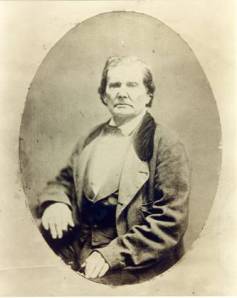
thomas lincoln

Thomas Lincoln, Abraham Lincoln’s father, was a barely literate farmer, but well known for his story-telling flair.

Left with motherless young children, Tom Lincoln did what most men did in those days. He left Sarah and Abe care/of Dennis Hanks, now eighteen or nineteen, and set out to find a new wife. His choice was fortuitous for all involved.

Sarah_Bush_Johnston_Lincoln

Abraham Lincoln had warm affection for his stepmother, Sarah Bush Johnston. He would provide for her till the end of his life.

Sarah Bush Johnston, recently widowed with three children of her own, had been a childhood friend of Tom Lincoln. More an arrangement for their mutual convenience than a romantic courtship, it was a good match. When the new Mrs. Lincoln arrived with her children and a wagon with real furniture, she discovered two Lincoln children badly in need of mothering and bathing.

Abraham Lincoln: The New Step-Family

Sarah Johnston had two daughters: Matilda and Sarah Elizabeth, called Betsy, since there were now three Sarahs in the family). John was about Abe’s age. The boys shared the loft with Dennis Hanks, and got on well, although as adults, their paths, as well as their characters, diverged.

dennis_hanks

Dennis Hanks was Abraham Lincoln’s cousin once-removed (according to some sources). He was ten years older than Lincoln, and lived to a ripe old age.

The happy circumstances of the new family dynamic brought a lasting affection between Abe and his stepmother. For the rest of his life, he provided for her care and spoke of her with warmth. In turn, Tom Lincoln bonded very well with his stepson John, a good ol’ boy by nature, and the two became hunting and fishing companions. Dennis Hanks married Betsy Johnston three years after the families merged.

Lincoln remained with the family until he was twenty-one. From that time forward, the distance between him and his kin grew. Always introspective and inclined toward book learning, which his stepmother encouraged and his father considered a waste of time, Lincoln knew his future depended entirely on his own efforts. His family would only detract.

Abraham Lincoln and Cousin Harriet Hanks

Abraham Lincoln married Mary Todd when he was thirty-two, struggling to earn a living as a circuit lawyer. Within a year, they had a son and a small house in Springfield, Illinois. When Dennis Hanks’ daughter Harriet contacted her second cousin a few times removed, it seemed the perfect solution. Harriet was in her late teens, and desired an education. She could attend school in Springfield and board with the Lincolns. In return, she could help Mary with the house and baby.

It was not a successful arrangement, even though Harriet stayed for about a year.  The problem was Mary. Harriet was the only Lincoln relative Mary would ever meet.  She was not only “poor,” but she had limited breeding, something vital to the social-minded Mrs. L. Harriet expected to be treated like family; Mary treated her like hired help.

Abraham Lincoln and His Elderly Parents

Thomas and Sarah Lincoln lived about an hour and a half (in today’s drive-time) from Springfield. It was a fair stretch in the 1840s, since the area was isolated.  Lincoln managed an occasional visit – alone, when he was “riding the circuit.”

Nevertheless, even at a time when money was tight for his family, Lincoln provided whatever he could for their advancing years. He purchased forty acres to give them a home and insure against their want. His Johnston half-kin, particularly John Johnston, would contact him from time to time, usually asking for money, couching it as a request for their parents. Abraham Lincoln had no animosity toward him, and certainly did not wish to see his aging parents in need, but he also had no regard for his step-brother. He considered him one of the laziest men he had ever known. He advised Johnston more than once to find work, believing it to be the best answer to his financial problems.

abraham-lincoln-young

One of the earliest photographs of Abraham Lincoln was taken some time in the early 1840s.

 Most historians have determined that the relationship between Lincoln and his father was cool. The future President had outgrown his homespun roots. He never brought Mary to visit his family. None of his children would know their Lincoln grandparents. When his father was dying, Lincoln did not rush to his bedside.

Mary Lincoln and Her Mother-in-Law

mary in mourning

Mary Lincoln did not contact her stepmother-on-law until after Lincoln’s death. The fact that Sarah Lincoln was illiterate may have been the reason.

Mary Lincoln never met her step-mother-in-law, although her husband spoke of Sarah Bush Johnston Lincoln with affection and regard.

After Lincoln’s assassination, and after the Lincolns had been married for more than twenty years, Mary contacted the senior Mrs. Lincoln, now well past-eighty.  (Sarah being unable to read or write may have been the main impediment for prior correspondence.) Mary wrote the elderly woman a very graceful letter of mutual condolence. She also sent Sarah Lincoln some personal mementos of her illustrious stepson, and even a bolt of cloth for a new dress.

Sources:

Berry, Stephen – House of Abraham – Houghton Mifflin, 2007

Epstein, Daniel Mark – The Lincolns: Portrait of a Marriage – Ballantine Books, 2008

Sandburg, Carl – Lincoln Collector – Harcourt Brace & Co., 1950

Posted in A POTUS-FLOTUS Blog, Abraham Lincoln, American Civil War | Tagged , , , , , , , , , , , , , , , , , , , , , , | 10 Comments

Martha Washington’s Dinner Table

mt vernon dining room

The dining room at Mount Vernon was the central place of all social activity.

Martha Washington’s dining room table was her pride and joy.

Martha Washington: Plantation Mistress

Martha was a twenty-seven year old widow whose late husband had a vast fortune in land and property, along with that rarest of all Colonial commodities: ready cash.  George Washington could not have chosen a better wife and consort.

Mrs. Washington had inherited a huge inventory from the Custis estate – all the accoutrements of gracious living: Nearly four dozen tablecloths and ninety-nine napkins and towels, silver candlesticks, beautiful and expensive silver teapots and accessories, 134 pewter plates.

martha teaset

Martha Washington brought a wealth of table accessories to Mount Vernon. She she inherited elegant serving pieces from the Custis estate

For formal dinners she brought nine dozen and nine china plates and serving dishes of English porcelain, dozens of beer and wine glasses.  She also brought an array of copper kettles and pots, skillets, stew pans, frying pans, ladles and tongs.  She also brought the beginnings of a collection of recipes that would be the envy of her neighbors.

Portrait of First Lady Martha Washington

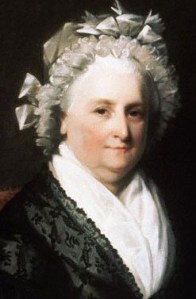
The quintessential portrait of Martha Washington, the elegant hostess of Mount Vernon and New York and Philadelphia.

From the start, guests were a part of the Mount Vernon tradition.  Both George and Martha Washington were neighborly people.  They were also each the oldest of several siblings, and throughout their forty-year marriage, brothers, sister, nieces, nephews and even great-nieces and nephews would be welcome visitors – sometimes for months at a time.  Once Washington reached his fame, guests – even strangers – came in droves.

The Washingtons’ Dinner Routine

Dinner, the main meal of the day, would be served, usually (and very promptly) at two p.m.  It could last for two or three hours, depending on the number of guests they expected and the enjoyment of their company.

The ladies entered dressed in elegant brocades in winter, light cotton gowns in summer.  The gentlemen wore their best knee breeches and coats.  Shoes were be polished, buckles shining brightly.  They would be dining in style.

Soup came first – perhaps a chowder or peanut soup.  Baskets of biscuits and breads, freshly churned butter and assorted jams were passed for all to enjoy.  Then fish.  Since the Potomac River flowed right past their back door, alive with millions of shad in season, all Mount Vernon hands were ready with their nets to harvest the bounty.   It supplied the needs of the entire plantation.  Some would be salted and set aside for storage, and there was enough for trade in Fredericksburg or Alexandria.

Then came the meats: hams, mutton, beef, game and poultry of all kinds.   Wild turkey, duck and goose were plentiful in the woods around the area.  The Mount Vernon smoke house overflowed.  (It is said that the Marquis de Lafayette had so admired the smokehouse largesse, that the Washingtons sent him a barrel of a dozen large hams as a gift.)

And of course, the wine flowed liberally.

The Garden Bounty of Mount Vernon

mt. vernon kitchen

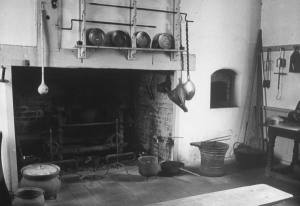
The kitchens, above all, were Martha Washington’s domain. She provided the daily planning and supervision. Nothing connected with hosting duties escaped her personal attention.

The kitchens were not the only domain of Lady Washington.  Mount Vernon’s gardens were hers as well since she claimed “vegetables indispensable to the kitchen.”  Since George Washington wanted the estate to be a model of self-sufficiency, the garden was planted right behind the stables, which assured a seemingly endless supply of natural fertilizer.

They raised a variety of asparagus, beets, beans, spinach, peas, artichokes, onions and lettuce, and planted herbs to edge their rows.  Thus any dinner chez Washington would feature an assortment of vegetables, stewed, baked, boiled, casseroled or otherwise.  What was not used for the immediate feeding of the household and their guests was traded or stored in their root cellars for future needs.

The Mount Vernon Orchards and Dessert

When the Revolutionary War ended, and General Washington returned to Mount Vernon to retire and enjoy the rest of his days, he undertook the planting of orchards of fruit trees.  He planted several varieties of pear, apple, peach, cherry and plum trees, which supplied the estate with fresh fruit for at least six months of the year.

Dessert at the Washingtons’ table was as plentiful as the main dinner course:  Pies, cakes, confections, fresh fruits and cream, puddings, comfits, trifles, and even Lady Washington’s Great Cake – an eleven pound confection designed to last for several days.   Ice cream had become popular by the time George Washington became President.  Tradition holds that Thomas Jefferson had returned from France with the recipe.  The Washingtons enjoyed the new confection immensely and purchased an ice-cream maker for their own use.

Then came coffee, perhaps tea (although tea would be served later in the day), and assorted dessert sweet wines.  Once dinner was finished, the tablecloths was removed, and an assortment of nuts placed right on the bare table for all to enjoy.

Then the ladies would retreat to another parlor, and resume their handiwork and gossip; the men would linger over claret and nuts, and whatever conversation suited them, be it politics or plantation management or the price of a new carriage.

It would always be an evening to remember.

Sources:

Brady, Patricia – Martha Washington: An American Life – Viking, 2005

Randall, Willard Sterne – George Washington: A Life – Galahad Books, 1997

www.mountvernon.org

Posted in A POTUS-FLOTUS Blog, George Washington | Tagged , , , , , , , , , , , , , , , , , , | 1 Comment

Garret A. Hobart : The First “Modern” Veep

Few people realize how history might have been changed but for the death of Garret A. Hobart

Garret Hobart: The Unknown Running-Mate

garret hobart

Garret A. Hobart, Vice President during William McKinley’s first term in office.

Garret Augustus Hobart (1844-1899), born and raised in New Jersey, educated at Rutgers University, was a prominent attorney, with many varied business interests.  He gravitated to political service, and became a member of the New Jersey Assembly and served a term as its Speaker.  Then he was elected to the State Senate, and served there as Senate President.

Although he had no national exposure, his prominence in Republican politics as well as his independent wealth made him an ideal delegate-at-large to several national conventions.

 Why Hobart was “Modern”

William McKinley, a fiscal “sound money” man,  was very well known by the time of his election in 1896.  He had been a Republican Congressman for nearly fifteen years, followed by two terms as Governor of Ohio.

407

William McKinley, 25th President of the United States, had never met his running mate prior to the election. They would become close personal friends.

 When Garret Hobart was nominated as his Vice President, named primarily as a geopolitical accommodation, the two men had never met.  McKinley duly invited Hobart to visit him, and strangely enough (considering the previous hundred years of presidential politics) the two would become close personal friends as well as political allies.   They sincerely liked each other.

With McKinley skating to an easy win in 1896, he found a true “partner” in the new vice-president.  Hobart was consulted on political matters.  He was given specific and confidential tasks to perform for the President.  He had also become a knowledgeable and effective parliamentarian, and had gained the respect of both houses of Congress.

This was a totally new aspect of the vice-presidency, which, prior to that time, had strictly been a toothless, clawless position of semi-honor.  Previous vice presidents had all but been ignored.

Mrs. Hobart and Mrs. McKinley

Ida Saxton McKinley in a Lacy Dress With a Plumed Accessory in H

First Lady Ida McKinley was a semi-invalid and could not manage the social duties of the White House.

But the real godsend was Jennie Hobart, the Vice President’s wife.  Ida McKinley was a frail invalid, afflicted with laming phlebitis and an epileptic condition, a stigmatic word that was never spoken aloud.  The misfortunes of her health also wreaked havoc on her emotional outlook, and she became petulant and difficult.  Her world became extremely narrow, and she grew to depend on her doting husband for everything.  He spared no effort to make her unfortunate situation easier.

The new First Lady’s peevish personality precluded any suggestion to relinquish her title or the essence of her position to substitutes.   She would brook no challengers.  Thus it created monumental inconveniences for the President as well as for the White House staff.

Tuttle Hobart.JPG

Jennie Hobart, the “Second” Lady, would be a godsend to President and Mrs. McKinley.

Into this breach stepped Jennie Hobart, a kind and tactful lady.  She made it a point to befriend both McKinleys, but in particular, the hapless Ida.  Knowing that it was impossible for the First Lady to stand and receive guests, it was Jennie who offered to receive with her.   Ida could be seated, holding a large bouquet of flowers.  Jennie would stand beside her, be introduced as “Mrs. Vice President,” shake hands with the visitor, and introduce the guest to the frail First Lady.  This way it kept Ida from doing anything other than smiling and nodding, yet she would be “center stage.”  It worked well.  Everyone benefitted.

The Social Challenges

Since the usual political “entertaining” was often curtailed to accommodate to the President’s ailing wife, the Hobarts helped fill another void.  They had a large house nearby, and with their independent means, provided the atmosphere for political figures to meet informally – or in confidence.  This was very much in keeping with Secretary of State and Mrs. Madison opening their home for social-political entertaining nearly a century earlier.  This way, the Vice President got to know everyone in town.  Mrs. McKinley did not mind a bit, and the President was grateful.  Much could be accomplished.

Garret Hobart became not only a popular vice president, but a well regarded one, all the more so, since he had little national experience prior to his election.

McKinley never deigned to invite him to regular Cabinet meetings, however; it would take decades before that would happen.  But Hobart was actively and substantively consulted by the President, who grew to depend on the man who had become his true friend and ally.

Hobart: The Accident of Fate

William McKinley was an extremely well-liked president, and after a jingoistic war (which he opposed) was easily fought and won, he was even more popular.  He was a shoo-in for a second term.  With no political fences to mend, so to speak, and since he got on so well with his equally admired vice president, it was expected that the McKinley-Hobart ticket would prevail again in 1900.

History can be a fickle player.  Garret Hobart had a fatal heart attack in 1899.  He was only fifty-five.

Theodore Roosevelt was elected the new vice president.

When McKinley was assassinated only months into his second term, the dynamic Theodore became President of the United States.  The quiet Garret Hobart, a good man, is forgotten by history – even in New Jersey.   But he was the one who enhanced, advanced and enriched what had previously been an inconsequential office.

Sources:

·         http://www.historycentral.com/bio/rec/GarretHobart.html

·         Leech, Margaret – In The Days of McKinley, 1959, Harper & Brothers

·         Halstead, Murat – The Illustrious Life of William McKinley, 1901, Memorial Edition

·         Purcell, L. Edward, (Editor) Vice Presidents: A Biographical Dictionary – 2005, Facts on File Publishing

Posted in Nifty History People, William McKinley | Tagged , , , , , , , , , , , , , , , | 4 Comments

Dolley Madison in Plain Clothes

Dolley by James Peale

One of the oldest of the Dolley Madison portraits, the garb may not have been strict Quaker, and jewelry was verboten, but the influence of plain attire is apparent.

For the first twenty-five years of her life, Dolley Payne Todd Madison wore Quaker gray gowns and bonnets.

Dolley:  A Strict Upbringing

Dolley Payne (1768-1849) was born and raised into a strict Quaker family.  Her father, John Payne, was a convert, and like most people who choose their religion, he rigorously observed the tenets of the faith.

It was a simple life.  Dolley dressed in the conventional Quaker gray gowns and bonnets, attended prayer meetings on Sunday, “thee’d and thou’d” in her speech patterns, and disdained everything that smacked of opulence or luxury.

Despite the adherence to Quakerism, the Paynes owned a few slaves, which would prove a great moral conflict to Dolley’s father.  But for the first twelve or fifteen years of her life, the handful of bondsmen were a part of that life.

The Paynes would be a happy and loving family, with eight of their ten children living to maturity.  But it would not be a particularly merry one.

Dolley:  The Seminal Experience

The story goes that when Dolley was around ten, and likely during one of her mother’s many confinements, Dolley was sent to spend a fortnight with her Episcopal grandmother in Virginia.

For the first time, she was exposed to bright colors, other than flowers in the fields and gardens.  Dolley never saw vivid color inside the home.   Added to the bright blues and greens and reds, she saw rich fabrics, something she would love for the rest of her life.  Velvets, silks, satins and brocades.  And jewelry!    She heard lively music.  She had been taught that music was for hymn singing only.  Here was not only music – but dancing!

And, the story continues, Dolley was treated to desserts: cakes and pies, jams and comfits.  At home, sweets other than perhaps honey, were not a part of the plain Payne diet.  Dolley’s sweet tooth would become legendary!  She would never forget this experience, and admitted on various occasions that she “did not have the soul of a Quaker.”  Dolley liked stuff.

Dolley:  The Philadelphia Story

When she was fifteen, the inner turmoil her father felt as a slave-owner, expressly forbidden by Quakerism, had finally reached the point that he manumitted (freed) his human “property,” at great financial cost to himself.  Then he sold his successful plantation, and moved to Philadelphia, the great Quaker City in Pennsylvania, where he would find “Friends.”

Dolley

The house that John Payne bought for his family (and later turned into a boarding house) still remains in Philadelphia.

Her parents purchased a large brick house in the center of Philadelphia, which still stands today.  John Payne purchased a starch manufacturing concern, and the family limped by.  Dolley, as the oldest daughter, was needed to help raise the children at home.  Paynes business was a failing one, not only financially, but in his sense of personal worth.

He retreated into a severe depression which eventually resulted in his death.  The house would become a boarding house to help support the family.

Dolley Is A Quaker Bride

Meanwhile, during this time of personal and financial upheaval in the Payne family, Dolley met and was courted by a young Quaker lawyer named John Todd.  Todd was one of the few “Friends” who refused to abandon the family in its time of need.  He also had fallen in love with the attractive and very personable Dolley Payne.

It was her father’s last wish that Dolley marry Todd, and whether she did so to please her dying father or because she sincerely loved the young attorney is still debatable.  The bottom line is that she did marry him, and they had a happy, if not long marriage.   (For the record, Dolley was the ONLY one of John Payne’s children who married into the Quaker religion.  Strict obedience to the faith was not hereditary.)

Three years later, disaster struck in the guise of a yellow fever epidemic that claimed nearly a quarter of Philadelphia’s population.  John Todd was one of its victims, as was their infant son Temple.  Dolley herself was very ill, but she managed to recover.  So did her two-year-old son, Payne.

Dolley in Washington

This early image of Dolley Madison is likely the way she might have appeared at Lady Washington’s levees. Her clothing, of course, would have been far more decorous, and her Quaker bonnet would have covered her curls.

Dolley and little “Payne” returned to live with her mother and to help with the boarding house.  It was 1794, and Philadelphia was the country’s capital and temporary home to congressmen, senators and all levels of government officials .  It did not take long before The Widow Payne’s boarding house gained a reputation of being the liveliest and most enjoyable home-away-from-home in town – particularly noted for its charming and engaging hostess, the recently widowed Dolley Todd.

Still wearing her Quaker gray gowns and bonnets, once the traditional mourning black had been discarded, Dolley began was receiving invitations to First Lady Martha Washington’s levees.  One of Dolley’s sisters had married one of George Washington’s nephews, so she had “family access.”  Despite her plain clothes, her engaging personality and vivacious manners made her an instant hit with the First Family

Six months after John Todd’s death, the Widow Todd was introduced to Congressman James Madison, and her life would change dramatically.

Sources:

Anthony, Carl Sferrazza – First Ladies: The Saga of the Presidents’ Wives and Their Power 1789-1961, 1990, William Morrow

Allgor, Catherine, – Parlor Politics: In Which the Ladies of Washington Help Build a City and a Government, 2000, University of Virginia Press

Allgor, Catherine – A Perfect Union: Dolley Madison and the Creation of the American Nation – 2006 Henry Holt and Company

Moore, Virginia – The Madisons: A Biography, 1979, McGraw Hill

http://www.whitehouse.gov/about/first-ladies/dolleymadison

Posted in A POTUS-FLOTUS Blog, James Madison | Tagged , , , , , , , , , , , , , , | 1 Comment