Dolley Madison and the Inaugural Ball

Dolley Madison was already a superstar when James Madison was elected President in 1808.

The Early Inaugurals

The inaugurations of George Washington had been solemn affairs, both in New York City and Philadelphia. No government of the “we the people” type had ever been attempted before, and the mood was dignified, somber and, in the Biblical sense, awesome. Martha Washington didn’t arrive in New York for several weeks.

When John Adams was inaugurated in 1797, Mrs. A. was back in Massachusetts nursing John’s elderly mother, who would succumb within the month.

earliest known wh image

One of the earliest images of the White House.

Thomas Jefferson, who inherited the new and unfinished White House only a month after Abigail Adams hung her laundry in the East Room, was mainly a man of the “small table,” preferring a dozen guests rather than throngs. Jefferson was a long time widower, as was his Vice President. The ranking woman of Washington, therefore, was Mrs. Madison, wife of his Secretary of State. As such, she was recruited periodically to play hostess for the President, whose Southern hospitality was always gracious, but just a tad remote. Thus, to fill a much-needed void in the fast-growing town, the outgoing Dolley Madison opened the Madisons’ doors, providing a place for meeting, greeting, and polite politicking in an informal and non-threatening setting.

The Washington Social Scene Circa 1809

idealized madison

James Madison was in his mid-fifties when he became President of the United States in 1809.

In 1809, the town was little more than a village, although it would grow every year. Most congressmen, diplomats or other government officials found accommodations in local boarding houses. Where could people meet and be introduced? Where could men discuss the events of the day “off the record”? The parlors or salons of the fashionable and well-placed women of the day provided the venue, and at the top of the list, was the home of Secretary and Mrs. Madison. The movers and shakers of Washington flocked chez Madison for luncheons, receptions, teas, dinners and suppers, which Dolley was happy to host several times a week.

The socially talented Mrs. M. had a true and rare gift for inclusion and an innate diplomacy. Even those who claimed opposing political views were happy to come to Mrs. Madison’s parlor, sure of their unbiased welcome and her effortless talents for inclusion. Everyone was greeted, everyone was introduced, and she permitted no “wallflowers.” No one ever had anything but the highest praise for Dolley. She had the unusual quality of counting both men and women among her many friends and admirers. She was not a flirt. She did not gossip. And she always kept her word, including (and especially) the words of confidentiality. Even more important, the praise and the friends were sincere.

The First Inaugural Ball

DECODED Dolley

Gilbert Stuart painted Dolley Madison in her prime – a forty-year-old mistress of the White House, and probably of Washington, DC itself.

By 1809, when James Madison was inaugurated, Washington had grown substantially, as had the country, which was now celebrating its 20th birthday. Always ready for a party, Mrs. Madison, still attractive at forty, decided on hosting an Inaugural Ball to commemorate the occasion. The only accommodation available to hold a large number of people was Long’s Hotel near the Capitol Building. More than four hundred invitations were issued – the largest number of guests ever seen at an event in the city before.  The attendees were happy to pay the then-exhorbitant cost of $4 per ticket.

Musicians were engaged, caterers and confectioners were hired. Flowers and bunting and all sorts of decorations were hung. Hundreds of candles lit the room. Everybody who was anybody in Washington came in their finery to make merry, to dance, to dine and to enjoy. First Lady Dolley Madison was dazzling in her buff-colored gown and matching turban with feather plumes. In a short time, word of mouth spread of the affair and style, and both buff and turbans became the fashion of the day. It was the beginning of a new era.

The coup de grace, however, came at the supper. Dolley Madison, as was her custom, sat at the head of the main table. Dolley’s place had been an established custom in the Madison family, relieving her reticent husband of hosting and serving responsibilities. He could then sit mid-table, and engage in the quieter conversations he preferred. To one side of the First Lady sat the Minister of France; on the other, the Minister of England. England and France had been traditional enemies for centuries. Those countries were currently at war. Under any other circumstances, those official representatives would not have even been in the same room together, let alone the same table. But they both knew they would be on their very best diplomatic behavior, and no incident would be forthcoming. Both ministers liked and admired Mrs. Madison, and would not wish to offend her. Only Dolley could have managed that situation!

And the Inaugural Ball has become a quadrennial tradition for two centuries.

Sources:

Anthony, Carl Sferrazza – First Ladies: The Saga of the Presidents’ Wives and Their Power 1789-1961, 1990, William Morrow

Allgor, Catherine, – Parlor Politics: In Which the Ladies of Washington Help Build a City and a Government, 2000, University of Virginia Press

Moore, Virginia – The Madisons: A Biography, 1979, McGraw Hill

http://www.whitehouse.gov/about/first-ladies/dolleymadison

http://www.whitehouse.gov/about/presidents/jamesmadison


Posted in A POTUS-FLOTUS Blog, James Madison | Tagged , , , , , , , , , , , , , , , , , , | 2 Comments
Caroline Harrison Electrifies The White House

   New York City was electrified n the early 1880s, but the White House would not be on the grid until 1891.

Benjamin Harrison Arrives in Washington

bharrison

Benjamin Harrison, grandson of President Wm. Henry Harrison, served a single term between Grover Cleveland’s non-consecutive terms.

Incumbent Democrat Grover Cleveland was running for a second term against Republican Benjamin Harrison of Indiana in 1888. It was another one of those peculiar elections where the one who received the most popular votes (Cleveland) did not win the most electoral votes (Harrison).

Grandson of a President and waver of the “bloody shirt” reminder of the Civil War, Ben Harrison (1833-1901) was the not most popular person to come down the pike. In fact, between Harrison and Cleveland, it was said that the former had no friends, the latter only enemies.

Nevertheless, Benjamin Harrison was the new President.

Caroline Harrison Inspects the White House

CarolineHarrison

Caroline Scott Harrison was a talented homemaker – and water colorist. She is credited with starting the White House china collection.

Of all the First Ladies to occupy the White House, then or now, Caroline Scott Harrison (1832-92) takes first prize as housekeeper par excellence. She cooked, sewed, planted, canned, designed and ran a household to a perfection that could win a Martha Stewart competition.   She also was a water colorist, and gave classes in china painting in their Indianapolis home. In her spare time, she soloed in her church choir and served as President of her Woman’s Club.

carie watercolor

One of Caroline Harrison’s water colors. Her work was considered good enough for her to give classes in china painting when they lived in Indianapolis.

True to form, she bustled into the White House and gave it a thorough white-glove inspection from top to bottom. She was not happy. There were rats, termites, rot, assorted bugs, and a kitchen that had not been updated in forty years. And, there were exactly five bedrooms and only one bathroom – insufficient for the large extended family the Harrisons brought with them. It would definitely not do for Carrie.

Mr. Edison Inspects
Benjamin Harrison was a willing advocate for major renovations. He was surprised to learn that candles and gas lamps were still the only means of light – and here it was a decade after Thomas A. Edison had invented the incandescent bulb!

Knowing nothing about electrification, the Harrisons went straight to the best source. They invited the great inventor to make a feasibility study. Mr. Edison was happy to oblige, and came to Washington with a small team of scientists and engineers. It took two days, but they made a thorough examination, and declared it was not feasible: the place was a firetrap that could go up like a tinderbox.

That announcement laid the groundwork for Mrs. Harrison’s new plan: a new White House. After all, the old mansion was nearly a hundred years old. Times had changed

Planning A New White House

It was a major problem: old kitchen, insufficient private rooms, inadequate office space, no bathroom accommodations, outdated everything – and no hope for the modern conveniences people seemed to be enjoying everywhere else.

Congress considered the proposal for a new White House. They formed a committee – with Mrs. Harrison assigned a key place. She had suggested building a palace comparable to our European counterparts – part a working-residence, and part a museum. Designs were solicited from several well-known architectural firms. Their drawings and bids are still housed in the National Archives.

Then Congress decided otherwise. They believed that the “house” of Jefferson and Lincoln should be maintained, not razed. They authorized around $35,000 to make the necessary repairs, the first of which would be to implement Edison’s lighting requirements. It would take a full two years before those improvements were completely installed. In September, 1891, the Washington Post had a front page article declaring that the East Room was darkened, and the electric lights were turned on.

The Harrisons Are Afraid of the Light

Carrie-DAR

Caroline Harrison was elected the first President-General of the newly-created Daughters of the American Revolution. That group commissioned her formal White House portrait.

The words “electricity” and “firetrap” and “tinderbox” were, and still are, fearful words, especially to those naïve in the ways of modern inventions. The Harrisons begged Edison to assign a special electrician to the White House to oversee any problems that might arise. He was happy to oblige, which was how Irwin (Ike) Hoover was first brought to the White House, where he would spend the next forty-plus years.

First and foremost, Ike Hoover was in charge of turning the lights on and off. If the President or his family or his guests planned to enter a darkened room, Hoover was summoned to turn the lights on. The reverse was true if the room was to be vacated. Neither Benjamin nor Caroline Harrison would go near that switch, for fear of electric shock or worse – an incident that could spark a fire.

It is said that when Ike Hoover was to be out of town, the First Family would leave the lights burning all night.

The Harrisons did not have a long time to enjoy their newest technology. Carrie developed tuberculosis, and died before their term was over. Benjamin Harrison, in mourning, only made a half-hearted attempt at a re-election campaign. He would lose to none other than Grover Cleveland, the man he had nosed out of the White House four years earlier.

Sources:

Carpenter, Frank G. – Carp’s Washington – 1960, McGraw Hill

Irwin Hood Hoover, Forty-Two Years in the White House, 1934, Greenwood Press (reprint,) 1974

http://www.whha.org/whha_timelines/timelines_workers-02.html

Posted in A POTUS-FLOTUS Blog, Benjamin Harrison | Tagged , , , , , , , , , , , , , , | Leave a comment

The Sons of Varina Davis

One of the little-known tragedies of Varina Davis’ life was that she survived all four of her sons.

Samuel Emery Davis (1852-54)

Forty-four year old Jefferson Davis and his twenty-six year old wife Varina had been married for seven years. There had been no hint of a pregnancy, and the couple had resigned themselves to their childless fate.

The birth of Samuel Emery Davis, born in 1852 and named for his paternal grandfather, surprised and elated his parents. Shortly after the infant’s birth, Jefferson Davis was appointed Secretary of War under President Franklin Pierce, and the Mississippi couple moved to Washington.

wedding picture

Jefferson and Varina Davis would have six children. Four sons would predecease the couple.

President and Mrs. Pierce had tragically lost their eleven-year-old son only weeks before the inauguration. Jane Pierce, a melancholy woman by nature, was in deep, deep mourning, but she found comfort in the companionship of young Mrs. Davis and her new baby. A little more than a year later, little Samuel sickened and died. The Davises were understandably grieved, but Varina was also pregnant again.

Jefferson Davis, Jr. (1857-1878)

Perhaps the birth of Samuel jump-started Varina Davis’ physiology. She would bear five more children. Margaret Howell Davis was born in 1855.

Jefferson Davis Jr., their third child, was a difficult birth. It was winter, and the weather was abysmal. Washington was locked in a blizzard, and Varina’s pains had begun – promising to be long and dangerous. The midwife they had engaged lived several blocks away, and could not get to the Davis’ house. By chance, she was a neighbor of Senator William Seward (who would be Lincoln’s Secretary of State). She begged the use of his horse and carriage for the emergency, and the Senator insisted on personally driving her to the home of the Secretary of War, a man he barely knew.

The midwife arrived in time, and while baby Jeff would survive, Varina developed a puerperal fever, and was seriously ill for weeks.

Jeff grew up to be a sturdy boy, who loved his visibility in the Confederate White House. Playful and rambunctious like most normal little boys, he was decidedly good looking and oozed charm. The household staff called him “General.” But after the Civil War, life was not easy for the boy.

Within weeks after the Confederates surrendered at Appomattox, his father was captured and imprisoned.   Varina sent him, his sister and little brother to Canada, in care of her mother. It was in everyone’s best interest. The children would be loved – and out of harm’s way. Two years would pass before the family reunited, and it would be a life far different from the one they had known. The Davises were wealthy before the War; now their land was gone, their income was gone, and their prospects were tenuous.

Davis kids

(Left to right) Jefferson Davis Jr., Margaret Davis, Varina Anne (Winnie) Davis and William Davis, taken after the end of the Civil War.

Jefferson Davis was nearly sixty and in poor health.  He needed to find employment, so they went to England.  Jeff Jr. continued his schooling, but unlike either of his parents, he was a lazy student, and difficult to motivate. Once back in America, he continued to flounder. For a brief time he went to school in Maryland – and later barely survived a semester at the Virginia Military Academy.  It is said that Jefferson Davis had sadly remarked to his wife, “We do not understand this boy and I fear we never shall.”

Finally, in 1877, twenty-year-old Jeff Jr. went to Memphis, Tennessee as clerk in his brother-in-law’s bank. A year later he died in a yellow fever epidemic.

Joseph Evan Davis (1859-64)

Little Joe is the only Davis son people vaguely remember. He is the “Willie Lincoln” of the Confederacy. Said to have been their brightest and most promising son, he was the one of tragedy.

In May, 1864, he was playing in the upstairs nursery of the Confederate White House. It was a beautiful day, and the floor-to-ceiling windows were wide open. The five-year-old evaded his nursemaid, ran out onto the balcony and plunged three stories to the concrete walk below. The child never regained consciousness and died a few hours later. His grieving father had the balcony torn down the following day.

Joe was buried in Hollywood Cemetery in Richmond, where the rest of the family would later be interred.

William Howell Davis (1861-1872)

Billy Davis was a war-baby, born at the end of 1861, shortly after his parents had moved to Richmond as Confederate President and First Lady. From the start, he was sickly.

Months later, as the boom of federal cannons could be heard near Richmond, Jefferson Davis sent his wife and children to North Carolina for safety. The letters between the Davises at that time are filled with concern about their baby’s health, and the Confederate President was prepared for the worst.

Rebel soldiers stationed in North Carolina remember seeing Mrs. Davis, babe in arms, pacing up and down outside the hotel where they were staying, in an effort to lull the fretful baby into some restful sleep.   The family’s hardships following the War proved to be his undoing. His health never returned fully, and William Davis would die at only eleven.

The Marker in St. Paul’s Church

Inscribed on the wall of St. Paul’s Episcopal Church in Richmond, Virginia is a large plaque dedicated to the memory of the four sons of Confederate President Jefferson Davis. This was the church where the family prayed while they lived in Richmond.

the elder davis family

An elderly Jefferson and Varina Davis, with their daughter Margaret and their grandchildren.

Decades after the Civil War, Margaret Howell Davis Hayes, the older sister of the Davis boys assumed the responsibility of honoring the brothers she hardly knew. Of the six Davis children, she was the only one who married, had children, and lived a full lifespan. One of her brothers died before she was born. Two died as children. One was a troubled young man.

Their sister would never forget that they were the sons of illustrious parents. She would never forget them, either.

Sources:

CASHIN, JOAN – First Lady of the Confederacy, 2006, Belknap Press

http://jeffersondavis.rice.edu/JeffersonDavisJr.aspx

http://lifeofthecivilwar.blogspot.com/2010/04/he-fell-from-porch.html

http://jeffersondavis.rice.edu/WilliamHowellDavis.aspx

Posted in American Civil War, Nifty History People | Tagged , , , , , , , , , , , , , , , , , , , , , | 1 Comment

Rachel Jackson’s Inaugural Gown

  The Smithsonian Institution maintains a priceless collection of First Ladies’ inaugural gowns – at least those of the past hundred years.

composite jacksons

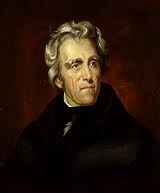
A composite and somewhat glamorized double portrait of Andrew and Rachel Jackson. They were never painted together during their lifetime.


But if they had collected and maintained every First Lady’s inaugural gowns, the most valuable could arguably be the gown purchased by Rachel Jackson for her husband’s inauguration on March 4, 1829.

Mr. and Mrs. Andrew Jackson

At the time of Andrew Jackson’s election in 1828, both Andrew and Rachel Jackson were sixty-one years old, and both were in poor health. He had a long list of chronic ailments, although he would live to be seventy-eight. She, on the other hand, had a bad heart.

They had been a loving and devoted couple, married for nearly forty years.  Jackson was happy to give his wife anything that was in his power, but the two things she craved the most, he could not provide:  children of their own, which was in God’s hands, and his company.  Jackson was a man who could not stay-put.

It had also been a marriage marred by scandal and slander. She had been married before she met Jackson. She had been, of all horrors, a divorcee.  It made her reclusive, spawned by the murky details of her unhappy first marriage.  The reclusiveness was further heightened by her growing religious fanaticism.

Rachel managed to find some comfort in their well-named Hermitage plantation in Nashville, Tennessee, surrounded by her large family, dozens of little nieces and nephews, and close friends.

Rachel had also grown stout. Her manners, while acceptable in frontier-Tennessee, were unacceptable in the polite societies of larger cities. Her education was scanty. Her conversation was limited. In short, she was not about to fit into the footsteps of the incomparable Dolley Madison – or the sophisticated and cultured Elizabeth Monroe and Louisa Adams.

rachel2

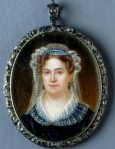
Rachel Jackson in one of the very few portraits that exist of her. Jackson wore her miniature likeness on a chain around his neck until he died.

Rachel Jackson Becomes First Lady-Elect

But in late 1828 Andrew Jackson was elected President of the United States, and despite her personal misgivings and disinclination, she agreed to go to Washington with her newly-elected husband, because she knew he wanted her near.  And she always wanted to please him.

She planned to bring some nieces with her to manage the social obligations. Needing an appropriate gown for the inauguration, however, she went with some well-meaning friends to a dressmaker in Nashville, and selected a white gown. Many later historians claim she was poorly guided by her friends (and/or the dressmaker), since it appeared to be more suitable to a young bride rather than a heavy, dropsical woman past sixty.

In town for a fitting, she read a newspaper story rehashing her unhappy first marriage and her divorce and subsequent marriage to Jackson – compounded by their realization that the divorce had not been finalized when she married Andrew Jackson.  They had been immediately remarried, but the scandal had wings and a long life.  Jackson was a man who made enemies, and comments about his “adulterous wife” was the quickest way to Old Hickory’s spleen.  He carried two bullets in his body as souvenirs from duels he fought over Rachel’s honor.

If roiling of those muddy waters weren’t enough to cause Mrs. Jackson pain, the article went on to discuss Rachel’s “unfitness” for her new role; that she would bring disgrace to the White House. She wrote to a friend that she would rather “be a doorkeeper in the house of the Lord than to live in that great white palace.”

Rachel Jackson left the shop in a flood of hysterics.  We will never know what the gown looked like, other than the well-quoted comment that it was white.  Her friends brought her back to the Hermitage, where she suffered a heart attack a few days later. She died on December 22, 1828, only ten weeks before a grieving Jackson took his oath of office.

gravesite

The Jackson gravesite at the Hermitage in Nashville TN where Rachel is buried in what would have been her inaugural gown.

She was buried in her beloved flower garden, wearing that same white gown she would have worn the evening of March 4, 1829.

It is arguably the most expensive inaugural gown in First Lady history. It cost Rachel Jackson her life.

SOURCES:

Anthony, Carl Sferrazza – First Ladies: The Saga of the Presidents’ Wives and Their Power 1789-1961, 1990, William Morrow

http://www.eyewitnesstohistory.com/jacksoninauguration.htm
Burstein, Andrew – The Passions of Andrew Jackson – Borzoi/Knopf, 2003
Meacham, Jon – America Lion: Jackson in the White House – Random House, 2008


Posted in A POTUS-FLOTUS Blog, Andrew Jackson | Tagged , , , , , , , , , , , , , , , , | 1 Comment

George Washington’s Losing Battle: Educating Jack Custis

No matter how hard he tried, George Washington was never going to make a scholar out of his stepson.

 George Washington’s Inherited Family

When George Washington met and married the widow Martha Dandridge Custis in January, 1759, he inherited her large fortune and her two small children. By all standards, he took his parental responsibilities very seriously, including their education.

When George Washington married the widow Martha Custis, her children, Jack and Patsy, were four and two respectively. Washington was an affectionate stepfather

Colonial children usually learned their letters and numbers from their mothers, and Martha obliged. When John (Jacky) and his little sister Martha (Patsy) were around six, a tutor was engaged. Patsy’s education, past her “three-Rs” in accordance with tradition, focused heavily on domestic subjects: embroidery, gardening, basic herbal remedies, and the essentials of home and plantation management. She learned most of this from the domestically expert Martha, who had always preferred the womanly subjects to formal studies.

custis children

George Washington’s step-children: John (Jack) Parke Custis, and Martha (Patsy) Custis.

Jacky, however was another story. Plain and simple, he hated schoolwork, and much preferred to ride his horse and shoot his musket and play with his friends.

George Washington’s Education

George Washington was only eleven when his father died. His expectations for a solid formal education were dashed.   The best he could hope for was absorption by association, which he received in generous supply when his elder half-brother Lawrence took him under his wing, and introduced him to the finest families in Northern Virginia.

George Washington’s education was instructive, rather than pleasurable, but he absorbed well, and learned to apply his knowledge. He was an intelligent boy, and became an intelligent man, and prominent in Colonial Virginia even in his teens.. He associated with the cream of society as well as the cream of intelligence.  Two things he learned in great abundance: the importance of formal education, and his sorry lack of it.

Jack Custis’ Academic Expectations

George Washington was no fool. His little stepson showed no interest in book-learning, let alone Latin or Greek. Washington understood. He intended to raise his stepson in expectation of his future position. At his maturity, Jack Custis would become a great landowner. He would inherit large plantations. He would also be expected to take his place in the House of Burgesses. Classical education was not essential. But fair general knowledge, and some pertinent application was necessary. And Washington, charged with oversight of this education, sought to provide the very finest possible opportunities for the would-be wealthy gentleman.

jack custis

John (Jack) Parke Custis was Martha Washington’s son by her first marriage. He died of a malarial-type fever when he was only twenty-seven.

At eight or nine years old, Jack was sent to board with Reverend Jonathan Boucher, a clergyman-educator who lived close enough for his mother’s attention and his step-father’s supervision – yet far enough away for the boy to feel independent. Washington’s extensive correspondence with Boucher indicates that he kept sharp tabs on the boy’s progress – or, in the case of Jack Custis, the lack thereof. But Washington hoped, and Jack promised to try harder and apply himself.

To his credit, Jack was an affectionate boy-to-man.  He adored his mother, and was sincerely fond of his stepfather. He would always be a good son. His promises were well intentioned – just never executed.

Jack Custis: The Schoolboy

It was an age of “spare the rod, spoil the child,” and the Reverend Boucher may have been limited and uncompromising in his approach as a schoolmaster. Imagination played no role in pedantry.

But it was never a secret that when Jack Custis came of age, he would be a very wealthy gentleman. Thus he naturally gravitated to the “gentleman’s” pursuits of riding and hunting, dancing, socializing and sporting fine clothes. Book learning was not on his agenda. Despite Jack’s many promises to his stepfather (who he truly liked and admired) that he would be more attentive, his tutor threw up his hands and declared Jack Custis to be the most “voluptuary” boy he knew. The meaning, in its archaic sense, meant “pleasure-loving.”

Still, George Washington did not give up on the young man.  He wanted the very best for his stepson.

Jack Custis: The Teenager

Finally, in near-desperation, he decided to send Jack, now about seventeen, to Kings College in New York City (today’s Columbia University). In those days, entrance examinations were not required.   Family funds were the only pre-requisite.

As expected, Jack did not want to go. He had no head for academics. His heart was also elsewhere. He had met and fallen in love with young Eleanor Calvert and wanted to get married. But Jack went to New York to please his stepfather, and, no surprise, where his scholastic achievements were as lackluster as they had ever been. He lasted a semester.

He came back to Mt. Vernon and persuaded his parents that he was responsible enough to marry his Nelly.  He proved to be a far better husband (and sire of children) than he had ever been a student. He would have four children before he died at only twenty-seven.

The Custis Legacy

When Jack Custis died, his twenty-five year old widow was left with four children under ten.   Nelly would later remarry and have more. She would also remain extremely close to the Washingtons, who loved her dearly and forever considered her part of their “family.”

washingtonfamily

George and Martha Washington with their step-grandchildren: George Washington Parke Custis, and Eleanor Parke Custis. The Washingtons raised the two youngest children of Jack Custis as their own.

George and Martha Washington adopted Jack’s two youngest children, Nellie and George Washington Parke Custis. They would be the delight of the Washingtons’ old age. Nellie would inherit her mother’s beauty and her grandmother’s domestic talents.

G.W. Custis however, much to his step-grandfather’s exasperation, would inherit his father’s disinclination for study. He would never be a scholar either.

Sources:

  • Bourne, Miriam Anne, First Family: George Washington and his Intimate Relations, W.W. Norton & Co., 1982
  • Brady, Patricia – Martha Washington: An America Life – Viking Press, 2005
  • Randall, Willard Sterne – George Washington – Galahad Books, 2006
Posted in A POTUS-FLOTUS Blog, George Washington | Tagged , , , , , , , , , , , , , , , , , , | Leave a comment

Calvin Coolidge Takes the Oath of Office

Calvin Coolidge (1872-1933) was sworn in as the 30th US President by his own father – one of those quirks of history not likely to be repeated.

Calvin Coolidge: Political Mediocrity

Nothing in Calvin Coolidge’s background ever suggested that he would become president.   A mediocre lawyer from western Massachusetts, Coolidge spent more than two decades plodding along in mediocre political offices mainly to augment his mediocre income.

calvin coolidge

Calvin Coolidge had been a mediocre Massachusetts politician who held various state legislative offices became he became Governor of Massachusetts.

When he became Governor of Massachusetts in 1919, he believed it to be the pinnacle of his career, and assumed the honor would help his law practice when he retired. For weeks he ducked involvement in a growing crisis among Boston’s police, who were demanding pay increases. Coolidge insisted that it was a “Boston” issue, rather than a state issue, and repeatedly urged the Mayor of Boston to deal with it. When it became impossible for Boston to reach an agreement, the police went on strike. At that point, Governor Coolidge issued a memorable sentence: There is no right to strike against the public safety by anybody, anywhere, any time.

That one galvanizing sentence catapulted Calvin Coolidge onto the national stage. He was nominated as Vice President on the Republican ticket in 1920.

Calvin Coolidge: Vice President

calvin and grace

Calvin and Grace Coolidge. Both as Vice President and later President, Coolidge and his wife would be hugely popular.

It had to be the best job Calvin Coolidge ever had – Vice President of the United States!  It was a position of honor and comfortable income, with very little responsibility other than presiding over the Senate, a constitutionally-assigned task, and pleasant ceremonial functions, like ribbon-cutting, ground-breaking, and award-presenting. Since President and Mrs. Harding did not care for the reserved New Englanders, they gave the second-couple very little substantive duties.  Coolidge did not complain. He filled the bill admirably.

Taking everyone (including themselves) by surprise, the Coolidges became wildly popular in Washington. Coolidge had a saharan wit, all the more hilarious by its dead-panned delivery. He became widely quoted. Grace Coolidge was attractive and personable. Together they charmed and delighted officialdom. They were invited everywhere!

Hardings and Coolidges

A rare photograph of the Hardings (left) and the Coolidges. They did not care for each other.

The Death of President Warren Harding

In midsummer 1923, no one had any idea that President Warren Harding was ill. His frequent chest pains were diagnosed as chronic indigestion, caused by rich food and too much stress. The rich food and stress were definitely part of the problem, but “Doc” Sawyer, the Hardings’ long time physician and friend, failed to realize the obvious signs of a failing heart.

It had been a very difficult few months for Harding, who readily admitted his lack of qualifications for the office to his intimates. Still, he was a popular president, blessed by “presidential” good looks and the politician’s “glad hand.” But he was becoming painfully aware that some of his cabinet members and high-level appointees, close friends for many years, had their hands in the public till up to their elbows. An avalanche of malfeasance and scandals would become public a year later.

The distraught Harding decided to take a working-vacation in Alaska. He needed the rest. He had not been sleeping well or feeling well. On his trip, a violent attack of stomach pains was said to be food poisoning; a week later, he suffered a heart attack and died.

Coolidge Becomes President

The Coolidge sons, John and Calvin, Jr., were teenagers with summer jobs in August, 1923, so it was just Calvin and Grace Coolidge who were in Plymouth Notch, Vermont, the tiny village where Coolidge was born and raised. Coolidge and his father were particularly close, and the visits were annual events.

Around 2 AM on August 3, everyone had been in bed for hours. There was a loud and persistent banging at the door, and a sleepy senior Coolidge finally answered. A telegraph operator had come with momentous news: the President was dead. The elderly man trudged upstairs to awaken the sleeping new President. When Coolidge was told, it is said that he and his wife knelt in silent prayer for a few minutes before dressing and coming downstairs.

oath of office

Coolidge takes the oath of office in a tiny gas-lit parlor of his father’s house in Plymouth Notch, VT.

Coolidge dictated a telegram of condolence to Mrs. Harding, then a brief message for the newspapers. There was no telephone at the Coolidge farmhouse. The place had yet to be electrified. The only light sources were kerosene lamps. It would have taken hours to locate a local judge to administer the oath of office in rural Vermont, and time was of the essence. The continuity of the government needed to be assured.

Coolidge’s father was a man of distinction in his community: a farmer, a merchant and a part-time legislator. He was also a notary public, and therefore an officer of the court, duly authorized to administer the oath.

Grace Coolidge held the family Bible as her husband placed his left hand upon it and raised his right hand. In less than three minutes it was done. Calvin Coolidge had been officially sworn in as 30th President of the United States.

He solemnly shook hands with the handful of people who had come to bear witness to this unique event held in a tiny gas-lit parlor in the wee hours of the morning. Those witnesses would soon make their way back to town to spread the news that the country had a new President, and they had personally seen him take the oath.

Then Calvin and Grace Coolidge went back upstairs to bed. “What else is there to do at two o’clock in the morning?” he is quoted as saying.

Sources:

Boller, Paul F., Jr. – Presidential Anecdotes – Oxford University Press, 1981

Coolidge, Calvin – The Autobiography of Calvin Coolidge – Academy Books, 1972 (reprint)

Dole, Bob – Great Presidential Wit – Scribner – 2001


Posted in A POTUS-FLOTUS Blog, Calvin Coolidge | Tagged , , , , , , , , , , , , , , , , | 3 Comments

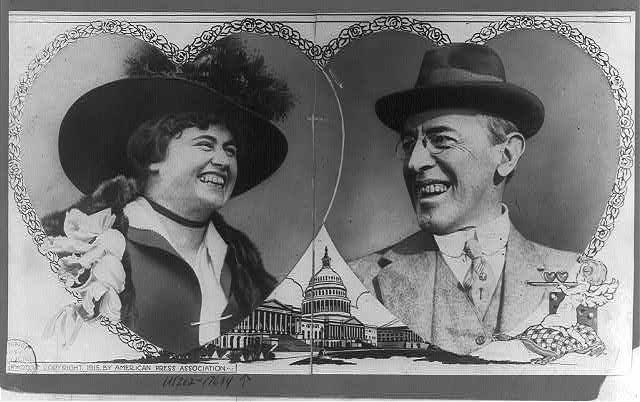
Woodrow and Edith Wilson: Honeymooners

The widowed Wilson married the widowed Mrs. Galt only eight months after they had met.

the happy couple

The happy honeymooners: President Woodrow Wilson and his new bride, the former Edith Bolling Galt.

The Wilsons:  A New First Couple

The morning of December 16, 1915, Woodrow Wilson was a happy man.  Aides said the new bridegroom was whistling and dancing. He had married the forty-three-year-old widow Edith Bolling Galt the previous evening at a small ceremony in her Washington town house.

The new Mrs. Woodrow Wilson sold her town house and moved into the White House ready to assume traditional First Lady duties, but her first responsibility was to her husband. Dr. Cary Grayson, Wilson’s personal physician, was also Edith’s friend, and primarily responsible for introducing them. Now that they were married, Dr. Grayson  shared some of the troubling facts about Wilson’s health with the President’s new wife.

Grayson explained that Wilson had a long history of un- or misdiagnosed strokes, chronic digestive ailments, severe headaches and arteriosclerosis, or hardening of the arteries. Arteriosclerosis was untreatable, according to the doctor, but other problems could be helped by a change of diet, fresh air, exercise and reduced stress. Edith was charged with the task of making sure the President obeyed that regimen. She took the charge very seriously.

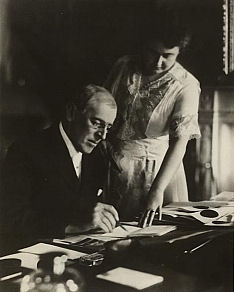
The newlyweds were inseparable. They rose very early every morning, had coffee in their room, and then went to play nine holes of golf. Neither were good golfers, but the fresh air and exercise was healthy, and they enjoyed it immensely. Then they had breakfast together, before they went to their daily duties. Unhappy with those arrangements, Wilson had a desk moved into his own office for Edith. He wanted her near him.

working together

President Wilson wanted his bride by his side. He had another desk moved into his private office.

Woodrow Wilson had something with Edith that he had never had with his first wife:  the luxury of time and companionship. He had spent most of his first marriage immersed in family and financial obligations. With Edith, there were no families to raise, and they had no financial worries. They were very deeply in love. They could enjoy each others’ company.

Edith Wilson’s New Role: Presidential Confidante

Traditionally, First Ladies were concerned with social matters and housekeeping management.   Since the first Mrs. Wilson’s death some fifteen months earlier, those activities had been curtailed, if not neglected. Edith Wilson was an experienced hostess, and assumed those duties easily.  White House dinners and receptions glittered under her expert supervision.

President and Mrs Wilson

Mr. and Mrs. Wilson were inseparable. They went everywhere together.

The Wilsons appeared together at every opportunity: at vaudeville and theatrical performances; on near-daily carriage rides; at baseball games. Edith Wilson loved appearing in public. She was photogenic, and happy to pose for the photographers. She was also happy to accept bouquets and take a bow.

World War I had erupted in Europe a year earlier, and the President was immersed in keeping up with the tumultuous events. In a decision that would be unheard of today, he taught Edith the secret cipher codes, so she could “translate” his confidential messages. Professor Wilson was also giving her  a crash course in on-the-job governmental education. She began reading her way through his extensive library, and poured over the daily newspapers.   Professor Wilson encouraged her to ask questions, and was delighted to explain the fine points.   President Wilson never talked down to her, expecting her to understand completely. She usually did.

Woodrow Wilson had never been a familiar man in the sense of glad-handing and personal relationships. Those few who had become close to him began noticing the increasing influence the new Mrs. Wilson seemed to have with the President. They did not like it one bit. They were shocked at her access to privileged information. They were being shunted aside – and besides, a woman had no place in politics.  Edith made no effort to woo them either. She would not permit anything to come between her and her husband.

Edith Wilson and The First World War

The United States finally entered the Great War, as it was called then, in 1917 – three full years after it had inflamed Europe – and after Wilson had exhausted all efforts to keep America out of the fighting.
Now the First Lady embarked on new duties and activities.  When Mrs. Wilson’s photo was printed in newspapers across the country depicting her as a Red Cross volunteer, wearing her uniform cap and apron, thousands of women joined up to help with the humanitarian effort.

FL Edith

Woodrow and Edith Wilson spent less than four happy years together before his health failed.

She dismissed the White House gardeners to free them for more important  war work. Then she bought a flock of sheep to keep the lawns cut au naturel. When the sheep were sheared,  a pound of their wool was sent to each state, to be auctioned off for war bonds.

Edith was also in charge of “renaming” captured German vessels. Drawing on her old lineage dating back to Pocahontas, she gave the ships Indian names. When “meatless,” “wheatless,” and “heatless” days were introduced  to save food and fuel, the Wilson White House was happy to participate. Edith insisted that the policy was strictly enforced – and even more important, made public.

Those were the happy years for Edith and Woodrow; three wonderful years of intimate partnership. If the politicians found their closeness annoying, they were nevertheless polite, but they were beginning to dislike her intensely.  Edith sniffed enemies trying to breach her relationship with the President, but she held her tongue – but it rankled. And she made no bones about letting her husband know how she felt.

It would rankle her even more, once the War had ended.

Sources:

  • Hatch, Alden – Edith Bolling Wilson: First Lady Extraordinary, 1961, Dodd, Mead
  • Levin, Phyllis Lee – Edith and Woodrow – 2001, Lisa Drew Book
  • Schachtman, Tom – Edith and Woodrow – 1981, GP Putnam’s Sons
  • Wilson, Edith Bolling – My Memoir – 1939, Bobbs Merrill


Posted in A POTUS-FLOTUS Blog, Woodrow Wilson | Tagged , , , , , , , , , , , , , , , , , , , | Leave a comment

The Year of Four First Ladies: 1860-1861

Two First Ladies born in a year is unusual; three is rare. Four is extraordinary.

Four First Ladies Are Born   

Between 1860 and 1861, four little girls were born who eventually would marry men who became Unites States Presidents. One was from Georgia, one a New Yorker, and two Ohioans.

Their backgrounds were remarkably similar: middle class, moderately educated (no college girls!), with sufficient financial and/or other disappointments in their younger years to give them a sense of responsibility.

All welcomed the role of First Lady, but the Presidency would literally kill two, permanently damage one, and totally delight the other.


Ellen Axson: The Velvet Glove

EllenWilson

Ellen Axson, the woman who would become the first Mrs. Woodrow Wilson.

In May, 1860, Ellen Axson would be the first First Lady born in the Deep South. This eldest child of a Presbyterian minister made her appearance in Savannah, Georgia just as the Civil War was about to begin. By twenty, she assumed complete responsibility for her family, caring for her two younger brothers, an infant sister (which had resulted in her mother’s early death) and a chronically depressed father who died shortly afterwards. Early on, she demonstrated a decided talent for art and considered becoming an art teacher, but those hopes ended with responsibilities at home.

At twenty-five she married Woodrow Wilson, a young scholar about to embark on an academic career. He rose quickly in his profession, while Ellen’s life centered on raising their three daughters, plus an assortment of relatives as long-term houseguests in the Professor’s household. It would fall to Ellen to manage the house, the family, the budget, the “guests” and most off all, the brilliant-but-difficult Woodrow. He never gave a speech or prepared a lecture series without his wife’s unusually sagacious input. As he advanced, those insights plus her ability to moderate Wilson’s demanding nature would become essential.

When Ellen Wilson became First Lady in March, 1913, she came with a secret she didn’t even know herself. She was already seriously ill with Bright’s Disease, a kidney ailment, then always fatal. For a year, she remained obvious to her flagging energy, capably handled the traditional First Lady duties. She also became actively involved in slum clearance projects, designed the Rose Garden and planned White House weddings for two daughters. And she was always available for the care and comfort of Woodrow Wilson.

Ellen Wilson died in the White House. She was only fifty-four.

Florence Kling: The Duchess

Florence Kling, also born in 1860, was the daughter of a wealthy but tyrannical Marion, Ohio businessman. Headstrong as girl-to-woman, her early elopement failed. When Florence met Warren G. Harding, she was eking out a meager living teaching piano, rather than return to her father’s house.

Since she was considered domineering and imperious, Harding nicknamed her “Duchess” – and it stuck. Harding was a newspaper publisher, thus a prominent citizen in Marion, with time and opportunity for political involvement. With no Harding children born to the couple, Florence began helping out on the Marion Star as circulation manager.

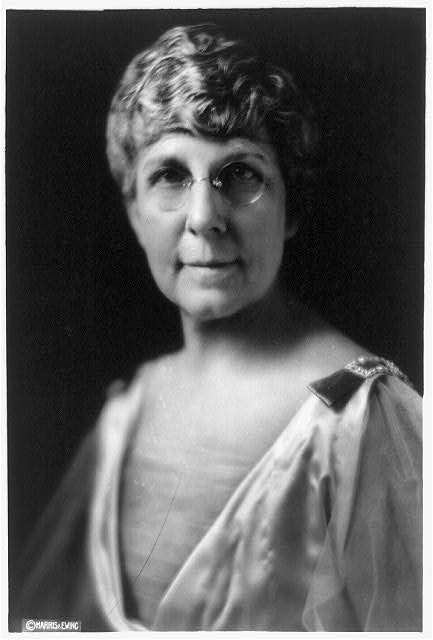
The Duchess

Florence Kling DeWolfe, the woman who would become Mrs. Warren G. Harding

The Duchess was a keen political observer, with a sharp finger on the public pulse and the Ohio politicians who surrounded Harding (because he looked like a man who should be president) grew to respect her savvy. She was in her glory.

As a popular U.S. Senator between 1914-20, Harding made little impression on his peers or the Ohio electorate other than his geniality and diligence in answering his mail. It would be a lack of viable candidates, post-World War I apathy, and the amendment giving women the vote that brought him to the public eye. Most politicians considered Florence Harding the “power behind the throne.”

The scandals and misjudgments of the Harding Presidency did not surface until both Hardings were in their graves. He died first, having been in office for only thirty months. She died less than a year later at only sixty-three. Neither completed what would have been a “normal” term in office.

Helen Herron: The Wannabee Lady

Helen Herron, born in 1861 in Cincinnati, Ohio, wanted to be First Lady from the time she was fifteen years old and spent a fortnight at the White House. Nicknamed Nellie, from birth, she was determined to become First Lady herself.

Family finances (or lack thereof) precluded college for the bright girl. She was expected to marry, raise a family and take her proper place in society. She had other ideas – or at least the location for that place in society.

Nellie Taft

Helen Herron (Nellie), the woman who would become Mrs. William Howard Taft.

William Howard Taft, a huge teddy-bear of a Yale graduate and rising young attorney, seemed to fit her requirements. His pedigree was excellent, and his possibilities were endless via his own considerable abilities.

But if Will Taft would be her vehicle, Nellie would be the pilot of their course. She was the “politician in the family,” according to her husband, and she assiduously shepherded him away from his own lifelong dream: a seat on the Supreme Court. For nearly twenty years Nellie skimped and saved, paying political expenses first. She joined, contributed, attended, hosted and maneuvered to keep her husband a) in the spotlight, and b) on the target. Her wish came true when President Theodore Roosevelt supported Taft as his chosen successor.

Only four months into the Taft Presidency, Nellie Taft suffered a severe stroke that impaired her ability to read, write and speak. She would spend the rest of the Taft Administration learning how to communicate again. Her health had become the most important priority.

William H. Taft would realize his dream a decade later, becoming Chief Justice of the Supreme Court. Nellie’s life would be a quiet and private one until her death at eighty-two.

Edith Carow: The Dee-Lighted Lady

Edith Carow, born August, 1861, was a New Yorker from a good family with failing finances. Fortunately for her, her best friend was Corinne Roosevelt who lived nearby. The Roosevelts were a wealthy and warmhearted bunch, happy to include her in their family outings.

Little Edie literally grew up with Theodore Roosevelt, three years her senior. Many people expected them to marry some day. They did – but not as expected. He went away to Harvard, met the beautiful Alice Lee, and married her instead. Three years later, Alice died in childbirth, and Theodore went off to become a cowboy. Two years passed before they met again by chance, and life began for Edith.

wh edith

Edith Kermit Carow, the woman who would become Mrs. Theodore Roosevelt.

TR had opted for a political life from the start – and the electorate loved him. Many politicians feared him, but they could never hate him – his charm and exuberance were far too infectious!

Roosevelt was only forty-two and vice president when President William McKinley was assassinated in 1901. Edith and Theodore moved into the White House with six children between four and sixteen, a menagerie of ponies, dogs, frogs and a snake, cartloads of books and trunks, and enough energy to power the country, which they did.

Edith Roosevelt was a “cool” woman, shunning photographers and reporters and keeping a very safe distance from politics. Nevertheless, she knew everybody, was gracious to everybody, and provided the steady and surprisingly intellectual companionship her rambunctious husband and family needed.

She lived to be eighty-seven with a lifetime of some of the greatest memories in the world: blessed with good health, an exciting life, married to the man she had always loved.

Sources:

  • Anthony, Carl Sferrazza – Nellie Taft: The Unconventional First Lady of the Ragtime Era – 2005, William Morrow
  • Anthony, Carl Sferrazza – The First Lady, the Jazz Age, and the Death of America’s Most Scandalous President – William Morrow, 1998
  • Morris, Sylvia Jukes – Edith Kermit Roosevelt – Coward McCann, 1980
  • Saunders, Frances W. – Ellen Axson Wilson – University of North Carolina Press – 1985


Posted in A POTUS-FLOTUS Blog, Theodore Roosevelt, Warren G. Harding, William Howard Taft, Woodrow Wilson | Tagged , , , , , , , , , , , , , , , , , , , , , , , , , , , , | 1 Comment

The Jackson Inaugural Brawl

    Andrew Jackson was a 62-year old widower when he was inaugurated in 1829.

Jackson’s Road to the White House:

The road to the White House was a long one for Andrew Jackson.  His laborer father was killed in an accident only weeks before Andrew’s birth in the Carolina wilderness.  His mother raised him the best she could, but he was a wild child, preferring sports and games to studying.  His education was spotty at best.

By the time he reached his later teens, however, with a little time out for American Revolution (scouting, messenger service and imprisonment), he managed to “read law.” With a law book, some basic legal forms and two saddle bags, Jackson migrated to Nashville, Tennessee when he was twenty. He became an instant success.

Within a decade, he practiced law, became a judge, owned businesses, speculated in land acquisition, owned property ( including his own large plantation), served in Congress, resigned, was elected to the Senate, resigned, raced horses, fought several duels, made and lost fortunes and was beloved throughout the state.

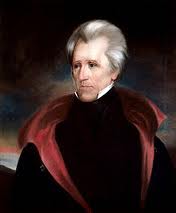
andrew jackson 1

Andrew Jackson as he appeared about the time of his inauguration. He was sixty-two years old.

When he was elected General of the Tennessee Militia, (an honorary position rather than military), he found his true calling and never practiced law again. He took his militia duties seriously, and made a name for himself as a vicious Indian fighter. At the technically-too-late Battle of New Orleans in early 1815 he became a bona fide hero, and a force to be reckoned with.

He first ran for the Presidency in 1824, and led the popular vote in a four-way race. But after Congressional maneuvering, the election went to John Quincy Adams. Screaming “unfair,” Jackson began campaigning for the election of 1828. That time he won in a walk.

Andrew Jackson’s “Jacksonians”

Andy Jackson was nicknamed “Old Hickory” for his toughness. He was not a man to inspire neutrality. One either loved him or hated him. Thomas Jefferson once called him “the most dangerous man in the country.” To the educated and sophisticated Easterners, Jackson was a violent-tempered, illiterate backwoodsman, despite his assiduously cultivated charm and manners. To most Tennesseans, however, he was not merely Tennessee’s Favorite Son, he was Tennessee.

senator andy

Andrew Jackson personified “The Hero.”

Jackson had acquired a strong cadre of young admirers during the early 1820s, all of whom brought energy and conviction to electing their hero to the presidency. His campaigns are usually considered the beginning of the two-party system as we know it today. After their loss in 1824, the Jackson followers redoubled their efforts via one of the nastiest political campaigns (both sides) in history, coupled with a lackluster performance by the acerbic and unpopular John Quincy Adams.

So in 1828, Andrew Jackson, tall, emaciated, toothless, riddled with disease and dueling bullets, was now President of the United States.

more jax inaugural

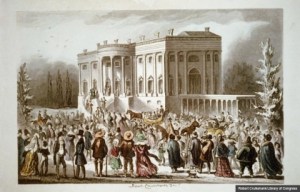
Throngs of people flocked to Washington DC to see General Jackson inaugurated as president. They came from hundreds of miles away for the festivities.

March 4, 1829:

Andrew Jackson came to his inauguration wearing a mourning band. His beloved wife Rachel had died only a few weeks earlier, and he was deeply grieving. The trip from Nashville to Washington had been a long one and he was exhausted. It is said that in those pre-amplification days, his voice was so low his inaugural address could barely be heard.

miniature

Andrew Jackson wore a miniature of his beloved wife Rachel hung from a silver chain around his neck.

But “Old Hickory” was a man of “The People,” and as such, armies of “The People” came to Washington to see one of their own take his place in the White House. Outgoing President John Quincy Adams, who loathed the hotheaded president-elect, did not attend. He did not want to shake Jackson’s hand. It was a bitter cold March 4, and the sixty-two year old Jackson, in chronically poor health, delivered his inaudible speech.

Then he proceeded a mile down Pennsylvania Avenue from the Capitol to the White House, with thousands of enthusiasts in his wake. Those followers would range from the polished and urbane New York politician Martin Van Buren to the rank-and-file of the great unwashed.  Nevertheless, all thronged to the White House for a grand party.

The White House Inaugural Festivities:

The White House was thrown open to the public for Jackson’s inaugural festivities. It was wall-to-wall Jacksonians. His supporters, who believed that as taxpayers they had a part-ownership of the president’s house, descended on the Executive Mansion like vultures. They jammed themselves into the downstairs rooms, top hats merging with coonskin caps, satin waistcoats next to buckskin and coarse overalls. No matter, all were welcome.

Jax inaugural

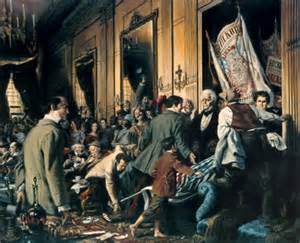
An artist rendering of the crowd-gone-wild at the White House following Jackson’s inauguration.

The usual libations were on hand: coffee, tea, and punch (probably liberally spiked with rum) and assorted cakes and sweets. With such mayhem and overcrowding, punch was generously spilled in all directions and on all people. So was tobacco spittle. Cake was ground into the carpets. Souvenir swatches were cut from the draperies. Cups, saucers and glassware was broken. People climbed on the chairs and tables, hobnail boots and all, to get a better look at their Hero – or to find a passing tray of punch. Cobbler-nails from rough boots tore the upholstery beyond repair. Fist fights broke out spontaneously among those clamoring for a better vantage point, or another cup of punch. It became a free-for-all. “Ladies fainted, men were seen with bloody noses and such a scene of confusion took place as is impossible to describe,” according to an eye-witness.

Andrew Jackson was exhausted and in poor health. Whatever festivities he might have enjoyed had been deadened by his bereavement. Indeed, one of his first acts as President was to plant a magnolia tree on the White House lawn in Rachel’s memory.

Instead, rather than elbow his way through the throng, Jackson simply climbed out of a second-story window to escape the hordes. Then he went back to the boarding hotel where he spent the previous night, and checked in again.

Sources:

http://www.eyewitnesstohistory.com/jacksoninauguration.htm
Burstein, Andrew – The Passions of Andrew Jackson – Borzoi/Knopf, 2003
Meacham, Jon – America Lion: Jackson in the White House – Random House, 2008


Posted in A POTUS-FLOTUS Blog, Andrew Jackson | Tagged , , , , , , , , , , , , , , , | 3 Comments

Theodore Roosevelt: A Man for a Continent

Theodore Roosevelt was a remarkable man in many ways, not the least of which, was his broad appeal to all sectors of the country.

Theodore Roosevelt:  Northerner

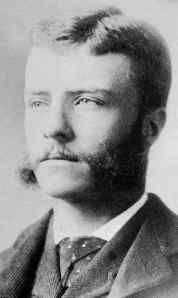
college-age TR

Theodore Roosevelt sported fashionable side whiskers when he was in college. They would disappear, but the moustache would remain.

Theodore Roosevelt (1858-1919) was born and raised in New York City.  He was a small child during the Civil War, but as he grew to maturity and developed his own sense of political philosophies, he was unquestionably a Northerner.  He was pro-Union, and anti-slavery.  Those attitudes would never change.

His upbringing was exceptional for his times, and despite his poor health (childhood asthma), he enjoyed a broad range of activities, thanks in great part to his prominent and wealthy family.  His appetite for knowledge of all kinds was almost legendary.  Natural science, one of his earliest interests, became his lifelong passion, and his “amateur” expertise as a naturalist was Olympian, and could easily rival academic professionals.

Like many Northerners of wealth, Theodore also had the Northern conscience which dominated his fathers life.  The elder Roosevelt served on countless charitable boards, sponsored countless progressive civic projects, and gave freely of his time and wealth to improve social conditions of the less fortunate.  It was this conscience that propelled his son into politics, where he might be useful.

Theodore Roosevelt:  Southerner

Theodore was also half-Southern.  His mother, the former Martha (Mittie) Bulloch, was a Georgia belle, with a pedigree equal to the New York Knickerbocker Roosevelts.  Mittie’s sister Anna would live with her northern in-laws throughout Theodore’s childhood, and was partially responsible for his early education.

Mittie was a somewhat dreamy person; some historians now believe she may have had a predisposition toward depression.  While her “influence” upon her extraordinary son was never as dominant as the boy’s father, she was the one who introduced him to his lifelong love of poetry, good literature and perhaps his love of adventure.  He may also have inherited his love of “heroics” from his Southern family.

Mittie Roosevelt also had two brothers who made their own legendary names as blockade runners in the Confederate Navy.  Theodore was always proud of his Southern uncles James and Irvine Bulloch and the tales of their derring-do.  As an adult, Theodore would speak with pride of his Georgia forebears, and the fact that he was a part of them.

Theodore Roosevelt:  Easterner

No question about where Theodore belonged.  Child-to-man, he was of the Eastern Establishment.  His Roosevelt Dutch ancestors were already in America for two centuries before he was born.  His family was a welcomed New York Knickerbocker asset to Mrs. Astor’s “400” guest list.   And while the Roosevelts were never financially on a par with the Astors or Vanderbilts, they were well-propertied, and consorted with the upper classes comfortably.

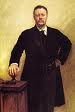
Sargeant Teddy

The official Presidential portrait of Theodore Roosevelt was painted by John Singer Sargent. It captures the entire man.

Theodore Roosevelt was also a Harvard graduate, cordially welcomed into the best of clubs, and into the homes of the Beacon Hill society counterparts of his New York family.  Saltonstalls, Lodges, Cabots and Lees were dee-lighted by his company, and he was just as dee-lighted to be in theirs.

His first wife, Alice Hathaway Lee, came from a Boston family that was connected to everyone in Bostons highest social standing.  They adored their son-in-law, and even after their daughter died in childbirth at only twenty-three, would maintain a very cordial relationship with Theodore – even after he remarried.

Theodore’s speech would always have that Eastern-Harvard affectation; his attitudes would reflect their sense of “the best people,” his favorite companions would be those of his class, and the people he would come to meet through his Eastern peers would be welcomed openly and heartily.  He was at home with them.  They were the ones he called by their first names.  They were the ones he permitted to call him Theodore.

Theodore Roosevelt:  Westerner

Then of course, there was a whole new world about to open up to young TR shortly after his first wife died.  As a self-diagnosed treatment for his understandable grief, Theodore Roosevelt went West to the Dakota territory, bought a ranch and a herd of cattle, and opened the door to a new outlook on life.  The experiences he had in the Dakotas would truly change his life.  The friendships he made there were “earned” and he was the one who had to earn them.  The cowboys grew to respect the four-eyed dude who would and could adapt to their harsh lifestyle, man for man, and without a complaint.

The city slicker would become as comfortable in buckskin and a cowboy hat (albeit custom made from Abercrombie and Fitch)  as he was in dress clothes and silk hat.  He was as natural drinking from a tin cup as he was in holding a crystal goblet.  And he loved sleeping under the stars.

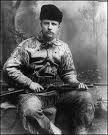
cowboy ted

Theodore purchased a “western outfit” from NY’s Abercrombie & Fitch, and had his picture taken for posterity.

As time passed, Theodore Roosevelt’s love of natural sciences and his equal love of the strenuous life would lead him even farther west.

Theodore Roosevelt:  All-American

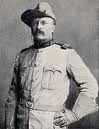
rough rider

At forty, TR became Lt. Colonel of the volunteer “Rough Riders”, an assortment of NY policemen, Harvard athletes and cowboys. They all got on famously!

This unique ability to relate easily to a nation of so many styles would win him devoted friends and legions of followers. When Theodore Roosevelt became “TR,” and his prominence began to rise, he had the unusual fortune to count on support from all parts of the continent.

When he assembled his volunteer corps of Rough Riders, New York policemen mixed with Harvard graduates, and they both rode side-by-side with cowboys and ranchers.  And, under TR’s leadership, they were equals.

In his political campaigns, the monied Wall Street Easterners provided the funds, the Westerners the enthusiastic manpower, and both North and South, all claimed him as “their own.”

It is only fitting that he has a permanent home atop Mount Rushmore in South Dakota.  He is the only one of its august residents who had ever been anywhere near the place.

Sources:

Brands, H.W. –  TR: The Last Romantic  – Basic Books, 1997

McCullough, David –  Mornings on Horseback  – Simon & Schuster, 1981

Miller, Nathan – Theodore Roosevelt: A Life –  Wm. Morrow,  1992

Morris, Edmund – The Rise of Theodore Roosevelt – Coward McCann, 1979

Posted in A POTUS-FLOTUS Blog, Theodore Roosevelt | Tagged , , , , , , , , , , , , , , , | 2 Comments