The Washington Dancing Classes

Dancing was a vital social skill in colonial times.   Children were taught at an early age.
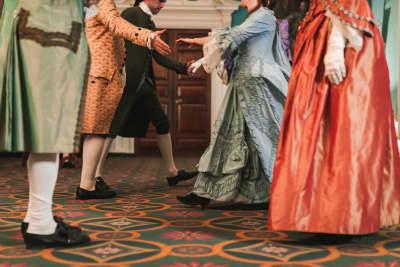
Colonial dancing (Colonial Williamsburg collection)

Martha and George Washington: Dancers

George Washington was considered an excellent dancer by all who knew him, and he enjoyed it even into his older years. As President, both in New York and in Philadelphia, there are many references to the aging President cutting a mean rug!

Not quite so for Lady Washington. In her youth, she danced as well as any of her peers, and was acknowledged to be petite and graceful. Like most women however, the aches and pains of the years took their toll, and she was content to let her husband choose another partner for the dance floor. Besides, it was considered unbecoming for aging women to dance. The “infirmity” card must have taken hold. More than forty years would pass before a First Lady would dance in public – and that one would be very young!

Dancing Classes: A Community Event

Young Colonel and Mrs. George Washington and the children – Jacky and Patsy Custis.

When George and Martha were raising Jacky and Patsy (her children by her first marriage), dancing lessons were as mandatory as teaching reading and writing. It was a skill all children were expected to learn when they were as young as five years old. Since centralized dancing schools were not available near Mount Vernon, a dancing master (usually male) would be privately engaged. Dancing lessons in colonial times was an occasion for everyone to party and relax.

A typical scenario would be to contact a few neighbors with children of reasonable age-proximity, and the families participated and shared the cost of the dancing master.

Along with the dancing master would come the neighbors: fathers, mothers, children of all ages (as many as they had), servants and horses – all to be hosted by the first in the “round-robin”.

Dormitories for the boys and girls would be created in an upstairs attic. Rooms on a lower floor would be set aside for their parents (and any babies or toddlers too young to participate). Guests’ servants would be accommodated by host servants. Horses would be stabled accordingly.

Then there would be a week-long party.

The Dancing Class

Dancing masters were not to be toyed with. They could be as strict and demanding as pedagogues, and complete obedience and attention was required as their children were learning their steps. Besides, parents were not far away, if discipline was required.

Martha (Patsy) Custis, Martha Washington’s daughter by her first marriage, was only sixteen when she died.

John Parke (Jacky) Custis enjoyed dancing, dressing stylishly, and all the trappings of a Virginia gentleman.

Every day, little children were taught to stand gracefully and learn to bow and curtsey properly, and to walk with pointed toes. Older children began to learn some of the basic steps of the minuet, considered as important to gentry as riding a horse. By the time children were nine or ten, the steps had become more intricate. A full-scale formal minuet could take nearly a half-hour to perform. Then they would learn the reels and gavottes that were lively and less formal.
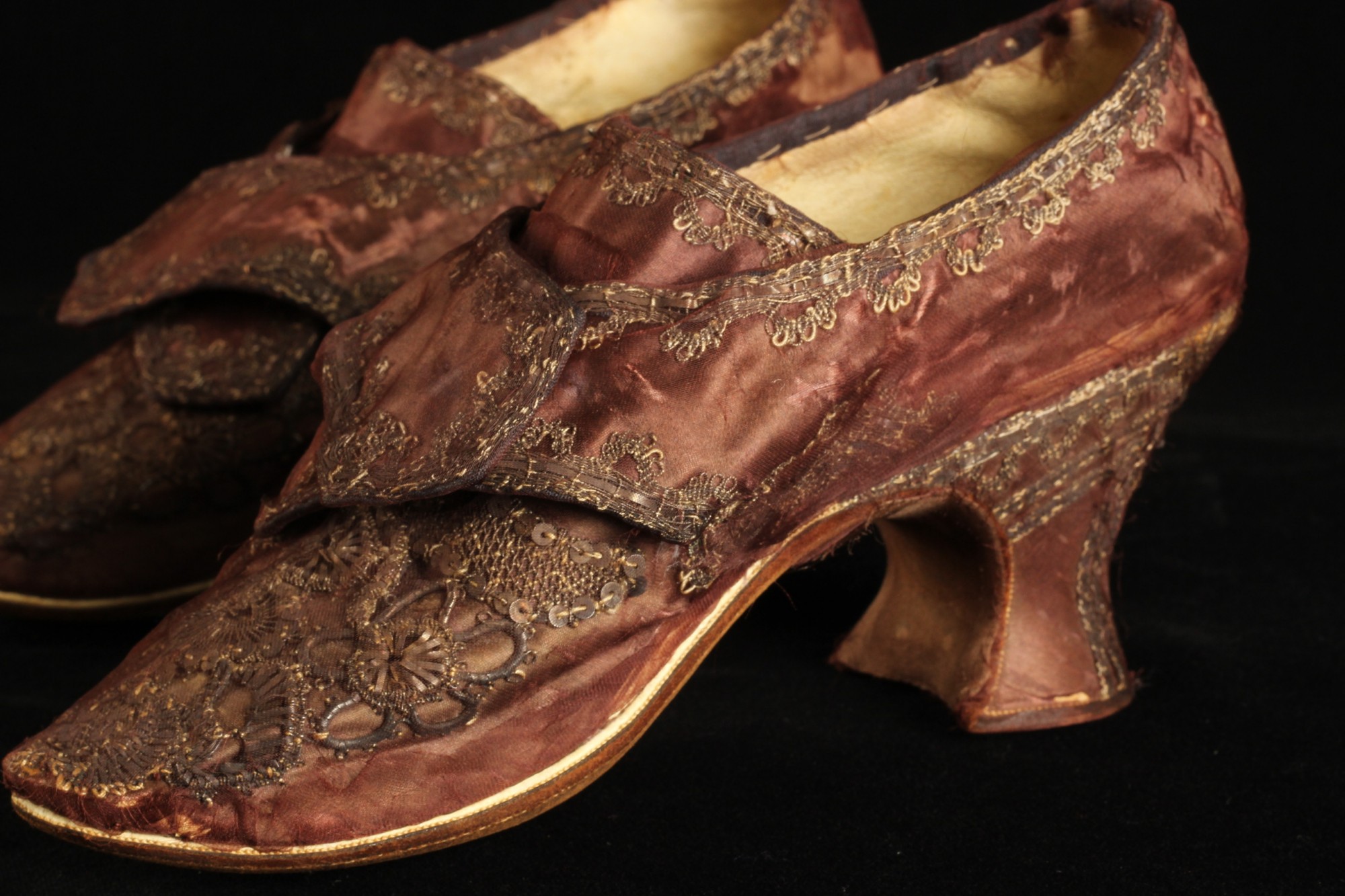
Martha Washington’s dancing slippers (Mount Vernon collection)

Meanwhile, since the little “Fred and Gingers” were occupied, the host would take his planter-neighbors for an inspection tour of his plantation, where they could converse about their crops and trade and farm-talk – or politics. The ladies would retire to the parlor or the veranda with their handiwork, and share the latest fashions or recipes or gossip.

Around 4 PM, after a bountiful dinner, the dining room table would be dismantled, chairs moved to the edge of the room, and the fiddlers (or whatever musicians were available) would come to play. The children would demonstrate what they had learned. Then came a few hours of country dancing by adults and children alike. This would be repeated each day for several days.

Since no small child could be expected to remember everything without sufficient practice (something their parents were expected to encourage), a complete review of their lessons – plus new ones – would occur the following month when everyone, including the Dancing Master, would descend upon the next in the round-robin for a repeat of the week-long party. This might be repeated year after year, as the children grew and became more adept.

Dancing Classes for the Next Generation

By the time the Washingtons raised Martha’s grandchildren, Nelly and George Washington Parke Custis, both George and Martha were well into their middle age. The children were ten and eight respectively; the new President and First Lady were in their late fifties.

Their first “Presidential” house in NYC was large enough to accommodate 100 guests in the ballroom.

But New York and later Philadelphia serving as temporary capitals, were the two largest and most cosmopolitan cities in the new country. Here dancing schools were available. The Washingtons did not need to engage a private master. Nelly and “Wash” could be taken to a central location for instruction – but learn they must and learn they would. It was an imperative to social upbringing. Dances and balls were given regularly not only by the new President, but by all the leading families.

It was a mandatory social skill.


Sources:

Chadwick, Bruce – The General and Mrs. Washington – Sourcebooks, 2005

Randall, Willard Sterne – George Washington: A Life – Galahad Books, 2006

http://carlanthonyonline.com/2012/02/17/george-washington-loved-to-dance-it-up-on-his-birthday/

http://www.colonialmusic.org/Resource/GW&Dance.htm

Posted in A POTUS-FLOTUS Blog, George Washington | Tagged , , , , , , , , , , , , , , , , | Leave a comment

The Presidential Stepping Stone

More than half our Presidents have been lawyers, at least by discipline. Whether they liked it or not, and even whether they actively “practiced law” is something else.

POTUSes Reading Law

john-adams

John Adams won fame as a lawyer by defending the British soldiers accused of fomenting the Boston Massacre.

In the “olden days,” one did not need a college education, or even a secondary level education to “read law.” One merely needed to find an established attorney who would agree to take him on as an apprentice. This usually involved allowing the candidate to read his mentor’s law books, followed by discussion from time to time. Once the candidate had read sufficiently, and the practicing attorney was satisfied as to his ability, the candidate would appear before a panel of lawyers, be questioned on a few related subjects, and when they were satisfied, a new lawyer was now entitled to practice law.

thomas jefferson

Thomas Jefferson studied law with George Wythe, considered the best attorney in the Colonies.

John Adams, once graduated from Harvard, read law. So did William & Mary student Thomas Jefferson, who apprenticed himself to George Wythe, who is considered by some to be the “father” of law schools as we know them.  James Monroe, however, never completed his William & Mary studies, preferring to enlist in the American Revolution. A few years later, he apprenticed himself to Governor Thomas Jefferson, who was happy to have him as a student.

young abe

Lincoln was self-taught, but he was well thought of by his legal peers.

Andrew Jackson and Abraham Lincoln are rare anomalies. They read law with only a modicum of basic formal education. Neither of them had more than three years of schooling. Whatever learning they acquired, they acquired on their own. Both became relatively successful in a law practice.

The last POTUS who became a lawyer by “reading law” was Calvin Coolidge. He had graduated from Amherst College in Massachusetts, and when he decided to pursue the law, funds were tight, and “reading law” was still acceptable – in the mid-1890s.

calvin coolidge

Calvin Coolidge was the last President who “read law” rather than attended a formal law school.

The first President who went to a formal law school, was Rutherford B. Hayes, who had graduated from Kenyon College in Ohio, and went on to Harvard Law School in the 1840s. At that time, Harvard was one of the rare institutions of higher learning that issued law degrees.

Today of course, formal training at a School of Law, is essential, whether it is practiced – or merely used as a stepping stone politically.

Law Hating POTUSes

But just because a young man (and we are only talking about Presidents here) becomes an attorney, and usually at a young age, does not mean that he enjoys the work, or even wishes to continue its mundane practice. More than a few of our Presidents actually loathed practicing law, and preferred politics, or diplomacy or even conceptual legal philosophy to the day-to-day i-dotting.

Thomas Jefferson practiced law (in the sense of taking on clients) for only a short time. He was much happier as a planter, architect, inventor, politician or natural scientist. His conceptual overview of law, however, was a part of his lifetime achievements. James Madison, Jefferson’s close friend, is said to have studied governmental law as part of his curriculum at the College of New Jersey (Princeton). He devoted himself only to theoretical studies, however. And James Monroe, despite his well-placed mentor, never practiced law either. He was politics and diplomacy from the beginning.

John Adams enjoyed practicing law, albeit not for a long career, nor a hugely successful one. By the time he was forty, his lawyering days were over, and he devoted himself exclusively to politics.

sully portrait

John Quincy Adams was considered a fine attorney – but he hated it. He much preferred the diplomatic life. Or even writing poetry.

His son, John Quincy Adams, considered a fine lawyer in his own right, loathed practicing law. It is said that whenever he found himself “needing” to open a law office for financial reason, it made him physically ill. Politics and diplomacy was his preference, and obviously where whatever legal skills he had developed were put to their best possible use.

the hero

Andrew Jackson was never well regarded as an attorney by his Eastern peers. He preferred military life, anyway.

Andrew Jackson became a lawyer (it is suggested) because it would give him the opportunity to rise to the gentlemanly status he admired. His own rough background and poverty practically consigned him to learning a trade. Lawyers wore suits, not overalls. But once the 21-year-old Jackson became a lawyer, he became involved in politics, among other interests. Once he became a General in the Tennessee militia, he never practiced law again. He found a trade he liked better, with niftier clothes.

The Later Haters

James Garfield, president for a few months in 1881 before he was assassinated, had read law as well. He was actually an ordained minister, a college teacher and president and a lawyer – and he never made a living at any of it. He had discovered politics, and it was a full time career.

college-age TR

Young Theodore Roosevelt studied law for a few months at Columbia University. It bored him. He went directly into politics.

Both Roosevelts, Theodore and Franklin, studied law. Theodore enrolled at Columbia University after graduating Harvard, but dropped out from boredom. He never seemed to regret the decision. Franklin also went to Columbia after Harvard, but never finished. He managed to pass the bar before his studies were completed, so there was no need. He was also an indifferent attorney with little interest or effort. He jumped at the first chance he could to be involved in politics. He was better at it.

Woodrow Wilson had a law degree from the University of Virginia. He practiced law ineffectively for a year, was bored and decided to study for a doctorate, and concentrate on theoretical governmental studies thereafter. He was better at that, too.

The Law Lover

young will

Young William Howard Taft truly loved the law as a profession. But rather than practicing law, he preferred the judiciary. He was our only President who became Chief Justice of the Supreme Court.

Arguably, the best lover-of-law of all our presidents was William Howard Taft. He not only loved the law, but he loved the judiciary. He became an appellate judge early in his career, followed by a lifetime of public service. It is said that being president was the only job he ever had that he didn’t like. His ambition was always to have a seat on the Supreme Court. He achieved that too.

Taft was named Chief Justice by President Harding. Harding had thought briefly about studying law early in his life, but decided it was just too hard.

Sources:

Burstein, Andrew – The Passions of Andrew Jackson – Borzoi-Knopf – 2003

Dalton, Kathleen – Theodore Roosevelt: A Strenuous Life – Borzoi-Knopf, 2002

Unger, Harlow Giles – John Quincy Adams – DeCapo Press, 2012

Presidential Shysters


Posted in A POTUS-FLOTUS Blog | Tagged , , , , , , , , , , , , , , , , , , , , , , , | Leave a comment

Florence Harding and The Veterans

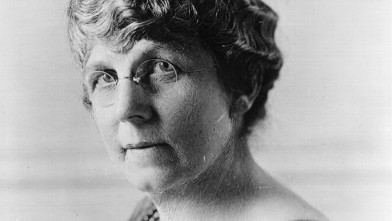
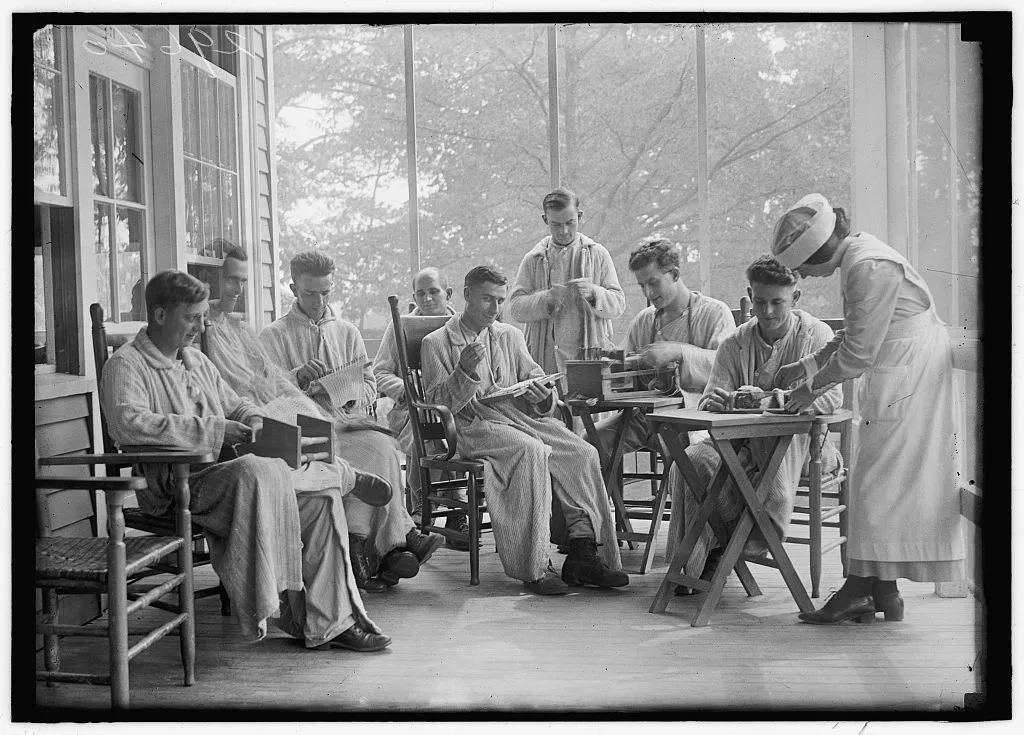
After World War I, thousands of wounded soldiers were crowding into Washington hospitals. Florence Harding would be a regular visitor.

Florence Kling Harding: Lonely Wife

Florence Harding never had a strong maternal instinct. An early and disastrous elopement left her a divorcee with a son, but her tyrannical father made her a devil’s offer: he would raise the boy as his own, provided she gave up parental rights. If it bothered her,  it is unrecorded. Her ties to her son, while not severed, were more like a distant aunt, rather than a mother.

duchess
Florence Harding was nicknamed “Duchess” by her husband – partly because of her domineering disposition.

A few years later, she married  Warren Harding. He was five years her junior, handsome and affable, with a lifelong wandering eye. She was relatively plain, domineering, and plagued with a chronic and serious kidney ailment. By the time they had been married for ten years, one of her kidneys had been removed, and while the couple would share a room, they would not share a bed. There were no Harding children together. Harding’s eye, and the rest of him, continued to wander.  It was not a happy marriage.

With little to keep her at home, Florence Harding gravitated to working at the Marion Star, the small-town weekly newspaper her husband had purchased some years earlier and helped build it into a strong Ohio daily. Nicknamed “Duchess” by her husband (in part because of her imperious manners and bossy disposition), Florence carved a niche for herself in the circulation department of the paper.   While Warren set the policy of the paper and wrote the editorials, she ran a fleet of newspaper delivery boys, and saw to it that both the subscribers and the advertisers paid their bills on time.

The consensus among “her boys” was that Mrs. H. was an exacting taskmistress, but was always kindly toward them. She would have their respect – and even some grudging affection.

Florence Harding: Political Wife

The Hardings
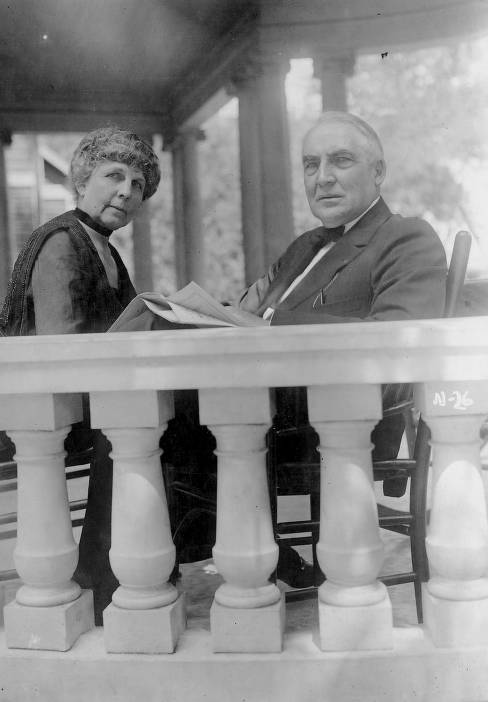
Florence and Warren Harding on the front porch of their Marion, Ohio home.

Partly due to the Duchess’ administrative skills and attention to detail, the newspaper flourished and ran smoothly. Warren Harding now had time on his hands. In between regular bouts of infidelity, he found a niche for himself as well: as a popular guest speaker at various civic and political functions. He was good at it. He was invited to speak all around the state.

The Duchess was not a naïve woman, nor was she acquiescent.  She went with him whenever she could. Politics appealed to her. The hard-driving forceful men who populated that arena appealed to her. It was not considered an appropriate venue for women at that time, but Florence was an exception. The Ohio politicians who gravitated to Harding began to realize that a) she was the power behind the throne as it were, and also b) she made pretty good sense. They began to give the Duchess due respect, and a seat at their counsel table. She wore her nickname with pride, and gained their grudging affection. She was “one of the boys.”

Florence Harding Discovers More “Boys”

Florence and a vet
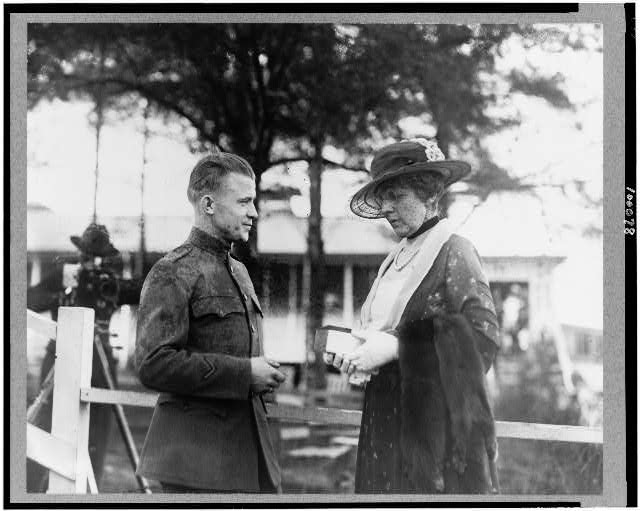
Florence Harding took a sincere and serious interest in wounded veterans of World War I.

In 1914, Warren Harding was elected Senator from Ohio.   The good-looking man was now a distinguished middle-aged man of fifty, with a shock of snow-white hair that made him look like a matinee idol. The Duchess, partly due to genetics and a failing kidney, looked old and frumpy.

While she had looked forward to starting a new life in Washington, she was lonely, and had few friends. Even though she left her card everywhere, she was invited only to the large affairs, where everyone was invited. She had not found her niche.

But by a rare stroke of good fortune, she had become acquainted with the wealthy Evalyn Walsh McLean. Her husband owned the Washington Post. She owned the Hope Diamond. Even though Evalyn was twenty-five years younger than Florence, a strong and sincere friendship was formed. Under Evalyn’s guidance, the Duchess purchased more fashionable clothing, went to more fashionable parties, and began to support more fashionable causes.

WWI VA-hospital

It was Evalyn who suggested that Florence visit the area’s veterans’ hospitals.   The Great War, as World War I was called then, had left thousands of American servicemen permanently wounded. The two women began dropping in at the hospitals once or twice a week to spend a couple of hours talking to the veterans, reading to them, playing cards with them, and otherwise being good company.   More often than not, they brought flowers or treats. Florence’s interest in them was sincere, and she would remain engaged with their cause for the rest of her life. They were “Her Boys,” with capital letters!

First Lady Florence Kling Harding

When Warren Harding became President in 1921, the Duchess had no intention of staying in the background. She wanted to be accessible. Folksy. One of the people.  So did he.

gardenparty
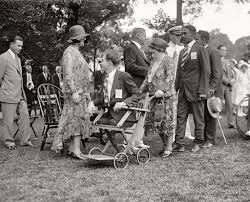
Both Hardings enjoyed Greeting guests at one of the annual White House garden parties for veterans.

Perhaps the one act that gave her the most pleasure was opening the White House grounds for a garden party for wounded veterans. Notices went out to all the veterans’ hospitals in the area, and disabled soldiers came in droves. They came in wheelchairs and on crutches. They came on litters, and with canes. They came bandaged, they came blinded, they came leaning on others. They were treated to sandwiches and cakes and lemonade and fruit punch. First Lady “Duchess” was delighted to circulate among them, shaking as many hands as she could and offering a kind and heartfelt welcome.

It was such a hit, that she made the affair an annual event, and held them three times – until her husband’s early death.

At least at the veterans’ garden party Florence Harding was not only respected, but the affection was not grudging. She was loved.

Sources:

Posted in A POTUS-FLOTUS Blog, Warren G. Harding | Tagged , , , , , , , , , , , , , , , , | Leave a comment

Abraham Lincoln, Father Abraham

There is no question that Abraham Lincoln loved his wife and children dearly, but was he a “family man” by nature?

Lincoln: The Family Child

thomas and sarah lincoln

Abraham Lincoln’s father and stepmother, Thomas and Sarah Bush Lincoln. He was remote, she was encouraging.

Abraham Lincoln (1809-1865) was born to a hard-working, but essentially poor family. By his own admission, his youth was “the annals of the poor.”   His mother died when he was nine. His older-by-two-years sister Sarah died in childbirth when she was still in her twenties.

Like many widowed men with small children, his father, Thomas Lincoln, planned to remarry not long after his wife’s funeral. Life was hard; spouses needed spouses. Recalling a childhood friend from years earlier, and knowing she was a widow with small children herself, he sought her out. They agreed to marry, a fortuitous event, at least in the eyes of Abraham Lincoln.

Sarah Bush Johnston came into the family with three children in fair proximity to the Lincolns. Her son, John Johnston, would bond easily and pleasantly with Thomas Lincoln. They hunted, they fished, they were two of a kind – and it was a kind that Abraham never was. He, on the other hand, would bond with his new stepmother. She would later recall that “they understood each other.” It would be Sarah Lincoln who encouraged her stepson to read and learn.

If there was love in that family, it might better be described as “affectionate distance.”

Lincoln: The Non-Family Young Man

When Abraham Lincoln reached maturity (age 21), he set out on his own. He had nothing save the clothes on his back. Once he left the Lincoln household, he never returned, except for brief visits, although he kept in general touch – and was solicitous for the family’s welfare. He would eventually purchase the land for their homestead, so they would not be in want.

By sheer dint of his own efforts, he made his way in the world, and it was a struggle. Parlaying slight encouragement from casual mentors, and a disposition that always gained him friends and regard, he educated himself. He “read law” – alone, and managed to pass the Illinois bar.

Picture

Mary Owens was one of the few documented “romantic” episodes in Lincoln’s early life. She was a heavy woman, and Lincoln was not attracted to her.

His “romantic” experiences were few and unsatisfactory. According to Mary Owen his one “potential” romance, he “lacked those little links which make up the great chain of woman’s happiness.” Lincoln was not attracted to her, but even so…

As it was, it would not be until he was thirty and Mary Todd had entered his life, that Lincoln’s tender private feelings would be uncovered. It was a somewhat rocky romance, and historians have teetered back and forth for a hundred and fifty years to try to determine its true nature.

But they married; Mary became pregnant immediately. Lincoln, still poor and in debt, needed to earn a living. They had precious little time to devote to each other.

Lincoln: The Family Man

Abraham and Mary Lincoln would have four sons. Robert, Edward, Willie and Tad. Their second son, Eddie had always been sickly and died before his fourth birthday.

Lincoln family3

An idealized etching of the Lincoln family. Abraham, Willie, Tad, Robert and Mary. Their second son, Eddie, had died in early childhood.

Robert Lincoln, the couple’s eldest son, would claim that he barely knew his father. During his early years, the elder Lincoln was “riding the circuit” for weeks and even months at a time. Robert’s earliest memories centered around his mother, and some spotty recollections of his sick brother. By the time Willie and Tad were old enough to be his playmates, Robert was in prep school, preparing for college.

The “playful” Lincoln, the one that Willie and Tad knew better, was a Lincoln well past forty. While he was never wealthy, he had become comfortably middle-class, and could devote himself to his Springfield law office, rather than making a continual round-robin of Illinois court houses.

But even then, politics had far more allure to Father Lincoln than did home-and-family life. Having had little enjoyment of family when he was a boy himself, perhaps he had no point of reference.

It is also well known (and well commented) that Mary was a difficult woman, and perhaps Lincoln preferred the male camaraderie or even his solitude to the noise of the parlor atmosphere.

Finding the Time for the Family

Lincoln Family

An etching of The Lincoln family after Willie had died. Abraham and Mary, Tad and Robert.

Tad and Dad

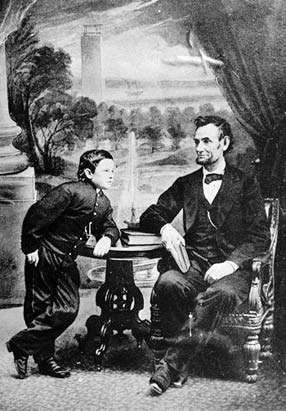
Abraham Lincoln and Tad. The President was devoted to his youngest son, particularly after Willie had died.

President Lincoln was unquestionably beset with care, problems and a heavy workload during the four years of Civil War. He had even less time than before to devote to family matters. Even when his 11-year-old son Willie died, he had precious little time to mourn. He had little left in him to comfort his deeply troubled wife, whose intense mourning worried him. Robert was away at college, most of the time. The only thing that gave the President “family” comfort was his son Tad, who at eight, was still somewhat babyish.

Finally the Civil War ended. The bleeding had stopped. If the President urged the nation to bandage its wounds, so must the President. The morning of April 14, Robert Lincoln was home on leave from the Army, and had a chance to discuss his future with his father: he wanted to return to Harvard and go to law school. Lincoln agreed. Later that afternoon, in a rare drive with his wife – just the two of them – he began the binding of his own wounds, and discussed their future, once he retired from the Presidency. Mary would claim she had never seen her husband so cheerful.

He was finally making time for his family. But there wasn’t any time.

SOURCES:


Clinton, Catherine – Mrs. Lincoln: A Life – Harper Collins, 2009

Donald, David H. – Lincoln – Simon & Schuster, 1995

Epstein, Daniel Mark – The Lincolns: Portrait of a Marriage – Ballantine Books, 2008

Lachman, Charles – The Last Lincolns – Union Square Press, 2008


Posted in A POTUS-FLOTUS Blog, Abraham Lincoln | Tagged , , , , , , , , , , , , , , , , , , , , | 1 Comment

Chester Alan Arthur: A VEEP on Hold

Campaign poster

The Republican candidates in 1880: James A. Garfield and Chester Alan Arthur.

Vice President Chester Alan Arthur became President following the assassination and death of James A. Garfield.

CAA: The Basics

Born in Vermont and raised in upstate New York, Chester Alan Arthur (183o-1886) was a preacher’s son who attended Union College, read law, established himself in New York City, and became the epitome of a sophisticated and well-to-do gentleman attorney with excellent administrative talents.

chester-a-arthur-color

Chester Alan Arthur, noted mainly for his distinctive mutton-chop whiskers.

He became active in Republican politics, and met Senator Roscoe Conkling, a Utica attorney and the unquestioned Republican political boss of New York. Conkling would became Arthur’s mentor and close personal friend, and rewarded him in the 1870s by being named him Collector of the Port of New York, a prestigious and lucrative federal appointment.

conkling

Senator Roscoe Conkling of New York was the close friend and mentor of Chet Arthur.

The Port, along with the Customs House, was fraught with corruption. In the clean-sweep, reform-minded Hayes Administration, the overhaul of the Port was its cause celebre, and Chester Alan Arthur was its chief victim. He was personally honest, and no charges of malfeasance were ever brought, but he had turned a blind eye. He had to go. So he returned to private law practice and politics-as-usual.

The Surprising Nomination and Candidacy of Chet Arthur

The nomination and election of 1880 was one of the most fractious in Republican history, wrestled between spoils-system advocates called “Stalwarts,” and the “Half-Breeds”, just a tad more reform-minded. Spoilsman Conkling, a close friend of President Ulysses S. Grant, had convinced the reluctant General to run for a third term. That nomination failed after days of maneuvering, posturing and balloting. James Garfield, a moderate and nominal Half-Breed, won the nod.

In an effort to mend fences, Garfield sought to appease an irate Conkling by offering the Vice Presidency to a New Yorker. It was an honorable, but non-substantive office, important only for geopolitical accommodation. When Chester Alan Arthur was approached, he sought Conkling’s counsel. “I would advise against it,” said the Senator.

But in a rare moment of independence, Arthur claimed that the Vice Presidency was a higher honor than he had ever dreamed of, and accepted.

James Garfield and Chester Alan Arthur won the election, which was a squeaker. But they carried New York.

The VP vs. the Cabinet

The Constitution stipulates that the Vice President presides over the Senate, and only votes in the event of a tie. In an odd occurrence, the Senate was equally divided between the Republicans and the Democrats, thus there were many ties, mostly of an administrative nature. VP Arthur consistently voted with the Conkling faction – frequently in opposition to the President’s wishes. There was a serious rift forming in the official family.

President Garfield sincerely tried to accommodate, but he was becoming disenchanted with his Vice President. The Cabinet was even more sour on him, believing Arthur to be no more than Conkling’s henchman.

The Assassination of Garfield

guiteau_004

Charles Julius Guiteau shot President James A. Garfield. The President died ten weeks later.

Only four months into his administration, President Garfield was shot by an assassin. He would linger in pain for ten weeks until he expired.

The very first night – when there was concern that Garfield might die within hours, the Vice President was summoned from his New York townhouse. He took the night train to Washington and arrived the following morning. He paid his respects to Mrs. Garfield, and attended a Cabinet meeting, where he was promptly ignored. He had become anathema to the team that the President had laboriously cobbled together. Assured that Garfield’s prognosis had improved, Chet Arthur went back to New York.

Meanwhile, Charles Julius Guiteau, the certifiably insane assassin, had been apprehended and jailed, where he announced to the newspapers that he “was a Stalwart of the Stalwarts, and now Arthur will be President.”

CAA: The Guiteau Connection?

Chester Alan Arthur was as horrified by the chain of events as the rest of the country.

As Campaign Chairman, headquartered in New York during the election, Chet Arthur had regularly “seen” the peculiar little man who haunted the waiting room nearly every day, pestering the politicians. The gentlemanly chairman usually tipped his hat to all, and murmured the “good morning” or “good afternoon” pleasantries. Guiteau was convinced in his diseased mind, that Arthur was his “friend.”

Thus the Vice President was inexorably liked to Guiteau, the assassin. Rumors spread like wildfire. Some people believed that Arthur had been complicit – or had even masterminded the horrific deed. Guiteau lost no opportunity for public fanfare (and the general public, then as now, were insatiable in their desire for news) and expected a reward for “president-making.” Chet Arthur became understandably fearful of reprisals or even lynching.

He made no statements or left his town house.

VP Arthur Refuses to Assume Duties

So why didn’t the Vice President assume the duties of a President who was critically ill and would never rise from his sickbed? Three prior Vice Presidents had assumed office upon the death of a President, but never for the incapacity of an ailing one.

There was no constitutional or legislative mechanics for such a step.

In addition, it was summer. Congress had adjourned and its members had gone home. Few people stayed in sultry Washington if they could avoid it. President Garfield had even been en route to a well-needed vacation himself.

Chester_A_Arthur_by_Daniel_Huntington

Chester Alan Arthur, a perceived political hack, grew substantially in office, and became a surprisingly competent President.

Finally strange as it may seem today, very little presidential business transpired that summer of 1881. In the ten weeks that Garfield lay dying, his signature was only needed once – for a routine matter.

Vice President Arthur had categorically refused to assume any presidential responsibilities as long as Garfield was alive. And for this, he was heartily applauded for his restraint.

As the evidence of Guiteau’s insanity became more and more apparent, the estimation of the impeccably behaved Chet Arthur rose in the eyes of his countrymen. As President, he continued to assert his independence and gradually disassociated himself from Conkling’s influence. He brought his sophistication and style to the White House, as well as a competent and fair-minded, albeit not inspired, administration.

Sources:

Kenneth D. Ackerman – The Dark Horse: The Surprise Election and Political Murder of President James A. Garfield – Carroll & Graf Publishers, 2003

Barzman, Sol – Madmen and Geniuses: The Vice Presidents of the United States – Follett Publishing, 1974

www.whitehouse.gov/about/presidents/chesterarthur

www.senate.gov/artandhistory/history/common/generic/VP_Chester_Arthur.htm


Posted in A POTUS-FLOTUS Blog, Chester Arthur | Tagged , , , , , , , , , , , , , , , , , , | Leave a comment

Sarah Knox Taylor: The First Mrs. Jeff Davis

Sarah may have been a tiny little blip in history, but her connections are cool!

Sarah Knox Taylor: The Army Brat

General Zachary Taylor, career military officer who came up through the ranks. They called him “Old Rough and Ready.”

Zachary Taylor was a forty-year career soldier who rose through the ranks. He was born in Virginia and raised on a respectable plantation outside Louisville, Kentucky and eventually married Margaret Mackall Smith, of ditto gentry from Maryland.

Sarah Knox Taylor (1814-35) was born and raised in the U.S. Army. Called “Knox” by the family (for her birth at Ft. Knox which was then in Indiana), she was the second daughter born to the Taylors. They would have six children, four living to maturity: three daughters and a son. Taylor’s career kept him moving from pillar to post in keeping with the army’s deployment requirements. It was a harsh and dangerous life.

Accordingly, the customary upbringing for military children in the early 19th century was to keep them at home until they reached schooling age, somewhere around seven or eight. Then they would be taken “back east” to be educated under the general supervision of family members. Once they were in their mid-teens, they reunited with their parents.

Sarah Knox Taylor Falls In Love

When Knox was seventeen, she was back with her parents at Ft. Crawford in Wisconsin. It was the time of the Black Hawk War (known primarily as the skirmish that gave Abraham Lincoln “veteran” status). Her father was in command of the fort. His second-in-command was a young West Point graduate, Lt. Jefferson Davis. He had the fortune (or misfortune) to fall in love with his commanding officer’s daughter. She returned the affection with all her heart.

While there is a fair amount of controversy about exactly why Zachary Taylor disapproved of the match, the one thing that stands out is the simple fact that Taylor was adamantly opposed to any of his children marrying into the army. He believed it was too harsh a life and detrimental to their health. Two young daughters had already died from frontier-related ailments. In short, he wanted better for his kids. Most sources generally believe that Taylor respected Davis as an officer and gentleman, and that the objection was “not personal.” They were both, of course, flinty-natured, stubborn and difficult.

The romance between Jeff Davis and Knox Taylor (who he always called “Sarah,”) lasted for three years, steady and true. When he was deployed elsewhere, their romance was maintained via correspondence. It seems that stubbornness ran in the Taylor family. She was not about to change her mind or affection either.

The Davis-Taylor Elopement

Jefferson Davis tried many times to sway then-Colonel Taylor to consent to the marriage. It was impossible. If Mrs. Taylor had anything to say about it, it is unrecorded. Davis however, had a “plan B”: Since his military “obligation” had been fulfilled, he decided to resign his commission and enter the private sector. Perhaps by offering his bride a non-military life he would surmount Taylor’s objections. It didn’t work. So Jeff and Sarah decided to elope. It was a hard decision, since both of them truly wanted her parents in attendance. But they wanted to get married even more.

They tied the knot in June, 1835, at the home of Sarah’s aunt, who lived in Louisville. It was a small wedding, saddened by the fact that neither Colonel nor Mrs. Taylor were in attendance. Then, private citizen Davis took his new bride to New Orleans to introduce her to his family.

Sarah and Jeff Davis: The Sad Little Story

JeffDavis2a
Jeff Davis mourned his first wife for eight years. Some say he mourned her forever.

The Davis family liked Sarah and welcomed her warmly.  But New Orleans was hot and sultry, especially in the summer, when it was enveloped by a miasmal atmosphere. Both bride and groom developed malaria. She died. He recovered. They had only been married for three months. He buried her in the Davis family plot, and would mourn her death deeply for the next eight years, living reclusively on his plantation in Mississippi. Some say, he mourned her death for the rest of his life.

Naturally this did not improve the relationship between Davis and his erstwhile in-laws. They believed he contributed to their daughter’s death via such an inhospitable climate. This did not deter Colonel Taylor from purchasing a plantation in equally sultry Baton Rouge, Louisiana however.

The Davis-Taylor Reconciliation

A dozen years later, recently-remarried Jefferson Davis was a Congressman. Zachary Taylor was now a full General of the Army, in senior command during the War with Mexico. Davis, West Point-trained, and always a soldier at heart, resigned his congressional seat to re-enter the army in charge of a voluntary Mississippi brigade.

In one of those accidents of fate, General Taylor and ex-Congressman Davis met on a steamboat headed for the Texas-Mexican border, and it is said that Taylor embraced Davis as a “son.” Perhaps it was his remaining link with his daughter; perhaps Davis had redeemed himself in Taylor’s eyes. Whatever it was, the relationship was re-cemented, and now-Colonel Davis was invited to join Taylor’s personal staff, where his performance as a soldier was commendable.

Not long afterwards, Taylor grudgingly accepted the Whig nomination for U.S. President in 1848, and won easily. Davis, by that time, was back in Congress. Both he and his second wife would be considered “family.” They were at Taylor’s bedside when the old General died in the White House.

The P.S. to the story: all three of Zachary Taylor’s daughters married soldiers. His son, Richard Taylor, would be a military man himself, and a General under his former brother-in-law, Confederate President Jefferson Davis. So much for parental authority.

Sources:

Posted in Nifty History People, Zachary Taylor | Tagged , , , , , , , , , , , , , , , , , , | Leave a comment

The Three Lives of Theodore Roosevelt

Theodore Roosevelt was only 60 years old when he died. The country was stunned. How could TR allow himself to be blindsided by the Grim Reaper?

TR’s Death

The real truth was that TR, the poster-boy for the strenuous life, had been in poor health for several years, stemming from his South American adventure-cum-tropical-diseases, an assassin’s bullet still lodged in his chest, and an assortment of other ills. That he survived as long as he did is a testimony to his aforesaid strenuous life and indomitable will.

The metaphorical truth is that Theodore Roosevelt (1858-1919) died of extreme old age, having lived (at least) three lives at a time, and all to the fullest. That would make him nearly two hundred years old, a big number, by any calculation.

TR: The Life of a Politician

Sargeant Teddy

The formal Presidential portrait of Theodore Roosevelt depicts every inch the professional statesman and politician that he was.

Interestingly enough, our Founding Fathers and their contemporaries believed wholeheartedly in the concept of noblesse oblige. Those who were privileged were expected to take a place on their governing council, whatever and wherever it was. Our originators wanted the best and the brightest to assume the heaviest responsibilities.

A century later, or post-Civil War, things had changed. Most people of privilege looked upon a political life for their sons as they would look at a career on the stage for their daughters. A presidential “advisor” perhaps. A member of a “blue ribbon panel” perhaps. But a candidate for office? Abhorrent!

Theodore Roosevelt was then, an anomaly. He was a member in good standing, not only of the upper crust, but of New York’s Knickerbocker upper crust. His family came over on one of the next ships post-Mayflower. They made a fortune and thrived. But they were never a) snobbish, and b) were always inclined toward the noblesse oblige. Philanthropic, generous and morally upright.

How a Harvard educated, foppish, intellectually inclined Theodore chose to mix it up with the hard-drinking, back-scratching recent immigrants who filled every spittoon in every City Hall in the country has always presented a puzzle for historians.

But mix it up he did – and they loved him for it! Toothy, bespectacled and non-stop fist-thumping talker notwithstanding. He was real. He was decent. He obviously relished the company, and (much overlooked) he was very, very smart.

He spent the better part of forty years in Republican politics, and made the profession respectable-for-gentry again. His political interests were far reaching: from New York tenement sweatshops to building navies, and from war and peace in the abstract to War and Peace in the specifics. This in itself is a wonderment: the most bellicose of Presidents was the first American to win a Nobel Peace Prize!

And, as a professional politician (in the true sense of the word), he was one of the best.

TR’s First Love

cowboy ted

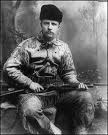
Hunter, sportsman, natural scientist – all were a part of TR’s great love for the great outdoors.

Politics, however, was not Theodore’s first love or first choice. Long before he even knew what politics was, a sickly, frail and asthmatic child fell in love with natural science. His far reaching political interests were dwarfed in comparison to the wide and varied interests he found in nature, whether it was plants or rocks, insects, birds, critters of all kinds, or merely a good view. He learned everything he could about them. By age seven, his collections were already impressive. By twelve, he was a bona fide taxidermist.

That TR would choose “natural science” as a profession is a no-brainer. But he did not.

Today, natural science offers literally hundreds of opportunities for a professional to make his mark. In the 1870s, the field was limited to the university or the laboratory. Perhaps Theodore realized that such a “small” professional universe would never fulfill his oversized personality, or give him the chance to make His Name.

TR and muir

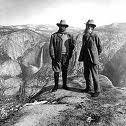
. As President, TR was in a position to use his love of natural science for the good of all Americans.

Nevertheless, natural science would be his truest love, and would last a lifetime. As President, he set aside millions of acres out west as national parks, wildlife preserves, and national monuments for the benefit of generations of future Americans (and visitors).   It was not “in name only.”  He spent weeks and months personally enjoying his camp-outings.

Theodore Roosevelt might have made a substantive-but-limited professional career in natural history in the nineteenth century. He could easily do the same today, and be at the top of his game (no pun intended.)

TR: The Author’s Life

By the time twenty-one-year-old Theodore was about to graduate Harvard, he had already drafted a book about (of all things) The U.S. Naval War of 1812. Naval history, and indeed, history of all kinds, was another of his passions. His book, when published shortly thereafter, became the gold standard on that subject for many years. Writing may or may not have been secondary to reading for him, but he managed to write forty books in forty years. How many books he read in fifty-five years is unknown. And that doesn’t count the dozens and dozens of articles he wrote for newspapers and magazines. And the thousands of personal letters he wrote.

the great room

The Great Room at Sagamore Hill, TR’s home on Long Island Sound, is a treasure trove of his favorite things: presidential, scienc-y, and, of course, loaded with books!

All writers are readers, by sheer necessity as well as inclination. Theodore Roosevelt, partly due to his childhood frailties and partly due to his enormous intelligence, but mostly due to the breadth and scope of his interests, was a prodigious reader. It is said that he read a book-a-day just about all his life.

So how does he rate as a writer?

Theodore Roosevelt-the-author would not be a serious challenge to Shakespeare, Poe or even Stephen King. He wrote off the top of his talents; meaning that he did not put the same serious effort into the craft as he did with science or politics. But he did possess a dandy way with a phrase, a superb vocabulary, a gift of on-the-mark clarity, and if nothing else, a huge volume of words.

TR: RIP

Theodore Roosevelt packed more life into sixty years than Methuselah did in nine-hundred and sixty.

We are lucky to have had him, for goodly and for badly, in our lives and memory.

Sources:

Brands, H.W. – TR: The Last Romantic – 1997 BasicBooks

Dalton,, Kathlen – Theodore Roosevelt: A Strenuous Life – 2004, Vintage

McCullough, David – Mornings on Horseback – 1982, Simon & Schuster

Morris, Edmund – Theodore Rex – 2002, Random House


Posted in A POTUS-FLOTUS Blog, Theodore Roosevelt | Tagged , , , , , , , , , , , , , , | 2 Comments

Grace and Calvin Coolidge on the Farm

President Calvin Coolidge loved to take his wife with him on Presidential out-and-abouts. She was pretty, she was stylish, and she had an impish humor. She was enormously popular.

President and Mrs. Coolidge

calvin and grace

President and Mrs. Calvin Coolidge. He loved taking her with him when he appeared publicly.

Calvin Coolidge was arguably the most sexist president we ever had. He believed politics was a man’s business, in fact, ALL business was a man’s business. Women were for home and family and always as supporting players. “Don’t try anything new, Grace,” was his advice to her when they assumed the First Couple-hood.

If Grace didn’t like being shunted to the background, she never seemed to object. Despite her own college education (University of Vermont), and despite being a teacher of the deaf – back in 1900 – Grace Goodhue was content to be Mrs. Calvin Coolidge, housewife. He would always be the breadwinner, she the bread baker.

Nevertheless, despite the inequality of the marriage to modern eyes, it was a happy union. Calvin Coolidge loved his wife dearly and she knew it. And if anyone had suggested that he was dismissive of her, or disrespectful, he would have been crushed. His love went deep and it was true. And for her part, when her parents tried to dissuade their outgoing and personable daughter her from marrying such a silent and cold fish, she countered with, “But he makes me laugh.”

And indeed, a good part of the success of that marriage was due to their senses of humor. His was Saharan in its dryness, all the more so because of the unexpected wit from such a bland persona. And when it was delivered in his usual dead-panned expression, people were hilarious. Her humor was teasing and mocking; delightful when it was accompanied by her wall-to-wall smile. And they never seemed to tire of bantering with each other.

Smiling Grace

Grace Coolidge was enormously popular during her time as First Lady. She had an infectious smile.

At every opportunity, President Coolidge loved to have his pretty wife along wherever he was invited. Not only was she attractive to look at, but she had innate charm and a genuine love of people which came across all the time.  She could also be trusted to avoid making any public statements other than “thank you for the flowers.”

The Farm Story

One delicious (and oft-told) story about the Coolidge tease, is when the President was invited to inspect a government-run experimental farm. It was reputed to have some of the most modern technology for the 1920s. Coolidge was a farm boy himself, having grown up on his father’s farm in Plymouth Notch, VT. He knew about a lot about farming. Grace was not a farmer’s daughter, but ever since her marriage, regular visits to the Coolidge farm were on their agenda. Calvin and his dad were particularly close.

So Coolidge accepted the invitation, and brought his Missus. They were both treated to a comprehensive tour – but they were separate tours. She, to get the “overall” view, and he to inspect in greater detail.

The Coolidges

You would never guess from the serious expressions that both Coolidges had a delicious sense of humor.

En route, Mrs. Coolidge was taken to a large enclosure with a henhouse, filled to capacity with hens and little chicks, but she could see only one rooster. When she remarked about it, the farmer boasted of his “prize” rooster – one able to “service” the entire lot. She queried, “Just how many times a day does this prize rooster ‘copulate’?” When told that rooster could mate perhaps 35-40 times a day, Mrs. Coolidge twinkled to her host, “You must be sure to tell that to President Coolidge when he passes this way.”

Sure enough a half hour later, the President and his escorts passed that same henhouse, and was given Mrs. Coolidge’s “message.” Coolidge nodded, and was his usual silent self, until they were about to leave the area.

“Hmmmm. Thirty or forty times a day,” he twanged. “Same hen?” “Oh no,” said the farmer, “he services them all.” Coolidge didn’t miss a beat. “You be sure to tell that to Mrs. Coolidge,” he added.

Sources:

http://www.calvincoolidge.us/humor.html

Calvin Coolidge – A Great President, Plus a Bonus Chicken Story

http://www.historyextra.com/blog/coolidge-effect

Posted in A POTUS-FLOTUS Blog, Calvin Coolidge | Tagged , , , , , , , , , , , , , , | Leave a comment

Lucy Hayes and the Laced Oranges

220px-Rutherford_B__Hayes_and_his_wife

Young Rutherford and Lucy Hayes. Shortly after they married, he “took the pledge” of abstinence, and remained true to his word.

Lucy Hayes has gone down in history as “Lemonade Lucy” for banning spirits in the White House – but did people find a way around it?


The Spirits of ‘76

Samuel B. Tilden was the Democratic Governor of New York, and won the popular vote in the Presidential election of 1876. He also won the electoral vote, but was outflanked by some Republican maneuvering.

The election of 1876 was one of the most fractious and genuinely corrupt in history. A decade after the Civil War, an unpopular Reconstruction policy was splintering the country. Samuel Tilden, Democratic Governor of New York, was the likely victor, winning the popular vote but was seemingly finagled out of the presidency by some very fancy political footwork by the Republicans in the electoral college, thus making Rutherford B . Hayes, Governor of Ohio, the 19th President.

The incoming First Lady Lucy Webb Hayes (1831-1889) was a devout Methodist, and a lifelong teetotaler. A devoted wife and mother, she had become enthralled by the preachers and orators who railed against John Barleycorn. Her husband, a tad less virtuous, had been known to bend a convivial elbow in fellowship. But that was back in his youth. In the early days of their marriage Hayes had taken the pledge, possibly in compliance with Lucy’s request, and signed the book in the presence of the pillars of local society who bore witness. Breaking one’s word was a serious offense against one’s honor and integrity. Rutherford B. Hayes was a man of his word.

President Rutherford B. Hayes

“Rud” Hayes was a lawyer, who at aged forty, enlisted in the Union army and rose to become a major general – a field general.  He had led his troops in battle and was wounded four times, once seriously. He was blessed with a character and kind personality that engendered not only respect from his men, but their sincere affection. Both Rutherford and Lucy Hayes would remain deeply involved in veterans’ affairs for the rest of their lives.

Rutherford B. Hayes, 19th President, had been a lawyer, a wounded Major General, Congressman and Governor of Ohio. He distanced himself from ay chicanery, but was happy to assume the Presidency.

After the war, he served two terms in Congress and then was elected a two-term governor of Ohio. In those post-rebellious years, a Republican lawyer, a wounded general, congressman and governor were impeccable credentials. Being from Ohio, an important industrial state with thousands of veterans, neither North nor South, made him practically unbeatable.

Alas for him, the scandals of the Grant administration, along with the violence created by a heavy-booted Reconstruction policy, turned the tables and did the unthinkable: nearly elected a Democrat – the party many claimed had caused the Civil War. Fortunately for the political powers that were and still wanted to be, they could nitpick a few electoral votes (which indeed had produced a few elements of viable corruption) into Republican victories and swing the election.

Hayes himself was a decent sort.  He assiduously remained above the fray, turning a blind eye and a deaf ear to the disputatious electors, preferring to keep his image of “squeaky clean.” The Republican politicians won out. Hayes was elected.

The Dry Decision

At the time the Hayeses were in the White House, the Women’s Christian Temperance Union had grown into a huge moral lobby with major political implications. Neither Hayes nor his wife had actually joined the organization, nor would they ever.

Perhaps because of the scandals and suspicions surrounding the election, plus the polarizing Reconstruction issues facing them, banning spirits in the White House must have seemed like a good idea for a diffusing red herring. After all, who could find fault with people who opposed drunkenness? The new First Couple were unassailably righteous. And dry. But whose decision was it?

pres rud and lucy

President and Mrs. Rutherford B. Hayes were a conventional and morally upright First Couple.

Lucy Hayes usually gets the blame or credit, depending on your point of view. The moniker “Lemonade Lucy” was given to her during their administration, and she reportedly wasn’t happy about it. By her own admission in letters and diaries, she considered herself a shy woman, and while personally temperate, she insisted that she did not wish to tell other people what to do. She claimed that if someone wanted a glass of brandy or champagne, it was not her concern. Besides, she claimed to be in favor of temperance, not abstinence.

Nevertheless the morally upright women of the WCTU commandeered her as their heroine, singing her praises to all who would listen. They wrote stories about her in their newspapers, commissioned her portrait, and refused to be swayed by the fact that she still declined to formally join their ranks.

The Laced Oranges

One of the elaborate and lavish pieces of dinnerware that Mrs. Hayes commissioned for the Hayes White House. The oranges created more excitement, however.

Making the White House bone dry may have been honorable, but it was not a popular call amongst Washington politicos who enjoyed their casual vices of fellowship. Perhaps it was Hayes himself who issued the dictum. Perhaps Hayes enlisted Mrs. Hayes to take the heat, since chivalry was still in flower, and nobody would dare criticize the First Lady for her unimpeachable virtue. They might poke a little fun, but they would not be rude.

The upshot was that there was no booze of any kind, not even wine or champagne, for four years. The White House social scene between 1877-1881 was always gracious and occasionally lavish, but very dull.

The story goes that a large bowl of oranges was always placed in the gentlemens cloakroom of the White House prior to a social occasion. They went like hotcakes. It became a popular congregating place for the politicians since (the story continues) the oranges were laced with rum.  Ha ha.

Then, of course, there was the conflicting story that yes, there were “laced” oranges, but it was only “rum flavoring.” Ha ha HA.

Historians have pondered over this for more than a century and they are still as divided about it as they are about the election of 1876.

We will probably never know for sure.

Sources:

  • Anthony, Carl Sferrazza – First Ladies 1789-1961, William Morrow,1999
  • Boller, Paul F., Jr. – Presidential Anecdotes, Oxford University Press, 1981
  • Geer, Emily Apt – First Lady: The Life of Lucy Webb Hayes, Kent State University Press, 1984
  • Whitney, David C. – The American Presidents: Biographies of the Chief Executives from Washington through Clinton, The Readers Digest Association, Inc., 1996


Posted in A POTUS-FLOTUS Blog, Rutherford Hayes | Tagged , , , , , , , , , , , , , , , , , , , | 5 Comments

John Adams and The Validation of America

john-adams
John Adams. First Vice President. Second President. One of the giants of American history.

March 4, 1797 is one of those barely recognized dates – but it is a pivotal one.

The Lonely Inaugural of John Adams

Inaugurals today are times of celebration: parades, parties, balls. People come from all over the globe to attend. It is hard to believe that poor John Adams had very little personal support to celebrate with him on the day he rose to the highest office in the land. It was essentially a lonely day for the Second President.

He was in Philadelphia. Washington, DC was still under construction. His devoted wife and loving companion Abigail was home in Massachusetts. John’s aged mother, was failing rapidly, and Abigail had returned to nurse the elderly woman, who would die a few weeks later.

abigail adams-2
Abigail Adams was back in Massachusetts caring for her dying mother-in-law. She never witnessed her husband’s moment in the sun.

John Quincy Adams, his eldest son, was in Europe. The thirty-year-old man was a new bridegroom, on his way to becoming one of our foremost foreign diplomats.  The President’s youngest son, Thomas Adams, was also abroad, serving as his brother’s secretary.

John’s daughter Abigail Smith, called Nabby by everyone, and his middle son Charles, were in New York, too far away to make the journey. Neither were prospering in their lives, and would cause John and Abigail Adams considerable anxiety and grief during the next four years.

But John Adams, lonely or not, put on his best gray broadcloth suit, glanced through his carefully worded speech, and prepared to take the oath of office as it was written in the Constitution.

George Washington: The Main Attraction

John Adams had never been a particularly popular man. At sixty-two, he was short, pudgy, balding and well known for his irascible disposition. He was admired and respected to be sure, but hardly beloved.

houdon washington
George Washington, every inch the towering figure of his era.

The beloved one was George Washington. At sixty-five, he was still tall, stately and every inch the man of the hour befitting the many statues that would be erected in his honor.   Now he was finally retiring to Mount Vernon, more than happy to return to his vine and fig tree. His wife Martha did not attend the inauguration either. She had gone home some weeks earlier to prepare the estate for her husband’s arrival.

The outgoing president was the best known and most popular man in the country. George Washington had been on the national scene for a quarter century, as a legislator, a great general, and finally as President of the United States for two terms. Both his elections had been unanimous. The throngs of people gathered at the Philadelphia State House that March 4th, were to say farewell and pay their respects to George Washington, the greatest man of their time. They were not there to see John Adams.

Adams knew this. He also knew he had a hard act to follow. His election was not unanimous.

The Election of John Adams

George Washington congratulates John Adams at his inaugural.

John Adams had been Vice President for eight years under President Washington – a thankless and inconsequential position, according to John, “The most insignificant office ever devised by the mind of man.” This time around, there was a rival for the office, the man who would now become his Vice President: Thomas Jefferson.

The constitution of the still very new United States of America had not been established with political parties in mind. Indeed, the thought of political factions filled many of its founders with grave trepidations. Parties were strongly discouraged.

The original idea was that the President would be the one who received the most votes; the Vice Presidency would go to the runner-up. The country was already beginning to suspect that this was not a good or effective process. But Adams and Jefferson had been good friends for more than twenty years. They might not always agree on everything, but they certainly could work together. So they believed.

The Legacy of 1797

John Adams was right to believe that the event was not so much about him as it was about the outgoing George Washington. But in a way, it was one of the country’s most important inaugurals.

Prior to 1789, there had never been an elected government. For thousands of years, there had only been monarchies or quasi-monarchies. A government-by-law and election had been untried. George Washington could have been made king had he wished. He did not wish. But there was no one else in the fledgling nation who enjoyed the level of Washington’s prestige and regard, so he agreed to serve, and after his two unanimous terms, the presidency would be contested from that time forward.

Neither George Washington nor John Adams were inaugurated at the Capitol Building, which was still under construction in 1797.

On March 4, 1797, George Washington voluntarily stepped down. He would be fairly out, John Adams would be fairly in. They had known each other for decades. While they were not close personal friends, they had always enjoyed an amicable relationship, and they regarded each other with sincere respect. When the two men shook hands at the end of the ceremonies, it was heartfelt and with good will.

It was orderly.

There was no uprising. There was no coup d’etat. There were no armies, no soldiers, no protesters jamming the streets seeking to undermine the lawful transfer of power.

There was no plot to overthrow the lawfully established government.

The Constitution had worked. The system was validated. It was a seminal moment.

Both George Washington and John Adams knew it. And they both knew the enormity of what it all meant.

Sources:

  • Ellis, Joseph J. – Passionate Sage – W.W. Norton Co., 1993
  • McCullough, David – John Adams – Simon & Schuster, 2001
  • Shepard, Jack – The Adams Chronicles – Little Brown, 1975
         
Posted in A POTUS-FLOTUS Blog, George Washington, John Adams | Tagged , , , , , , , , , , , , , , , , , , , , | 2 Comments