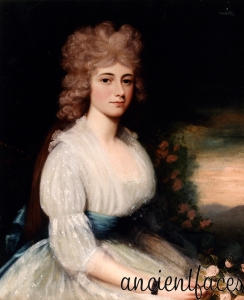
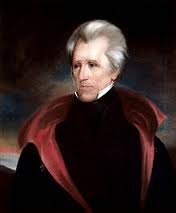
Mrs. Adams, Dr. Physick, and Her Unmentionable Problem

Louisa Catherine Adams: A Brief Medical History

lcadams
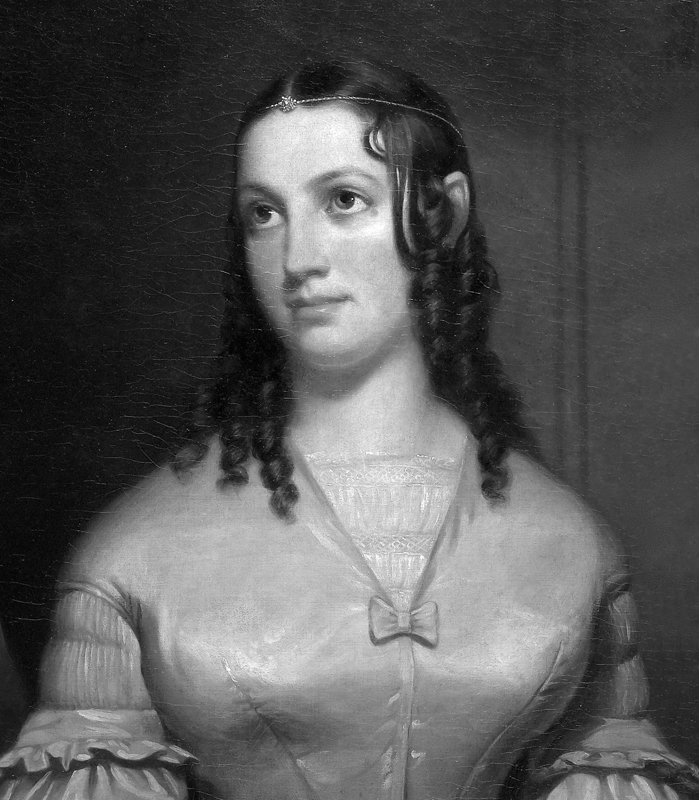
Louisa Catherine Adams was the well educated and cultured wife of John Quincy Adams.

Louisa Catherine Adams (1775-1852), London born and Paris educated, was raised to be exactly what she would become: a perfect consort for a man of distinction. John Quincy Adams was the US minister to the Netherlands and the son of the Vice President of the United States when he met and married her. His potential distinction was certain, but marital felicity was not.  JQ was a cold, controlling man.  Emotional stress always takes its toll.

Add to this low-grade strain was Louisa’ fifteen pregnancies. She miscarried chronically, sometimes fairly late in her term. There was a stillborn. Another died before she was a year old. Only three sons would be born and live to maturity. It took its toll as well.

When Louisa was in her late thirties, she spent the better part of five years in St. Petersburg, Russia, where her diplomat husband served as Minister Plenipotentiary. Russian winters, then as now, are legendary. The cold and dampness in poorly heated accommodations took its own toll. Louisa would blame her subsequent chronic “rheumatism” on the horrible Russian weather.

Then there was her “unmentionable” problem.

Dr. Philip Syng Physick

Philip Syng Physick (1768-1837) was a Philadelphia doctor, whose prominent family had sent their promising young son to London and Edinburgh, Scotland for his medical education, said to be the finest in Europe.  Then he returned to Philadelphia to begin a medical and surgical practice, which included teaching at the University of Pennsylvania.

The eccentric (and oddly-named) Dr. Philip Physick was considered the finest physician in America in the early nineteenth century.

In those early decades of the nineteenth century, anesthesia was still in the distant future.  So was general sanitation.  Bleeding was still a time-honored cure-all.  If a doctor, and particularly a surgeon, was to enjoy high distinction, it would be because of his skill and adeptness with the knife.  Sharp instruments were a plus; so was the surgeon’s speed in repairing or removing the affected problem.

Dr. Physick’s practice was varied and far-reaching for its time.  He designed and crafted any number of surgical instruments and scalpels himself, in various sizes and shapes, to be used for specific anatomical purposes.  He experimented with medicines and potions, and is said to be the first to use carbonated water for medicinal purposes (soda pop!).  His approach was far ahead of his time.

Although he was a cold man of regimented habits, he was still considered the finest doctor in the country, albeit eccentric, anti-social and perhaps downright peculiar.

The “Unmentionable” Louisa Connection

Louisa Catherine Adams shared an “unmentionable” problem with her brother Thomas Johnson – a private ailment usually spoken of in whispers: “piles,” or hemorrhoids, which are essentially varicose veins of the rectum. It may well have been a genetic or familial condition, since there is evidence that several in the Johnson family were afflicted.   In Louisa’s case, it was undoubtedly exacerbated by her fifteen pregnancies. In addition to the discomfort and often severe pain from this condition, it could be seriously complicated by an impacted bowel and inability to evacuate.

In extreme cases there was only one treatment: surgery. It was a completely new approach being pioneered by Dr. Physick. It was a complicated procedure, particularly since there was no anesthesia. Ether and chloroform were still decades away.  Topical and/or alternative measures were a century away.  So was basic hand-washing or instrument boiling.

Nevertheless, Louisa Adams, her brother and her fifteen-year-old niece made the trip to Philadelphia in 1821, where the surgeon confirmed that Thomas Johnson was in dire need of surgery.  Discovering that Mrs. A. had the same “delicate condition,” she was advised to undergo the surgery as well.  But Thomas Johnson’s problem was far more intense, so he became the guinea pig.
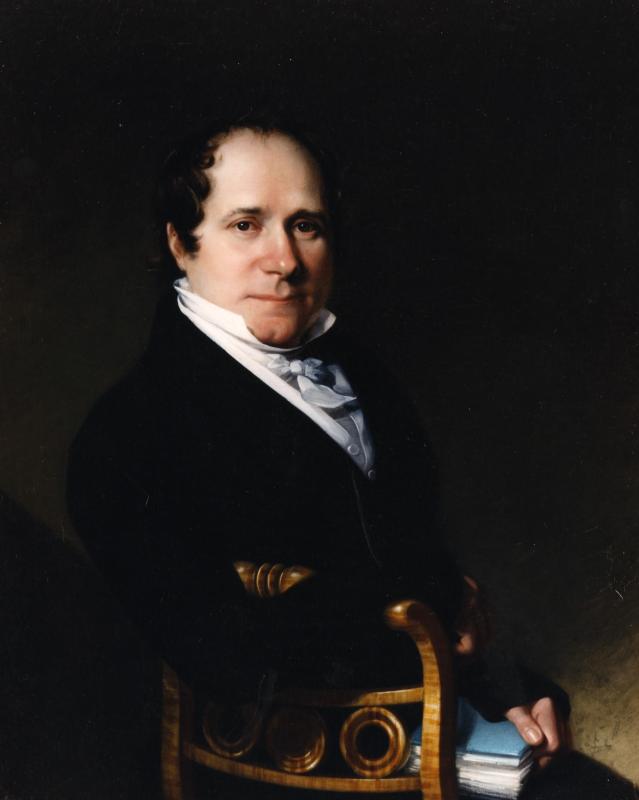
Thomas Johnson by Chester Harding, 1820
Thomas Johnson, Louisa’s younger brother, also suffered very badly from the same “delicate condition” as Louisa. His case was more severe.

At Dr. Physick’s recommendation, Louisa and her niece rented rooms at a boarding house to prepare him for his surgery, and to help him recuperate.  The doctor insisted on arduous attention to his food preparation, chopping and grinding and boiling a particular kind of moss into a bad-tasting-but-supposedly-therapudic soup which he needed to eat for several days prior to surgery.  In those days before food processors and blenders, its preparation took hours. It would be weeks before he was ready for his operation.

Louisa Adams Goes Under the Knife 

When Thomas Johnson recovered completely, he was thrilled with the outcome.  The quality of his life had vastly improved.  Thus encouraged, Louisa decided to subject herself to the same procedure.   Once again she and her niece checked into the boarding house that Dr. Physick recommended (and where he performed the surgery, by the way) and prepared herself to go under the knife.  She and her niece chopped and ground and boiled the moss-soup for her to drink for several days prior to the operation.

For delicacy’s sake, Mrs. Adams was not required to completely undress.  She merely removed the necessary clothing.  Then her hands and feet were tied down, and she laid on her side exposing the particular orifice, in this case, her derriere.  In lieu of any anesthetics, she was given a hefty dose of laudanum (a strong opiate), and steeled herself for the pain that would follow. She remained awake, albeit “la-la’d” throughout the operation.

Dr. Physick was experienced in this type of surgery; Louisa Adams’ problem was also not as severe as her brother’s.  The ordeal did not take as long, nor was the recovery period as lengthy.  And happily for her, she enjoyed the same results of her “unmentionable” surgery.  She was so pleased that she asked her husband to pay Dr. Physick $100 above what his bill called for.

Sources:

Nagel, Paul C. – Descent from Glory – Oxford University Press, 1983

Shepherd, Jack – Cannibals of the Heart – 1980, McGraw Hill

http://www.archives.upenn.edu/people/1700s/physick_philip_syng.html
Posted in A POTUS-FLOTUS Blog, John Quincy Adams, Nifty History People | Tagged , , , , , , , , , , , , , , , | 6 Comments

President John Tyler Elopes!

John Tyler was a man of Firsts.  The First Vice President-to-President, the First President to remarry, and the President with the most children – fourteen.

The President

John Tyler was the first Vice President who became President upon the death of his predecessor.

John Tyler became President in April, 1841, only one month after William Henry Harrison was inaugurated President. Harrison, nearing seventy, had died suddenly, making John Tyler the first Vice President to assume office upon the death of a President.

Letitia Christian, Tyler’s first wife, was an invalid for several years before she was First Lady. Little is known about her, other than bearing seven children.

At fifty-one, Tyler arrived at the White House with his stroke-crippled wife and seven children between eleven and twenty-five.  Within a year, his wife died, and a daughter-in-law subbed for hosting duties.  John Tyler, a Virginian, was known for his southern hospitality.

After a respectful mourning period, the lonely President cast an appreciative eye on Miss Julia Gardiner, a glamorous young woman thirty years his junior.

The Rose

Julia Gardiner was a New Yorker, very pretty, very cultured, very charming, and very very rich.   A few years earlier, she had been involved in an 1840-style scandal! A New York merchant used her likeness (perhaps with her permission), on his advertising circulars, identifying her as “Miss Julia Gardiner, the Rose of Long Island.” Her wealthy and socially upper-crust parents were horrified, and whisked the family off to Europe for two years, to let the talk die down.

Julia Gardiner, who would become the second Mrs. John Tyler, was thirty years younger than her husband – and younger than three of his children!

When they returned, since she and her siblings were of marriageable age, her father took them to Washington. Having hobnobbed with the rich, powerful and titled in Rome, London and Paris, the Gardiners decided to do likewise in Washington. They settled in for the social season and left their cards everywhere – including the White House. As expected, invitations poured in – including one to a Tyler reception, where the President was much taken with “The Rose.”

Julia was only twenty-three, and was being pursued by a bevy of would-be wooers, all old enough to be her father. She declined their proposals. The President of the United States, however, was a different story. He pursued and wooed, and she declined. But he persisted. She wavered.  The POTUS presented a heady possibility.

The Proposal

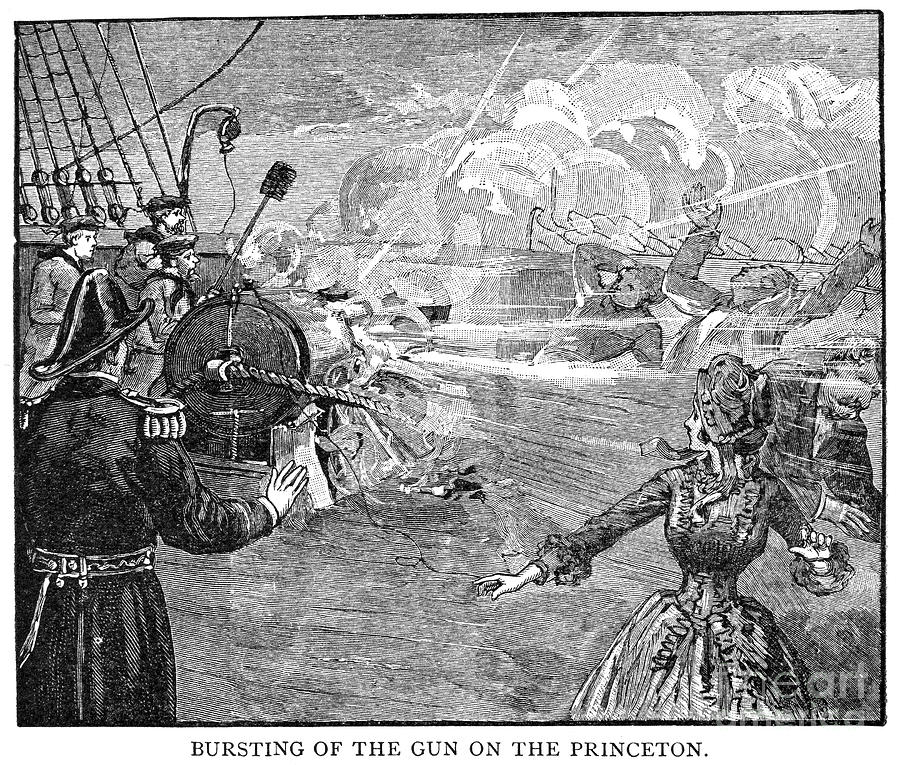
Then came a disaster. Julia and her father had been invited by the President to join a party cruise down the Potomac. The gunboat Princeton had been fitted with a new cannon which would be demonstrated to some three hundred Tyler’s guests.   All went well. The demonstrations were successful.

The explosion on the gunship Princeton killed several people, including Julia’s father, David Gardiner.

Later in the afternoon, as the ladies went below for a luncheon, the gun was demonstrated once more. This time, it misfired, killing several onlookers, including David Gardiner, Julia’s father.

“The Rose” was understandably distraught, and the solicitous President plied her with condolence notes and flowers.  Then he sent invitations to appropriately private luncheons and teas. Julia, a daddy’s girl who had just lost her daddy, became more receptive to the President’s kind attentions. He was, after all, still slim and attractive at fifty-four.   This time, when he proposed, she accepted, but only if her mother consented. Mrs. Gardiner, who was even richer than her husband had been, did not consent. She did not think Tyler was wealthy enough to support the Gardiner lifestyle. She had a point. Tyler was comfortably well-off, but hardly in the Gardiner class. But President Tyler was nothing if not persistent. He had persevered with Julia and would now persevere with her formidable mother. It paid off. He finally won her approval.

The Elopement

So in a few months, the President quietly slipped out of Washington with one son and only one naval escort, and came to New York. He checked into a fashionable hotel, asked for the manager, and proceeded to place the hotel and its staff in immediate lockdown.   No one was allowed to enter or leave. Tyler did not want his presence known, nor did he want speculation as to his purpose. The next morning, after he released all his “hostages” and shook hands with everyone, he went to the Church of the Ascension, where he and his bride were married in a small private ceremony. Then they went to the Gardiner town house for the wedding breakfast. Later, the President and the new First Lady drove in an open carriage down Broadway, where they were indeed recognized, and the purpose surmised. The news, of course, spread like wildfire.

Why Elope?

The “second” batch of Tyler children grew up at Sherwood Forest, Tyler’s Virginia home along the James River.

So why the elopement? The reason the President usually gave was understandable. It had only been a few months since David Gardiner had died. Julia was still in mourning and the proprieties must be observed.

Then, of course, it could be conjectured that John Tyler did not wish to incur “cradle robbing” snickers and gossip.  Finally, there were the seven Tyler children (three of whom were older than their new step-mother). They had not been told of the marriage, and it was big news to them, and not particularly welcome. It might also be conjectured that their inheritance might be dissipated should the new marriage be fruitful.  A legitimate concern.

As it was, the snickers and gossip abounded anyway.  The President was called either “Lucky John,” or “that old fool.” Turns out “Lucky John” prevailed. His second marriage was a happy one. It was also very fruitful, to the dismay of his “first” family. Seven more little Tylers would make an appearance, the last one, when Tyler was nearly seventy.   With fourteen children who reached adulthood, Tyler was the most “fathered” of all our Presidents.

Sources:

  • Anthony, Carl Sferrazza – First Ladies 1789-1961, William Morrow,1990
  • Seager, Robert III – And Tyler Too, McGraw Hill, 1963
  • Truman, Margaret – First Ladies, Random House, 1995


Posted in A POTUS-FLOTUS Blog, John Tyler | Tagged , , , , , , , , , , , , , , , , , , , | 3 Comments

Washington and Lincoln: The Weems Connection

George Washington died in 1799, ten years before Abraham Lincoln was born.

GW: A Symbol for his Age

The glorious George Washington.

When George Washington died a few weeks before his sixty-eighth birthday, he was a towering figure, arguably the most important and respected man in the country.   His death shocked the young nation he helped found.  Eulogies filled the newspapers and pulpits. All the “old soldiers” of the Revolution gathered to mourn and commemorate his passing.

George Washington had done more than merely lead soldiers in battle. He had helped to shepherd a country into being.   He “retired” to private citizenship voluntarily, only to be recruited back into the forefront as the first president of the very new United States. He served for eight years, the last four, reluctantly. Then he peacefully (and gratefully) turned the office over to his duly elected successor, and again retired.

It had never been done before, this “voluntary” transfer of high power.

It was the stuff of legends.

Mason Weems, Itinerant Preacher

A depiction of “Parson” Mason Weems.

In 1800, the year after George Washington’s death, the population of the United States stood at just over four million people. There were fifteen states and the country was pushing westward. In those early frontier times, established churches were a luxury that few towns could support. Thus during the first decade of the nineteenth century, a wave of evangelism began to appear, termed as the Great Awakening. Itinerant preachers, some trained, most self-proclaimed, roamed the country, performing the christening, marriage and funeral rituals, and spreading the gospel. Then they moved on to the next town to do the same.

Mason Locke Weems was one of those ministers, known to history as “Parson” Weems. Some time during that first decade after George Washington’s death, he decided to write a book about the Great Citizen-General. It would be the first “American” biography, and the first attempt at re-creating the life of the illustrious man.

Modern historians and biographers either snicker or shudder at the mention of the good Parson and his whole-cloth invention of young George, his hatchet and his father’s ex-cherry tree, which has become Weems’ greatest claim to fame.

An early illustration (NPS)

But for several years of so-called “research,” Weems met and interviewed scores of people who claimed to know Washington, including veterans of the Revolution who were happy to share their reminiscences of their Commander-in-Chief. By that time, those memories were thirty-some years old, and, as now, often were muddled or enhanced with time. Then too, the criteria for historical research and writing was limited to a florid way with the vernacular, which Weems had in abundance. Truth and reliability mattered little, and the essence of myth and legend mixed freely with fact and went unchallenged.

The Grant Wood 1939 depiction of young George Washington and the “cherry tree story.”

Weems was not a bad man. He was a preacher of sorts, devoted to preaching “the good” of man. And who was the epitome of the “best of men” then? George Washington. His virtues (then and now) were real and unassailable. His honesty and character were unquestioned. More importantly, those qualities were considered worthy of emulation. “Teaching” the next generation to emulate the glorious George Washington was uppermost in Parson Weems’ mind. And for centuries upon centuries, one of the character-teaching tools were Aesop’s fables, with a moral to every story. And the moral, according to the Parson, was that George Washington was the epitome of virtue and honesty. And a little story about the honest child who became an honest man presented a moral to be embraced.

So Weems wrote his book and “The Life of George Washington” was published to huge success. It lasted for decades. Generations of children learned to revere the first President from Weems’ account: It was written down and published, therefore, it must be so.

Abraham Lincoln: Reader

Abraham Lincoln, by his own account, had perhaps a year’s schooling all told, which consisted of a few weeks here and there. Whatever he learned was through his own efforts. His parents were illiterate. Also, by his own account, Lincoln was a poor boy with little access to the tools of learning.

An illustration of young Lincoln reading by the fire.

The story goes that when he was perhaps twelve or thirteen, Lincoln, the self-taught reader, borrowed a book from a neighbor. The book was damaged and Lincoln labored for two weeks to pay the neighbor for the book. This is a true story. Lincoln himself was known to tell it.

That book was Parson Weems’ “The Life of George Washington,” and it made a huge impression on the young Lincoln. It was likely the first complete book he had ever read. Whether he believed every word of it is open to conjecture, but that is not unlikely, either.

What Lincoln did believe, however, were exactly the concepts that Weems attempted to portray: Washington’s honesty (i.e. the very purpose of the cherry tree legend), his high moral character, his leadership both military and political, his sense of duty, and his devotion to his men and his country.

Those were the very qualities Lincoln would strive to attain himself.

The Value of Legends

Myths and legends have been around for millennia.  Ancient civilizations are filled with them. Bible stories are frequently constructed in that regard. Nearly every age has its romantic mystique of a real person, from Alexander the Great to John F. Kennedy.

What purpose do such “stories” have? Historians today try hard to demystify our “heroes,” in an effort to debunk them. They water an anecdote into a footnote, creating a disdain for history as a subject itself. It merely becomes a series of hard-to-remember almanac facts instead of the accomplishments of real people. Legends are indeed glorified, but a glorification based on some substance.  They are memorable far longer than the almanac facts that are quickly forgotten.

There is nothing wrong with a little glory. Or a little story.  Say that it is a “story,” but tell it!  We are always in dire need of good role models. Abraham Lincoln found his role model via his introduction to an exaggerated George Washington, but he would remember it always, and treasure the example.  It did not seem to hurt him a bit.

Sources:

Davis, William C. – Lincoln’s Men – The Free Press, 1999

http://www.mountvernon.org/research-collections/digital-encyclopedia/article/parson-weems/

http://www.authorama.com/life-of-abraham-lincoln-5.html

Posted in A POTUS-FLOTUS Blog, Abraham Lincoln, George Washington, Nifty History People | Tagged , , , , , , , , , , , , , , , | 3 Comments

The Dying General: Grant’s Final Campaign

   Ulysses S. Grant was unquestionably a great and able general, but he was no businessman.

The General’s Last Hurrah

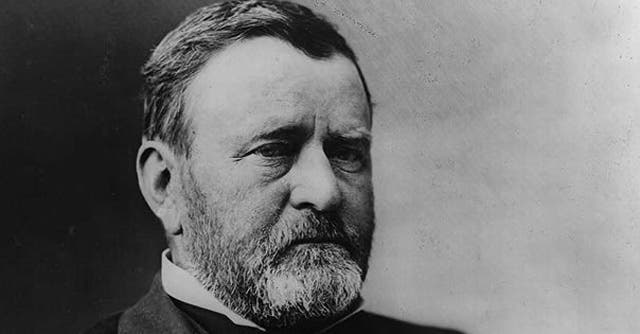
When Ulysses S. Grant retired from two terms as President of the United States in early 1877, he was the most famous man in the world. There had been serious financial scandals during his administration involving cabinet members and even his personal staff. While Grant was never involved in any misconduct, naughtiness was done on his watch. He was tainted. But he was still popular.

Julia and Ulysses

Ulysses and Julia Grant were a particularly happy couple. She was his devoted companion through good times and some very bad times.

Partially to give himself a rest from the near-daily reports of malfeasance, and partly because it was a novelty for him and his wife Julia, they decided to travel.  Grant had never been a wealthy man, but he had accumulated some money and could finance his two-year sojourn around the world. It was a party of three-plus. Ulysses, Julia and their teenaged son Jesse – and a journalist John Russell Young, who would crank out thousands (and perhaps millions) of words to provide a running commentary of the Great General in the Great Capitals. It was printed regularly, since Grant was being hosted wherever he went, by Kings, Queens, Emperors and other ruling members of all the important places in the world. He was still front page news.

At the end of two years, partly because they were getting antsy, and mostly because they were running out of money, they came home, only to find that Grant was more popular than ever. Perhaps popular enough for a third term. He made a lukewarm effort in that direction, but it failed.

He was fifty-eight years old. He still needed a job, and Grant, out of uniform, had never been good in the “job market.”

Former President Ulysses S. Grant made a half-hearted attempt to regain the white House in 1880. He was fifty-eight and needed a job.

The Great General is a Financier

General Grant had been a great favorite of the rich and famous since his rise to battlefield stardom. While they may have gravitated to him early in his rise because he was “rising,” they grew to truly like him as a man, and perhaps in their own way, considered him a national treasure.

Post-Civil War, there were very few laws on the books about public servants accepting private gifts. Out-and-out bribery was one thing, a box of cigars was another thing, but lavish gifts, such as houses or fine carriages and teams of horses was not considered a blatant no-no. And when the givers of such gifts had names like Vanderbilt and Whitney, they knew how to maneuver around technicalities.  And technically, Grant was now a private citizen.

So they were happy to provide a town house for the former President in New York City, where he could be available to party with them. But he still needed a job.

It was his son USG, Jr., always called Buck, who suggested the partnership with Ferdinand Ward, a Wall Street so-called “genius.” General Grant readily admitted that he knew absolutely nothing about finances, but Ward said it did not matter. He would be the one to manage the financial end of things, and General Grant could be the outside “face” of things. He was hoping that the former soldiers of the Grand Army of the Republic who had trusted their old commander with their lives, would now be willing to trust him with their money. They did. They did bigtime! With General Grant’s name on the letterhead, money for investments came pouring into the firm, and for two years, handsome dividends were distributed regularly. Ulysses S. Grant was now a rich man. His grown sons had invested in the firm, and they were now rich men. Even Julia invested some of her “pin” money and was doing nicely.

Then the whole thing plunged to its death. Ward had concocted a Ponzi-like scheme (like Bernie Medoff) which is basically a Borrow-from-Peter-to-Pay-Paul affair. Then he cajoled Grant to borrow a substantial amount of money, supposedly as a bridge loan, from his pal, William Vanderbilt. Then Ward immediately fled the country, leaving Grant holding the proverbial bag.

Ulysses S. Grant: A Man of Character

Last Grant fam photo

Grant loved nothing more than being surrounded by his family – and they were all there during his last years.

Dying Grant

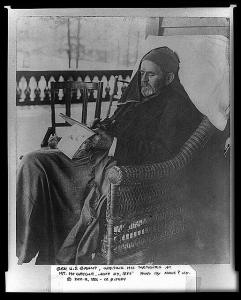
One of the last photographs of General Grant, as he was completing the final edits of his memoirs.

Ulysses Grant was guilty of nothing, except perhaps of poor judgment in business partners. He insisted that he would honor all the company’s debts. If being financially ruined with his reputation in tatters wasn’t enough, the sixty-two year old General learned that he had incurable cancer of the throat. He turned over all his possessions, including deeds to his houses, his gifts-from-royalty, and even his Civil War memorabilia to pay his creditors. He was virtually penniless.

The iconic Civil War general had been approached on several occasions to write his Civil War memoirs, and had always declined, claiming he was not a writer. But other veterans, from privates to generals, were penning their reminiscences and making small fortunes. Grant needed the money, and Mark Twain, who had a substantial interest in a publishing company, offered him an enormous advance. The General agreed. He did not want to leave his family in debt or in want.

The Personal Memoirs of U.S. Grant were sold out by subscription even before they were released. It made a fortune for Grant’s heirs.

With his usual intensity of effort, he plunged into recollecting those campaigns and battles of a quarter century earlier. He corresponded with many of his old colleagues, reviewing their clarification and memories. He pored over the old maps and the old orders. He spent hours at his desk, despite the increasing pain from his cancer. He refused all pain-relieving medication so that his mind would not be dulled. The final galleys were finished only days before he died. When Twain told the dying man that the advance sale had topped $300,000, Grant was amazed.

Older Julia

Grant had been concerned that his wife would be left in want. He needn’t have worried.

He may have believed that he “was not a writer,” but Mark Twain (who was a pretty fair one) insisted that the writing was excellent. Bruce Catton, the late historian of the Civil War, once commented that Grant had “the gift of clarity.” In the century-plus years since Grant’s Memoirs were published, nearly every military historian has rated them as some of the finest war memorials every written.

And Mrs. Grant became a very wealthy widow.

SOURCES:


Flood, Charles Bracelen – Grant’s Final Victory:  Ulysses S. Grant’s Heroic Last Year – 2012, DaCapo Press

Goldhurst, Richard – Many Are the Hearts – 1975, Reader’s Digest Press

Young, John Russell – Around the World with General Grant – 1879, American News


Posted in A POTUS-FLOTUS Blog, American Civil War, Ulysses S. Grant | Tagged , , , , , , , , , , , , , , , , , , | 3 Comments

Grover Cleveland’s Scandal: “Where’s My Pa?”

Presidential candidate Grover Cleveland was accused of fathering an illegitimate child.   It was true.  Maybe.

Grover Cleveland: The Bachelor Candidate

formal portrait

Grouchy-faced and pudgy, Grover Cleveland would never be anyone’s beau ideal of a romantic figure.

Grover Cleveland (1837-1908) was a forty-seven year old bachelor when the Democrats chose him as their presidential candidate in 1884. People said that Cleveland did only two things, but he did them both extremely well: he worked, and he ate. “Working” accounted for his successful business law practice and his sterling reputation in Buffalo, New York.  The eating part was verified by the 300 lbs. that was packed on to his 5’9” frame.

If he wasn’t working – or eating – he was socializing with the fellows who gathered at the local firehouse to play cards or smoke cigars or plan their next fishing trip. He was definitely not a “parlor” guy. His manners were gruff.  There was little about him that was sophisticated, cultured or courtly – or handsome. Former President Rutherford B. Hayes  called him “a brute with women.”

Grover Cleveland: The Buffalo Politician

Buffalo, New York was the state’s second larges city after the Civil War. The Erie Canal had made it a huge shipping center.

Despite his rough exterior, a bipartisan group of citizens approached Grover Cleveland in the early 1880s offering to support him as Mayor of Buffalo.  New York’s second-largest city had been filled with corruption even before the Civil War.  Cleveland’s reputation for honesty and getting-things-done made him the perfect choice. He had considered the idea of a political career fifteen years earlier, but he did not advance quickly, and opted to devote his energies to his law practice.

But this time, the Mayoralty of Buffalo was an easy victory for him – especially with strong bipartisan support from the town’s finest citizens. He ran and won. Then he began to clean up the graft and bribery, the bid-rigging, the kickbacks and general vice.

The State of New York took notice, and elected him Governor. Cleveland proceeded to do likewise for the State. He was a force to be reckoned with: a viable reform candidate for the Presidency in 1884. Despite his unfamiliar national resume, Grover the Good became the Democratic choice.

Grover Cleveland: The “Pa” Story:

Democratic candidate Cleveland had been nominated because of his flawless reputation – until a sleazy Buffalo newspaper printed a story that he had fathered an illegitimate child a decade earlier. Other newspapers got wind of the story and created a scandal of it. Pastors and priests all over the country decried the liaison from the pulpits. Needless to say, everyone expected Cleveland to vociferously deny such a monstrous charge. He did not.

He told his campaign managers to “tell the truth” – a mantra that he would always follow. And the truth was this: some years earlier, he had been acquainted with a widowed seamstress named Maria Halpin. Casual with her favors, Mrs. Halpin was also acquainted with several of Cleveland’s friends. When there was to be a child, Grover Cleveland volunteered to accept responsibility. While he was never sure of his paternity, he was the only bachelor amongst Maria’s intimates and did not wish to have his married friends embarrassed. He was also in a position to afford financial assistance – and even tried to set Mrs. Halpin up in a dressmaking business. Despite Cleveland’s monetary assistance, she proved to be an unfit mother, and when the boy was still small, Cleveland had him placed in suitable foster care. Some say he grew up to be a professional man; some say he died when he was a child. Nothing has ever been ascertained fully.

Cartoons of the Cleveland-Halpin “scandal” filled the newspapers.

The intrusion into his private life galled Candidate Cleveland no end, and indeed, any intrusion into Cleveland’s personal life would irritate him profusely, but he satisfied the electorate – and in particular, their wives. He had admitted the truth of the affair. He also was able to document his financial responsibility to the woman and child in question. Now the pastors and priests had another field day –those vehemently opposed to the situation, and those who were more tolerant, commending him for his honorable actions. Everybody had an opinion.

The Republican newspapers also had a field day with their taunts of “Ma! Ma! Where’s my Pa?”

The Election of 1884: The Republican Scandals

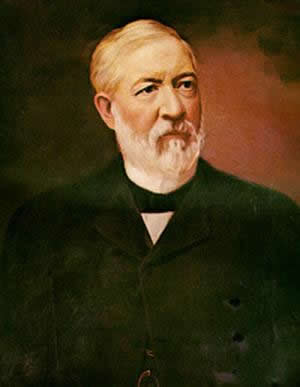
Ever since the founding fathers, personal and political scandals have been a part of elections. The Republican candidate in 1884 was Senator James G. Blaine – a man who had been in the political spotlight since the Civil War, and was very well known throughout the country. But he was tainted.

James G. Blaine was not without his own scandal issues. But his were financial – not “moral.”

More than a decade earlier, he had been mysteriously involved in a complicated financial fraud and accused of accepting considerable sums in stock shares from a questionable railroad consortium called the Credit Mobilier. The scandal dragged on for years. The charges against Blaine were never completely proven – but the inferences were never completely put to rest, either.   There was enough smoke, if not for fire, certainly enough to make a stink.

The Democratic newspapers countered with their own slogan: “Blaine, Blaine, James G. Blaine, continental liar from the state of Maine.”

It was a nasty campaign all the way around. And there had not been a Democratic President since James Buchanan, nearly thirty years earlier.

Grover Cleveland Wins the Election of 1884:

It was a squeaker. Out of nearly 10,000,000 votes cast, the difference between Cleveland the winner and Blaine the loser, was less than 25,000. It was even close in electoral votes: Cleveland received 219, and Blaine received 182. (There were only 38 states at that time).

Now the scandalous slogan would be turned back to the Republicans: “Ma! Ma! Where’s my Pa?…. Gone to the White House, Ha Ha Ha!”

And a year and a half later, President Grover Cleveland, at age 49, would marry and go on to have five legitimate children.

Sources:

  • Brodsky, Alyn – Grover Cleveland, A Study in Character – St. Martin’s Press, 2000
  • Dunlap, Annette – Frank – State University of NY/Excelsior – 2009
  • Jeffers, H. Paul, – An Honest President – William Morrow, 2000
Posted in A POTUS-FLOTUS Blog, Grover Cleveland, Nifty History People | Tagged , , , , , , , , , , , , , , , , , | Leave a comment

Ethel Roosevelt: TR’s Other Little Girl

All Theodore Roosevelt’s children had some of his qualities, but Ethel was more like her mother than any of them.

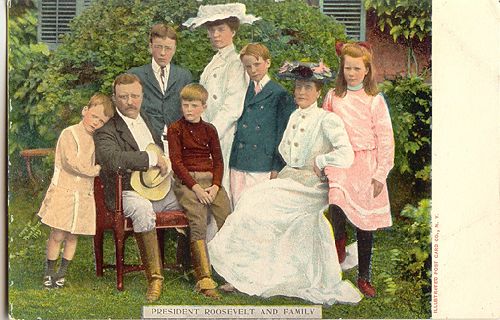
The Roosevelt Family of Sagamore Hill. Ethel, their second daughter, is at the far right.


Ethel Carow Roosevelt, The Second Daughter

Ethel Roosevelt (1891-1977) was seven years younger than her half-sister Alice, and surrounded by brothers: two older and two younger.

Chubby as a child, with little of the sparkle that enveloped her older sister, Ethel developed a take-charge attitude from her earliest age. “Bossy,” as her brothers remembered. Nevertheless, it was to Ethel that most of them turned for support, comfort and good sense.

ethelandedith
(l to r) Edith and Ethel Roosevelt

She was, of course, a tomboy. She had little choice in the matter. All Roosevelt children were expected to run and climb and play hard. The strenuous life was a given. But her mother’s natural reserve was also a part of Ethel’s nature. Edith Carow Roosevelt was a cool woman, some said cold. That coolness was be a blessing within the family, since it was she who applied the gentle brake to her husband’s lead-footed acceleration speed. Ethel was not cold, but she was a measured woman. The dependable one in the family.

Ethel in the White House

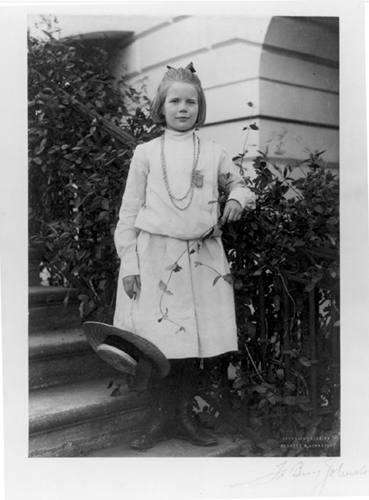
Ethel Roosevelt, as First (or maybe “second”) Daughter. She was not as good copy as her sister Alice.

Poor Ethel. She was not quite ten when Theodore Roosevelt became President of the United States. Somehow her childhood was completely overlooked and overshadowed in the White House.

Alice, the older daughter, stunning and outrageous at seventeen, received more attention than anyone except Theodore – and sometimes that was questionable. Ted and Kermit, both still in prep school, were Theodores-in-waiting. Ethel’s younger brothers, Archie and Quentin, six and four, captivated everyone with their antics and “fun.” Ethel, not particularly cute, pudgy, and without visible talents, was lost in the shuffle.

In 1905, when Alice married Congressman Nicholas Longworth and became the most exciting young matron and hostess in Washington, public eyes began to turn toward her younger sister, now around fourteen. If the press thought they might find another Alice-in-situ, they were sadly mistaken. Ethel was the solid one. Like her mother, she was the one who shunned the spotlight, much happier in the background. And since Ethel had neither the beauty nor the personality of Alice, the press learned quickly enough to leave her alone. Even her traditional “coming out” debutante part was bland.

Ethel Roosevelt, not quite a traditional debutante – but what a hat!

Ethel Roosevelt:  Mrs. Richard Derby

In 1913, when Ethel was twenty-two, she married Dr. Richard Derby, and moved to Oyster Bay, on Long Island, near the family home at Sagamore Hill. They had four children.

When World War I began in Europe, Ethel began to “come into her own.” Dick had volunteered his medical and surgical expertise overseas in France, and Ethel, leaving their baby with her parents, joined him, working as a volunteer nurse in the American Ambulance Hospital. (While the four sons of Theodore Roosevelt always get credit for joining the army long before the US entered World War I, it was actually Ethel who enlisted first.) It is also where she began her close and lifelong association with the American Red Cross.

dickderby
Dr. Richard Derby, Ethel Roosevelt’s husband.

The experience of nursing stood her in excellent stead. There would be many tragedies in her family where her steadfastness and quiet strength were needed. Her oldest son died of blood poisoning when he was only eight. That trauma plunged Dick Derby into a deep depression that lasted for several years. It fell to Ethel to maintain the household, the finances and the rest of the family.

Ethel Roosevelt Derby, the “Family Glue”

Ethel was always close to her siblings, as well as to her mother. In 1918, her youngest brother Quentin died, followed shortly afterward by Theodore. It was to Ethel that the family again turned for quiet advice, for comfort and for the balance that every family needs. She was closest to her brother Kermit, the most sensitive of all Theodore’s cubs, with a lifelong tendency toward melancholy – and liquor.

It was Ethel to whom her mother Edith turned in her advancing years. She had lost a son in the First World War, and she would lose two more (Ted and Kermit) in the Second War. When Edith Roosevelt died at 87 in 1948, Ethel and Alice (who had never been particularly close) vowed to remain in better touch. Her other remaining sibling, Archie Roosevelt, ultra-conservative in his politics, was always more estranged from the family fold. Ethel loved her brother dearly, but found herself making “the family excuses” for his shrill tone.

Ethel Derby: The Queen of Oyster Bay

Ethel Roosevelt Derby never strayed far from where she was born and raised at Sagamore Hill. She lived in Oyster Bay till her death at 86.

Once her mother died, it was Ethel who oversaw the re-creation of their home at Sagamore Hill as a national historic site. She was on its board of directors until her death.

Ethel Roosevelt Derby, a 60-year member of the Red Cross.

She was also an active participant in the American Civil Rights Movement, and while she preferred to keep a low profile, and keep her politics “at home,” she hosted meetings in her own home to help to secure low-cost housing for minority families in the Oyster Bay area.

Her one small foray into a national scene was in 1960, where she made a brief seconding speech for Richard Nixon.

True to her character and quiet style, Ethel Roosevelt Derby had her formal portrait painted wearing her Red Cross uniform rather than evening clothes. She was an active member for more than sixty years.

All Theodore’s children carried some of his genes and some of his personality and character traits. Ethel had his take-charge attitude (when she wanted to), but she also had her mother’s balanced temperament. And in her own way, she was also a national treasure.

Sources:

Caroli, Betty Boyd – The Roosevelt Women –  Basic Books, 1998

Renehan, Edward J., Jr. – The Lion’s Pride: Theodore Roosevelt and His Family in Peace and War – Oxford University Press, 1998

http://www.theodorerooseveltcenter.org/Learn-About-TR/TR-Encyclopedia/Family-and-Friends/Ethel-Carow-Roosevelt-Derby.aspx


Posted in Nifty History People, Theodore Roosevelt | Tagged , , , , , , , , , , , , , , , , , , , , , | 6 Comments

VP Hannibal Hamlin, Coast Guard Private

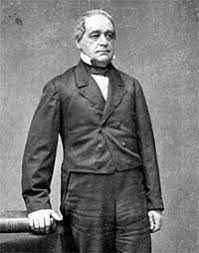
Hannibal Hamlin was Vice President during Abraham Lincoln’s first term. He was a decent man, lost to history.

Vice President Hamlin, The Background

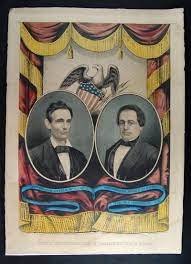
Hannibal Hamlin, from Maine, was a likeable and respected attorney, a pleasant but far from stellar United States Senator. To balance the Republican ticket with midwesterner Abraham Lincoln at its head, he was selected by the convention in 1860 to be Vice President. It was a honorable position, albeit one with no “heavy lifting.

Hannibal Hamlin, Senator from Maine, was the 1860’s Republican choice to run as vice president to Abraham Lincoln.

Hamlin had never met Lincoln before, but once the election was won, and the two of them were preparing for their new posts, President-elect Lincoln invited the Maine Senator to Springfield, IL for a visit. Hamlin was quick to accept. The two spent a few productive hours in discussion, and each would be complimentary about the other. Once in office, however, Lincoln, like his predecessors, had no idea of how to utilize the position of Vice President effectively. Thus, poor Hamlin, who had wielded considerable weight in Maine Republican politics, was now toothless and clawless in Washington. His only “authority” by virtue of the Constitution, was to preside over the Senate. He had lost whatever clout he had in Maine politics, mainly because his ability to influence its political patronage activities ended with his new office. To wit, he had no jobs to distribute.

The clean-shaven Lincoln and the pleasant faced Hannibal Hamlin.

Abraham Lincoln always treated his Vice President with respect and cordiality, quick to make time for him whenever Hamlin requested a meeting. But Lincoln had no assignments to offer to the ex-Maine Senator, and Maine was not a particularly important state, politically-speaking.

Political Military Commissions During the Civil War

The American Civil War had, by and large, a voluntary army in 1861. The regular army numbered perhaps 25,000 soldiers and officers, many of who defected to the Confederacy. To ease the burdens of recruitment on such a large scale, Union governors were empowered to commission officers.

Hundreds, and possibly thousands of lawyers and politicians of all ages enlisted at once. By virtue of age, experience, education, perceived leadership and social standing, they were usually immediately commissioned as officers.  Many of them were very good. Future Presidents Rutherford B. Hayes, James A. Garfield and Benjamin Harrison were politicians who proved to be competent officers, and were soon wearing a general’s stars.

Lincoln and Hamlin 1860

And strange as it may seem today, Congress, during the Civil War, was a part-time entity. Washington had abysmal weather during the summer. Built on a swamp, it was a festering morass of potential malaria, typhoid and other fevers usually related to buggy and boggy water and air. Any politician who could, left the city during the summer. Even Lincoln and his family retreated a few miles out of town for the healthier climate of the Soldiers’ Home in suburbia during the summer.

Thus it was not uncommon for high level politicians, i.e. congressmen and senators, to go back home – or possibly to volunteer with the army for a few months, if they felt so inclined, and their health permitted. It was a novel adventure for them.

Hamlin Joins the Coast Guard

Hannibal Hamlin and Abraham Lincoln were the same age, in their mid-fifties in 1864. Certainly well past their physical prime. But Hamlin was bored as Vice President (as most early Veeps were), and had a sincere desire to be of use somehow and somewhere.

When Congress adjourned for the summer of 1864, Vice President Hannibal Hamlin returned to Maine, and joined the Maine Coast Guard.

The Maine Coast Guard was not the Coast Guard one recognizes today. During the Civil War, it was indeed a “coast guard”. Maine shares a long border with Canada, and it was a well known fact during those troublesome times, that Canada was a hotbed for Confederate plotting, blockade running, counterfeiting and assorted mayhem. The Maine Coast Guard was an entity specifically designed to guard its coast line against any activity that might appear potentially dangerous or subversive. It was manned, as one might expect, primarily by old men and boys. Everyone else had already enlisted in the main army.

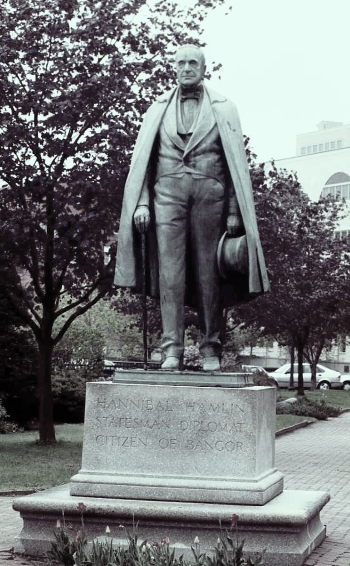
A statue to commemorate one of Maine’s favorite sons, Senator, and Vice President Hannibal Hamlin. They liked him in Maine.

So Vice President Hamlin enlisted in the Coast Guard as a private, and in that position he remained. He would never achieve the acclaim of his fellow “downeaster”, Joshua Lawrence Chamberlain, a genuine hero of Gettysburg.  Hamlin was never “promoted” or given a higher rank as might be deemed fit for his age, education, experience or civilian position. It does not appear that he requested any preferential treatment, either. He drilled and marched alongside 13-year-old boys and men his own age and older. He stood watch with them when his turn came. And he even served for a while as company cook. (One suspects that lobster was not on the menu.) When his “hitch” ended a few months later, he returned to Washington to take up his Vice Presidential duties once again.  One could conjecture which occupation was more exciting.

Nevertheless, there has never been another instance of so high a ranking political figure serving while in office in such a low military position. But Hamlin was a pleasant fellow. He did not complain as far as we know, especially since Lincoln had selected Andrew Johnson of Tennessee to be his running mate in 1864.

Perhaps ol’ Hannibal just needed to enjoy a few weeks at summer camp!

Sources:

Barzman, Sol – Madmen and Geniuses: The Vice-Presidents of the United States, 1974, Follett Publishing

Purcell, L. Edward, (Editor) Vice Presidents: A Biographical Dictionary – 2005, Facts on File Publishing

https://www.senate.gov/artandhistory/history/common/generic/VP_Hannibal_Hamlin.htm

http://millercenter.org/president/johnson/essays/biography/3

Posted in American Civil War, Nifty History People | Tagged , , , , , , , , , , , , , , , , , , , , | Leave a comment

Louisa Adams and the Jackson Ball

In 1824, James Monroe, our last Founding Father(ish) was retiring. His Cabinet was a virtual nursery for a new generation poised to take over.

The Players and the Playing Field: 1824

JohnQuincyAdams
Sec. of State under James Monroe, John Quincy Adams was a main contender for the election of 1824.

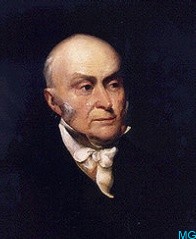
Leading the field for the election of 1824, was Monroe’s Secretary of State, John Quincy Adams, a New Englander who had been on the national stage since he was little more than a boy. His credentials were impressive and impeccable. His personality, alas, was cold, caustic and usually forbidding.

Then there was William Crawford of Georgia, Secretary of the Treasury under Monroe. He was qualified and competent, but alas for him, dull as dishwater. (Money people usually are.)

Add to the mix “Harry of the West,” Kentucky’s favorite son, Henry Clay: Congressman, Speaker of the House, brawler and duelist. Not boring, though.

Include – maybe – John C. Calhoun, Yale-educated South Carolinian and Monroe’s Secretary of War. Oozing his southern charms, he was always a potentially dangerous foe.

Then, of course, there were the surprises.

Mr. and Mrs. JQA

John Quincy Adams (1768-1848) was an ambitious man, perhaps expected from birth to attain great achievement. His consort, Louisa Catherine Johnson Adams (1775-1852) was London-born, Paris-educated, raised to be exactly what she became: wife to a man of prominence.

beautiful louisa
Louisa Catherine Adams was London-born, Paris-raise, and the elegant consort for a diplomat.

Despite their on-paper congeniality, it was not a particularly happy marriage (at least not to Louisa). JQ’s difficult and controlling personality kept her in the background, trotted out only when she was needed. During the Monroe Administration, Adams needed her charm and social skills frequently, since First Lady Elizabeth Monroe’s “airs” made her unpopular. With the White House all but abdicating the role of social center, the home of the Secretary of State was poised to pick up the slack.

Louisa’s salons were always well-attended, and her gifts for remembering the nuances of the whos, whats and wheres were invaluable to her politically ambitious and astute husband.

The Adamses Prepare for A Ball

With the Federalist Party virtually dead, and the prevailing Democratic-Republican Party beginning to show signs of fracture (judging by the growing field of possible successors to Monroe), John Quincy Adams needed something to raise his image above his rivals.

The Tenth Anniversary of Andrew Jackson’s technically-too-late victory at the Battle of New Orleans was approaching, and the General was unquestionably the most prominent and popular man in the country. Having the Hero of New Orleans by his side would be a huge coup for any aspiring presidential candidate.

Adams decided to take full advantage of the occasion and host a grand ball in Jackson’s honor. It would be the social event of the year.

andrew jackson 1
In 1824, General Andrew Jackson was arguably the most popular man in the country.

Naturally his socially talented wife would be key to its success. The problem was that it was a “last minute” decision and preparing for an occasion that required an enormous amount of preparation was mammoth.

The guest list included nearly every prominent Washingtonian, except for the Monroes, who disdained socializing in private homes. Congressmen, Senators, Cabinet members, justices and administrators, merchants, journalists and professionals, all high-ranking military officers – plus their wives and eligible sons and daughters. Hundreds of invitations were handwritten by Louisa and her female relatives and friends – and hand-delivered.

Logistics, Catering and Decorations

John Quincy and Louisa Adams lived in a reasonably large house, by Washington standards, particularly since assorted nieces and nephews on both sides of the family regularly made their home (or long-term visits) with Aunt and Uncle Adams. But the house was never designed to be occupied by hundreds!

It had to be completely emptied of all furniture. Chairs, tables, bureaus, beds and carpets all had to be removed and stored elsewhere. It would be a no-chairs, standing-room-only affair, a practice the mega-popular Dolley Madison employed at all her White House soirees a decade earlier.

Caterers, bakers, confectioners and appropriate purveyors of libation were engaged. No expense was spared. General Jackson deserved only the best.

Louisa recruited her nieces and friends to make suitable decorations and festoons. They fashioned hundreds of paper cutouts to affix to the walls, giving their furniture-less rooms an air of festivity.

The “Jackson Ball” was a whopping success, with hundreds of people crammed into John Q. and Louisa Adams’ townhouse.

The relatively small townhouse!

General Jackson, Guest of Honor

Andrew Jackson was definitely a drawing card, but at that time and on that occasion, nobody (not even the savvy John Quincy Adams or Jackson himself) realized that he was a wild card in the pack of candidates. There were many who suspected that wily ol’ JQ wanted to recruit the popular General as his vice-presidential running mate. But of course AJ would play second fiddle to no one.

The tall, lanky General was graciousness itself as he took the gorgeously gowned and coiffed Mrs. Adams’ arm to circle the floors and exchange pleasantries with the throngs.

It was exactly what John Quincy Adams had hoped: the social event of the year. Even the partisan newspapers waxed poetic over the “Jackson Ball”, with one bit of doggerel appearing in the newspaper…

Maids and matrons, belles and madams,

All are gone to Mrs. Adams.

But there was one thing the politically intuitive Adams did not figure on. He had planned to make General Jackson his friend and ally. He did not expect to make him the rival and implacable enemy that he would become only months later.

Sources:

http://millercenter.org/president/jqadams/essays/firstlady/louisa

Allgor, Catherine – Parlor Politics: In Which the Ladies of Washington Help Build a City and a Government – Univ. of Virginia Press, 2002

Nagel, Paul C. – Descent From Glory: Four Generations of the John Adams Family – Oxfvord University Press – 1983


Posted in A POTUS-FLOTUS Blog, John Quincy Adams | Tagged , , , , , , , , , , , , , , , , , , , , , , , | Leave a comment

Robert T. Lincoln: Witness to Assassinations

elderly bob
Robert Todd Lincoln, when he was sixty, vowed never again to meet a President of the United States.

When Robert Lincoln was nearly sixty, he vowed never again to meet a President of the United States. He was a prominent man with an iconic name. Meeting and greeting Presidents was a given. But he let it be known that he would decline all presidential invitations. He believed he was a jinx.

The Assassination of Abraham Lincoln

young robert
Young Bob Lincoln, about the time of his father’s assassination. He was only twenty-one.

Robert Todd Lincoln was twenty-one years old when John Wilkes Booth killed his father at Ford’s Theater. Awaiting his discharge from the Army, Robert had been on leave in Washington. That very morning, he had discussed his future plans with Abraham Lincoln, saying he wanted to attend Harvard’s Law School. His father agreed.

The Assassination of Lincoln

Later that night, Robert was urgently summoned to the Peterson House, across from the theater, where his father lay dying and his distraught mother was hysterical. As he watched Abraham Lincoln breathe his last, Robert Lincoln was now man of the family. He would have to make the decisions for Mary Lincoln and his twelve year old brother Tad.

He was the family escort for the President’s coffin on the long, somber ride back to Springfield, Illinois.  Then he returned to Washington to help his family pick up the pieces of their lives.

The Assassination of James Garfield

Fifteen years later, Robert Lincoln had become an established attorney. He had foregone law school, and instead read law with a Chicago firm, still an acceptable form of legal education. He passed the Illinois Bar and opened a practice. He had earned a solid reputation as a competent and diligent corporation lawyer.

The election of 1880 saw the Republican Party imploding during a fierce and tumultuous electoral process and election. A “dark horse”candidate, James A. Garfield of Ohio had been declared the winner. His first task was to assemble a cabinet designed to heal the fractures within the party. All factions  needed to be included. All regions of the country needed to be included. It was a thankless and daunting task. The only nominee who easily sailed through the confirmation process was Robert T. Lincoln of Illinois, now Secretary of War.

Robert Todd Lincoln, prominent Illinois attorney, about the time he was named Secretary of War in President James Garfield’s cabinet.

The introverted Robert Lincoln had always kept a low political profile, reluctant to make speeches or public appearances. He shunned the spotlight as much as his parents enjoyed it. But his name still had magic, and he was undoubtedly a capable attorney in his own right. He was acceptable to all the contentious party factions. Believing it his duty, he accepted the position.

Lincoln and Garfield had never met prior to the inauguration, but, as expected, they began to develop a cordial working relationship. Four months later, a schismatic cabinet had determined to work together as best they could for the sake of their country – and their political party. Partly in an effort to create better unity within, they planned to accompany Garfield on a trip to New England for the Fourth of July holidays. Robert Lincoln planned to go, but at the last minute, other pressing needs arose, and he was forced to bow out.

An artist rendering of the assassination of President James Garfield. Robert Lincoln had just left the premises.

As a courtesy to the President, he went to the railroad station to tender his regrets to Garfield personally. Only minutes after he departed, two shots were fired by the insane Charles Julius Guiteau. Robert Lincoln had barely returned to his office when a White House aide informed him of the horrific deed, and urged him to dispatch soldiers to surround the executive mansion to protect the fatally wounded president.

Ten weeks later, the second president to be assassinated died. Once again, Robert Lincoln rode a funeral train.

The Assassination of William McKinley

Twenty years passed, and Robert Lincoln had become a personage in his own right. He had not only served as Secretary of War, but had been appointed Minister to Great Britain. Back in private life, he became president of the Pullman Railroad Car Company. By his late fifties, he was a prominent citizen; someone who would be more than welcome in Presidential circles.

As such, he was specifically invited by President William McKinley to meet him at the Pan American Exposition in Buffalo, New York, in September, 1901, when Leon Czolgosz, a political anarchist, pumped bullets into the President. Once again, a President would die from an assassin’s bullet. It is undetermined exactly where Robert Lincoln was at the time of the assassination, but he was definitely on the premises, invited and expected by McKinley.

Bearing witness to three presidential assassinations – or at least being in the arena – took a toll on Robert Lincoln. He had inherited a superstitious streak from both his parents, and believed that he might be fatally bad luck. He had vowed never again to meet a President.

The Lincoln Memorial

That vow was kept for the next twenty years. But in 1922, Robert Lincoln was obliged to break that vow, and would meet both President Warren G. Harding and former President (and current Chief Justice) William Howard Taft. There was no avoiding the situation.

Eighty-year-old Robert Todd Lincoln (right) broke his vow never to meet another President. He was the Guest of Honor at the dedication of the Lincoln Memorial – an invitation he couldn’t refuse.

An exquisite temple dedicated to the memory of Abraham Lincoln was being dedicated in Washington, DC, and eighty-year-old Robert Todd Lincoln, the sixteenth president’s only remaining son, was the guest of honor – an honor he could not refuse. It was also an occasion where the President of the United States was on hand to dedicate the Lincoln Memorial – an honor he could not refuse either. Interestingly enough, President Harding was born the very year that Lincoln died, and would die himself within the year.

Sources:


Posted in A POTUS-FLOTUS Blog, Abraham Lincoln, James Garfield, Nifty History People, William McKinley | Tagged , , , , , , , , , , , , , , , , , , , , , , , , , , , , | 1 Comment

Dr. Jonathan Letterman and Civil War Medicine

Evacuating the wounded from the battlefield could take days at the start of the American Civil War.

The Letterman System

letterman
Dr. Jonathan Letterman is usually considered the Father of Battlefield Medicine.

Dr. Jonathan Letterman (1824-72) was an army surgeon who came from a distinguished medical family. During the 1850s, he was deployed at various locations “out west,” and learned firsthand the needs as well as the limitations of his profession. It also gave him ample time and opportunity to rethink a good many military medical procedures that had been entrenched since the Napoleonic Wars a half-century earlier.

At the beginning of the American Civil War, Dr. Letterman was appointed by the Surgeon General as the Medical Director of the Army of the Potomac. He was given the rank of Major. It was a fortuitous appointment. Jonathan Letterman was now in a position to put several of his unconventional (for the times) ideas into practice.

The Ambulance Corps Is Created

In 1861, the start of the Civil War, the system of retrieving wounded soldiers from the battlefield was inefficient at best. The army surgeons were in charge of the ambulances. The drivers and stretcher bearers were a motley assortment of non-combatants, i.e. buglers, drummers, cooks, etc. They were untrained, and in many cases, little more than children who would and did cave in under pressure and run from the field. It did not take very long before the army surgeons realized that they were overwhelmed with casualties and had neither the time nor facility to train their support underlings.

General George McClellan was an early and ardent advocate of Dr. Letterman ‘s approach to evacuation of casualties.

After the battle of Second Manassas (Bull Run) in midsummer, 1862, it took a week to remove the wounded from the battlefield. Many soldiers died unnecessarily whose lives could have been saved with nothing more than prompt treatment. Recognizing this gross ineffectiveness, General George B. McClellan, an ardent supporter of methods and training procedures, gave Dr. Letterman a free hand to employ whatever means he thought necessary to improve such poor medical service. Dr. Letterman had been thinking and rethinking such matters for a decade, and had many systems and changes in mind.

He immediately began organizing a well-trained and equipped Ambulance Corps, as an entity of its own. He designed special insignias for its members, which provided quick on-field recognition. It also gave the corps a sense of camaraderie amongst themselves and amongst the troops.

The Ambulance Corps was composed of non-medical personnel, but they would be trained and supervised by the army doctors. A chain of command was set in place to insure order rather than chaos. Each corps had a captain; each division a first lieutenant; each brigade a second lieutenant; and each regiment a sergeant. They would oversee all aspects of recovery from the field – including the care and maintenance of the ambulance wagons themselves.

The newly-created Ambulance Corp proved its value within months after it was established. Quick response likely saved hundreds of lives.

New ambulance wagons were properly equipped for the immediate care and transport of the wounded. It was a modified wagon well supplied with stretchers, kettles, lanterns, beef stock, bed sacks, and emergency medical supplies. The ambulance staff was recruited among rank and file soldiers.

Under Dr. Letterman’s system, ambulance personnel were specifically trained to lift and carry the wounded, and provide certain immediate treatment, such as applying tourniquets. They were also charged with cleaning, refitting and resupplying the ambulance wagons after a battle.

With proper training, a sense of its huge value and importance to the war effort, and most of all, lives saved by the timely removal of the wounded from the battlefield, the Ambulance Corps was able to provide quantifiable results in short order.

The Results of the Letterman System

When the Civil War began in 1861, no one was prepared for the horrendous number of casualties, both North and South. The original slap-dash measures of finding and evacuating casualties proved to be inefficient and humiliating to the army in general. Immediately after the Second Battle of Bull Run in the summer of 1862, (which took a week to remove the casualties) Dr. Jonathan Letterman was put in charge and in addition to organizing his Ambulance Corps, he also instituted a system for providing actual statistics regarding the evacuation of casualties.

The Battle of Antietam, September 17, 1862: 9500 casualties evacuated in twenty-four hours.

The Battle of Fredericksburg, December 13, 1862: 9000 casualties evacuated in twelve hours.

The Battle of Gettysburg, July 1-3, 1863: 14,000 casualties removed from the field by the morning of July 4.

So exceptional were the results of the Letterman System, that Congress mandated the system by law in 1864. Dr. Jonathan Letterman has rightly earned the title of “The Father of Battlefield Medicine.”

Sources:

Henig, Gerald S. and Niderost, Eric – Civil War Firsts: The Legacies of America’s Bloodies Conflict, Stackpole Books, 2001

http://www.army.mil/gettysburg/profiles/letterman.html

http://www.civilwar.org/education/history/biographies/jonathan-letterman.html

Posted in American Civil War, Nifty History People | Tagged , , , , , , , , , , , , , , , , , , , , , | Leave a comment