President Garfield’s Train

 James A. Garfield, President for barely six months, was dying from an assassin’s bullet.

Garfield: The Long Hot Summer

president garfield

The 20th President, James A. Garfield.

The summer of 1881 had been one of the hottest ever remembered by Washingtonians. The temperatures soared over 90 degrees practically every day. Charles Julius Guiteau, a “disgruntled office seeker,” better classified as a bona fide lunatic, had pumped two bullets into James Garfield (1831-1881) on July 2nd. He never rose from his bed again.

Despite a primitive air-conditioning system rigged by the Navy Corps of Engineers, lowering the White House sick-room to a more comfortable 75 degrees, the poor President was suffering and miserable.

His “team of doctors” must have been trained at the “Keystone Kops School of Medicine.” Blocked by their own medico-political infighting, plus a united distrust of any form of antisepsis (as had been practiced for several years in Europe), they ran in circles making things worse probing for a bullet they could not find. Modern historians and physicians believe that had they done nothing at all, Garfield would have survived.

garfield-deathbed

An artistic rendering of the President’s sickroom. Very few visitors were admitted.

As it was, infection set in.   The doctors were “ept” enough to recognize infection when they saw it, but antibiotics were a half-century in the future. They could do nothing except drain the abscesses as they arose, and pompously keep the “bad news” from the President, his family, and the general public.

By late August, President Garfield, who had been conscious throughout, and who displayed remarkably good spirits and common sense, now knew he was dying. He wanted to go back home to Ohio and die in his own bed. He also wanted to “see the old folks again.”

The doctors were united on this point. It was a 500 mile journey over the Appalachian Mountains. It would be excruciating for the sick man, and they feared he would not survive the trip.

Mrs. Garfield’s Suggestion

Lucretia Rudolph Garfield

Lucretia Garfield had spent a month in Long Branch, NJ recuperating from malaria. It was she who suggested the location, still hoping that her husband would recover.

Only a few weeks after Garfield’s inauguration on March 4, First Lady Lucretia Garfield (1832-1918) had fallen ill with a severe case of malaria. By early June, the frail woman had begun to recover. Faced with the likelihood that the summer climate would cause a relapse, she was taken to Long Branch, a seaside town in New Jersey, where they believed the “ocean breezes” would have therapeutic value.

It was beneficial. Mrs. Garfield gained strength during the month she spent at the shore. Convinced that her husband might still recover, it was she who suggested that Long Branch might be restorative. It was only 250 miles. It would take only a few hours on the train. There were no mountains to cross.

Garfield’s Journey Begins

francklyn cot1

A postcard depicting the Charles Francklyn “cottage” in Long Branch, which the industrialist put at the President’s disposal. The building burned in the 1920s.

The consensus was that the First Lady’s suggestion was a good one, and if nothing else, the poor man would be more comfortable in the cooler climate. Charles G. Francklyn, a wealthy industrialist with a luxurious “cottage” near the ocean, was happy to put the residence at the President’s disposal. The Pennsylvania Railroad was equally happy to provide the train, which included refitting the private car of the railroad’s president. Three cars were attached to the engine: the “president’s car,” a car for the Garfield family, the doctors, and key staff, and a car for baggage.

A special rubber mattress-bed was fashioned by the Navy Corps of Engineers, filled with water and suspended on long poles that could be supported by six burly men. This way, the patient could be carefully carried down the White House stairs and into a waiting wagon that would take him to the railroad station. The mattress-with-poles was suspended over a platform-like structure inside the train. Since it would not rest against a solid object, the jostling would be kept to a minimum, cushioning the suffering President from the jolting of the train.

Garfield’s Journey: The Last Mile

The one hitch in the plan was the fact that the train station nearest the Francklyn cottage was a sub-station in Elberon, a tiny borough of Long Branch. Nevertheless, it was still nearly a mile from the cottage. It would necessitate another lift from the train and onto a horse-wagon, a slow and painful walk down an unpaved stony road, and yet another lift from the wagon and into the house itself.

garfield's train track

A stereoscopic view of the Francklyn cottage, the Long Branch bluff, and the spur track that was built from the station to the door.

This time it was the railroad personnel who used ingenuity. The Pennsylvania Railroad brought in a unit of trackmen with all their tools to lay a spur track down Lincoln Avenue, right up to the cottage. And the entire town turned out to help.

Temporary right-of-way paperwork had to be completed, and signed. The road had to be leveled and graded, and carts of rubble had to be cleared away even before any track could be laid.

The workers were not ready to begin until very late in the afternoon, perhaps a good thing, since the temperature was still well into the nineties. They worked right through the night, with residents setting up refreshment tables, the Elberon Hotel sending in wagons of sandwiches, and volunteers pouring gallons of lemonade for the sweating workers. Residents with horses and wagons volunteered to cart away the rubble. Boys who were too young for hard labor but too big to remain idle were recruited as “torch boys,” working in fifteen or twenty minute shifts holding flaming torches in the still oppressive heat to provide light for the workers.

But the effort worked. Garfield’s “train” pulled up to the Francklyn cottage. But another hitch! There was a slight incline at the very end and the train couldn’t make it.   A dozen or so of the biggest men available volunteered and physically pushed the train the last few yards to the door.

garfield marker

There is a small marker at the location where the Francklyn house used to stand.

The President died two weeks later, his funeral train retracing that last mile. Then the spur track was torn up.

Sources:

  • Kenneth D. Ackerman. The Dark Horse: The Surprise Election and Political Murder of President James A. Garfield. Carroll & Graf Publishers, 2003
  • Brown, E.E. The Life and Public Services of James A. Garfield, D. Lothrop & Company , 1881
  • Peskin, Allan. Garfield, The Kent State University Press, 1978
  • https://garfieldnps.wordpress.com/tag/francklyn-cottage/
Posted in A POTUS-FLOTUS Blog, James Garfield | Tagged , , , , , , , , , , , , , , , , , , , , , | 4 Comments

Eleanor Roosevelt Looks In The Pot

Eleanor Roosevelt had a decade of social and political activity when her husband became New York Governor in 1928. But she still had lessons to learn.

eleanor%20roosevelt

Eleanor Roosevelt, about the time she was First Lady of New York.

Eleanor Roosevelt: The Wilderness Years

Eleanor Roosevelt (1884-1962), born to an aristocratic New York family (Theodore Roosevelt was her father’s brother), was orphaned by the time she was ten, and raised by her maternal Grandmother Hall and an assortment of live-in aunts and uncles, all of whom were a little “dotty.”

She spent the only happy three years of her youth at a finishing school in England. Once graduated at eighteen, she returned to New York, and made her obligatory “social debut.” After that”ordeal” was over, she found her true calling by volunteering (via the socially acceptable Junior League) in a settlement house on New York’s Lower East Side. She loved it!  And they loved her.

young couple

Eleanor Roosevelt was twenty when she married her 5th cousin Franklin Delano Roosevelt.

But at twenty, when she married her fifth cousin Franklin Delano Roosevelt, she returned to the “accepted way of life” of New York’s upper crust. She bore six children within the first ten years of her marriage. One died. She was not particularly happy. Socializing was not her forte; she wanted to be useful.

Then, when World War I finally came to American shores, she began finding some outlet for her enormous energies by volunteering at Red Cross canteens. She was happy to pour coffee and make sandwiches. She could do better, of course, but. it was a start

Eleanor Roosevelt: Politics 101

full family

Eleanor and Franklin Roosevelt would have five children, but “home and family” activities were never fulfilling enough for Mrs. R.

Women were finally given the constitutional right to vote in 1920, and thirty-five-year-old Eleanor Roosevelt was encouraged to join the League of Women Voters. She had never been a “suffragist” per se; never marched, never chained herself to fences, never expressed anything other than mild, or non-committal support. But now, she felt obliged to understand the essence of what she would be voting for – or against.

Franklin Delano Roosevelt had been involved in politics since the early days of their marriage, so of course Eleanor was familiar with its elements, and of course, her politics and his coincided. Perhaps his coincided with hers, since it would always be Eleanor who was the more “liberal” in her social and political attitudes.

But in 1922, Franklin Delano Roosevelt contracted polio, and would spend the rest of his life in a wheelchair, or wearing heavy braces. His formidable mother hoped his “condition” would rescue him from the disreputable elements of politics, and he would become the “country squire.” Eleanor disagreed. So did Louis Howe, FDR’s oldest, closest, and perhaps wisest political advisor (and one of the “disreputable elements” that Sara Delano Roosevelt loathed). It would be Eleanor and Louis Howe who encouraged FDR to keep one finger on the public pulse and another in the political pie.

As part of a concerted campaign to help her husband, Eleanor began serious involvement in social organizations in New York.  She visited factories, championed labor unions, immigrant needs, educational efforts and state politics.  All this activity brought her into close relationship with Governor Alfred E. Smith, an uncultured Irishman from the Lower East Side, who was making a national name for himself.

By the time FDR ran for, and was elected Governor of New York in 1928, Eleanor Roosevelt had a long resume of her own accomplishments, and an even longer contact list of social and political resources.

Eleanor Roosevelt: The “Pot” Lesson

The new First Lady of New York was not entirely happy at the turn of events, at least as they pertained to her. She did not want to be relegated to the “social” background like other Governors’ wives, hosting tea parties and accepting bouquets from school children. She wanted substantive assignments.

The new governor agreed. He needed her to be his “eyes and ears” since he could not get out and about very much himself.

Very early in his administration, he asked “his missus” to make an inspection tour of several of the state prisons that came under his jurisdiction. They were his responsibility, and he wanted to make sure that the inmates were treated humanely, and fairly.

eleanor_in_shop

Eleanor Roosevelt visited hundreds of factories, mines, prisons, founderies and related places of occupation in order to get a true “feel” for what we needed.

Eleanor duly spent several days making rounds, and returned with armloads of paperwork and reports for the Governor. When they discussed her “travels,” FDR did not want to see the paperwork. He wanted her observations and “impressions.” What she saw and what she thought.

He asked her about the food. “Did you inspect the kitchens? Were they clean?   Were the prisoners getting enough to eat? Was the food nourishing? Was it reasonably tasty?” Eleanor was complimentary, and assured her husband that she toured all the kitchens. Then she produced the weekly menus that she had received from the wardens.

“But did you look in the pot, Eleanor? Did you taste the food?” he asked.  She had not, and thereby learned valuable lessons: just because the menu says “beef stew” does not mean that it is properly prepared.  She needed to look in the pot and taste it to make sure it wasn’t just cornstarch gravy and a few stray potatoes and peas.

Eleanor Roosevelt would learn to push harder to get to the essence. She would not put her trust merely in what someone told her; she would need to see for herself and draw her own conclusions. Then too, there is the lesson that even the smallest details provide great insights.

Those were lessons she never forgot, and extraordinary woman that she was, instinctively knew how to apply them in dozens of other situations.

Sources:

Roosevelt, Eleanor – Autobiography of Eleanor Roosevelt – Harper & Bros. 1961

Cook, Blanche Wiesen – Eleanor Roosevelt: Volume One 1884-1933 – Viking Press, 1992

http://www.firstladies.org/biographies/firstladies.aspx?biography=33

http://www.fdrlibrary.marist.edu/education/resources/bio_er.html

http://www.pbs.org/wgbh/americanexperience/features/transcript/eleanor-transcript/

Posted in A POTUS-FLOTUS Blog, Franklin D. Roosevelt | Tagged , , , , , , , , , , , , , , , , , | Leave a comment

Hillary Rodham Clinton: On the Couch

A book review.

Dr. Alma Bond has done it agaihttp://i0.wp.com/bancroftpress.com/wp-content/uploads/2013/09/HillaryCover12-2.jpgn, penning another psychological (sort of) look at a prominent woman. This time, it is Hillary Clinton, a living person, and as such, treated with kid gloves.

The Device

Dr. Bond is a literate author and psychoanalyst with a score of published books to her credit.  In this one, she has employed the same literary “device” she used with a previous book, Marilyn Monroe: On the Couch.  She uses an alter-ego in the guise of Dr. Darcy Dale, a psychoanalyst who shares her session notes with the reader. In Marilyn’s case, the device worked well. Marilyn needed a shrink to finish breakfast.

In Hillary Clinton’s case, the device is somewhat thin. Hillary Clinton, like her or not, is a very “together” woman, not to mention an intensely private one.  She doesn’t really need a shrink, particularly since as a “head person,” she doesn’t share and she doesn’t whine.

The ruse is even thinner. Hillary Clinton, “troubled” by yet another one of her husband’s liaisons, makes an appointment with Dr. Dale. This gets her in the door and on the couch, but it is never discussed again. But after forty years, Hillary is probably bored and immune to Bill’s lady friends.

The Basic Hillary

Mrs. Clinton has been on the political stage for a quarter century.  There is little to the story that the public doesn’t know. A sweet, occasionally wise mother, exhausted by her overbearing and critical husband. A common enough scenario.

And a common enough Hillary Rodham. A plain-jane-with-a-brain, anxious to please, and defiant in proclaiming her indifference to “plain.” It was, after all, the 60s. A time for bra-burning, strident and loud insistence for a woman’s right to be whoever she wanted to be.  Plain was a plus.

Hillary goes to college, opts for Yale Law School, and is bowled over by the attentions of hunky Bill Clinton, with his “aw shucks” charm and Rhodes scholar paperwork. She falls madly in love; he not so much, but then again, he was a man with a libidinous tapeworm.

Bill Clinton was the one with the political agenda, the goal and the ambition: Governor of Arkansas. Hillary, a more sophisticated Chicago girl, sort-of wanted the big law firm career and the big bucks. Clinton was her vehicle. She wanted Bill.

She follows him to Arkansas, marries him, to the dismay of her flashy-trashy mother-in-law, and becomes the family breadwinner. Arkansas pays a pittance to governors, and not everyone is Winthrop Rockefeller.

They have their ups and downs, and finally a mega-up. He is elected President of the United States, and she is now First Lady. A Public Figure. For goodly or badly. It would be another up and down eight years, and one can only guess whether or not Hillary enjoyed the White House.  Then.

The Rest of the Story

Despite author Bond’s best efforts and “Darcy Dale’s” undisguised gushy admiration, Hillary Rodham Clinton: On the Couch becomes a resume recital, most of which is well known to everyone. She also includes at least a dozen pages of bragging-on-Chelsea. That Hillary is a devoted mom who loves her daughter dearly is never in question. Chelsea Clinton has always been a nice, sensible young lady. The country wishes her well.

Hillary Clinton (the Rodham part got dropped after her First Ladydom), is, of course, a major league player in American politics, and has been for decades.  She is dissected in the media on a daily basis.  Political pundits write about her.  She has written her own books and gets big bucks for speaking about them.  The millions who love her and ballyhoo everything, know that few can hold a candle to her impressive credentials, her diligence and her work ethic. Those who don’t like her and nitpick everything (an equal number), never deny her credentials, diligence and work ethic.

But alas for Dr. Bond, whose own impressive credentials, diligence and work ethic rival Mrs. Clinton, we never really get into Hillary’s head, let alone her heart, which is really what this book purports to do.

Putting up with Bill Clinton’s extra-curricular activities as well as her own privacy vs. presidential ambition ambivalence (either one more than sufficient reason to “have her head examined”) are glossed over lightly. If she had/has any close friends, we know nothing. Early pals are shrugged off, and we suspect her “friendships” are more alliances than personal, anyway. So despite her public persona and fish bowl existence, Mrs. C. remains elusive and private, even to Dr. Dale. Good for her!

One would have liked to know if Hillary misses driving her own car. Or goofing off for a day in an old bathrobe and bunny slippers, and to hell with her hairdo. Or escaping her retinue to go window shopping at the mall or stopping for a Big Mac.  We remain clueless, but suspect that figures highly in her ambivalence.

Hillary Clinton: On the Couch serves nicely, and Hillary lovers will love the book.  Hillary bashers, if they bother to read it at all, won’t.  So what else is new?  But the fact that she is still living presents its considerable problems to an author. Perhaps Dr. Bond will choose a subject with a little time-lapse in between for her next effort.  Like Mary Lincoln or the Empress Josephine. Interesting subjects, so much easier, and Dr. Bond is a wonderful writer, with a good ear. It would give her a chance to develop her own speech patterns.  And did I mention work ethic?!  Rock on, Dr. Bond!

Hillary Clinton: On the Couch: Inside the Life and Mind of Hillary Clinton

Dr. Alma H. Bond

Bancroft Press, 2015

ISBN-13: 978-1610881647

Posted in A POTUS-FLOTUS Blog, Recommended Reading | Tagged , , , , , , , , , , , , , , , | Leave a comment

Kate Sprague and Roscoe Conkling: Beauty and the Boss

Some of the juiciest gossip post-Civil War centered around NY Senator Roscoe Conkling and Kate Chase Sprague. Both were married, and the liaison was the stuff of scandal!

The Beauty

katechase

Kate Chase was the pretty and very fashionable social leader in Washington. Mrs. Lincoln hated her. It was mutual.

Kate Chase Sprague (1840-1899) was one of the best known women in Washington during the Civil War years. Her father, Samuel P. Chase, former Governor of Ohio, was Lincoln’s Secretary of the Treasury. He had strong presidential ambitions himself, and maneuvered and positioned for the top post for more than a decade, happy to spend his considerable wealth on his goal and his pretty daughter. Both lucky and unlucky in love, Chase had married three times, but the young and attractive women all died before they were thirty-five, thus Kate had been educated and groomed to be his political escort and hostess.

govspchase

Secretary of the Treasury Samuel P. Chase had ambitions of replacing Lincoln as President.

Kate reveled in her exalted social status, all the more since her arch-rival Mary Lincoln despised her. Displaying a penchant for fashionable and expensive clothing that far exceeded Mrs. L, she spent her father’s fortune on lavish entertaining to bolster his ambitions. Chase raised millions for the War, but Cabinet Secretaries were not paid amply, and Chase was an honest man. To continue his pursuit for the presidency in 1864, he needed an infusion of money.

The infusion came in the person of William Sprague, the young Governor of Rhode Island, who had made a fortune in textiles. Barely thirty, he was not only the “boy-governor,” but a political “general.” It is easy to understand what he saw in Miss Chase. She was very pretty, socially “ept,” and at the top of society’s pecking order. It is mind-boggling to understand what she saw in him. Short, ugly, licentious (having already fathered an illegitimate child in Europe), a hard drinker with a vile, violent and abusive temper. But he had money and was willing to spend it. Kate adored her father and bartered her marital happiness for campaign financing.

It was a bad, bad bargain.

The Boss

Political bosses have been around throughout history. Sometimes they were called “kingmakers.” Sometimes they were called prime ministers. The common thread is their enormous power-behind-the-thrones. Nothing happened without the boss’ approval.

conkling

Senator Roscoe Conkling of New York was one of the most powerful political bosses post-Civil War.

Roscoe Conkling (1829-1888), a middle-class attorney from Utica, NY, was a boss who became wealthy, powerful, and a force to be reckoned with both in NY and on the national level. Interestingly enough, he was never accused of personal corruption; his wealth was considered legitimately earned, not grafted. President Grant once offered him a Supreme Court justiceship, but he declined. Nevertheless, no one in New York Republican politics could be elected dog-catcher without Conkling’s rubber stamp. And the corruption and graft on lesser levels was rampant.

By the time of the Civil War, Conkling had become powerful enough and rich enough to be elected to Congress, and later to the Senate – an election by the NY legislature, rather than by the “people.” (That would require a Constitutional amendment in the 20th century.)

The Sprague Marriage

Within a year, Kate Chase’s marriage had become extremely unhappy. Despite Sprague’s wealth, the groom’s drinking, carousing and abusive behavior had become common gossip, and most Washingtonians knew that the couple’s relationship was bitter and acrimonious. Nevertheless, they would have four children. The last two, according to gossip, might not have been Spragues.

kate-and-husband

Gov.-turned-general-turned-Senator Willaim Sprague married Kate for her social pull. She married him for his money.

Kate took whatever comfort she could from her children, but mostly from her father, who was always “first” in her life – and politics. Chase’s ambition had reached a point that Lincoln finally had to force his resignation, and in a shrewd maneuver, appointed him Chief Justice of the Supreme Court, where it was believed he could do no harm.

Meanwhile, once the Civil War ended, Sprague managed to get himself elected Senator from Rhode Island. The marriage deteriorated further, and the couple spent long periods apart. The Sprague house in posh Narragansett and the Chase estate in Georgetown literally put space between them.

Enter Conkling

Roscoe Conkling’s marriage had never been thrilling, but it had never been abusive or violent.  He merely left Mrs. Conkling behind in Utica, and remained in Washington to do as he pleased. The comparison to Sprague was polar. Conkling was urbane and sophisticated. He dressed impeccably, drove the finest carriages, and displayed meticulous manners. He was also about 6’2″, fair-haired with a “Lord Byron” style curl, and usually sported a gold-knobbed walking stick.

Conkling and Mrs. Sprague had been acquainted from their earliest days in Washington, and even prior to her marriage, Conkling was known to escort “Miss Chase” to various events.

As Kate’s marriage continued to deteriorate to a point of whispered “divorce,” Conkling and Mrs. Sprague’s liaison became closer. While neither of them were brazen, they were seen together frequently. The “romance” became an open secret – and a scandal.

The Breaking Point

In the summer 1879, while Kate and the children were vacationing in their Narragansett home, Conkling paid a visit. The story goes that he was wearing his dressing gown, breakfasting with Kate one morning, when Sprague showed up unexpectedly. He was drunk – but still grabbed a shotgun and threatened to throw Conkling (a man nearly twice his size) out of the window (or down the stairs). Then he threatened the same to Kate, and had her locked in her room.

When she managed to escape her “imprisonment,” the Spragues separated permanently. She went abroad with the children. He filed for divorce, which was granted, but she received no financial settlement. In those days, a woman involved in a scandalous affair forfeited any “right” to her husband’s ffinancial support.

Alas for the proud Kate Chase Sprague, she was left in near-bankruptcy. Her last years were spent selling butter and eggs from her Georgetown farm in order to subsist.


Sources:

Did They or Didn’t They?

http://womenshistory.about.com/od/civilwar/fl/Kate-Chase.htm

Kenneth D. Ackerman. The Dark Horse: The Surprise Election and Political Murder of President James A. Garfield. Carroll & Graf Publishers, 2003


Posted in Nifty History People | Tagged , , , , , , , , , , , , , , , | 4 Comments

Mrs. Hoover’s Bad Habit: The “Surprise Supreme”

 Herbert and Lou Henry Hoover started their marriage in China – with six servants.   They didn’t need them, but it was customary – in China.

The Mining Engineer

lou in china-2

Lou Henry Hoover, shortly after her marriage.

Both Herbert Hoover and Lou Henry were graduates of Stanford University, and degreed geologists. Even though they were the same age, he graduated three years ahead of her, and the two of them corresponded as regularly as possible, since his various jobs took him to remote locations in the world. Once Lou completed her education, the two married. By that time, Bert as his friends called him, had embarked on a hugely successful career as a mining engineer and consultant, and the two of the circumnavigated the globe, living in exotic places. It was a fascinating life.

China

The Hoovers spent the first ten years of their marriage traveling to exotic places. They both adapted easily to their surroundings.

Their honeymoon (and his job) was in China, and, according to Chinese custom, their house came equipped with a hierarchy of six servants.  The new Mrs. Hoover would learn early how to work with “staff.”

By the beginning of World War I (1914), the Hoovers had been living in London’s tony Mayfair section for five years, firmly involved in the smart set of wealthy London society, since Hoover was a millionaire several times over.

Entertaining on a high-level was a part of the Hoover lifestyle. Since they were wealthy, and their household included several servants, most of the “details” of hosting were done by others. All Mrs. H. needed to do was “invite” and tell the head housekeeper how many and what time – and perhaps a hint of what might be served.

Mrs. Hoover’s Bad Habit

History would paint both Herbert and Lou Henry Hoover as “aloof” or “unsociable,” but that was far from the truth. They were genial people, happy to mix with their English friends and neighbors.

Since “others” were responsible for the mundane details of entertaining (think Downton Abbey), both Hoovers were somewhat oblivious to the consternation it caused their household staff when Mr. and Mrs. Hoover, together and separately, invited people for lunch or dinner on the spur of the moment.

It was not unusual for Mrs. H. to advise the housekeeper at nine o’clock that there would be a dozen for luncheon at one. An hour or two later, after attending a meeting or making calls, she might telephone and up the count to twenty. Mr. Hoover may have extended invitations as well, and by noon, the number of guests expected could exceed thirty.

This went on so often, that the Hoover kitchens were prepared for all exigencies. The larder was always well stocked.

The Habit Continues in America

louandsons

Both Hoovers adored children, and had two sons of their own. Allan (left) and Herbert, Jr. (right).

When the Hoovers returned to the U.S. in 1918, his renown as a mining consultant was dwarfed by his new-found prominence as a humanitarian on a grand scale. He and his wife had performed yeoman services providing the necessities of life – food, clothing, shelter, fuel and medical supplies – to war-torn Belgium.

Recruited by President Woodrow Wilson to “come home” and head the Food Administration, the Hoovers purchased a house in Washington, and immediately became involved in the capital’s social circles. In addition, Lou, with many interests of her own, including the nascent Girl Scouts, developed friendships and resources apart from those of her husband.

Needless to say, their “bad habit” of issuing spontaneous invitations for meals wreaked havoc with their Washington household staff. They never knew how many places to set, and despite the Hoovers’ best intentions to keep their guest lists in check, anywhere from ten to fifty extra guests might show up.

Entertaining at the White House

hoover-02

The formal portrait of First Lady Lou Henry Hoover. She was arguably the least known of the 20th century First Ladies.

The Hoovers were one of the wealthiest couples to reside in the White House, and it was all self-earned. Herbert Hoover had been a poor farm boy, orphaned at ten. He had developed a strong sense of noblesse oblige, and quietly returned his monthly salary check to the treasury. While there was a substantial budget for presidential “entertaining,” it seldom covered those expenses in full, and Mrs. Hoover would just as quietly write a personal check for the difference.

Even though the Great Depression caught the country off guard and austerity was now the watchword, President and Mrs. Hoover believed the White House should continue to present a positive face. There would be guests for breakfasts, luncheons and dinners. And teas.  And receptions.  Often there might be two or three teas and receptions in a day.   “Company, company, company!” groused Ava Long, the head housekeeper.  But Lou Hoover, concerned that her husband’s onerous workload needed some respite, continued to invite a large group of guests that she thought might be helpful to alleviate the President’s mounting cares.

The “Surprise Supreme”

It had started innocently enough. A one o’clock luncheon was planned for Mrs. Hoover’s guests, perhaps a dozen.   By ten, the number had increased; by eleven it had increased yet again, and by noon, the kitchen was advised that forty would be coming within the hour.

Ava Long had already gone to the market, but this was far more than she expected, and there was not enough food.   She immediately instructed the kitchen staff to empty the iceboxes, collect whatever meats were available and put it all through the grinder. Then she had them prepare a basic “white sauce.”

The ground-up meat was formed into croquettes, cooked, plated and “sauced” for the luncheon guests.

The ingenuity paid off. Everyone thought the croquettes were delicious. When one guest asked for the name of this wonderful concoction, the housekeeper told her it was called “The White House Surprise Supreme.”

Nevertheless, the strain was too much for Mrs. Long, and she resigned a few months later.

Sources:

Anthony, Carl Sferrazza  – First Ladies 1789-1961, William Morrow,1990

Boller, Paul Jr. – Presidential Anecdotes, Oxford University Press, 1981

Caroli, Betty Boyd – First Ladies: An Intimate Look at How 38 Women Handled what may be the most Demanding, Unpaid, Unelected Job in America – Oxford University Press, 1995

Hoover, Irwin Hood – 42 Years in the White House – Houghton Mifflin Co. , 1934

http://www.firstladies.org/biographies/firstladies.aspx?biography=32


Posted in A POTUS-FLOTUS Blog, Herbert Hoover | Tagged , , , , , , , , , , , , , , , , , , , , , , , , , | 1 Comment

Mrs. Madison: The Most Popular First Lady Ever

Other First Ladies have been better looking, more intellectual or talented. But no one has ever been more popular.

Everybody Knew Dolley

DECODED Dolley

No First Lady has been more universally popular than Dolley Madison.

Dolley Madison (1768-1849) was arguably the best known woman in the United States during the first half of the nineteenth century. This was no small accomplishment, since communication had only two routes: the spoken word and the written word. Two centuries later, we can only rely on the written evidence – and there was plenty of it! And everybody had nice words for Dolley Madison.

From her early days in Philadelphia, then capital of the new nation, Dolley Payne Todd, recent widow, gained prominence helping her mother run a boarding house catering to several congressmen, one senator and Thomas Jefferson, the Secretary of State.

Her attractive looks and winsome smile assured her recognition in town; her natural hosting charm at the boarding table won the admiration of the country’s movers and shakers. The marriage of one of her sisters to one of President George Washington’s nephews gained her “family access” to Lady Washington’s levees, where she delighted the cream of Philly.

So well known was the young Widow Todd, that Congressman James Madison wanted to meet her. He was immediately enchanted, and within six months, the two were married. Now as Mrs. Madison, wife of a very important figure in the new nation, she began to make her own mark as a quintessential hostess and political helpmeet.

The Personal Qualities of Dolley

Good looks, a winsome smile and gracious entertaining certainly help earn a reputation for popularity, but there were other deeper, substantive qualities that endeared her to both men and women.

Dolley Madison did not pry.

Dolley admitted on more than one occasion that her “happiest” blessing was a lack of curiosity about other people’s business.  She intuitively knew the difference between “neighborly” (…and how is your dear mother?) and “nosy” (is your homely daughter still unmarried?) This is no mean virtue.

Dolley Madison did not gossip, badmouth or spread rumors.

Guests to Dolley Madison’s “Wednesday evenings” always dressed in their finest, and were on their best behavior.

She practiced the old saying: if you have nothing good to say about someone, say nothing.  Nor she did not allow others to demean others in her presence. Both in Philadelphia and later in Washington, when she was at the pinnacle of society, everyone knew that an invitation to Mrs. Madison’s soirees meant that they would be on their best behavior. No one ever wished to offend their lovely hostess.

Dolley Madison never betrayed a trust.

People from all walks of life mixed and mingled at Mrs Madison’s soirees.

Both as the wife of the Secretary of State and later as First Lady, Dolley Madison was privy to knowledge of all kinds: political, personal and private. She seldom, if ever, solicited the information, but if it was shared with her in confidence, it remained with her, in confidence. And that “trust” included marital trust. Dolley did not flirt. The men adored her, but so did their wives, daughters and mothers.

Dolley Madison, Political Helpmeet

Dolley Madison was a product of her own times, and as such, took the customary womanly back seat to her brilliant husband. She dismissed all inference of political influence, saying that hers was only “politics by people.”

earliest known wh image

One of the earliest images of the White House. Washington DC was still a tiny village when the Madison’s lived there.

Her great gift was her ease in bringing people together from all walks of life, high brows and low, and those in between. Her Wednesday evening “squeezes” (so called by the sheer numbers of people who came) permitted Senators to mix with shopkeepers, generals and judges to mingle with farmers and tradesmen, and editors and clergymen to share conversation with hob-nailed rustics passing through town.  All were welcome. All went. And all were appreciative of the “Presidentess'” hospitality.

Rather than having guests introduced to her, Dolley broke tradition by standing near the door and greeting them personally. Since she was sensitive to the shy or “wallflower” type, it was her policy and practice to make sure that all strangers to town were introduced to someone with a common interest. Since she had the politician’s gift for remembering names, faces, places and pertinent details, this was not as daunting as it may sound since  country was a lot smaller!

James Madison, Proud Husband

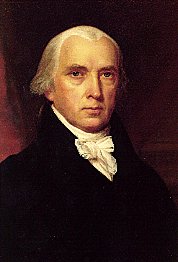
James Madison (1751-1836), seventeen years senior and half-a-head shorter than his wife, had loved his Dolley from the start. Indications are that she many have had less enthusiasm when they married.  But she always claimed that “their hearts understood each other,” and a deep love and bond grew over the years.

jamesmadison2

President Madison was always enormously proud of his wife’s popularity.

The “Great Little Madison” (so-called because of his size and his importance in drafting the Constitution) understood both the nature and the substance of his wife’s talents, and how much they added to his personal happiness as well as to his political life.

He was enormously proud of Dolley’s popularity, and knew he could trust her discretion. For himself, he preferred the “small table” – perhaps a dozen guests, which he felt was more conducive to serious discussion. Dolley, or course, was happiest in a crowd. So they compromised and did both.

Dolley always sat at the head of the table; Madison’s secretary at the foot. This way, President Madison could sit mid-table next to guests of his own choosing, was spared serving obligations, and could concentrate on his conversation.  He relied on his tactful and uber-social wife to keep him apprised of everyone’s welfare, their comings and goings, the births and deaths, sickness and health – those personal (and non-confidential) details that everyone in town always entrusted to Mrs. M.

James Madison reveled in his Dolley and her talents, and beamed at her popularity. His own public image was always moderate at best, but Dolley… she was a star of the first magnitude!

Sources:

Anthony, Carl Sferrazza – First Ladies: The Saga of the Presidents’ Wives and Their Power 1789-1961, 1990, William Morrow

Allgor, Catherine, – Parlor Politics: In Which the Ladies of Washington Help Build a City and a Government, 2000, University of Virginia Press

Foster, Feather Schwartz – The First Ladies: An Intimate Portrait of the Women Who Shaped America – Sourcebooks, 2011

Moore, Virginia – The Madisons: A Biography, 1979, McGraw Hill

http://www.whitehouse.gov/about/first-ladies/dolleymadison


Posted in A POTUS-FLOTUS Blog, James Madison | Tagged , , , , , , , , , , , , , , , , , , , , | Leave a comment

The Stewardship of the Second Mrs. Wilson

“Steward” was the word that Edith Bolling Wilson used to describe herself during the last 18-months of Woodrow Wilson’s presidency, when he suffered a crippling stroke.

Edith Bolling Wilson: A Conspiracy Theory?

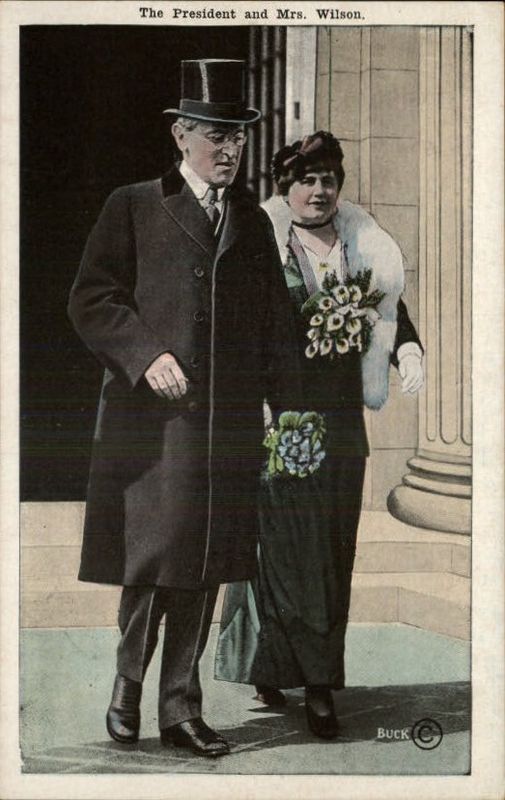
President and Mrs Wilson

The Wilsons, around the time of their marriage in late 1915.

Modern historians, freed by the distance of a century, are poles apart on the subject of the second Mrs. Wilson. Some hail her as “the first woman president.” Others disparage her saying that she took it upon herself to “run the country.”

The middle ground point of view is more inclined to focus on a concerted effort to prevent the extent of the President’s condition from becoming public knowledge.

Edith’s role in the so-called “cover up” was more than political. It was personal. She was still a bride. Woodrow Wilson’s first wife of thirty years had died early in his administration. Eight months later, he met the widowed Edith Galt (1872-1961), and they were married in December, 1915. Less than four years later, Wilson collapsed with a severe stroke.

Edith’s priorities never wavered and were summed up simply: she was married to a sick man who happened to be President of the United States. Her loyalty was to her husband, not to his position as head of state.

With the assistance of Cary Grayson, Wilson’s personal doctor, and Joseph Tumulty, his private secretary, Edith controlled the priorities: Protect Woodrow Wilson from any stress that might exacerbate his condition, or worse, cause another episode.

Woodrow Wilson Has A Stroke

“Recovering” Woodrow Wilson and Dr. Grayson in 1920. (photo via Woodrow Wilson Birthplace, Staunton, VA)

In September, 1919, when Edith heard the thunk in the bathroom, Dr. Grayson was urgently summoned to the President’s room.  He recognized the signs immediately. Specialists were called and they all agreed: Woodrow Wilson (1856-1924) had had a severe stroke – but he would live. They also agreed that Wilson’s mental impairment was recoverable, but it would require several weeks of bed rest.

The public was told that the President was ill and needed rest, but the details were sketchy at best. Vice President Thomas Marshall was not summoned, nor given any authority or responsibilities.

Dr. Grayson’s thinking, generally corroborated by the attending specialists, was that Woodrow Wilson needed to maintain his “aura” of being The President; if that was removed (i.e. divested to the Vice President) he would lose his will to live. That thought became primary in Edith’s mind: her husband must be protected from stress, and he must remain President.

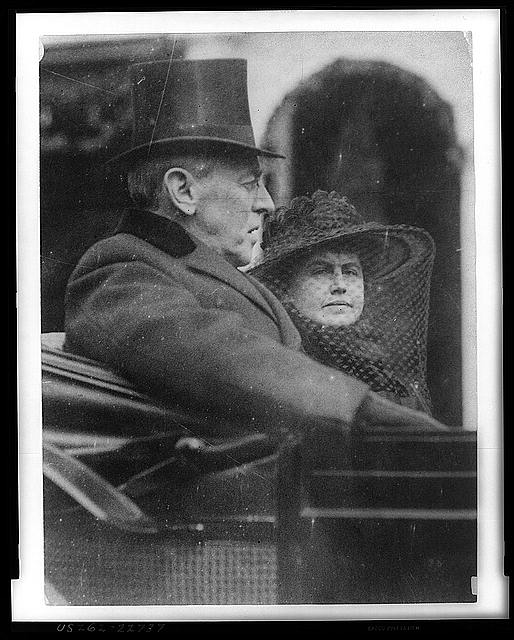
2ndinaug

WWI takes its toll. The Wilsons at the inauguration in March, 1917.

Between Mrs. Wilson, Tumulty and Grayson, who churned out regularly-sweetened reports of the President’s condition, they carefully orchestrated Wilson’s infrequent appearances, once he was permitted to resume some of his duties. The formidable Mrs. Wilson was in constant attendance, often taking notes – at the President’s request, she claimed.

Edith Wilson: Steward or Dragon Lady?

In the memoirs she wrote twenty years later, Edith Wilson insisted that she made no presidential decisions and assumed no government functions. Her only decisive role, she said, was to determine what was to be brought to the President’s attention, and when: a very important decision.

Edith02

Even as an “older” widow, Edith Wilson remained a formidable presence.

Edith Bolling Galt Wilson was an intimidating woman, both physically and in personality. She stood 5’9″ in her stockings, and was the largest First Lady to that time. She was considered “Junoesque” in physique, nose-to-nose to most of the political men she encountered.

It was Mrs. Wilson who summoned them on occasion; it was Mrs. Wilson who received them; it was Mrs. Wilson  who was on hand to change the subject, if she thought it might be upsetting for her husband and it was Mrs. Wilson who let them know when time was up when they visited the President.

Like a fire-breathing dragon protecting his cave, Edith became an obstacle to members of congress, the cabinet, the press and to some extent, the country as a whole. No one got past her, and as time went on, few of her contemporaries liked her.

Truth or Half-Truth?

Frail ex-President Woodrow Wilson. After his stroke, he never walked again without two canes and/or an aide.

The basic truth is that Wilson did recover to a fair extent, although he had some permanent paralysis and would never walk again without two canes.

His mental acumen, while somewhat reduced, was by no means incompetent. He could read and understand; his memory, while somewhat impaired, was still primarily sound. He was still, for the most part, running the show – whatever show that was.

What was impaired, was his emotional health, his personality, his disposition, and to a fair extent, his judgment. This is a common phenomenon with stroke victims. He cried easily. His fixation on the League of Nations, the key point to the Treaty that concluded World War I, amounted to intransigence. Always flinty with his peers, he became flintier and paranoid, accusing anyone who disagreed with him to be “treacherous.”  The one time Edith suggested that he might compromise, he looked at her piteously saying, “Don’t you turn on me, too.”  She was devastated and never did it again.

Today the Vice President would be summoned at once, and would assume presidential responsibilities. In 1919, however, there was no real constitutional mechanism for a Vice President to assume responsibilities for an incapacitated President. Vice President Marshall cringed at the thought. The status quo needed to be maintained.

Was Edith “running the country” as many people claimed? Had she “become the President?” These are hostile remarks, never said with admiration, let alone any appreciation. Those who knew her at that time grew to dislike her intensely, as do many modern historians. The perception was that she prevented  access to the President. She was the gate-keeper. The dragon protecting the cave.

She alienated most of those associated with the Wilson era, and when several of them wrote their own books, she believed she was treated badly or unfairly.  She wrote her memoirs to present her “side” of the story, which, as might be expected, was skewed to her own advantage.

The only thing to her benefit, was the fact that she lived to be nearly ninety, and outlived all the “Wilsonians,” thus having the final say in the matter.

Sources:

  • Levin, Phyllis Lee – Edith and Woodrow – 2001, Lisa Drew Book
  • Miller, Kristie – Ellen and Edith – 2010, University Press of Kansas
  • Schachtman, Tom – Edith and Woodrow – 1981, GP Putnam’s Sons
  • Weinstein, Edward A. – Woodrow Wilson: A Medical and Psychological Biography – 1981, Princeton University Press
  • Wilson, Edith Bolling – My Memoir – 1939, Bobbs Merrill
Posted in A POTUS-FLOTUS Blog, Woodrow Wilson | Tagged , , , , , , , , , , , , , , , , , , , , , , , , , | Leave a comment

Lincoln and the Jews: A Book Review

The Book.

Lincoln and the Jews, by Jonathan D. Sarna and Benjamin Shapell, is an important book on many levels. First, it is a beautiful book, and very very classy. The illustrations, while not rivaling Michelangelo, are copies of historical ephemera: letters, photographs, newspaper articles and related items. Many are priceless because they are written in Abraham Lincoln’s own hand. The others are important because they are personal connections to Abraham Lincoln.

While much of the illustrated ephemera comes from the Library of Congress or similar Lincoln archives, the bulk of it is from the world-renowned private collection of Benjamin Shapell, lovingly assembled, preserved, protected, and now available to all.

It is not leather-bound and gold-tooled, but it is a book that looks wonderful on the coffee table or the shelf. Or read in entirety. The publishers should be proud.

The Great Man

Then of course, as the title suggests, the book concerns Abraham Lincoln, and is an essential to any and all interested parties, scholars, and collectors of Lincolniana. During the last century and a half, practically everything of even remote interest and connection to Lincoln has been assiduously ferreted out, documented, protected, described and fit to belong to the ages. That new, undiscovered, or hidden-away-for-a-century material has surfaced (or resurfaced) makes Lincoln and the Jews a great and rare treasure. It opens up a hitherto unknown, or under-known aspect of the sixteenth president.

The Jews

Then there is the Jewish connection. Even rarer.

There are no surprises here regarding Abraham Lincoln’s attitudes or treatment toward the handful of Jewish people whose paths he crossed during his adult life. (It is surmised that in his “annals of the poor” upbringing, he had no early Jewish acquaintances.)

By Lincoln’s election in 1860, there were perhaps 150,000 Jewish people in the United States, scattered throughout the country, mostly in pockets of urban areas. It is undeniable that anti-Semitic attitudes permeated, as they always did and do, creating some of the clannish and insular connotations that fed the anti-Semitism. After all, 1860 still acknowledged the pervasive “Know-Nothing” nativism of the previous decade, and some of the “best people,” the people of importance, of prominence, of wealth and power unabashedly held those negative attitudes.

But not Lincoln. Even if this book had no documentation of his ecumenical attitudes toward his Jewish acquaintances, everything we know about him suggests open, fair, respectful and kindly behavior toward all with whom he came in contact, regardless of race, religion, nationality or circumstance. Frederick Douglass, who met Lincoln on a few occasions, remarked that he never felt any distinction because of his color. It is likely that Lincoln’s Jewish connections felt similarly. In other words, Lincoln was a mensch. A human being. No surprise here.

The two important and well-known connections between Lincoln and the Jews, were not  about individual people, but had farther-reaching connotations. He supported appointing Jewish chaplains in the Union army. Where there had been none, by the end of the Civil War, there were fifty. Then there was rescinding Grant’s infamous General Order #11, the expulsion of Jewish sutlers from his army, a sad blot on the Grant escutcheon. Lincoln did not wish to have a whole class or nationality condemned “because of a few sinners.”

What is a semi-surprise, is the number of Jews who rippled around the sixteenth president’s life. There is a wonderful graphic illustration in the front of the book, suggesting just such a ripple effect of the Jews in Lincoln’s circle. A few were long-time acquaintances. By Lincoln’s own words, at least one was a “valued friend.” Abraham Jonas shared a first name, and knew Lincoln since his early days in Springfield. He rode the court circuit with him; he likely broke bread with him during those weeks away from home. He was one of the first who promoted and supported him for President. Lincoln knew the Jonas family, and a half-century later, one of their sons recalled having the martyred President pat his head or tousle his hair. Such was the importance of the remembered link.

And such was the importance of any link, that well into the twentieth century, Jews who were young children with no personal memory of Lincoln, treasured those mementos of their family’s connection – no matter how slight or remote.

The Religious Link

Lincoln was never formally associated with any particular denomination, nor did he join any specific church, although his wife Mary, a lifelong Presbyterian, attended regular services. He occasionally went with her.

This lack of church-going formality does not make a person a non-believer. Lincoln had a deep reverence for God, and was surprisingly knowledgeable in the Scriptures. Mostly Old Testament. In a detailed study of all Lincoln’s scriptural quotes, Old vs. New Testament, the Old predominates.

Judaism has always been perceived as a “questioning” rather than blindly dogmatic faith. In the Jewish religion, questioning is not only permitted, it is usually encouraged. It makes for more conceptual, and hopefully wiser, thinking. Lincoln was undeniably self-educated, and a deeply conceptual thinker. It would not be unreasonable to ponder how much that concept of “questioning” appealed to him, or if he recognized that aspect in the few Jewish people of his closer acquaintance.

The Importance of Lincoln and the Jews

Historians and lay folk can debate the importance of this book forever; some may consider it insignificant or arcane, in that it deals with a minuscule percentage of the population, and not especially mistreated. Black slaves numbered in the millions, and their needs were far greater than the American Jews of 1860.

But even after more than 150 years of space-time, and in an age where esteem has become an endangered species, Lincoln and the Jews is important because of the enormity of respect given to all involved.

Throughout Jewish history, it has always been the wise man who is revered by the community, and in American history, there are few men who consistently displayed such depth of wisdom as Abraham Lincoln. The great respect for this wisdom is pervasive throughout Lincoln and the Jews, and does credit to its author and collector.

Lincoln and the Jews

Sarna, Jonathan D. and Shapell, Benjamin

Thomas Dunne/St. Martin’s Press, 2015

ISBN978-1-250-05953-6

Posted in A POTUS-FLOTUS Blog, Recommended Reading | Tagged , , , , , , , , , | 3 Comments

McKinley and Bryan: The First Battle of the Bills,1896

William McKinley, long time Congressman and former Ohio Governor, was the odds-on favorite Republican candidate for president in 1896.

McKinley: Bill the First

[Wm. McKinley]

William McKinley, a kindly and conservative Republican candidate.

William McKinley (1843-1901) was a sweetheart of a fellow. An Ohioan of a poor, hardworking family, he enlisted in the Civil War as an eighteen-year-old private, and remained for the full four years, eventually becoming a major.  According to the tenets of his deep Methodist faith, he didn’t smoke, drink, swear, play cards, dance, gamble or chase women. Nevertheless, he was immensely popular with his comrades, and would have hundreds of friends during his lifetime.

His commanding officer, and long-time mentor, was Brig. General Rutherford B. Hayes, who took a liking to this clean-living young man, and encouraged him to study law. Once the war ended, McKinley followed his mentor’s advice, moved to Canton, Ohio, opened a law practice, joined every organization in town, and married the daughter of the local banker.

He was elected to Congress in 1876, when he was thirty-three, and served for seven terms, becoming a leading expert in tariffs and all things money-ish. He mellowed somewhat, and managed to pick up a few vices of camaraderie, in particular cigar smoking, a nip of whiskey or brandy on occasion, and playing benign card games – for points, not money. He also was extremely popular among his peers. It is said that they usually apologized first before arguing with his remarks on the Congressional floor.

Bryan: Bill the Second

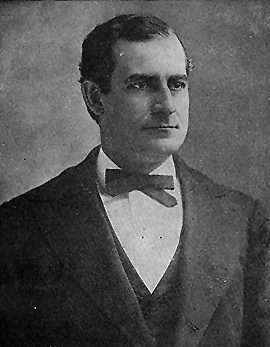
William Jennings Bryan, young and dynamic and a Democrat.

Devout Presbyterian William Jennings Bryan (1860-1925) was almost young enough to be McKinley’s son. A middle class midwesterner, Bryan came of age in the post-Civil War era, when the “grange” movement began to peak. Farmers were in despair about high prices, usually due to tariffs, a very complicated and excruciatingly boring subject.

Bryan became a lawyer, located himself in Nebraska, and identified himself firmly with the nascent “populist” movement, which was associated with the “Free Silver” movement. They espoused free coinage of silver to make more money available, particularly to the farmers who needed it. This was seen as inflationary and a severe threat to the American economy, mostly by the Eastern money-men who knew about such things. To further clinch his rural-religious and we-the-people credentials, he was an ardent prohibitionist, never drinking anything stronger than root-beer.

The Power of Oratory

During the 19th Century, one key to political success was oratory. Early Presidents, i.e. Washington, Adams, Jefferson and Madison, had mediocre powers of speech-making. Even Lincoln was said to be only middling as a public speaker.

But in those days before radio and television enabled a candidate to come into the living room of John Q. Public, political speech making was as popular a civic event as a sporting match. People came in droves to hear a good stump and thump.

McKinley was fair in that department, but William Jennings Bryan was the master of his voice. A good sized, barrel-chested and handsome man, he could be easily heard, even in a large venue. He had the flair of the dramatic.  He understood the power of the raised brow, the pregnant pause, the modulation between thunder and a near-whisper.

And it was this power that catapulted him to prominence in 1896.

The Democratic Candidate

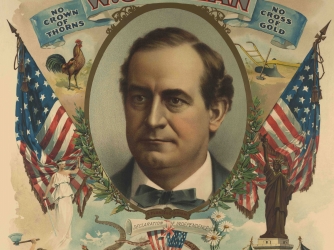
Color lithography had become affordable and popular. Both candidates made good use of their images.

Bryan had served for two terms as an unremarkable Congressman. He ran for the Senate in 1894, and lost. He published a Nebraska newspaper and supported the Democratic, Free Silver, Prohibition and Populist causes.

In 1896, he was asked to make a speech at the Democratic Convention endorsing the free coinage of silver. He made history, instead. His “Cross of Gold” speech was one of the most mesmerizing pieces of oratory ever delivered at that time, and he swept the entire convention into a frenzy of support. He may (or may not) have given a thought to being its candidate, but the man, the speech and the moment had come together.

He would be the youngest presidential candidate of a major party. Ever. He was thirty-six.

The Battle of 1896

Many historians claim that the election of 1896 was the first “modern” presidential election. Indeed it had many elements that are still important today. The difference between “the Bills” was not merely a difference in political philosophies or agendas (which it was, of course), but it was also a difference between energy and money.

The color celluloid campaign button first made its appearance in 1896, and has proliferated ever since.

Bryan, young and aggressive, had a youthful vitality and energy that predated a young Theodore Roosevelt. He gave new meaning to the word “campaigning.” Prior to this time, it was unseemly for a candidate to actively seek office. “Standing” for election, rather than “running” for it, was the accepted way. Bryan ran. He traveled the entire country, happy to give his Cross of Gold (or other) speech to anyone who would listen. And everybody was listening to this “Silver-Tongued Orator of the Platte” as they called him.

Bryan’s “Democratic platform,” as it were, was considered radical for the time, yet today, many of the progressive reforms he espoused have long been a part of everyday society: woman suffrage, minimum wage, an income tax, labor arbitration and only two terms for a President.  McKinley’s “platform” was more subdued and devoted to the long recognized continuation of sensibly-tried-and-true.

McKinley and his running mate, Garret Hobart. Every club and organization produced its own campaign buttons.

But while Bryan criss-crossed the country at a frenetic pace, McKinley, partially in deference to his semi-invalid wife, chose to remain in Canton, Ohio, and let visitors come to him. They did. In droves. Meanwhile, his long-time closest friend, Marcus A. Hanna, one of the wealthiest industrialists in Ohio, was delighted to spend a good part of his vast fortune “advertising” McKinley. There had been campaign “souvenirs” before; handbills, scarves, parade banners and songs. But now there were color photographs, colored posters plastered on barn walls, trinkets, cigar silks, and the very latest gimmick: celluloid buttons with the candidate’s photo on it! Things that we recognize today as “premiums” were disseminated with abandon. They were immensely popular, and became a instant component of modern political campaigning.

Money talked. It talked louder and clearer than William Jennings Bryan the orator. McKinley won easily.

But the Battle of the Bills had only just begun.

Sources:

http://www.ushistory.org/us/41e.asp

Leech, Margaret, In the Days of McKinley – Harper & Brothers, 1959

Morgan, H. Wayne – McKinley and His America – Syracuse University Press, 1964

Prescott, Lawrence J. – The Great Campaign of 1896 – Loyal Publishing Col., 1896


Posted in A POTUS-FLOTUS Blog, Nifty History People, William McKinley | Tagged , , , , , , , , , , , , , , , , , | Leave a comment

Ulysses S. Grant: The Locket Story

  When Ulysses S. Grant met Julia Dent, it was love at first sight.

Grant Meets Dent

Young Lt. Ulysses S. Grant (1822-1885), recently graduated from West Point, was a frequent guest at the Dent home for several weeks before he met their eldest daughter.

Grant had been the academy roommate of Fred Dent. When they graduated, young Dent encouraged Grant, about to be deployed to Jefferson Barracks in St. Louis (a popular first assignment for young officers) to call on his family. He assured his pal that he would be welcome.

Once situated at Jefferson Barracks, Lt. Grant duly rode out to White Haven, the Dents’ modest plantation, where Col. and Mrs. Dent embraced him warmly, and told him “not to be a stranger.” Lt. Grant began coming for Sunday dinners. The Dents were a tight-knit and outgoing family, something totally new for Grant, whose own family had a peculiar dynamic: half boisterous, half silent.

Wedding photo of Grant

Perhaps the earliest photograph taken of Ulysses S. Grant, taken after he had graduated from West Point.

Some weeks later, Julia Dent graduated from her St. Louis boarding school and returned home. She finally met her brother’s friend.

Julia was not a particularly pretty young woman. Nor classically educated. Nor witty or talented. But the attraction between her and Grant was apparent from the start. They could talk to each other with complete openness and understanding. Some would call it a simpatico. Some would say soul-mate. Grant began coming to White Haven several times a week.

The Secret Engagement

A few months later, Grant was re-deployed, and found himself uncharacteristically depressed. When he began to think about the reasons for his despondency, he realized that he did not want to leave Julia. He had fallen in love.

He proposed to her, but Julia was hesitant. It was not that she didn’t love Grant. She did. But she knew that her parents, who were fond of the young man as their son’s buddy, would not approve of him as a son-in-law. First off, they were both too young. Julia had just turned eighteen; Grant was only twenty-one. And secondly, Second Lieutenants in the Army were paid meagerly.  The Dents wanted their daughter to enjoy the luxuries of life.

Ulysses Grant could not counter those valid arguments. They were too young; his earning power was small. But they decided to become engaged, and at her insistence, it was a secret engagement. Grant agreed, and offered to give her his West Point ring. Julia again hesitated to accept the ring at that time, so Grant gave her his photograph.

Julia offered the common-for-the-time lady’s love token: a lock of her hair.

Grant encased it in a locket and wore it on a silver chain around his neck.

The Grant Marriage

Grant wore that locket for four years, during which time he saw Julia only once, and for a brief time, but after his service in the War with Mexico, he returned to St. Louis to collect his bride. This time, the young man who rode up the path to White Haven was a tanned, tough twenty-six year old Captain. Old enough to marry. Julia was twenty-two. Old enough to marry.

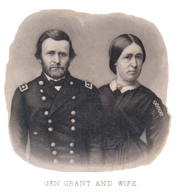
Grant and Wife

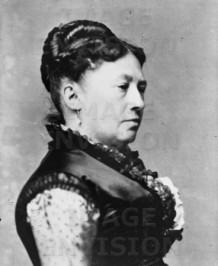
Very few photographs were taken of Julia Grant. Her “wandering” eye problem made her sensitive to the camera.

If they had any trepidations about their love “lasting” through the long separation, it was dispelled very quickly. Whatever feeling they had; whatever bond was between them, their emotions remained strong and true, including the strength of character and unswerving loyalty essential to both of them.

The Dents could find no objections to the marriage, and Ulysses and Julia married in 1848.

They had good times and bad, some wonderfully good, and some horribly bad. But they rode the years through together and inseparably. They had four children, and seldom if ever, had a serious quarrel. He was, according to the Victorian expression, “her all.” And she was his Rock of Gibraltar.

The Ups and Downs of the Grant Marriage

The bad times of the Grant marriage occurred in the early years, when the loneliness of military separation resulted in Grant’s battle of the bottle. After resigning from the army in disgrace, he spent the better part of ten years floundering – with no real vocation or motivation. Or money. Julia Grant (1822-1901) never wavered or complained.

Julia rt. profile

Mrs. Grant usually posed for the camera in profile. This is the photograph usually used from her terms as First Lady.

Grant as President

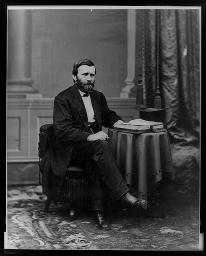
General Grant, and later President Grant, was photographed many times.

The good times that followed were phenomenal: The premier Union General during the Civil War, the Hero of Appomattox, and finally, a two-term President of the United States. That was followed by a stupendous trip around the world, feted and fed by monarchs who fell all over themselves hosting the most famous man in the world. Julia Grant was delighted by the attention.

Then came the opportunity to partner in an investment company. Grant had no knowledge or experience in investments, but those matters were to be handled by his partner, Ferdinand Ward. It started out brilliantly. Grant became a rich man.

Then came more bad times. Really bad times. Ward was a scoundrel, and the investment brokerage imploded, with General Grant holding the proverbial bag of debts that he insisted would be repaid. If that wasn’t bad enough, he was also diagnosed with inoperable cancer of the throat.

The Death of General Grant

Grant’s wife and children were all with him during his final days. It was a very close family unit.

In a great effort to repay the brokerage debts, provide for his family, and maintain his good name, the dying man wrote his Civil War memoirs, which would be the family salvation.

For the last weeks of his life, during the summer of 1885, he was taken to Mt. McGregor, not far from Saratoga Springs in New York, where it was believed the cooler mountain air might bring him some comfort from his excruciating pain. His family rallied around him, and Julia was never out of earshot.

Only a week after Grant completed the final galley corrections, he died.   Undertakers were called in to prepare his body for the immense funeral and procession that would take place.  It is said that when they undressed him, he was still wearing the silver chain and locket containing Julia’s hair. He had never taken it off.

Sources:

Flood, Charles Bracelen – Grant’s Final Victory:  Ulysses S. Grant’s Heroic Last Year – 2012, DaCapo Press

Goldhurst, Richard – Many Are the Hearts – 1975, Reader’s Digest Press

Grant, Julia – The Personal Memoirs of Julia Dent Grant, G.P. Putnam’s, 1975

http://www.smithsonianmag.com/history/general-grant-in-love-and-war-94609512/

Posted in A POTUS-FLOTUS Blog, American Civil War, Ulysses S. Grant | Tagged , , , , , , , , , , , , , , , , , , , , , , , , , | 2 Comments