Thomas Jefferson and the Tripoli Pirates: A Book Review

TJ and Tripoli

Thomas Jefferson and the Tripoli Pirates, the new best seller by Brian Kilmeade and Don Yaeger.

Thomas Jefferson and the Tripoli Pirates has been sitting on the Best Seller list for several weeks now, and hooray! It does exactly what it wants to accomplish: interest the reader in an informative-but-not-didactic manner, and prove the point that “the more things change, the more they remain the same.” Or, if you will, the old axiom that history repeats itself.

According to the authors, Brian Kilmeade and Don Yaeger, (and this is perhaps the most important crux of the book) piracy along the Barbary Coast (i.e. Morocco, Tunis, Algiers and Tripoli, or modern-day Libya) has been going on for centuries. In fact, when John Adams and Thomas Jefferson were European diplomats, representing the Articles-of-Confederated United States, in the mid-1780s, such piracy had already been going on for centuries. Pirates cruised the Mediterranean preying upon merchant ships or other vessels that did not belong to them, and exacting “tribute,” or, calling it by its rightful name, “extortion.” To wit: pay us for not beating you up.

Both Adams and Jefferson were seriously involved in efforts to safeguard American ships from these predators. Both were men of the Age of Reason, and both were essentially men of good will: dedicated to resolving problems to the general satisfaction of all parties, with no real inclination for personal glory.  Adams, crustier than most, was also a basic Puritan. He believed that Mahometans, or Musselmen, which is what people were calling followers of Islam in those days, were people of the Book – or some Book at any rate, and could be reasoned with. Besides, he believed that engaging in any war with Islam would be costly and perhaps unwinnable.  He made a strong point. Jefferson, who had actually purchased a copy of the Koran years earlier, had his doubts. When their genial, but somewhat smarmy Barbary coast diplomatic counterpart met with the Americans, he indicated that their Holy Book countenanced killing the infidels in order to get an express ticket to Paradise. Mr. J., the cool deist, decided then and there that “reason” was not viable when dealing with religious fanatics.  Another strong point.

Nevertheless, paying off the Barbary pirates became policy for the new United States. We were poor and needed the trade. We also did not have the military might to put an end to it. Other countries like England and France had been paying off for years.  Sort of a pesty situation – and we had far more important issues to deal with.

But since the authors are writing adventure history rather than pure philosophical history  (not to mention the authors’ eye on Hollywood), fast forward to the Jefferson Administration. We were building a Navy, and had already been training an elite Marine Corps. The “millions for defense” was starting to become more important than the “one cent for tribute,” especially since the “tribute” was bleeding us dry. Besides, the piracy was not ending. And these were not merely renegade bandits; this was criminal mayhem, state-sponsored by various beys, deys, bashaws and pashas, the various chieftain-style leaders along the North African coast. And, to complicate the already complicated situation, these beys, deys, bashaws and pashas did not always get along with each other (what a surprise!).

Meanwhile, our ships, merchant and otherwise, were still being plundered and captured, and our sailors and merchantmen were still being enslaved at hard labor, or left to rot and die in North African fortress-prisons. President Jefferson, who was a very unwarlike man, had had enough. Like it or not, he would hold his nose, and deal with the situation once and for all. Giving his underlings a “take care of it” blank check of sorts, in goes the Navy, in go the new ships, including the Constitution, which later became Old Ironsides, and in go the Marines. All twelve of them.

The authors grab the reader’s interest from the start, and make an actual historic event into the adventure story it truly was. It combines diplomacy (sort of), playing one side against another (sort of), ships with sails happy to hoist false colors (not unheard of), consuls, captains and generals working together (sometimes) and at odds (what else is new?), and some fine, brave Americans who were willing to defend the right of free trade. And oh yes, there was that long, hard trek across the desert, with a handful of trained American soldiers trying to help reclaim a previously-usurped bashawship with unruly sub-armies of divergent characters, methods, and reasons for going in the first place.

It is all done with a minimum of notes and citations and the usual i-dotting that one now expects from history and produces little more than zzz’s. Bravo to the authors for putting the “story” back in “history.” Thank you.

Thomas Jefferson and the Tripoli Pirates

by Brian Kilmeade and Don Yaeger

Sentinel Publishing, 2015

  • ISBN-10: 1591848067
  • ISBN-13: 978-1591848066


Posted in Recommended Reading | Tagged , , , , , , , , , , | 6 Comments

Abigail Fillmore and the White House Library

Abigail Fillmore is one of those early First Ladies who has faded into oblivion. She needs to be re-explored.

Miss Powers, Teacher

Abigail Powers (1798-1852) was only two when her father died. She later claimed to have inherited two important things from the father she never knew: his love of reading, and his vast (for upstate New York in 1800) library.

AbigailFillmore

One of the rare etchings of Abigail Powers Fillmore, wife of the 13th President.

By the time she was sixteen, she was the local “school marm,” credited as being the first First Lady to work outside the home.

One of the few stories known about Abigail Fillmore, was that she taught Millard Fillmore, (1800-1874) a husky farm boy her own age who wanted to learn. The usual image is of a young woman teaching a big fellow his A-B-C’s.

Yes, but not quite. Millard Fillmore knew his letters and numbers and basics, but his education fell far short of his ambition: not being a farm boy. A neighbor offered him a chance to read law, a then-acceptable means to become an attorney – but only if young Fillmore could improve his basic education. Friends suggested that Miss Powers, the local teacher, might tutor him.

Abigail was happy to oblige, and in the process, the farm boy and the school marm fell in love. It would be a long courtship, while Fillmore continued his education, and his fiancee continued to educate others.

Some years later, when Fillmore passed the New York bar the couple married and began their life together.

Abigail Fillmore: Wife, Mother, Librarian

Once Abigail Fillmore was a lawyer’s wife and mother of two she “retired” from teaching, since Millard Fillmore could support his family very nicely. He was not only a practicing lawyer, but eventually was elected to Congress as a Whig.

fillmore

Millard Fillmore, Congressman, Vice President and 13th President. He was considered a handsome man.

Once her children were school-aged, Abigail had some time on her hands, and needed an outlet for her energies and intellect. The Buffalo suburb of Aurora, New York, where the Fillmores made their home, had grown sufficiently to begin its own lending library, and Mrs. Fillmore became one of its earliest supporters.

Some of the extant letters between Abigail and Millard Fillmore contain lists of books she wished for him to purchase for the library. En route to Washington, Congressman Fillmore had to pass through New York City and Philadelphia, where book stores were numerous.

Congressman and VP Fillmore and Family

Millard Fillmore’s career was somewhat spotty. He won some elections and lost some elections; his law practice was mediocre. Certainly nothing to make him any more than middle-class, and certainly nothing to qualify him for his future role.

fillmorehouse

The restored home of Millard and Abigail Fillmore, now a Presidential site outside of Buffalo, NY.

Abigail had spent some time with him in Washington – and did not like it. She missed her children (still in school), her six-room house (boarding in Washington was cramped) and her activities in Aurora. She also came to dislike social Washington. She was a bookish woman, and believed the women she met were superficial.

The Unexpected POTUS & FLOTUS

No one ever expected Millard Fillmore to be elected Vice President in 1848, let alone President. He was barely known outside of upstate New York and in small Washington circles. He had never made a big impression, and was certainly not anyone’s idea of a presidential candidate. To balance the Whig ticket, the politicians needed not only an Easterner, but a Northerner, since General Zachary Taylor, the hero-of-the-day, was Virginia born, everywhere-bred, and currently a Louisiana resident.

Fillmore’s views on slavery, which was quickly moving to the top of the political hot-potato list, were moderate. This meant he would be acceptable in the South.

The Whigs were successful. Millard Fillmore was now Vice President.

No one ever expected President Zachary Taylor to die a year and a half into his term either. But he did. Mediocre Millard Fillmore was now President. Middle-class teacher-librarian Abigail Fillmore was now First Lady – a position she did not relish at all.

fillmoredaughter

Mary Abigail Fillmore was around twenty when her parents were in the White House. She helped host their social duties.

The thought of receiving lines and entertaining the “superficial” women she thoroughly disdained was unappealing. Several months earlier, she had broken her ankle. It had been a bad break, poorly set and poorly healed. It gave her chronic discomfort, plus a ready (and acceptable) excuse to avoid the receptions; she was happy to dispatch her now twenty-year-old daughter as a willing and able substitute.

But when they moved into the White House, Abigail Fillmore discovered there wasn’t a book in the entire place – not even a Bible. For a studious and scholarly woman by nature, this was unacceptable. She asked her husband to lobby Congress to provide funds for a permanent White House library – a place where the President, the Presidential family, and Presidential secretaries and aides could research whatever information they required – or even find an hour’s respite from their daily duties.

Fillmore obliged. Congress, as is their wont and privilege, dickered and dithered. Fillmore was not the most popular fellow ever elected. A “generous” budget for books was duly whittled down to a modest sum of around $500 (depending on which source you espouse).

But it was the great contribution of the Fillmore Administration, and certainly the most lasting. First Lady Abigail F. was well qualified to manage the appropriation, select the books to be purchased, and to handle them with care and diligence. She arranged for the White House maintenance carpenters to build bookshelves, and prepared long lists of requested volumes.

One could easily picture the former teacher-librarian spending many happy hours when her requests were delivered, unpacking the books, organizing and cataloging them properly and placing them on the shelves. It was the job she was meant to do.

Sources:

Anthony, Carl Sferrazza –First Ladies 1789-1961, William Morrow,1990

Caroli, Betty Boyd – First Ladies – Oxford University Press, 1995

https://www.whitehouse.gov/1600/first-ladies/abigailfillmore

http://www.firstladies.org/biographies/firstladies.aspx?biography=14


Posted in A POTUS-FLOTUS Blog, Millard Fillmore | Tagged , , , , , , , , , , , , , , , , , | 3 Comments

TR and the White House Gang

When Theodore Roosevelt became President in 1901, he brought his wife and six kids – the largest group of youngsters in the White House.

The Young Roosevelts

1903 --- A portrait of Theodore Roosevelt (1858-1919) with his family in 1903, prior to his election to President in 1904. His oldest daughter Alice stands at the rear. He is serving out the term of his predecessor, William McKinley, assassinated in 1901. Roosevelt's most durable achievments include reform of trusts, clean food, and the national park system. --- Image by © CORBIS

Theodore Roosevelt had the largest family living in the White House. (l. to r.: Ethel, TR, Ted, Archie, Alice, Kermit, Edith and Quentin.

At 42, Theodore Roosevelt was our youngest president, and not surprisingly, his family was filled with youngsters. Alice, at seventeen, would become an immediate hit: pretty, and totally outrageous. Ted, at fourteen and Kermit, at twelve, were away at prep school most of the time. Ethel, at ten, was in a local school in Washington.

That left Archie and Quentin, seven and three respectively, when their father came to the White House. Smart, impish and full of the rambunctious exuberance associated with Rooseveltian activity, once they started school, they became the leaders of a select group of local boys whose antics in and out of the White House actually made the newspapers – sometimes. They were dubbed “The White House Gang.”

Archie_Roosevelt_poses_with_Algonquin_1902

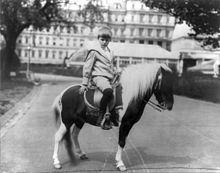
Archie Roosevelt and Algonquin, one of the Roosevelts’ numerous pets.

If Archie and Quentin were the gang-leaders, the Supreme Commander, albeit honorary, was the President of the United States himself, who, as his wife Edith frequently remarked, “was her seventh, and oldest, child.” Edith Roosevelt, while technically not a member of the gang, was more like a participating den mother. She was so enthusiastic and involved, that little Archie once remarked, “When Mother was a little girl she must have been a little boy.”

Gangster Activities

littlequentin

Quentin was three when he began living in the White House. He was an immediate hit.

The activities of the White House Gang ran the gamut of sublime to ridiculous – and always noisy. They plotted obstacle courses in the corridors, played hide-and-seek wherever they wanted, created a baseball diamond on the grounds (without permission!) and even threw spitballs at some of the presidential portraits. They “borrowed” trays from the kitchen, and sledded down the backstairs. Nothing was sacred. When Quentin was sick with measles, Archie smuggled Algonquin, his pony, upstairs in the White House elevator to cheer up his ailing brother.

The gang teased White House staff, visitors and diplomats, and was even said to throw snowballs from the White House roof – until forbidden by the Supreme Commander.

Time, visitors, and even the august stature of their father’s position was meaningless to the pint-sized purveyors of mayhem. In fact, TR was almost as enthusiastic a participant as the rest of the gang.

gangsters

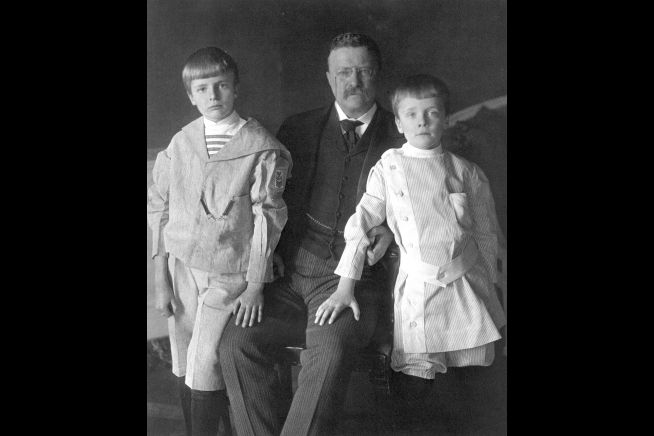
No President enjoyed romping with his family more than Theodore Roosevelt. Pictured here with Archie and Quentin.

Once, when the POTUS was in his office discussing matters of state with an important visitor, Quentin appeared and announced, “It’s four o’clock, Father.” TR checked his watch and said, “So it is.” Then he promptly terminated his meeting saying, “I promised the boys I would play with them at four o’clock…and you know you must not keep a small boy waiting.”

The Later Gang

Theodore Roosevelt was President for seven and a half years, and kids, as kids do, got older, went to school and began to mature, at least somewhat. The “Gang” however, continued, albeit sporadically once schooling got underway, and time was needed for study. Some gangsters moved away, others were added, like Charlie Taft, when his father, William Howard Taft became TR’s Secretary of War. Charlie and Quentin were the same age, and became boon companions.

One “gangster” who remained throughout was Earle Looker, a Washingtonian who became a well-known journalist and wrote a book called The White House Gang, recalling his youthful glimpse into an extraordinary opportunity. His memories added to the overall perspective of all the Roosevelts from the eyes of a child – eyes that seldom deceive. What is particularly refreshing is his observations about the closeness of parent-to-child, and in this case, parents-to-children. Theodore and Edith were always active and engaged parents. The family always came first.

The “gangsters” stayed in touch, some more closely than others, as they grew up to follow their individual paths.

Quentin Roosevelt, who most resembled his father in looks, build, exuberance, leadership qualities, varied interests and general intellect, had a talent all his own: mechanics. Growing up in the Age of the Airplane, he wanted to be an aerospace engineer. WWI interfered.

quentin

Quentin Roosevelt enlisted in the French Air Force even before the US entered World War I.

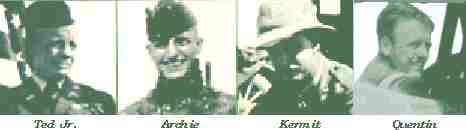
All four Roosevelt sons, including Quentin, volunteered well before the U.S. became involved. Kermit joined the British Army in the Middle East. Ted and Archie were severely wounded, and their recoveries would take months before they were up and around. “Q”, as his gang called him, joined a French squadron, looping-the-loop in little more than a box kite with a motor. He was shot down and killed. He was only twenty.

Still Later

TRkidsWW1

All four of TR’s sons served in World War I. Ted and Archie were severely wounded. Quentin was killed in action.

Quentin’s death devastated the family, particularly the former President and the Gang’s Supreme Commander. TR died at sixty, only a few months after learning that his youngest son had been killed.

There was a natural outpouring of sympathy when the news of Quentin’s death was made public, to include the now-adult members of the White House Gang. Edith Roosevelt cherished the letters she received from some of the young men who had been little guys, racing through the White House hallways, waylaying the most important people in the country.

According to Earle Looker, some of the Gang stayed in touch with their den mother for the rest of her long life. She lived to be eighty-seven.

Sources:

Bishop, Chip – Quentin & Flora: A Roosevelt and a Vanderbilt in Love during the Great War – CreateSpace, April, 2014

Hagedorn, Hermann – The Roosevelt Family of Sagamore Hill – Macmillan, 1954

Looker, Earle – The White House Gang – Amereon Ltd., 1940

http://www.theodorerooseveltcenter.org/Learn-About-TR/TR-Encyclopedia/Family-and-Friends/White-House-Gang.aspx

Posted in A POTUS-FLOTUS Blog, Nifty History People, Theodore Roosevelt | Tagged , , , , , , , , , , , , , , , , , , , , | 3 Comments

Mary Lincoln’s Old Clothes

The close but unlikely friendship between Mary Lincoln and Elizabeth Keckley would be permanently shattered by what Mrs. Lincoln would consider a gross betrayal. It was not intended as such.

Mrs. Lincoln’s Debts

When Mary Lincoln was First Lady, merchants in New York and Philadelphia were delighted to grant her unlimited credit. She ran up huge bills that her husband knew nothing about.

inaugural gown

Mary Lincoln wanted to be the great setter-of-styles as First Lady. She purchased a large and expensive wardrobe.

Once Abraham Lincoln was dead, however, the merchants had no reason to court his widow. They began dunning her for payment. Mary confessed to Elizabeth Keckley, her mulatto dressmaker and close confidante, that she believed she owed about $38,000 – an enormous sum. Modern historians have tried, but have never been able to make an exact calculation. Historian Jean Baker surmises the debts were more like $10,000 – still an enormous sum. In Lincoln’s best financial year in Springfield, he only earned $6,000.

Lincoln had died without a will. It would take more than two years to settle his estate, and even then, it was divided equally between Mary, his widow, and his two sons: Robert and Tad, a minor.

deathbed

When Lincoln died, he died intestate. His estate was tied up for two years, and his widow would be consumed with fear about money for the rest of her life.

Congress had been miserly with the Widow Lincoln. There was no such thing as a Presidential Widow’s pension. They gave her the balance of Lincoln’s one-year salary of $25,000. That is what they had given the widow of William Henry Harrison, and that was a quarter-century earlier.

Congress as a whole did not like Mrs. Lincoln. They believed she was extravagant (probably very true), and some still believed she was a Confederate sympathizer (not true).

Meanwhile Mary was panicked by her mountain of debt, compounded by her need to keep it as private as possible.

Keckley

Elizabeth Keckley was a Washington modiste, who became not only dressmaker to Mrs. Lincoln, but her closest friend and confidante.

Mary had prevailed upon Elizabeth Keckley to accompany her and her children back to Chicago. “Lizzie” stayed for about six weeks, and later claimed that “listening to Mrs. Lincoln sob for three months was about as much as she could stand.” More importantly, the former First Lady could no longer pay Mrs. Keckley, and the dressmaker was neglecting her own business. Mary was very generous in her promises, and sincere in her willingness to repay Mrs. K. She would be happy to share whatever pension or contributions Congress or the rich Republicans would give her, but they were not giving her anything. Meanwhile Lizzie was just as broke as Mary Lincoln claimed to be.

The Old Clothes Scandal: A Brief Overview

mary in mourning

Mrs. Lincoln never wore anything but black after her husband’s assassination.

Mary Lincoln wore only “widow’s weeds” after her husband’s death, but she had accumulated a large First Lady wardrobe of elegant and expensive gowns that she would never wear again. In an effort to raise money, she decided to sell some of her clothing.

This was 1868 – long before the Smithsonian began its First Ladies collection. If any one of Mary’s dresses were available to the public today, it would bring thousands of dollars. But in 1868 it was not only tacky, but was considered scandalous.

The former First Lady went to New York under an assumed name, and with a reluctant Elizabeth Keckley, the only person she trusted in tow, they haunted the thrift stores and resale shops, hoping for a buyer. Nobody was going to give “Mrs. Clarke,” as she was calling herself, the money she sought.

Finally she became entangled with a shady pair of salesmen who sold her the proverbial bill of goods. They had guessed her true identity, and convinced her that it would be beneficial to hold an auction. Mary took the bait.

MLoldclothes

The auction of the former First Lady trying to sell her clothing was a huge scandal in all the newspapers. Her son Robert, and Lincoln’s many friends, were mortified.

It became a complicated and convoluted series of events. Mrs. Lincoln finally returned to Chicago, leaving a completely unequipped Lizzie Keckley to manage. Then the auctioneers compounded the problem by coaxing Mrs. Lincoln into providing “personal letters” they could show to potential buyers. Sort of a shiny version of blackmail. The auction became a huge scandal and was reported in all the newspapers, completely humiliating the former First Lady, and her son Robert as well. Her mortification was further exacerbated since the event was a total failure and she had to pay more than $800 to retrieve her own clothes.

“Behind the Scenes”

Elizabeth Keckley never had any intention or desire to harm Mrs. Lincoln or any of the Lincoln family. Whatever she did was motivated by her own financial need.

Her dressmaking business in Washington was failing rapidly without the First Lady’s patronage.  The Widow Mary had no money to pay a seamstress, but was still commandeering an enormous amount of Mrs. Keckley’s unpaid time.

Leaving Lizzie in New York to oversee the auction was a foolish decision in many ways. First and foremost, the seamstress was totally unequal to handling delicate business responsibilities. Secondly, she was desperate for money. She was approached by a writer who suggested they collaborate on her story: the memoir of a Negro woman who had purchased her own freedom and had become the seamstress to the First Lady of the land. They titled it Behind the Scenes, or, Thirty years a Slave, and Four Years in the White House. The publishers wanted to make money.  Lizzie Keckley wanted to avoid poverty.

behindthescenes

When “Behind the Scenes” was published, it further mortified Robert Lincoln and Lincoln’s old friends and associates.

When Behind the Scenes was published, Mrs. Lincoln (and Lincoln intimates) were horrified at the invasion of the Lincolns’ privacy. Mary was particularly devastated at the publication of several of her personal letters to her seamstress.

Her son Robert and some of Lincoln’s old friends quietly bought up as many copies as possible, and Behind the Scenes was as much a failure as Mary’s old clothes auction.

Elizabeth Keckley never made any money from the book, and would die forgotten and in the poverty she justly feared.

And Mary Lincoln never spoke to her – or of her – again.

Sources:

Baker, Jean – Mary Todd Lincoln: A Biography – W.W.Norton & Co. 1999

Clinton, Catherine – Mrs. Lincoln: A Life, HarperCollins, 2009

Fleischner, Jennifer –  Mrs Lincoln and Mrs. Keckly. New York: Broadway Books, 2003.

http://www.nysarchivestrust.org/apt/magazine/archivesmag_winter09_Clinton.sht

Posted in A POTUS-FLOTUS Blog, Abraham Lincoln, American Civil War, Nifty History People | Tagged , , , , , , , , , , , , , , , , , , , , , , , , | 6 Comments

Caroline Harrison: White House Artist

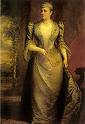
Carrie-DAR

The formal White House portrait of Caroline Harrison was a gift from the Daughters of the American Revolution. She had been the organization’s first President-General.

In the late 1880s, bustles were in fashion, and Caroline Harrison was the most “bustling” of all the First Ladies

Mrs. Harrison: Domestic Diva

Most women today will readily admit to disliking the drudgery of housework, to include cooking and cleaning, laundry and ironing. A good many will admit to liking cooking but not cleaning, or sewing and knitting but not laundry. A rare few, the “Martha Stewarts” among them, will claim to love all the details and mechanics of home-making. Those rare few are usually extremely creative as well, turning straw into gold.

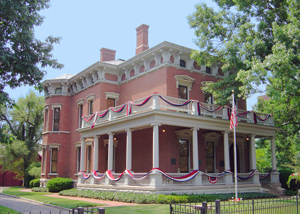
Better house

The Harrison home in Indianapolis, Indiana, where visitors can see some of Carrie’s artwork – and her excellent taste in decor.

Caroline Scott Harrison (1831-1892) was one such woman. Not only was she well educated, but her own mother taught home economics. Carrie, as she was always called, learned well. She cooked and baked, canned and gardened, sewed and knitted, raised children and moved the furniture. She did it, for much of her adult life, on limited income. Benjamin Harrison (1833-1901), her husband, was an attorney, but it would not be until after the Civil War that his practice became successful. Carrie was forced by necessity to make do the best she could with what she had. And what she had was creativity and talent for “everything home.”

Once her children were past school age, and once the Civil War had ended and her resources had improved, she had both the time and the wherewithal to take her many talents to the next level.

Mrs. Harrison: Indianapolis Matron

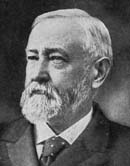
bharrison

President Benjamin Harrison struggled with his law practice until after the Civil War. By then, an attorney, a Republican, and a Civil War general was a hot political prospect. It did not hurt to be the grandson of a former president, either.

Carrie Harrison may have been a homebody by nature and circumstances, but once she had reached forty, she was more than ready to expand her stage.

Always a church-going woman (her father was a minister-educator), she naturally gravitated to her Presbyterian Church activities, which included signing in the choir. She had always had a lovely singing voice, and frequently was given solo roles.

In the early 1870s, as a direct result of the enormous activity women undertook raising money and goods and services for the soldiers during the Civil War, the General Federation of Woman’s Clubs was founded. It enabled women to use their education and organizational skills in ways unheard of a generation earlier. As a fringe benefit, they enjoyed it! They were useful, and liked the challenges!  Since most of these clubs were dedicated to charitable efforts, husbands usually acquiesced and they met with approval all the way around. Within a short time, the good that they were doing was quantified and recognized. By the end of the 1870s, every state had numerous chapters, and there was hardly a town or city that did not organize hundreds of women to worthwhile causes – outside their homes. Modern historians have coined the phrase  “community housekeeping.”

Caroline Harrison was no exception. The Woman’s Club movement appealed to her “bustling” nature, and she became active, and eventually the president of her Indianapolis chapter.

Mrs. Harrison, Artist:

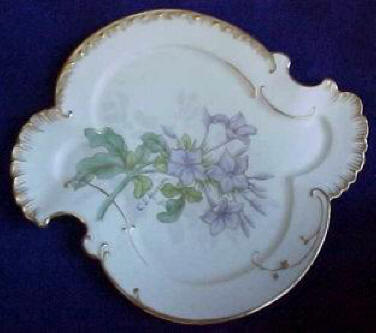
china painting

China painting became a popular hobby after the Civil War. Carrie was a talented artist and gave classes.

Carrie Harrison had displayed artistic gifts since childhood, and was encouraged to sketch and paint in watercolors from early on. Painting and sketching was a popular pastime for girls, and most schools taught and encouraged it. Carrie’s existing floral water colors demonstrate her considerable talent.

carrie orchids

Most of Caroline Harrison’s china painting were floral.

Somewhere in the mid-nineteenth century, “china painting” became a popular hobby. Women would learn to apply transfer prints to plain porcelain plates and cups, then paint them, and fire them in the kiln to produce decorative accessories. A rare few gifted women could create their own designs.

Caroline took some lessons in this new media, and found it very much to her liking. She installed a small kiln in her house, and even began giving lessons to some of the local women who wanted to explore a new hobby.

First Lady  Harrison: The Baby Cups and The Collection

When Benjamin Harrison was elected President in 1888, Mrs. Harrison had a hard act to follow. Her predecessor, Frances Cleveland, was younger than her own daughter, dimpled, pretty and enormously popular. Mrs. H. was a plus-size with gray hair and no dimples. She was a grandmother. But she was also a dynamo.

1899, Washington, DC, USA --- Caroline Harrison and Relatives --- Image by © CORBIS

President and Mrs. Harrison with their daughter and two grandchildren.

She bustled into the White House, inspected every nook and cranny and set out to fix what she believed was unsatisfactory, which was mostly everything.

But under her administrative skills, necessary changes were made, the staff “shaped up,” and it is said that the conservatories were never more beautiful or bountiful.

imagesCAVO9MHD

Bustles were in vogue – and FLOTUS Caroline Harrison was a “bustling” woman!

Carrie still managed to find a bit of spare time to paint, however. As usual, First Ladies receive a good deal of unsolicited letters from plain citizens, and common courtesy has always demanded a respectful response – especially from the White House. Carrie was no exception in that regard, and all respectfully written letters were answered.

There is a story that in a rare move, she determined that any couple who wrote to her advising that they had named their newborn baby either Benjamin, Harrison or Caroline would get a special gift – a baby cup hand-decorated by the First Lady.  It may be apocryphal, but it still a good story and in keeping with Mrs. Harrison’s talents and character.

But one accomplishment is absolute!  It was Carrie Harrison who “discovered” remnants of old presidential china services gathering dust in the White House attic.  It was Carrie Harrison who researched their provenance and began the catalog, which eventually became  the White House China collection that is so popular today.

Sources:

Anthony, Carl Sferrazza –First Ladies 1789-1961, William Morrow,1990

Caroli, Betty Boyd – First Ladies: An Intimate Look at How 38 Women Handled what may be the most Demanding, Unpaid, Unelected Job in America – Oxford University Press, 1995

http://www.firstladies.org/biographies/firstladies.aspx?biography=24

http://www.presidentbenjaminharrison.org/learn/collections/caroline-harrison-s-art


Posted in A POTUS-FLOTUS Blog, Benjamin Harrison | Tagged , , , , , , , , , , , , , , , | 3 Comments

ULYSSES UNDERGROUND: A Book Review

Ulysses Underground: The Unexplored Roots of U.S. Grant and the Underground Railroad, by G.L. Corum

If anyone wants to know anything – even the most minute detail about the abolitionist movement and/or the Underground Railroad, particularly as it applies to Southern Ohio & Indiana, let them look no further than G.L. Corum, who knows practically everything, and tells it all in ULYSSES UNDERGROUND: The Unexplored Roots of U.S. Grant and the Underground Railroad.

The author has accumulated a rare body of knowledge about the people, the relationships, the places, and the events of about a half-century preceding the Civil War.

Corum is an engaging writer, and has managed to breathe some life into many of these long-dead and very serious persons. Granted (no pun intended) some of the people and their “stories” are a little tedious, many of them are truly fascinating. While “Ulysses Underground” is geared to a very specific audience, in Corum’s hands, the interested reader will be well pleased.

The Underground Railroad Movement

Practically from the start of the USA (as a USA), there was strong objection to slavery, and as the country grew both in size and in population, that abhorrence strengthened. With southern Ohio and Indiana abutting Kentucky with its large slave population, it became a natural route for the Underground Railroad, the term coined to describe a secret network of safe-houses and related help for those who chose to escape servitude and flee north to freedom. It was a perilous journey, not only for those who fled, but for those who gave aid.

Corum is by now probably deeply and ethereally connected with dozens of such lost-to-history persons who risked their own lives and safety to assist the runaways. The author’s research has uncovered minuscule leaves on minuscule twigs of minuscule branches of saplings. This is in no way is meant to trivialize sincere and dedicated knowledge. Someone must be the “keeper of the flame,” and a capable volunteer came forward.

G.L. Corum is a good and solid writer, and one might even detect a wry sense of humor from time to time. As a fair marketing strategist, the author knows that without a major connection (i.e. General Ulysses S. Grant) there would be little chance at readership. This is the latest popular trend.  Many historians are doing it lately; using gossamer filaments to tie minutiae to a famous person in order to achieve popular recognition for intrepid scholarship.

The Grant Connection. Or Maybe Not So Much.

Ulysses S. Grant was born in 1822 in Point Pleasant, a little town in southern Ohio. His parents, the bombastic Jesse and the silent Hannah, were both, if not card-carrying abolitionists, certainly ardently anti-slavery, acquainted with many of its leading proponents. This is an absolute fact.

But herein lies the problem: linking this “underground railroad” theme to Ulysses S. Grant.  One can grow up in the shadow of Yankee Stadium and even have Yogi’s autograph – and still not play baseball, or like it – or even be a Yankee fan. The ties to Grant are thin and often circumstantial.

F’r instance.  Author Corum makes a effort to tie Ulysses to active involvement with the abolitionist movement via a letter he wrote as General Grant to a childhood friend, in which he asked to be remembered to a particular lady – an old neighbor from the old neighborhood.   The author’s research turned up considerable evidence of the woman’s anti-slavery support and activity, but this does not tie Grant to anything resembling a real connection to the Underground Railroad movement, and in fact, it is more plausible that Ulysses-the-child remembered the woman as a nice lady who left cookies on her porch.

Ulysses Grant’s own anti-slavery sentiments (and he was definitely against slavery) did not preclude him from marrying into a slave-holding family. The senior Grants were not keen on Julia, but Grant was far more concerned about how his beloved wife felt about them. Julia’s father gave her two slaves as a wedding present, and Grant never demurred, although as time went on the Union-Secessionist conversations with his also-bombastic father-in-law became uncomfortable.

Then too, Ulysses Grant became the Great General, and President of the United States, and arguably the most famous man in the world during his time. If he had any strong Underground Railroad connections, it would have been uncovered then – and certainly by now.

What Works:

G.L. Corum is a passionate historian and a better-than-somewhat writer. There is also an intelligent mind at work. The author’s sincere efforts to make Grant’s infinitesimal small step into a giant leap is a stretch, but it does provide first-rate title interest.

But the part that does work, and that does work very well, is the excellent scholarship and research into that period of time in that particular section of the country, on a subject of considerable and worthy interest.  A fine and laudable effort!

Historical societies and library associations will be well pleased to engage G.L. Corum for their programs. Scholars and scholars-to-be will find the book full of excellent information.  It may be a limited audience, but hey! A “keeper of the flame” is nothing to sneeze at.

ULYSSES UNDERGROUND: The Unexplored Roots of U.S. Grant and the Underground Railroad

By G.L. Corum

RivetingHistory

ISBN-13: 978-0996206419


Posted in Recommended Reading | Tagged , , , , , , , , , , , , , , , | 1 Comment

Tom and Dolley: The Original Ben and Jerry

Ice cream has always been one of America’s favorite desserts. But was it Thomas Jefferson or Dolley Madison who deserves the credit?

Ice Cream Clipart Free | Clipart Panda - Free Clipart Images

Ice cream has been one of America’s favorite desserts for more than 200 years.

Many people believe that “Dolly Madison” ice cream is named for the First Lady because she invented ice cream.

Wrong.   She did not invent ice cream.  It is actually an ancient recipe.

Many others believe that it was because Dolley Madison (note the “e” in the correct spelling) introduced ice cream at the White House.

Wrong again. She did not introduce it.

What she did, however, was to popularize our country’s favorite dessert to this day.

The Tom Contribution

thomas jefferson

Thomas Jefferson usually gets credit for bring the “receipt” for ice cream to the US. It originated in France.

But the story goes that it was actually Thomas Jefferson, a cosmopolitan and sophisticated man with an undeniably epicurean palate, who discovered the delectable confectionary treat in Paris, (where else would it be possible?) where he lived for several years during the 1780s. So taken was Mr. Jefferson with the famous French cuisine, that he brought one of his servants all the way from Virginia, specifically to be trained in French culinary skills.

When Jefferson arrived home, at the end of the 1780s, his Monticello plantation was open to dozens of guests nearly every day. They would be treated to an array of exotic delicacies – from France. Including ice cream.

Antique Ice cream molds in various shapes

Jefferson’s particular recipe was written in 18 careful steps, including such notations as “a layer of ice, a layer of salt for three layers.” Then he added a note to “put it in moulds jostling it well down on the knee then put the moulds into the same bucket of ice.” It is said that George Washington (or perhaps it was Mrs. W.) who received a copy of the recipe for ice cream and served it as President. It is further said that George and Martha had a particular apparatus for making ice cream. But since they never lived in the White House, the Washingtons cannot get credit.

But for certain, in 1801, by the time Thomas Jefferson was our third President and actually living in the White House, ice cream was served. One dinner visitor expressed amazement that it been brought to the table “in the form of small balls, enclosed in cases of warm pastry” – like a modern-day Baked Alaska. Without the flames.

The Dolley Contribution

Dolley by Gilbert Stuart

Dolley Madison served ice cream for years before the Madisons lived in the White House. As First Lady, she popularized the sweet treat throughout the country.

Dolley Madison, wife of Jefferson’s Secretary of State, was frequently asked to serve as hostess for the widowed President. Her grace and superb social skills were remarkable, and she became the acknowledged leader of Washington society.

white house 1807

First Lady Dolley Madison exchanged recipes with many congressional and government wives. Ice cream was likely one of those recipes.

When James Madison became President in 1809, Dolley was the most popular woman – if not the most popular person in the country. The White House became the center of constant rounds of luncheons, dinners, balls, teas, receptions and suppers. The kitchen was probably never closed. Invitations were generously extended, and Mrs. M. herself would greet guests and make sure they were properly introduced – at least to somebody. It was part of her charm, and a cornerstone of her popularity.

By that time, ice cream had become a fashionable dessert for the Washington set – and undoubtedly elsewhere. Mrs. Madison was known to exchange recipes with many congressional wives, so it is likely that the recipe for ice cream was among those she passed along to the “rest of the country.”  It is also likely that since it was such a hit in Washington, everyone was anxious to try it out.

Image result for free birthday clipart ice cream

Vanilla, chocolate and strawberry have been the most popular flavors for generations. “Oyster” never really caught on.

Dolley, who was known to have had a sweet tooth, served it often. We aren’t sure about chocolate syrup, “jimmies” or M&Ms. We really don’t even know what flavors she served, other than vanilla, although adding fruits and berries would seem to be a no-brainer even in the early nineteenth century. One story mentions that Dolley’s favorite flavor was oyster ice cream, but it doesn’t appear that it ever caught on.

Those marketers who commandeered her spelled-wrong name and image for their national brand did so, not only as a tribute to the sweet confection the early First Lady loved so much – but as a tribute to the most universally beloved First Lady who ever lived in the White House.  Sort of giving just desserts to a treat that is much more than just dessert.

Sources:

Allgor, Catherine, – Parlor Politics: In Which the Ladies of Washington Help Build a City and a Government, 2000, University of Virginia Press

Moore, Virginia – The Madisons: A Biography, 1979, McGraw Hill

http://www.thedailybeast.com/articles/2014/07/13/an-investigation-into-the-delicious-origins-of-ice-cream.html

http://www.pbs.org/food/features/ice-cream-founding-fathers/

Posted in A POTUS-FLOTUS Blog, James Madison, Thomas Jefferson | Tagged , , , , , , , , , , , , , , , , | 1 Comment

Grace Coolidge: The Press Conference

  The Coolidge Presidency saw two important “entertainment” milestones: one very small, and one very large.

Official Calvin

President Calvin Coolidge was the antithesis of the “Roaring Twenties”. He didn’t roar, and he was generally “unflappable.”

The Small Milestone

Calvin Coolidge (1872-1932) was the first president to receive a budget allowance for entertaining.   Previously, with few exceptions, all dinners, luncheons, teas, receptions and related social gatherings were paid for by the President. Personally.

The thrifty Coolidge made ample us of his new largesse, and was said to have hosted more social functions than any previous President. It is further said that he began holding breakfast “meetings” – since this way he could charge his own ham and eggs to the budget. Maybe.

The Large Milestone

The Coolidge Administration (oddly enough considering their reserved personalities) was plunked right into the heart of the Roaring Twenties and the catapulting phenomenon of pop culture as we know it today.

babe ruth

Grace Coolidge was a lifelong baseball fan – for Boston! Her heart was broken when Babe Ruth became a NY Yankee.

pickfair

Mary Pickford and Douglas Fairbanks were some of the movie stars to visit the White House during the Coolidge Administration.

Movie and vaudeville stars, radio personalities, writers, musicians and recording artists, sports figures and assorted others of varying notoriety, from hero to crackpot, dominated the headlines and found their way to the White House to shake hands with the President.

The quiet Coolidge was always glad to shake hands and pose for a photo with Mary Pickford or Charlie Chaplin or Babe Ruth. He believed it “warmed up his public image.” Sometimes they were invited to lunch or dinner.

jolson

Vaudeville and Broadway star Al Jolson was one of the biggest pop icons of the 1920s.

Mrs. Coolidge: Hostess

No one was more important at a White House dinner party than the pretty Mrs. Coolidge. In her mid-forties, she still had her youthful energy, and was a snappy dresser to boot!

Formal Grace

Pretty and personable Grace Coolidge in her formal White House portrait – one of the most popular of all First Lady portraits.

Grace Coolidge (1879-1957) had  graduated from the University of Vermont, and before her marriage, had taught for some time at the Clarke School for the Deaf in Northampton, Massachusetts. Personable and outgoing, she was the one who kept the table conversation going. Between “hello” and “goodbye,” Coolidge seldom participated.

will rogers

Vaudeville star and humorist Will Rogers was Grace Coolidge’s personal pop culture favorites. He adored her!

Thus it would fall to the First Lady to see the film, know the words to the song, hear the broadcast, read the book or magazine article, and know every ball player’s batting average. She asked the good questions and her easy smile charmed them all.

Charles_Lindbergh

Charles Lindbergh was the “pop icon” that Calvin Coolidge found personally most interesting.

Nevertheless, despite his wife’s outgoing nature and despite the fact that he loved her dearly, Calvin Coolidge was extremely sexist. He believed a woman’s place was two steps behind her husband, ergo, the First Lady was not permitted to make any statements on the record, except perhaps “Thank you for the flowers.”

If Grace objected to her position or background role, she never let it be known. She was happy to be First Lady, Mrs. Coolidge, housewife.

The Press Conference

One of the activities permitted to First Ladies of course, was hosting “ladies” luncheons and teas, i.e. for the wives of senators and congressmen and visiting businessmen, and even occasional women’s groups.

Grace as photographer

Grace Coolidge was an avid amateur photographer.

As part of her official duties, she frequently took them on a tour of the White House or its grounds, commented on its history, and invited them to tea.

But the 1920s was a time that changed public mores forever. Women not only voted, but they enjoyed the opportunities of gainful employment. Journalism was one avenue that had been open to women for some time. Practically every town newspaper had a “woman’s” or “society” editor to report on the meetings and special events for women. And dozens of women’s magazines, such as Ladies Home Journal and Redbook, had been around for decades.

On one occasion, some of the women reporters in Washington asked Mrs. Coolidge if they might interview her. The First Lady charmingly said that she did not grant interviews, but she would be happy to take them on a tour of the White House. The reporters were delighted to accept.

Mrs. C. spent a pleasant hour escorting them around the Executive Mansion, but when it was time for the journalists to depart, they still clamored for a “few words” they might use as a quote. Grace knew her husband – the President – would not be pleased if she spoke “on the record,” but she did not wish to disappoint the women of the press either.

So she drew on her past experience at the Clarke School, and gave them a three-minute speech – on the record. In sign language.

Sources:

  • Anthony, Carl Sferrazza –First Ladies 1789-1961, William Morrow,1990
  • Boller, Paul F., Jr. – Presidential Anecdotes, Oxford University Press, 1981
  • Wikander, Lawrence & Ferrell, Robert (eds) – Grace Coolidge, An Autobiography, 1992, High Plains
Posted in A POTUS-FLOTUS Blog, Calvin Coolidge | Tagged , , , , , , , , , , , , , , , , , , , , , | 1 Comment

Under This Roof: The White House and the Presidency: A Book Review

Everyone knows the White House. Everyone should know the Presidents. And the rooms themselves are a national treasure!

Under This Roof

Under This Roof, The White House and the Presidency, by Paul Brandus

Paul Brandus is a long time Washingtonian  POTUS expert, and happily for all, a fellow who understands his audience. He does not write tomes; he does not include a book-in-itself of citations and references. He does not seek to pontificate. In other words, he makes history a delight to learn (which, of course, it is). Especially for those who know very little about history, or have been turned-off while trying.

Under This Roof: The White House and the Presidency offers a birds-eye view of twenty-one rooms in the White House (some repeated and redecorated over the generations), and the importance of those rooms in context with a particular administration. Some are a little surprising. For instance, Brandus leads off with the State Dining Room to pair with John Adams’ Presidency. One might have expected the great East Room which was famously used to hang their laundry.  But no, Brandus chose the State Dining Room, which was not used as a dining room at all during Adams’ brief tenure in the White House. The State Dining Room was chosen to “tell the Adams story” because it is where the equally famous Adams “blessing” is immortalized on the fireplace mantel, courtesy of Franklin Roosevelt. Nice touch!

Rooms of course change as do administrations and generations. What was once a President’s study becomes another President’s bedroom. What was once a small dining room is turned into a guest room. What was once blue becomes yellow, then green, then back to blue again.  And what was once considered the height of fashion becomes dowdy over time.  Not all First Ladies (who are usually credited with the decor) are blessed with Mrs. Kennedy’s good taste in furnishings.

Interspersed with all the delicious tidbits that the author interjects for our amusement, delight, amazement, etc., are some serious moments of history that come alive. Widowed President John Tyler, for example, held a state funeral service in the White House for the victims of the explosion on the gunboat Princeton; months later, he married the daughter of one of the victims.  Woodrow Wilson spent the last eighteen months of his Presidency semi-confined to his bedroom following a massive stroke – the details of which, for all intents and purposes, was concealed from public officialdom as well as from the public.

It is, of course, the stories of history that are usually the most memorable. School children still learn about Abigail Adams’ laundry story in the un-completed East Room of the un-completed Executive Mansion and how Dolley Madison “saved” the portrait of George Washington only hours before the White House was burned during the War of 1812. Those stories will be remembered far longer than tariff bills and civil service reform legislation. (Do not misunderstand. Tariffs and civil service are important – but they are memorable only to the serious scholars, and usually do not inspire a deep love of history in the masses.)

Journalist Paul Brandus tells a good story, and a good “history-light,” which is exactly what is needed to narrow the great chasm that has existed for nearly three generations: all-or-nothing. Either a total oblivion/disparagement about history, or i-dotting and t-crossing everything to congratulate scholastic and research prowess. There is plenty of room in history to include both Willie Nelson and Pavarotti.

What is particularly interesting about Brandus’ approach, is that he effectively ties the essences of some Presidential administrations to a particular room (or rooms) in the White House.  Or not.  William McKinley, for instance, a “war” President during a short and jingoistic war, turned a room into an actual “war room” – where maps were hung and telegraph and telephone wires were installed for whatever moment-to-moment information was possible – in 1898.  On the flip side, Abraham Lincoln never slept in the “Lincoln bedroom” or even in the “Lincoln bed” which his wife purchased especially to accommodate his 6’4″ frame.  But his son Robert did!

Then we learn about “building stuff.” The stables erected by Andrew Jackson, no longer needed, of course. The conservatory, make that conservatories of flower gardens and nurseries and the demolishment of same to make way for the West Wing built by Theodore Roosevelt. The various updates and modernizations, some very good, some very bad, led to the complete overhaul of the old mansion during the Truman Administration.

But more than anything Under This Roof is a story of a particular house, and an assortment of occupants, paid for by the American public. The occupants were real people dealing with real situations. They lived here; some died here. Some had joyous experiences; some poignant and sorrowful, and some were out-and-out funny. Some Presidents were great; some merely did the best they could under the circumstances, and a few achieved greatness because of the huge responsibilities that fell (sometimes suddenly) upon their shoulders.

Under This Roof is a quick-moving read. It is almost like having a guided tour of the White House itself! It brings history alive, and that is no small accomplishment! It is a perfect gift for the Holiday season.  And you might enjoy it yourself!

UNDER THIS ROOF: The White House and the Presidency, by Paul Brandus

Lyons Press

ISBN 978-1-4930-0834-6

$25.95


Under This Roof

Posted in Recommended Reading | Tagged , , , , , , , , , , , , , , , , , , , , | 2 Comments

Moving Mamie Eisenhower

   Mamie Doud was only nineteen when she married recent West Point graduate Lt. Dwight Eisenhower.

Young Army Bride

Mamie’s parents, John and Elivera Doud were not happy about their daughter’s marriage.  They adored Dwight David Eisenhower, and would consider Ike their “son” for the rest of their lives, but they believed their rather spoiled daughter was much too young – and that her privileged upbringing might not be adaptable to army life.  They suggested that the youngsters wait.

But Ike was a professional soldier, and his duty was to go where he was deployed.  While he and Mamie had agreed to wait for a year, Ike’s orders were sending him east.  Mamie lived in Denver, Colorado.  Waiting, at least for them, was not an option.

wedding photo

Lt. and Mrs. Dwight D. Eisenhower: the wedding photo

According to Mamie Eisenhower (1896-1979) many years later, they moved twenty times in twenty years.

Young Army Wife

Mamie’s parents knew their daughter rather well, particularly the part about adapting to the rigors – and economies – of army living.  Mamie’s domestic skills were skimpy.  She did not cook or sew.  A two-room officer’s bungalow required little upkeep.  Her academic skills were not much better.  She had been an indifferent student.

But Mamie seemed to shape up nicely to the exigencies of army life.  She fit in easily among the cadre of young officers’ wives, and her broad grin matched that of her husband’s.  They made friends easily, and were happy to take their turn hosting the pick-up parties that were fashionable on-base.

The Early Ikes

Ike and Mamie Eisenhower moved twenty times in twenty years.

But the moving from place to place was another story.  Sometimes they barely had time to unpack and get accustomed to their new environment when new orders arrived and they were off again.  But with experience comes wisdom, and in the moving department, Mamie became a pro.

The Moving Plan

Very early in their married life, Mamie decided on a plan to make moving from place to place as simple as possible.

First.  The colors of their rooms would always be the same.  Their bedroom would be a mint green (to please Ike), and she would accent the room with her favorite color: pink.  (It would be too much to ask for Ike to sleep in a pink bedroom, but he could accept a rose-pink spread or pillows.)  The colors for their living room and dining room would also be consistent throughout their many moves.  This way it would always look like “home.”

young Mamie

Mrs. Ike learned to be a General’s wife. She knew what she wanted.

Second:  Army wife Mamie saved and stored her packing crates and boxes – unless they completely fell apart from jostling or age.  Each crate and box was specifically marked according to the items they carried.  This way she knew what would fit and where it would go.  And if it was not going to “fit” in the new quarters, the items were stored away till the next move. Sooner or later those trays or dishes or lamps or end tables would be needed again.

Perhaps the good thing about “military moves” are that Mrs. Army Wife does not have to do the actual packing and moving.  The army was happy to do it for them.  All Mamie had to do is organize the “stuff” and supervise the job.  She learned to be superb.

The Unpacking

Packing up to move is only half the problem; unpacking is the other half.  Throughout the first quarter century of the Eisenhower’s marriage, through dozens of moves both in the USA and overseas, Mamie developed a consistent philosophy of unpacking.  It was unorthodox, and would probably not be acceptable to modern wives today, but it suited Mamie perfectly.

The philosophy: Make it “home” ASAP.  She would decide immediately where the big furniture was to be placed – usually in a similar arrangement from house to house.  This way it would always have the same “feel” to it.  The boxes and crates of “accessories” were all marked room-by-room, so they could be found quickly.

Ike did not have the luxury of having a few days off before reporting for duty; Mamie didn’t have the luxury of having him around to help move furniture or hang pictures – or even ask where he might like to have something put.  He had to report; she had to make the house live-able.

The Details

Once the big furniture was in place, Mamie immediately hung her pictures and set out her knick-knacks.  She would always have a lot of them.  Most women today leave that accessorizing until much later in the moving process, but not Mamie.

The Eisenhowers

Whenever Ike came home, as long as Mamie had organized everything, he always knew where “home” was.

If the ashtrays and vases were on the table; if the pictures were hung in the usual place they had hung before, i.e. living room pictures, bedroom pictures, dining room pictures; if the doilies were on the backs of the sofas or armchairs and the books were lined up on the shelves, the new quarters would look like home.

Unpacking the pots and pans, unpacking the dishes and glasses and silverware, even unpacking their clothes and personal belongings… all that could wait a day or two.

But when Ike came home that first night and opened the door, he knew immediately that he was “home.”

Sources:

Brandon, Dorothy – Mamie Doud Eisenhower – Scribners 1954

Eisenhower, Susan – Mrs. Ike – Farrar Straus Giroux, 1996

Lester, David and Lester, Irene – Ike and Mamie – G.P. Putnam, 1981


Posted in A POTUS-FLOTUS Blog, Dwight D. Eisenhower | Tagged , , , , , , , , , , , , , , , , , , | 3 Comments