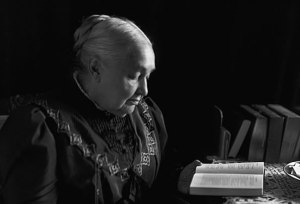
Unusual For Their TIme: On the Road With America’s First Ladies, Vol 1: A Book Review

unusual-times-andy

Unusual For Their Time, by Andrew Ochs, is a one-of-a-kind book, and a must-read for all FLOTUS aficionados!

Andy Ochs has written an extremely unique book. It is part historical-ish, part biographical-ish, part memoir-ish, part travelogue-ish – and completely delightful!

Contracted to film C-SPAN’s First Ladies series in 2014-15, the author-cum-camera toured the country visiting the homes, birthplaces and other sites connected with America’s First Ladies, plus a few Presidential “hostesses,” a title given by historians to daughters, nieces, sisters and in-laws who substituted for widowed or bachelored Presidents. By his own admission, the author was given not only a warm welcome wherever he went, but access to dozens of rooms of memorabilia usually tucked away in vaults or behind the velvet ropes. And also, by his own admission, he had the special experiences of holding what they held and walking in precious footsteps.

If Andy Ochs was not born with the history gene, after this journey, he has had one helluva transplant!

Starting with Martha Washington and ending Volume 1 with Ida McKinley, he takes the reader on the grand tour of nifty places like Mt. Vernon, not-so-nifty but essential like the Adams birthplaces, and even some completely obscure sites (and equally obscure First Ladies) like Abigail Fillmore’s house or the property that once belonged to John and Letitia Tyler (his first wife, and the first FLOTUS who died in the White House). Who knew? In the latter case, even the present property owner hadn’t a clue. And of course we are treated to Julia Grant’s St. Louis birthplace and supposed-to-be retirement home, painted in bilious green, which supposedly was the color of the Gilded Age.

The biographical and historical part is fairly obvious and easy to understand: The old gals lived wherever they lived, and here are their furnishings or personal possessions. Anybody can go to those historic places and see their chairs or tables or piano. You can see (usually in locked cabinets), their vases or special china plates or jewelry, or even gifts they received from important visitors when they were First Ladies.

But it is the memoir-able part that makes Unusual For Their Time unique. It is the story of the filming. The personal part about filming the episode in his socks, or holding rare articles in gloved hands. Or assembling and disassembling camera equipment two or three or more times to accommodate yet another incoming tour group.

Then there are the “finding the sites” stories – some of which are not on a must-see historical site map. And he brings a smile to the readers’ faces, when he inserts a “cheap eats” paragraph citing some local oasis, particularly noted for Caesar salad and grilled cheese. Hopefully, all those local beaneries will take advantage of their moment of glory, and offer a few books for sale!

Author Ochs does more than merely entertain or educate. He makes these assorted women come alive. Some of them knew each other; most did not. But nevertheless, they shared the common bonds of girlhood, wifehood, motherhood as well as White House-hood.

Some were poor. Most were not. All had some education, and many were better educated, or from financial backgrounds that surpassed their husbands. Sometimes by a lot. All of them experienced the sorrows of life and death. Some lost parents at an early age. Some lost siblings at an early age. A huge percentage lost children – a devastating event that bonds them all.  None of this, however, was “unusual for their times.”

Author Ochs selected a publisher devoted to providing an outlet and funding for veterans’ memoirs and related projects, and has generously assigned his royalties to that cause. This is certainly a bonus reason to buy the book. But in doing so, he has consigned his book to only cursory technical talents and skills. He would truly benefit from a good editor. “Formatting” is not really editing, and a knowledgeable professional to check for redundancies, basic fact-checking vs. typos, copy-tightening and even a little better writing talent might be helpful.

The author titled his book Unusual for Their Time, and perhaps a few of them were, but it is a stretch as a whole. What was usual? Were they really unusual? With very few exceptions, their pre-First Ladydom lives were as common to their times, locations and stations in life as a proverbial head cold. Ochs tries hard to give each one of those fine women a quality or experience to substantiate the unusual-ness, but it is a stretch.  All women, regardless of their generation, their century and their age are individual in some way. But these gals were visible; their names were generally known during their lifetimes and are even today noted in the history books. Modern First Ladies rate books of their own.  Some of those old gals rate chapters; others merely footnotes.  But the crux of it all, is that we of a later generation did not have the opportunity to know them. And the truly sad part is that these lovely ladies had few opportunities to “be known.”

Andy Ochs has given us this very special chance to get to know them. Like Harry Truman, a pretty fair historian himself once said, “There is nothing new under the sun except the history we don’t know.”

Now we know them a little better.

Can’t wait for Volume II!

UNUSUAL FOR THEIR TIME: On The Road With America’s First Ladies

Author: Andrew Ochs,

Publisher: Tactical 16, April 2106

ISBN-13: 978-1943226122

$15.99
 

Posted in Recommended Reading | Tagged , , , , | 1 Comment

James Madison’s Romantic Lesson

jamesmadison2

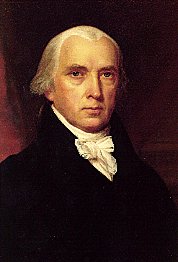
James Madison, looking much more imposing than the small-in-stature man he was in real life.

James Madison, a bachelor of 43, had a history of romantic disappointment.

The Non-Imposing Jemmy Madison

James Madison (1751-1836) was a man of small physical stature, anywhere between 5′ and 5’6″ tall, depending on which sources you espouse. But no source indicates him at more than 125 pounds, thus making him slight, as well as short. Obviously aware of his lack of physical presence, he nevertheless pursued a few romantic opportunities early in his life. Unsurprisingly, he was turned down.

young-madison-maybe

Said to be a portrait of the young James Madison. Maybe. There is a resemblance.

Madison came from a well-respected and wealthy central Virginia planter family, the eldest of many siblings. His father sent him to the College of New Jersey (Princeton) for his education. He was a remarkably astute student, and eventually awarded today’s Masters’ degree in political science. Even though he was a qualified lawyer, he preferred political theory rather than mundane practice, much like Woodrow Wilson a century later.

Perhaps assuming that bachelorhood was to be his lot, Madison poured his energies and passions into politics, and by his thirties, was playing an essential role in helping form a new government for a new country: The United States of America.

young-tj

Thomas Jefferson was a lifelong friend and political intimate of James Madison.

portrait_james_madison

Prior to his marriage, Madison usually dressed in black.

When he was still in his twenties, he formed his most important relationship: a lifelong friendship with Thomas Jefferson, another central Virginian, eight years older, just as brilliant and nearly a foot taller.

Despite his dour black-clad appearance (some claiming that he looked like a little man on the way to a funeral), Madison was said to have had an outgoing personality among friends and a good raconteur, with a repertoire of ribald stories.

Mr. Madison’s Middle-Aged Romance

By the time James Madison was forty, he had been nicknamed “The Great Little Madison,” and was a Congressman in the new country he helped create. He moved to Philadelphia, and he became a close advisor to President George Washington and his cabinet.

dolleys-home-in-philly

The building just below the steeple is said to be the Payne Boarding house, where the widow Dolley Payne Todd served as hostess.

earlyphilly

Philadelphia, circa 1790s, when it was the capital of the United States.

While Philadelphia was the largest city in the country in 1794, it was still a small town, compared to cities today. The population was perhaps 40,000, having just withstood a yellow fever epidemic that claimed an estimated 5,000 souls.

Dolley by James Peale

The Widow Todd, a.k.a. Dolley Madison.

One of those survivors was the young widow of Quaker lawyer John Payne Todd and her two-year-old son. The Widow Todd had returned to help manage her mother’s boarding house, temporary home to several Congressmen, one Senator and the Secretary of State, Thomas Jefferson. She graced its dinner table, the most popular venue in town. She was seen frequently among the shops and stalls of Philadelphia in her Quaker mourning garb, but mourning or not, her pleasant good looks and infectious charm turned heads, including that of Congressman James Madison. He wanted to meet her, despite the fact that she was taller than he was, as well as being seventeen years his junior. And good looking, to boot.

It has never been documented why Madison didn’t ask his good friend Jefferson to facilitate the introduction, but he didn’t. Instead he asked Senator Aaron Burr of New York to arrange a meeting with the most charming hostess in Philadelphia.

The Widow Todd, overwhelmed when she was told that Mr. Madison wanted to meet her, wrote to her lifelong friend Eliza Lee, “Thee must fly to me at once! The Great Little Madison wishes to meet me tonight.”

Congressman Madison indeed met the Widow Todd, and was enchanted. He visited the boarding house frequently and began to invite the pretty widow on carriage rides, or to concerts or lectures or to friends’ homes for small gatherings. And he did the one thing certain to win her heart: he brought toys or treats for her little boy.

James Madison’s Lesson

Not long into his courtship, Madison asked the Widow Todd to marry him. Fairly prompt remarriage was customary in colonial times, especially when there were small children involved. The Widow gently told her suitor “it was too soon.” Her first husband had only died six months earlier.

idealized-madison

After his marriage, it is said the James Madison dressed much spiffier!

James Madison was devastated. He had truly fallen in love with Mistress Todd, and had allowed himself to be vulnerable. It was another rejection. He spent a horrible day believing he would never find marital happiness.

But Madison was a cerebral man, and when he mentally reviewed the events of the previous day, he realized that the Widow had not said “no.” She merely said that it was too soon. It was not a rejection per se. Maybe it was the timing. It wasn’t “no.” Maybe it was “not yet“.

Risking all, he continued to woo. He continued to invite. She continued to accept. The whole town was likely aware of the ensuing courtship.

A Little Help from Their Friends

george and martha

George and Martha Washington, a marital “connexion” to Dolley and a good friend to Congressman Madison.

Mistress Todd’s sister had married one of George Washington’s nephews, thus making her a family connexion with family access to Lady Washington’s  levees in Philadelphia. Both Washingtons knew her – and liked her enormously.

The President took the opportunity at one of those levees to maneuver himself and a companion in reasonable proximity to his niece-in-law’s sister. Then he filled his companion with fulsome praise for Congressman Madison, noting that “whoever marries him will be a fortunate woman indeed.” The Widow Todd always referred to that incident as “President Washington’s Private Address to Mistress Todd.”

In September, 1794, eleven months after John Payne Todd had died, his widow became Dolley Madison, and her life truly began.

The couple would have more than forty years together as one of the happiest and most devoted Presidential couples in history. James Madison would indeed have marital contentment – in no small part because he was patient, and understood that “not yet” does not mean “not ever.”

Sources:

Allgor, Catherine, – Parlor Politics: In Which the Ladies of Washington Help Build a City and a Government, 2000, University of Virginia Press

Allgor, Catherine – A Perfect Union: Dolley Madison and the Creation of the American Nation – 2006 Henry Holt and Company

Moore, Virginia – The Madisons: A Biography, 1979, McGraw Hill

http://www.whitehouse.gov/about/presidents/jamesmadison

http://www.biography.com/people/dolley-madison-9394952

Posted in A POTUS-FLOTUS Blog, James Madison | Tagged , , , , , , , , , , , , , , , , , , , , | 5 Comments

George Washington’s Two Revolutionary Sons

young GW

George Washington, General of the Continental Army

George Washington had no children of his own, although he raised two step-children, and was considered a responsible and affectionate parent.

GW: The Revolutionary War

When the Revolutionary War began in 1775, George Washington was 43 years old. Having served in the Virginia Militia in his youth, rising to the rank of Colonel, he was considered the highest ranking “American” officer. He was appointed General, and sent to take command of a ragtag army forming in Massachusetts.

Forty-three was considered well into middle-age at that time. A new generation was now approaching adulthood – and enlisting as soldiers. Washington’s aides would become his military “family.”

Lafayette: The Favorite Son

lafayette

The Marquis de Lafayette “joined” the American army when he was nineteen. And at his own expense.

When the shot fired at Lexington was “heard round the world,” it was a clarion call to a young French nobleman, the Marquis (with a string of first and middle names) de Lafayette (1757-1834). Fatherless at two years old and trained at France’s finest academies, he was commissioned as a military officer by his early teens. He saw in the American Revolution a cause he believed in, as well as a chance for glory, something vitally important in the 18th century.  Other Frenchmen had enlisted and had been sent to America, but Lafayette was of the highest nobility and outranked them all.

At his own expense, which was huge since it included purchasing his own ship and soldiers, he parted from his young wife and sailed for America, arriving in the summer of 1777. After offering to serve without pay, Congress made him a Major General. He was not yet twenty.

lafayette2andgw

Many illustrations were made (in retrospect) of George Washington meeting Lafayette.

They sent him to George Washington, and the two men of different generations, bonded quickly. It did not hurt that Lafayette was a Freemason, as was Washington. Nevertheless, Washington did not know exactly what to do with the young French officer of high nobility. Congress had awarded the Marquis his rank, believing it to be “honorary.” Lafayette believed himself to be experienced and able. In time, George Washington would learn that the young Frenchman was indeed intelligent, capable and a fine commander. He was given increasing responsibilities.

lafayetteandgw

George Washington and Lafayette

The Marquis de Lafayette was also charming and effusive (in contrast to Washington’s reputed “cool”) and grew to love and admire General Washington with his whole Gallic heart. His filial devotion was sincere, and contagious. The austere Washington grew to love the French aristocrat like a son. And always would.

In 1781, after Cornwallis’ defeat at Yorktown, where Lafayette was a key commander, the Marquis had a tearful farewell with his beloved “father.”

surrender_of_lord_cornwallis

Lafayette and the French Army were instrumental at the Siege and Battle of Yorktown. Alexander Hamilton was instrumental as well.

They would never see each other again, although they corresponded and exchanged gifts. Washington is known to have sent a barrel of Mt. Vernon hams to his French “son.” He was understandably proud when the Marquis emerged as a notable French general and advocate of the Rights of Man.

As events in France morphed into the French Revolution and Reign of Terror, Washington was deeply concerned for the safety of his dear young friend, but as the President of a small country just beginning to get underway, he needed to steer a neutral course.

Nevertheless, Lafayette had named his first son George Washington Lafayette, and when events became dangerous, he sent the young boy and his tutor to safety, in care of his godfather, the President of the United States.

Alexander Hamilton: The Ambitious Prodigal

hamilton

Alexander Hamilton. His greatest regret may have been his birth in the West Indies. It made him “ineligible” to be President.

Alexander Hamilton (c. 1755-1804) was close in age to Lafayette and also “fatherless” – but Hamilton was an illegitimate child born in the West Indies. At an early age, his exceptional intelligence and aptitude was recognized by the townsmen, who arranged to have him study at Kings College, now Columbia University, in New York.

When the American Revolution began, he volunteered early on, mostly for the glory part.

General Washington, dismayed by the motley and undisciplined militiamen that were cobbled together, would come to rely heavily on a cadre of young staff officers to help with the endless paperwork, sans carbon paper, let alone copiers.

alexander-hamilton

Hamilton was a multi-talented and very smart fellow. He was also incredibly ambitious.

Hamilton was invited to be on Washington’s staff, and his superior intelligence, education and business genius was quickly noticed. The General, an astute businessman himself, discovered a worthy young officer and financial wizard in Hamilton.

Youth is always attracted to danger and glory, and a superbly intelligent youth is also easily bored and in need of challenges. Lt. Col. Hamilton wanted a battlefield command; Washington was not inclined to grant it. Whether it was a lack of confidence in Hamilton’s military abilities, or his desire to keep the brilliant aide on staff is subject to conjecture. Some believe that Washington was concerned that the militiamen would not respond well to a “staff” officer whose rank was perceived as honorary.

The ambitious Hamilton grew impatient, and the two men had a rocky on-again-off-again relationship. Washington was uncharacteristically forgiving of the young-man-in-a-hurry, perhaps recognizing the same qualities of his own youth. By the end of the War, Hamilton was finally allowed to prove his military mettle at Yorktown.  He did a commendable job.

hamiltoncolor

Hamilton, along with James Madison and John Jay, was instrumental in drafting the Constitution of the new United States.

George Washington and Alexander Hamilton maintained a cordial correspondence and reunited some years later in Philadelphia, where the now-thirty-year-old NY attorney and politician had been sent to help draft a Constitution to replace the inadequate and ineffectual Articles of Confederation.

Washington, now in his mid-fifties, had been coerced from retirement to preside over the Constitutional Convention. Scrupulously attentive to his position as “presider,” he made few comments during the proceedings, but is said to have been an active participant behind the scenes in informal discussions. Like Hamilton, he saw the absolute necessity of a strong, centralized federal government to unite the diverse States which were only superficially United.

When Washington was re-recruited away from his beloved Mt. Vernon to assume to Presidency of the (hopefully) United States, he insisted that Alexander Hamilton again be part of his “official” family. The President truly loved the brilliant young man with the massive talents and massive ego.

Their relationship would always be rocky, but forgiving.  Just like so many other fathers and sons.

Sources:

Knott, Stephen F. and Williams, Tony –Washington and Hamilton: The Alliance That Forged America – Sourcebooks, 2016

http://www.smithsonianmag.com/history/washington-amp-lafayette-162245867/?no-ist

http://www.infoplease.com/t/history/true-washington/hamilton.html

http://www.ushistory.org/valleyforge/served/lafayette.html

Posted in A POTUS-FLOTUS Blog, George Washington, Nifty History People | Tagged , , , , , , , , , , , , , , , , , , , | 5 Comments

Calvin Coolidge Jr.: A Life Cut Short

young coolidges2

The Coolidge Family

The death of any child before his time is a devastating blow to the parents.

Mortality

Even into the 20th century, infant and child mortality were extremely high. With primitive pre-natal, obstetric or pediatric care and little attention to basic sanitation, one in four babies died before their fifth birthday. Another 10% would die before they reached puberty. In harsh wilderness environments, the incidence of early death was even higher.

Large families were common, however. Many women bore eight, ten or more children. With such physical strain coupled with normal aging, later children were frequently born weaker and more likely to succumb early.

Families were accustomed to small coffins.

The Typical Coolidge Gang

Calvin and Grace Coolidge were exceptions. Grace Goodhue (1879-1957) was an only child. Calvin Coolidge (1872-1933) had only one sister, and she died young. “Only” children tend not to want “only” children. The Coolidges therefore had two sons, John and Calvin, Junior.

young-coolidge-family

Calvin and Grace Coolidge with their sons, John (l) and Cal Jr. (r)

The Coolidges were as typical a New England family as one could find during the first quarter of the 20th Century. They lived in half-a-two-family-house in Northampton – in the western part of Massachusetts.

Calvin Coolidge was a middling attorney, who augmented his middling salary by holding middling public office. He served as Mayor of Northampton, a state legislator, and later Lt. Governor and finally Governor, much to his surprise and the dismay of the eastern Harvard crowd.

Mrs. Coolidge was a housewife and mother. She did most of her own housework, all of the cooking (never great), and sewed, knitted and crocheted with some skill.

caljrmowing

Who but a Coolidge would cut the grass in a suit and tie???

She was also an affectionate and engaged mother. Calvin, while regularly in Boston on business, was pater familias. Once the boys approached their teens, they were expected to do family chores, and hire themselves out for the common jobs of childhood: shoveling snow, raking leaves and delivering newspapers.

Both Coolidge sons were athletically inclined and joined baseball teams. Grace liked baseball, and always would. It was she who played catch or pitched the ball for John and Cal Junior to hit. She also learned the mechanics and rules of baseball, and became a knowledgeable and ardent Boston Red Sox fan.

coolidge-building-soapboxcar

Cal Sr and Jr build a soap-box car. Shirt and tie – but no jackets!

When Coolidge was around, he was an affectionate supervising parent. There is an old photograph that tells it all nicely: A 40-some-year-old Coolidge, wearing a tie, helping Cal Junior (also in tie) build a soapbox car.

Calvin Junior

half-a-house

The Coolidge half-a-house in Northampton, MA

Both sons were good students, but neither exceptional nor particularly bookish. They had joined the Boy Scouts. They were nice looking, sociable and popular with their peers.

Calvin Coolidge Junior (1908-1924) inherited his mother’s broad smile and outgoing nature – along with his father’s sahara-dry wit and deadpanned expression. But since both Coolidge parents were blessed with a sense of humor, it stood to reason.

Calvin the father became a surprise Republican Vice Presidential candidate in 1920. As a nationally unknown Governor of Massachusetts, he had burst into the limelight some months earlier during a Police strike in Boston, declaring There is no right to strike against the public safety by anybody, anywhere, any time. 

Senator Warren Harding of Ohio was the surprise candidate for President, having said little other than wanting to “return to normalcy.” Both quotes resonated well with the electorate however, and they won in a walk!

caljrtobacco

Cal Jr. on his summer job in 1923 – working on a tobacco farm in Connecticut. No suit. No tie. Normal kid.

The one often-repeated story about Cal Junior occurred shortly after President Harding’s sudden death in August, 1923, which elevated VP Calvin Coolidge into the top spot.

As expected, the fifteen-year-old boy had a summer job that year – as a farm hand on a tobacco farm in Connecticut, a labor-intensive and physically demanding job. The news had just come over the radio that Calvin Coolidge was now the President of the United States.

One of the other boys working on the farm commented to young Cal, “Boy, if my old man were President I wouldn’t been working here.” Cal retorted, “If your old man were my old man you would.”

The Tragic Death of Calvin Junior

the-coolidge-family

The Coolidge family, about the time Coolidge was Vice President.

Presidential son Cal Junior attended the Washington schools and blended happily into the capital scene, making friends, doing his schoolwork and enjoying sports. Very sixteen-ish. One of those sports was tennis, and the White House had a tennis court on the property.

In July, 1924 Cal was playing tennis. He wore his tennis shoes without socks, and rubbed up a blister. A common enough occurrence. Not worth bothering about. Certainly not worth complaining about.

But this blister was a blood blister, and it became infected. Penicillin and other antibiotics were still a few years in the future. The poison of the infection entered Cal’s bloodstream, and the boy declined rapidly. He was in pain, and delirious with fever that did not respond to the treatment of the day.

calvin coolidge

President Coolidge. He could do many things, but he could not save his son’s life.

Doctors had been summoned immediately, but every effort they made failed. They could do nothing. The President and First Lady sat with their sick son, but they could do nothing. Cal Junior begged his father to “help him,” after all, he was the President. But the President was helpless. He could do nothing. Within the week, Cal died.

His body lay in state in the East Room of the White House, with an honor guard of Marines and sailors. There were contingents of Boy Scouts participating in the simple service. Flowers and wreaths poured in from across the country. Then his body was taken back to Plymouth Notch, VT for burial in the Coolidge family plot.

President Coolidge was never the same after his young son’s death. Silent Cal became even more silent.  He remarked simply, “When he went, the power and glory of the presidency went with him.”

Sources:

Coolidge, Calvin – The Autobiography of Calvin Coolidge – University Press of the Pacific, 2004

Wikander, Lawrence & Ferrell, Robert (eds) – Grace Coolidge, An Autobiography, 1992, High Plains

http://www.history.com/this-day-in-history/the-boston-police-department-goes-on-strike

https://www.whitehouse.gov/1600/presidents/calvincoolidge

Posted in A POTUS-FLOTUS Blog, Calvin Coolidge, Nifty History People | Tagged , , , , , , , , , , , , , , , , , , , , | 5 Comments

William Tecumseh Sherman: Grant’s Perfect Lieutenant

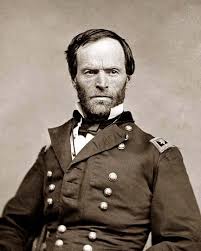
William Tecumseh Sherman, frequently considered the first “modern” general, was above all, the indispensable lieutenant to Ulysses S. Grant.

sherman

Sherman Meets Lincoln

William T. Sherman (1820-1891), Ohio born and bred, was orphaned as a child and foster-raised by the politically powerful Ewing family. A West Point graduate, he fulfilled his obligations, entered the private sector, and by 1861, was content as the head of the Louisiana Military Academy.

When the Civil War began, he returned North. His brother John was now a United States Senator – a Republican Senator, with Lincoln’s ear.  “Cump,” as his intimates called him, was brought to meet the President, and requested reinstatement in the U.S. Army.  It was William T. Sherman himself who requested a “second-in-command” assignment. He did not want full responsibility. Lincoln likely figured that Sherman knew best, and reinstated him as a Colonel, but soon after promoted him to Brigadier General.

It was disastrous. Always considered moody but outspoken, Sherman came to an early conclusion that the War would be long, hard, and cost tens of thousands in casualties. This was diametrically contrary to the conventional wisdom and considered opinions of his military higher-ups. They declared that Sherman was “deranged,” and in dire need of a rest. They packed him off to Ohio to recuperate.  Once determined that “Cump” was sufficiently recovered, (perhaps because the Union Army was in dire need of experienced leadership), he was declared fit for service.

Sherman’s Crucible: Shiloh

sherman

William T. Sherman, considered by many to be the first “modern” general.

At a little town in Tennessee called Pittsburg Landing, immortalized by its tiny Shiloh Church, Sherman’s seeds of greatness were sown. It did not begin well. Believing that the rebels were nowhere in sight, he was completely surprised the morning of April 7, 1862, when forest critters came running out of the woods, followed by the Confederate cavalry yipping their distinctive whoops.

Sherman sprang into action, rallying his division, riding between his lines, shoring up the ranks as needed. Ulysses S. Grant, senior commander at Shiloh, was doing the same, on a higher level. He rode all day, back and forth between his divisions, checking on his subordinates and their armies.

lt-grant

Ulysses as a young Lieutenant. He was two years younger than Sherman, but outranked him during the Civil War. Sherman never objected.

Grant and Sherman had been casually acquainted since West Point, where Sherman, an upper-classman had only superficial contact with Cadet Grant. Subsequent meetings during the next fifteen years were similarly casual. This time would be different. When Grant came to assess Sherman’s position and options, he realized quickly that his subordinate was doing precisely what he himself was doing: covering and adjusting his responsibilities as needed – back and forth and continually. Satisfied that Sherman was in control of his situation, he moved on to another part of the bloody field. They thought alike.

Later that night, in a driving rainstorm, Sherman went to find Grant, who had taken shelter under a huge tree. “It’s been a devil of day, Grant,” Sherman is quoted to have said. Grant nodded and replied, “Yup. Whip ‘em tomorrow, though.” Then the two men were silent, puffing on their cigars under a tree in the rain, on the bloodiest battlefield the world had ever known.

They had become friends.

Sherman’s Maturity: Vicksburg

Capturing Vicksburg, an impregnable fortress in an unassailable position on the Mississippi River, was arguably Grant’s most daunting assignment, and would be his finest victory, albeit excruciatingly difficult.

USG-2

General Grant and General Sherman were said to be “together,” the best general ever!

Ulysses S. Grant was not a general of the war-council. While he was always accessible to his commanders’ suggestions, he preferred to work alone. He designed six or more “feints” or proposed plans of attack – including digging miles of canals – while he waited for the mud soaked terrain to improve. Sherman was involved in these ancillary efforts, performing dutifully and capably. He was beginning to understand his somewhat enigmatic commanding officer.

What he did not understand was Grant’s proposed objective to bring the Army below Vicksburg and attack the fortress from the rear. Like most of Grant’s staff, he thought the strategy was dangerous and doomed to fail. Adding to the insanity was the presumption that Grant was detaching his army from its supply line – a classic verboten in military manuals. No food. Limited medical supplies. No communications.

Sherman, Grant’s ablest and most loyal subordinate general, had grave reservations. He drafted a well-conceived, well-worded memorandum of opposition and sent it for Grant’s review. Grant concurred with all of Sherman’s reservations and comments. It was very risky, Grant agreed, but he believed it was worth the risk, and Vicksburg could be taken.

Sherman, the loyal lieutenant, followed his captain. Grant was right. The risks were worth taking, and the victory at Vicksburg would crown Grant with glory, and plant new strategic concepts in Sherman’s head.

William T. Sherman: Lessons Learned

shermanquote

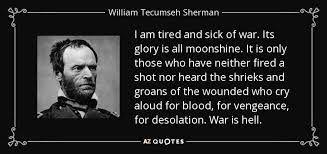
Sherman was always a soldier – never a politician. He called it “true.”

Sherman, in his “derangement” had been correct all along. Three years after Fort Sumter, the war was still raging, and the casualties were in the hundreds of thousands. By mid-1864, Grant had been sent to command the entire Army with Sherman in full command of the western armies. If Grant became known as the “butcher of the battlefield,” Sherman could be called the “butcher of the battleground.”

marchingthroughgeorgia

Sherman marches to the sea. And makes Georgia howl – just like he declared.

He had learned well from Grant’s examples: trusting his own instincts and taking calculated risks. He also understood, perhaps better than anyone else, (and perhaps better than he himself realized) that war is truly hell. In Sherman’s eyes, war had ceased being armies facing armies on a battlefield, and began to emerge as a total entity of itself: destroying the enemy’s ability and will to fight on.

He said he would make Georgia howl, and he did precisely that. Leading three separate armies in a hundred mile swath, William T. Sherman marched across Georgia, destroying everything in his wake. The property damage would be horrendous, but the casualties, in comparison to Grant’s battles, were minuscule. Nevertheless, the South would never be quite the same again. Nor would waging war.

Sources:

Catton, Bruce – The Civil War – Fairfax Press – 1980

Flood, Charles B. – Grant and Sherman – Farrar, Straus, 2005

Grant, Ulysses S. – Personal Memoirs of Ulysses S. Grant – World Publishing (reprinted) 1952

http://www.pbs.org/wgbh/americanexperience/features/general-article/grant-sherman/

Posted in American Civil War, Nifty History People, Ulysses S. Grant | Tagged , , , , , , , , , , , , , , , , , , , , , , | 3 Comments

The White House New Year’s Day Reception

earlywashdc

An early artistic rendering of Washington DC about the turn of the 19th century.

After two years in New York and ten years in Philadelphia, the capital of the country was moved to Washington at the very end of 1800.

The Dismal Days

Washington DC was just opening for business in late 1800, after a ten-year building process. Designed and built practically from scratch from donated pieces of Virginia and Maryland, the new city was muddy, full of building debris, stray dogs, cats and pigs, unpaved streets, fields of weeds, and huge distances between neighbors.

john-adams

John Adams was the first POTUS to open the White House for a public reception on New Year’s Day – in 1801.

President John Adams came to the White House alone. His wife Abigail joined him shortly afterwards, along with John and Esther Breisler, their long-time stewards.

The place was cold and damp, basically unfurnished other than what Adams brought himself. No one was there to welcome him. The inhospitable atmosphere was matched by the President’s private feelings. His presidency had been troubled and generally unsuccessful, and he had recently lost a bid for a second term to his Vice President and good friend Thomas Jefferson. He had also come to suspect a widening rift marring their quarter century of friendship.

His few weeks in residence in the unfinished President’s House would not be happy.

Nevertheless, Adams began what would become an annual event for more than a century.

New Year’s Day: 1801

white house 1807

One of the earliest images of the White House – circa 1807.

George Washington had instituted a Presidential open house reception on the 4th of July, both in New York and in Philadelphia. Everyone was invited. No formal invitations were needed.

As Chief Occupant in the new President’s House in Washington, especially in a centennial year, Adams believed it was the “people’s” house, and it was incumbent upon him, its first resident, to extend hospitality. Thus, on New Year’s Day, 1801, the doors were open to any and all persons in Washington who wished to come by, shake his hand and exchange greetings.

A year later, Jefferson, urbane and sophisticated, followed suit and cordially greeted any and all who wished to shake his hand on New Year’s Day.

Thus a tradition was born and continued.

Traditions

Public Presidential receptions differed somewhat from official or private ones. The purpose was to express cordiality to the general public. Refreshments were either very modest or not included. (Presidents were expected to pay for their guests’ refreshments out of pocket until the time of Calvin Coolidge.)

andrew jackson 1

Hordes of well-wishers came to Andrew Jackson’s New Year’s Day receptions.

As the town grew, the New Year’s Day reception lines grew longer.  And if a person, male or female, was properly dressed (most of them in their finest clothes) and willing to stand patiently in line, they were welcome.

Except for slaves. Or even free blacks. It was not a written rule originally, but a tacit understanding. Few blacks could be “properly” dressed, and few blacks – or whites – would be comfortable standing next to each other in line.

By the time of Andrew Jackson, the white population of Washington had grown from some 10,000 in 1800 to nearly 28,000 in 1830. Jackson, a man-of-the-people, attracted thousands of proletariat followers. Clothing was more rustic, manners more coarse, but the people still came to shake hands with Their Hero, who seemed pleased to shake hands with them.

New Year’s Day: 1863

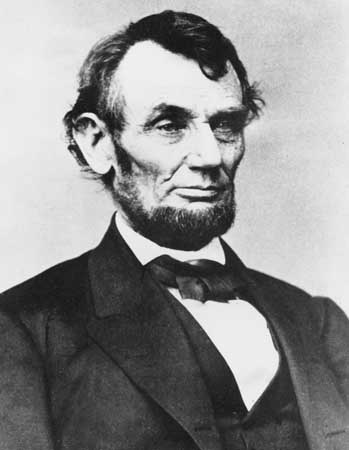
The annual New Year’s Day reception in 1863 is arguably the most important event in the Reception’s history. Abraham Lincoln was President, and the Civil War was raging.

President Lincoln

The New Year’s Day reception of 1863 is arguably the most important. President Lincolns Emancipation Proclamation was going into effect.

It was a Thursday. Earlier that morning, a somber President, well aware of the momentous occasion, retweaked any final changes he wanted made and had the final copy of the Emancipation Proclamation prepared. Then at 11a.m., as customary, the Blue Room reception began, for high ranking public officials and invited guests. A half hour later, the White House doors were opened to the public, and for the next three hours, the President duly shook hands with any and all who had waited in line. Mrs. Lincoln, who was still in mourning for their son Willie who had died less than a year earlier, knowing the importance of this particular day, came for an hour.

At three p.m. the public New Year’s Day reception ended, and the President moved to a different room to sign his carefully written full name to the Emancipation Proclamation.

Hundreds of Northerners who had been active in anti-slavery efforts, some for a generation, had flocked to Washington for this welcome event. Thousands had lined Pennsylvania Avenue waiting to shake the President’s hand. His arm grew tired. His kid glove was stained by contact with thousands of hands. But everyone who came was welcome.

The following year, there were a few well-dressed, cultured and educated Negro attendees admitted to the Reception. It was the first time they had been permitted to attend a social event in the White House.

The End of the Receptions

Sargeant Teddy

TR perfected a handshake that moved the crowds forward like an assembly line.

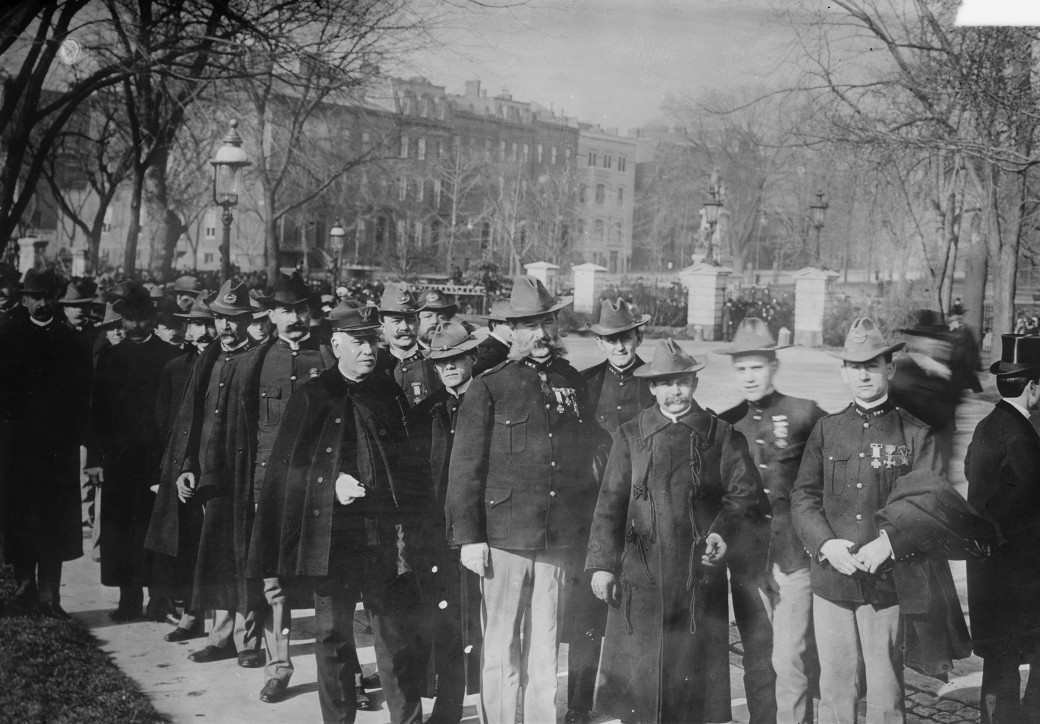
nyreception-1909
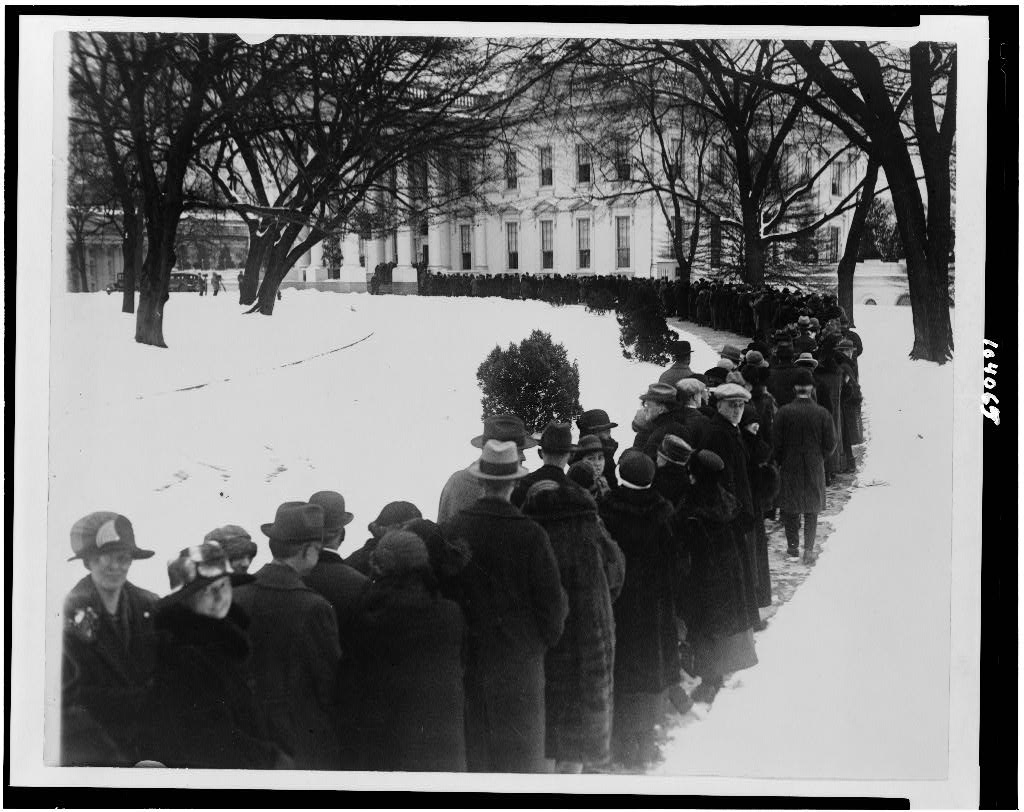
Crowds lined up for the 1909 New Year’s Day Reception.

As time went on, the New Year’s Day receptions became cumbersome and onerous for the President. Some, like Theodore Roosevelt who was naturally gregarious, perfected a handshake that firmly pushed the visitor along, while controlling the strength of the handshake itself.  By 1900, the population of Washington DC was over 279,000, not counting visitors. By the twentieth century, the estimate was more than 9,000 attendees and was becoming annoying for the president, who complained of a sore arm and hand.

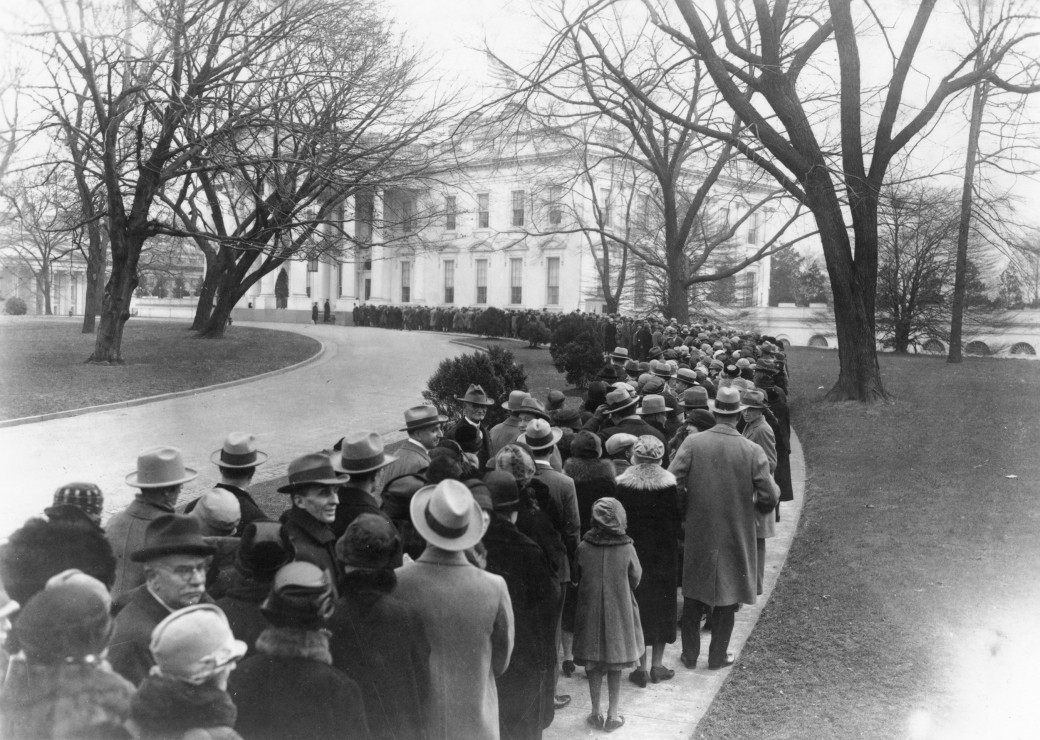
crowdnew-year-reception

A crowd lines up outside the White House for the annual New Year’s Day Reception.  Notice the weather.

Then there was the obvious problem: Cold, wet, damp weather, with attendees standing outside, perhaps for hours, coughing and sneezing, chilled to the bone.  It had become a serious health concern.

nyreception-1927

One of the last images of crowds lining up for the New Year’s Day Reception.

The last New Years Day Reception was held in 1932. Herbert Hoover had followed the protocol three times, but by 1933, whether it was from his own disinclination to press the flesh, or the unwieldy (and unhealthy) crowds, or even a perceived threat to his personal safety, since the Great Depression was gripping the country, he was “out of town” on New Year’s Day.

No President since has sought to revive the old custom, and today, the logistical and security problems would make it completely impossible.

Sources:

Brandus, Paul – Under This Roof: The White House and the Presidency – Lyons Press, 2016

Landau, Barry H. – The President’s Table: Two Hundred Years of Dining and Diplomacy – Harper-Collins, 2007

http://www.history.com/this-day-in-history/john-adams-moves-into-white-house

http://www.smithsonianmag.com/history/how-the-emancipation-proclamation-came-to-be-signed-165533991/?no-ist

Posted in A POTUS-FLOTUS Blog, Presidential Sites | Tagged , , , , , , , , , , , , , , , , , , , , , , , , , , , | 6 Comments

Roosevelt and Remington: The Cowboy and the Sculptor

Theodore Roosevelt was an unlikely cowboy. Frederic Remington was an unlikely sculptor of the West.

Roosevelt the Cowboy

Teenaged TR

Theodore Roosevelt was a sickly child who built his body by sheer will and exercise.

Theodore Roosevelt (1858-1919)was a wealthy New Yorker by birth and upbringing. A nearsighted and asthmatic child, he overcame much of his frailty by sheer will and family encouragement. His physical weaknesses helped channel his interest in natural science however, since it could be enjoyed via his collections of plants and rocks and small critters. By the time he was twelve, he was a bona fide taxidermist with a great love of the outdoors.

Theodore had many varying interests, and his Harvard education led him into politics (Republican) and the writing of history.

When his first wife died in childbirth at only twenty-three, a distraught Theodore went to the Dakotas to heal his grief and sow the seeds of his own greatness.

cowboy-ted

TR outfitted himself for his western adventure – and had his photograph taken.

He immediately astounded the locals with his Abercrombie and Fitch outfit, his thick spectacles on a silk cord, his Harvard-Eastern accent, and his quaint way of speaking. They didn’t know what to make of him,until he bought a small ranch and a herd of cattle, and proved his mettle, riding long hours, eating “grub”, sleeping under the stars, shooting varmints and rounding up the bad guys. They loved him. They also respected him. The fact that his ranch failed was never held against him.

Some historians claim that Theodore Roosevelt would never have achieved what he did if he hadn’t “gone west.”

Frederic Remington: Western Sculptor

fredericremington

Frederic Remington. Artist. Sculptor. Bon vivant.

Frederic Remington (1860-1909) was also a New Yorker, albeit upstate, with as fine a pedigree as Roosevelt. He could trace his lineage to both George Washington and western artist George Caitlin. Remington displayed a superior talent for art as a youngster, along with decidedly unacademic inclinations. He much preferred the outdoors, athletics and drawing.

remingtonsketch1

Frederic Remington made his reputation and fortune sketching characters and scenes of the old west.

Nevertheless, he managed to go to Yale. For one semester. He spent more time with athletic programs than studies. Returning home, he admitted to his general laziness and decided to live off his income, and perhaps do a little newspaper reporting and illustrating. In short, the gentleman’s life.

remingtonsketch2

Remington sketches were so popular they were issued in book form.

At nineteen, with vague thoughts of buying a ranch or something similar, Remington went west. He invested in ranching, but those efforts failed. He preferred the comforts of indoor life, and his neighbors thought him lazy. He began sketching the Wild West right before the wildness of it disappeared forever with the railroad and the settlers. He sold a few paintings to the locals, and sent some sketches back east to the newspapers and magazines. His true calling was becoming clear.

Realizing that his art was still unpolished, and perhaps with some newfound maturity, a 24-year-old Remington returned to NY, studied at the Art Students League, improved his technique, and by 25 was a regular contributor to several magazines eager to capture the feel and experiences of the Wild West.

Roosevelt and Remington: Common Bonds

remington-roosevelt

Remington and Roosevelt team up as author and illustrator.

Remington was making a serious name for himself in the art world. Harper’s, Leslie’s and Century magazines, the cream of the publication world, gave him plum assignments. He was making a living through his art. He was also beginning to collect the artifacts and colors and sinew for what his art would become.

His biggest break came in late 1886 when he was commissioned to provide more than 80 illustrations for Theodore Roosevelt’s Ranch Life and the Hunting-Trail, to be serialized in Century Magazine prior to book publication.   TR, also an ex-cowboy and rancher (but never lazy!) and the young and brilliant artist became friends for life.

remingtoncover

Magazines featured Remington drawings regularly.

remingtoncover2

Another magazine cover for Frederic Remington

Remington’s career was beginning to soar. He was hailed as one of America’s greatest painters. He won prizes at the Paris Exposition. At 29, he had a one-man show. In his thirties, he had discovered sculpting. His prowess as well as his enthrallment with it came as a surprise, but his instant success with bronze casts elevated him to a whole new status.

Meanwhile, TR’s career was also rising, and falling, and zig-zagging, but always on an upward level. TR just didn’t quite know what career he wanted. Politics? Writing? Or the natural sciences he had loved since he was a boy. He decided to do everything.

Rough Riding with TR and Remington

rough-rider

Theodore Roosevelt, Rough Rider

When a potential war with Spain was churning, Frederic Remington was in his late-thirties; not only an artist-sculptor of renown, but also one of the country’s leading sketch-journalists. Roosevelt was just shy of forty.

TR, having decided to focus on politics, and maintain natural science and writing as side-interests, was now Assistant Secretary of the Navy, itching to prove himself in some other way than behind a desk. The War with Spain would do that.

remingtonmexwar

One of Remington’s sketches in Cuba.

TR, gathered a volunteer regiment of cowboys, Ivy League college fellows and New York City policemen to form the Rough Riders.  He was commissioned Lt. Colonel, and took them to Cuba. Remington was sent there by the newspapers to sketch and report the action. Both men performed their respective assignments brilliantly, certainly in the sense that it would bring them exceptional fame.

The Broncho Buster

The “bully little war” with Spain was mercifully short, and the Rough Riders et al were mustered out in Montauk, Long Island some six months later. Due to the high rate of yellow fever, malaria and assorted tropical diseases, the army was quarantined there for several weeks.

bronchobuster-2

One of the original castings of Remington’s Broncho Buster was presented to TR as a gift from his soldiers.

When the Rough Riders were formally disbanded, Colonel Roosevelt was surprised when his men chipped in and presented him with one of the original bronze casts of Frederic Remington’s most famous western sculptures: The Broncho Buster. Thousands and perhaps millions have been cast in reproductions. An original casting would be worth well into six figures today.

TR was deeply moved by the token of affection and esteem, as well as the choice of gift. It was placed prominently in the great North Room at Sagamore Hill, and he always declared it to be one of his most prized possessions.

It is still there today. If you visit Sagamore Hill, you will see it.

Sources:

Corry, John A. – A R0ugh Ride to Albany: Theodore Roosevelt Runs for Governor – Fordham University Press, 2000

Brands, H.W. –  TR: The Last Romantic  – Basic Books, 1997

McCullough, David –  Mornings on Horseback  – Simon & Schuster, 1981

https://www.nps.gov/thro/learn/historyculture/theodore-roosevelt-the-rancher.htm

http://www.frederic-remington.org/biography.html


Posted in A POTUS-FLOTUS Blog, Nifty History People, Theodore Roosevelt | Tagged , , , , , , , , , , , , , , , , , , , | 5 Comments

Mrs. Grant and Mrs. Davis: A Healing Friendship

Two Civil war icons, one North, one South, finally met in old age, and became friends.

Varina Davis: The Confederate Queen

Varina Davis (1826-1905) first appeared on a national stage when she was eighteen and recently married to Congressional widower Jefferson Davis, nearly twice her age.

young varina

Mrs. Jefferson Davis as the Confederate First Lady.

The tall (around 5’10”) dark beauty mingled at the highest levels of US government.  From the start, she became her husband’s secretary and amanuensis, taking dictation for his letters and notes and speeches. It was a career that lasted for the rest of his life.

By the time Jefferson Davis was elected Confederate President in 1861, they both had enjoyed close friendships with many of their northern counterparts. A Mississippian by birth, Varina had close relatives in the North, and those deep personal ties  would work to her disadvantage as the Confederate First Lady.

Like Mary Lincoln, the Union First Lady, many of her “countrymen” suspected her allegiance. They also disapproved of her political savvy and influence on her husband.

Bottom line: she was not popular. Nor was her husband.

Varina Davis: Post-Civil War

By 1865, the once wealthy Davises had lost a huge amount of their property and fortune. Davis also lost his freedom and spent two years incarcerated in Fortress Monroe.

Once released, the Davis family were wanderers. Their once-prosperous plantation in Mississippi had been devastated past repair. Davis’ main concern was providing for his still-young family. Being past sixty, in poor health and political status, this presented difficulties.

Davis kids

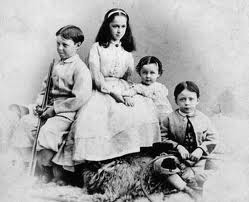
In 1866, the Davises had four children under twelve.

Jefferson Davis died in 1889, at 81.  His reputation, at least in the South, had begun to mend. Hers, however, had not. Only two children of the six she had borne remained. Her once-willowy figure had grown bulky. Her suspected Northern allegiances still rankled ex-Confederates. And her finances were precarious.

An opportunity arose when an admiring Joseph Pulitzer offered her a position writing for his newspaper in New York. Interestingly enough, while much of the South was still cool, the North found Mrs. Davis interesting and delightful.

Julia Grant: The Early Years

Julia Grant (1826-1901) and Varina Davis were the same age. Born to a middle-class St. Louis planting family, she met West Point graduate Ulysses S. Grant when she was barely eighteen. He was twenty-one. It would be four years, punctuated by the Mexican War, before they married.

Julia Dent Grant

Julia Grant as a young bride.

His up and down career during the 1850s was mostly down, despite their four children and obvious marital congeniality. By 1861, ex-Captain USG was at the bottom of his fortunes, working at a job he hated: a clerk in a tannery owned by his father.

Despite his plodding routine, surrounded by Julia and the children, he was happy. And they were happy.

Julia: The Civil War Years and After

By her own admission, Julia Grant spent the four years of the Civil War as either “Penelope” waiting for her Ulysses, or as a nomad, with children in tow. The ex-Captain rose quickly in a Union Army sorely in need of competent, experienced professional officers.

Once again it was up-and-down for Grant, but this time, the downs were glitches and the ups were giant leaps forward. Grant wanted his wife nearby, and Julia joined him whenever he summoned. And despite her Southern-ish, slave-holding family ties, her allegiances were never suspect.

grant-family-4

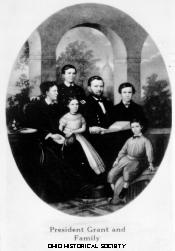
General Grant and family.

By the end of the War, General Grant was the general, the hero, the man of the hour, with fortunes assured.

By 1868, USG was a shoo-in for the Presidency. While the Davises wandered, Julia spent her happiest eight years as mistress of the White House. Never a beauty nor witty in conversation, she was always a pleasant, sociable person who made friends easily.

After the Presidency, the Grants spent two years traveling the globe, feasted and feted by Kings, Queens, Emperors and even the Mikado of Japan.

Julia: Later

A yo-yo life seemed to follow the Grants perpetually. The highest of all fortunes soared briefly, and then, once again plummeted.

When Grant was 62, a business venture failed ignominiously, bankrupting him. Within months, a diagnosis of terminal throat cancer followed. To provide for Julia and his family, to repay his creditors and to rescue his good name, he raced the clock, writing his war memorials. A week after the final edits, he died.

elderly julia

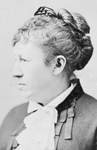
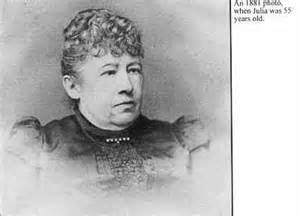
Julia as a middle-aged woman.

Grant’s Memoirs were a huge success, making Julia a very rich widow. She traveled as she pleased, and surround herself with a close-knit family and many friends. And like Varina Davis, she had become a city girl, with a town house in New York.

The Friendship

In 1893 there was a celebration at West Point, an institution dear to both Davis (class of 1828) and Grant (class of 1843). Both in their late sixties, the Widow Grant and the Widow Davis attended the ceremonies.

They had heard of each other of course, but had never met.

elderly varina

Varina Davis in her elder years.

It turned out they were both staying at the Cranston-on-Hudson Hotel, and it was Julia who learned of the coincidence first. “Oh, I have always wanted to meet her,” she is said to have remarked.

She inquired of Mrs. Davis’ room number, and knocked at the door. It was a pleasant surprise for Varina, who invited her in, and a friendship began.

grants-tomb

Grant’s Tomb in New York City. Varina Davis attended the dedication with Julia Grant.

The two iconic women of the Civil War discovered they lived within blocks of each other in New York City, and we’re both social and active, having left partisan politics behind decades earlier.

Varina Davis had been hosting a small salon for some time. Always intellectually inclined, she patronized the galleries, theatres and lecture halls. Julia, as always, had dozens of friends. Now she would have one more.

They were seen periodically driving in an open carriage en route to lunch or a drive through the park, chatting away, as if they had known each other for years.

When Grant’s Tomb was dedicated in 1897, Julia Grant sent a personal invitation to Varina Davis to attend the ceremonies.  It has been suggested that in its own way, their friendship helped knit the North and South back together.

Sources:

Ross, Ishbel – The General’s Wife – Dodd, Mead, 1959

Ross, Ishbel – First Lady of the South: The Life of Mrs. Jefferson Davis, Greenwood Press, 1958

http://www.southernheritage411.com/news../1230.php

http://www.firstladies.org/biographies/firstladies.aspx?biography=19

Posted in A POTUS-FLOTUS Blog, Nifty History People, Ulysses S. Grant | Tagged , , , , , , , , , , , , , , , , , , | 3 Comments

Eleanor Roosevelt’s Road to Val-Kill

eleanor%20roosevelt

Eleanor Roosevelt, at the time she became “Eleanor Roosevelt.”


Eleanor Roosevelt was nearly forty before she had a life, and place of her own.

FDR, Eleanor and Polio

The marriage between Franklin and Eleanor Roosevelt, fifth cousins by birth, had never been a joyful one. Their personalities were poles apart, and while they truly cared for each other and recognized and appreciated the others’ strengths, the young Mrs. Roosevelt was never comfortable – or happy – with motherhood and matronly engagement in the social scene of the New York well-do-do. Her volunteer work helping new immigrants and World War I soldiers was far more satisfying.

young couple

The young Mr. and Mrs. Franklin Delano Roosevelt.

the-formidable-mama

Sara Delano Roosevelt, on the cover of TIME Magazine.

Sara Delano Roosevelt, Franklin’s overbearing mother, was another cross to bear.  Eleanor, still in her twenties, did not have the self-confidence to wrest control of her life (or family) from the domineering woman.

When he was thirty-nine, Franklin D. Roosevelt was stricken with polio. His political career had been a steady rise to a point of becoming the Democratic Vice Presidential candidate in 1920. It would now fall to Eleanor to provide the impetus and continual spur to keep him engaged in life, living and politics.

Eleanor Becomes “Eleanor”

At the end of World War I, Eleanor Roosevelt discovered that her husband had become romantically involved with another woman. It was a devastating blow to the inward and unfulfilled woman. After fifteen years of marriage, she was at a crossroads. She had borne six children in ten years. One died. She was further trapped between an overbearing mother-in-law and a time-consuming round of social obligations that she hated.

franklin_roosevelt_secretary_of_the_navy_1913

Franklin Delano Roosevelt, about the time he was thirty.

She offered her husband a divorce. He was ambivalent, but his mother was horrified by the scandal. She threatened to cut her son off without a cent. FDR’s longtime political advisor, Louis Howe, was also adamant, insisting that FDR was cutting his own political throat.

Franklin and Eleanor came to an amicable resolution. They would remain married, but they would lead emotionally detached lives. Since neither of them were bitter or rancorous people, each cherishing personal harmony, they could make their new relationship work.

Eleanor and Franklin: The Long Separations

Once the acute phase of his illness had passed, FDR’s main goal was his health and regaining his mobility, which would forever be denied.

His treatment centered on swimming in the warm waters of Florida and Georgia; he was  gone for weeks and even months at a time.

hydeparkestate

The Roosevelt estate at Hyde Park. It is a magnificent place.

The five Roosevelt children were now in boarding school. The huge estate in Hyde Park, about an hour from New York City, was her mother-in-law’s. Not hers. Not even her husband’s. Eleanor felt more like a guest than a resident.

She began to find interests of her own; interests that had surfaced decades earlier with her volunteer work in the settlement houses of the Lower East Side. She had loved it.

Eleanor as Eleanor

louis-howe

Louis Howe would be a close political friend to both Franklin and Eleanor Roosevelt.

Eleanor had never been an active suffragette, but when women got the right to vote in 1920, Eleanor joined the League of Women Voters, and at Louis Howe’s suggestion, and with her husband’s enthusiastic support, she became active in the women’s division of the Democratic Party. This led to her acquaintance with dozens of women whose interests coincided with hers.

With FDR and the children away, there was little to keep her at Hyde Park. Her outside activities increased, and her political connections (being niece of Theodore Roosevelt and wife of FDR) were excellent credentials.  There was also her own innate abilities. Her opportunities broadened. She loved it.

Sara Roosevelt was displeased. She had been unenthusiastic by her son’s political inclinations at best. To have a daughter-in-law off and running in such “unladylike ” circles was horrifying. Eleanor spent more and more time away from Hyde Park.

A Place of Her Own

val-kill

The Val-Kill cottage on the Hyde Park property was Eleanor’s own getaway. The entire Roosevelt family used it frequently, however.

It was FDR, aware of his wife’s discontent with the old life and fulfillment in the new, who suggested that she might like having a place of her own. Somewhere where she would not feel constrained. Where she could invite her friends, chair committee meetings in comfort – or even stay up late to read or write. Without disturbing anyone.

The Hyde Park estate was large, with plenty of room to build a separate cottage. FDR was always eager to make his wife happy when and if he could. Of course Eleanor would always stay in the “big house” whenever FDR and the children were in residence. For appearances and convenience.

val-killinterior

The furnishings at Val-Kill were pure Eleanor. Functional.

It was truly a cottage – only six rustic rooms. Eleanor had been an enthusiastic sponsor of a consortium of local craftsmen in the nearby village of Val-Kill, ergo, her “cottage” was furnished by those craftsmen. The arts-and-crafts utilitarian style suited Mrs. R. perfectly. She always preferred function to decor. And knowing that it helped support local interests and families was a primary benefit.

FDR was more than a mere supporter. He became a frequent visitor when he was home. In appreciation, Eleanor had a swimming pool built on her property, since the large estate did not have one, and swimming was an essential exercise in FDR’s health regimen. The entire family used it during warm weather.

The Estate

FDR

President FDR. He was sixty when his mother died and the Hyde Park property became “his.”

FDR did not become the owner of the Hyde Park estate until 1941, when his formidable mother died.

eleanoratval-kill

Eleanor never stayed in the main house after FDR’s death. Val-Kill would be her “home.”

With his wife’s agreement, the President made his will, which included arrangements for the estate’s future. After his wife’s death, the property would go to the government and provisions were made to build a Presidential Library, the first planned by a living president.

Eleanor survived him by more than fifteen years, and saw the completion of the FDR Library.

The former First Lady never lived in Hyde Park again. Val-Kill would be her home from then on.

Sources:

Roosevelt, Eleanor – Autobiography of Eleanor Roosevelt – Harper & Bros. 1961

Cook, Blanche Wiesen – Eleanor Roosevelt: Volume One 1884-1933 – Viking Press, 1992

http://www.firstladies.org/biographies/firstladies.aspx?biography=33

http://www.fdrlibrary.marist.edu/education/resources/bio_er.html

Posted in A POTUS-FLOTUS Blog, Franklin D. Roosevelt | Tagged , , , , , , , , , , , , , , , , , , , , | 2 Comments

U.S. Grant: The Shiloh Tree HQ

Army Generals in the Civil War usually commandeered the best houses in the area for their Headquarters.

Pittsburg Landing, TN

Pittsburg Landing, TN was a small village on the Tennessee River. Control of that river, which flowed into the Mississippi, was essential – both North and South. The North needed to choke off supplies to the Confederate army. The South needed their supply lines to remain open.

usgrant

Ulysses S. Grant was the Union commander at the Battle of Shiloh.

Battlefields are seldom planned, but in this case, the battle was generally expected. General Ulysses S. Grant, the recent hero of Forts Henry and Donelson, was assigned command of a large army of some 40,000 soldiers to wrest complete control of the  Tennessee River.

albertsjohnston

General Albert S. Johnston was in command of the Confederate forces – on the first day.

doncarlosbuell

General Don Carlos Buell was en route by river steamer with 20,000 reinforcements.

Opposing him was General Albert Sidney Johnston, the best they had, according to Jefferson Davis. (General Robert E. Lee was still riding a desk in Richmond.). He was there to secure the river with his army of nearly 40,000. Scouts had been sent by both sides. They knew what was coming. Grant had already sent for General Don Carlos Buell to come with his 20,000 soldiers.

So the battle, named for a small Dunkers church named “Shiloh,” out in the middle of nowhere, was not a surprise. Everyone knew a battle was inevitable. They even knew the probable location. Both sides were prepared.

shilohchurch

A recreation of the little Dunker Shiloh Church, for which the battle is named.

The Surprise

What was a surprise, and what always remains a somewhat-controversy, is when it occurred.

battleofshiloh

An artistic rendering of the Battle of Shiloh – the bloodiest battle of the Civil War.

Early in the morning of April 6, 1862, Union soldiers were just rising, their campfires lit to fry bacon and heat coffee. There was no cause to expect any fighting that day.

All of a sudden, there was a rustle of branches and trees, and forest critters came running out of the woods and into the camps. This was immediately followed by Southern cavalry yipping their rebel yells! The battle was on.

General Grant was in severe pain. The ground had been soaked by torrential spring rains, and two days earlier, his horse slipped in a muddy crevice and rolled over, trapping his rider’s ankle. It was not broken, but it was badly bruised, and so swollen that his boot had to be cut off. He was still using a crutch.

But as soon as word came that the armies had engaged, Grant mounted his horse and spent the entire day in the saddle, riding for hours from corps to corps, division to division to issue orders, direct strategy when needed, tactics when needed, send reinforcements where needed, and send stretcher bearers and wagons for the wounded – everywhere.

When he arrived at the killing fields of Sherman’s army, he quickly noted that “Cump” was doing exactly the same thing: riding circles within his corps for the same purpose. The two Generals thought alike.

Grant and Sherman

sherman

William Tecumseh Sherman. Some historians claim that Grant and Sherman together, made the perfect General.

U.S. “Sam” Grant and William Tecumseh “Cump” Sherman had known each other since their West Point days. Sherman, older by two years, was two classes ahead. West Point classes in the pre-Civil War days, were small. A graduating class might only number 40-50 cadets, thus everyone at every level would likely have been acquainted.

Grant and Sherman had met on occasion during the next twenty years, but it was a casual old-school-tie. The mercurial-tempered Sherman was faring much better than the laconic and directionless Grant.

But today, on the fiercest battle by the bloody River, the two became “friends.” They thought alike, and anticipated and understood each other without much discussion. Grant was senior to Sherman in command, but he knew intuitively that his subordinate was in complete control of his corps, and was functioning exactly the way Grant would have done in the same position.

The casualties were horrendous. They would get worse. By the end of the day, the battlefields were such that the phrase about walking for a hundred yards upon corpses without touching the ground was born. It would be used again. And again.

Then the torrential rains began late in the day, and an exhausted Grant, with his throbbing ankle, rode back to the small house he had commandeered as his Headquarters. Only his HQ had been re-commandeered by the Army surgeons for the wounded and dying. They had priority.

The Tree

shilohoaktree

An oak tree (questionable if it is the oak tree) similar to the one that sheltered General Grant in the rain.

A few yards from the cabin-surgery was a large oak tree, perhaps 150 years old. Its spreading branches offered a small bit of protection from the deluge, and Grant, with his crutch, leaned against the huge trunk and tried to rest. The rain and the pain became too much, and he hobbled inside the cabin to find a dry corner where he could stretch out and rest his leg.

But the sights and sounds of men vs. saw blades, of the bloody arms and legs being tossed into barrels, and the smell of torn flesh and blood (reminiscent of his father’s tannery that he hated so much) made it impossible for Grant to rest. So once again, he found shelter under his tree.

Sherman had been wounded four times that day, albeit slightly. Now, having tended to his men, he set out to check on his commander. He found Grant leaning against a huge oak tree, hat pulled low over his brow, trying to sleep in the rain.

The conversation is reported to have been such:

Sherman: Well, Grant, it’s been a devil of a day.

Grant: (nodding) Whup ’em tomorrow, though.

Then the two Generals puffed silently on their cigars in the rain.  Grant had heard from Buell. Some 20,000 fresh troops would be there by morning. And it would start all over again.

Sources:

Flood, Charles B. – Grant and Sherman: The Friendship That Saved the Union – Farrar, Straus, 2005

Henig, Gerald S. & Niderost, Eric – Civil War Firsts – Stackpole Books, 2001

Kelly, C. Brian – Best Little Civil War Stories – Cumberland Press, 2010


Posted in A POTUS-FLOTUS Blog, American Civil War, Nifty History People, Ulysses S. Grant | Tagged , , , , , , , , , , , , , , , , , , , , | 1 Comment