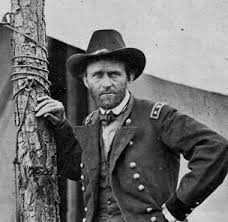
Grant and Buckner: Three Conversations

The quintessential General Grant

U.S. Grant and S.B. Buckner were cadets at West Point.

Cadets Grant and Buckner

Ulysses S. Grant, class of 1843, and Simon Bolivar Buckner, class of 1844, were both midwesterners of middle-class standing both financially and academically.

West Point classes were small prior to the Civil War, perhaps 40 or 50 cadets. Most students had at least a passing acquaintance with their upper and lower academy mates.

Grant, an Ohioan, was a year ahead of Buckner, unremarkable except for his “U.S.” initials and his superb horsemanship. He graduated mid-class.

Simon Bolivar Buckner, a Kentuckian was likewise unremarkable, except for his “namesake” monicker and his good looks. He also graduated in the middle of his class.

Confederate General Simon Bolivar Buckner

The acquaintanceship between them was pleasant, but casual.

Lts. Grant and Buckner renewed their cordial old-school-ties during the War with Mexico. Then they went their separate ways. Grant remained in the Army; Buckner, always drawn to the military and then seduced away by civilian opportunities, joined-and-resigned the army several times, with no detriment to his career or advancement. It was commonplace.

Grant and Buckner: The First Crucial Conversation

When gold was discovered in California in 1849, the Army sent troops to the territory to maintain a presence – and order.

Second Lt. Ulysses S. Grant

Grant, a recent husband and father, was assigned to quartermaster duties fifteen hundred miles away from his dearly beloveds. Bored with his duties and desperately homesick for his family, he fared badly and began to drink. Faced with the threat of dismissal, Grant resigned, and slowly made his way back home.

He was broke when he reached New York City, and by chance ran into Simon Buckner. Legend has it that Grant asked his old friend for a loan, and Buckner, in more comfortable finances, advanced the funds.

The sentiment and background is true, but the details are not. According to Buckner many years later, Grant was down on his luck, but had wired his father asking for traveling money, and was waiting for the funds. The hotel manager was pressing however, and refusing him further credit. Buckner said that he knew the manager, and would vouch for his old friend. He convinced the manager that Captain Grant was an honorable man and good for his debts. Grant gained an extra day or two of room and board.

No money exchanged hands, but Buckner was a friend when a friend was needed, and Grant never forgot.

Grant and Buckner: The Second Crucial Conversation

General Grant with four stars.

A decade later, a more noteworthy meeting took place between the two old friends at Ft. Donelson, TN. The Civil War was raging, and both ex-West Pointers were now Generals – on opposing sides.

Buckner was one of three generals defending the large fortress on the Cumberland River. John Floyd, a “political” general, was senior, and decided to slip away. Having been a member of President James Buchanan’s cabinet, he knew that if captured, he could be hung for treason, a reasonable assumption.

As second-in-command, General Gideon Pillow also opted to slip away believing himself too great a prize for the Union. He had taught Grant and Buckner at West Point, and was a senior officer in the War With Mexico.

That left Simon Buckner.

He sent Grant a formal message, requesting the terms and procedures for surrender. USG replied with a curt note: Nothing but Unconditional Surrender was acceptable, thus earning another one of his nicknames.

Despite the blunt exchange, the actual meeting between the old friends was extremely cordial, according to Buckner – once their business had been accomplished. They reminisced for a half hour, and Grant dryly remarked he would likely have let Pillow go, since he believed he was more valuable to the Union by retaining Confederate command. Neither Grant nor Buckner had high regard for Pillow. Grant added that had he known Buckner was in charge, he would have waited for reinforcements.

Then Grant quietly suggested that since Buckner would be taken prisoner, Grant’s purse was at his disposal. Buckner declined, saying he did not need any money, but they both remembered earlier times.

Grant and Buckner: The Third Crucial Conversation

Mark Twain, a great admirer of General Grant.

More than twenty years passed. Grant’s career was well known. Buckner indeed had been a POW in New England before he was exchanged and reassigned. After the War, he returned to private endeavors, took the oath of allegiance, and even served on-and-off in the United States Army.

Grant’s Memoirs insured financial security for his family.

In 1884-5, ex-President Grant was dying of cancer as well as writing his Personal Memoirs in an effort to provide financially for his family following a disastrous business fiasco.

With the entire country maintaining a death watch during the hot summer of 1885, General Grant was moved from his NYC townhouse to a cooler climate in the Adirondack Mountains. Only a few days before he expired, he was visited by Simon Buckner, one of the very few men the dying General agreed to see.
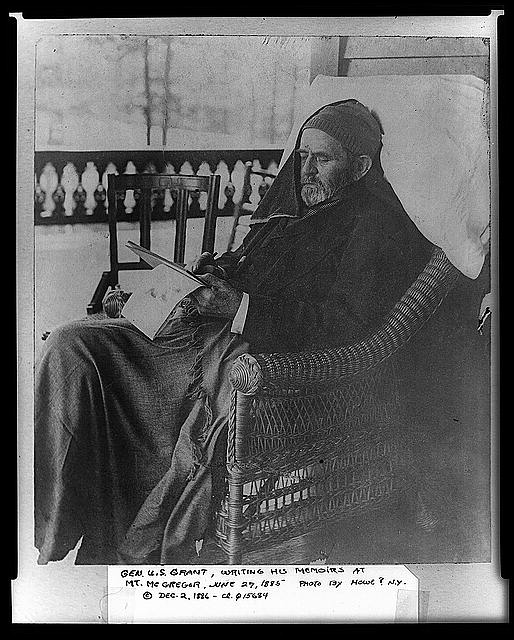
One of the last photographs taken of General Ulysses Grant

Grant could barely whisper a greeting, and communicated by written note, but the gesture of their 40-year friendship was appreciated.

According to Buckner, “I wanted him to know the Confederate soldiers appreciated his conduct at every surrender during the war and after the war in reconstruction days.” He continued, noting that when he returned to New York, newspapers were clamoring for interviews but he declined.  Their meeting was personal and private.

A day or two later, he received word that General Grant desired that their conversation be publicized, and Buckner granted an interview accordingly.

Grant died only days later. Simon Bolivar Buckner, classmate, Confederate and good friend was an honorary pallbearer at his funeral.

Sources:

Flood, Charles Bracelen – Grant’s Final Victory:  Ulysses S. Grant’s Heroic Last Year – 2012, DaCapo Press

Goldhurst, Richard – Many Are the Hearts – 1975, Reader’s Digest Press

Grant, Ulysses S. – Personal Memoirs of Ulysses S. Grant – World Publishing (reprinted) 1952
http://www.granthomepage.com/intbuckner.htm

Posted in American Civil War, Nifty History People, Ulysses S. Grant | Tagged , , , , , , , , , , , , , , , , , , , , , , , , | 5 Comments

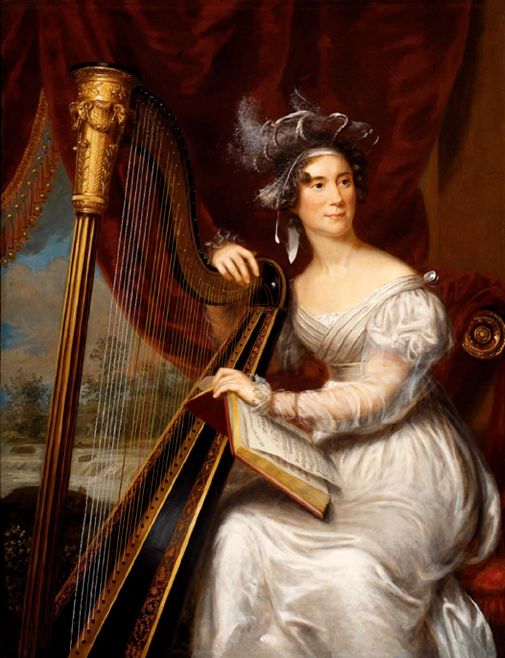
Louisa Adams, Neglected First Lady

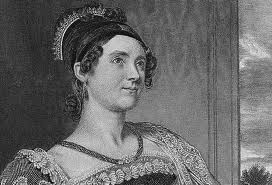
Louisa Catherine Johnson Adams

No one had a better resume for becoming a First Lady than Louisa Catherine Adams.

Louisa: Englishwoman of High Standing

Louisa Catherine Johnson was born in England and well educated in a convent school in Paris. Her American father had relocated to England several years prior to the American Revolution.

Louisa was pretty, with a gift for languages, music and poetry. She played the harp and the harpsichord. She was well trained in the fashionable skills of charm and conversation. In essence, for exactly what she became: the wife and consort of a man of prominence.

JQ in Europe

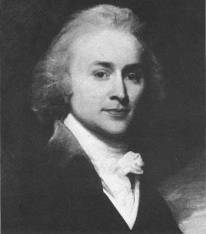
Young John Quincy Adams

At twenty, she met John Quincy Adams, recently appointed Minister to the Netherlands at the start of his illustrious diplomatic career.

During their two year (mostly by correspondence) courtship, Louisa had ample opportunity to sense the cold and critical personality of her intended, and one might be hard pressed (reading their letters) to wonder why she continued the relationship. Nevertheless, the couple married.

Louisa: Learning to Cope

From the beginning, Louisa Adams was relegated to the background of her husband’s life as ornament and mother; nothing like the close and loving domestic partnership between the groom’s parents, the venerable John and Abigail.

As her upbringing dictated, Louisa graced society, smiling and bowing and making suitably pleasant conversation. Her diplomat husband was happy to escort her to the party, and then disappear with his counterparts, to play cards, have a brandy, and conduct private discussions.

The coolness of their relationship in no way precluded her fifteen pregnancies, losing most babies through miscarriage. Only three survived to adulthood. And then, two of them gave their parents grief.

John Adams grew to love his pretty daughter-in-law.

When the young Adamses returned to America with their infant son, George Washington Adams, she finally met her new in-laws. Abigail was distressed that her son married a delicate and pampered Englishwoman; she had preferred a hardier soul, preferably a New Englander. The women’s relationship would be strained. John Adams, however, grew to love his pretty new daughter-in-law, and she, in turn, adored the old gentleman.

In 1809, JQ was appointed Minister Plenipotentiary (i.e. Ambassador) to St. Petersburg, Russia. Without consulting his wife, he arranged for George and John II, their two older sons to remain in Boston; he and Louisa and two-year-old, Charles Francis, would go to Russia. Louisa was devastated at leaving her boys (11 and 9), and begged to remain behind until they could reunite as a family. JQ refused. The senior Adamses, perhaps remembering their own family separations, were not overly sympathetic.

louisa

The cosmopolitan Mrs. Louisa Adams

Louisa would not see her older boys for five years. By that time, they were half-grown men.

Louisa: Mrs. Secretary of State

JQ Adams was a man of great ambition and expectations. His appointment in 1817 as Secretary of State to James Monroe was considered the perfect position. He was arguably the most experienced and cosmopolitan man in the country. His foreign counterparts liked him. Fortunately for both the President and his key Secretary, they got on well. Adams served a full eight years.

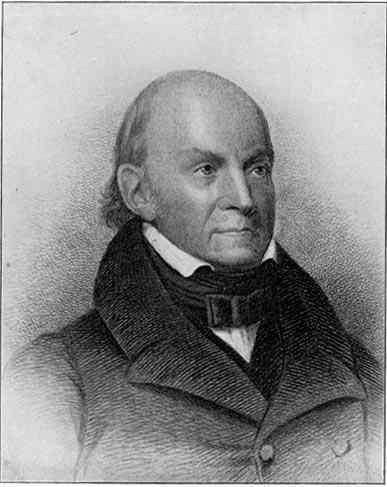
John Quincy Adams in the prime of life.

The family gladly moved to Washington, DC. She was accustomed to a metropolitan environment; JQA also preferred the capital city to provincial Quincy, MA.

Louisa was now past forty. Her numerous pregnancies, and five devastating winters in St. Petersburg, were beginning to take their toll on her health, which thereafter would be chronically iffy.

Mrs. John Quincy Adams

First Lady Elizabeth Monroe preferred a remote social role. It would be up to Mrs. JQA to take up the reins, whether she liked it or not, to become the leader of Washington society. And whether she liked it or not depended a great deal on how she was feeling.

JQ was aware that he was socially inept, with a cold and forbidding persona. He required someone to run interference, and was happy to trot out his charming and politically savvy wife to attend (and host) the various salons, take note of who was there, when they arrived and what was said – all considered superb bellweathers of how the winds were blowing.

FLOTUS Louisa Adams

When JQA became President in 1825, the expected culmination of a sophisticated life of achievement became a daily grind of misery and disappointment. His long-sought election was a four-way contest decided in the House of Representatives. Some believed it was finagled. JQA was more unpopular than ever. His Presidency was thwarted at every turn, despite the considered and progressive programs he espoused.

George Washington Adams, John Adams II,  and Charles Francis Adams

Rather than presiding over a White House glittering with cosmopolitan social events, JQ presided over a tedious table, relieved in part by the brandy flask or wine decanter. Louisa Adams, chronically ailing and menopausal, no longer glittered in society. For all intents and purposes, the couple were estranged in the White House. When apart, their letters were formal and stilted. He called her “Madam;” she addressed him as “Sir.”

First Lady Louisa Adams kept to her room a good deal of the time, reading, writing poetry, and even penned a little play called The Adventures of A Nobody. Their last days at the White House were grief-filled by the misadventures of their sons. George had become an alcoholic and committed suicide shortly before the end of his father’s term.  John II had also taken to drink. Even young Charles Francis seemed headed for dissipation. Then, of course, there was JQ’s bitter resentment at having been defeated for reelection by his nemesis Andrew Jackson in 1828.

It was not until after the Presidency that their mutual sorrows began to draw them closer. Some say the last decades of their fifty year marriage were their happiest.

Sources:

http://millercenter.org/president/jqadams/essays/firstlady/louisa

Allgor, Catherine – Parlor Politics: In Which the Ladies of Washington Help Build a City and a Government – Univ. of Virginia Press, 2002

Nagel, Paul C. – Descent From Glory: Four Generations of the John Adams Family – Oxfvord University Press – 1983

Shepherd, Jack – Cannibals of the Heart – 1980, McGraw Hill


Posted in A POTUS-FLOTUS Blog, John Quincy Adams | Tagged , , , , , , , , , , , , , , , , , | 3 Comments

George and Martha Washington: Dinner for Two

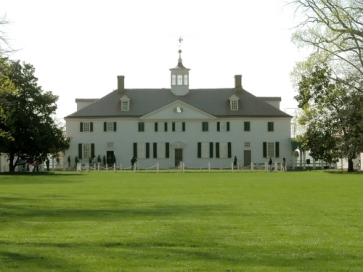
mount vernon

Mount Vernon. The mecca for Washington admirers.

When George Washington married Martha Custis, he was a well-known personage in Virginia.

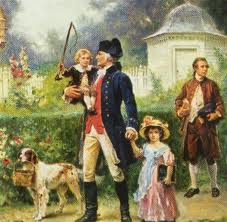
Col. And Mrs. Washington

washington family

For fifteen years, the Washingtons enjoyed life as wealthy Virginia planters.

For fifteen years, George Washington, former Colonel of the Virginia militia, lived in gentrified society, which included a seat in the House of Burgesses. George and Martha Washington hosted graciously at Mount Vernon as well as making regular trips to the Colonial Capital in Williamsburg. They also raised two children from Martha’s first marriage.

Both were the eldest of several siblings, and extended family visits to Mount Vernon were frequent. The Washingtons were also neighborly, and grand parties at their plantation might last a week.

When the political ties with Great Britain, the Mother Country, were straining to a point of rupture, George Washington was appointed to the Virginia delegation at a Continental Congress, meeting in Philadelphia.

The General and Mrs. Washington

Little did ex-Col. Washington think, as he left for Philadelphia in 1775, that he would not see his beloved Mt. Vernon for nearly eight years.

As tensions became outright hostilities, and angry shots were fired in New England, George Washington was appointed General by Congress, and sent to Boston to take charge of a motley array of undisciplined militiamen, and make an army of them. It was a huge challenge.

In the 18th century, wars were seasonal: spring, summer and fall. Bad weather and worse roads (if there were roads) made battle unfeasible and downright dangerous. Thus the armies went into winter quarters, to train, to re-equip, to repair and to plan.

An interior room of the Washington HQ at Valley Forge

Each winter, when Washington’s army “wintered,” Martha Washington joined her husband wherever they were. Many officers’ wives did the same – especially if there were no small children to tend to. (By the mid 1770’s, Martha’s daughter had died, and her son Jack was grown and married.)

Generals, even in midst of war, maintained a social presence as well as a military one. In Washington’s case, that social presence was vital to the cause of independence. Wealthy Americans throughout the colonies often needed to be wooed and encouraged to support American independence both orally and financially. Armies needed arms, food, blankets, shoes – and forage for their horses.

Who better than General Washington, one of the wealthiest men in Virginia, to explain and exhort the patricians to the cause?

Mrs. Washington was instrumental in this purpose. By socializing with the Grand Dames, she could gently solicit distaff support.

The Morristown, NJ Winter HQ (photo from the historygirl.com)

In winter quarters, Washington’s key aides were housed dormitory-style in a room or two in whatever house Washington had chosen as his headquarters. If the General was not otherwise occupied, he dined with his key officers, with meals prepared under Martha’s total supervision.

Come spring, when the snows had cleared, and the “war” was about to resume, Martha returned to Mount Vernon to supervise the spring cleaning and the resupplying of their larder.

The Mount Vernon Hotel

The American Revolution did not end formally until 1783, and General Washington remained with his Army throughout. But once hostilities ceased and the loose ends were tidied, he returned his commission to Congress and happily became a private citizen at his beloved Mount Vernon.

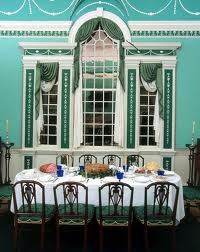
mt vernon dining room

The Washington dining room at Mt. Vernon.

18th Century transportation was primitive: foot, animal, or animal-and-vehicle. Twenty miles a day was a nice pace. Taverns and inns and hotels were spread at a distance and frequently unsuitable for family travel.  It was commonplace for strangers to knock at a private house requesting (and receiving) a nights’ lodging and even a meal.

The road to Mount Vernon became a well traveled route. Nieces and nephews were frequent long-term or even permanent houseguests. Old friends, old soldiers and total strangers found their way to their door. Room was found, horses were stabled and fed, servants were quartered and fed, and an announcement that “dinner was at three” was a tacit invitation. The table was usually set for a dozen if not more.

The President

Even before George Washington was inaugurated, he sent his secretary, Tobias Lear, to New York City to find a suitable residence befitting the President of the United States and his family; large enough to accommodate all the important people he expected to entertain.

The house on Cherry Street that was home to the First President.

A house on Cherry Street was selected; its ballroom could hold a hundred. Samuel Fraunces, was engaged to manage the demands of food service, including its preparation, but Mrs. Washington naturally maintained her authority over household matters.

With few exceptions, George Washington’s presidential dinners were stag affairs, both in New York and in Philadelphia. Women were invited to “Lady Washington’s” weekly levees, and occasionally to some larger receptions. But politics and the running of a government was a man’s job. Martha may have helped plan the dinners, but usually had her own dinner with visiting family members and the young grandchildren they were raising.

By the time Washington’s two terms in office ended, he and his wife were both in their middle sixties, and thoroughly tired of the non-stop merry-go-round and frequent separations.

Dinner for Two

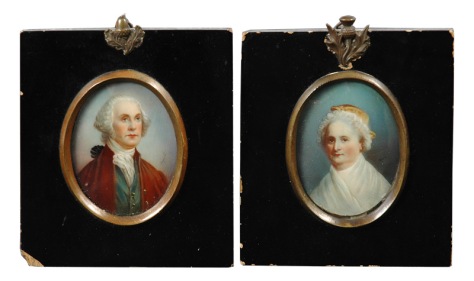
george and martha

George and Martha Washington

There is nothing particularly interesting or noteworthy about a couple, married nearly forty years, having a quiet dinner together at home. Even a couple so notable and admired as the Washingtons. Unless, of course, it is remarked upon and documented.

We do not know whether they had a large formal meal, with soup and meats and compotes and cakes. We do not know if the large Mount Vernon dining room table was set with fresh flowers and their finest china and silver.

But it was noteworthy. In a letter George Washington wrote to Tobias Lear, he commented that  “Unless someone pops in unexpectedly, Mrs. Washington and myself will do what I believe has not been [done] within the last twenty years by us, that is to set down to dinner by ourselves.”

Sources:

Bourne, Miriam Anne, First Family: George Washington and his Intimate Relations, W.W. Norton & Co., 1982

Chadwick, Bruce – The General and Mrs. Washington – Sourcebooks, 2005

Randall, Willard Sterne – George Washington: A Life – Galahad Books, 2006

http://www.mountvernon.org/


Posted in A POTUS-FLOTUS Blog, George Washington | Tagged , , , , , , , , , , , , , , , , | 4 Comments

Warren Harding: Bloviator of Nostrums and the Founding Fathers

A few men have the gift of speechifying pontifically and saying little. Like Warren Harding, 29th President.

Warren Harding at the podium. Bloviating.

Warren G. Harding: Newspaper Man

Harding was always a hands-on newspaperman.

Warren Harding was one of the most affable men in town. He was easy going, a bona fide glad-hander, and a fellow who fit easily into any social setting. Tall and good looking, he supposedly gained political supporters because “he looked like a President.” While some were not enthusiastic about him, there are very few records of anyone actually disliking him.

harding w-moustache

Harding was said to be the best looking young man in town.

When WGH came to Marion, Ohio, he was still looking for a career path. Following a mediocre college education, he had spent some time working for a printer, and liked it well enough. He became part-owner of a Marion weekly newspaper, finding potential advertisers and subscribers. He became very good at it, eventually bought out his partners and made it a viable daily newspaper.

Around the turn of the century, his wife Florence created a place for herself as circulation manager of the newspaper: Taking charge of the delivery newsboys and seeing that the subscribers and advertisers were paid up. She was very good at that.

Warren G. Harding: Popular Guest Speaker

Warren G. Harding was a good looking fellow even as he aged.

Harding’s natural hail-fellow-well-met inclination accounted for a good part of the newspaper’s success. He happily joined every civic and fraternal club in town – the Kiwanis, the Masons, the Lions, and of course the Republicans. He attended their meetings, and their members became advertisers in The Marion Star.

A local newspaper publisher is always a welcome guest speaker, and Harding was happy to accept the invitations that began coming his way. He was very good at that, too. Even better, he truly enjoyed having an audience.

By his own admission, he was “a booster.” He like to talk about all the good things America had to offer. It was easy to do. It was the time of Theodore Roosevelt, Republicans, flag-waving, apple pie and 4th of July parades. Very little of what Harding said was important or deep in concept. Then again, most of his audiences were businessmen. “Feel good” talk suited them just fine.

It was how he said things, how he “bloviated” (as he called it), and the addiction he had for alliteration and juxtaposition that caught the public eye – or ear.

Warren G. Harding: Politician

Warren Harding

Warren G. Harding. He really did look like a President.

It did not take very long for the man who looked like a president to come to the attention of some Ohioans seeking a man who could be president. A good looking fellow with a thriving newspaper, who enjoyed pontificating and sounding important was fine criteria for public office, and Harding was easily elected to the Ohio State Legislature, and even for a term as Lt. Governor.

The statewide office not only gave him entrance to Ohio’s political community, but a whole new set of invitations to “bloviate.”

With his wife capably seeing that the Marion Star’s bills were paid (and its creditors paid up), Harding was free to accept many of those invitations. He enjoyed traveling, and even better, enjoyed his extended popularity.

In 1913, the country had ratified a Constitutional amendment to elect U.S. Senators by popular ballot. (Before that, state legislators elected the Senators.) 1914 was Ohio’s first opportunity to elect a Senator, and the good-looking Warren Harding won easily. He had bloviated his way around Ohio, and had many friends eager to offer support.

Warren G. Harding & the Founding Fathers

The Founding Fathers – at least some of them.

One cannot copyright a title. Nor can one copyright two perfectly ordinary words used in sequence.   Some intrepid historians claim that the use of the words “founding fathers” had been used decades earlier, but that is a specious argument – since it applied to people other than George, Tom, Ben, Jemmy and the rest of the gang.

But in 1915, it appears that Warren Harding, bloviator first class and alliteration addict, delivered a speech and used the term in exactly the meaning we have come to understand today. He obviously liked the phrase, and not long thereafter, used it again.

And again and again. And by the time he was a viable candidate for President in 1920, the phrase “Founding Fathers” had only one meaning (although many people use the phrase in more localized manner, i.e. The founding fathers of the town, or the business, etc.) “Founding Fathers” became the definitive collective for the 18th Century framers of the mechanics of our country.

Warren G. Harding & The Critics

Harding was a pleasant fellow, but basically an empty suit, according to the intelligentsia. H.L. Mencken, a fellow newspaperman (Baltimore Sun) and pontificator with a better vocabulary and wickedly satiric sense of humor, found WGH to be a perfect bullseye for his barbs, which came fast and furiously, “founding fathers” notwithstanding.

In 1920, WGH bloviated the following… “America’s present need is not heroics, but healing; not nostrums, but normalcy; not revolution, but restoration; not agitation, but adjustment; not surgery, but serenity; not the dramatic, but the dispassionate; not experiment, but equipoise; not submergence in internationality, but sustainment in triumphant nationality.”

H.L. Mencken, The Sage of Baltimore

In response, Mencken critiqued, “He writes the worst English that I have ever encountered. It reminds me of a string of wet sponges; it reminds me of tattered washing on the line; it reminds me of stale bean soup, of college yells, of dogs barking idiotically through endless nights. It is so bad that a sort of grandeur creeps into it. It drags itself out of the dark abysm of pish, and crawls insanely up the topmost pinnacle of posh. It is rumble and bumble. It is flap and doodle. It is balder and dash.”

Bloviator and empty suit perhaps, but “Founding Fathers” does have the right ring to it, and we must give credit where due.

Sources:

Russell, Francis – The Shadow of Blooming Grove: Warren G. Harding in His Times – McGraw Hill, 1968

Sinclair, Andrew – The Available Man: Warren Gamaliel Harding – The Macmillan Co., 1965

https://constitutioncenter.org/blog/how-the-signers-became-founding-fathers

https://www.goodreads.com/quotes/38761-he-writes-the-worst-english-that-i-have-ever-encountered

http://teachingamericanhistory.org/library/document/return-to-normalcy/


Posted in A POTUS-FLOTUS Blog, Warren G. Harding | Tagged , , , , , , , , , , , , , , | 4 Comments

Betsey Humphreys: Mary Lincoln’s Wicked Stepmother

One of the earliest photographs of Mary Lincoln.

When Mary Lincoln was seven, she and her five siblings lost their mother.

The Todd Marriage…and Remarriage

Robert Smith Todd (1791-1849) was 21 when he married Eliza Parker. Every indication was that it was a marriage of inclination. They liked each other and wanted to marry. Every further indication is that the marriage was a happy one.

Robert Smith Todd, Mary Lincoln’s father

Robert Todd, a third generation Lexington, KY gentleman, was a lawyer, planter, businessman and state legislator, like many men of his generation. Also like many men of his generation, including his neighbor Henry Clay, he enjoyed his whiskey, cigars and cards.

Eliza Parker (1794-1825) was a local girl, raised to be decorous, well mannered and trained to manage a slave-holding household. She bore seven children in twelve years.  Elizabeth, Frances, Levi, Mary, Ann and George. Another died at birth. George’s birth left her with a puerperal fever. She died a few days later.

Whether Robert Todd was devastated, or overwhelmed at the prospect of being father of a motherless family of six, within a few weeks he departed for his office in Frankfort, the state capital. The children were left under the general supervision of Grandmother Parker who lived next door. Twelve-year-old Elizabeth also assumed “mothering” her younger siblings.

Within a few weeks of being in Frankfort, Todd began courting Betsey Humphreys, a blue-blooded Kentucky belle, who at 26, was bordering on spinsterhood. It was an odd courtship, more like a business transaction than a romance. Perhaps Todd was more concerned with finding a new mother for his brood.

Betsey Humphreys Todd, Mary Lincoln’s stepmother.

Betsey herself may have been overwhelmed at that prospect. Ever mindful of conventional mourning customs regarding remarriages (at least 18-months), she departed Frankfort for an extended visit to her family, and the courtship became primarily one of formal correspondence. Nevertheless, they married.

The Second Mrs. Todd

The new Mrs. Todd found a sullen atmosphere in Lexington. Grandmother Parker, who had stepped in to raise her late daughter’s children, was unhappy, and likely angered at her son-in-law’s rush to remarry. In those early days, the pater familias was inviolable. Robert Todd must be above reproach or criticism. Any hostility was borne by the woman; the interloper. Whether intentionally or subtly, Grandmother Parker may have poisoned the children’s attitude, which would never improve.

Betsey Humphreys did little to help her own cause. Whether she was a wicked stepmother or not is always open to conjecture, however, according to those who knew her, she was a detached woman, sparing in her affections – even to the eight children she bore herself.

She was strict in her discipline, with little patience for childish misbehavior, finding it much easier to criticize than to praise. She was also inclined to sequester herself in her room, nursing her many pregnancies and related ailments.

The Todd’s town house in Lexington, KY. The family moved there when Mary was in her teens.

Betsey’s background had been carefully cultivated by her mother, Mary Brown Humphreys, who was one of the true grand dames of Kentucky and who came to exert great influence on all the Todd girls. Grandmother Humphreys was a firm believer that it took a full six generations to make a lady. Indoctrinated to that theory from birth, Betsey believed it her bound duty to create “ladies” out of her four little step-daughters, whether they liked it or not.

This influence of lady-ness was not lost on them. An aristocratic Todd-ness was pervasive.

Betsey and Elizabeth

Elizabeth Todd, at twelve, was perhaps the most embittered about her father’s remarriage, having assumed a fair amount of mothering of her younger siblings during her father’s long absence.

Elizabeth Todd Edward. Mary’s eldest sister loathed her stepmother.

Whether she resented her new stepmother’s obviously cold authority, or her father’s frequent business trips, surrogate mothering, or the pervasive influence of Grandmother Parker, Elizabeth developed an implacable dislike of Betsey Humphrey Todd and it would never change.

At sixteen, she married Ninian Edwards, Jr., a student at Transylvania University, and the son of Illinois’ first governor. She happily moved to Springfield, its new capital, and planned to create a societal atmosphere in the still-rustic town.

With Elizabeth gone, the other Todd “first family” merged with their growing half-siblings. Since new “halfs” occurred ever two years, the house became more and more crowded. Mary, only eleven when her eldest sister moved away, would later comment about her “desolate childhood.” Since she was the only one of her sisters who showed any academic inclination, she was sent to the best finishing school in Lexington, a mile from their house in town. Mary chose to board at school where she was happy, returning home only on weekends.

Betsey and Mary: Later

Katherine Helm was Mary’s niece. Long after Mary’s death, new light was shed on her aunt’s upbringing.

Elizabeth Todd Edwards made it her personal goal to rescue her full sisters from their unhappy environment. At some time, Frances, Mary and Ann all came to live with the Edwardses in Springfield, where they were introduced to up-and-coming men of distinction. To Elizabeth’s satisfaction, they all married and became the core of the capital’s genteel society. It would be said that the Todd family practically owned Springfield – at least socially.

When Mary Todd married Abraham Lincoln, she developed a softer view of her stepmother. While they would never become close, as an adult, and as a mother herself, Mary came to understand the stresses that Betsy had inherited, exacerbated by such a large and growing brood. Mary was also not unaware of her own mercurial temperament. She was not an easy child to raise.

Years later, when Mary-in-the-White-House was separated from her large extended family not only by distance, but by Civil War, she found an added bond with Betsey Todd, even though they hadn’t seen each other in more than a decade. Mary lost a son; her stepmother lost three sons.

Sources:

Berry, Stephen – House of Abraham: Lincoln & The Todds, A Family Divided by War – Houghton Mifflin, 2007

Clinton, Catherine – Mrs. Lincoln: A Life – Harper Collins, 2009

Helm, Katherine, Mary, Wife of Lincoln, Harper & Brothers, 1928

https://ehistory.osu.edu/articles/life-mary-todd-lincoln

https://www.mtlhouse.org/biography

Posted in Abraham Lincoln, Nifty History People | Tagged , , , , , , , , , , , , , , , , , , , | 6 Comments

Burying General Grant

General Grants funeral procession in New York City was seven miles long.

When General Ulysses S. Grant died in 1885, it was not a surprise. He had been ill for more than a year, and everyone knew it.

Double Barrels of Woe

For a few years in the early 1880s, General Grant was a wealthy man.

In 1880, after an embarrassing semi-attempt at a third presidential term for President, an iconic Hero-General Ulysses S. Grant became a titular partner in a New York investment firm. Readily admitting his lack of knowledge about finances, he was assured that Ferdinand Ward, his whiz-kid partner, could handle that end. General Grant would be the famous “face” of the company. For a few years, all went well. Grant and his family became wealthy.

Then the bottom fell out of the tub. Ward was a scoundrel who had concocted a “borrow-from-Peter-to-Pay-Paul” scheme. The business collapsed in scandal, leaving General Grant holding the proverbial bag.

Innocent of any misdeeds other than poor judgement in choosing business partners, Grant vowed to make good on all the company’s debts – well into six figures! (Likely several million dollars, today.) He and his family were totally impoverished. He turned all his assets over to his creditors, including his Civil War memorabilia.

Within months of that plummet from fortune, he was diagnosed with terminal cancer of the throat…

Victorian Medical Practice

…only nobody dared call anything “terminal” in the 1880s, and even long after. Doctors usually had a fair idea of the eventual nature of many fatal diseases, but cures and treatments were decades or more in the future.

Finishing the final edits of Grant’s Memoirs. He died days later.

Rather than facing questions they could not answer, doctors found it much easier to offer patients and their loved ones hope and prayer, as opposed to grim tidings.

General Grant had been offered a huge royalty advance for writing his war memorials, something he had declined to do for years. Now, fearing that his family would be left in poverty and his good name tarnished, he agreed to the project. He pursued his “book” with the same tenacity he had projected during his military campaigns.

Doctors visited Grant daily, sometimes two or three doctors and sometimes two or three times a day. Despite his continually worsening pain, he refused all sedation or pain killers. He believed it would compromise his ability to think clearly. All he permitted was having his throat painted with cocaine to numb the local area.

Barely able to swallow solid foods, the General lost huge amounts of weight. His voice became little more than a painful whisper. Maybe the doctors believed in miracles, but Grant was a practical man. He knew better, and had no illusions.

Grant’s Burial Choices

The newspapers and magazines followed Grant’s illness closely.

As his health continued to deteriorate, Grant began thinking of his burial wishes. As a two-term President, and perhaps more importantly, the victorious Civil War General, he knew his funeral arrangements would be a major event for the country.

He wrote a memo-to-himself, since he instinctively knew that facing the inevitable would upset his beloved wife and family. In the memo, he determined three choices for his burial site.

Grant’s family was with him during his last days.

One choice was Galena, IL. After Appomattox, Galena claimed Grant for its own. He was not born there, nor anywhere else in Illinois, and only lived there less than a year, working at a hated clerking job in his father’s tannery. But Galena is where his illustrious career was reborn, and Illinois was where he received his first “star.”

Another possible choice for burial was New York City, whose citizens had been so good to him when he needed it most.

But his first choice was West Point, where he was trained to the work he was to admirably fulfill. The Academy would gladly welcome his final resting place – but there was one insurmountable problem. They would not allow Julia Grant to rest beside him.

Julia

Julia Dent (1826-1901) was Grant’s one-and-only. He met her when he was 21, recently graduated from West Point. She was barely 18, and the sister of his Academy roommate. It was love at first sight for both of them, but marriage was four years away, punctuated by the Mexican War.

General and Mrs. Grant.

Julia had been through thick and thin with him, and the first half of their nearly 40 years together was decidedly thin. She never complained, loved him devotedly, and made a happy home for them and their four children wherever they were.

During the Civil War, Julia would write of being a nomad, a Penelope following her Ulysses whenever and wherever he asked. She knew him better than anyone, and in some ways, perhaps better than he knew himself.

Wherever he would rest forever, Julia must lie beside him.

The Final Decision

The Grant family was especially close.

It was not until shortly before he died in August, 1885, that General Grant showed that memo to his eldest son, Colonel Fred Grant. The General had been right: it was a difficult and upsetting subject, but it had to be faced. Fred assumed the responsibility.

West Point could/would not accept Julia and that was a deal breaker. Galena – or other Illinois sites – was perhaps too remote, and besides, Illinois “belonged” to Lincoln. New York it would be. They had sincerely loved him. And they could afford him.

The temporary crypt for General Grant.

Within weeks of Grant’s seven mile long funeral procession in New York City, attended by thousands of Civil War veterans, north and south, including Union and Confederate pall bearers, a private subscription was begun.

Grant’s Tomb on Riverside Drive in New York City.

More than $600,000 was privately donated to construct a magnificent 150-foot high Tomb on New York’s Riverside Drive, overlooking the Hudson River. It was formally dedicated in 1897.

Together forever.

Four years later, according to Grant’s specific instructions, Julia Grant was brought to lay beside him, as she had done for nearly forty years.

Sources:

Flood, Charles Bracelen – Grant’s Final Victory:  Ulysses S. Grant’s Heroic Last Year – 2012, DaCapo Press

Goldhurst, Richard – Many Are the Hearts – 1975, Reader’s Digest Press

http://starship.python.net/crew/manus/Presidents/usg/usgobit.html

This Week in NYC History: President Ulysses S. Grant’s Is Laid to Rest in Riverside Park

http://www.grantstomb.org/hist2.html


Posted in A POTUS-FLOTUS Blog, American Civil War, Ulysses S. Grant | Tagged , , , , , , , , , , , , , , , , , , , , | 5 Comments

Herbert Hoover, Food Administrator

Mr. and Mrs. Herbert Hoover

When World War I finally came to US shores, President Wilson summoned Herbert Hoover back home.

The Hoovers: Ex-Pats

For nearly twenty years, Mr. And Mrs. Herbert Hoover had lived abroad, in various and exotic locations. They didn’t even have a US residence. On their infrequent trips “home” they usually stayed with family.

Herbert Hoover (1874-1964) was one of the pre-eminent mining engineers in the world, and had become a bona fide millionaire by the time he was forty. At the outset of the Great War in 1914 (as it was called then), the wealthy Hoovers had been living in the upscale Mayfair section of London for a few years.

Virtually unknown outside his small circle, Herbert Hoover became famous when he helped tens of thousands of Americans return home when war began in August, 1914. That assistance was immediately followed by a yeoman effort to rescue the starving populace of Belgium, who had been brutally overrun by the advancing German army.

By 1917, Herbert Hoover was a household name.

The World’s Bread Basket

President Woodrow Wilson had tried for three years to keep America neutral. Since George Washington, the country had a long-standing tradition of remaining uninvolved in foreign entanglements. The President had won his second term because “he kept the country out of war.”

But events frequently override the best of intentions, and by April, 1917, events had come to a head; the country clamored to participate in the War to End All Wars.

The Food Administration undertook to feed our soldiers and our allies abroad.

Believing that our purpose was not only to fight in the War, but to sustain both our forces and our exhausted and decimated allies, Wilson proclaimed the US as the world’s bread basket. It was a huge project. Europe was truly exhausted; starvation was a reality in many places. The US had been a mega-benefactor in sending shiploads of food and humanitarian supplies to Belgium. Now it needed to do it for a continent.

Wilson sent for Herbert Hoover.

The Administrator

Herbert Hoover had displayed prodigious talents as a superb administrator, coordinating the efforts of a capable cadre of young Americans living abroad – collecting, shipping and distributing survival necessities to war torn Belgium. More than $5 million in foodstuffs were being sent across the Atlantic each month. The specially-designed flag for this humanitarian effort was the only one respected by seven belligerents.

Now, as the head of the newly-created Food Administration, Hoover’s managerial system was well honed. He assumed the modest title of “Food Administrator” and set to work feeding the world.

A massive (and successful) public relations campaign was instituted to encourage substitution of needed resources.

Further blessed with a talent for amassing and absorbing copious amounts of facts and figures, Hoover determined that production needed to be expanded while US consumption needed to be conserved…simultaneously.

A powerful public awareness program was quickly put into effect. Wheatless days; meatless days, and even heat-less days. Understanding that this one voluntary measure alone could save nearly 15%, without rationing, the country was happy to participate. First Lady Edith Wilson was immediately on board, insisting that the White House comply 100% with the policies.

Women were particularly encouraged to conserve and substitute at home.

Hoover’s plans also included a series of substitutions. Wheat was one of the most durable grains, and was thus earmarked for troops overseas. Bakeries and housewives were urged to bake with rye, or oatmeal, or barley or corn. Sugar, another commodity needed overseas, could be substituted with syrups or honey or fruit.

Meat, especially pork, was another product that could be cured to last. It was said that Hoover learned so much about hog raising (he had grown up on a farm) that he could tell you how many pounds of ham, pork chops, roast and bacon could come from a single hog.

Lou Henry Hoover, the Administrator’s energetic and capable wife, was also recruited to participate in the programs. She wrote magazine articles, spoke to various civic organizations, and helped promote inexpensive and easy-to-prepare “substitution” recipes.

Posters were hung everywhere – in schools, workplaces, public facilities, etc.

Even little children were targeted to “do their part” for the war effort.  The saying, “Eat everything on your plate.  There are children starving in Europe!” may seem archaic and perhaps downright peculiar today, but it originated during World War I, and seems to have become a part of childhood memory ever since.

It was a mammoth effort between farms, mills, processing facilities, bakeries, grocers and consumers across the country. Then there was the packaging, transporting by train and truck, barge and steamboat, arranging for overseas shipping, and distribution to wherever it was needed.

Hoover oversaw it all, and added to his cadre of project managers who were devoted to their “Chief” as he came to be called.

Hoover By the Numbers

World War I formally ended in November, 1918, but the Food Administration was still providing sustenance overseas.

According to a contemporary source, the normal pre-war tonnage had tripled between 1918-19.

…………………………………..Normal Pre-war …………………….  1918-19

Breadstuffs………………….3,320,000 (tons)………………………..10,566,165

Meats & fats……………………645,000…………………………………..2,369,630

Sugar (US & West Indies)..618,000…………………………………..1,704,523

And that was just a small sampling.

Herbert Hoover had become not only a household name, but a verb. To “Hooverize” came to mean conserving food. He had also become one of the most respected and admired men in the world.

And he never took a dime for any of his services.

Sources:

Smith, Richard Norton – An Uncommon Man: The Triumph of Herbert Hoover – Simon and Schuster, 1984

Sullivan, Mark – Our Times: Over Here 1914-18, Scribners, 1933

http://www.easternct.edu/germinaveris/the-food-administration-of-herbert-hoover-and-american-voluntarism-in-the-first-world-war/

http://exhibits.mannlib.cornell.edu/meatlesswheatless/meatless-wheatless.php?content=two

Posted in A POTUS-FLOTUS Blog, Herbert Hoover | Tagged , , , , , , , , , , , , , , , , | 2 Comments

Harry Truman’s Harried Christmas: 1945

Harry Truman, home for Christmas, 1945.

The Sudden Presidency

President Roosevelt looked very ill when he met with Churchill and Stalin for the last time.

While political insiders had noticed Franklin D. Roosevelt’s physical decline, the country was in shock when their President – for twelve years and counting – died suddenly in Warm Springs, GA. His failing health had been generally hidden from the public.

It had also been hidden from VP Harry Truman, who had only seen him once or twice since the inauguration on January 20, 1945. FDR and Truman had never been more than pleasantly cool acquaintances. Truman had never been included in important decisions.

Now, on April 12, 1945, when Harry Truman received an urgent summons to the White House, he could guess the reason. He later claimed that he felt like the moon, the stars and all the planets fell on him at once.

He had little idea of the momentous decisions on his plate.

The Presidential Plate

Harry Truman and his family looked none too happy when he was sworn in after FDR’s sudden death.

When HST was sworn in, it was obvious that World War II was ending in Europe. Within weeks, Hitler committed suicide; by Truman’s 61st birthday on May 8, the war would be officially over in Europe. But the war in the Pacific was still raging, and the Japanese showed no signs of relenting.

On his first day in office, Truman was told about the Atomic Bomb. He had no previous knowledge, and it would fall to him to make a monumental decision a few months later.

He would meet with Stalin and Churchill to determine the “aftermath” of the War in Europe.

Then there was the daunting task of trying to assimilate the returning military, take care of the wounded, and incorporate everyone as seamlessly as possible into a post-war society.

Equally daunting, he needed to steer a wartime economy into a peacetime economy.

He had to deal with unions, veterans’ bureaus, a devastated Europe, a huge influx of new immigrants, ominous tensions between Washington and Moscow, and with a population whose regard for him (especially following the huge regard and popularity of Roosevelt) was less than enthusiastic.

All had multi-levels of sub-problems. Then there were lesser problems, all with their own multi-levels. There would be many more to come.

But mostly, he catapulted the world into the Atomic Age.

All in a space of a few months.

Mrs. Truman

Bess, Harry and Margaret Truman had always been a close family unit.

Bess Truman, a homebody by inclination, was now center stage in the most powerful country in the world, at a crucial time in history. It was not her preference nor style, and was not to her liking. But she had little choice.

Within a very short time, she felt marginalized and pushed out of her husband’s life. Aides and bureaucrats, military officers and foreign ambassadors clamored for a few minutes on the President’s schedule, and he had no time for his wife. She was superfluous. They had always been close, and now she was a spectator rather than a partner, and she was very angry.

Her preference was to return to their home in Independence, Missouri, which she did frequently. It was her house. She had her lifestyle. She had her friends. According to their daughter Margaret, the Truman presidency was a low ebb in the Truman marriage: a serious emotional separation, that neither one could do anything about.

Christmas, 1945: Part 1

Bess Truman was always a homebody. This was “home.”

In many ways, Christmas 1945, was the happiest the country had experienced in more than a decade. The Great Depression had ended. The War had ended. And while there were thousands and thousands of “empty chairs,” there were even more thousands of chairs that had been empty, and were now filled.

Christmas trees were decorated. Stores displayed all the goodies that spell holiday. Churches were filled to capacity. Families were together. The USA had been spared the physical devastation that had decimated most of Europe. There was a lot to celebrate.

Bess Truman went home for the holidays. The President, beset by pressing matters, was not comfortable leaving Washington. Besides, if he left, more than a dozen Secret Service agents and as many newspaper reporters would have to go along, and be away from their families on Christmas Eve.

Christmas, 1945: Part 2

Late on December 24, HST received some optimistic news from his Secretary of State, and decided to spend at least part of Christmas with those he loved best. The weather was horrible; most planes were grounded by a terrible blizzard. It took more than four hours before the presidential plane took off, and it was a wild ride. When the newspapers got wind of his unexpected and dangerous flight, they took him to task for “taking chances with his personal safety.”

When he arrived at their house, presents in hand, Bess Truman did not help matters. Her chilly reception, commenting that he “might as well have stayed in Washington” was infuriating, especially after all the trouble he had taken to get home.

The Trumans at home – the place they loved best.

Truman returned to Washington the next day and sent his wife a hot-tempered letter. The following day, upon reflection, he telephoned Margaret to go to the local post office, retrieve the letter, and burn it – which she did.

Then he sat down and wrote Bess another letter – which was never sent, and only discovered after his death twenty seven years later.”

“You can never appreciate what it means to come home as I did the other evening after doing at least one hundred things I didn’t want to do, and have the only person in the world whose approval and good opinion I value look at me like I’m something the cat dragged in…”

Bess was never happy in the White House fishbowl, but the Trumans would learn to adjust better.

When they retired permanently to Independence, it got better. Much better.

Sources:

Truman, Margaret – Harry S Truman – William Morrow & Co., 1973

Truman, Margaret – Bess W. Truman – Macmillan Publishing, 1986

http://www.firstladies.org/biographies/firstladies.aspx?biography=34

https://www.trumanlibrary.org/hst-bio.htm


Posted in A POTUS-FLOTUS Blog, Harry S Truman | Tagged , , , , , , , , , , , , , , , , , | 4 Comments

Abigail Adams and the Inoculation Decision

abigail and john

Young Abigail and John Adams. A composite picture.

Smallpox was an extremely contagious disease. The mortality rate was at least 30%.

George Washington’s Decision

Shortly after the battles of Lexington and Concord in mid-1775, George Washington, a former Colonel of the Virginia Militia and the highest ranking professional soldier in the American colonies, was appointed General of the Continental Army.   He was sent to Boston to consolidate the militia troops, bring order, train them to their purpose, and prepare for all contingencies. It was a daunting task.

George Washington taking command of the Colonial Army. (From the Mt. Vernon collection)

When he arrived in Boston, he found himself in the middle of a smallpox epidemic. British soldiers were affected; militia recruits from all over New England were affected; runaway slaves who had fled north to enlist were affected; the general populace was affected. Smallpox was highly contagious. The sickness and death rate was frightening.

George Washington had contracted smallpox when he was in his late teens. He recovered, grateful that his pock marks were not too disfiguring, but mostly because once recovered, he was immune to smallpox thereafter.

Realizing the potential danger to his men, his army, and their cause, he isolated those who were already immune. He quarantined anyone who showed even the slightest sign of the disease, and immediately restricted all soldiers from any contact with Boston civilians, where the disease was rampant. He improved sanitary conditions within his camps. And he insisted that his soldiers be inoculated.

He felt so strongly about it, that he insisted Martha Washington be inoculated as well. When she was in Philadelphia, she bit the bullet, went through the frightening procedures, and spent a month “recuperating” from her ordeal. Her recovery was considered relatively mild.

Inoculation for Smallpox

In 1775, inoculation against smallpox was not new; it had been used in America for several decades with reasonable success, albeit with great danger.   It was also very controversial.

Not long after the Adams family was inoculated, Dr. Edward Jenner substantially improved the procedure.

A cut was made in the healthy arm, and a small amount of skin lesions from infected pustules were introduced. Then the arm was bandaged. It purported to give the patient a “light” case and subsequent immunity. Many people could not understand the concept of this practice, however it had a high success rate. A patient needed at least a full month for preparation, for the inoculation to be administered, to take hold, to “suffer the light case” – sometimes far more severe than anticipated, to recover, and to be no longer contagious.

In short, it was not to be undertaken lightly.

The Adams Family Inoculations

John Adams had been inoculated against smallpox before his marriage.

John Adams had been inoculated as a young man prior to his marriage, and long before the practice had become more acceptable in the Colonies. He had suffered greatly during his three-week recuperation in a hospital “with headaches, backaches, knee aches, gagging fever and eruption of pock marks”.

Abigail Adams made a fearsome decision to have herself and the children inoculated.

His wife Abigail had not been inoculated, but certainly knew about it, and in July, 1776, when the epidemic was particularly virulent, she bit the hard and dangerous bullet. She and the four Adams children, all under eleven, and a few other family members and townspeople, went ten miles from their home in Braintree to Boston, to be inoculated by Dr. Thomas Bullfinch, an expert at the procedure. Her aunt and uncle who lived in Boston offered the medical hospitality of a furnished house – except for bedding.

According to Abigail, …We had our Bedding &c. to bring. A Cow we have driven down from [Braintree] and some Hay I have had put into the Stable, wood &c. and we have really commenced housekeepers here…All our necessary Stores we purchase jointly.”

Abigail Adams further noted, “God Grant that we may all go comfortably thro the Distemper, the phisick part is bad enough I know. I knew your mind so perfectly upon the subject that I thought nothing, but our recovery would give you eaquel pleasure, and as to safety there was none.”

The Adams house in Braintree. They would be away for weeks before they were all well enough to return.

In early July, 1776, while Abigail was preparing for this dreaded event, John Adams was preoccupied in Philadelphia, shepherding thirteen divergent colonies to unite and declare their independence from Great Britain. Once the Declaration of Independence had been signed, he had an equally formidable task of a different nature: helping to govern a generally dis-united new country.

Abigail, the Children, the Reactions

Earlier practices of inoculation included a week of preparatory purging via self-induced vomiting. Dr. Bullfinch did not subscribe to that practice completely, although he had prescribed some distasteful medication. Abigail advised her husband that “the little ones are very sick and puke every morning,” but that afterwards they are comfortable.

Young John Quincy Adams suffered a light case of smallpox.

Abigail suffered a mild form of the disease, and was soon able to nurse the children through their respective ordeals. John Quincy, who had just turned nine, appears to have suffered the least.

Nabby Adams, their eleven-year-old daughter, was very sick with fevers, terrible body aches, and erupting pustules.

Neither Charles (aged 6) and Thomas (aged 4) responded to the inoculation, and it had to be repeated. For Charles, it had to be repeated three times – the last, with a more “active” scraping, insuring that he would contract the dreaded disease as if he had contracted it naturally. The little boy suffered horribly, and was delirious for two days. It took weeks for him to recover.

It would take even more weeks before Abigail could take the children home again.

But they would never have to worry about contracting smallpox. They were immune. They had been inoculated.

Sources:

Www.drzebra.com

Gelles, Edith B. – Abigail and John: Portrait of a Marriage – William Morrow, 2009

Levin, Phyllis Lee – Abigail Adams – St. Martin’s Press, 1987

Massachusetts Historical Society – Letters from Abigail to John Adams, 13-14 July, 1776


Posted in A POTUS-FLOTUS Blog, John Adams | Tagged , , , , , , , , , , , , , , , , , , , , | 6 Comments

The Unexpected President: Chester Alan Arthur…..Life and Times: A Book Review

There are very few things that Chester Alan Arthur is “famous” for. One, is his mutton chop whiskers; the other is his statement that “I may be President of the United States, but my private life is my own business.”

The Unexpected President, by Scott S. Greenberger

With that latter statement in mind, Scott S. Greenberger, and indeed any biographer of the 21st President, would be hard pressed to sub-title his book anything other than Life and Times. Mr. Arthur has scrupulously locked every available door to his inner self.

Born in 1832 in a little-bitty town in Vermont to a strict and pious family, he received a liberal education at Union College, became a lawyer, and moved to New York City – where he belonged.

He discovered a not-so strict or pious lifestyle that fit him hand-in-glove. In an age where manners, prestige, manly pompousness and all the accoutrements of the good life were the essence of the good life, Chet Arthur was the poster boy. A handsome, bewhiskered six-footer, he became an immaculate dresser, with cultivated manners, tastes and well-to-do urbanity. He attracted some of the most powerful political mentors in the state. He also acquired a genuine blue-blooded Virginia belle for a wife.

Finding a perfect middle-ground of Civil War service, he was appointed Quartermaster General for the New York Militia, performing yeoman service supplying, equipping and feeding tens of thousands of volunteer soldiers (and their horses) – and never left New York nor fired a shot.

Arthur’s association with NY Senator and political machine boss Roscoe Conkling lasted for the better part of his adult life. Different in temperament according to Greenberger, they nevertheless became close friends. Conkling appreciated Arthur’s gifts for administration, fund-raising, and all the backstage mechanics of political appointments that run governments. He was a treasure. He did it all, and he did it well. Even better, he enjoyed doing it. Prestigious jobs and serious wealth came with it, including the plummiest of all positions: Collector of the Port of New York. The lucrative salary, along with the perks of traditional share-the-spoils, amounted to $50,000 per year – the same as the President of the United States.

The Port, however, was a morass of political corruption, bribery, finagling and decadence. Chet Arthur was in charge, and when heads had to roll, it would be his head. While he never was personally accused of malfeasance, bad stuff happened on his watch, and reform minded President Rutherford B. Hayes removed him.

Arthur resigned in semi-disgrace to practice law, and enjoy political camaraderie in late night partying, copious amounts of champagne, steaks and oysters, cigars, card playing, and occasional cavorting with “sporting” ladies who wore low-cut gowns and short skirts. It placed a strain on his marriage.

Four years later, by a freak of political maneuvering, and against the advice of Conkling, he was candidate for Vice President – and won pretty much by a whisker.

Four months later, President Garfield was shot by an assassin, and the reader finally gets a tiny peek into the man. Chet Arthur’s wife had died a year earlier; he was a somewhat distracted father; he had a marginalized relationship with Garfield and his cabinet, and had acquired a pen-pal: an invalid spinster named Julia Sand, who appointed herself his “Jiminy Cricket.”

The assassin, Charles Guiteau, a certifiable lunatic, claimed to be the “Stalwart of the Stalwarts,” who had made Chester Arthur president. The slight acquaintance between Arthur and Guiteau was superficial; little more than “Good morning.” Nonetheless, there was reasonable speculation that the Vice President was complicit in some way.

Chester Alan Arthur was now in fear of his own assassination. For the better part of the ten weeks remaining in Garfield’s ebbing life, he drew the shades on  his New York townhouse and seldom left. He relied on his well-cultivated and steely persona to see him through all his anxieties and cares. His behavior was impeccable. His words were few, and well-measured. He categorically declined to undertake any “presidential” duties or activities while President Garfield was still alive. For this, he was admired, and began to grow – both into the position he would fill, and in the respect of his fellow countrymen.

He came to a saddened Presidency along with a secret of his own. He was a sick man and he knew it. Nevertheless he redecorated the White House, according to his excellent and sophisticated taste, mostly with his own funds. He distanced himself without rancor from Roscoe Conkling, whose star was quickly fading. He embraced a favorable position toward Civil Service reform, which in its quirky way was responsible for both the loss of his Collectorship position and the death of President Garfield.

While he hoped to be nominated for a term on his own, he refused to seek it overtly.  He returned to his well ordered life in New York, was asked to co-chair the huge funeral for General Grant, and to help dedicate the Statue of Liberty. The machine politician had become a statesman who had earned the approbation of the country.

But true to himself, he kept the pot of “mind your own business” on a steady boil, destroying most of his personal papers and documents. We are welcome to know the manners of the persona, but we can never really know the man. Greenberger surmises that Arthur was less than proud of his pre-presidential career. No argument here.

Chester Alan Arthur’s life by itself would be little more than a magazine article, since so little of him is available. The times he lived in were interesting, but not especially exciting.  Civil Service Reform is not a sexy topic.  Author Greenberger has done an admirable job piecing together its random pieces, and presenting our mutton-chop President as a man with some real chops.

The Unexpected President is a quick and surprisingly nifty read – hardcover or ebook!.

Greenberger, Scott S. – The Unexpected President: The Life and Times of Chester Alan Arthur, De Capo Press, 2017

ISBN-10: 0306823896

From $18.30

Posted in A POTUS-FLOTUS Blog, Chester Arthur, Recommended Reading | Tagged , , , , , , , , , , , , , , , , , | 1 Comment