The Eisenhower Tragedy: Ikkie

Mamie, Ike and Little Ikkie

Nothing pained Ike and Mamie Eisenhower more than the death of their firstborn son.

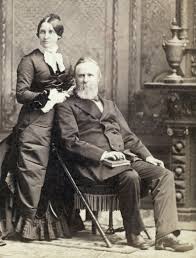
The Parents Eisenhower

Mamie Doud became “Mrs. Dwight Eisenhower” on July 1, 1916. She was nineteen.

Lt. Dwight Eisenhower

Surprising everyone, including herself, Mamie adapted well to army living. Both bride and groom were sociable people, with easy smiles and good natures that fit well anywhere. Ergo, they were popular. And since military brass has a responsibility to scout for potential leadership, Ike’s superiors had their eye on him. They liked Mamie, too.

Mamie Doud Eisenhower

In September, 1917, their first son was born. He was named Doud Dwight, but from the start he was nicknamed Ikkie (pronounced Icky and sometimes spelled Ikky), and he was the joy of their lives.

Despite Ike’s disappointment at not being deployed overseas during WWI, the young couple made the best of it, with Ike assigned the interesting new challenge of becoming a tank maven. It would stand him in excellent stead.

Meanwhile, along with being new parents, they became part of a socially active army base with dozens of friends who entertained each other at frequent parties and dinners and assorted come-on-overs. Their friends doted on their “Little Mascot” almost as much as they did.

Ikkie Eisenhower (Eisenhower National Historic Site)

But perhaps Ike doted most. He couldn’t wait to come home to play with his new son. He brought the toys and treats that dads everywhere love to give their offspring. He even had a pint-sized uniform made for the baby, and showed him off proudly.

When Ike was traveling with a convoy, he called Mamie often, and the story goes that most of the conversation was about the baby. Mamie, somewhat miffed at not getting enough attention, said that maybe Ike might like to ask about his wife… A contrite Ike immediately changed the subject, asked Mamie about her day, but within a few minutes was back talking about Little Ikkie, who was growing like a weed: strong, straight, smart, and everything a little boy should be.

Ike was a tank officer.

But in late December, 1920, (and there are a few versions of the story), Ike had received a promotion and engaged a maid to help around the house.

The Tragedy Part 1:

Unbeknownst to everyone, the maid had been exposed to scarlet fever, then a contagious and potentially fatal disease. The girl had neither symptoms nor knowledge that she had been exposed and had become a carrier. It was Christmas. Ikkie became sick. The doctor had him admitted to Johns Hopkins Hospital, but nothing could save the three-year-old. He died on January 2, 1921 in Ike’s arms.

To say that Ike and Mamie were devastated is an understatement.

An honor guard escorted Ike, Mamie and the baby’s coffin to the train for Ikky’s burial in the Doud family plot in Denver. Whether they blamed each other or blamed themselves, or blamed the maid or an unkind fate or whatever people flail at during crises is unknown. But both Ike and Mamie responded differently, and it nearly ruined their marriage. According to Julie Nixon Eisenhower, “Ikky’s death closed a chapter.”

Twenty-four-year-old Mamie, despite her determination to be cheerful, needed to be comforted, to be held and loved and have a strong shoulder to cry on.

The Eisenhowers were an attractive couple.

But thirty-year-old Ike, for all his broad smile and sociability, was a very private person, and his pain was unbearable. He stayed on duty hours longer than was assigned, he was morose when he returned home, barely approachable. He needed to be alone with his grief.

The Tragedy Part 2:

The pain of their loss, and the pain of their growing distance did not go away, despite the birth of their second son John, less than two years later. Now stationed in Panama, Ike worked long hours, and far away from her own loving family, Mamie turned to a motherly Virginia Connor, their neighbor and wife of Ike’s commanding officer General Fox Connor, for the comfort she needed.

The Eisenhower marriage finally became so strained, that Mamie couldn’t sleep and lost weight (and she was always petite). She practically fled back to Denver to see her own parents, and suggest that she and Ike might be headed toward a divorce. (There are a few versions of this story as well). One version says she planned to remain in Denver indefinitely, but her parents (who adored Ike) insisted she return and put her marriage in order.

The story continues that Mrs. Fox Connor had been saying the same thing – and even suggested that Mamie use her “womanly wiles” to achieve that end. “You mean I should vamp Ike?” Mamie asked. The response was affirmative.

The story further continues that Mamie bought a new nightie, and got her hair done. Some sources claim it was the first time she had it styled with the bangs that would become her trademark. Maybe… But it obviously worked, since they both worked harder at accommodating to each other’s needs.

The Tragedy: Part 3

Ike seldom spoke about his firstborn, who he had loved with his whole heart. According to Mamie herself, “For a long time, it was as if a shining light had gone out in Ike’s life…Throughout all the years that followed, the memory of those bleak days was a deep inner pain that never seemed to diminish much.”

Ike no doubt loved his son John, but not to the depth he had loved Ikkie. That part was sealed forever. From that point on, he always sent Mamie flowers on Ikkie’s birthday.

Ikkie’s small coffin lies between Ike and Mamie.

When the Eisenhower Presidential Center was built, the retired General-President made a private flight to Denver, had Ikkie’s small coffin disinterred and brought it to Abiline, KS, where he was laid to rest, waiting for his parents to join him.

In one of the rare comments he made on the subject, Eisenhower called Ikkie’s death as “the greatest disappointment and disaster of my life, the one I have never been able to forget completely”.

Sources:

Eisenhower, Susan – Mrs. Ike: Memories and Reflections on the Life of Mamie Eisenhower – Farrar, Straus and Giraux – 1996

Lester, David and Lester, Irene – Ike and Mamie – G.P. Putnam, 1981

http://www.firstladies.org/biographies/firstladies.aspx?biography=35

https://www.britannica.com/biography/Dwight-D-Eisenhower

Posted in A POTUS-FLOTUS Blog, Dwight D. Eisenhower | Tagged , , , , , , , , , , , , , , , , | Leave a comment

Theodore Roosevelt and the Maxwell House Connection

Theodore Roosevelt was a mega coffee drinker from earliest childhood.

TR: For “Medicinal Purposes”

Coffee is non-alcoholic, but still perceived as an adult drink. It is common today for children to abstain from coffee drinking until way past puberty. Parents frequently tell their little ones, “It’ll stunt your growth.”

Little Theodore.

But back in the 1860s when Theodore Roosevelt was a young ‘un, he suffered from severe asthma. Doctors readily recognized the illness, the symptoms and even the prognosis. But it would be decades until they were able to discover viable treatment.

Nevertheless, they tried their best, according to the “conventional wisdom” of their profession.

Theodore Roosevelt’s parents were wealthy, educated and prominent New Yorkers, with access to the most progressive medical theories. Thus, TR was dosed with huge amounts of strong black coffee, duly prescribed by his doctors. Whether he became habituated to the caffeine (and he was always a frenetic individual), or he just loved the taste, he became a coffee drinker in huge proportions. He was said to drink a gallon of it a day (copiously infused with tablespoons of sugar) when he was in the White House!

As an aside, he was also prescribed big black cigars (for an asthmatic 6-year-old!) – probably the worst thing that could be suggested. But TR, as an adult, never smoked anything.

The Maxwell House Hotel

The famous Maxwell House Hotel in Nashville, TN

Nashville, TN, a tiny village when Andrew Jackson first set foot in it around 1789, had become a thriving and important midwestern capital by the mid 1850s. A first class hotel was essential.

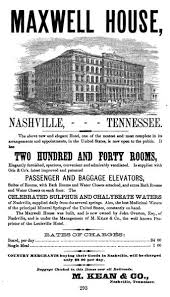
The owners advertised it like crazy!

The Maxwell House Hotel was undertaken in the late 1850s by the son of an old Jackson intimate. Construction began in 1859, but the Civil War put the project on hold, although the unfinished shell was used for a Union Army barracks. By 1869, however, the building was completed, and became the star of Nashville. It was five stories high, had 240 rooms featuring steam heat, gas lighting and a bathroom on every floor. It was loaded with mahogany and brass, and definitely up to Gilded Age snuff. Rooms, which included meals, cost a hefty $4 per day.

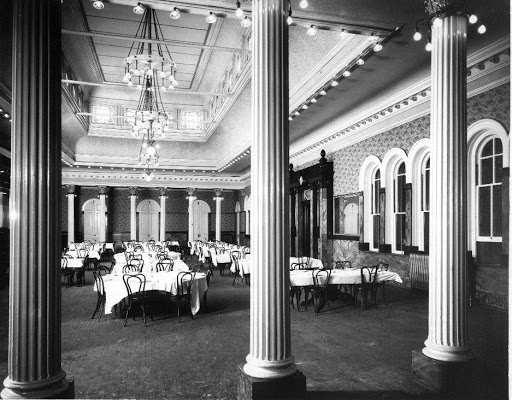
The Maxwell House dining room was redecorated many times.

Its dining room, which became famous all by itself, offered a broad assortment of fine cuisine plus frontier-style game dishes.

Needless to say, by the 1880s, and into the early years of the 20th century, every “important person” traveling through the area made it a point to stay at the Maxwell House Hotel.

The Coffee Part

Coffee has been around (at least in North America) since before Columbus. It has always been a popular drink.

Maxwell House Coffee – it’s still around!

But in the mid 1880s, Joel Cheek, a Nashville resident, met a British coffee broker named Roger Nolley Smith, who could “smell” great coffee even when it was in the green bean stage. The two of them formed a partnership for developing the “perfect blend,” and in 1892, Cheek approached the management of the Maxwell House and offered him 20 pounds to try free of charge. They tried it; it sold out quickly, and they reverted to their old blend. But when their regular customers complained, Cheek and Smith found an exclusive customer of solid value.

Their new enterprise was so successful, that Cheek resigned from his coffee brokerage business and formed a new company as a coffee manufacturing grocery distributor. Their trademarked name Maxwell House Coffee was its flagship product, known nationwide.

The TR-Connection Part

TR visits Andrew Jackson’s Hermitage

Theodore Roosevelt was also a frenetic traveler who spent a good thirty years of his adult life on-the-road, as it were. As President, he visited dozens, if not hundreds of cities, towns and even some tiny places where the train stopped. He was definitely known to visit the Maxwell House Hotel in Nashville. So did several other Presidents at one time or another.

Whether President TR sipped his Maxwell House coffee at the Maxwell House Hotel in 1907 is debatable. Other legend has it that he was offered a cup when he visited Andrew Jackson’s Hermitage plantation, verified as October 21, 1907. And whether he proclaimed it to be “good to the last drop” is also debatable.

TR, well known as a nifty coiner of phrases (“The man in the arena,” “the backbone of a chocolate éclair” et al), never claimed to have said it. “Good to the last drop” is a good slogan but it is not an uncommon one. It is said that Coca-Cola used that slogan as well.

Somewhere around 1915, Maxwell House Coffee began using its “Good to the last drop” slogan – but made no mention of Theodore Roosevelt.

As an aside, permission to use a famous person’s likeness or endorsement is relatively new. During the 1880s and 90s, any advertiser could use a photograph or sketch of said celebrity with impunity. POTUS Grover Cleveland tried in vain to have prohibitive legislation enacted, since his young, pretty wife was routinely “endorsing” stuff from pianos to corsets to arsenic tablets without so much as a by-your-leave.

By the 1930s, Maxwell House began running advertisements that claimed TR had “originated” its slogan. Or at least used it. Since TR had already been dead for more than a decade, he could not confirm or deny it.

Periodically, the TR connection to the slogan surfaces in some advertising, but Kraft/Heinz (who now owns the Maxwell House brand) has kept its distance from the alleged connection.

The Value of a Good Story

A good story, true, false, or a mixture, should never be dismissed as worthless. There is always value, as long as it does no harm, and it is acknowledged as the “story” it is. Most stories have at least a grain or two of truth, and may even be remembered longer than documented facts.

Few people today would care whether their Maxwell House coffee was endorsed by Theodore Roosevelt or not. We are lucky if people today even heard of Theodore Roosevelt.

Sources:

Brands, H.W. – TR: The Last Romantic – 1997 Basic Books

Dickson, Paul – Words from the White House – Walker and Company, 1013

https://www.britannica.com/biography/Theodore-Roosevelt

http://www.theodorerooseveltcenter.org/

Maxwell House Hotel


Posted in A POTUS-FLOTUS Blog, Grover Cleveland, Nifty History People, Theodore Roosevelt | Tagged , , , , , , , , , , , , , , , , , , | Leave a comment

U.S. Grant and Son: Meeting Lincoln

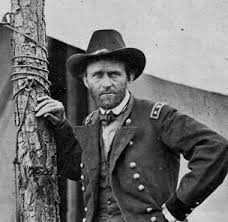
The quintessential General Grant

Little Fred

Frederick Dent Grant (1850-1912) was the oldest son of Ulysses S. Grant. His earliest memory of his father may have been when he was four, and he and his two-year-old brother were playing on the porch of their grandparents’ house in St. Louis, MO, when a tired and dusty rider appeared, saw the boys, dismounted quickly and ran up the stairs two-at-a-time, scooping a boy in each arm and smothering them with kisses. Their mother, hearing noises out front, came to check. Her husband, an army captain she hadn’t seen for two years, was home. Finally.

Ulysses and Julia Grant vowed they would never be separated again for more than a few weeks, and never were.

Boy Fred

Young Fred Grant

At ten, with two brothers and a sister, Fred and his family, now complete, moved to Galena, IL. They were there less than a year when the Civil War began. West Point trained ex-captain Ulysses S. Grant was the only person in town with military experience and was asked to train a volunteer regiment, which he did. Elihu Washburne, his Congressman, and pal of President Lincoln, took an interest in his constituent, and mentored his career.

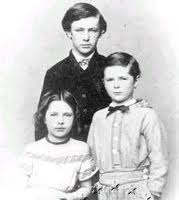
Fred Grant and his brother Buck, and his sister Nellie.

Some months later, rank and promotion gained, Grant began his illustrious military revival. Boggling any modern mind, Julia Grant begged her husband to “take Fred with him,” believing her eldest son could learn much at his father’s knee. Further boggling any modern mind, now-Colonel Grant agreed.

So at age eleven, Fred Grant went off to war, and for the most part, remained with the army for four years. Naturally, when danger was imminent, his now-Brigadier General father wired his wife, and put Fred on a train to his mother. Fred LOVED being with the army. He learned to march and drill, improved his horsemanship, his marksmanship, and ate grub like the rest of them. The soldiers LOVED him, and considered him a manly fellow.

After now-Major General USG became the Victor of Vicksburg, and shortly thereafter the Savoir of Chattanooga, President Lincoln believed he had finally found “his general.” He sent for Grant, who he had never met, and planned to promote him to the rank of Lieutenant General, unbestowed since George Washington.

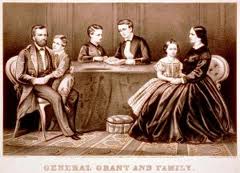
The entire Grant family spent considerable time with the army.

U.S. Grant & Son

President Lincoln.

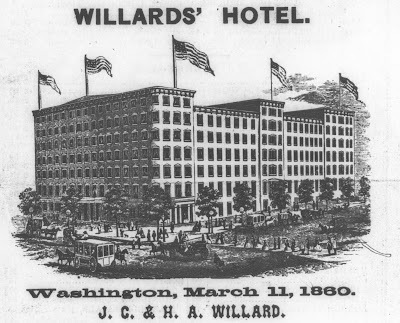
Naturally when the POTUS summons, you go immediately. Barely packing essentials, General Grant took a train to Washington with a very small entourage, and thirteen-year-old Fred. They arrived tired (no sleeping facilities on board) and grimy, and went directly to the Willard Hotel, considered the best in town. The capital was awash with military brass, but Grant was a “western” general, and few in Washington had ever seen him.

The Willard Hotel

Grant asked the desk clerk for a room, and was disdainfully told that he had only one –  in the attic. The General agreed, and signed the ledger, writing, U.S. Grant & Son, Galena, IL. That was it. No rank, no nothing. But the clerk, upon reading the entry, immediately found “room at the inn.”

Grant & Son went up, washed up, rested a bit, and then went downstairs for dinner. They were given a small table and ordered their meal. There was a buzzing of whispers and comments, and finally a man began pounding his knife on the table to get attention. He rose and announced an illustrious guest dining there: General Ulysses S. Grant. Everyone stood and shouted enthusiastically, “Grant! Grant! Grant!”

According to Fred, “My father arose and bowed, and the crowd began to surge around him; after that, dining became impossible and an informal reception was held for perhaps three-quarters of an hour, but as there seemed to be no end to the crowd assembling, my father left the dining-room and retired to his apartments.

The most famous illustration of the first meeting of Lincoln and Grant

Some time later, Grant & Son were escorted to the White House for a reception. It was an impressive first meeting. The extremely tall, lanky President beamed a warm smile, took Grant’s hand in both of his, saying, “I am most delighted to see you, General.” The two men talked for a few minutes, and then Lincoln escorted his guest-of-honor into the large East Room, to present him to a “crowd which surrounded and cheered him wildly… eager to press his hand. The guests present forced him to stand upon a sofa, insisting that he could be better seen by all.”

Lincoln quietly gave Grant a copy of the brief speech he planned to make at the formal ceremony the following day, adding that a few brief words from the new Lieutenant General would be in order. According to Fred, when they returned to the Willard Hotel, an enormous crowd had assembled and remained for hours.

The next day, at 10 a.m. Grant & Son returned to the White House for the small formal ceremony in the Red Room. Following the President’s brief remarks, the new General of the Army made a few brief remarks as well, ending with “I feel the full weight of the responsibilities now devolving upon me, and I know that if they are met, it will be due to those armies, and, above all, to the favor of that Providence which leads both nations and men.”

General Frederick D. Grant – a striking resemblance

1909: ….& Son

1909 was Lincoln’s centennial year, with celebrations and speeches throughout the country. Nowhere was it celebrated more enthusiastically as in the Windy City. Chicago rolled out a huge array of demonstrations for Illinois’ favorite son. On the program was General Frederick D. Grant, the young fellow who had accompanied his father to meet the President. He was now the second highest ranking officer in the United States Army.

Sources:

Grant, Julia Dent – The Personal Memoirs of Julia Dent Grant: (Mrs. Ulysses S. Grant) – 1975, G.P. Putnam’s Sons

MacChesney, Nathan William (ed.) – Abraham Lincoln; the tribute of a century, 1809-1909, commemorative of the Lincoln centenary and containing the principal speeches made in connection therewith.

Porter, Horace – Campaigning With Grant – Mallard Press, 1991

https://libguides.css.edu/ld.php?content_id=53030369


Posted in A POTUS-FLOTUS Blog, Abraham Lincoln, American Civil War, Ulysses S. Grant | Tagged , , , , , , , , , , , , , , , , , | Leave a comment

The Franklin D. Roosevelt Spanish Flu Casualty

The young Roosevelt family.

One of the serious casualties of the great Spanish Flu epidemic of 1918-9, was the marriage of Franklin and Eleanor Roosevelt.

Franklin Roosevelt In Europe

Asst. Sec. of the Navy, FDR

In mid-1918, Franklin D. Roosevelt, Assistant Secretary of the Navy, was sent to Europe to inspect Naval installations, meet with French officials, and visit the “front-lines” of the troops. He had no idea that a virulent influenza had begun to decimate millions of Europeans, already seriously weakened by the devastation of the Great War. Eventually the “flu” claimed more lives than the war itself.

He returned on the USS Leviathan, unaware that many passengers and crew were already sickened by the pandemic. Several died before the ship landed in the US. Franklin Roosevelt not only was violently stricken, but the flu was complicated by double pneumonia. When the ship docked in Hoboken, NJ he was carried off on a stretcher.

Much too ill to return to Washington, or even to the family estate in Hyde Park, he was brought to the Roosevelt town house in New York City to recuperate.

The Seeds of Marital Trouble

Sara Delano and her daughter-in-law Eleanor.

For all their strengths of political partnership, Franklin and Eleanor Roosevelt could easily be categorized as a mismatch in many ways. Mostly, the mismatching was of their dispositions and personalities.

He was more outgoing; she more withdrawn. He was lighthearted with an easy sense of humor. She was serious minded. He enjoyed the traditional social/societal role of his wealthy upbringing. She believed the traditional role (at least the woman’s role) was boring, tedious and a waste of time. She preferred to be useful. He, like many political men of that era, enjoyed the company of women – but as an approving audience, rather than as a participant. Eleanor was not yet a participant, but she spoke her mind, and by her own admission, tended to critique and suggest improvements rather than give blanket approvals.

By 1918, Franklin and Eleanor had been married for thirteen years and had five surviving children (one died in infancy). The story goes that after their youngest son John was born in 1916, Eleanor decided she did not want any more children. Six in ten years was quite enough. And, in those days, when artificial birth control was a taboo subject, certainly among the upper classes who could easily afford large families, there was only one way to ensure no more children: separate bedrooms.

Franklin and Eleanor had already been growing apart. With the coming of World War I, they were finding interests outside of their marriage. Perhaps he knew it. Perhaps she suspected differences. But she was not prepared for the great awakening.

Eleanor’s Great Awakening

Franklin D. Roosevelt was extremely ill when he returned from France, and was bedridden for several more days.

Lucy Mercer

Still accepting her role as a traditional wife, she nursed her husband. As she unpacked his suitcase she discovered a packet of letters tied in a ribbon. They were not from her. She recognized the handwriting as that of Lucy Mercer, her part-time social secretary, and opened them.

These were not casual “housekeeping” letters. These were genuine love letters, indicating a relationship between her 38-year-old husband and her 27-year old secretary had been going on for some time. (Whether it was ever consummated is still open to conjecture. Neither FDR nor Lucy Mercer ever divulged the particulars.)

Eleanor was devastated. A lonely and loveless child, she had hoped to find close intimacy in marriage. FDR was never a “close” person, and Eleanor learned that soon enough. But she not prepared for such a betrayal.

When FDR recovered, she confronted her husband, who could not deny the evidence. She offered him a divorce, if he wished.

The Choices

Eleanor Roosevelt became her own “person” when she was nearly forty.

Not all marriages are happy. Even decades-long marriages may not be happy ones. But in the nineteen-teens, divorce was still scandalous. Most unhappy marriages were papered over, blind-eyes turned, and marriages-of-convenience put in place. If feasible, spouses separated for extended visits to relatives and friends, returning home at sporadic intervals “for appearances.” Some merely went their separate ways while remaining under the same roof.

In the end, neither Franklin nor Eleanor actually made the choice. Circumstances made their choices for them.

Louis Howe, the most important advisor in BOTH Roosevelts’ lives.

When Franklin’s mother, the formidable Sara Delano Roosevelt, was informed of the situation, she was horrified. No Delano or Roosevelt had ever been divorced, and she was not about to let it happen. She idolized her only son, but nevertheless was determined to cut him off without a cent if they divorced, and she maintained the major control over the Roosevelt inheritance and property.

When Louis Howe, FDR’s long-time political advisor learned of the situation, he told Franklin in no uncertain terms, that he could kiss any ambition for a political career goodbye. No one would elect a divorced man to high public office, and FDR had the presidency on his radar for a decade.

The Decision

Neither Franklin nor Eleanor Roosevelt were rancorous people by nature. They loathed confrontation and argument, especially if charm (him) and sincerity (her) could be more effective. And despite the “betrayal” they did not hate each other. To the contrary, they cared deeply for each other and always would.

But for the family name, the children, Mrs. Roosevelt Senior, Franklin’s political ambition, and most likely financial reasons, FDR and Eleanor chose to remain together, but apart. He promised never to see Lucy Mercer again (not quite kept – but kept from his wife). Eleanor would be encouraged (by both FDR and Louis Howe) to explore her own interests, which she did.

The Spanish Flu may have badly scarred an already fragile marriage, but like they say, “what doesn’t kill you, makes you stronger.”

Sources:

Cook, Blanche Wiesen, Eleanor Roosevelt: Volume One 1884-1933 – Viking Press, 1992

Perisco, Joseph E. – Franklin & Lucy – Random House, 2001

Roosevelt, James – A Differing View – Playboy Press, 1976

https://www.ncbi.nlm.nih.gov/pmc/articles/PMC5849954/

https://www.smithsonianmag.com/history/ten-famous-people-who-survived-1918-flu-180965336/?page=6


Posted in A POTUS-FLOTUS Blog, Franklin D. Roosevelt, Nifty History People | Tagged , , , , , , , , , , , , , , , , | 2 Comments

Sarah Polk: Gas Lighting

Sarah Childress Polk was FLOTUS in the mid-1840s – a time of major technical and industrial advances.

Technology, Circa 1840s

When James and Sarah Polk were in the White House (1845-49), the country had grown enormously. Between 1830 and 1840, the population had risen from around 13,000,000 to 17,000,000. There were now 27 states in the Union with more to come. The Gold Rush of 1849 was on a close horizon, and would help propel the nation into a modern age of industry and invention.

Railroad tracks now connected Washington to Baltimore, and New York to Philadelphia, and points beyond. Railroad trains themselves were beginning to look more like trains we recognize today, rather than the early design of stage coaches linked together like a pull-toy.

The telegraph also connected cities and towns by wire! The Morse Code tapped out messages that could travel a hundred miles in a minute – or less. Schoolboys everywhere learned the new Code, both as a hobby and as a means of future employment.

Gas and oil lighting had been around for decades. New York and Philadelphia had already installed the necessary pipe lines by the 1840s, and the new street lights powered by gas was cheaper than candles. And safer. Washington DC had begun the infrastructure by the mid-40s, and was now focusing on updating the White House lighting system. A prize coup for the technology.

The Polks:

The Polks: an unlikely Presidential couple.

Neither James Knox Polk nor his wife Sarah had ever expected to be First Couple. He had been a middling Tennessee Congressman in the 1830s, including a stint as Speaker of the House. Then he served a term as Governor of Tennessee. Then he lost the next two elections, and promptly disappeared.

Political and factional/sectional infighting among the Democrats resuscitated Polk as an innocuous candidate, agreeable to everyone (mostly those who did not know him). That he won against Whig’s Henry Clay – who everybody knew, was a huge upset. Most people said that Polk did not win, rather that Henry Clay lost.

Mrs. Polk

Sarah Childress Polk (1802-91) was a well educated Tennessean who had accompanied her Congressman husband to Washington and had thrived in its socio-political atmosphere. Attractive and stylish, she walked the fine line between the traditional and the progressive, and just about everyone thought well of her.

The Polks had no children, thus Sarah was spared many of the common health issues of 19th century women. With no “family” responsibilities at home, plus a personal disinclination for mundane housekeeping, she was free to accompany her husband on his political travels. She enjoyed it. He, a rather stiff fellow with few intimates, was glad to have her company. He enjoyed it.

Sarah had opinions and suggestions (progressive), but they were for his ears alone (traditional). She was not about to change once she became First Lady. That she took on a fair amount of the secretarial/administrative work during her husband’s single term in office (sparing him the out-of-pocket expense) was little known during their time. While they were considered rather well-to-do, they were a thrifty pair.

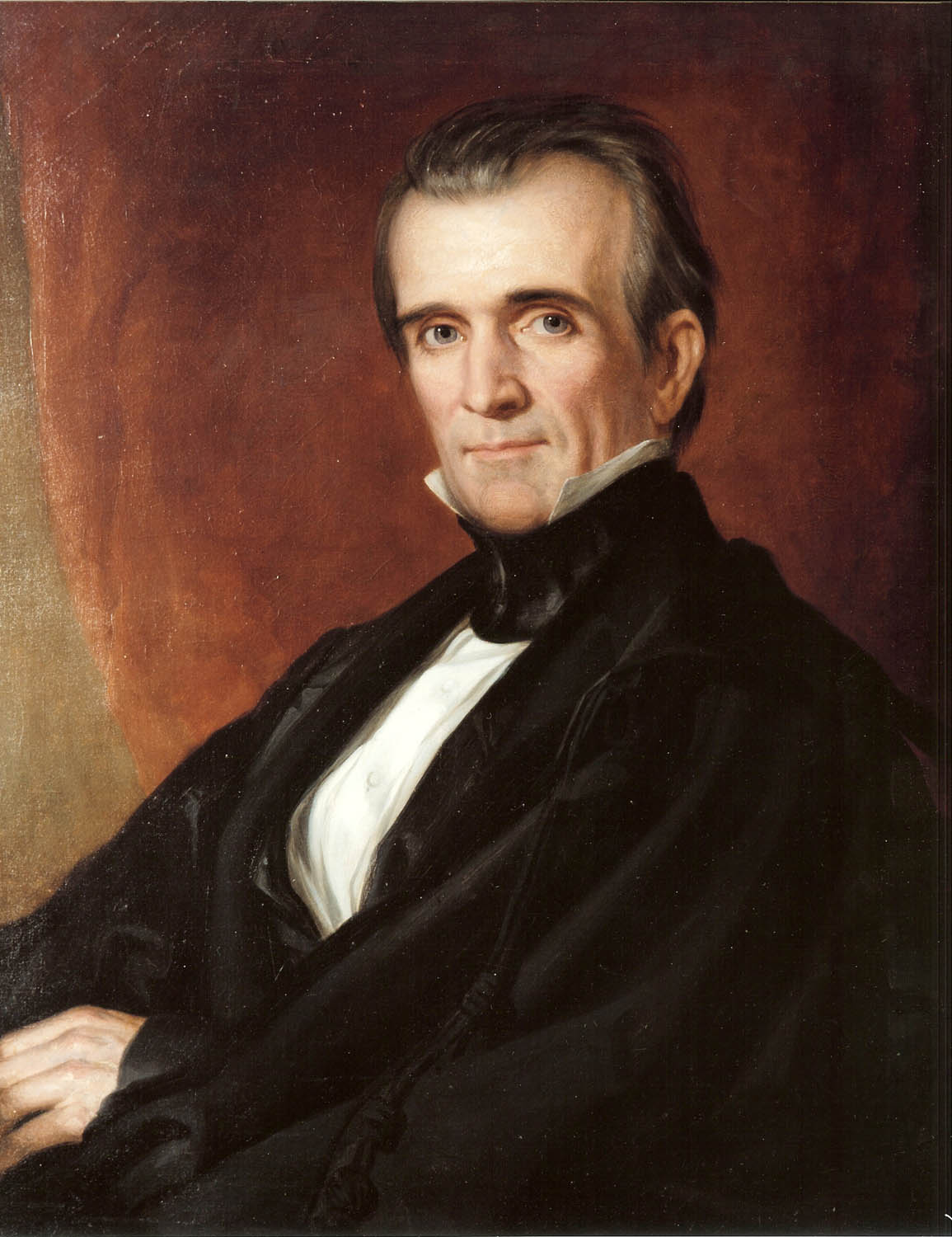
President James Knox Polk

Sarah deferred all political matters and many of the mansion’s “household” functions to her husband’s decision, but the one area of responsibility she absolutely controlled was the tenets of her devout Presbyterian faith. This precluded dancing, alcohol, card playing and insistence on strict observance of the Sabbath. They conducted no business nor received visitors on Sunday. If someone came by unknowingly, they were invited to accompany them to church, but it was rare.

Both Polks were sincerely overwhelmed by their sense of office. They believed it was an awesome responsibility (in the Biblical sense), and that all their efforts should be fixed firmly on the business of government. No idle pastime was permitted.

Nevertheless, despite eschewing frivolity and refreshments (another out-of-pocket expense), the Polks did a reasonable share of gracious entertaining.

The Gaslight Story

Twenty years is sufficient time to determine the benefit/necessity of new inventions. By the late 1840s, gas lighting had proven itself there to stay, which it did for another forty years.

Once the Capitol Building installed gas lighting around 1847, the Baltimore Gas Company extended its pipeline beneath Pennsylvania Avenue to the White House. Gas street lamps placed along the avenue were also connected to the line, illuminating Washington’s most famous street.

Gas lights usually looked like the candles they replaced.

It was a boon opportunity for the premier residence in the country to have its chandeliers retooled for modern convenience. The President was consulted, and Congress was consulted – and an appropriation for gas installation was approved.

The only one not on board was First Lady Polk. She especially loved her magnificent bronze chandelier that President Monroe had hung in the Blue Room, which held thirty long tapers. The White House, committed to high elegance, used beeswax candles, the most expensive kind. Hundreds were purchased regularly to light the public rooms. Sarah loved their grace and the subdued lighting they offered.

In a word, Sarah was a skeptic. Notwithstanding, she lost that battle, and gas was duly installed. But Mrs. Polk kept her candles – just in case.

Just In Case

The Baltimore Gas Company, like all utilities, are in business to make money. And to save money, in what was still considered an early-to-bed-early-to-rise environment, they made it a practice to turn off the gas at 9 PM.

Unaware that the POTUS and FLOTUS were having a soirée, the gas company shut off the valves without notice, and the huge chandeliers and candelabra were abruptly extinguished and the entire place was in the dark.

The Monroe Chandelier – today!

Without a moment’s hesitation, Mrs. Polk, who had insisted on keeping her long tapers, was able to rescue her guests from darkness. The candles were brought and lit, bringing light to what might have been a dark spot on their record.

The elderly Sarah Polk.

Her “memorials” – a reprinted copy!

Decades later, when the elderly Widow Polk (who lived to be nearly 90) told her life story to the couple who penned her biography, she listed her White House gaslight experience as one of her most treasured memories.


Sources:

Anthony, Carl Sferrazza – First Ladies: The Saga of the Presidents’ Wives and Their Power, 1789-1961, Harper Perennial, 1992

Boller, Paul F., Jr. – Presidential Wives, An Anecdotal History, Oxford University Press, 1988

Nelson, Anson and Fanny – Memorials of Sarah Childress Polk – ADF Randolph Company (reprint of 1892 publication)

https://www.whitehouse.gov/1600/first-ladies/sarahpolk

http://www.firstladies.org/biographies/firstladies.aspx?biography=12

Posted in A POTUS-FLOTUS Blog, James K. Polk, Nifty History People | Tagged , , , , , , , , , , , , , | 1 Comment

William McKinley: A Little Help From His Friends

In 1893, the USA suffered a huge “panic,” or economic recession – larger than it had ever experienced before.

William McKinley: The Panic of 1893

In 1893, the usual collision of factors that create recessions occurred – with the usual results. Factories closed, mines closed, entire towns became near-ghost towns. People lost jobs, there was widespread unrest, complete with strikes (illegal) and anarchistic rumblings (frightening).

Congressman William McKinley, a man with many friends.

William McKinley (1843-1901) was a rural Ohioan, born into a large and rather poor family – but hard work, education and devotion to their Methodist faith was in ready supply. After serving for a full four years in the Union Army, earning him a brevet rank of Major, he returned to law school, became an attorney, moved to nearby Canton and opened a practice. Always genuinely likable and outgoing by nature, he prospered, made dozens of friends, and married the daughter of the richest man in town.

One close friend was one he had known since his schooldays. Robert L. Walker had done well in life. He had lent McKinley the money for law school, and made generous contributions to all McKinley’s congressional campaigns. Thus, when Walker needed a favor so he could open a tin plate manufacturing company, he asked McKinley to co-sign a bank loan. Happy to be able to repay Walker’s generosity, McKinley obliged – to the tune of $17,000, so he thought. He was never one to delve deeply into his own financial situations.

Walker had not been completely up-front with his old friend however, and the complications of the transaction actually amounted to well over $150,000 – more like $2.8 million today. Then the “Panic” began, and Walker defaulted and declared bankruptcy, leaving poor McKinley holding the empty bag.

There was one more complication: In 1893, William McKinley was a popular Governor of Ohio, looking forward to reelection – and shortlisted for the Presidency in 1896.

“No Man is a Failure Who Has Friends….”

..so sayeth Mark Twain.

There were few public men in America who had more friends in both high and low places  than William McKinley.

Young Billy McKinley

Even as a young soldier, and despite his total lack of vices-of-camaraderie, such as smoking, drinking, dancing, gambling, playing cards, swearing and chasing women (and probably more), William McKinley was never perceived to be priggish or unmanly. He was popular. His lifelong mentor and good friend was his commanding officer, General-turned-POTUS Rutherford B. Hayes. It was Hayes who suggested “young Billy” study law.

As a young lawyer, McKinley was a joiner of every club and organization in town – from the Masons to the Elks, and the Methodist Church to the Grand Army of the Republic, a veterans group with a million members. And of course, the Republican Club. He made friends easily, and once made, they would be lifelong.

Ida McKinley was devoted to her husband.

When he married Ida Saxton, he was warmly embraced by her family, who owned property, the newspaper and the bank in Canton. Life was good.

As a young attorney, he defended some mine workers (at no charge) struggling to advance their lot in life. They had been arrested after participating in an “illegal” strike. McKinley won the case, had them acquitted, and his reputation as a lawyer (and as a friend of the working man) spread. For life.

Coincidentally, that same case brought him into contact with the mine owner, a man named Marcus A. Hanna, who not only thought highly of the young McKinley, but became his ardent supporter and dearest friend. For life.

During McKinley’s seven terms in Congress, dozens of other prominent men became his friends. These were not merely “political” friendships, although there were many of those. These men became close, personal friends. For life.

…In High and Low Places

Governor McKinley was blindsided by the co-signed loan. It was not only a huge personal problem, it was a huge potential scandal-in-situ. He was guilty of no wrongdoing, but he nevertheless insisted he would resign from the governorship, return to law practice and pay off all debts.

His friends in high places with heavy wallets were not about to let that happen. They offered to pay off the debt themselves, but McKinley wouldn’t hear of such a thing! So his friends called a meeting – followed by calls to the banks begging for a moderate grace period so decisions and appropriate repayment mechanisms could be put into place. The banks obliged.

Myron Herrick

Marcus A. Hanna

Ida McKinley, the Governor’s frail and chronically ailing wife was included in that meeting. Her father had died recently, leaving her a sizable fortune of more than $80,000 – well over a million dollars today. Without hesitation, she offered to put the entire sum in her husband’s hands, saying, “My husband has done everything for me all my life. Do you mean to deny me the privilege of doing as I please with my own money to help him now?” McKinley’s friends were not about to let that happen either.

H.H. Kohlsaat

The upshot of the meeting was to establish a trust fund, organized by several wealthy friends-of-the-Governor, including Mark Hanna, Myron Herrick and H.H. Kohlsaat as trustees. The McKinleys placed all their property in the hands of the trustees, who then went on to collect voluntary “contributions” to pay off the outstanding notes. The public was very sympathetic to their Governor’s plight, and the contributions came from high and low sources, and in particular, a dollar or two from hundreds of miners who had been befriended by McKinley some twenty years earlier.

By the end of 1893, the notes had not only been paid, but the McKinley’s property had been returned to them.

There was no scandal.

There were no glaring headlines.

McKinley was easily re-elected Governor of Ohio.

Four years later, he was elected President of the United States.

Sources:

Leech, Margaret, In the Days of McKinley – Harper & Brothers, 1959

Morgan, H. Wayne – McKinley and His America – Syracuse University Press, 1964

Philips, Kevin – William McKinley – Times Books, 2003

https://www.whitehouse.gov/about-the-white-house/presidents/william-mckinley/

https://ohiohistorycentral.org/w/Marcus_A._Hanna

Posted in A POTUS-FLOTUS Blog, Nifty History People, William McKinley | Tagged , , , , , , , , , , , , , , , , , , , , | Leave a comment

Woodrow Wilson and the Spanish Flu

Woodrow Wilson had delicate health from childhood.

Woodrow’s Delicate Health

If health problems were a major campaign issue a hundred or more years ago, it is unlikely that Woodrow Wilson would have been considered for high office.

Severe headaches, stomach problems and vague discomforts began early in his adolescence, and many physicians today believe them to have been caused by, or at least exacerbated by psychological stress, striving, thwarting, or other emotional issues. That would never go away. He complained frequently about not-feel-wells.

Then there were at least three un- or misdiagnosed strokes that he suffered before he was fifty. For some reason, he pooh-poohed the serious issues as “overwork” or “writers’ cramp”.

The President and his physician, Dr. Cary Grayson,

His White House physician, Dr. Cary Grayson (who became a close personal friend) noted his history as well as his arteriosclerosis and high blood pressure, and put him on strict healthy regimen. A bland diet. Fresh air and exercise. As much rest and relaxation as possible. Wilson felt better than he had in years.

The Spanish Flu

The Spanish Flu, circa 1918, was not Spanish. Some even say it originated in the USA and was “brought” to Europe by the American Expeditionary Force. The origins may be debated endlessly, but the upshot is that it was virulent throughout Europe toward the end of the First World War. It also  killed more people than the millions who died fighting.

Any influenza is not something to be taken lightly. Nowadays, most people who get it feel lousy for a week or so, and then recover. But if one’s health is already compromised (the elderly, the chronically ill, etc.) it can be a killer.

The Spanish Flu, more lethal than most, affected the already weakened without pity. It was especially hard on thousands of young soldiers, already debilitated by fetid, unsanitary trench living, by wounds, by malnutrition etc. It also decimated non-combatants, regardless of country, sex, or age who had suffered terribly from deprivation, exposure and starvation. It lasted for the better part of two years.

President Wilson, Possible Victim?

President Wilson in his best days.

Woodrow Wilson had truly tried to keep us out of war, but when it finally became inevitable, it came quickly. We mobilized and sent our military “over there” much faster than anyone believed possible. It has been said by most historians that WWI was won because the USA provided fresh troops for the exhausted European Allies.

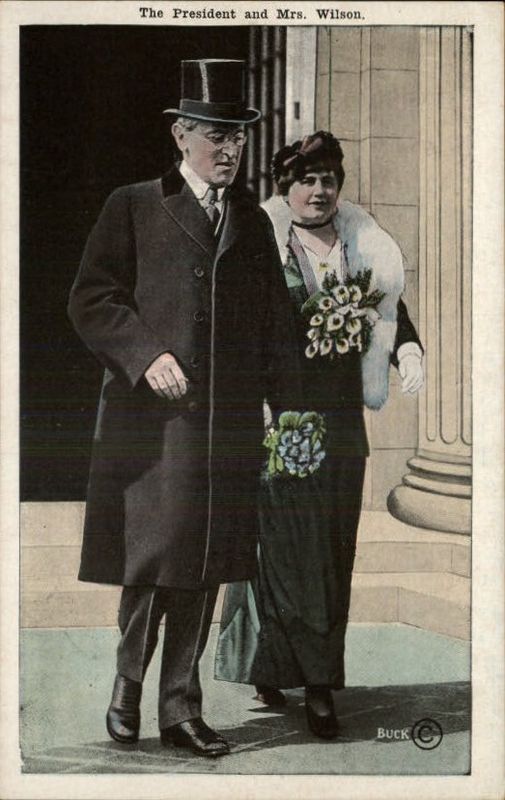
President and Mrs. Wilson were treated like royalty.

President Wilson was determined to play a prominent part in the peace negotiations in Paris once the war ended. It was his passion and the culmination of his life’s work. Against 1918 tradition (sitting Presidents never leave the country) he decided to go in person. Against political and diplomatic counsel, he chose his own “team,” which most politicians faulted as skewed and poorly balanced. And against administrative counsel, his “support staff” was woefully inadequate.

Georges Clemenceau, Premier of France, cared little about lofty ideals.

British Prime Minister David Lloyd George didn’t care about lofty ideals either.

The hoopla and the fanfare and the parades celebrating “Weel-son” grew tiresome in short order. He found himself overly preoccupied with mundane chores (acknowledging bouquets, for example) that others, if he had brought them along, could have easily handled. He was not getting the rest he needed. The banquets were wreaking havoc on his delicate digestion.

And the wily European politicians were focused on blame and restitution, and cared nothing about the lofty ideals that had consumed Wilson all his life.

No wonder he fell ill.

How Sick Was The President?

The late 19-teens was still tied to Victorian times, especially medically. Doctors still had limited knowledge, and the conventional wisdom was to sidestep unfavorable information from all concerned, including the patient.

Treating casualties from the Spanish Flu

Dr. Grayson, who accompanied the Wilsons on their diplomatic mission, insisted to his counterparts, to the press, and even to Wilson and his staff, that the President was overworked, the weather was too damp, and that he was merely suffering from a severe cold. Administration personnel back in Washington were determined to keep any “grave situation” about the President’s health from the public.

But Grayson was seriously concerned. Wilson had a high fever and body aches and pains. He had a gagging cough and a sore throat. He was so weak he could barely sit up. Those symptoms strongly suggest “flu,” and since the virulent “influenza” was still rampant in Europe, it is easy to surmise that Wilson had the flu.

But others who were physically close to the President noted other symptoms, not usually associated with flu: forgetfulness, incoherence, inability to remember names of intimate associates, or even the purpose of his trip to Paris. He had suffered from strokes previously – and Grayson knew it. Wilson biographer Scott Berg indicated worrisome behavior, becoming testy and obsessed by minor details that seemed delusional, perhaps presaging behavior patterns to come.

Was it the Spanish flu? Or did the President suffer another stroke? The two are not mutually exclusive, and high fevers can temporarily affect a patient’s cognitive ability. We may never know for sure.

What we do know, however, is that Woodrow Wilson had a long history of health issues that challenged and changed his personality. Nine months after his “flu,” he was futilely coaxing a recalcitrant Congress to ratify the Treaty he had signed on behalf of the American public – which included a League of Nations, his most treasured lifelong goal.

Tense and stressed to the point of nervous collapse, Wilson had a major stroke. Once again, the extent of his condition, prognosis, limitation and its consequences were smoothed over and withheld from the general populace. The powers that were had become very good at it.

President Wilson was seriously incapacitated for the rest of his term, and indeed until his death in 1924.

Sources:

Berg, Scott A. – Wilson – G.P. Putnam’s Sons – 2013

Heckscher, Augustus – Woodrow Wilson: A Biography – Scribner’s – 1991

Smith, Gene – When The Cheering Stopped – Wm. Morrow & Co. – 1961

ttps://www.washingtonpost.com/history/2020/03/14/flu-woodrow-wilson-coronavirus-trump/


Posted in A POTUS-FLOTUS Blog, Nifty History People, Woodrow Wilson | Tagged , , , , , , , , , , , , , , , , , , | 1 Comment

The Death of Rachel Jackson, “A Being so Gentle…”

Rachel Jackson was almost a First Lady; she died a few weeks prior to Jackson’s inauguration. 

Rachel Donelson: The Three Marriages

When Rachel Donelson (1767-1828) was seventeen, she married Lewis Robards, a prosperous Kentucky planter ten years her senior. She was said to be attractive, with dark, flashing eyes and an outgoing, lively personality. Her family considered Robards a fine match and Rachel went willingly. It did not take long for her to discover that Robards was a jealous and abusive man, who perhaps confused her outgoing nature with flirtation. He, on the other hand, was known to have a violent temper, and a disposition toward infidelity. Rachel was unhappy. So was Robards.

The basic story goes that one of her brothers came, supposedly at the urging of Robards himself, to bring Rachel back to her mother’s house in Nashville. While there, she met one of her mother’s boarders, a lanky young lawyer named Andrew Jackson, who had recently come to make his home in Tennessee.

The attraction between Jackson and the unhappy Mrs. Robards was quick to flower – although it was claimed by all that nothing inappropriate ever happened between them, despite Robards’ continued violent suspicions.. 

Then the story gets very murky. What seems to be generally true (although in what order may be questionable), is that Robards and Rachel reconciled, and she returned to Kentucky with her lawful husband. But things did not improve, and the Donelsons (who had come to like young Jackson) asked him to bring Rachel back home – permanently.

Then things get even murkier. Rachel decided to visit friends in Natchez, then part of Spanish Florida, ostensibly to escape Robards’ wrath and/or any further reconciliation. Andrew Jackson signed on for the riverboat trip, ostensibly to protect them against Indians. He escorted Rachel to her Natchez friends and returned to Nashville, where he learned sometime later that Robards had petitioned for a divorce. Believing the divorce had been granted (seriously murky here), he hurried back to Natchez to marry his now-free Rachel. This was in 1791. They were both 23.

General and Mrs. Andrew Jackson

The new Mr. and Mrs. Jackson returned to live happily in Nashville, among a close-knit clan of Donelsons. That is, until 1794, when it was learned that the Robards divorce had never been finalized, thus the Jacksons were  “living in sin.” They immediately remarried on January 15, 1794.

Rachel the Reclusive

General Andrew Jackson. Statesman.

Even though the Jacksons married for a second time, and the Donelson family adored their brother-in-law, the scandal of Rachel’s divorce and possibly bigamous marriage to AJ changed then both.

Jackson, always a volatile sort with a mix of good points and bad points, became even more thin-skinned. Having as many foes as friends, those foes quickly learned that the fastest way to Jackson’s spleen was to talk freely about Mrs. Jackson’s “character.” He fought duels and carried bullets in his body defending her good name. He was also destined to be a public figure of national proportions.

The Jackson Plantation as we know it was not built till later in their lives.

Rachel became more reclusive. And then more reclusive. And finally reclusive enough to suit the name they gave to their Nashville home: The Hermitage. With no children of their own, she found comfort in the company of her large family and select friends, happy to be their beloved “Aunt Rachel.”

Although the Jacksons adopted a couple of children, and foster-raised a couple more, there has always been some indication that Rachel believed her empty womb was God’s punishment for leaving her first lawful marriage, no matter how miserable she was. And of course, periodic aspersions about her bigamy, her character, her adulterous marriage, etc., managed to bubble up from the murk (and Jackson’s enemies), and caused her added distress.

When Rachel Jackson was around forty, she became acquainted with Rev. Gideon Blackburn, a Presbyterian minister. Her religious fervor now deepened that reclusiveness. Later, at his wife’s request, AJ had a small adjoining chapel built for her daily devotions.

That Last Year: 1828

1828 began very poorly for Rachel. Lincoya, the Indian orphan boy they adopted when he was a toddler, developed tuberculosis and died. He was only 17. Rachel loved him dearly, and was devastated at his death. 

Her own health had been failing as well. Now, past 60, she had slowed down visibly, and tired easily. She had grown stout and puffy and was said to wheeze when she walked. Even then, early doctors suspected heart problems. Modern medicine concurs, although it is hard to determine if it was chronic angina, congestive heart failure, or otherwise.

Her depression grew throughout the year. Jackson’s growing likelihood as the next President deeply disturbed her.  She wrote a friend, “I would rather be a doorkeeper in the House of the Lord than live in that great white palace.” Like it or not, Jackson won the election.

Rachel acquiesced about going to Washington in order to please the husband she loved so dearly. She planned to take two nieces to handle the social obligations. She would remain secluded.

When she learned, either by reading a Nashville newspaper or by local gossip (everything is always murky with the Jacksons!), that in addition to the old adultery charges, people said she was unfit for the White House, and that she would bring shame to the presidency. She became hysterical, and friends brought her home.

A few days later, she suffered a major heart attack. Jackson never left her side. Legend has it that three days before Christmas, 1828, she insisted she felt a little better and that he get some rest. He went into to next room, and shortly afterward, she died, thus sparing him the pain of witnessing her last breath. Legend continues that Jackson held her for hours, hoping she would revive.

Rachel’s grave in the Hermitage garden. Jackson lies beside her.

Her funeral on December 24, was also legendary. Businesses throughout Tennessee were closed; church bells rang for an hour; 10,000 people came to the Hermitage to pay their respects to “A being so gentle and so virtuous, slander might wound but could never dishonor.”

Nevertheless, Andrew Jackson would never forgive those who he believed hastened her death.

Sources:

Burstein, Andrew – The Passions of Andrew Jackson – Borzoi/Knopf, 2003

Meacham, Jon – America Lion: Jackson in the White House – Random House, 2008

Remini, Robert V. – Andrew Jackson 1767-1821 – Vol. 1: American Experience – History Book Club, 998

www.potus-geeks.livejournal.com

Rachel


Posted in A POTUS-FLOTUS Blog, Andrew Jackson, Nifty History People | Tagged , , , , , , , , , , , , , , , , , , | 1 Comment

Lincoln’s White House: A Book Review

If one had to describe Lincoln’s White House: The People’s House in Wartime, one could easily call it a string of pearls encased in a Tiffany box. It is more than just a mere delight. It is a treasure that belongs in every Lincoln lover’s library.

James B. Conroy, the author of this gem, is not an historian by profession, or even a writer by profession. He is an attorney, but we do forgive him. He has managed to put together an eminently well-constructed book. Lawyers are usually excellent at the well-constructed. Conroy is also readable, detailing the ins and outs of the White House for four years of Civil War, the Lincolns, and Washington DC in general.

He has included drawings of the main and second floor of the White House as it was in 1861, which adds to the understanding of the book’s thrust. The better to visualize the areas upstairs (in those days before the West Wing) – where the President’s office was, where the waiting room was, usually filled with office and clemency seekers; the connection to his secretaries’ office; even the shared bedroom of his secretaries, Nicolay and Hay – and the long hall from the President’s Bedroom where Lincoln was said to wander from time to time, even in his nightshirt, to share a story with his secretaries, who he came to regard as family. 

The book flows effortlessly (and effortlessness always results from very hard work!) from the beginning of Lincoln’s presidency – even prior, with a walk-through and goodbye from President Buchanan. It introduces the House, its modest staff, its critical personae, and the facts of the matter: directing and managing the “irrepressible conflict” that was tearing the country apart, and likely unavoidable. Conroy discusses the myriad of visitors, mostly the “pigs at the teats” clamoring for office, and later, the heart-wrenching supplicants, sometimes on their knees, seeking pardons for their miscreant loved ones. It is usually said that the bulk of Lincoln’s wartime correspondence was devoted to clemency issues. 

Mary Lincoln, of course, rates more than just passing interest, or even the chapter Conroy assigns to her on her own. She had inherited a structure sorely in need of refurbishing. Little had been done since the mid 1840s, and the White House always gets a lot of wear and tear. Mrs. L. was never a popular First Lady, partly due to the War, partly due to her Southern upbringing, partly due to her well-known shopping habits and poor choices of companions, and partly due to her difficult personality. It is up to the reader to determine which “partly” belongs to which paragraph. Mostly, however, she tried her best.

The author relies heavily on the writings (public and private) of Lincoln’s young (under thirty) secretaries: John G. Nicolay, John Hay, and a lesser known William O. Stoddard. All of them were excellent diarists/writers, although Hay is the one who sparkles. They not only described the “what’s and when’s and where’s” but added in a lot of their own opinions as to the why’s. That in itself adds to the wonderful readability. 

Who knew, for instance, that while Mary Lincoln was in the Conservatory nearly every day, if Lincoln passed through once a year, it was a lot. While it is fairly well known that the 16th President had been ill with smallpox at the time of his Gettysburg speech, it is a revelation how really sick he was – and that calling it “variola,” a mild form of the disease, was more a public relations waffle (partly to ease Mrs. Lincoln’s anxieties). These are personal tidbits that make the occupants real, honest-to-goodness, easy to care about people, rather than the stuffy almanac facts that history students are force-fed and generally turned off by. 

Conroy has written his own personal “care-about” paragraph in his introduction (and I always read introductions, since it offers insights into the author’s thinking). He tells his own anecdote about a long-ago professor challenging him to “engage with the past and its purpose” and state his own purpose. Authors (including history writers) do have the liberty and responsibility of a point of view, whether you agree with it or not.

Lincoln’s White House does have a purpose, and it is told well. In Conroy’s hands, the House itself becomes its own main character, with its smells, its bones, its ghosts, its visitors, its politics and arguments and its towering sense of time, place, history, tradition and, hopefully, lessons.

The book is wonderful. Get it. Read it. Treasure it!

Lincoln’s White House: The People’s House in Wartime

By James B. Conroy

Rowman and Littlefield, 2016

Lincoln’s White House: The People’s House in Wartime,

Available HC/Paper ad e-book


Posted in A POTUS-FLOTUS Blog, Abraham Lincoln, American Civil War, Presidential Sites, Recommended Reading | Tagged , , , , , , , , , , , , , , , , , | 1 Comment

Lucretia Garfield: The Rough Road to a Happy Marriage

When the Garfields became First Couple in 1880, they had a solid and happy marriage, but…

…A Long Time A-Comin’

When James Garfield and Lucretia Rudolph married in 1858, they were both twenty-seven – and had been engaged for five years.

An early photo of young James and Lucretia Garfield

Both came from the “Western Reserve” part of Ohio, not far from Cleveland and Lake Erie. Both came from families of very modest means. Both were raised on farms rather than towns, and both were part of the Disciples of Christ evangelistic faith. Then there were the differences. James was only two when his father died, and his mother raised him and his three elder siblings alone. But James was an outgoing and warm-hearted fellow, and surprisingly smart academically. He grew to be a strapping young man – about six feet tall, two hundred pounds. With steel blue eyes.

Lucretia, or “Crete” as she was called by family, was petite, with a delicate figure that would never desert her – not even after seven children! She was introverted, raised by a family devoid of emotion or demonstrative affection. She would later write, “I do not think I was born for constant caresses, and surely no education of my childhood taught me to need them.” Education, on the other hand, was strongly encouraged – even to girls – and Crete had good mind for it.

She first met James Garfield when they were both around sixteen and attended the local Geauga Seminary.

The “Eclectic”

Crete’s father, an elder with the Disciples of Christ, was instrumental in founding the Western Reserve Eclectic Institute (later to be called Hiram College, and still later to be part of Case-Western Reserve). His daughter was duly enrolled, and studied a classical education, which included French and literature. It suited her, and equipped her well for becoming a school teacher, which she eventually became.

James Garfield was a surprisingly fine classical student.

James Garfield also attended the Eclectic, studying a more rigorous curriculum of Latin, Greek, sciences, mathematics and plenty of religion. He excelled, seriously considered the ministry as a profession, and was ordained and preached a sermon by the time he was twenty. He was also so prolific in his studies that he student-taught a few classes and was popular.

By 1853, it was noticeable that he was paying marked attention to Miss Rudolph. Their courtship progressed, and they considered themselves “affianced.” Sort of.

But the elders of the Church and the Eclectic believed that Garfield was “their future,” and thus deserving of a better education than their little college could provide. They arranged to send him to Williams College in Massachusetts, where there happened to be a large community of Disciples, to keep him on the straight and narrow.

The Williams Separation

The years Garfield spent at Williams College were seminal to him in many ways. He and Crete corresponded steadily, but his “straight and narrow” had a few bends and detours in the road. He became acquainted with other young ladies, one of whom seems to have been a more serious acquaintance. But the gals in his circle were apprised of his “engagement” and considered Crete as their “sister.” Garfield also became interested in politics, and was an ardent supporter of abolition.

Since Massachusetts was several hundred miles from the Western Reserve, he did not come back for vacations. Crete went there once in 1855, and then again for his commencement in 1856.

By that time, their relationship was somewhat strained, and Garfield suspected that Crete did not really “love” him. She felt neglected by a fiancée who spent little time with her. Undemonstrative like her family, the story goes that she was unable to convey her feelings verbally, but permitted Garfield to read a few select pages in her diary, where she admitted to her deep feelings. They finally married in November, 1858.

Separations of the Heart and Body

General James A. Garfield

Meanwhile, Garfield was steadily progressing in his career. He became principal and then president of the Eclectic, but discovering a better stepping stone to fame and fortune, began to read law. Then he was elected to the State Legislature, and spent much of his time in Columbus. And, despite their first child, born in 1860, he was as neglectful of his wife as he had been of his fiancée.

In 1861, when the Civil War began, Garfield entered the Union Army, and eventually became a Major General. There was another long separation. Then, in absentia, he was elected to Congress, but Since he did not need to take his seat until late 1863, he remained in the Army.

Treasury Secretary Salmon P. Chase

Pretty young Kate Chase looked good on Cong. Garfield’s arm.

For a while, he was assigned to Washington, DC, and stayed with Secretary of the Treasury Samuel P. Chase – a former Ohio Governor. Garfield soon attracted attention by squiring his lovely daughter Kate to various social events. Then, on a trip to New York, he engaged in a brief romance. Crete found out, and her errant husband confessed all to his patient, and very forgiving wife.

Meanwhile, she was obviously disappointed and lonely, and wrote him in 1863, that after five years of marriage, they had only spent twenty weeks together – and offered him a separation, if he chose.

The Ties That Bound

In 1863, three-year-old Eliza Garfield died of diphtheria. Both parents were devastated, and it is believed that their shared grief allowed Crete to respond to her husband in ways she had never been able to do before. She would write to him, “…our love has been made so perfect through this great suffering.”

The five Garfield children.

Crete began visiting him in Washington, but still felt disconnected. Finally, after living apart so much, and after his Congressional seat was secure, they built a house in Washington, and eventually had five more children (A sixth died in infancy.)

Whether Garfield chose to repair his precarious marriage because it would reflect poorly on his political future is undocumented. Nevertheless, the couple found common bonds in their scholarly pursuits, delighted in their children, joined several Washington literary clubs, attended the theater frequently…and in other words, became a strong and loving family till death did they part.

President Garfield was assassinated in 1881. She survived him by nearly forty years.

Sources:

Posted in A POTUS-FLOTUS Blog, James Garfield, Nifty History People | Tagged , , , , , , , , , , , , , , , , | Leave a comment