Lincoln Cousin: Dennis Hanks

Betsey Johnston and Dennis Hanks

It was a complicated and sometimes confusing kinship.

Dennis Hanks: A Flotsam-Jetsam Childhood

Dennis Friend Hanks (1799-1892) was the illegitimate son of Nancy Hanks – an aunt of another Nancy Hanks, Lincoln’s mother.

Born in Hardin County, KY, a decade before his more famous relation, Dennis was raised by great-aunt, Elizabeth Sparrow and her husband Thomas. Since the Sparrows also helped raise Nancy Hanks (Lincoln’s mother, occasionally believed to be illegitimate as well), the family was closely connected. Once Nancy Hanks married Thomas Lincoln, they lived in proximity.

When the Lincolns moved to Indiana when Abe was around six, the Sparrows-plus-Dennis joined them. Three years later, the Sparrows died of the “milk sickness.” So did Nancy. Dennis Hanks, now nineteen, moved into the Lincoln cabin to help with the farm – and to look after the children, Abraham, aged nine and Sarah, aged eleven.

Managing a subsistence farm, with odd-jobs on the side and two youngsters to raise was a huge effort for Tom Lincoln. He left the children care-of Dennis, and returned to Elizabethtown, KY to renew his acquaintance with an old childhood friend, who he had learned was a widow with children.

Now It Gets Really Complicated

A composite of Lincoln’s father and stepmother.

Thomas Lincoln and Sarah Bush Johnston indeed married, happily for the Lincoln family. She came to Indiana with a wagon containing some real furniture, where she found Dennis Hanks and the Lincoln children who were, so she said “in sore need of bathing and mothering.”

Both necessities were tended to quickly enough, and Abraham Lincoln bonded affectionately with his new stepmother. She later commented that “they understood each other.”

An illustration of the rail-splitter.

Sarah had two daughters and a son, in that order. The son, John Johnston, was Abe’s age. The two girls, Sarah Elizabeth about two years older, and Matilda a little younger. Since three out of four females named Sarah in a two room cabin was a bit much, they decided to call Sarah “Betsey,” a name she used for the rest of her life.

Perhaps living in such close quarters gave rise to romance, but in 1826, Dennis Hanks married Betsey Johnston. This made Dennis not only Abe’s cousin, but now his step-brother-in-law.

Dennis and Betsey had twelve children – eight living to maturity. All of them referred to Lincoln as “Uncle” Abe. The young Hanks’ couple lived near the Lincolns until 1830, when a) they all moved to Illinois, and b) Lincoln reached his majority, and set out on his own.

Dennis Hanks in his mid-years.

Meanwhile, Dennis became a “pioneer” of sorts in a small village near Charleston, where the senior Lincolns had made their home. Hanks was a shoemaker, ran a tavern/inn/boardinghouse called the “Illinois House,” and ran a gristmill as well. He had several businesses, but was never wealthy.

Lincoln the circuit rider.


Thomas Lincoln’s cabin in Coles County, IL

Lincoln and Dennis Hanks went their separate ways for the most part, although they remained in touch. It is said that when Lincoln “rode the circuit” in Coles County, near Charleston, he occasionally visited his cousin-brother-in-law. In 1851, he even represented Hanks in some legal matters. But as Lincoln grew in maturity and stature, the correspondence was sparse, except as regarded “family matters” – i.e. Lincoln’s stepmother, an aging widow that Lincoln always remembered affectionately. Suffice it to say however, that while he had a pleasant relationship with his older cousin, he never brought his wife, the former Mary Todd, or any of his children, to meet his Lincoln-Hanks relatives.

Dennis Hanks Gets A New Pocket Watch

The White House circa Lincoln.

Dennis Hanks and Abraham Lincoln shared several family traits. Height and lankiness, yes. A similar speaking voice. Mostly however, a unique way with words. Dennis was a prominent citizen of Coles County – but mostly as a town “character.” Lincoln, of course, became a prominent lawyer and son of Illinois. And President of the United States.

Hanks was never one to let his light grow dim under the bushel. While he never sought any “presidential” preferences, he made his kinship to the top of the heap very well known.

A natty-looking Dennis Hanks.

In 1864, there were political riots in Charleston, IL, and a few citizens were imprisoned. The usual mechanisms for obtaining their release were being stymied. The town fathers decided that perhaps a “special envoy” might be able to persuade the kindly President to intercede, so they sent Dennis Hanks. Lore says they bought him a new suit of clothes and a train ticket to Washington. En route, he was robbed of his pocket watch.

Even during the Civil War, it was very easy to get into the White House to see the President. He had regular “office hours” for that purpose, for anyone who had the patience to wait until called. Dennis Hanks was not the usual visitor, however, and the President’s perceptive secretaries noted the tall, thin, sixty-something year old man, whose bearing and manner of speaking seemed vaguely familiar.

The silver pocket watch. POTUSES were expected to have GOLD watches.

Further lore says that the fairly loud conversation between the secretary and the “visitor” was heard by Lincoln himself, and he came to the door, saying “Dennis? Is that you?” He was quick to usher in the cousin he hadn’t seen in several years.

Lincoln promised to look into having the Charleston citizens released (although it took some time). Then, in conversation, Dennis mentioned that he had been robbed of his watch. Lincoln pulled a fine silver pocket watch from a drawer. It was a “William Ellery” watch, made by the American Watch Company. According to Dennis Hanks in later recollections, Lincoln gave him the watch. Then he pulled a gold watch from his vest pocket in comparison, noting that the President was expected to keep a gold timepiece.

Dennis was happy with his new silver watch. When he returned to Charleston, he had it engraved with his initials.

Sources:

Sandburg, Carl – Abraham Lincoln: The Prairie Years – Harcourt, Brace and World, 1926

White, Ronald C. Jr. – Lincoln: A Biography – Random House, 2009

https://www.theamerican.co.uk/pr/ft-Keeping-Time-With-Lincoln

Posted in A POTUS-FLOTUS Blog, Abraham Lincoln, Nifty History People | Tagged , , , , , , , , , , , , , , , , , , , | 2 Comments

The Long Retirement of The Widow Wilson


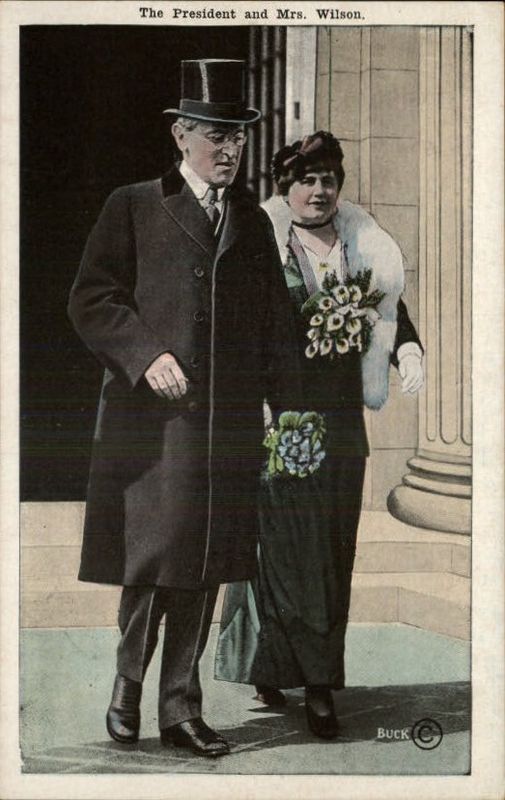
Edith Wilson (the Second Mrs. WW) was one of our longest lived FLOTUSES.

The Second Mrs. Woodrow

Edith Bolling Galt was a comfortably fixed 42-year-old widow when she met sitting President Woodrow Wilson, a recent widower fifteen years her senior.

Woodrow and Edith: The happy couple.

He had dearly loved his first wife, who had died eight months earlier. They had been married for 30 years, and he was bereft and lonely. He met Edith eight months later and fell in love almost immediately. She had been a widow for six years. She took a little longer to woo.

It was 1915. Traditions and mores were different. A President courting, let alone contemplating remarriage so soon after his wife’s death, raised eyebrows. Wilson’s closest advisors insisted that remarriage would ruin his chances for re-election. He didn’t care about being reelected. He wanted Edith.

Fifteen months after Ellen’s death, Woodrow and Edith Galt married. To everyone’s surprise, the public was happy for them.

They liked her. She was statuesque, nice looking, stylish, and seemed to spiffy-up her new professor-husband. He dressed better and smiled more. The politicians however, had misgivings about the assertive bride, who seemed to marginalize them. There were cracks emerging.

The Steward

Woodrow Wilson in better days.

The Wilsons had four years of a happy marriage, despite rifts growing between the President’s advisors, the politicians and Mr. and Mrs. Wilson. The politicians believed Mrs. W. had entirely too much influence.

You can see the change.

In 1919, after reluctantly committing the USA to participate in The Great War (World War I), Wilson chose to attend the Peace Negotiations abroad personally, hoping to arrange an idealistic “League of Nations” to resolve issues diplomatically – and never again have such devastating wars.

The “League” was Wilson’s crowning achievement, but Congress balked, and Wilson was unwilling to amend. He undertook an aggressive speaking tour that took its toll on his always-fragile health. He suffered a massive stroke, and for the remaining 18 months of his Presidency, was a mere shell of himself.

Edith Wilson considered this period “her stewardship.” Her phrase. In her mind, her main function was to shield Wilson from any unpleasant stress that might cause another episode. She was first and foremost, a wife. A wife of a sick man who happened to be President of the United States. That she was the wife of the President of the United States who happened to be a sick man, was secondary.

After six weeks of bedrest, Wilson showed many signs of improvement, although he required two canes and his left arm was impaired. His mind was generally clear, albeit with some mild lapses. He was still calling the shots. His most pressing problem seemed to be the damage to his disposition and personality: What was once stubborn, was now intransigent. What was once wary, was now paranoia.

In semi-collusion with his doctors and private secretary, Mrs. Wilson assiduously kept the political/governmental leadership and the general public from information about the President’s health and ability to fulfill the needs of his office.

If Mrs. Wilson was unpopular among the Wilson circle before, she was now seen as imperious, and an impediment.

The townhouse is now owned by the Natl. Trust for Historic Preservation.

In March 1921, the Wilsons “retired” to a townhouse in Washington, where the former President continued to fail, and died in February, 1924.

The Widow

Edith was only fifty. She had no financial problems. Her health was excellent. What was she going to do? How would she spend her time?

As was common then, she became a “professional” widow.

Despite numerous opportunities, including requests from First Lady Eleanor Roosevelt to participate in civic or charitable programs, Edith kept her activities mostly Wilson-related.

Deciding that her position made her the “keeper of the Wilson flame,” she accepted the invitations to attend every opening session of the League of Nations. The League VIPs made a big fuss over their honored guest, who wore her trademark orchid corsage and was delighted to represent her late husband’s memory.

The Second Mrs. WW (left) in her elder years.

She worked closely with Ray Stannard Baker, Wilson’s choice as biographer, and helped prepare all the papers and documents the journalist needed for his massive undertaking.

But as former participants in the Wilson Administration began writing their memoirs, the SECOND Mrs. Wilson was not treated kindly. At least, she didn’t believe she was. The Wilson daughters became estranged from her for the most part as she generally erased any mention of their mother, the FIRST Mrs. Wilson. Wilson’s doctor, Cary Grayson and financier Bernard Baruch were practically the only two from the inner circle that remained her friends.

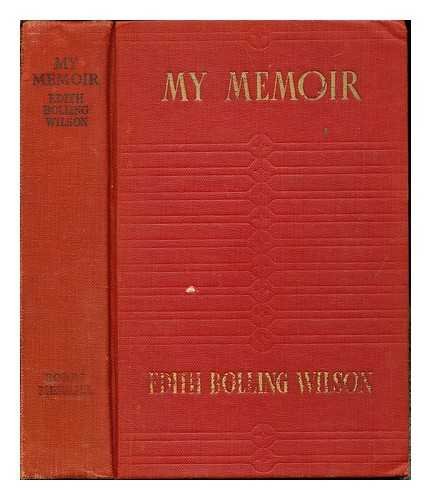
She vociferously denied she was “the first woman president,” but merely tried so hard to protect her husband’s health and wellbeing. “I myself never made a single decision regarding the disposition of public affairs.…The only decision that was mine was what was important and what was not, and the very important decision of when to present matters to my husband.” Thus she wrote her own memoirs, and gave as good as she got. They were published in 1938, to mild success.

She arranged the purchase of Wilson’s birthplace in Staunton, VA (his family moved when he was only a year old), and turned it into a Presidential site. It now houses the Wilson Library. It is nice, but not spectacular.

The birthplace now houses his papers.

She was a “consultant” on the movie Wilson, released during World War II as a tribute to the man who vainly strove to keep the world from war. It did fairly well – then. But it does not have “legs” today.

And she sewed a little for the Red Cross. Past that, if it wasn’t Wilson-related,” she kept her distance.

But since she outlived just about everyone of the Wilson circle, living to age 89 (and dying on Wilson’s 115th birthday), perhaps she had the last word.

Sources:

Berg, Scott A. – Wilson – G.P. Putnam’s Sons – 2013

Heckscher, Augustus – Woodrow Wilson: A Biography – Scribner’s – 1991

Wilson, Edith Bolling – My Memoir – Bobbs Merrill, 1938

http://www.woodrowwilsonhouse.org/league-nations

https://www.britannica.com/biography/Edith-Wilson


Posted in A POTUS-FLOTUS Blog, Nifty History People, Woodrow Wilson | Tagged , , , , , , , , , , , , , , , , , , , , , , , | 1 Comment

FDR and the Lend-Lease Metaphor


It’s an old story told thousands of times, but still rings true.

FDR: The President on Two Fronts

In 1940, President Franklin D. Roosevelt accepted the Democratic nomination for an unprecedented third term in office. Despite being crippled by polio, details assiduously withheld from the general public, his winsome grin and outgoing optimism had endeared him to the American voter. He won easily.

FDR cemented his relationship with the public via his Fireside Chats…

FDR had managed to tread the waters of the Great Depression for eight tumultuous years. Nothing completely cured the chronic unemployment and energy-sapping hard times, although the finger-in-the-dike, plug-up-the-holes, fight the fires “alphabet soup” programs had helped to a degree. But the people truly believed the President cared, and was trying to help them. He was.

…and everybody listened.

Coinciding with the still dragging Depression was a new and ominous threat from overseas. The rise of Nazism and fascism was rattling sabers and making warlike sounds yet again. It had only been twenty years since the War to End All Wars had decimated a huge part of the world.

The Unwarlike USA

FDR

Despite the fact the United States had fought in a half dozen or more wars and skirmishes during its brief 150-year history, the American people as a whole, were peace loving folks. Yes, of course there were always some who thrived on conflict and bloodshed, but it was a very small minority. Poll after poll, survey after survey, man-on-the-street comments all resonated with the opinion that we would be best served by staying out of any European mess, and minding our own business.

That had been the sage advice of George Washington. And we duly followed that course – until 1917. Even then, it was with many misgivings and little to gain from the outcome – not that we were looking for anything.

But these developments were different. They were not only warlike, they were brutal. European attempts to mediate aggression met with ridicule and deceit.

By 1940, the only “empire” remaining after the Great War was Great Britain and it had been tottering since 1918.

Roosevelt had a very broad worldwide outlook, which made many of his countrymen uneasy. But Roosevelt had always claimed that “politics was the art of the possible,” and when things appear to be impossible (despite a prescient world view), one sometimes needs to tread water until the obvious becomes truly obvious.

Meanwhile…

A growing personal friendship had begun between President FDR and currently out-of-office Winston Churchill, who had been a voice in the wilderness about the fascist threats in Europe. Everyone knew him – after all, he came from the Marlborough line. But many thought him rash and unstable.

The POTUS’ buddy.

The correspondence between the President and Churchill was one of depth and insight. Churchill always claimed that Great Britain was a target of aggression, and that assistance was desperately needed. FDR agreed, but knew instinctively that the US would not actively assist – especially supplying arms and munitions. Unless of course, if the Brits paid for it. Cash on delivery. The Brits did not have the funds.

Roosevelt, being a master politician with a long history of dissemblance in his personality, discussed the situation obliquely with several key aides and politicians. They all advised against any involvement. Unless of course, if the Brits paid for it. Cash on delivery.

The Royals.

Even the 1939 official visit from King George VI and Queen Elizabeth (the first of any sitting British monarch) did not bring the hoped for results. FDR liked the royals immensely and sincerely wanted to help, but his hands were tied. It was getting desperate.

Imagination, and perhaps an end run was needed.

Lend-Lease

The United States had a large fleet of antiquated ships of various sizes and functions sitting in “mothballs.” England, for centuries the “ruler of the waves,” could certainly fix them up and use them to their best advantage. But without cash, how could they “purchase” them? A loan? A rental? What if they were destroyed? Who could assure that they would be returned? Or paid for? FDR and his “team” suggested an exchange. Our outdated and unused mothball fleet in exchange for long term leases in various British held territories around the world. Sounded fair.

But no matter how appealing the swap sounded, cold hard cash sounded better to Congress, and they were balking. FDR, masterful as ever, bided his time. It was the only thing he could do.

In 1941, the Battle of Britain firebombed London night after night for months, depleting its dwindling resources. Daily radio reports and newspaper stories were heard and read by all Americans. Even those who had been supportive of Germany were having a change of heart as they heard of the vicious destruction – and the new trickle of information about the vicious decimation of humanity in “conquered” territory.

Selling the Story

The President’s home at Hyde Park.

FDR had a fine speaking voice and writing style. Using the medium of radio, he could actually “talk” to the American people directly – and they did not need to know that he was wheelchair bound. His “Fireside Chats” began shortly after he was elected – and everybody tuned in.

This was the time to explain Lend-Lease. He likened it to a man whose house was on fire, and believed it could be controlled if he had a rubber hose. He didn’t have one.  So he went to his neighbor, who did have such a hose, and asked to borrow it. The neighbor did not worry that the hose cost $15, or that it might be destroyed in the attempt to put out the fire. He worried that if that fire were not contained, it could easily spread to his own house. He was happy to lend the hose, asking only that it be returned when the fire was extinguished. Or, if it had been ruined, that his neighbor would replace it.

Millions of Americans tuned in. Letters and telegrams and phone calls poured into the White House in support.

They understood his metaphor.

Sources:

Davis, Kenneth – FDR: The War President: 1940-43 – Random House, 2000

Friedel, Frank – A Rendezvous With Destiny – Little Brown & Co., 1990

Meacham, Jon – Franklin and Winston – Random House, 2003

https://www.history.com/topics/world-war-ii/lend-lease-act-1

https://www.history.com/topics/great-depression/fireside-chats

https://www.nps.gov/articles/fdrww2.htm

Posted in A POTUS-FLOTUS Blog, Franklin D. Roosevelt, Nifty History People | Tagged , , , , , , , , , , , , , , , , , , , , | 1 Comment

James Monroe: The Hats Story

James Monroe came to office with more executive, legislative and diplomatic experience than any previous POTUS.

JM: The Fellow In A Tricorn

James Monroe (1758-1831) was the last of the Virginia Triumvirate: three-in-a-row two-term Presidents serving between 1800-1824.

Considered the earliest image of James Monroe.

Born in Westmoreland County, VA, he was orphaned early but had the good fortune to be mentored by an uncle, who remained a mainstay throughout his life. That included a solid education, including attending the College of William and Mary for a year that coincided with the American Revolution. James Monroe, along with most of his classmates, were quick to leave the academic world for military service.

Athletic and a superb horseman, he became a scout for fellow Virginian General Washington, earning praise and promotion, and a rare letter of commendation from GW himself. A Colonel by twenty-one, he was wounded, and returned to Virginia to recuperate. But once recovered, he found it difficult to find a colonelcy in the army again, since he did not have the personal funds to recruit a regiment.

Another mentor, Thomas Jefferson

Thus he returned to academics, heeding his uncle’s advice to read law with Virginia’s Governor: Thomas Jefferson. The association proved not only beneficial, but became a personal and political close friendship for the rest of their lives.

JM: The Public Service Hat

Practically sidestepping a career in legal practice, James Monroe entered public service. As the Revolutionary War evolved into a conglomeration of United-ish States under the Articles of Confederation, the young attorney became a state legislator, serving in Virginia’s House of Delegates and later in the Congress of the Confederation.

When ex-Governor Jefferson was dispatched to France for diplomatic service, Monroe was forced by economic need to focus on his legal career, became an attorney for the State of Virginia, and won another term in the House of Delegates.

The Articles of Confederation were finally dissolved following the Constitutional Convention, and Monroe, named to Virginia’s ratifying convention, straddled a middle ground between the proponents James Madison and General Washington, and the opponents, Patrick Henry and George Mason. It was, in its way, a battle of titans and giants.

Nevertheless, the differences and concerns were ameliorated, and Monroe was named to serve as one of Virginia’s first Senators. As political divisions began to emerge in the fledgling United States Congress, Monroe remained loyal to Jefferson and Madison, and took a leadership role in the Senate.

JM: The Diplomatic Hat, Part 1

Young diplomat James Monroe

President George Washington was firmly committed to a path of neutrality for the USA, which had neither resources or experience for global partisanships. By the 1790s, GW straddled his battles by naming John Jay (an anglophile) as Minister to Great Britain, and James Monroe (a francophile) as Minister to France, Thomas Jefferson’s old post. Monroe proved a little more partisan in the francophile department than GW liked, and was eventually recalled.

Monroe returned to Virginia, and renewed his mild efforts in law practice, and his stronger inclination toward Virginia politics. He became its Governor, serving two non-consecutive two-year terms. (Even today, Virginia statue does not permit a governor to serve a second consecutive term.)

The political divisions begun in the early 1790s, had manifested seriously by the time George Washington retired in 1797. Throughout the term of John Adams, Monroe concentrated on Virginia.

JM: The Diplomatic Hat, Part 2

The Emperor

Jefferson’s election in 1800 was enthusiastically supported by Monroe, and resuscitated his diplomatic career. Once Monroe’s gubernatorial term was concluded, Jefferson sent him back to France, this time to help negotiate the Louisiana Purchase, which literally doubled the size of the United States. Then he sent Monroe to Spain to try to purchase West Florida from Spain. That effort failed. Then.

Then Monroe donned another diplomatic hat, serving as ambassador to Great Britain, specifically hoping to quell the growing difficulty of British impressment of US sailors. That effort also failed. He remained in Britain until the election of James Madison.

While Monroe’s decade in Europe offered him a cosmopolitan lifestyle and broadened outlook, it also caused somewhat of a rift between him, Jefferson and Madison. Their relationship was strained for two or three years.

JM: Dual Cabinet Hats

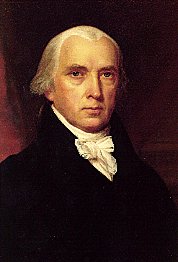
President James Madison

By 1811, James Monroe’s friendship with Madison had resumed, and the new President, having inherited many headaches on the diplomatic front, tapped Monroe as his Secretary of State, acknowledging his many years of practical experience in foreign affairs. Despite demanding British cessation of attacking and seizing American merchant ships, the new Secretary realized that nothing short of war would bring success.

He now became a War Hawk.

James Monroe

The War of 1812 was a travesty on several fronts. Americans had not been engaged in warfare for nearly forty years. Most of their generals had died; those remaining were aged. Weaponry had not been substantially improved in forty years either. Nor were battle strategies and tactics.

Now in his mid-50s, Monroe was one of the “young fellows.” When the Secretary of War resigned, Madison asked Monroe to wear an extra “hat.” The Senate balked, and Brigadier General John Armstrong assumed the War Hat. His intransigence in refusing to fortify and defend Washington DC, even when it became clear that it was the British objective, caused his forced resignation.

Monroe once again donned the Secretary of War hat, but the Senate was still balky about the two hats. So Monroe resigned his State hat. But no successor for State was forthcoming, and Monroe ostensibly wore the two hats for several months.

By 1816, James Monroe’s wartime leadership and energy made him the heir apparent to Madison. The old Federalist party was nearly moribund, and other challengers were younger – and could bide their time.

James Monroe creamed the opposition in the election, and was presented with one more hat. He wore that one for eight years.

Sources:

Cresson, W.P. – James Monroe – UNC Press, 1946

Unger, Harlow Giles – The Last Founding Father – DeCapo Press – 2009

https://www.whitehouse.gov/about-the-white-house/presidents/james-monroe/

https://history.state.gov/departmenthistory/people/monroe-james


Posted in A POTUS-FLOTUS Blog, George Washington, James Madison, James Monroe, Thomas Jefferson | Tagged , , , , , , , , , , , , , , , , , , , , , | 2 Comments

John Quincy Adams: The Homecoming

John Quincy Adams spent the most part of his youth in Europe.

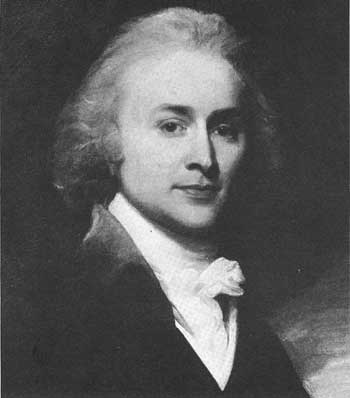
The earliest image of John Quincy Adams, about age 10.

The Continental Education

When John Adams sailed to Europe in 1778 as a diplomatic envoy from the new United States, he brought his 10-year-old son John Quincy with him. JQ, as he was beginning to refer to himself, was a bright and scholarly child, and the Adams parents held high hopes for his future. If they could provide an exceptional education for an exceptional student, so much the better – and worth the serious dangers they were facing.

For most of the next seven years (fully half of JQA’s solid memory), he received the cream of a European classical education. He attended the finest schools available, and did not disappoint. He also made some companionable friends his own age.

Dr. Franklin

The Marquis.

Then too, he met many of his father’s highest ranking political peers: Dr. Benjamin Franklin, Francis Dana, Thomas Jefferson and the Marquis de Lafayette.

In addition to his academic/cultural achievements, he displayed a rare gift that eluded both his parents: a happy faculty for languages. By his adulthood, JQA would be master of several. Fluent in Latin and Greek, of course. Plus English, French, German and Dutch, passable in Russian, Italian and Spanish. It would stand him in excellent stead throughout his life.

Abigail and John Adams, non-linguists.

Not long after his mother and older sister joined his father in London, JQ made a decision, enthusiastically supported by his parents: to return to the United States, and finish his formal education at Harvard. His father considered him the “greatest Traveller, of his age.”

JQA’s sister Nabby. They were very close.

And at nearly 18, he was old enough and experienced enough to return home on his own.

Cross-Atlantic Travel Circa 1780

Transoceanic travel had not changed very much since the early days of global exploration. Ships relied on sail power. The voyage took anywhere between 5-7 weeks, depending on the vagaries of weather, the currents, the worthiness of the ship itself, and, in the 1770-80s, the seemingly endless wars between European nations.

Passengers brought their own food, beverage, entertainment – and bedding. A dozen passengers was considered a party! A bucket was the extent of sanitation. And, since so few passengers made the long and arduous voyage, they were asked to provide small favors and courtesies for their shore-bound comrades: carrying letters and packages, and arranging for proper forwarding when they reached their destination.

When John Quincy Adams (1767-1848) embarked on board the Courier de l’Amerique, bound for New York, he was tasked with caring for and delivering a half dozen greyhounds to General George Washington in Virginia – a gift of the Marquis de Lafayette. He also carried several letters to various people up and down the coast.

But in the main, it was an uneventful voyage, with little “company,” and plenty of time for the studious young man to devote to his books.

The Young Celebrity

Young JQA, painted by John Singleton Copley


Granted, being the son of a well-regarded political bigshot and likely candidate for high office in the fledgling new country was enough to attract attention in New York. But JQ had developed a well-considered reputation of his own. As his father had said, he truly was the best traveled (i.e. cosmopolitan) young man of his generation. During his few weeks in New York City, and before rejoining family members in Massachusetts prior to entering Harvard, he was wined and dined, hosted and regaled by the crème de la Manhattan, anxious for news, and perhaps a bit of brownie-points toward political preference.

Perhaps surprising himself, he was introduced as a young man of importance and credentials, as well as being his father’s son, now American minister to Great Britain. Young Adams was caught up in a whirl of dinner parties, excursions and other festivities, and met many of the notables of his day, most of whom would figure in his forthcoming career.

Gov. George Clinton of NY

He enjoyed a pleasurable meeting with John Jay, made more so since JQ had become great friends in Europe with Jay’s nephew Peter Jay Munro. He was introduced to Elbridge Gerry and Rufus King, James Monroe, Henry Knox and NY Governor George Clinton, (eventually Vice President).

Perhaps surprising the young man even more, was the interest these notables took in an 18-year-old fellow’s political opinions and reflections of Europe. They sought news of course, particularly regarding the recent peace treaty between Great Britain and the United States, and its various provisions that were still causing problems. Naturally young Adams had little comment on those political aspects, but he wrote a thorough summary of those concerns to his father, adding that “the politicians here wait with great impatience to hear from you.”

He was developing the skills and crafts of the superb diplomat he would become.

The Family Reunion

Brother Tom

Brother Charles

After three weeks in the social whirlwind of New York, he spent another ten days traveling back to Massachusetts by land (rather than by packet ship), in order to see more of the country. In Boston, he stayed with his Aunt Mary and Uncle Richard Cranch while he prepared for an advanced placement entrance examination to Harvard.

But mostly, he was delighted to see his two younger brothers, Charles and Thomas, who he had not seen in six years. He left them as little boys; now they were nearly full grown young men. He made a notable diary entry, “I shall not attempt to describe the different sensations…after so long an absence…the friends of my childhood and a number of my nearest and dearest relations. This day will be forever…one of the happiest I ever knew.”

But in some ways, he was a stranger in his own country. Much had changed. So had he.

Sources:

Kaplan, Fred – John Quincy Adams: American Visionary – Harper Collins, 2014

Unger, Harlow Giles – John Quincy Adams – DeCapo Press, 2012

https://millercenter.org/president/jqadams/life-before-the-presidency

https://www.whitehouse.gov/about-the-white-house/presidents/john-quincy-adams/


Posted in A POTUS-FLOTUS Blog, John Adams, John Quincy Adams, Nifty History People | Tagged , , , , , , , , , , , , , , , , , , , | 2 Comments

The Death of FLOTUS Caroline Harrison

This image has an empty alt attribute; its file name is potusharrison.jpg

The election of 1892 was another Presidential rematch.

The Rematch Election

Sitting Republican President Benjamin Harrison was poised to seek a second term – against Democratic ex-President Grover Cleveland, who held the position from 1885-9.

Grover Cleveland, the opponent.

Grover Cleveland was generally well considered – even by Republicans. He was conservative, stable, of good judgement and character, and fairly accessible. His biggest problem was that he was a Democrat – and it was barely 20 years since the Civil War. The Democrats were still perceived to be the party of rebellion – and traitors. It was anathema to many that a Democrat could hold the highest office in the country.

So in 1888, the Republicans ran Benjamin Harrison, also conservative, stable, of good judgement and character, and fairly accessible. He was also a Midwesterner (Indiana), a Union Brigadier General, and possessed of a superb name and lineage. The Republicans waved the “bloody shirt” again and Harrison won.

Young Carrie Harrison

But it was a squeaker. He won the electoral votes, but lost the popular votes by less than 100,000 out of 10 million cast.

Benjamin Harrison, a cool fellow of limited personal skills, proved to be a solid, albeit uninspiring POTUS. He could list a few accomplishment, including having six new stars added to the flag – the most of any one-term president since the country began.

As an aside about early election campaigns. Until the 20th century, it was considered self-serving, unbecoming and indeed tacky, for a candidate to actively seek election, believing that the office should seek the man. Both spoke little, and relied on their supporters and associates to propel their candidacy.

Now, in 1892, a rematch election was up for grabs.

President and Mrs. Harrison

This image has an empty alt attribute; its file name is carolineharrison.jpg

Caroline Scott Harrison

Benjamin and Caroline Harrison had married young. Only twenty. Despite the solid lineage of Harrisons, their financial status was meager. His law practice struggled. It took more than a decade before he was able to support his family comfortably. And, with limited funds, two children, and Ben’s cool persona, the ups and downs of marriage took a toll.

General Benjamin Harrison

This image has an empty alt attribute; its file name is genbenjaminhelm.jpg

General Benjamin Harrison

When the Civil War began, Ben Harrison hung a flag from his window and raised a regiment, awarding him a Governor-appointed colonelcy, enough to send home a paycheck each month, along with truly affectionate letters to his wife.

But Carrie was a talented Homemaker First Class, and enjoyed domesticity. She cooked, sewed, gardened, decorated, and painted water colors. She also sang in the choir, joined a woman’s club and became its president, bought a small kiln and gave lessons in china painting – the new rage after the Civil War. Bustles became fashionable, and Carrie was a bustling lady.

This image has an empty alt attribute; its file name is harrison-house.jpg

The Harrison home in Indianapolis.

The marriage improved, and both found their niches in Indianapolis life. Politics beckoned, and bland persona notwithstanding, Benjamin Harrison was a hit. All the way to the White House.

FLOTUS Harrison

Most early First Ladies were homebodies by inclination, plus the fact that few opportunities were available to make them shine. They were content to put home and family first, and take their bows as Mrs. President.

The DAR portrait

Carrie, was truly a homemaker, and bustled through the White House, actually making a difference, and leaving a record of accomplishment. She insisted on a major upgrade to the House itself, something that had not been done for decades, including electric lights.

She entertained graciously, supervising a well-run kitchen, bountiful flora in the conservatory, all the niceties of FLOTUSdom, vis-à-vis the appropriate notes, letters, bouquets and invitations.

Then there was her serious interest in collecting and researching the remnants of previous White House dinner services…

In 1890, when the Daughters of the American Revolution established their organization (since the new Sons of the American Revolution denied them membership), she was number 7 on their membership list. She was delighted to serve as their first President General, squeezing one more activity into her busy bustling schedule.

Early 1892

Carrie’s health, like other Victorian women, had its limitations. She had a bout or two with pneumonia – never to be taken lightly. A fall had added to the aches and pains of natural aging. She was 58 when she became First Lady, one of our oldest till that time.

Nevertheless, she was surprised when her normal energies began flagging in the winter of 1891, and medical attention was required. There are a few sources that claim she had pneumonia. Some said typhoid. Both of them were serious illnesses, but most sources concurr that she had consumption, what is now called tuberculosis. Prior to WWII, it was a killer. Very few survived, although there were many who languished with it for decades.

Carrie’s health failed rapidly, and in 1892, there was no cure, and the only treatment per se, was a cool climate and nourishing diet. By early July, when fluid collecting in the First Lady’s chest complicated her already serious condition, she was sent to a cottage at Loon Lake in the Adirondack Mountains. The President accompanied her on the train, along with her personal doctor, and her widowed niece, Mary Dimmick. Other family members arrived a few days later. The POTUS only remained for a few days, since Congress was in session, but once it adjourned in August, he returned to her side.

For a brief time, she showed improvement, enough to take an occasional carriage ride, but by September, she had declined precipitously. The President (already nominated for a second term), began cancelling engagements, preoccupied with his wife’s health. By September 20, the decision was made to bring her back to the White House, according to her own wishes.

She was carried on a stretcher and placed on a cot in a wagon, to take her on a slow four-mile journey to the depot, and gently carried aboard the train to Washington.

Once back in the White House, she rallied briefly, but by then, Benjamin Harrison’s heart was not in the campaign for re-election. He cancelled more appearances.

On October 25, she died.

On Tuesday, November 8, Benjamin Harrison lost the election. It wasn’t that much of a squeaker. Some said he no longer cared.

Sources:

Caroli, Betty Boyd – First Ladies: An Intimate Look at How 38 Women Handled what may be the most Demanding, Unpaid, Unelected Job in America – Oxford University Press, 1995

Foster, Feather Schwartz – The First Ladies from Martha Washington to Mamie Eisenhower – Sourcebooks, 2011

https://millercenter.org/president/bharrison/campaigns-and-elections

http://www.newyorkalmanack.com/2014/09/a-first-ladys-failed-adirondack-cure/

http://www.firstladies.org/biographies/firstladies.aspx?biography=24

https://www.whitehousehistory.org/the-life-and-presidency-of-benjamin-harrison


Posted in A POTUS-FLOTUS Blog, Benjamin Harrison, Grover Cleveland, Nifty History People | Tagged , , , , , , , , , , , , , , , , , | 2 Comments

Lincoln’s Second Inaugural Ball

The mood of the country was vastly different in 1865 than in 1861.

The Difference Being…

…(at least in general essence), that in 1861, the country was nervous and frightened. Several Southern states already seceded, and the tensions at South Carolina’s Ft. Sumter were about to plunge the country into a real shootin’ war. Nobody wanted that – but it seemed that the events were out of anyone’s control.

For certain, no one would have predicted the four years of blood and battle and death of the cream of a generation, or the thousands of families left grieving, or the billions of dollars spent to abet that blood and death and grief.

But on Thursday, March 4, 1865 just about everyone knew that the end was drawing near. Yes, there would be more battles and blood and death. And grief. But it was going to end – sooner than later. Finally. President Lincoln, looking a decade older than he did in 1861, gave perhaps the finest inaugural speech ever.

The guest of honor.

People from all over the North had flocked to Washington. The train station was jammed, and nobody noticed the coat of fresh paint in honor of the occasion. The hotels were overflowing. The largest, the Willard and the Metropolitan, placed cots in their hallways. Boarding houses were packed. Even the Lincoln-Johnson Clubs (since the name “Republican” was on hiatus for the election of 1864) provided accommodations as best they could for the visitors. Some out-of-towners booked rooms as far away as Baltimore, preferring to day-trip the festivities.

On Saturday, March 6, the last formal Presidential reception of the season was held at the White House. Thousands of well-wishers piled through the doors to shake Lincoln’s hand. According to staff members, the hordes trampled the place – some even cut swatches of draperies or cushions as souvenirs. WH guard William Crook said “it looked as if a regiment of rebel troops had been quartered there – with permission to forage.”

The Inaugural Ball

The Patent Office circa 1860.

“Republican” wasn’t mentioned in the 1864 election.

The Inaugural Ball was an on-and-off tradition since the days of Dolley Madison, depending on the personal preferences of the incoming POTUS. This one was set to take place on Monday, March 8. The Lincolns did not have to pay for it. Nor did the government. It was underwritten by the Lincoln-Johnson Clubs, or the political organization, in honor of Lincoln’s re-election, and no expense was spared. The tickets cost a whopping $10 each (Dolley’s ball was only $4/per in 1809), but it entitled entrance to a gentleman and two ladies. It also included a sumptuous supper. Every ticket (4,000) was sold. After expenses, any surplus went to the aid of the soldiers’ families.

The event was held in the old Patent Office, which until recently had been used as a makeshift hospital. It was quickly decorated with flags and banners, and a raised dais for President Lincoln and his guests.

Early that evening, crowds dressed in their finest and most fashionable clothes, began to fill the halls as the band music played. Cabinet members, members of Congress and the judiciary, all the military brass, and the diplomatic corps. Virtually everybody of importance.

The Guest of Honor

Mary Lincoln – ready to enjoy life again.

Promptly at 10:30, the band played Hail to the Chief, and President and Mrs. Lincoln walked to the dais that had been built for them. Mrs. L., who had only begun to wear “color” a few months earlier (following an extended mourning period for her young son who died in 1862), wore a white silk and lace gown, with her usual floral headpiece. Speaker Schuyler Colfax and Senator Charles Sumner were part of their party, especially invited by the President as a public sign that there was no breach between the Executive and Legislative branches.

The Lincolns were happy to welcome the throngs who came to pay their respects and shake his hand once again.

But perhaps the most personal pleasure for President and Mrs. L. centered around their son Robert. Only a few weeks earlier, finally in uniform and attached to General Grant’s staff, Bob had been given special leave to attend his father’s inauguration. At twenty-one, he presented a fine figure of a young man, not nearly as tall as his father, but still above average in height.

On his arm was Mary Harlan, the daughter of Iowa Senator James Harlan. The Harlans had met the Lincolns four years earlier, and enjoyed a pleasant relationship. Both Lincolns, with no daughters of their own, had taken a warm interest in the young Harlan girl, who at the time was around fourteen. Mrs. L. had been heard to remark that Miss Mary might be a fine match for Robert, but of course, they were both much too young – then.

But now, Robert was not too young, and Mary, at eighteen was definitely ready for courtship.

The President and Mrs. Lincoln beamed as they watched their eldest son waltzing his pretty young “date” around the dance floor all evening.

The Wild and Hungry Party

Shortly after midnight, the doors were opened for the supper.

Long tables, designed to accommodate 300 persons at a time, all featured elaborate centerpieces, such as a confectionery model of Admiral Farragut’s flagship, and a sugary depiction of the Capitol and its new dome. They were filled with beef, poultry, game and smoked meats, oysters, breads, salads and other delicacies, provided by T.M. Harvey, the caterer. Mr. Balzer, the confectioner had his own tables with towers of jellies, ices, cakes, tarts, fruit, nuts and chocolate. And coffee and tea.

Four thousand people tried to descend on the food at once, and within minutes the beautiful tables were in ruins. Gentlemen grabbed entire platters of foods for personal picnicking in the alcoves. Gorgeous gowns were stained by gravies and pates. Glasses were broken, plates and cutlery dropped, and souvenir hunters took whatever wasn’t nailed down.

But, as the saying goes, a good time was had by all. They needed it.

Sources:

Conroy, James B. – Lincoln’s White House: The People’s House in Wartime – Rowman and Littlefield, 2016

Leech, Margaret – Reveille in Washington: 1860-1865 – Harper & Brothers, 1941

https://www.nps.gov/linc/learn/historyculture/lincoln-second-inaugural.htm
https://www.nps.gov/articles/-the-honor-of-your-company-is-requested-lincoln-s-second-inaugural-ball-at-the-patent-office.htm


Posted in A POTUS-FLOTUS Blog, Abraham Lincoln, American Civil War | Tagged , , , , , , , , , , , , , , , , , , | 2 Comments

Traveling With Lady Washington

Martha Washington was a homebody, and never liked to travel.

Traveling: 18th Century Style

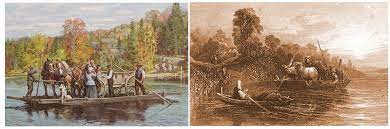
If Martha Washington disliked traveling, and actually was afraid of it, she had reasons. Travelers had limited options: foot, animal, vehicle-and-animal. If water crossing was included, they required a boat or raft, plus a ferryman.

There were few, if any, well-traveled roads. If one made 20-25 miles in a day, it was  a quick journey. Occasional taverns or way-stations were the provinces of men, and not suitable for “ladies,” unless in dire straits. Few traveled alone, certainly not women.

Early Martha Journeys

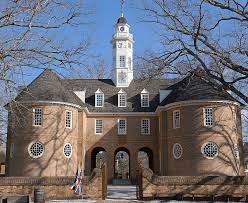
The restored Colonial Capitol building in Williamsburg. Very elegant.

Martha Dandridge (1731-1802) was born and raised in New Kent County, VA, about 25-30 miles from Williamsburg, the Colonial capital, considered the finest and most elegant city in the Colony.

Martha’s father, John Dandridge, served for a time in the Virginia House of Burgesses, and occasionally brought his young family to Williamsburg for shopping, visiting and the social scene. At eighteen, Martha married Daniel Parke Custis, heir to one of the largest plantations in the Colonies. Periodically they traveled between Custis’ “White House” estate in New Kent, and his recently inherited family manse in Williamsburg. Other than those jaunts, and occasional trips to see family, there was no need for traveling. Then Custis died after seven years of marriage. Martha, now a widow, was 25. She had two surviving children: Jack aged 4, and Patsy, aged 2.

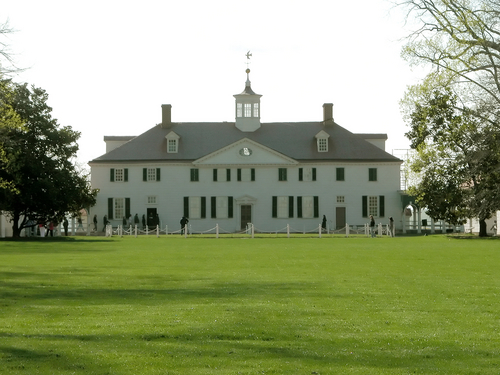
The nice house wasn’t quite as nice, then…

Not quite two years later, she met and married George Washington, who had recently inherited a “nice place” along the Potomac River, some 100 miles north of New Kent County. It was all new to her, but she accepted the ordeal of the journey, and grew to love Mount Vernon with all her heart.

Washington was also elected to the Virginia House of Burgesses, and frequently took Martha the children along. She knew Williamsburg – and her sister lived there. It was pleasurable with the company and protection of her husband. Likewise, she enjoyed the occasional trip to visit friends in Alexandria or Fredericksburg, only a half-day’s ride from Mount Vernon.

That sufficed until the Revolutionary War.

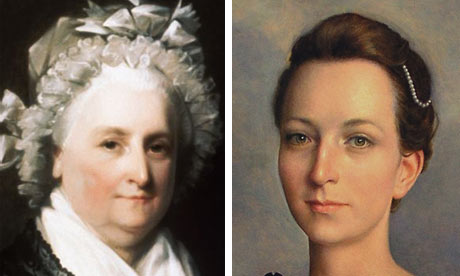
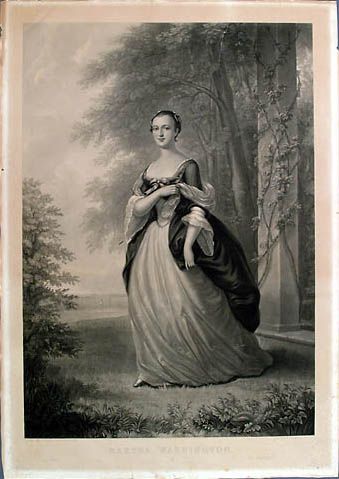
Said to be an etching of the young Martha.

The Long, Hard Journeys

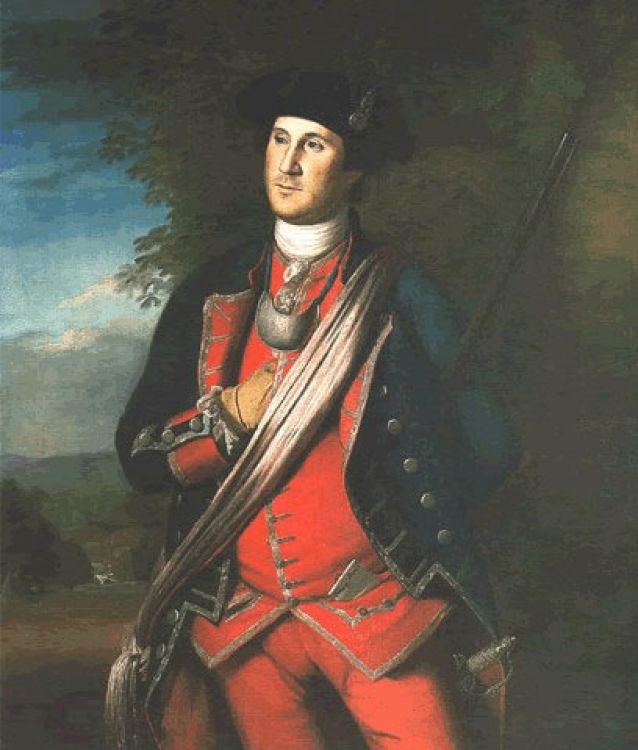
One of the earliest portraits of George Washington

In 1775, Ex-Colonel George Washington served as a delegate to the Continental Congress, called to address the numerous grievances and issues between the thirteen colonies and Great Britain, the “mother country.” At 43, fifteen years after his 8-year service in the Virginia Militia, he was the only delegate who had actual military leadership training. When he came to a session wearing his uniform, it was a foregone conclusion that he would be assigned high military leadership. As Massachusetts delegate John Adams, commented, Virginia was the largest and richest colony and should be at the head of it.

Named General of the Continental Army, Washington immediately left for Massachusetts. Save for one brief visit, he did not return to his beloved plantation for eight years.

Naturally, he missed his wife. Patsy had died a few years earlier. Jack had recently married. There was nothing keeping Martha from joining her husband when he desired her company.

As the winter of 1775 approached, he sent for her. It would take a month or more for her to arrive – along with Jack and his bride, appropriate drivers and servants, and a wagon full of supplies that General Washington requested. And Martha’s “medicine” box. He had already made several pleasant acquaintances en route to Boston some months earlier, and supplied introductions to prominent citizens who were happy to host Mrs. Washington-and-party along the way. Appropriate letters were sent long in advance.

Since it was wartime, and she could be a prize, GW usually sent an escort party.

The basic way it worked, was that a station-to-station route was planned: i.e. Mount Vernon to Annapolis, to stay with the Calverts, her daughter-in-law’s family. Annapolis to Baltimore, to stay with Calvert kin. At way-stations along the road, her party might stop for a few hours to rest, water the horses, stretch their own legs, and perhaps get some refreshments (although they usually carried plenty of food). As they neared their destination, a rider was sent on a fast horse to advise their hosts that Mrs. W.-and-party would be arriving. The hosts then sent their own rider to escort their guests to their home.

The party might stay for two or three days – depending on weather, physical health, or how difficult the traveling had been.

Crossing the Rivers

Crossing rivers was a daunting effort.

By far, the most daunting legs of Martha Washington’s journeys were across rivers. She was petrified, and even with experience, never overcame her fear. It was one thing to ford a shallow stream or a narrow creek where her carriage and wagon could be pulled through easily enough.

But crossing the Potomac or the Delaware or Hudson was a serious ordeal. These were deep “Moon” rivers (wider than a mile). Mrs. W-and-party were forced to travel miles out of their way to the nearest ferry station. Several trips might be required to take the wagons, the escorts and servants and the horses across. Then, of course, the ferryman (or men) had to recross that river. One crossing and return might take a full day.

Martha Washington always insisted that she be the last to go across. She needed to be convinced it was safe.

The Final Leg

As Mrs. W.-and-party neared their final destination, a fast courier was sent to bring word to the waiting General, who immediately dispatched soldiers to bring her through the last leg of her journey.

During the Revolutionary War, Martha Washington made several trips north: to Boston, to New Jersey (twice), to Philadelphia, Valley Forge and Newburgh, NY.

In some ways it became easier, especially when she had made numerous friends en route. But it was always an ordeal.

Sources:

Brady, Patricia – Martha Washington: An American Life – Viking, 2005

Chadwick, Bruce – The General and Mrs. Washington – Sourcebooks, 2005

Randall, Willard Sterne – George Washington: A Life – Galahad Books, 2006

https://www.mountvernon.org/george-washington/martha-washington/martha-at-the-front/

https://www.history.com/news/martha-washington-military-spouse-battlefield

Posted in A POTUS-FLOTUS Blog, George Washington, Nifty History People | Tagged , , , , , , , , , , , , , , , , | Leave a comment

Frances Cleveland: The Wedding Gown

Grover Cleveland came to the White House with a secret.

Grover Cleveland’s Secret   

At 49 years old, Grover Cleveland (1837-1908) was a lifelong bachelor. Nearly 300-pounds on his 5’9” frame, he was the heaviest President up to that time (1885). His jowly and mustachioed features seemed to be in perpetually etched grouch. Definitely a non-Adonis.

Nevertheless, he was secretly engaged to be married, and if that weren’t enough, he was planning to marry a 21-year-old young lady he had known since birth. Frances Folsom had a good figure, a peaches-and-cream complexion and dimples! She had recently graduated from Wells College in upstate New York, and had just returned from a European trip, where (among other things) she purchased her bridal trousseau.

Frances Folsom was the youngest FLOTUS ever!

The “engagement” had been a total surprise to Washington society, whose matrons had been intent on introducing the gruff, overweight President to every eligible (and equally unattractive) widow and spinster in town. But no sooner did Miss Folsom and her mother arrive back in the United States, than the wedding was not only announced but executed a week later. Since the event was to be held in the White House, completely under his personal control, President Grover Cleveland had seen to all the plans himself: the ceremony, the invitation list, the minister – even the wedding vows. His sister Rose Elizabeth, who had been his hostess for a year of First Lady duties, arranged the menu, the floral decorations and summoned the Marine Band.  All the bride had to do was show up for the ceremony – with her wedding gown.

The wedding announcement

Perhaps there was reason for all the secrecy. If there was anything that could augment the Cleveland scowl, it was an invasion of his privacy. And what was more private than his own wedding? Fewer than fifty invitations were issued, all written by hand – by him. The press was expressly forbidden to attend the small ceremony.

Frances Folsom:  The Bride…

Making the story a little more complicated than merely eyebrow-raising cradle-robbing, was the fact that Cleveland had been Frances’ legal guardian for more than a decade. Her father, Oscar Folsom, had been his close friend and law partner. When Frances was born, “Uncle Cleve” gave the Folsoms the baby buggy. When Folsom died in a carriage accident when Frances was eleven, it was only natural for Cleveland, executor of the Folsom estate, to assume guardianship, and see that Frances and her mother had all the comforts of middle-class life in Buffalo, New York.

No wonder the President guarded his news of impending nuptials!  The quasi-familial relationship could be the stuff of scandal!

…and Her Gown

The gown drawn from the description.

The one small concession about the wedding that President Cleveland made a detailed written description of Miss Folsom’s wedding gown. After all, nearly every dressmaker in the country and their customers waited with bated breath to learn what the young and pretty new First Lady would wear on her historic wedding day.

Plum assignments went to artists at both Harper’s Weekly and Leslie’s, the two major magazines of the day: create the wedding scene – complete with an imaginative rendering of Miss Folsom’s wedding gown, taken from the public description. One newspaper wrote:

“The bride wore an enchanting white dress of ivory satin, simply garnished on the high corsage with India muslin crossed in Grecian folds and carried in exquisite falls of simplicity over the petticoat. The orange blossom garniture, commencing upon the veil in a superb coronet, is continued throughout the costume with artistic skill. She carried no flowers and wore no jewelry except an engagement ring, containing a sapphire and two diamonds.” 

Another description offered:

Another view of the wedding gown nobody saw.

“Frances Folsom was a lovely bride in ivory satin and a long veil; her train was four yards long.  Attached to the left side of her gown was a scarf of soft white India silk, looped high and forming an overskirt bordered on the edge with orange blossoms; full folds of mousseline, edged with orange blossoms, were draped across the bodice.  Her bridal veil, of white silk tulle, five yards in length, was fastened to Frances’ hair with orange blossoms and trailed to the end of her magnificent train.  She wore long gloves to meet the short sleeves of the elegant gown. 

A rare photo of Frances in her real gown (LOC)

Since neither the journalists nor the artists saw the gown, nobody could understand what it really looked like. But one of the important descriptions given to the press was that it had an exceptionally long train. Great liberty could be taken from the description-with-long-train. Thus it was no surprise when the very next issues of both Harper’s and Leslie’s carried artistic representations of the wedding scene – but with completely dissimilar gowns. But both depictions featured exceptionally long trains!

The Gown Story Continues

Most modern brides, if they choose a traditional wedding gown, either wear a family heirloom, or spend serious money on a one-time dress. Grandma’s gown might be understandably altered to fit before re-use of course, and then professionally cleaned and packed away for possible posterity. Even a brand new gown is likely to share that long-term fate.

But new First Lady Frances Cleveland thought otherwise. Shortly after the wedding, she had the gown altered to wear at public receptions. Thrifty-minded Grover Cleveland would likely frown at the one-shot-only expense.

The recycled-repurposed wedding gown.

So the signature long train was removed, and wedding gown was dyed a rose-pink, and used for publicity purposes. (Note similarity of backgrounds and pose.) Later, Frances had it altered yet again for her formal portrait. One would never know it had been her recycled wedding gown. Maybe all the confusion from a “written description” had an ulterior motive!  No one would know the difference.

Sources:

Carpenter, Frank G. – Carp’s Washington – McGraw Hill, 1960

Cross, Wilbur and Novotny, Ann – White House Weddings – David McKay Co., 1967

Dunlap, Annette – FRANK: The Story of Frances Folsom Cleveland, America’s Youngest First Lady – Excelsior Editions, 2009

Foster, Feather Schwartz – Mary Lincoln’s Flannel Pajamas and Other Stories From the First Ladies Closet – Koehler Publishing, 2014

https://www.whitehouse.gov/about-the-white-house/first-ladies/frances-folsom-cleveland/


Posted in A POTUS-FLOTUS Blog, Grover Cleveland, Nifty History People | Tagged , , , , , , , , , , , , , | Leave a comment

Theodore Roosevelt: Tweedledum and Tweedledee

Theodore Roosevelt knew the power of conceptual spot-on images and phrases.

TR: The Social Conscience

TR SR

Theodore Roosevelt, Senior

Theodore Roosevelt (1858-1919) was born into a socially conscious family. They were prominent and wealthy, with a strong sense of noblesse oblige. Roosevelt Senior served on countless boards of charitable organizations, not only gratis, but with huge chunks of his time and personal funds. The moral lesson was not lost on his young son.

Shortly after TR graduated Harvard, he embraced politics as a way to be of service. He chose the Republican party as his vehicle; it was the party of Abraham Lincoln, his idol.

As a young NY Assemblyman, he had the opportunity to associate with social classes far different than his upbringing. He also personally observed the plights of the impoverished, which in New York City’s 1880s, centered around millions of immigrants who had begun to flood our shores. TR’s father had died some years earlier, but the moral lessons still remained.

Labor, Management, Strikes and Violence

President TR

In 1902, the chasm between management and labor had been deepening for decades. Theodore Roosevelt had become President following the assassination of William McKinley, but there was nothing in the Constitution – or other regulatory law – that permitted the government to intervene in what was considered private industry. By the 1870s, the widening differences between the needs of labor (better wages, better working conditions) and the philosophies of management (it was cheaper to replace) had evolved into budding labor unions, with actual strikes and violence, which were becoming strong, disruptive, and occasionally deadly.

Labor strikes became violent.

In the early fall of 1902, organized anthracite coal miners in Pennsylvania had limped along for years, gaining only minuscule concessions from the mine owners. With their ranks swelled by unskilled immigrant labor from various countries and speaking various languages, their labor union had grown stronger. They voted to strike. Coal was arguably the chief fuel for millions of people in the east. Without coal, innocent people would suffer in the winter. Some would die.

Theodore Roosevelt was an active man and president. Patience was an effort sometimes. He ached to help resolve the situation to gain concessions from all concerned. About the only thing he could do “presidentially,” was to suggest arbitration and/or facilitate separate meetings with some of the mine owners and managers, and ditto with a delegation of miners and their representatives.

John Mitchell, Miner

John Mitchell, UMW President

John Mitchell (1870-1919) was orphaned at a very young age, and went to work in the mines when he was ten. In his teens when the nascent Union of Mine Workers was born, he became active. By 1898, he was its president. For the ensuing ten years of his presidency, the membership rose from 30,000 to 300,000.

Mitchell was an unlikely union leader. He was soft spoken. He eschewed rabble-rousing. His approach was pragmatic, and indeed, conservative. He was amenable to the give-and-take. He never sought any concessions that were not a) needed, b) warranted and most of all c) attainable. He was even known to concede his most precious goal of “union recognition,” in order to achieve a 10% raise for the miners.

When he met President Roosevelt, the two men saw eye-to-eye. TR liked him.

Facilitating the Arbitration

Facilitating a gradual meeting of minds between management and labor was exactly the kind of challenge that TR relished. Like his idol, Abraham Lincoln, TR always believed in a middle ground “third” route to bridge gaps.

By October, the threat of a prolonged strike was becoming an emergency. With no coal, millions of families would be without heat. Many would freeze to death.

Carroll D. Wright, Negotiator

He named Carroll D. Wright, a skilled and able negotiator as his labor commissioner. Wright held a series of separate meetings with the owners and labor representatives. He culled their demands and concerns carefully, prepared a comprehensive report, and recommended arbitration. Both sides were amenable.

Ah, but…

While the mine owners were agreeable to arbitration, they categorically refused to include representatives from the United Mine Workers in the discussion. Not even in the same room! And that was non-negotiable. 

Sociology: A New Science

While the philosophy of a social conscience has been around since ancient times, and while it began to take shape in the early 19th century, it had finally taken root by the early 20th century, once the Industrial Revolution had changed the lives of mankind. Sociology made a systematic methodological international comparison of social institutions, specifically between labor and management, and the haves and have-nots on many fronts.

But while the early sociologists argued and differed about the causes and methods and various outcomes and/or “cures,” one thing remained: sociology itself. It had become respectable. Most people accepted its purpose to gain in-depth, scientific understanding of social worlds and human behavior.

Upshot and Resolution

As the strike dragged on, neither side giving much way, save a general lukewarm concession to accept arbitration, so long as no representative of the labor union was included. They would permit Mitchell to be present only as a “spokesman” for the workers.

E.E. Clark, “secret” union leader.

A commission was named, to include a military engineer, a mining engineer, a judge, an expert in the coal business, and an “eminent sociologist.” Mitchell asked the President if he might include two other representatives: a Catholic clergyman (since so many miners were of that faith), and E. E. Clark, head of the railway conductors’ union, (under the heading of “eminent sociologist”). “Management” was amenable, to the President’s immense relief.

Tenniel’s famous illustration.

Roosevelt was always a conceptual thinker and voracious reader, and undoubtedly aware of Lewis Carroll’s famous Alice Through the Looking-Glass and its delightful fanciful characters. He later wrote of  “the mixture of relief and amusement” he felt, when he thoroughly grasped the fact that the operators “would rather have anarchy than Tweedledum, but if I called it Tweedledee they would accept it with rapture.”

There seems to be a lesson here.

Sources:

Brands, H.W .- TR: The Last Romantic – 1997, Basic Books

Morris, Edmund – Theodore Rex – 2002, Random House

https://www.dol.gov/general/aboutdol/history/coalstrike

https://www.theodorerooseveltcenter.org/Learn-About-TR/TR-Encyclopedia/Capitalism%20and%20Labor/John%20Mitchell

Posted in A POTUS-FLOTUS Blog, Theodore Roosevelt | Tagged , , , , , , , , , , , , , , , , , | Leave a comment