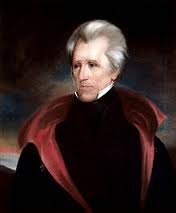
The Third Act of Millard Fillmore

The First Act being his youth and political rise, the Second Act being his Presidency…

Millard Fillmore: Lame Duck

This image has an empty alt attribute; its file name is millardfillmore.jpg
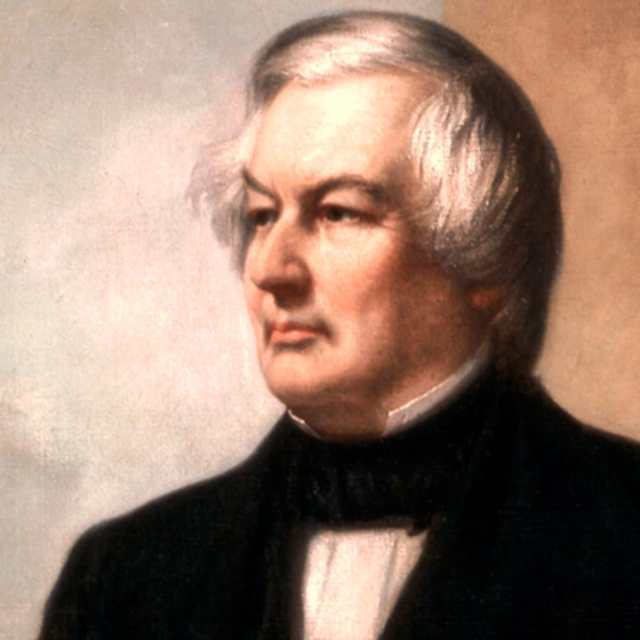
President Millard Fillmore

Millard Fillmore (1800-74) had been elected Vice President on the Whig Ticket led by General Zachary Taylor in 1848. He did not actively seek the election, but when it was offered, he was honored. Then Zachary Taylor died a year and a half later.

Fillmore was a strapping fellow, boy-to-man, and worked very hard for his education and his admission to the New York Bar. But once an attorney, he preferred elected (or appointed) office to the actual practice of law.

But as President, he made efforts to walk the fine line between “leadership” and gravitating to “popular” politics. Unfortunately for the 1850s, popular politics were so badly divided that actual leadership was perceived as a drawback. Millard Fillmore, being a child of his time and upbringing, was a man of simple principles. He did not like slavery, but…. he believed it was protected by the Constitution, i.e. he couldn’t/wouldn’t do anything about it, hoping it would go away on its own. He believed in the expansion of the country (sea-to-shining-sea), and believed America should be for Americans, i.e. not immigrants, not Catholics, not foreigners…

He was not alone in these sentiments rightly or wrongly. But it did not bode well for his election to a term of his own in 1852. He wanted the Whig nomination, but the fractious party and convention chose General Winfield Scott, who lost.

Third Act, Scene 1

Democrat Franklin Pierce of New Hampshire was elected President. Following the inauguration ceremonies, Abigail Fillmore, the now-ex-President’s wife of more than 25 years, caught cold, which worsened into pneumonia, and she died at the Willard Hotel a week or so later. Whatever plans they made were now cancelled.

Abigail Powers FIllmore died shortly after leaving the White House.

Fillmore returned to their home in Buffalo, NY alone. He was the first POTUS who left office with a limited income, no real property and no pension.

A year later, his daughter Mary Abigail, who had helped host White House functions, died of cholera.

Third Act, Scene 2

With vague thoughts of helping rally a crumbling Whig party and possibly becoming its presidential candidate in 1856, he began speaking at locations across the country. He had a fair number of supporters, particularly among nativist organizations, who feared the huge influx of Irish Catholics. While some ex-Whigs (which was never a cohesive political party in the first place) organized the embryonic Republican party, many others formed another party – the American party, specifically in support of their xenophobic attitudes.

Fillmore the Politician
Mary Abigail Fillmore died a year after her mother.

Fillmore joined that party (nicknamed the Know-Nothings), but on the advice of political friends, decided to travel abroad for a while, and weigh his options. He spent the better part of fifteen months overseas, and even met Pope Pius IX, once he learned he could avoid kneeling and kissing the Pope’s ring.  

In absentia, the American party nominated Fillmore as its Presidential candidate in 1856. The Whigs had dissolved by then. The Republicans fielded their first candidate, John C. Fremont, and the Democrats nominated aging James Buchanan, who had also spent several years abroad. Fillmore campaigned actively, made a decent showing, but lost. His active political days were over.

Act Three, Scene 3

This image has an empty alt attribute; its file name is carolinefillmore.jpg
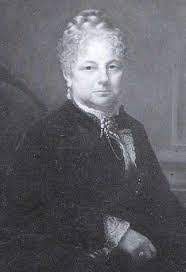
Caroline McIntosh Fillmore

Still plagued with financial instability, he planned to revitalize his law practice, but fate intervened in the form of Mrs. Caroline Carmichael McIntosh (1813-1881), whose first husband had been a railroad owner and businessman. They were childless, and she became a very wealthy widow. They married in 1858, having first agreed to a pre-nuptial contract. This removed his financial strain, and they promptly built a large mansion in Buffalo, NY. It is said that she relished the prestige of being married to a former POTUS.

Unfortunately, within a few years of their marriage, the Second Mrs. Fillmore’s health began to decline, and she showed signs of early dementia. Most sources said she became temperamental and erratic. She changed her will numerous times.

The early Fillmore home in Aurora.

During the Civil War, Fillmore was not a huge fan of President Lincoln (although the Lincolns paid a courtesy call at his mansion en route to Washington). Nevertheless, he supported the Union cause, and became the Commander of the Union Continentals, a militia corps of older men (over 45) formed to guard Upstate New York, in case of Confederate attack. That unit was tasked to guard the Lincoln funeral train en route to Springfield, IL. He remained active in the corps till his death.

Fillmore supported George McClellan in 1864 however, believing him to be best at bringing the country together. He was branded a “copperhead.” He became unpopular again.

But perhaps with time to fill and no monetary worries, he began what could arguably be the best of his efforts: a local legacy of serious value, even today.

He had been one of the founders and a chancellor of the University Buffalo beginning in 1846, and continued the association until his death. He raised funds for its medical school.

He was a founder and large contributor to the Buffalo General Hospital.

He became a founding member and vice president of the Society for the Prevention of Cruelty of Animals and a generous supporter of the Orphans Asylum.

He was a founder of the Buffalo Fine Arts Academy.

He was a founding member and president of the Buffalo Historical Society, and spearheaded the fundraising campaign for Buffalo’s Society of the Natural Sciences.

And perhaps, in memory of his first wife, Abigail Powers Fillmore, who founded their local library a half-century earlier, (and began the White House library as well) Millard Fillmore lay the groundwork for the Grosvenor Library, serving as president of its board of trustees.

He left an estate upward of $250,000 in 1874 money. Likely a couple of million, today. He made several substantial charitable donations. They liked him a lot better again in Buffalo.

Sources:

Collins, Herbert R. and Weaver, David B. – Wills of the U.S. Presidents – Communication Channels, Inc. – 1976

Rayback, Robert J. – Millard Fillmore, Biography of a President – Easton Press (reprint) – 1986

https://buffaloah.com/h/mf/grande/

http://www.thepresidentshalloffame.com/13-millard-fillmore-1850-1853

Posted in A POTUS-FLOTUS Blog, Millard Fillmore, Nifty History People | Tagged , , , , , , , , , , , , , , , , | 4 Comments

The Emergence of Candidate Warren G. Harding

Yes, Warren Harding was a dark horse, and yes, it did happen in a smoke filled room…  BUT…

Leading Up To 1920

There was an odd assortment of coincidences that created the “perfect storm” of enthusiasm for Harding.

Two years prior to the election of 1920, both major parties were in either flux or disarray or confusion.

Woodrow Wilson

On the Democratic side, President Woodrow Wilson, the man who kept us out of war in 1916, finally brought us into the Great War only weeks after his second inauguration. Eventually the once-reasonably-popular President became very un-popular, had a couple of serious strokes, and was a mere shell of himself. None of the “available” Democrats rose to the level needed, and even the “B” or “C” team generated little enthusiasm. Wilson did not take part at all.

This image has an empty alt attribute; its file name is tr-milwaukee.jpg
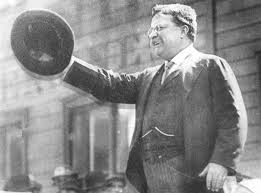
Theodore Roosevelt

On the Republican side, in 1918 most Republicans were willing to forgive ex-President Theodore Roosevelt for his Progressive (Bull Moose) schism in 1912. He was still viable; he was still popular, and he was only sixty. But unbeknownst to most, TR was a sick man, having lived three lives at a time for most of those sixty years. He died in January, 1919.

He had not groomed anyone for the Presidency, nor did the few likely contenders generate much enthusiasm either – and indeed were more apt to fight amongst themselves than to harness a team.

Senator Warren G. Harding

Warren Harding (1865-1923), as human as they came, was an amalgam of virtues and failings. On the virtue side, he was a helluva nice guy. He had an easy smile, a strong and warm handshake, and his “nice to see ya” greetings were sincere. Very few people could say they didn’t like him. On the failing side, it wasn’t that he was lazy so much as he was lethargic. He preferred the easy way – doing what came naturally to him.

Warren Harding at work.

As the editor/publisher of the local newspaper in Marion, OH, he was one of the best known men in town. Everybody knew him; most men called him by his first name, and he returned that camaraderie. As a popular guest speaker (“bloviating”, as he called it) at the civic and fraternal organizations in the area, it was short hop to political office.

By 1900, he was elected to the State Legislature, and then for a term as Lt. Governor, one of his best jobs! No heavy lifting, and the ceremonial duties fit like a glove. Now he began bloviating all over the state, and all the Republican politicos knew him. In 1914 he was elected to the Senate. Now he was invited to bloviate across the country.

He liked that job too. He fit in well with the Old Boys Club, never introduced substantive legislation, voted according to GOP trends, and answered his mail. Piece of cake.

Suffice it to say that in 1920, when he was up for re-election to the Senate, he was a shoo-in, and was looking forward to it.

Harry Daugherty et al

Harry Daugherty was an Ohio fellow, more sleaze than stellar, but he and his cohorts had been promoting WGH as “a man who looked like a President” for years, and now he put his heart and soul into achieving that goal.

Harry Daughtery, Campaign Mgr.

By 1920, between Daugherty’s efforts, WGH’s affability and bloviate-ability, Harding was becoming everyone’s 2nd, 3rd or 4th choice. He knew everybody. Some people considered him “the best of the second-raters.” Certainly the most affable, and disinclined to fight with anyone. Daugherty predicted that Harding would be nominated by party bigwigs at 2 AM in a smoke-filled hotel room.

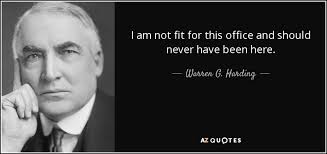
But the big fly in that ointment was Harding himself. He was never wildly enthusiastic about the Presidency, and always considered himself “unqualified for the job.” He preferred to remain in the Senate where it was a) easier,

This image has an empty alt attribute; its file name is wghunfitquote.jpg
He looked like a President, but never felt comfortable in the office.

b) pleasanter, c) a better fit for himself, and d) the ol’ bird-in-the-hand.

When they got to Chicago for the convention, WGH waffled throughout. Ohio law prevented a candidate to run for simultaneous office. It was one or the other. He had already filled out paperwork for the Senate spot, waiting until the last day of eligibility. Daugherty and Mrs. Harding pulled out all the stops to keep him from mailing it.

This image has an empty alt attribute; its file name is the-duchess.jpg
The formidable Florence Harding

Chicago…and Memories of 1880

There were still several politicians who recalled the Republican convention of 1880, when deadlocks occurred and it took 36 ballots to put forward the relatively unknown James A. Garfield. Nobody wanted a re-run of that misery. Everybody wanted the convention over and done with.

Alas, this was not looking good. General Leonard Wood, IL Governor Frank Lowden and CA Sen. Hiram Johnson were the front runners, and could not got along at all, either amongst themselves or with party leaders.

In 1920, as in 1880, there was another heat wave, and air conditioning was still not available. And hotel prices in Chicago were much higher than they had been in 1880. This was a deal-breaker.

It had become imperative to many delegates that the nomination be over and done on Saturday, June 12. Six ballots had already been taken, and there was little movement among the leaders. Sunday, being the Sabbath, the delegates would not convene.

This entailed yet another day or possibly more of expense for the delegates – who had to pay their own way! Hotels, transportation, meals, drinks, entertainment, etc.

That included Harding, a man of average means, who was picking up the tab for himself and his missus, a few underlings – plus all the expense of the usual hospitality centers.

Thus the smoke filled room in the wee hours of Saturday, June 12, 1920.

Sources:

Stoddard, Henry L. – As I Knew Them – Harper & Brothers, 1927

Russell, Francis – The Shadow of Blooming Grove – McGraw Hill, 1965

Sinclair, Andrew – The Available Man – Macmillan Co., 1968

http://www.encyclopedia.chicagohistory.org/pages/3217.html

Posted in A POTUS-FLOTUS Blog, Nifty History People, Warren G. Harding | Tagged , , , , , , , , , , , , , , , , , | 3 Comments

John Quincy Adams and Mary Frazier

At eighteen, John Quincy Adams returned to Massachusetts after eight years in Europe.

Young Man JQ:

His Harvard education suited him well. Classes were small and elite. Only the best and brightest. John Quincy Adams, who had hobnobbed with the crème de la crème in the great capitals, made new friends and colleagues with his peers and professors.

When he read law with Theophilus Parsons, a Newburyport attorney, he continued those friendships, and periodically joined his pals at the local taverns for wine, brandy, and even a few songs. By twenty-two or -three, he was coming out of his solitary and somewhat cranky persona and began attending the usual parties, card games and local social events.

Perhaps hard to believe, considering 250 years of the acerbic JQA personality known today, he was generally personable and popular. In an Adams fashion.

Mary Frazier, Young Maiden

Mary Frazier was somewhere around fourteen or fifteen when she met young Mr. Adams, considered one of the most cosmopolitan, sophisticated and promising young men of his generation. His father had just been elected Vice President of the brand new USA. In the eighteenth century, fourteen was still too young, even in an age when girls matured early. Fifteen was definitely “courtable,” and sixteen was marriageable.

Early in their acquaintance, there was a gathering. JQ noted in his journal that “Miss Mary Frazier from Boston was of the party: she appears sensible and agreeable.” She was also a fine looking young woman, possessed of a pleasant disposition. Her father, Moses Frazier was a shipbuilder and Newburyport office holder. JQ began calling at the Frazier house. There is some confusion as to Mary’s receptiveness to young Adams’ attentions, but then again, no matter how “courtable” fifteen may be, fifteen is fifteen, and still very young. He, on the other hand, at twenty-two or -three, was not only interested, but “in love.” Or so he said. Or so he always said, even many years later.

The Courtship and Disillusion/Dissolution

In the eighteenth century, courtship was taken very seriously. Casual “dating” or “playing the field” is generally 20th century culture. If a young man regularly called on a young woman, or chose her as his frequent walking or dancing companion, the young man’s “intentions” came into question, usually by the parents. This approach was well within the cultural and historical framework of their time.

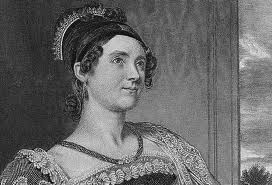
The cosmopolitan Mrs. Louisa Catherine Adams

JQ was definitely interested; perhaps interested enough to consider marriage. In a letter to a college chum he admitted, “all my hopes of future happiness in this life center on that girl.” Mary (and again, this can be a little murky and second-hand) was likely flattered, but reserved. All sources however, indicate that she was less ardent than her suitor, who was around eight or nine years her senior. Nevertheless she seemed willing to agree to an engagement.

The Frazier parents were cool, despite JQ’s education and notable parentage. He had barely started a legal practice. He had no reliable income, and was likely to remain that way for several years.

Abigail Adams, the formidable mother

When JQ’s mother Abigail Adams learned of a possible “engagement,” she was just as cool as Moses Frazier, and perhaps more direct, noting that her son was still dependent on his parents for financial support. Abigail was concerned about his ability to provide for a new family before he established his law practice and advised him to “never form connections until you see a prospect of supporting a family.” Her discouragements were enough for John Quincy to delay a public engagement, something Mary did not want to put off.

The romance ended, and some historians suspect that the coldness of JQA’s personality began to morph into permafrost when his emotional attachment to Mary Frazier ended, possibly irritated by the fact that at twenty-two or -three he was still financially dependent. He renewed his commitments to career.

Later

But Mary Frazier nevertheless found her way into a secret compartment of John Quincy Adams’ heart, small as it may have been. He was nearly thirty when he finally married Louisa Catherine Johnson, who never quite compared. While he undoubtedly cared for his wife – and they were married for a half century – the romance was cooler, and devoid of the pangs of his once and dearly remembered love.

He never forgot Mary Frazier, and in some ways, her halo glowed shinier with each passing year, and his fond remembrance became more dream than memory. He knew members of her family, and ran into them from time to time. Mary married – after JQ did, had a daughter, and died of consumption at thirty. Likely Mr. Adams grieved in his own way.

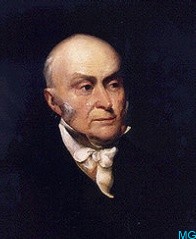
The older John Quincy Adams

Very late in life, he was walking in Mt. Auburn cemetery in Cambridge, and came to her daughter’s grave. He shed tears. Even then. So late in his life he recalled Mary as “the most beautiful and beloved of her sex.”

A Thought

One of the dear loves of JQA’s life was poetry. He loved it throughout his entire life. He wrote commendable poetry himself, and it is one of the few pleasures/pastimes he shared with his wife and children.

Sophisticated and cultured, JQ likely knew of the immensely talented and short-lived John Keats (1795-1821), a man young enough to be his son. One of Keats’ most famous works was Ode On A Grecian Urn, wherein the images depict a young man chasing his ladylove around the vase for eternity.

One could wonder if the Ode was nearer to his heart than even his beloved Cicero.

Bold Lover, never, never canst thou kiss,

Though winning near the goal yet, do not grieve;

She cannot fade, though thou hast not thy bliss,

For ever wilt thou love, and she be fair!

Sources:

Kaplan, Fred – John Quincy Adams: American Visionary – Harper, 2014

Nagel, Paul C. – John Quincy Adams: A Public Life, A Private Life – Alfred A. Knopf, 1997

Unger, Harlow Giles – John Quincy Adams – DeCapo Press, 2012

https://www.poetryfoundation.org/poems/44477/ode-on-a-grecian-urn

https://millercenter.org/president/jqadams

Posted in American Civil War | 2 Comments

New York: Mother of VEEPS

New York can boast being home to ELEVEN Vice Presidents!

The Old Guys…

 In the early days of our country, a geopolitical balance between the President and Vice President was considered important – at least in vote-getting accommodation. With only a handful of states, long distances between them, and only rudimentary communication and transportation, it is easy to understand “regional” balance.

Our first two VPs, (John Adams and Thomas Jefferson) were unquestionably political heavyweights, and the Vice Presidency was considered a stepping stone to the top job. Then came the first New Yorker.

This image has an empty alt attribute; its file name is aaron-burr.jpg
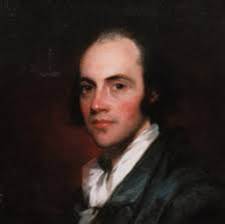
Aaron Burr

Aaron Burr (Jefferson 1) … a New York fellow and Princeton graduate of genuine talents and questionable character. His main contribution was the need for the 12th amendment (voting separately for POTUS and VP) and the demotion of an already insignificant position to one totally marginalized.

This image has an empty alt attribute; its file name is georgeclinton.jpg
George Clinton

George Clinton (Jefferson 2/Madison 1) a mid-state New Yorker and 7-times Governor and old pal of George Washington. But by the time he was elected VP, he was nearly seventy and well past his prime. Some said he was senile. Maybe. Nobody really cared – but they still elected him twice!!

Daniel Tompkins (Monroe 1&2) – Arguably one of the most obscure of the old gents, mid-state New Yorker Dan was a man of great promise and energy, who performed capably as NY’s Governor during the War of 1812. When he was nominated, everybody was pleased. But he fought an ongoing battle with the bottle, and lost. Conspicuously. He barely showed up for his minimal duties, and nobody really noticed. Too bad. He could-a been a contender!

Daniel Tompkins (1774-1825)

Martin Van Buren (Jackson 2) – was a mid-state fellow and arguably our first “professional” politician. He was good enough for Jax to “groom him” for a Presidential term on his own – and the last VP to immediately move on up for a hundred and fifty years (until GHW Bush).

The Middle Victorians

If geopolitical accommodation was important prior to the Civil War, it became essential afterwards. Before the War, the executive office was delicately balanced North-South. After the War, it was North – and Midwest.

Millard Fillmore (Taylor) – was from upstate, near Buffalo, a farm boy turned so-so attorney and Congressman. As the country neared the cataclysmic differences of the 1850s, the slave owning Taylor needed a Northern (but non-abolitionist) running mate. Nobody really knew/cared much about Fillmore. Besides, Congress was considered the “important” branch of government. Then Taylor died, and the country learned enough about Fillmore not to elect him on his own.

This image has an empty alt attribute; its file name is williamwheeler.jpg
William Wheeler (1819-87)

When William Wheeler (1819-87/Hayes) was elected VP, he was a non-important upstate NY Congressman from a little village nobody ever heard of. Nobody ever heard of Wheeler either, and that included Hayes, who famously remarked, “I am ashamed to say this, but who is Wheeler?” He was a lonely fellow, widowed with no children or close family. When he retired as VPOTUS, he went back to his village, and the country by and large said, “who was Wheeler?”

Chester Alan Arthur (Garfield) was one of the most unlikely VPs. He never held elected office and was considered a political hack and minion of the boss system. An “adopted” New Yorker from childhood (born in Vermont), as a young man and competent attorney, he gravitated to the Big Apple and thrived in the political boss system. As an accommodation to the NY political boss, dark horse James Garfield tapped dark horse Chet Arthur (perhaps #4 or #5 on his list) as VP. When Garfield was assassinated, Chet became POTUS, and did a fair job of it – better than expected.

Levi P. Morton (1824-1920/B. Harrison) was another New England born but adopted New Yorker, self-made after the Civil War, when there were great fortunes to be had. He made a sizeable one. Almost as a pastime, he became involved in politics, mostly the ceremonial part (as opposed to substantive). He served ably as the Ambassador to France under both Garfield and Arthur. In 1888, he was nominated and elected VP under Benjamin Harrison, a position that suited him. He lived to be 96, one of our longest living Veeps.

Levi P. Morton (1824-1920)

And Into the 20th Century

The huge strides in transportation and communication made the country much smaller at the turn of the 20th century. Geopolitical needs became more of a tradition than a necessity for a good fifty years into the century. Then the VP position became substantive.

Theodore Roosevelt (McKinley 2) was well on his way to superstardom (war hero and Governor of NY) by the time of McKinley’s second election. The Vice Presidency was never on his bucket list. Two unrelated and undervalued reasons: 1. McKinley’s VP Garret Hobart, a close friend, well-respected by Congress, was a shoo-in for McKinley’s second nomination. But he died, and death is always an acceptable “excuse.” 2. Gov. TR’s huge appetite for action and accomplishment was giving the NY political bosses agita. They did not wish to harm him – but they wanted him out of NY. TR bit the bullet “for the party’s sake” and the rest became history.

James Sherman (1855-1912)

James S. Sherman (Taft) was another upstate New York attorney of middling repute, but primarily of the “old guard” rather than “progressive” ilk. No relation to the General, he nevertheless served competently in Congress, and was nominated to run with Taft in ’08, since nobody really cared about the second spot. They even coerced him to run again with Taft in ’12, but he was dying and knew it. In fact, he died shortly before election day – and they couldn’t reprint the ballots, so some 3.5 million Americans voted for a dead guy to be VP!

More than 60 years later, another New Yorker was nominated and confirmed, but not actually elected. It was more of a valedictory Lifetime Achievement award for Nelson Rockefeller (Ford), whose forty years of public service included 4 terms as NY Governor. He of famous name and mighty pockets served ably, and elected or not, we are glad to have had him in our country’s history.

Nelson Rockefeller (1908-1979)

Sources:

http://www.smithsonianmag.com/history-archaeology/The-Vice-Presidents-That-History-Forgot-160281765.html

http://www.senate.gov/artandhistory/history/common/briefing/Vice_President.ht

Barzman, Sol – Madmen & Geniuses: The Vice-Presidents of the United States – Follett Publishing, 1974

Young, Donald – The History & Dilemma of the Vice Presidency: American Roulette – Holt, Rinehart and Winston, 1972

Posted in Chester Arthur, Martin Van Buren, Millard Fillmore, Nifty History People, Theodore Roosevelt | Tagged , , , , , , , , , , , , , , , , , , , , , , , , , , | 1 Comment

The Personal Memoirs of Julia Dent Grant

Unknown until the 1970s, Julia Grant wrote her memoirs.

The Iconic General Grant

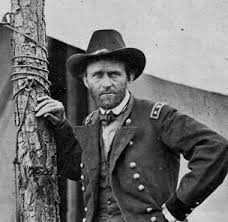
By the time Julia Dent Grant decided to put pen to paper, she was an old lady – at least by 1890 standards. She was in her 70s. Nevertheless, she was a very famous person: the widow of Union General and later President of the United States, Ulysses S. Grant.

The iconic General Grant

When he was not-quite-so-old, but very seriously ill, Grant began composing The Personal Memoirs of Ulysses S. Grant. It was not his idea. He was deeply in debt from an unfortunate business effort, and vowed to repay all his creditors – which included hundreds of Civil War veterans who had once entrusted him with their lives, and later, their life-savings.

Many Civil War veterans, both North and South, privates and generals, wrote memoirs of their experiences. They were wildly popular, and dozens of old soldiers made small fortunes. Grant had been approached on several occasions. Publishers believed any memoir by the great General-President would be a best seller. But Grant never fancied himself a writer and usually declined.

Nevertheless, his dire need for money to provide for his beloved wife and family (whose personal fortunes were also wrecked in the business fiasco) changed his mind for him. He was also in a race with the clock. He was dying and he knew it.

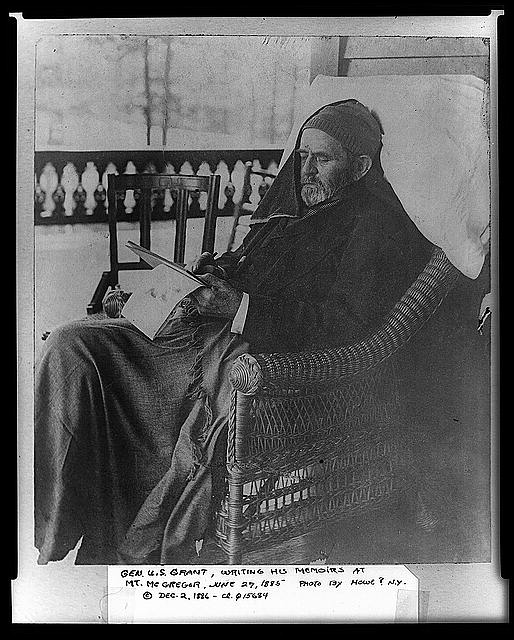
His last photo, working on the final edits.

Under the auspices of Mark Twain, a pretty fair writer himself, the General put pen to paper, and proved to be a remarkably good writer, once he got the hang of what was expected. The final galleys were completed only days before he expired.

The book was indeed a best seller. It made a large fortune for the Grant estate, and provided Julia Grant with a comfortable widowhood.

The Iconic Mrs. Grant

Grant and his “plain little wife.”

Little was known about Julia Dent Grant prior to the Civil War, other than she was from St. Louis (a slave state), was plain in looks, and had an eye condition that, at the time, could not be repaired.

But the Civil War changed a lot of that. She was one of the Mrs.-Generals who traveled with her husband pretty much throughout. In reality, she had no permanent home of her own between 1861-65. Their children were either with them (often), or boarded in schools or with family. As Grant became “the” General, the role of Mrs. Grant was elevated, since (among other virtues) it was believed that when she was in camp, Ulysses Grant forswore any intoxicating beverages.

All the soldiers liked and respected her. By nature, she was a nice lady.

Even before the war ended, Mrs. General Grant was courted by the influential Congressional wives who had been disenchanted early on by the imperious First Lady Mary Lincoln. When they offered to help Mrs. Grant over the shoals of political Washington, she was happy to accept the assistance. Since Julia was plain and neither fashionable nor intellectually inclined – and most important, very happily married to a man who adored her – she was no threat.

The First Lady

The eight years the Grants spent in the White House, were arguably Julia’s happiest, despite some nasty scandals that rocked their reputation. She learned how to put on the expected “airs” of position without it tainting the essential nice-lady Julia. Then the “retired” Grants traveled the world for two years, and returned even more popular than ever.

But they were also financially strapped. Out of uniform or office, Grant never seemed to be good at making money. Thus his business venture that had turned very sour.

Julia’s Book

Julia was not quite sixty when she became a widow. Her children were grown, married with lives and children of their own. Her own health was excellent. Grant’s Memoirs, published coincidental to his death, made anywhere between $300-450,000 in advance sales alone, depending on who you asked. She was financially set for life. She also had dozens of friends, and always would.

Middle aged Julia. She took very few photos.

But she was understandably lonely, and began telling some of her stories to her eldest son Fred, who took some notes for her. In time, she began writing them down herself. It started as an outlet for her loneliness, but then she developed some actual ambition. Several Civil War “wives” had written their own books. Elizabeth (Mrs. George Armstrong) Custer, Almira (Mrs. Winfield Scott) Hancock, and Julia’s own late-in-life friend Varina (Mrs. Jefferson) Davis, to name a few.

Even though she was the first First Lady to pen her own memoirs, perhaps her expectations were too high. Several publishers showed respectfully mild interest, but were unprepared to pay the advance she requested, which was very steep. The writing style was predictably flowery Victorian fluff, although some of the stories were delicious. The bottom line, was that they were never published by the time Julia died in 1901. They eventually wound up in a granddaughter (or great-granddaughter’s) trunk.

Much Later

Fast forward seventy-five years when they were re-discovered, and given to the capable Grant historian John Y. Simon to edit and annotate. They were published in 1975 to solid success, and are considered a mainstay for all Grant scholars. According to Simon, there are many minor inconsistencies in time, dates, persons – but Julia was writing from more than 35 years of memory. We can forgive her.

Yes, it is treacly Victorian fluff-writing, unremarkable save for the subject herself in reflected glory. However…. They fling open the doors of Ulysses S. Grant the person and the family man. Not so much the General or the President. There are an easy dozen or more wonderful stories that lay their characters and personalities open for the reader to know and like them as people. Their marriage was one of great romance and deep, lifelong love. They were truly each others’ one-and-onlies, going through thick, and some decidedly thin times.

We are grateful that she penned her memoirs, fluffy or not. Grant would have been lost without his Julia.

Sources:

Flood, Charles Bracelen – Grant’s Final Victory:  Ulysses S. Grant’s Heroic Last Year – 2012, DaCapo Press

Grant, Julia Dent – The Personal Memoirs of Julia Dent Grant: (Mrs. Ulysses S. Grant) – 1975, G.P. Putnam’s Sons

http://www.firstladies.org/biographies/firstladies.aspx?biography=19

https://www.theguardian.com/books/2017/feb/20/100-best-nonfiction-books-personal-memoirs-ulysses-grant


Posted in A POTUS-FLOTUS Blog, American Civil War, Nifty History People, Ulysses S. Grant | Tagged , , , , , , , , , , , , , , , , , , | 1 Comment

President Theodore Roosevelt and “The Sargent”


It is a long standing tradition for Presidents to have an official portrait painted.

Theodore Roosevelt, President

Theodore Roosevelt (1858-1919) was a prism of a man, many sided depending on his mood or current interests. He had arguably dozens of interests, and was knowledgeable on dozens, perhaps hundreds of other subjects. The arts however, other than literature and poetry, were not high on his list. His tastes in music, theater, ballet, and the visual arts were by and large respectful, but pedestrian.

Only 42 when he became POTUS, he was at the height of his physical and mental energy. A natural scientist, a cowboy, a prolific writer with a knack for turning a memorable phrase, a strong advocate of name-a-few-causes, and an astute politician, with an additional knack for judging the characters of the people he dealt with quickly and pretty much on target. And not pedestrian.

He was also a devoted family man, close brother, loving husband, engaged father, and loyal friend to those privileged to earn his friendship. And even more rare, those friendships were not predicated on “agreeing with him.” You could disagree on a wide range of subjects without harming the friendship in any way.

All said, TR was a complex man.

John Singer Sargent, Artist

Portrait of Fanny Watts, painted by 21-year-old J.S. Sargent

John Singer Sargent (1856-1925) was less than three years older than Roosevelt. An American by parentage, he was born, raised and widely traveled in Europe. His formal education was spotty, but his artistic abilities came to the fore at a remarkably early age. By 21, he was already winning prizes at the prestigious Paris Salon. While his idol and inspiration was Diego Velasquez, the 16th century Spanish artist, one of his closest friends would be Claude Monet, the 19th century Impressionist.

As a young man, Sargent painted whatever he liked, but very early in his career, he discovered that portraiture was far more profitable for obtaining commissions. He was also very good at it. By the time he was 25, he was earning some $5000 per portrait.

Suffice it to say he was never a starving artist.

But he was an American, and by the time he was 30, his reputation abroad had hopped the pond. He received commissions and projects in his native land.

The Painter, The Portrait and the President

John Singer Sargent in 1903 – about the time he painted TR.

In 1902, President Roosevelt personally invited  John Singer Sargent to paint his portrait, writing, “It seems to me eminently fitting that an American President should have you paint his picture.” It was a coup for the painter. Both of them were famous, and at the top of their respective careers.

Sargent was dee-lighted to come to the White House in early 1903 and spend a few days, making his sketches, and determining the varied characteristics that he wished to portray of his very complex subject. TR, of course, knowing that he likely had the best of the best for the job, was dee-lighted to give him every courtesy… except time.

When it came to the actual painting part, Sargent required little. He worked quickly. But he was very picky about the pose: where and in what surroundings. He spent a good part of two full days with TR in tow, poking through every inch of the White House trying to find the perfect location and the perfect pose.

Not unsurprisingly, the impatient Roosevelt became antsy. And prickly. He was busy. He had other things to do, and besides, the portrait wasn’t really his idea anyway.

Finally, as they were descending the great staircase, the visibly annoyed President complained that Sargent didn’t know what he wanted.

The artist, snapped back that “TR didn’t know how to pose.”

The President rested his right hand on the newel post at the foot of the stairs tucking his left hand into his pocket and firmly declared that he knew very well how to pose. Sargent turned and exclaimed excitedly, “Don’t move, Mr. President, that is perfect!”

They were both right. Theodore Roosevelt knew very well how to pose. John Singer Sargent knew how to recognize it immediately. It was perfect.

TR was a busy fellow who found it hard to sit or stand still.

The only downside, was that TR didn’t like posing, renowned artist notwithstanding. He agreed to pose for only two sessions and they were short, and grudging. All in all, it was not a pleasant experience for the artist or the subject.

Capturing the Subject

All portrait artists strive to capture the “inner” soul, persona, character, pick-a-word, of the subject, not merely the physical features. The ability to evoke beneath-the-surface qualities is what separates the fine from the genius. Sargent wanted to capture the ruggedness, the determination, the vision and the leadership plus the very charming and personable side of TR.

That in itself was a challenge, given the multi-sides of the subject.

According the New York Times, when the portrait was available for “review,” the critics said that the portrait does not quite capture the “genial side of the President,” but rather his alertness and distinct energy, his attitude when in “the mood of fierce discussion, his lips still quivering with speech, his eyes narrowed behind the glasses in a watchful gaze.”

Happily for all, Theodore Roosevelt was dee-lighted with the portrait. To him, it captured him as a man of power, with a commanding presence and resolute disposition. Exactly what he believed an American President should be. In a letter to his son Kermit, he said, “I like his picture immensely.” When other artists contacted him to suggest another portrait, he adamantly refused, remarking “Upon my word… After Sargent painted his portrait I registered a vow that I was through with sitting for any more portraits.”

It really was a perfect portrait.

P.S. To capture the gentler side of TR, the loving, the caring, the warm and genial facet of his prism, one needed the instantaneous moment of photography. The well known photo of Grandpa TR and his little granddaughter Edith Roosevelt Derby says it better than anything!

Sources:

Brands, H.W. – TR: The Last Romantic – 1997 Basic Books

Dalton,, Kathlen – Theodore Roosevelt: A Strenuous Life – 2004, Vintage

Stoddard, Henry L. – As I Knew Them – Harper & Brothers, 1927

http://www.theodorerooseveltcenter.org/

https://www.nga.gov/collection/artist-info.1858.html

https://boundarystones.weta.org/2019/06/21/tale-two-painters-theodore-roosevelts-portraits

Posted in A POTUS-FLOTUS Blog, Nifty History People, Theodore Roosevelt | Tagged , , , , , , , , , , , , | 1 Comment

Andrew Jackson’s Magnificent Truxton

Andrew Jackson loved horses since early boyhood

AJ: Rider and Racer

The story of 12-year-old Andrew Jackson serving as messenger in the Continental Army and later captured and imprisoned is true, told in every history book. Besides his daring and rash personality and general knowledge of the woods and trails in the Carolinas, it was his superb riding skill that got him the messenger job.

He had a good way with horses from the start. By 15, he was considered an excellent judge of horseflesh, and a savvy trader. He also discovered the spirit of the speculator within himself. It cost him his modest inheritance. Nevertheless, the Sport of Kings would always be a passion with Old Hickory.

He came to Nashville, TN when he was twenty, having read law sufficiently to pass the South Carolina bar. In pre-statehood Tennessee, lawyers were a welcome commodity. There was land to purchase, debts to claim, business to buy and sell and above all, money to be made. Jackson would make and lose a few fortunes within the next decade. Horses however, were always part of his inventory of wealth.

AL: The Fortuitous Purchase

By 1804, Tennessee had become the 16th state, it’s population growing by leaps and bounds. Its also-growing social scene was enhanced by actual formalized racetracks. (Previously, if a horse race was to be run, it was marked out by the participants on an open field.) If horse racing was popular, it could arguably be outstripped by the thrill of gambling.

Jax was already strapped for cash, but he owned Indian Queen, a fine horse, which he arranged to race with the unbeaten Greyhound, a gelding owned by a neighbor, Lazarus Cotton. In a heavy blow to Jackson’s pride and purse, a triumphant Greyhound won all three heats.

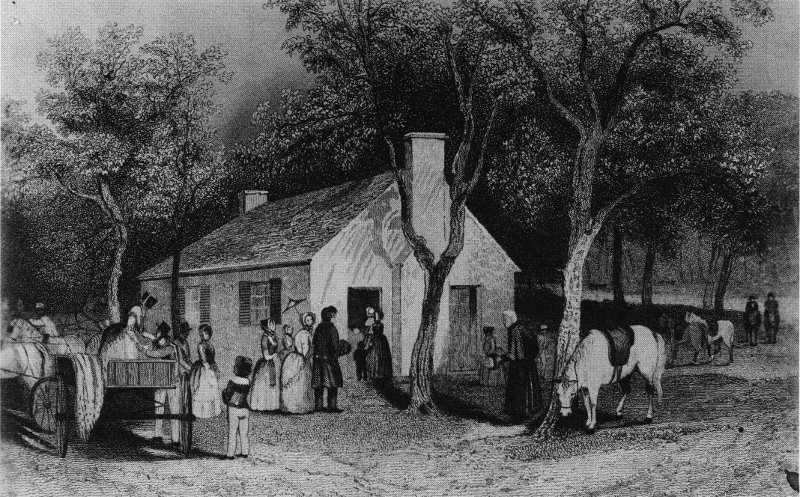
“The Hermitage” in its early days.

Greyhound had also won a race against a splendid Virginia import named Truxton, whose reputation preceded him into Tennessee. That loss practically bankrupted his owner, one John Verrell, and the big bay was his last asset, about to be seized to pay his debts. At six-years-old, Truxton was a handsome stallion, more than fifteen hands high, well-formed with white hind feet. His pedigree was impeccable, sired by a champion British horse, Diomed, out of Nancy Coleman, from a Chesterfield County Virginia stable. Jackson wanted him – badly. He was nearly bankrupt himself, but staked practically everything on his own knowledge of horseflesh, and smelled a winner!

He offered Verell $1500 for Truxton, plus three geldings and a promise of two more, should Truxton “win a purse” next fall. In return, Jackson would pay off Verell’s debts of $1170.

Once Truxton was his, Andrew Jackson entered him in a return match with Greyhound – for a side bet of $5000. According to Marquis James, a Jackson biographer of nearly a hundred years ago, “how Jackson raised five thousand dollars at this critical juncture is a point the present reviewer is unable to clarify.” Other biographers have inferred that debts and gambling never seemed to interfere with Jackson’s forward thrusts.

And…..They’re Off!

General “Old Hickory”

Jackson and Verell worked together to train Truxton to his purpose. It is said that Jax was a hard trainer, (easy to believe) pushing the horse to the limit of endurance, but somehow instilling in the animal a will to win – not unlike the character of Andrew Jackson himself.

The match race between Truxton and Greyhound was the last race of the 1805 season – and nearly everyone from miles around was in attendance, including the ladies. Greyhound was the favorite, based on his previous wins, plus the ongoing gossip that Jax had exhausted Truxton in training. Betting was heavy. Not only cash was wagered, but according to Congressman Balie Peyton who had heard the story from Jackson himself, numerous 640 acre tracts were staked. Plus several wagers in “wearing apparel.”

Patton Anderson, Jackson’s 125-pound jockey, bet all his worth on Truxton – plus, it is said, he wagered a few other horses that he didn’t even own, including a few with “ladies’ saddles on them.”

The Hermitage – later.

The race was a very big deal in Nashville.

Truxton’s eye-of-the-tiger training came through, whipping Greyhound soundly. The jockey treated his co-winners with a barrel of cider and a basket of ginger cakes. The winnings paid off all Verell’s debts, made a small fortune for Andrew Jackson, and the hats and belts helped replenish his wardrobe.

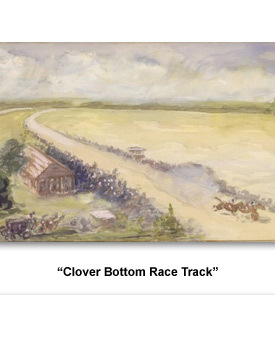
After beating Greyhound, Jackson bought him immediately, and added to his stable at the new Clover Bottom Racetrack, of which he was a part-owner.

Truxton was also coincidentally responsible for one of Jackson’s most famous duels – but that is another story to be told at another time!

The Future of Truxton

For five years Jackson did not lose a major race that had not been immediately offset by a major victory. Truxton alone won more than twenty thousand dollars in early 1800’s prize money!

Meanwhile, like all fine racehorses, Truxton was put to service, and went on to sire some excellent foals, earning Jackson a considerable amount in stud fees. Truxton offspring were considered some of the finest racehorses in Tennessee.

Andrew Jackson – later.

By the time Andrew Jackson became President in 1829, Truxton was an old horse, but Jackson was still an avid horse owner-racer. He brought a string of fine horses to an already crowded White House stable, and convinced Congress to cough up another $3500 for additional renovations. Legend has it, his beloved Truxton lived there, although he would have been past thirty – very old for a horse. Even Andrew Jackson’s horse.

Sources:

Brands, H.W. – Andrew Jackson: His Life and Times – Doubleday, 2005

James, Marquis – The Life of Andrew Jackson: The Border Captain; Portrait of a President – Bobbs Merrill, 1937

https://vault.si.com/vault/1956/07/16/tennessee-turfman

https://www.loc.gov/resource/maj.01006_0086_0087/?st=text

Andrew Jackson

Posted in A POTUS-FLOTUS Blog, Andrew Jackson | Tagged , , , , , , , , , , , , , , , , , | 6 Comments

Blaine, Burchard and Belshazzar: 1884

James G. Blaine was one of the more charismatic Republicans of the 19th Century.

Blaine: A Brief Bio

James Gillespie Blaine

James Gillespie Blaine (1830-93) was Pennsylvania born and raised, but once married, moved to Maine. A sometime journalist, he purchased a newspaper in Kennebec, managed it into one of Maine’s finest, and became involved in politics, which by the Civil War (and Maine) was predominantly Republican. They sent him to Congress.

Tall, slim, relatively nice looking (by Victorian bearded standards), what JGB had in abundance was charisma. He was a charmer. He was an engaging speaker. He had an easy going disposition and good sense of humor. He was disinclined to take anything too seriously – even the Presidency, which he wanted very much. His politics were generally middle-of-the-road.

The Gilded Age that blossomed into a virtual garden of gold after the Civil War, was predominantly centered around the railroads, which now brought the continent together. JGB (and others) invested in railroad stock which increased and cemented their fortunes.

As Speaker of the House for 6 years, he became involved in a complicated railroad construction company scheme called Credit Mobilier, which greatly discounted railroad stock to members of Congress, requesting nothing in return, except perhaps to be “open to the needs of the railroads.” It became a nasty scandal in the mid-1870s, and Blaine was deeply tarnished. He was never formally accused of anything (other than poor judgement) and while there was a congressional investigation, he never stood trial, nor was censured. And his constituents sent him back to Congress – as a Senator. Nevertheless, many believed that “where there’s smoke there’s fire,” and in Blaine’s case, it would be an ongoing smudge pot.

But the Presidential Bug is an insidious ailment, and Blaine was infected. He ran for the Republican nomination in 1880, but lost to James Garfield, who named him as Secretary of State. It was a brief tenure. Garfield died by assassination six months later, and the new Vice POTUS-turned-POTUS Chester Alan Arthur quickly replaced him.

The Politics of 1884

Interestingly enough, the presidential elections between Grant and McKinley, i.e. the five elections between 1876-1896, were incredibly close!  The electoral votes were heavy on the Republican side, but the popular votes were by whiskers. A majority of barely a thousand votes could tilt a major electoral state like New York. And it did that routinely.

The issues were generally mild and mechanical, like trade and tariffs, which accounts for the “boring” years between Lincoln and Theodore Roosevelt. In the 1880s, a good deal of politicking was also focused on Civil Service Reform, basically a mechanism for assigning political patronage jobs. There was rampant corruption: no-show jobs, no-bid contract awards, insider information, etc., not to mention redundancy and brain-drain. The political bosses ran their shows and were loath to relinquish an iota of power. The reformers naturally wanted reform. The “people” by and large, were lukewarm. Trade, tariffs and reform were not sexy issues.

The tarnished Plumed Knight.

Blaine, The Plumed Knight, was popular, considered capable and moderate, and in 1884, the election was his to lose despite his tainted image via Credit Mobilier.

Democrat Grover Cleveland

His Democratic opponent was little-known Grover Cleveland, whose political rise was barely three years old: Mayor of Buffalo, Governor of NY, and now poised for the White House. The Democrats were more concerned with morality, and Cleveland fit that bill. The worst that could be said is that he paid for a substitute during the Civil War – so he could provide for his widowed mother and four unmarried sisters.

Blaine campaigned hard this time. He traveled to the key states (NY, NJ, IN and CT), made speeches (he was much better at that than Cleveland), and attended all the dinners and events incumbent on a candidate for high office.

“Where’s My Pa?”

Very late in the campaign, when Cleveland was accused of (and admitted to) fathering an out-of-wedlock child, it appeared that Blaine’s election was in the bag. Until….

The Burchard-Belshazzar Bookends

Rev. Samuel Burchard stirred up a hornet’s nest.

Samuel Burchard was a New York Presbyterian minister of medium clout in 1884. Politically active in Republican ranks, he hosted a breakfast for 100 fellow clergymen a week before the election. Blaine was happy to accept. The press, which had become either a glowing beacon or a thorn in the side of many, was there. So was a Democratic “mole.” Blaine made his usual pleasant speech and was happy to glad-hand around the table.

But it was Rev. Burchard himself who provided the impetus for downfall!! In urging his fellow-ministers to beat the drum loudly for Blaine, he waved the usual “bloody shirt,” calling the Democrats the party of “rum, Romanism and rebellion.” Blaine himself was not even listening. But the “mole” heard every word and recognized a major oops.

Prohibition was becoming a popular issue, and leftover Civil War affiliations had been around for two decades… but Romanism! Catholics were indeed predominantly Democratic, and now Burchard was insinuating that Catholics were a) drunkards and b) traitors. The mole couldn’t wait to get to Democratic Headquarters and spread the word. (Had Blaine been listening, he might have spoken up, after all, his own mother was Catholic.)

The NY World had a headline cartoon!

Shortly afterwards, Blaine was another guest of honor – this time at a fancy banquet at Delmonico’s, hosted by an assortment of some of the richest and most politically powerful men in New York. Again, the newspapers got wind of it, likened it to the Biblical story of Belshazzar’s feast, and prepared a damning “illustration” of perceived graft, corruption and disregard of the lower classes. Blaine had been invited to similar dinners dozens of time during his career. But this one did him in.

Grover Cleveland claimed NY’s electoral votes and squeaked by. The first elected Democrat in nearly 30 years.

Sources:

Jeffers, H. Paul – An Honest President – William Morrow, 2000

Stoddard, Henry L. – As I Knew Them – Harper & Brothers, 1927

https://www.britannica.com/event/United-States-presidential-election-of-1884

https://www.history.com/topics/19th-century/credit-mobilier


Posted in A POTUS-FLOTUS Blog, Chester Arthur, Grover Cleveland, James Garfield, Nifty History People | Tagged , , , , , , , , , , , , , , , , , , , , , | 1 Comment

Mrs. Hoover Builds Her Dream House

Lou Henry Hoover was a talented and interesting woman.

Mr. and Mrs. Hoover: The First Twenty Years

Herbert Hoover (1874-1964) and Lou Henry Hoover (1874-1944) were an unusual couple, and well suited to each other. Both were born in Iowa, and moved west in their early youth. Her family was middle class and educated. His was poor, and even the doctor-uncle who raised him when his parents died, was far from wealthy.

Herbert Hoover’s birthplace

Lou Hoover’s childhood home.

The two of them met at Stanford University, had a mostly courtship by correspondence, and married in 1899. Stanford would forever have a special place in their hearts.

But from the onset of their marriage, they were generally rootless, living wherever Bert’s mining engineering duties took him. They were mostly exotic places… China, Burma, Ceylon, Egypt, and various locations throughout Europe. Having become a self-made millionaire prior to the start of World War I, they had settled with their two young sons in a very tony section of London. There they were acquainted with well-to-do Americans, and a high level of British society, and entertained frequently and in elegant style.

With the onset of WWI, Hoover relinquished engineering responsibilities to become a philanthropist on a grand scale. He never looked back.

But they still had no US residence – other than to claim Palo Alto, California as sort-of home.

The Hoovers rented this house in Washington, currently the Myanmar Embassy.

When President Woodrow Wilson summoned the Hoovers back to the US, to undertake the Food Administration, Bert and Lou decided to finally build a house of their own.

Lou Henry Hoover: Architect and Designer

Choosing the Stanford University area as the place of choice was the easy part. Building a home was much harder. Herbert Hoover was tasked with enormous responsibilities and had little time (or inclination) for personal comforts, thus it fell to his capable wife to plan and build their dream house – the only one they would ever own.

From the end of WWI to the middle 1920s, Lou train-tracked her way back and forth to California numerous times. The architect she originally engaged was dismissed early on, for blabbing about the project despite the Hoovers’ expressed wish that the project be kept private.

One of Lou’s sketches for the house (Stanford Institute)

She wound up engaging Arthur B. Clark, a Stanford art professor and avocational architect, who agreed to supervise the construction – provided that Mrs. Hoover design it. Interestingly enough, Herbert Hoover only insisted on two essentials: that it be fireproof, and that the walls be constructed of hollow tiles. Lou was the one who need to include all the Hooveresque necessities.

According to their intimates who saw the completed house, the final structure was classic “Hoover.” This, to them, was a conglomerate of eclectic tastes. Modern architects tend to call it “international.” Actually it was part North African, Pueblo, and Mission-style.

Their house in Palo Alto.

The site Lou chose for the house was built into a slope of San Juan Hill, allowing the front to be two stories, and the rear three stories. This makes the house appear quite a bit smaller from the outside. It is very roomy.

Home Sweet B&B

A rare vintage photo of an interior room. (Stanford Univ.)

In the 1920s, both Herbert and Lou Hoover were extremely busy people, with their own activities and responsibilities centering in Washington DC. They had rented a beautiful mansion on Dupont Circle for their personal/social use. Having been accustomed to frequent luncheons and dinner parties in London, they continued those traditions in Washington.

The house in Palo Alto was used infrequently – although when HH was elected President in 1928, his acceptance speech was delivered from that home.

Prohibition and The Hoover “Row”

The 1920s was the era of Prohibition. No booze. That supposedly included wine, beer and brandy along with the hard stuff.

A rare photo of the Hoovers together.

While the Hoovers were essentially moderate “drinkers,” themselves, they were long-standing hosts, and their dinner parties were elegant and generous, including libation. The house in Palo Alto had been built with a large wine cellar. The couple had a large collection of fine wines.

Naturally, since they were both engaged at high level positions of public trust (he as Secretary of Commerce, she as the President of the Girl Scouts), their entertainment was “dry.” They would not flout the law of the land, even though the Harding White House required a good deal of “medicinal” spirits. (As an aside, Coolidge, who occasionally enjoyed a beer or a small glass of whiskey, obeyed the Amendment, although he believed it to be a bad law, since so many “good people” were finding ways around it.)

The Hoovers’ well-stocked wine cellar in Palo Alto lay. Wine ages well.

But Mrs. Hoover was not happy. Prohibition was the law of the land, and her husband was poised to become President. She insisted on obeying the law, and further insisted that they dispose of their wealth of wine, since the public would be outraged. HH was not happy about it, and claimed it was the only time in their 25-plus-years of marriage that they really quarreled.

She won. The wine went. HH subsequently said that “he didn’t have to live with the public, but he had to live with Lou.”

The Hoover House Becomes Stanford Property

Despite the new digs, HH usually stayed at the Waldorf.

After the Hoover Presidency, the Hoovers became bi-coastal. She remained in California most of the time, enjoying her house. He visited periodically, but maintained a suite at the Waldorf Astoria Hotel in NYC. She visited periodically.

When she died in 1944, Hoover donated the property to Stanford University, according to both their wishes. It remains there today and is used as the private residence of the President of Stanford, whoever he/she may be.

You can go – but you can’t go in.

Sources:

Boller, Paul F., Jr. – Presidential Anecdotes, Oxford University Press, 1988

Dole, Bob – Great Presidential Wit – Scribner, 2001

Pryor, Dr. Helen B. – Lou Henry Hoover: Gallant First Lady – Dodd Mead, 1969

http://www.firstladies.org/biographies/firstladies

https://www.nps.gov/heho/learn/historyculture/herbert-hoover.htm


Posted in A POTUS-FLOTUS Blog, Herbert Hoover, Nifty History People | Tagged , , , , , , , , , , , , , , , , , , , | 1 Comment

The Presidents of New York

Virginia and Ohio claim to be Mother of Presidents – but NY claims 7 unique sons!

Three Who Re-Upped the Third Party Way

#8: Martin Van Buren

#8, Martin Van Buren (1782-1862) was a New Yorker from the border of the Catskill and Adirondack Mountains. His tavern-keeper father had him educated as best he could, but young MVB jumped at the chance to read law with a local firm and began a career in little-bit law and lot-bit politics, which he preferred, and mastered. He held varying positions in Albany, in the Albany Regency wing of the Democratic-Republican party. His biggest claim to political fame was his ability to charm, disarm, duck and waffle, suavely agree with everyone, and eventually get his way. One could arguably call him the first really “political” President.

In the mid 1820s, MVB became a convert to Andrew Jackson, and devoted his energies to electing Old Hickory and serving as his Secretary of State, and later Vice President.

As the logical successor to Jax in 1836, Van Buren inherited the whirlwind of Jacksonian banking woes, and when he sought re-election in 1840, he lost. He tried for the nomination in ’44, but lost again. But in 1848, he was nominated to head the anti-slavery Free Soil Party. They lost.

So MVB traveled, wrote his memoirs, and eventually died back in NY at 80.

#13: Millard Fillmore

#13, Millard Fillmore (1800-1874), another upstate New Yorker, was a farm boy who became an attorney. Holding political positions/offices seemed easier to provide a steady income. That included several years as Congressman. His rise was unremarkable, as were his abilities, but the 1840s and 50s were a rough time for strong candidates, and the Vice Presidency was innocuous, offering good pay, good perks, respectability and no heavy lifting.

As VP to Whig President Zachary Taylor, he balanced the Southern slaveholder on the ticket. They won. Taylor died, and Fillmore became Whig POTUS for two and a half years. He was more forgettable than failing (although that might be argued). But while he actively sought his party’s nomination in ’52, it was not forthcoming.

But another splinter party, the American Party had formed, known to history as the Know-Nothings. They were a narrow minded group, excessively xenophobic and anti-Papist. They wooed and won Fillmore to head their ticket in 1856. They lost, too.

So MF traveled, returned to Buffalo and married a wealthy widow. He died at 74.

#26: Theodore Roosevelt

Another VP-turned-POTUS-turned Third Party Presidential Candidate was #26, Theodore Roosevelt (1858-1919). Born in Manhattan to a prominent and wealthy family, he had every advantage but good health. That he acquired. His Harvard education, academic talents and larger-than-life personality were very noticeable. By 24, he was already in the New York State Legislature.

For the next fifteen years, he held a variety of medium positions that he whipped into a frenzy of publicity, making him a well-known figure on a national level. That soared when TR recruited a volunteer regiment for the Spanish American War, and returned to NY in glory. The Republicans made him Governor. Then the political bigwigs slyly “kicked him upstairs” to become Vice President in 1900.

When President McKinley was assassinated, 42-year-old TR was now “that cowboy in the White House.” He took the reins in his teeth and never let up. He became the first “accidental” POTUS to gain his own term. Then he prematurely renounced further presidential ambition, repented in leisure, chose his successor and rode off into the sunset. Not quite.

At 50, TR was too young, too vigorous, too personally popular, and too antsy. When his own party declined to renominate him, he formed his own Progressive Party, nicknamed the Bull Moose Party. They made a good showing in 1912, but they lost.

By the time TR died at only sixty, there was talk once more of nominating him for President.

New Yorkers are Tenacious

#21: Chester Alan Arthur

#21, Chester Alan Arthur (1829-86) was another “accidental” POTUS. Born in VT, his family moved to New York when he was a child. Seduced by the Big Apple as a young attorney, he became active in behind-the-scenes politics. In a surprise election, dark-horse James Garfield and darker-horse Chet Arthur were elected in 1880. Garfield was assassinated, and Arthur served three-and-a-half years of the incomplete term. He wasn’t too bad all things considered, but his party (Republicans) did not nominate him, although CAA was amenable to continue on. It was probably for the best. He was a sick man, and had he won, would have not completed his term either.

#22 & 24: Grover Cleveland

#22/24, Grover Cleveland (1837-1908) was born in NJ, but his minister-father moved to Buffalo when GC was a month old, so it sort-of doesn’t count. His education was spotty. By 18, recognizing that he was going nowhere, he read law with a Democratic law firm (hence GC’s political affiliation), and established a successful business law practice in Buffalo. Early ventures in local politics were disappointing, especially when he realized that business law was far more profitable.

But Buffalo was corrupt, particularly after the Civil War, and a coalition of Republicans and Democrats recruited GC for Mayor. He won, cleaned up a host of naughtiness, and was promoted to NY Governor.

Two years later, Cleveland became the Democratic Presidential candidate. THREE TIMES: 1884, 1888 and 1892! Won-Lost-Won, forever confusing the numerical order. He was honest, conservative but generally unimaginative. When he retired, he moved to New Jersey, where he died at 71.

#32: Franklin D. Roosevelt

#32. Franklin Delano Roosevelt (1882-1945) remains, and shall always remain the only POTUS who ran for and was elected to FOUR terms (1932-45). Born along the Hudson River, his family was wealthy and prominent – he was a distant cousin of the aforementioned Theodore. His career was moderate until he was 39, when he contracted polio, and spent a decade trying to regain his health as well as keeping his finger in the political pie.

Elected as a Democratic legislator etc., FDR was considered a pleasant lightweight. He fooled everyone by becoming a very potent leader.

He died only three months into his fourth term. He loved the job almost as much his distant cousin.

It is still much too early for #45 to be evaluated for the future.

Sources:

DeGregorio, William A. – The Complete Book of U.S. Presidents – Gramercy Books, 2001

https://www.britannica.com/topic/Free-Soil-Party

https://millercenter.org/transforming-american-democracy-tr-and-bull-moose-campaign-1912


Posted in American Civil War, Chester Arthur, Franklin D. Roosevelt, Grover Cleveland, Martin Van Buren, Millard Fillmore, Theodore Roosevelt | Tagged , , , , , , , , , , , , , , , , , , , , , , , , , , , , , , | 1 Comment