Woodrow Wilson 1919: Savior of Europe

This image has an empty alt attribute; its file name is president-wilson.jpg

When the Great War ended in 1918, US President Wilson was a hero to the Allies.

WW: Writer of Rules and Righter of Wrongs

Many historians over the past century have alluded to Woodrow Wilson’s messianic streak. He was a devout Presbyterian from a family of Presbyterian preachers, infused with a personal sense of right, wrong and destiny – particularly his.

Even as a young student, whenever he joined a group, be it the glee club or the baseball team, he gravitated toward the mechanics of “club,” drafting its constitution and rules. As a professor of governmental studies, what today is called political science, it was the mechanics of governments that intrigued him the most. 

By the time Wilson was elected President of the United States in 1912, he already had more than 30 years of political/governmental “cogitation” under his belt. He took office knowing exactly how he believed the country should be run. We had also been at peace for more than a half century. That helped. 

Within a year and a half, he was faced by Europe in a race to see which of its countries could turn to shambles first. 

The Example of George Washington

Professors traditionally do not earn huge salaries, and that included the popular young Prof. Wilson, who supplemented his meager income by writing and publishing. His biography George Washington first appeared in 1896, shortly before WW’s 40th birthday. Like all his writings, it was well received.

Our first President is famous for many things, but one of his great pieces of “advice” cautioned his “fledgling” country to avoid involvement in European conflicts. We were happily protected by two great oceans. We could afford to mind our own business. 

The iconic GW

We did exactly that for more than a century. 

In August 1914, as the guns opened on each other throughout the European continent (and even farther), Wilson’s advice was the same as GW’s: stay out of it. The country as a whole, was happy to oblige. For three years, we were “too proud to fight,” and Wilson won a second term largely because he  “kept us out of war.”

Meanwhile…

The Great War (so named for its extent, scope, brutality, devastation, hemorrhage of resources, and above all casualties) had enveloped not only Europe, but great chunks of Asia, Asia Minor, and even parts of Africa, and by 1917, it was mired in stalemate. Nobody was winning – and everybody was losing. 

But while POTUS WW steadfastly refused to commit US troops, he not-so-quietly supported the Allied war efforts in trade and humanitarian supplies. What he wanted most of all, was to be involved in the eventual peace process for determining the New World Order. He kept in close contact with most of the belligerents – at least to the extent of trying to fathom their needs and expectations. 

Wilson’s “Fourteen Points”

He devised his famous “Fourteen Points,” a series of conditions he believed European countries needed to address as a positive step to the New World Order that would be created. 

In It To Win It

Only weeks after WW took his oath of office for the second time, the conditions seriously confronting/affecting our country had become intolerable, and with a heavy heart (truly) Wilson asked Congress to enter The Great War on the side of the Allies.

Once the USA was committed, armed, supplied, trained and deployed overseas, the Great Stalemate came to a fairly rapid end. On November 11, 1918, the Armistice had been signed, and Peace Talks were scheduled to begin.

Against all US tradition, and against all political advice and opposition, Woodrow Wilson insisted on leading the US delegation. In person. 

The Wilsons

Weel-son, Weel-son!!!

The clamor of the European victors when Woodrow Wilson arrived in France was deafening. He was far more popular in Paris than in Washington. Or anywhere else in the USA. Parades were held in his honor. Dinners, banquets, dozens of daily bouquets. Medals were struck with his image. Peasants knelt as his procession passed. Every European notable vied for a few minutes of his time, gifts in hand. 

The Big Four

Then “The Big Four” as they were called, (the USA, Great Britain, France and Italy) got down to business…

Flies in Ointments

While the exhausted soldiers and citizens hailed “Weel-son” as a savior, the hard-nosed European politicians were making mincemeat of his Fourteen Points. “God only needed ten,” snarled George Clemenceau, France’s bulldog statesman. Many Wilson contemporaries and later historians believed WW to be no match for the wily Europeans, who knew their countries’ historical needs and recent sacrifices viscerally.

George Clemenceau

While Wilson debated like the professor he was, British PM David Lloyd George “argued like a sharpshooter,” with brilliant imagination and historical insight, and Clemenceau was his insistent self.

David Lloyd George

All acknowledged Wilson’s sincere intentions and idealism, but the European leaders were more interested in reparations – and a declawing-defanging punishment to Germany for starting the huge mess. Its army, navy and merchant ships were drastically reduced; its colonies were confiscated and redistributed; its economy was sorely thwarted, and the country would be surrounded by small “paper states” (Poland, Yugoslavia, etc.) that they believed would be a buffer. It practically assured Germany’s inability to revive. Lloyd George warned that he could not “conceive any greater cause of future war.”

Every one of Wilson’s Fourteen Points was abandoned or reduced to a shell. The only thing remaining was the creation of a League of Nations, to prevent a recurrence of The War to End All Wars. It was WW’s lifelong dream, and he was insistent on salvaging the League as a savior to mankind. In the end, it killed him.

Most modern historians tend to concur that World War I and World War II were merely the same war – separated by 20 years of a lukewarm truce.

Sources:

Brendon, Piers – The Dark Valley: A Panorama of the 1930s – Alfred A. Knopf, 2000

Heckscher, Augustus – Woodrow Wilson: A Biography – Scribner’s – 1991

Smith, Gene – When The Cheering Stopped – Wm. Morrow & Co. – 1961

https://www.whitehouse.gov/about-the-white-house/presidents/woodrow-wilson/

https://www.britannica.com/event/Fourteen-Points

Posted in A POTUS-FLOTUS Blog, Nifty History People, Woodrow Wilson | Tagged , , , , , , , , , , , , , , , | 1 Comment

Andrew Johnson: Owning His Cemetery

This image has an empty alt attribute; its file name is andrew-eliza-johnson.jpg

Andrew and Eliza Johnson

AJ: The Turbulent Soul

Andrew Johnson (1808-1875) always ranks in the bottom of the POTUS class. It was not always so much what he did or did not do, but more what he “was” as a person.

Born in North Carolina to despair and poverty, his uneducated father was a porter at a wayside inn, fetching water, chopping wood, etc. His mother was a servant. The senior Johnson died when Andrew was two; his mother, with two toddlers to raise, remarried in due course. The stepfather was just as poor and uneducated as Johnson’s natural father. 

At ten, Andrew’s parents apprenticed the children to a local tailor. They could not afford to feed and clothe them, and considered it a kindness: assure the boys of a trade, so they could earn a living.   

This image has an empty alt attribute; its file name is andrew-johnson.jpg
Andrew Johnson

No one would argue the truculent nature of Andrew Johnson. Various sources portray a) the harsh treatment by the tailor, and b) the belligerent apprentice, who attempted to run off several times. There is probably truth in both observations. 

Shortly before his 18th birthday (when his contract expired), AJ ran off again – this time to Tennessee, where the apprenticeship laws did not apply. 

The Political Rising of Johnson

Within a year, Johnson had settled in Greenville, TN, a modest working-class town. He married, opened a tailor shop, and joined the ranks of its citizenry. 

With help from his wife Eliza, who had a basic 3-R education, Andy learned to read, write and cipher. His tailoring business succeeded. By his early 20s, he participated regularly at town meetings. They made him an alderman. Then mayor. Then to the state legislature in Nashville, as a Democrat: the party of the working people. 

By 35, he was elected to Congress, and remained for more than a decade. The penniless boy now owned a 350 acre farm, a grist mill, and several lots in Greenville. Politics agreed with him. Granted he was never wildly popular or beloved, and had dozens of political adversaries. But he was bulldog-tenacious, and devoted to Greeneville – and Tennessee.

In the early 1850s, AJ purchased fifteen acres on the highest point in Greeneville, not far from the home he had recently built in town. It was a place to relax and meditate.

The Civil War and Afterwards

By the time the Civil War began, Andrew Johnson had been in politics for 30 years as a firm and dedicated Unionist. Period. Despite a decade of unrest in Tennessee (and elsewhere), he remained loyal to the USA. He was the only southern senator to remain in his seat when Tennessee seceded in 1861. As such, President Abraham Lincoln assigned the immovable Johnson to various posts (including Military Governor) in a bitterly divided Tennessee, challenging his administrative abilities and personal courage. The Senator did not disappoint. 

This image has an empty alt attribute; its file name is lincoln-johnson-poster.jpg
The Union ticket: 1864

This service won him Lincoln’s personal recommendation as Vice President in 1864 – on the Union ticket. With the country perhaps more divided than it had been in 1860, the word “Republican” was anathema.

The ticket won, and thus began Andrew Johnson’s bitter years. He had been a lifelong Democrat, but was elected on a Union ticket that was actually Republican. Lincoln’s assassination created philosophical and political turmoil for the new “accidental” POTUS, and AJ’s bellicose nature did not help. He alienated just about everyone.

After three turbulent years, he missed impeachment by only one vote. After that, neither party even thought about nominating him for a term of his own. 

AJ: 1869 and Forward

Politics had been Andrew Johnson’s vocation for nearly 40 years. Once “retired,” he remarked that he had done his duty. Nevertheless, back in Tennessee he was bored, and his rambunctious soul needed outlets. During the next five years, he ran for and lost, elections to the Senate and the House of Representatives.

In 1875, he tried again for the Senate – and won. (NOTE: State Legislatures elected Senators at that time). 

The new Junior Senator from Tennessee returned to the Senate, took his oath, and was welcomed back. When he made a brief speech, he was deeply touched by a standing ovation. 

Then the Senate adjourned, and AJ returned to TN. A short time later, he had a stroke and died. 

The Burial…and the Cemetery

Andrew Johnson’s funeral was small, and according to his wishes, in the Masonic tradition. He had first joined the organization in 1843, and had become a Master Mason in 1851. Also, according to his wishes, he was interred on that hill near his home.

This image has an empty alt attribute; its file name is johnson-tombstone.jpg
Johnson’s monument towers over the landscape

His wife Eliza died not long thereafter, and is buried there. In 1878, an impressive 27’ obelisk was erected by the family over Andrew and Eliza’s graves. Their sons, Robert and Charles, had predeceased their parents, and their remains were re-interred nearby. In due time, the Johnsons’ last remaining son and two daughters (Martha Patterson and Mary Stover) joined them. So did grandchildren – and even great-grandchildren. It was a family plot on a hillside until…

This image has an empty alt attribute; its file name is johnson-gravesite.jpg
The “gated” community

The Plot Thickens

Martha Johnson Patterson was the last surviving child of Andrew Johnson, and upon her death in 1901, she willed the burial land to the US government for use as a public memorial park dedicated to Johnson’s memory.

This image has an empty alt attribute; its file name is marthajohnsonpatterson.jpg
Martha Johnson Patterson

Administered by the War Department in 1906, it became The Andrew Johnson National Cemetery to honor US veterans of all wars. It is minuscule compared to the National Cemetery at Arlington or Gettysburg.

The first veteran was buried there in 1909. In 1939, there were 100 veterans.

From 1906 until 1942, the cemetery was under the jurisdiction of the War Department; the National Park Service took charge in 1942. In 2019, it was formally closed to new burials.

There are now 2000 headstones of veterans from the Civil War, the Spanish-American War, WW1, WW2, the Korean War, Vietnam, the Gulf War, Iraqi Freedom, and Afghanistan.

RIP.

This image has an empty alt attribute; its file name is johnson-gravesite2.jpg
The “inactive” Andrew Johnson National Cemetery

Sources:

McKittrick, Eric L – Andrew Johnson: A Profile – Hill and Wang, 1969

Trefousse, Hans L. – Andrew Johnson: A Biography – W.W. Norton, 1989

https://millercenter.org/president/johnson

https://www.nps.gov/anjo/cemeteryhist.htm

Posted in A POTUS-FLOTUS Blog, Andrew Johnson | Tagged , , , , , , , , , , , , , , , | 4 Comments

Herbert and Lou Hoover: Flexible Planning

Most people’s weddings are a big deal.

Herbert and Lou Hoover (The Hoover Institute)

Bert and Lou: The Non-Courtship

Herbert Hoover (1874-1964) and Lou Henry (1874-1941) met at Stanford University shortly after its doors were open. They were both studying geology, he for an engineering career, and she… because she found it fascinating. Their mutual professor, John C. Branner introduced them. 

The Hoover house in Iowa.

Their similarities were obvious. They were Iowa born in the same year, and both moved west at an early age. The Henrys moved to California for better opportunities. Bert was completely orphaned by ten, and Oregon relatives offered to foster-raise him. They were both energetic students with a gift for organization and administration – and love of the outdoors. 

The differences, however, were enormous. The Henrys were middle class, who could offer their daughter the benefits of both frontier and town life. And a solid education. Even before she attended Stanford, Lou had graduated from a teacher’s college, and had taught for a year. Thus while Bert was a senior at Stanford, Lou was a freshman.

This image has an empty alt attribute; its file name is lou-childhood-home.jpg
The Henry house in California

Hoover-the-orphan had limited means with little material wealth. He knew hard work would be his lot. Stanford University had just opened, and tuition was free, but room, board, books, sundries and even minimal pleasures were not. He took on an assortment of odd-jobs, ranging from helping in the cafeteria to delivering laundry to pay his expenses. He also became a class officer, the manager of the baseball team, and a host of other extra-curricular activities, all of which made him one of the best-known students at Stanford. Everybody knew who Herbert Hoover was. 

Nevertheless, he was painfully shy, especially with young women. Having such limited funds, and practically none for courtship, he avoided opportunities to mix and mingle with the opposite sex. 

But Prof. Branner tried. He made sure that his two most promising students were introduced. And they became friends.

Even in a mild courtship, it was friendship rather than romance. There is some indication however, that once she met her fellow Iowan, Lou decided to “major in Herbert Hoover,” believing that a life with him would never be dull.

When he graduated, they had a sort-of understanding; they agreed to correspond. 

The Pen-Pals

The two exchanged letters for the next three years. It wasn’t always easy. Bert had a shaky career start (the economy was to blame). Finally he was engaged as a mining engineer in harsh and remote locations, which made it difficult to receive mail.

This image has an empty alt attribute; its file name is hooverat23.jpg
The young mining engineer

They wrote friendly letters. He told her about his assignments, the challenges and the exotic locales he was living in. She told him about her classes, and news of their mutual friends and acquaintances. When she graduated, they had already decided to marry whenever it was feasible.

Lou graduated in 1898, and returned to live with her family in Monterey, teach school a little, and wait for her intended.

The Proposal

The story goes, that HH sent Miss Henry a congratulatory telegram when she graduated. It was a very long telegram, since he told her in detail about his new engineering assignment. It would pay $40,000/year. In 1899, it was a phenomenal amount, especially for a 24-year-old “youngster.” After all, President William McKinley’s salary was $50,000. Then he added that the position was in China.

Finally, he asked her to marry him, and honeymoon in China. With a $40,000 job, he could certainly afford a wife.

Lou got straight to the point. She sent a return wire of only one word. “Yes.”

Hoover booked passage on the next freighter.

The Flexible Wedding Plans

This image has an empty alt attribute; its file name is 995b2-6a00e5501561a18834015437acc9d4970c-320wi.jpg
Bert the dude.

It was a stranger who showed up at the Henry house in Monterey. Other than Lou, nobody had ever met him. Her parents had heard about him naturally, and Lou may even have shared parts of his letters with them – but the tall, tanned, muscular young man who was introduced as their son-in-law-to-be made a good enough impression. Charles and Florence Henry realized that their daughter had found a man well suited to her interests and intellect.

But although the young couple (both were 24) had agreed to marry a month earlier, the wedding had to be immediate. Bert was due in China, and passage for two had already been booked on a freighter leaving the next day.

The couple had asked Dr. William Thoburn, a professor at Stanford as well as a Methodist minister, to perform the ceremony. But he had died shortly before the wedding. Go to Plan B.

This image has an empty alt attribute; its file name is young-lou.jpg
Lou the fox.

Lou had been raised Episcopalian; Bert was a Quaker. Since neither of them were rigid in doctrine, and Lou had been teaching near an old Spanish mission, she asked its Catholic priest, Father Ramon Mestres, if he could preside in a civil ceremony. He was delighted.

Herbert and Lou were married on February 10, 1899. It was a small family and friends gathering at the Henry house. No fancy wedding gown. And the bride and groom, without consulting each other, had both purchased brown traveling suits. Lou was packed and ready for an adventurous life. The train was waiting to take them to San Francisco.

A rare photo of the newlyweds and the Henrys.

An Interesting Epilogue

A freighter across the Pacific in 1899 was the legendary “slow boat to China.” It carried only a handful of passengers. Among them was a young journalist named Frederick Palmer and his wife. His newspaper sent him to report on the growing unrest in China.

They became pleasantly acquainted with Mr. and Mrs. Hoover, and the friendship lasted a lifetime. 

According to lore, the Palmers were were amazed to learn that the Hoovers were day-old newlyweds. From the easy way they responded to each other, they thought the couple were probably married at least three years.

It would always be like that. 

Sources: 

Caroli, Betty Boyd – First Ladies: An Intimate Look at How 38 Women Handled what may be the most Demanding, Unpaid, Unelected Job in America – Oxford University Press, 1995

Pryor, Dr. Helen B. – Lou Henry Hoover: Gallant First Lady – Dodd, Mead, 1969

http://www.firstladies.org/biographies/firstladies

http://www.awb.com/dailydose/?p=1884

https://potus-geeks.livejournal.com/445027.html

https://millercenter.org/president/hoover/life-before-the-presidency

Posted in A POTUS-FLOTUS Blog, Herbert Hoover, Nifty History People | Tagged , , , , , , , , , , , , , , , , , , , | 1 Comment

The Sagamore Hill-Hyde Park Relations: Part 1

Family Ties.

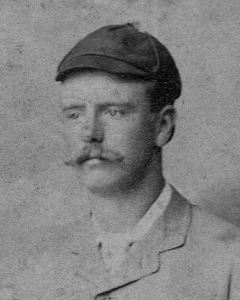
This image has an empty alt attribute; its file name is young-tr.jpg

The Common Bond

Claes Maartenszen van Rosenvelt came to New Amsterdam around 1640, about the time Peter Stuyvesant was its governor. He was not a wealthy man. He did not come for religious freedom. He did not come to escape hardship. He came for the promise of opportunity – which he found in what became New York. 

He married and raised a large family. Its most prominent branches can trace ancestry to two of Claes’ sons: Johannes (John) and Jacobus (James). Both married propitiously and prolifically, siring more generations of spelling-changed Roosevelts, all born in Manhattan.

This image has an empty alt attribute; its file name is tr-sr.jpg
Theodore Roosevelt, Sr.

Four generations later, the Johannes branch claimed Theodore Roosevelt Senior (1831-78), who inherited a sizable fortune in the plate glass industry, and built a comfortable summer house near other relations in Oyster Bay, near Long Island Sound. The Jacobus branch produced James Roosevelt (1828-1900). His side was also financially comfortable, but not nearly as wealthy as his fourth cousins. Nevertheless James did well, invested in railroads and other industries, and bought property in Hyde Park, along the Hudson River about 100 miles from the center of Manhattan – for his summer home.

This image has an empty alt attribute; its file name is fdr-father-james-roosevelt.jpg
“Mister” James Roosevelt

It would be a rare family today who could claim a close social relationship with such distant kinfolk. But the Roosevelts of the 1850s lived within a small pedigreed network, and family ties were still binding. They saw each other at the usual weddings and funerals, and occasional events attended by mutual friends in their social status. Bottom line: They all knew each other, but were not close.

The Two Roosevelt Branches

Theodore Roosevelt Sr. fathered four children: Anna (always called Bamie within the family), Theodore (known as TR to posterity), Elliott and Corinne. The four children, born within eight or nine years, were always close. Sad for the family, Theodore Sr. died of cancer at only 46.

James Roosevelt, called Mister James by his employees and neighbors alike, married twice. His first marriage produced James Roosevelt Roosevelt (always called Rosy). The marriage was happy for twenty-three years. Then she died.

Mister James was around 50 and lonely. Seeking more of a companion than a romantic partner, he cast his eye on Bamie Roosevelt, a woman in her mid-twenties. She was brilliant and capable on many fronts, but suffered from a spinal deformity which never limited her socially, but may have limited her romantically.

This image has an empty alt attribute; its file name is bamie.jpg
“Bamie” Roosevelt, TR’s sister

Bamie was not interested in a man old enough to be her father, nevertheless she hosted a dinner party and invited him – along with a good friend of hers.

Sara Delano: Catalyst

Sara Delano (1854-1941) came from another family with a pedigree – and purse – that easily matched if not exceeded the Roosevelts. Her father, Warren Delano, made his fortune in the China trade, sired a large family, and built a fine mansion about 20 miles from Mr. James’ Hyde Park estate. Sara spent much of her childhood abroad in exotic locales, but when she returned to NY for her education, one of her friends was a women her own age: Anna “Bamie” Roosevelt. Over the next decade, they became close, and saw each other often. 

If Bamie had serious matchmaking on her mind other than enjoyable company, it is unknown. Perhaps she just wanted to deflect Mr. James’ attentions. What transpired that evening changed the relationship between the Roosevelt branches – and perhaps history.

Sara Delano was tall, about 5’10”, with a fine figure and handsome (rather than pretty) face. She had numerous suitors, but unusual for the time, at 26 or 27, she had no particular interest in matrimony. But Mr. James “could not take his eyes off her,” and Sara found his attentions more than just agreeable. She was fascinated. 

Sara Delano

He called on her, sent letters, and courted her like a young man. And she responded eagerly to this gentlemen, 26 years her senior with a grown son – and grandchildren. Once she assured her father that she truly loved Mr. James (Warren Delano had known him as a businessman and neighbor), he gave his consent, and the two were married. Naturally the Oyster Bay branch were invited to the wedding on October 7, 1880.

Closer Ties

Typical of their times and class, Mr. James and his bride went on a six month honeymoon to Europe. One of their fellow passengers was young Elliott Roosevelt, Bamie’s brother, a man of twenty-one. They renewed their pleasant acquaintance, and found him delightful company. Elliott joined them at dinners and on excursions.

This image has an empty alt attribute; its file name is elliottroosevelt.jpg
Godfather Elliott Roosevelt, TR’s brother

When they returned to their Hyde Park home, Sara was already pregnant. The delivery was arduous and she was told that more children were not in her stars. But her son was born strong and healthy.

The couple asked Elliott Roosevelt to stand as godfather.

The Binding Tie

Throughout Franklin Delano Roosevelt’s childhood, he had a few unremarkable occasions to meet Eleanor Roosevelt, his fifth cousin and Elliott’s daughter. By their adolescence, both Eleanor’s parents had died, and she was being raised primarily by her late mother’s family, a generally dour and somewhat dotty bunch.

Young FDR

Naturally Eleanor had much stronger ties to her Sagamore Hill kin (once the house was built by her uncle Theodore), but even that was sporadic.

Young Eleanor

But when Franklin and Eleanor chanced to meet again, he as a Harvard student, and she, having made her debut, the attraction between them deepened. They liked each other. They admired each other. And they grew to love each other.

By that time, Franklin’s father had died. And their mutual illustrious kinsman, Theodore Roosevelt, was President of the United States.

When the “youngsters” married in 1905, Uncle Theodore gave the bride away.

Sources:

Brands, H.W. – Traitor to His Class – Doubleday, 2008

Burns, J.M. and Dunn S. – The Three Roosevelts – Atlantic Monthly Press, 2001

Pottker, Jan – Sara and Eleanor – St. Martin’s Press, 2004

https://www.nps.gov/people/theodore-roosevelt-sr.htm

https://www.nps.gov/people/sara-delano-roosevelt.htm

Posted in A POTUS-FLOTUS Blog, Franklin D. Roosevelt, Nifty History People, Theodore Roosevelt | Tagged , , , , , , , , , , , , , , , , , , , , , | 2 Comments

President Ike and the Interstate Highway System

This image has an empty alt attribute; its file name is youngike.jpg
Ike – the WWI tank officer

POTUS Ike: The Early Advocate

Dwight D. Eisenhower was a Lt. Colonel in the US Army in 1917, when US participation in The Great War began. He was deeply disappointed that he was not assigned to active military service abroad; instead he was posted to the transportation sector, particularly its newest technology: tanks.

This image has an empty alt attribute; its file name is early-20thcent-road2.jpg
A typical road circa 1920.

Realizing that military needs and public safety were intricately tied to our increasingly mobile society, the Army undertook a cross-country transportation maneuver from Washington DC to California.

It took 62 days involving 81vehicles of various description, a task-force of 24 officers and 258 enlisted men, and an average speed of 6 miles per hour, or just under 60 miles a day. It was a huge and grueling undertaking. Ike went along, and was charged with writing one of the reports. He indicated that while the infrastructure in most of the Eastern states was satisfactory, as was California, in between lay more than 2500 miles of incomplete roads, poorly structured roads, no roads at all, and poorly designed/constructed bridges. Few of them were connected.

In case of emergency, military or otherwise, how could people and materiel be transported across the country?

Ike became a believer of the importance of sound infrastructure. But the Depression and WWII prevented real progress. There was no money.

POTUS Ike: Convinced Advocate

Fast forward some 25 years. General Eisenhower was the Supreme Commander of the Allied Forces during the Second World War. After massive forces landed in Normandy, the race began to reach Berlin. Ike (and others) were seriously impressed by Germany’s excellent roads and highways. They were well paved and maintained, and wide enough to support large military vehicles, like the newly improved tanks. Bridges and overpasses were structurally sound. Once the Allies reached German borders, the march was  smooth. 

Five-Star General Ike

For several years after the war, Ike assiduously ducked the political opportunities that were thrown into his lap. He insisted he was apolitical, a loyal soldier, and even a growing statesman. But not a candidate.

That changed in 1952. A finally-acknowledged Republican, Ike was swept into the Presidency by a large majority. By that time, the Cold War and “The Bomb” was a serious threat to the country.

Meanwhile The Cold War

Tensions between the US and Russia began as soon as World War II had ended. The US had become a superpower, thanks to the hydrogen bomb. Russia wanted to get into the game.

With the death of Josef Stalin in 1953, Russia wasted no time in detonating its own hydrogen bomb. By 1955, 79% of the US citizenry believed that a nuclear attack was not only possible, but entirely probable. And maybe a lot sooner than we thought. Families built bomb shelters, stockpiled canned goods, and re-revved up their Civil Defense networks.

In 1954, Ike had appointed General Lucius Clay to chair a committee to make recommendations for building/connecting a highway system to service the nation’s growing needs.

In 1955, a large-scale urban emergency evacuation drill was undertaken, and surprising nobody, resulted in massive confusion and congestion. And an estimated 70 million people might require evacuation if a real emergency occurred!

POTUS Ike: Timing Being Everything

The need for major improvement to US infrastructure had been obvious to everyone for years. But massive projects take an enormous amount of planning and preparation before even an announcement is made. Thus, it was not until June, 1956, that the formal announcement of the U.S. Interstate Highway System was created.

This image has an empty alt attribute; its file name is president-ike.jpg
POTUS Ike

And here is where it gets interesting – apart from the fact that it was cohesive, well-planned and generally popular!

There were several reasons why connecting sea-to-shining-sea was proposed and begun.  

Safety. More than 36,000 traffic fatalities had been reported in 1954 alone, taking a multi-billion dollar toll on the country’s economy. Better roads meant safer roads.

Vehicular Life. Poorly existing roads were taking a heavy toll on vehicles, vehicle ownership and the cost of transportation, which was being passed along to the consumer. Better roads meant longer vehicular life.

National Security. Threat of a nuclear attack was not far-fetched in the 1950s. This demanded a civil/military force that could evacuate the populace quickly. Better roads assure the quickest response to emergencies.

The Economy. The health of the US economy demanded well-conceived planning for the future, which included a healthy transportation system particularly to move goods from farm to table. And building/maintaining better roads would create thousands of jobs.

Bottom line: Creating/fixing/maintaining a 40,000+ mile system of highways was essential to the health of the USA – on many fronts.

The Ike Contribution

President Dwight D. Eisenhower lent his name, reputation and leadership to The Interstate Highway System, the biggest infrastructure project ever undertaken by the US – and that includes the numerous construction projects of the New Deal.

The connecting highways include all the contiguous US states, including the then-territories of Alaska, Hawaii and Puerto Rico. They all had governors, senators and congressmen, well-known captains of industry and related disciplines with egos to match. Then there were the citizens themselves, some of whom strongly resisted the upheaval of their towns and communities.

You see these all over the country.

One of Ike’s best qualities was his ability to work with all types of people on all types of projects and harness a cohesive team that could work together toward a common goal for the common good. It was that quality that earned his success as Supreme Commander of the Allied Forces in WWII, as well as his later appointment to NATO. His influence must never be underestimated.

The Interstate Highway System was expected to take 12 years to complete, at a cost of around $25 billion (in 1950s money). Not surprisingly, it took 35 years, and ran more $500 billion in today’s dollars. It was formally named the Eisenhower Interstate System, and uses as its logo, Ike’s Five Stars.

This image has an empty alt attribute; its file name is clipart-5stars.png

And, being a nation of drivers, just about everyone in the entire country has been on a part of it at some point.

Sources:

D’Este, Carlo – Eisenhower: A Soldier’s Life – Henry Holt, 2002

Perret, Geoffrey – Eisenhower – Random House, 1999

https://www.history.com/topics/us-states/interstate-highway-system

https://www.eisenhowerlibrary.gov/research/online-documents/1919-transcontinental-motor-convoy

http://www.publicpurpose.com/freeway1.htm#intro

Posted in A POTUS-FLOTUS Blog, Dwight D. Eisenhower | Tagged , , , , , , , , , , , , , , , , , | 3 Comments

Ellen Herndon: Mrs. Chester Alan Arthur

Chester Alan Arthur was a recent widower when he was elected VP in 1880.

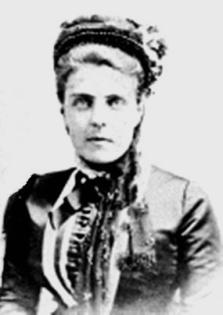
Ellen Herndon Arthur

The Private Arthurs

No one was more surprised than Chester Alan Arthur when he was nominated for (and elected) Vice President in 1880. Had she lived, Ellen Herndon Arthur would have echoed that surprise.

Chester Alan Arthur (1829-1886) was Vermont-born of a “humble” family. His father, a farmer-teacher-minister, was long on faith and short on funds. When Chet was still a toddler, the family moved from place to place in upstate New York for better opportunities. In a land where one (with pluck and luck) can rise from modest means to wealth, Chet leaped at the opportunity for an education at Union College. He excelled, studied law, and in time, decided to seek his fortune in The Big Apple, where, if you can make it there, you’ll make it anywhere. 

Nevertheless, while he never denied his modest beginnings and kept in contact with his family, like Lincoln, he seldom discussed personal details. 

Ellen Lewis Herndon (1837-80) came from both means and distinction. She was a Virginian, born to a high ranking naval officer; her father’s cousin Matthew Fontaine Maury, was an even higher ranking naval commander (both USA and CSA) and scientist of renown. 

Due to her father’s long absences at sea, Ellen (usually called Nell) was an only child, and had little contact with him. She would later admit she never knew her father very well. When he died in a tragic hurricane shipwreck in 1857, he became a bone fide hero, rescuing scores of passengers, but losing his life in the effort. 

A magazine image of Mrs. Arthur

Born in Fredericksburg, VA, young Nell lived mostly in Washington DC, and blessed with an excellent singing voice, sang in the St. John’s Church choir. She eventually moved with her mother to New York. For a while.

Becoming Mrs. Arthur

Chet Arthur (as his friends called him) adapted easily to the New York City lifestyle. He became a nifty dresser and epicure. His legal talents, especially those of administration, were recognized quickly, and the then-Governor of New York took a personal interest. When the opportunity arose, Governor Morgan appointed his young protege to high level positions, particularly once the Civil War began.

Prior to meeting Ellen Herndon in 1858 at a Saratoga Springs resort, Arthur focused on furthering his career and seems to have had little serious romantic involvement. But when his friend Darnley Herndon introduced the young attorney to his cousin Ellen, that changed quickly. 

A much later impression of Ellen Arthur

Despite the fact that Arthur the New Yorker and Miss Herndon the Southern belle came from backgrounds that were miles apart, they were attracted and the courtship proceeded apace. He visited the Herndon home in Virginia, and met many of her well-placed kinsmen. Their gracious lifestyle was embraced by the up-and-coming lawyer; the Herndon family liked him.

This image has an empty alt attribute; its file name is young-chet-arthur.png
Chester Alan Arthur, the young dude.

They married in 1859. She was 22, he was 30. They purchased a townhouse in Manhattan, and proceeded to entertain frequently – and lavishly. She had inherited a considerable fortune from her recently-deceased hero-father.

The Happy Couple

In many ways Nell and Chet were a happy couple. They had three children, the first died in infancy. Chet readily acknowledged how much he owed to the genteel Southern social style that his bride brought to the table, along with her finances. She, on the other hand, found fulfillment singing in the Episcopal Church choir, and the Mendelssohn Glee Club, where she sang their soprano solos, and performed at many benefit occasions. 

The Arthur townhouse on Lexington Avenue, NYC

The Civil War took a toll on the Arthur spouses as it did on many marriages. Nell openly favored the Confederacy, deeply concerned about her many relatives. Meanwhile Chet had become essential to New York’s military efforts, provisioning all the volunteer NY troops, to include housing, feeding, clothing, arming and sundries. He eventually was given the title of Quartermaster General, which allows history to consider him as a military general. When the 30-something Arthur tried to enlist for active duty, the Governor would not permit it. He was needed in New York. 

Very few photos of the Arthurs (rear, right) exist.

The Maybe Not-So-Happy Couple

After the Civil War, politics in general underwent many changes, not the least of which was the rise of the political boss who controlled all the patronage jobs in said city/county/state (wherever the boss reigned). “To the victor belongs the spoils,” and that meant politics. In the 1870s, it was primarily Republican, and usually corrupt. The emergence of Civil Service regulation was still years away.

While never personally corrupt, Chet Arthur was deeply rooted in the boss system, and became a high-ranking behind-the-scenes advisor. Few Republican decisions were made in New York without his input. In return, he was assigned plum positions that paid more than the President of the United States.

CAA was having a grand time of it. Delmonico dinners, speaking engagements, champagne and caviar meetings. Some may have included show girls or amiable waitresses. Bottom line, he was seldom home.

Here’s where things get a little iffy. His marriage was drifting, and some historians have conjectured that Nell planned to take the children and return to Virginia. Maybe. Both Arthurs were intensely private people. They kept no diaries, were seldom separated for any length of time, thus few letters survive. And the former POTUS Arthur burned most of his papers shortly before he died.

Nevertheless, in January, 1880, she was singing with her glee club on a cold and snowy night. She caught cold which became pneumonia, and died shortly afterwards. She was 42. 

She never saw her husband elected VP, nor become President of the United States following the assassination of James Garfield.

CAA’s endowed window to his wife’s memory.

Arthur never remarried. But as President, he endowed a magnificent Tiffany stained glass window in Washington’s St. John’s Church in her memory. It is still there.

Sources:

Greenberger, Scott S. – The Unexpected President: The Life and Times of Chester Alan Arthur – De Capo Press, 2017

Karabel, Zachary – Chester Alan Arthur – Times Books, 2004

https://www.whitehouse.gov/about-the-white-house/presidents/chester-a-arthur/

http://millercenter.org/president/arthur

https://www.whitehouse.gov/about-the-white-house/first-families/ellen-lewis-herndon-arthur/

Posted in A POTUS-FLOTUS Blog, Nifty History People | Tagged , , , , , , , , , , , , , , , , | 1 Comment

Lincoln, Brady and the Cooper Union Photograph

Said to be the earliest photograph of Lincoln.

Lincoln of Illinois

In February 1860, Abraham Lincoln, a country lawyer from Illinois was little known outside of his home state. He was fifty-one years old and a former Whig. Despite having served in the state legislature while he was still in his twenties, he had done little else to attract high political recognition past a single term in Congress in 1847-8.

But in 1858, he made a strong Republican challenge for Illinois’ Senate seat, held by Stephen A. Douglas, a well-known Democrat, who had served on a national level for more than a decade, and was considered a political force to be reckoned with. 

An illustration of the Lincoln-Douglas debate

In a startling and headline-grabbing campaign, tall and lanky Lincoln vied with “the Little Giant” (a full foot shorter than Lincoln) in a series of seven debates throughout Illinois. Thousands of people came from miles around to hear them. 

The issues, particularly those regarding slavery and secession, were deep and compelling, and both parties made effective arguments. Lincoln actually won the popular vote, but the bottom line was that Stephen Douglas was reelected by the Illinois legislature, which in those days elected the U.S. Senators. Lincoln returned to being an attorney.

But he had begun to attract widespread attention, was invited to speak throughout the Midwest. He was a rising star.

Mathew Brady of New York

If Abraham Lincoln was just beginning to achieve notoriety, Mathew Brady (c. 1822-96), a New Yorker by birth and choice, and photographer by talent, was already famous. 

Mathew Brady

He had made a name for himself early on by photographing an elderly John Quincy Adams. When he won top honors with his photos at the Great Exhibition in London in 1851, his fame was assured on both sides of the ocean. A few months later, when impresario Phineas T. Barnum brought Swedish soprano Jenny Lind to the USA, Brady took her photo, had it displayed prominently in his studio – and his reputation was absolute. 

Jenny Lind
Brady’s studio

In short, Mathew Brady became to photography what John Singer Sargent would later become to art: a supreme portraitist. Every well known personage wanted to sit for Brady.

Brady had yet another great gift – an instinct for publicity. His studio became a mecca for tourists in NY, and a photograph of a prominent person in Brady’s window guaranteed hundreds of copies to be purchased – and fame to the subject.

Lincoln Comes East

In fall 1859, Lincoln received an invitation from The Young Men’s Central Republican Union to speak in New York City. NY was a prime venue, so he accepted with alacrity.

This image has an empty alt attribute; its file name is cooperunion.jpg
Cooper Union had more seating capacity

The venue originally selected for Lincoln’s speech was at the Plymouth Church in Brooklyn, where Henry Ward Beecher, one of the preeminent ministers of his time, based his congregation. By the time Lincoln arrived for the event, in late February 1860, the venue had been changed. It was not large enough to support the huge number of politically savvy New Yorkers who wanted to attend. Cooper Union in Manhattan, with its great hall that could (and did) accommodate 1500 listeners was chosen. Those 1500 attendees were happy to pay the $5 admission fee. Lincoln had spent many hours crafting his speech. They would not be disappointed.

The Sitting, or Standing

Earlier on February 27, the day of the lecture, Abraham Lincoln visited Mathew Brady’s studio to have his photograph taken. Lincoln was an astute politician who had realized early on that the proverbial “picture being worth a thousand words” could easily apply in politics. He sat for countless photographs during his lifetime. 

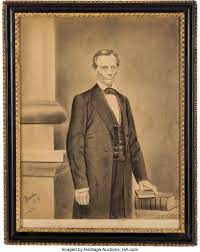
A beardless, standing Lincoln

Brady, already at the pinnacle of his fame, was happy to have the gangling midwesterner pose for the camera. He was well aware of Lincoln’s growing popularity, and happy to add him to his portfolio of prominent portraits. 

Lincoln’s “Brady” photograph is unusual in many ways. He was beardless, and only a dozen or so (usually unflattering) images were taken prior to his new facial “acquisition.” He was also standing. This is very rare (other than among the soldiers), because of his great height. It is said that Brady personally arranged Lincoln’s collar, which Lincoln recognized as an effort to minimize his long neck. 

Brady always favored “props” as part of the artistic setting. Lincoln had his hand on a book, and in the background was a pillar. Bottom line: Lincoln looked like a statesman. The character that showed through his deep-set eyes made exactly the statement that both subject and photographer wanted.

This image has an empty alt attribute; its file name is lincoln-brady-portrait2.jpg
A carte d’visite

Knowing that Lincoln was speaking that night, Brady’s photo was immediately developed and placed in the photographer’s studio window. Hundreds of cartes d’visite were printed – and immediately sold! 

Later, the photograph would be reworked as a woodcut by artist Winslow Homer (en route to being a premier artist on his own merit), and graced the cover of Harper’s Weekly, one of the foremost magazines of its day. The orientation was “flopped,” and an open drape displayed a scenic view.

It was also copied many times once Lincoln received the Republican nomination for president a few months later.

The woodcut done by Winslow Homer

The Aftermath

Lincoln’s speech at Cooper Union was a long one, arguably the longest speech he ever made. But it was a rousing success. Rather than lofty political fluff or the backwoods anecdotes that some expected, it was well-considered, well phrased and well balanced. His list of admirers grew. 

His name was now featured prominently as a potential presidential candidate that year. Magazine articles were written about him, most of them featuring the Brady photograph. 

Some time later, when Lincoln and Brady met again (Lincoln was his subject on several occasions), Lincoln credited the photograph in helping make him President.

Sources:

Guelzo, Allen C. – Lincoln and Douglas – Wm. B. Eerdsman Publ. – 1997

Oates, Stephen B. – The Approaching Fury – HarperCollins, 1997

Pistor, Nicholas, J.C. – Shooting Lincoln: Mathew Brady, Alexander Gardner, and the Race to Photograph the Story of the Century – DeCapo Press, 2017

https://www.britannica.com/event/Lincoln-Douglas-debates

http://www.abrahamlincolnonline.org/lincoln/speeches/cooper.htm

Posted in A POTUS-FLOTUS Blog, Abraham Lincoln, Nifty History People | Tagged , , , , , , , , , , , , , , , , , , , , , | 2 Comments

Thomas Jefferson: Smuggler

Thomas Jefferson was a man of many talents and interests…

The Agronomist

Long before Monticello as we know it was built and rebuilt by “Thomas Jefferson, Architect,” his love of the land on his little mountain was deep and lifelong.

This image has an empty alt attribute; its file name is monticello.jpg
Monticello as we know it today.

TJ was more than just a Virginia planter. Most of our early colonial plantation owners immersed themselves in agricultural knowledge. It was their means of livelihood, whether or not they personally dug, weeded, sowed or reaped. 

Jefferson, however, was a cut above. He not only cultivated his property for monetary profit (which never quite happened), but his football field of a kitchen garden, specifically for his personal use and for feeding his large labor force, was his own laboratory. His garden book meticulously details the weather, the season, the first bud of whatever flower, fruit or vegetable, the size and weights of the aforementioned, sometimes with hand-drawn illustrations. He was keen to graft seedlings to create (or try to create) new hybrids wherever possible. He was an agricultural scientist in the same sense that his friend Benjamin Franklin was a physicist. It was his hobby. It was his joy.

TJ’s kitchen garden…today.

The Making of a Cosmopolitan

This image has an empty alt attribute; its file name is tj-european.jpg
Thomas Jefferson, by Mather Brown

While Thomas Jefferson always straddled the line between a country farmer and a city fellow, slipping effortlessly into Virginia’s then-capital of Williamsburg, and later Philadelphia, his real transformation into a man of the world began when he was induced to go to Paris in 1784, as a “successor” to ambassador (to use the modern term) Benjamin Franklin.

He lived in a fine Parisian house. (Monticello had been named, but was piecemeal and under creation.) He purchased new clothing in the French fashion. He bought and wore a powdered wig. He polished his French language skills and learned other languages sufficient to get by. He sampled French cuisine and wines and quickly sent for a servant to learn the art of cookery. 

Always a master of the courteous bow and behavior, he enjoyed the company of an elegant class of people he seldom encountered in rugged America. He sat for portraits. And he met the crème de la crème of European intellectuals, philosophers, writers, artists and scientists. 

And he traveled. He spent three months traveling (as private citizen) through southern France and into northern Italy. He went alone, hiring post horses for his personal carriage en route as needed. He wanted to meet the people as they lived, writing, “You must ferret the people out of their hovels…look into their kettles, eat their bread… You will feel a sublime pleasure in the course of this investigation.” 

His visit through “wine country” – Beaujolais, Burgundy, Champagne and Bordeaux – was an oenophile’s delight, introducing him to some of the best wines, grapes and agricultural techniques in the world. He had cases of fine wines shipped back to Monticello. 

He planned to introduce vineyards in central Virginia, believing its soil was conducive to the craft. It was not successful during his lifetime, but TJ would be thrilled with the popularity of dozens of Charlottesville-area wineries that exist today.  

If the love of agriculture was high on TJ’s list of avocations, the same might be said of his passion for architecture. He was a fine draftsman with an instinct for design and building. 

Palladio’s huge influence on TJ
Andrea Palladio

Andrea Palladio was a Renaissance architect of the mid-sixteenth century, already dead for 200 years by the time Jefferson showed up in Italy. But his Greco-Roman-influenced buildings were still very much in evidence. Not only did Palladio design public buildings, but he specialized in the villas and private homes of prominent citizens.

Jefferson became a devotee of the old master, particularly his symmetry of design, and his domes and arches. These elements caused the Virginian to “rethink” his plans for Monticello, and rework them to the masterpiece that now exists, and is the only Presidential home on the list of UNESCO’s world heritage sites.

Then There Was Rice

Rice was known in America, of course, particularly to natives living in and around marshy lands – but it drew mosquitos and disease. Rice was also one of the main crops in northern Italy (and still is) with none of the American “problems.” So while there, Jefferson investigated several new techniques for growing the long-grain, or “rough” Basmati variety. He believed it would prove conducive in in the low-lying areas of South Carolina where rice was already being grown.

The problem was that the Italian city-states of northern Italy (Milan, Genoa, Turin, etc.) zealously guarded their crops from competition abroad. They had very strict laws – as in “punishable by death” – for taking it out of the country.

Smuggling

In defiance of punishment-by-death customs laws to take “rough rice” out of the country, TJ arranged for a muleteer to smuggle a couple of sacks to his attention back in France. He also sent a small packet of the grain to his good friend James Madison, and members of the South Carolina delegation.

Basmati rice

Later, he stuffed his pockets with some of the rice grains, and “walked it” out of the country. Perhaps he believed that customs officials would not insult an American gentleman by physically searching him for a minuscule amount of contraband. 

It appears that this smuggling foray of Mr. Jefferson was a one-off. There is no record or indication of him ever doing it again.

But an unapologetic Jefferson would later write that “the greatest service that can be rendered any country is to add  an [sic] useful plant to its culture.” 

TJ the agronomist was correct. The type of rice that he “imported” from Italy was easily and successfully grown in the Carolinas. And much of “Carolina Rice” as we know it today, can trace its roots to Mr. Jefferson, Smuggler.

Sources: 

Howard, Hugh – Mr. Jefferson, Architect – Rizzoli Intl. Publications – 2003

Malone, Dumas – Jefferson and the Rights of Man (Vol. 2) – Little, Brown – 1951

McLaughlin, Jack – Jefferson and Monticello – Henry Holt – 1988

https://www.monticello.org/site/research-and-collections/journey-through-france-and-italy-1787

https://founders.archives.gov/documents/Jefferson/01-11-02-0568

Posted in A POTUS-FLOTUS Blog, Thomas Jefferson | Tagged , , , , , , , , , , , , , , | 5 Comments

The Funeral of Theodore Roosevelt

When Theodore Roosevelt died on January 6, 1919, the world was stunned.

TR Dies

Not only was the world stunned at the death of former President Theodore Roosevelt, who was only sixty, but perhaps TR himself would have also been surprised, had he not succumbed to a heart attack, or perhaps an embolus – in his sleep. No pain. He had plans for his future, which included (maybe) becoming the Republican candidate for President (again) in 1920. 

Actually, TR had been in declining health for some time, but mostly precipitated by his Amazon adventures in 1913-14, and the tropical disease/infection that nearly cost his life. He recovered, but never completely. Tropical diseases have a nasty way of recurring periodically. 

This image has an empty alt attribute; its file name is older-tr.jpg
Older TR

The Great War in 1918 had been one of the roughest years for the old “Colonel.” President Woodrow Wilson had adamantly refused to allow his predecessor to raise a voluntary army and “lead it over there.” Instead, TR sent his cubs. All four of his sons saw service in the Great War, as it was then called. 

His eldest, Theodore Jr., had been severely wounded, and was still recovering. His second son, Kermit, was attached to the British Army, fighting in Mesopotamia (Iran, today). His third son, Archie, had been grievously wounded, and shipped home for further treatment and slow recuperation. But perhaps the greatest blow for the family happened six months earlier with the death of their youngest, Quentin, who at twenty was in the air service, flying little more than box kites with motors. 

Theodore was proud of all his boys, but Quentin’s death totally devastated him and subverted what remained of his health. He had continued his active schedule, but had been hospitalized for nearly two months for inflammatory rheumatism “with complications.” Nevertheless, he returned home to spend Christmas with his family. The doctors were seriously concerned, and advised him to return to the hospital after the holidays. But TR was optimistic, and the devotee of the strenuous life was happy to deceive himself that he was recovering.

TR’s last Christmas
This image has an empty alt attribute; its file name is sagamore-hill.jpg
TR’s favorite place: Sagamore Hill

On his last night he remarked to his wife how much he loved their home at Sagamore Hill. He asked his valet to turn off the bedroom light so he could sleep. And then he died in the wee hours. 

State Funerals

State funerals are awash in tradition, pomp and ceremony, protocol and procedure, an A-list of invited guests, and a White House and/or Capitol Building lying-in-state. The military brass are heavily involved, along with high officialdom. No detail escapes their attention. 

Prior to ex-President Roosevelt’s death, only five Presidents had been afforded State Funerals: William Henry Harrison, President for a Month (DIO); Zachary Taylor, President for about 18 months (DIO); Abraham Lincoln, who set the benchmark for the state funeral (DIO); James Garfield, assassinated President for 6 months (DIO), and William McKinley, assassinated President six months into his second term (DIO). There was a pattern: they all Died In Office. Other POTUSES, from the august figure of George Washington on down, had private funerals, although well attended memorial services were frequently held in various locations.

The first non-sitting President to be honored with a state funeral (in 1930) was TR’s immediate successor, William Howard Taft, ex-President and recently retired (due to health) Chief Justice of the Supreme Court.

The Private Funeral; The Public Mourning

“The old lion is dead,” was the telegram TR’s son Archie sent to his brothers overseas. 

It had been barely two months since the Armistice, the formal end of the Great War, where literally millions of young men had given their lives. President Woodrow Wilson was in France to take part in the peace processes, determined to create a new world order. In his absence, Vice President Thomas Marshall was dispatched to represent “the country” at TR’s funeral, held two days later (January 8) in the little village of Oyster Bay, on Long Island. The entire town was stunned. Their flags were immediately lowered to half mast, and public buildings, businesses and private homes were draped in crepe. Extra telegraphers had to be engaged at the Oyster Bay telegraph office to handle the thousands of wires pouring in. 

It was a private funeral

TR’s son Archie, his daughters Alice Longworth and Ethel Derby, and their spouses immediately came. Cousins and nieces and nephews came. Following a private service in the Great North Room at Sagamore Hill, an additional service was held at Christ Episcopal Church in Oyster Bay, filled to overflowing.

Cabinet members from both the Wilson Administration, and TR’s Administration marched in the procession. Senior military officers marched. Senator Henry Cabot Lodge, TR’s closest friend for nearly 40 years marched. Charles Evans Hughes, the 1916 Republican candidate marched. Senator Warren G. Harding, who would win the Republican nomination in 1920 marched. 

Contingents of Rough Riders who had followed their “Colonel” up San Juan Hill two decades earlier came to pay respects. Mounted policemen from New York City rode in to honor their former Commissioner.

This image has an empty alt attribute; its file name is tr-and-taft.jpg
Old friends

Squadrons of pilots from the recently re-named Quentin Roosevelt Airfield in Mineola, NY circled the area and dropped wreaths.

And former President William Howard Taft, who had been one of TR’s closest friends for more than twenty years, also marched. It was a bittersweet memory. Their long attachment had been severed in 1912, although there had been a reconciliation in 1918. After the burial at Young’s Memorial Cemetery, Taft was seen remaining at the gravesite for several minutes of private introspection. 

And dozens of children from the local school, and even now-grown former “students” lined the streets of town, to say goodbye to their friend and neighbor, the man who was their Santa Claus every year. 

“Death had to take Roosevelt sleeping, for had he been awake, there would have been a fight.”

– VP Thomas Marshall

Perhaps the way he would like to be remembered.

Sources:

Brands, H.W. – T.R.: The Last Romantic – Basic Books, 1997

Millard, Candice – The River of Doubt – Random House/Doubleday – 2005

Morris, Edmund – Colonel Roosevelt – Random House -2010

https://newrepublic.com/article/123236/new-republics-obituary-teddy-roosevelt

https://archive.nytimes.com/www.nytimes.com/learning/general/onthisday/big/0106.html

https://www.funeralguide.co.uk/blog/presidential-funerals

Posted in A POTUS-FLOTUS Blog, Theodore Roosevelt | Tagged , , , , , , , , , , , , , , , , , | 7 Comments

The FDRs: Home for the Holidays

This image has an empty alt attribute; its file name is franklinandeleanor2.jpg
President and Mrs. FDR

After the First War

When Franklin and Eleanor Roosevelt married in 1905, it was a love match. Despite differences in their personalities and natures (he was outgoing, she was introverted), they truly cared deeply for each other, and found more commonalities than disparities.

But fifteen years and six children later (one died in infancy), those commonalities were weakening, and the differences were becoming more apparent. During the Great War (as WWI was called), they were living in Washington, where Franklin served as assistant Secretary of the Navy. He enjoyed the job and the town immensely. He was a social fellow with an easy smile and sanguine outlook. He also had ambitions.

This image has an empty alt attribute; its file name is fdroosevelt-family.jpg
The young Roosevelt family

On the other hand, Eleanor disliked the social constraints of the capital city, and the proscribed activities that wives of high level officialdom were practically forced to undertake. Socializing. Paying regular calls. Having people pay regular calls on them. Eleanor had been active years earlier in nascent “social work,” volunteering at the settlement houses of New York’s lower east side. She loved it. She felt needed – and useful. 

As the Great War began reaching US shores, she found opportunities to renew those activities. Her husband also discovered opportunities elsewhere, in the form of the part-time social secretary Eleanor had hired.

The War over, his secret love affair was out of the bag. For various reasons, it was more expedient for Franklin and Eleanor to remain together, but while both their lives followed the political path, their trails were separate. 

The Ties That Bound

Despite the emotional turmoil that destroyed the intimacy of their marriage, both Franklin and Eleanor Roosevelt truly cared for and about each other. They were not rancorous by nature, and the relationship never devolved into spite or angry confrontation. They merely developed and encouraged separate lives, as well as genuinely bound themselves to what remained of “family” ties.

Gov. FDR and his family

But only two years later, Franklin contracted polio and it colored the entire family’s life forever. FDR spent more than half a decade seeking a cure, or at least treatment for his crippled legs. Since warm water exercise was top on the therapeutic list, he spent months away from Hyde Park on New York’s Hudson River, and swam in the temperate waters of Florida and Georgia. 

The five Roosevelt children went to boarding school. Eleanor began finding her own activities.

Although they were largely absentee parents, both cared about their five children. Thanksgiving and Christmas holidays became important. With a few exceptions, wherever they were, the holidays brought them together at Hyde Park, or Warm Springs, GA and later, at the White House.  

The Holiday Table

This image has an empty alt attribute; its file name is carvingturkey.jpg
FDR carves the turkey

A holiday dinner was a lifelong tradition with the Roosevelts. It was one of the few family ties binding them together (except during World War II when their four sons’ active service prevented a complete gathering). An enormous turkey with all the trimmings graced their table, and FDR took his place at its head.

Long before the convenience and accuracy of an electric knife, FDR had learned to carve a turkey with the precision of a skilled surgeon. First the legs and wings were dismantled and drumsticks were divided however that year’s recipients were awarded. The turkey breast, however, was his masterpiece, sliced neatly and paper thin and distributed accordingly to the recipients’ preferences. Gravy was passed. Cranberry sauce and sweet potatoes made rounds at the table.

Usually there was a family photograph with FDR, Eleanor, Granny (FDR’s mother), and the five children: Anna, James, Elliott, Franklin Jr., and John. In time, spouses (and there would be a revolving door of them), and grandchildren would join that table, and smile for the photographer.

Christmas With FDR and Tiny Tim

This image has an empty alt attribute; its file name is hydeparkestate.jpg
Hyde Park: The place he loved best
This image has an empty alt attribute; its file name is fdr-christmas-card-1942.jpeg
Most of POTUS FDR’s Christmases were spent at the White House

For numerous reasons, FDR spent 10 of his 12 POTUS Christmases in the White House. But in 1943 and ’44, they returned to Hyde Park, perhaps sensing it might be FDR’s last Christmas at home – or anywhere. Since it was wartime, and all the Roosevelt sons saw active service, whoever was available was urged to attend, especially spouses and grandchildren.

This image has an empty alt attribute; its file name is fdr43-xmasspeech.jpg
FDR wishes the nation a happy holiday season in 1943

Hyde Park was decorated lavishly, with a huge tree (cut from their own property) in their big living area, decorated in Victorian style – including candles on the tree. Boughs and wreaths were prominently displayed. Of course there was a turkey dinner. With the trimmings. Of course there were presents. Eleanor shopped and knitted all year long, and never forgot anyone. Sweaters, scarves, hats and mittens in various sizes were wrapped for the appropriately-aged grandchildren.

This image has an empty alt attribute; its file name is fdrandgrandkids.jpg
The POTUS and his grandkids

Stockings were filled by Eleanor late at night with candies and small trinkets. Christmas morning provided another tradition. First thing in the morning, a pile of children descended on FDR’s bedroom to receive their filled stocking, climbed into bed with him and opened their gifts. Even when grandchildren were part of that picture, their parents (if available) showed up in bathrobes and slippers. If they thought it was corny, it was still not to be missed!

But the highlight and lifelong tradition of the FDR household was after Christmas Eve dinner, whether in Hyde Park or the White House. The family gathered around, and FDR, in his comfy chair, opened his well-worn copy of Dickens’ A Christmas Carol, and “performed” the entire story in one reading. He had a voice for each character, elocuted with the style and imagination of a trained actor.

No matter how many times, over how many years the Roosevelt children heard the story, it was always a warm recollection of the holiday spirit, and a chorus of Tiny Tim’s parting words, “God Bless us every one!”

Sources:

Davis, Kenneth – FDR: The Beckoning of Destiny: 1882-1928 – History Book Club, 1971

Lash, Joseph – Eleanor and Franklin – W.W. Norton, 1971

Roosevelt, Eleanor – Autobiography of Eleanor Roosevelt – Harper & Bros. 1961

Roosevelt, Elliott and Brough, James – The Roosevelts of Hyde Park – G.P. Putnam’s Sons, 1973

https://potus-geeks.livejournal.com/662588.html?

https://buffalonews.com/news/ring-in-the-holidays-with-a-presidential-touch/article_1e416dd6-a29f-518d-8496-a669e69a1472.html

Posted in A POTUS-FLOTUS Blog, Franklin D. Roosevelt | Tagged , , , , , , , , , , , , , , , , , | 1 Comment