
It certainly was an “oddity.” Two Winfield Scotts running for President.
Winfield Scott, Consummate General
Winfield Scott (1786-1866), arguably the country’s first professional soldier, was born to be a general, despite his William and Mary education and a law degree. By the time he reached maturity, the newly created United States had no real standing army, only state-based militias.

But young Scott, an imposing 6’5” (an inch taller than Lincoln and an easy 100 pounds heavier) gravitated to military life like a duck to water. He absorbed its drill and mechanics, and mastered the tactical and strategic leadership necessary for high command. He was good at it. He entered as a 21-year-old captain 1808, and by the War of 1812, was a colonel.
During those hostilities, Scott was wounded, taken prisoner, exchanged, given additional commands, fought and won, fought and lost, and was awarded a Congressional Gold Medal. Breveted a Major General by 1814, once the army was demobilized, his rank was reduced to Brigadier General.
General Scott looked the part. His uniform was immaculate, well fitting and smartly pressed, shoes spit-polished, his hat at the proper angle, his epaulets and medals conspicuously placed. In his mind, he personified the army. He believed that discipline, steadiness and bearing were crucial to a military leader. His contemporaries nicknamed him “Old Fuss and Feathers,” even when he wasn’t old. He wore the nickname like a badge of honor.
Becoming the General of the Armies
He had superiors and he had rivals. He witnessed the Duke of Wellington’s victory just after Waterloo. He also led the relocation of the Cherokee tribes along the Trail of Tears.

After his sojourn in Europe, Scott wrote a 3-volume manual on Infantry Tactics, which became standard for the army for two decades.
By the mid-1830s, the General honed some political ideas and joined the newly-established Whig Party, mostly via disenchantment with the volatile President Andrew Jackson. By 1841, he was promoted to Major General, and Commanding General of the United States Army. The title was grand but the responsibilities were mild at best. A strong army was still not important to the United States. Nevertheless, Scott used his position to influence and champion training and discipline at West Point.
But it was the War with Mexico that made his career and reputation. While General Zachary Taylor won some headline-grabbing smaller battles, Scott was the one who planned the overall approach leading to the victories at Vera Cruz and Mexico City. He was made brevet Lieutenant General, a rank held only by George Washington.
The Last Whig Candidate
The Whig Party had a flurry of importance between 1836 and 1852. They were primarily sectional factions with their own agendas and candidates. They won only two Presidential elections: in 1840 with General William Henry Harrison, a leftover from 1812, who only lasted a month before he died. And in 1848, with General Zachary Taylor, who lasted two years before his death.


But in 1852, the Whigs were getting desperate as the clouds of Civil War were darkening. They again chose a military hero: Winfield Scott, now past 60. But Franklin Pierce of New Hampshire, a younger northern Democrat, sympathetic to Southern issues, won. “Win” lost.

Scott returned to the Army, but by the Civil War, he was 75, and now nicknamed “Old Fat and Feeble.” He planned the strategy that the North eventually followed, and retired.
Winfield Scott Hancock, The Superb
Winfield Scott Hancock (1824-86) was born to a prominent Philadelphia family and named for General Winfield Scott, who already had gained national prominence. Hancock’s record at West Point, class of ’44, was unexceptional.
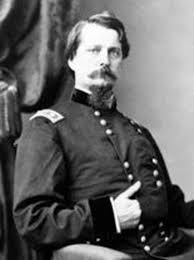
By graduation, he was 6’2” with a booming voice and assigned to Indian territory, but when the War with Mexico was underway, he joined his namesake General in Mexico, where he performed bravely and was wounded. The next fifteen years were commendable, but unremarkable – until the Civil War.
Always opposed to slavery, the Pennsylvanian made the not-very-hard decision to remain in the Union Army, where experienced, trained officers were needed. He was immediately made a colonel, and quickly rose to Brigadier General. During the Peninsula Campaign in 1862, he was cited in dispatches by General George McClellan, stating that “Hancock was superb.” The sobriquet “Hancock the Superb” stuck, and never disappointed his subsequent superiors. He, himself, never boasted of it.
Gettysburg… and beyond
The three-day battle at Gettysburg was a defining moment on many fronts, and Win Hancock was one of its heroes, but included losing his closest friend, Confederate General Lewis Armistead, and suffering a severe wound himself on the same fateful third day. His wound was treated as effectively as possible, but would fester periodically for the rest of his life.

It was nearly a year before he could return to active duty, where he again proved to be a brilliant commander at the siege of Petersburg, and again at the surrender at Appomattox.
Despite on-and-off medical leaves for his Gettysburg injury, Hancock remained in the Army, assigned to various posts in “reconstructed” areas. As a lifelong Democrat, he was naturally at odds with the Radical Republicans in Congress who espoused harsh terms that grated on his natural character and inclination. It also made him a potentially viable presidential candidate in 1880, a year when both candidates seemed little known and “unlikely.”
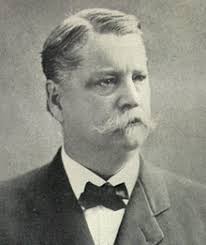
Major General Winfield Scott Hancock was defeated by ex-Major General-turned-Congressman James Garfield. The lopsided electoral vote was heavy for Garfield, but the popular vote was less than 2,000 out of 9 million votes cast. It is still the slimmest popular majority margin on record!
Thus another “Win” lost. He died five years later, from complications from his old war wound.
Sources:
Eisenhower, John S.D. – Agent of Destiny: The Life and Times of General Winfield Scott – Free Press, 1997
Goodheart, Adam – 1861: The Civil War Awakening – Alfred A. Knopf, 2011
Hancock, Almira Russell – Reminiscences of Winfield Scott Hancock (reprint) – Legare Street Press, 2022
Stackpole, Edward J. – They Met at Gettysburg – Bonanza Books, 1956
https://encyclopediavirginia.org/entries/scott-winfield-1786-1866/
 Presidential History Blog