
Poetry often evokes emotional memory, and I am old enough to remember when it was an important part of a grade school curriculum. We were taught to recite lines of poetry from memory even in the fourth grade. I can still summon a bunch of lines up from the depths today! Today’s youngsters only know poems that start, “Roses are red….”
That being said, writing poetry, even just for a private release of “thought made eloquent” is a lost art. And it does not necessarily mean that anybody can write poetry. At least not well. Not everyone who sings in the choir is ready for Carnegie Hall. And that includes long-ago First Ladies, much as I love them.
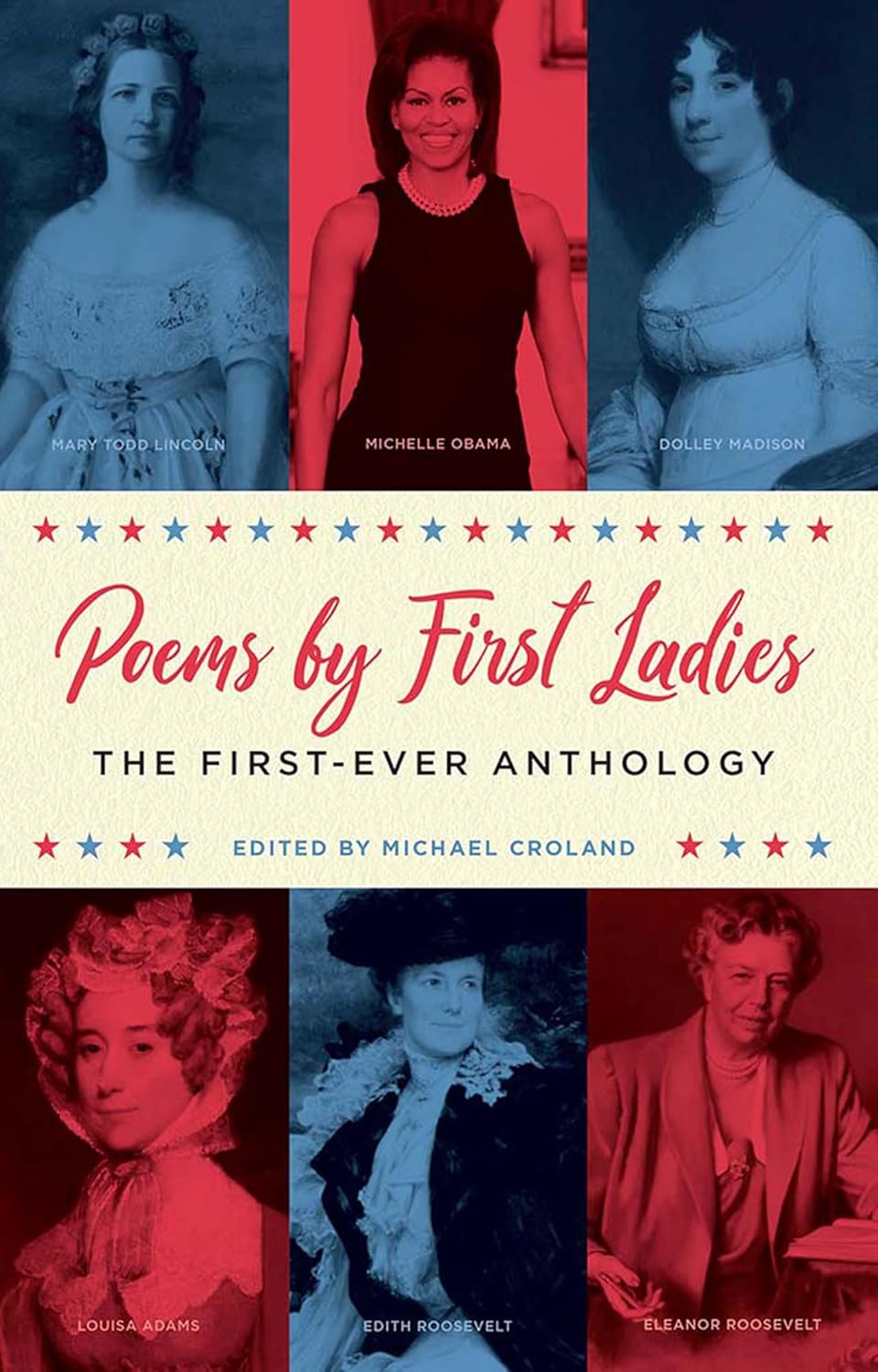
The real accomplishment in this slim volume of Poems by First Ladies: The First-Ever Anthology, goes to its editor, Michael Croland, who has dug deep and turned countless hours of research into a small treasure of nuggets. His long list of acknowledgements underscores the extent of those efforts. It was not an easy task!
Only fourteen FLOTUSES (plus one “substitute”) are included. Not all wrote poetry. Not all actually kept every scrap; after all, they had no inkling of their future prominence in their early years. Perhaps some did not think their scribbles were worth saving. Even for their kin.
The Ladies of course, were products of their own times. They wrote in the flowering terms of what poetry “was supposed to be”- then. High level rather than colloquial. Full of the poetic “licenses” of thee and thous, rhymes that didn’t quite, words that the OED dropped decades ago, and long forgotten references. And nom de plumes were fashionable.
They also wrote in the conventional formats. Sonnets. Couplets. Strict meters, contractions like “ere” or “e’en” that nobody uses anymore. Their subjects were conventional as well. Love, life, death, loss, nature, faith… But those subjects never change.
The most prolific of them all was Louisa Catherine Adams, John Quincy’s wife. This is to be expected. JQ loved poetry. They both wrote it all their lives. Maybe a little stilted, but nevertheless worthy. Writing poetry was one of the few family activities that the second set of Adamses truly shared. When they were all together, they frequently communicated with little verses of their own creation.
A few FLOTUS poems wear particularly well, and show substance. The eight lines from Dolley Madison come right to the point. Copying the style of her late-in-life close friend, John Quincy Adams, she responded in kind to his best poem, The Wants of Man, often included in anthologies. Dolley responded in part,
“My single want outweighs them all –
I want a soul like thine”
She offers the same economy of words and sentiment in her sonnet, Lafayette, written some 50 years after the American Revolution, when the now-elder statesman made a grand tour of the US, including a visit with the Madisons. Her sonnet ends with
Champion of Freedom! Well thy race was run!
All time shall hail thee, Europe’s noblest son!
Alas, Europe never hailed the Marquis with the gusto of America!
The gabbiest (in an era of gabby) was Rose Elizabeth Cleveland, Grover Cleveland’s sister who substituted for the bachelor President for a year before he married – in the White House. She was an intellectual feminist long before it was popular. She wrote books, she lectured, and she lived a bohemian lifestyle. The White House social calendar and all it entailed bored her, and writing was an outlet.
In The Dilemma of the Nineteenth Century, her 41-stanza (ten lines each!) story-poem, Rose focuses on an imaginary young woman whose illness was debated by a variety of doctors – among others, and it is concluded that the poor woman is merely the product of her confining lifestyle. Courtship. Marriage. Children. Cook, clean and take care of the home. She didn’t want that, and thus languished. She also took an easy way out in her traditional conclusion.
It is a pretty fair poem nevertheless, but in need of a good editor. Poetry is an art of economy. If brevity is the soul of wit, it is a kindred spirit to poetry.
Grace Coolidge suffered a tragic loss when her 16-year-old son sickened and died within a week. A short free-verse poem was her outlet and consolation. Acceptance rather than grief. A trusting piety. It was very personal. And an easy and sympathetic read.
By the mid-20th century, Grace Coolidge (Lily) and her FLOTUS successor Lou Henry Hoover (Bleeding Heart) had become close friends in their retirement. They wrote affectionate (and flowery) verses to each other. They were never meant for eyes other than their own, but the sincere feeling and admiration between them offer insights into their personal depth.They were definitely Victorian women, and like the imaginary patient in Rose Cleveland’s epic, we are all products of our upbringing.
Suffice it to say to the most discerning aficionados of poetry, Elizabeth, Emily and Edna have nothing to fear. Their reputations are intact. But for anyone interested in Presidential History, which always should and must include their spouses, Poems by First Ladies is one of those slim volumes that should be on every POTUS-lovers bookshelf.
Sincere kudos to Editor Michael Croland, who has done a great service to posterity! Order now online!
Poems by First Ladies: The First-Ever Anthology
Edited by Michael Croland
Dover Publications, 2026
 Presidential History Blog