
Women in the Arts
Art, to include music and literature with all its sub-sections, has been an acceptable venue for women – for centuries. But always (with exceptions) as a pastime. A hobby. For every Elizabeth Vigee Lebrun, court painter to Marie Antoinette, or Jane Austen, never out of print for 200 years, or Jenny Lind, the “Swedish Nightingale,” there are likely hundreds, perhaps thousands of talented women whose accomplishments were relegated to oblivion.
But by the Victorian Era, some of the fair sex were being formally trained in their respective talents, and a rare few actually were becoming publicly recognized and/or paid!
Lavinia (Vinnie) Ream
Vinnie Ream (1847-1914) was Wisconsin born, and Missouri educated in her early teens. Her artistic interests were always apparent, and her talents, even as a young girl, had become obvious. Happily for her, she had become acquainted with James S. Rollins, a Missouri Congressman, who would be her mentor for many years.
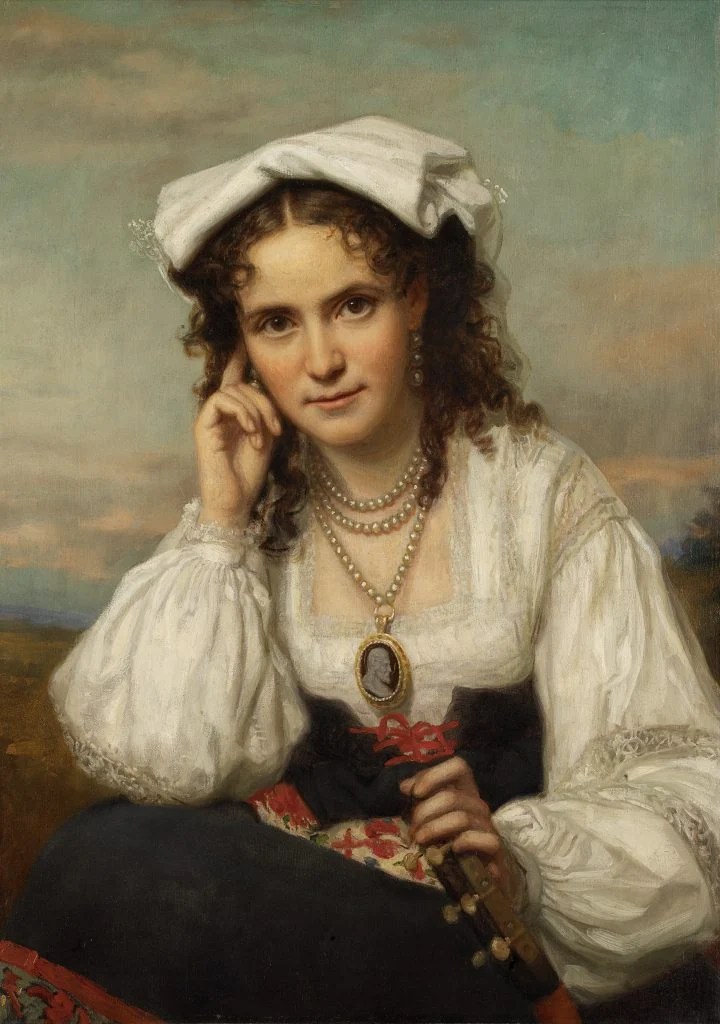
In 1861, her family moved to Washington, but her father’s health was failing and 17-year-old Vinnie needed to help support the family. She found a position in the Postal Service, and worked there for several years.
She was petite (perhaps 5’ tall), pretty, vivacious, with an outgoing personality. She was also very adept at promoting her own cause – and it came in handy.
Her mentor, Congressman Rollins, knowing of Vinnie’s interest in sculpture (very rare for women in the nineteenth century), introduced her to Clark Mills, considered the finest sculptor in America, famous for the equestrian statue of Andrew Jackson in Lafayette Square and other venues. Mills was impressed with Vinnie’s talents and offered her an apprenticeship, particularly crafting popular-at-that-time medallions of well-known men. She still continued to work at the Postal Service.
By 1864, the Rollins introduced her to President Lincoln, who agreed to pose for a bust of him. Four years younger than Lincoln’s son Robert, Vinnie came to the White House for five months, and the President sat still for a half-hour each time, while she executed a splendid piece of art.

Vinnie later commented that she believed the busy President was reluctant to oblige, but realizing that she was young and poor, he relented. And her artistic inner-eye was able to observe his character and kindness and reflect those qualities in her work.
A year later, Lincoln was assassinated, and Vinnie was devastated, as were most Americans.
The Lincoln Statue Part 1
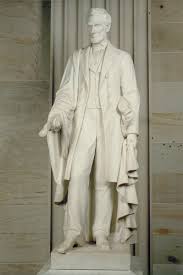
Congress commissioned a statue of the slain President for the halls of Congress and called for submission entries. Vinnie submitted the bust she had sculpted from life. Congress accepted her entry, and she became the first female artist to create a work of art for the US government. She was eighteen.
But it was not a popular decision. While her talents were acknowledged, some congressmen claimed she had little formal training and experience. True. Some said it was because she had developed several political friends via her assignments working with Mills. Also true. But the strongest objection was that she was a woman. Undeniable.
Nevertheless, she was awarded the commission – which paid a lavish $10,000. Half was paid when it was given, the balance to be received upon completion. Her financial problems were solved. She could leave the Postal Service and concentrate completely on sculpture.
Congress provided Miss Ream with a small room in the Capital’s basement which she used as her studio for two years. The statue was required to be larger than life. In fact it was 7’ tall, only 8” taller than the President himself. For reference purposes, Vinnie was also allowed to “borrow” the clothes Lincoln wore when he was assassinated. While she crafted her models, many Congressmen and other notables stopped by to look at the work-in-progress. She had become well known in Washington and had many admirers!
The Lincoln Statue Part 2
After the Civil War, Congressmen (both parties) who wanted to bring the country together via Lincoln’s “let ‘em up easy” policy were warring with Radical Republicans in Congress, men who wanted vindictive punishment for the South for causing the war.

President Andrew Johnson was never popular. Despite serving as a Congressman and Senator for 20 years, his relationships with most of his colleagues were cool. His personality was truculent by nature.
By 1868, Johnson, caught in a vise with few real supporters, was brought up on impeachment charges. The trial was bitter and the flimsy evidence (according to many historians) was more political than substantive.
The President was acquitted by only one vote: that of Kansas Republican Senator Edmund G. Ross.
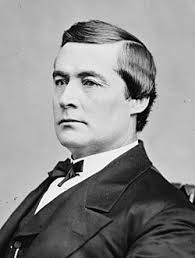
The Radical Republicans fumed at the loss, eager for vengeance and assigning blame. Senator Ross lived in the same boarding house as Vinnie Ream and her family and knew them, making it easy to find a scapegoat in the 21-year-old Vinnie, believing that she had “charmed” the Kansas Senator. She was an easy target. He was generally ostracized and not reelected.
While her commission for the statue was not cancelled, Vinnie Ream was evicted from her studio in the Capital, and relegated to a remote hallway in the basement, in part thanks to the unlikely kindness of Radical-in-Chief, Congressman Thaddeus Stevens, a man seldom described as “kind.”
Nevertheless, once she finished her full-scale model, she went to Italy to “supervise” the physical carving by expert stone masons. Six months later, she returned to the US with the completed statue.
It was formally unveiled in 1871, which Vinnie recalled as “the supreme moment in my life,” adding “The all-dominating impression I have always carried of Lincoln has been unfathomable sorrow, and I tried to put it into my statue.”
Sources:
Cooper, Edward S. – (2009). Vinnie Ream: An American Sculptor – Academy Chicago Publishers, 2009
Stewart, David O – Impeached: The Trial of President Andrew Johnson and the Fight for Lincoln’s Legacy -Simon and Schuster, 2009
 Presidential History Blog