
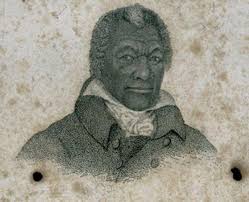
James… never in his youth used the surname Armistead.
Trying to Trace the Untraceable Information
It is a nearly impossible job to accurately delve into long-long-ago history when scant records were kept. It is all the harder when the information sought pertains to slave history from more than 250 years ago. Historians do their best…
Starting with Lafayette…
…It is much easier. The Marquis de Lafayette (1757-1834) was an incredibly wealthy and highly placed Frenchman. Espousing the cause of American independence when he was still in his teens, he outfitted his own ship and mini-army, came to a fledgling United States, and contributed mightily to is cause of liberty. He is beloved in the USA – even today.

It is because of him that we know anything about James “Armistead”… the Black slave who signed on as a double-agent in the American Revolution.
The Slave James
James (who never used a surname in his early years) is extremely hard to trace. His birthdates are listed as either 1748 or 1760. Twelve years is a big gap! Either 10 years older, or three years younger than Lafayette! He was said to have died in either 1830 or 1832, at aged 70 or 84. Another big gap.
He was born a slave in New Kent County, Virginia. Or maybe in North Carolina. Nevertheless, he became the property of Col. John Armistead of New Kent, and sometime later became the body servant of his son William – again, either six years younger or six years older!
While scant information is available about his younger years, it appears that James was favored and well treated – which included the rare benefit of learning to read and write.
The Trail Begins…
William Armistead (1754-93) had always been a strong proponent of independence, and by 1781, some seven years into a long sloggy war, British strategy had changed. Instead of focusing on New England and the industrial mid-Atlantic states like New York, New Jersey and the “capital” city of Philadelphia, the redcoats opted to come up the southern coast, hoping to separate the colonies from each other.
Almost as obscure a figure as James, William Armistead was currently serving as a commissioner to provide military supplies in Richmond, and had brought his manservant.
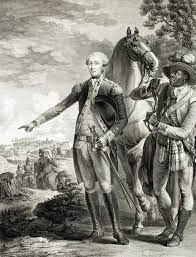
It was easy for a Black slave familiar with the terrain to pass through enemy lines. Most of them who served found work as teamsters or laborers. But a Black slave like James, who could read and write, and who displayed both poise and uncommon intelligence, was a perfect candidate to function as a spy. Even as a double-agent.
The Lafayette-Cornwallis Connection.
General Lafayette, now a veteran commander at perhaps twenty-three, was tasked by George Washington to create diversions in Virginia, where the British General Lord Charles Cornwallis was wreaking his own havoc. William Armistead suggested to Lafayette that his servant James could be useful. Lafayette, who always abhorred slavery, agreed, and took a liking to the man and saw his potential – as a double-agent!
James found a position waiting tables in the headquarters of General Cornwallis, now entrenched in Yorktown. Naturally the commanding officer and his staff discussed many military strategies around the dinner table, oblivious to those who served them.
James recognized the importance of many of those discussions and reported information back to Lafayette. He also carried important secret messages from the Marquis to American agents behind British lines. It was dangerous. If he had been caught, he would have been hanged at once.
Concurrently, having won the confidence of General Cornwallis, he was tasked with “aiding” General Benedict Arnold, the notorious traitor who betrayed General George Washington and the Revolutionary cause. James provided him with plausible misinformation.
Perhaps the most valuable information James passed along to the Marquis, was Cornwallis’ decision to remain in Yorktown. He had no plans to withdraw or evacuate. Lafayette thought enough of James and his value to the war effort to mention him in his reports to General Washington.
When the American siege of Yorktown resulted in the complete surrender of Cornwallis’ troops, Lord Cornwallis (with his own poise and humor) recognized his “ex-waiter” among the Americans, and admitted that James had “put one over on him.” No hard feelings.
Freedom Gained, Freedom Denied
In 1782, Virginia passed a manumission act freeing any slave who had fought in the war. Naturally it contained loopholes. It provided freedom only to slaves who had been armed, and served as enlisted soldiers, usually sent as substitutes for their masters. James was spy, however and carried no weapons, and was denied his freedom. He persisted continually, with the support of William Armistead – and the testimony of Lafayette himself,who wrote the following statement for him:

Engraving, c.1824, (VA History.org.)
“This is to Certify that the Bearer By the Name of James Has done Essential Services to Me While I Had the Honour to Command in this State. His Intelligence from the Ennemy’s Camp were Industriously Collected and Most faithfully deliver’d. He perfectly Acquitted Himself With Some Important Commissions I Gave Him and Appears to me Entitled to Every Reward his Situation Can Admit of.”
Finally, in early. 1787, James was granted his freedom, and it was then that he took the surname “Lafayette’ or “Fayette.”
Later…
By 1816, James Lafayette was the proud owner of forty acres in New Kent County, with a family – and even slaves of his own. He also had been granted an annual pension for his service.
A decade later, when the elderly Marquis de Lafayette made a highly publicized two-year visit to the USA, he was in Richmond, and recognized James in the crowd. He stopped his carriage, and immediately rushed to embrace his former comrade.
Sources:
https://virginiahistory.org/learn/james-fayette-revolutionary-spy
https://encyclopediavirginia.org/entries/lafayette-james-ca-1748-1830/
https://www.battlefields.org/learn/biographies/james-armistead-lafayette
 Presidential History Blog