
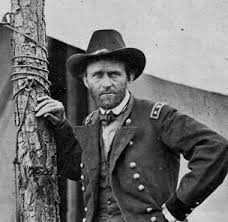
The Unlikely General
Ulysses S. Grant was an unlikely general. West Point educated (class of ’43), he was a middling student, and other than his fine horsemanship, there was little that stood out.
True, he served admirably in the War with Mexico, but he was a junior officer, and despite brevet promotions, was only a Captain.
Then followed a disastrous time in California-Oregon, where homesickness, depression and boredom led him to the whiskey barrel – and an ignominious departure from the Army. That was followed by a near decade of floundering. He had no real vocation, little useful skills, and no direction whatsoever. His only ambition was to provide for his wife and four small children.
But in 1861, when the Civil War began in earnest, the forgotten ex-Captain Grant re-enlisted in the Union Army, sorely in need of good, trained and experienced officers. Promotions and substantive assignments came quickly. Shiloh. Vicksburg. Chattanooga. Qualities previously unnoticed – even by Grant himself, came to the fore. Quiet leadership, intricate strategies, and breaking many tried and true military absolutes. And, unlike many of his fellow generals, Grant kept ego and “personalities” out of it whenever he could.
1869: The New President
After Lincoln’s assassination, the country clamored for Grant, who tried hard to avoid political involvement. But offers he couldn’t refuse were pouring in, and by 1868, he couldn’t say no. He was nominated, and won by a landslide against former NY Governor Horatio Seymour, who did not really want the office, and is now a name lost to history.

But successful generals – and even fine leaders – does not insure the political skills of a civilian government for nearly 40 million souls, across an entire continent. Despite his overwhelming popularity, he still had detractors. There were those convinced he was the Butcher of the Battlefield – causing humongous casualties. There were those who wanted the “old” union again, to include slavery, or a watered-down version of it. And each area had its own problems, concerns, needs… and that did not include the “former” seceded with strong currents of resentment.
General Grant always had a personal leadership style, rather than a military council. He seldom called staff meetings, and was used to charting the course. While he was invariably open to comments and suggestions from his lieutenants, and occasionally took their advice, he was still a leadership-loner.

He never claimed to be a politician and proved it from the start. Without including political leadership advice, he named his cabinet… and backtracked rapidly. His choices were faulty, and his list of detractors grew. And while Grant personally was never corrupt or dishonest, many of his appointees were found with hands in the public till. On his watch. Administration scandals were in every headline.
Of course there were “reformers,” wanting to clean up the political mess, and who favored the peaceful “isms” of the day. Socialism, temperance, communal societies, new and peculiar religious practices….
The Liberal Party began to organize.
Greeley? Really?
By 1865, Horace Greeley (1811-72) was nearly as well known as Grant. He had been “famous” much longer. Born in New Hampshire to a poor family, he showed brilliant scholastic abilities at a young age. Always a little “quirky” in personality, he left home for good at fifteen, found work in Vermont as a printer’s apprentice at a small newspaper, and read his way through the local library.

Six years later, after the newspaper folded, he went to New York to seek his fortune. He held short-term positions with short-lived publications, started his own short-lived literary journal, became a Whig, joined a Universalist church, and married Mary Cheney all before he was twenty-five.
In 1838, Greeley met Thurlow Weed, an upstate NY newspaper editor and leader of the liberal faction of the growing Whig party. Weed hired Greeley as editor of its newspaper, first backing William Seward, and later, in 1840, William Henry Harrison – the party’s first winner. Greeley jumped into the political fray with gusto!
After the successful 1840 campaign, Greeley moved back to NYC and started his own newspaper: The NY Tribune. After a rocky start, he found success beyond his wildest dreams. Always quirky, he dressed in a duster-style overcoat and a top hat with a turned-up brim. He was a vegetarian. He espoused communal societies, free love, temperance, women’s suffrage, spiritualism and other social anomalies. On the positive side, he was a good writer, a fair thinker, and hired excellent contributors for his paper: Ralph Waldo Emerson, Margaret Fuller, Karl Marx, and later, John Hay.
By the 1850s, he had made considerable money, a solid reputation in publishing, and was a founder of the Republican Party (replacing the ineffectual Whigs). By the Civil War, he was a force to be reckoned with – albeit still quirky.

He supported Lincoln – then he didn’t. Then he did again. He supported Grant – then he didn’t, and always considered him the Butcher of the Battlefield.
Political gadflies never really fit in. Nevertheless, he disassociated himself from the Republicans he helped found, and became the darling of the Liberals.
The Election Loss
The Liberal party was a fringe, i.e. spoilers. The Democrats were heavily the “solid south,” responsible for the Civil War. There were no superstars.
In 1872, the Democrats with no prayer of unseating the still popular (albeit vulnerable) Grant, opted to unite with the Liberal Party, seemingly their only hope. Horace Greeley, apostate Republican, was a name brand, sort-of. As expected, he lost the election.
But he lost a lot more than that. His healthy was failing. His wife’s health was failing – and she died. He lost most of the fortune he plowed into the failing campaign, which carried only a half dozen states. And he lost his mind, to a point that he needed to be hospitalized.
By the time the electoral college met to cast the official votes, the quirky Greeley had lost his life, too.
Sources:
Shenkman, Richard and Reiner, Kurt – One-Night Stands with American History – Quill/William Morrow, 1982
White, Ronald C. – American Ulysses, A Life of Ulysses S. Grant – Random House, 2016
https://millercenter.org/president/grant/life-before-the-presidency
https://www.history.com/news/ulysses-s-grant-president-accomplishments-scandals-15th-amendment
 Presidential History Blog