
Grant: The 1850s
Ulysses S. Grant had become a soldier under duress. His father insisted that his eldest son attend West Point. It was a free education. Not that Jesse Grant was poor; he was definitely middle class, with a successful tanning business in Ohio. But he had worked hard to become successful, and that meant an appreciation of thrift and value. And free is better than not free.

His son Ulysses, then seventeen, did not wish to go. His grades were fair enough, but he preferred to be a farmer. His father thought otherwise, so USG went to West Point. He did well enough to graduate mid-class, and by that time had accepted the challenges of soldiering. Not long after he graduated, he met the sister of his roommate, and they fell in love, although it would be four years till they married. The War with Mexico got in the way.
Once married however, the young couple became part of the young officer contingent at a couple of army forts, and were content and happy. Un…fortunately, when gold was discovered in California in 1849, the Army needed a presence, and USG was reassigned. By that time, they had a toddler, and his wife Julia was carrying their second child. Since the shortest distance to the west Coast was via the isthmus of Panama (a dangerous, swampy slog, almost guaranteed to spread disease), it was no place for a pregnant woman and a two-year-old. She returned to her family in St. Louis with the children. He went to Oregon/California alone, promising to send for them once he got settled.

He never got really settled, and was dreadfully homesick. It took months before he learned he was a father to a second son. He became depressed. And began to drink. The drinking was noticeable to his superiors and his resignation was requested.
Grant returned to St. Louis a despondent and humiliated man.
It got worse. The ex-captain could not seem to find satisfactory work. He wasn’t lazy, nor did he have an “attitude.” There just seemed to be no jobs available. And he was basically without direction. The two jobs that he managed to acquire via “connections” were short lived. Death and politics. No fault of his. His efforts at farming also failed. Poor soil does not ask for references. No fault of his.
Finally, he forced himself to write the hardest letter of his life. He asked his father for a position at one of his tanneries – a job he had hated throughout his youth. His father sent him north to Galena, Illinois, where his two younger brothers were managing one of the tanneries.
Galena: Spring, 1860
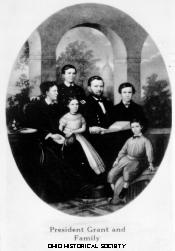
Grant, Julia and their four children arrived in Galena, rented a modest house ($100 per year), and began working for his brothers. Knowing how much the stench and blood of the tannery affected their older sibling, USG was usually dispatched to buy and sell and transport the carcasses. Sometimes he was the clerk in the store. Still, the stench clung to his clothes.
And, as expected, it was a job he detested, but he was grateful. He had a wife and family to support. And he and his brothers got on well enough.
If the job was a drudge, the Grant homelife was a joy. Grant and Wife were well-matched; they knew it, and they loved each other deeply. No matter how he plodded on during the day, when he came home in the evening, the cares seemed for fall from his shoulders. He was happy to horseplay with his children, and find comfort in his wife’s smiles and embraces.
Galena: Fall, 1860
It was no secret in Galena that the tanner’s newest employee was West Point educated, and had been a brevet Captain in the War With Mexico. It was also no secret that he was forced to resign from the Army for drunkenness. But when USG joined the fellows in the local tavern from time to time, no one ever saw him drink anything other than coffee.
With an election coming in November, and Illinois’ two “favorite sons” vying for nomination and election, the taverns were usually full of noisy debate – mostly about whether there was going to be a war. Galena was heavily Democratic; it was Stephen Douglas country.

Grant was reticent, not especially political and not a talker by nature. But he was the only resident of Galena that had any military experience. His considered opinion was usually solicited, and his comments were insightful and respected.
Galena: Spring 1861
Between the election of Republican Lincoln and his inauguration in March, 1861, the mood, the tenor and even the map of the United States had changed. Everyone was taking sides. Grant learned about old West Point pals who had remained in the Army, and who were now resigning to enlist with the new “Confederacy.” Julia’s father in St. Louis was writing him to sign on with the Rebels, assuring him that his experience was likely insure a Generalship.

But when seven states seceded by April and shots were fired at Fort Sumter in South Carolina, Galena became a “Union” town all the way. Every able bodied man was signing up to enlist.
Naturally miners and merchants, farmers and tradesmen needed to be trained as soldiers. When the town fathers approached USG, and asked him if he would train the volunteers, he accepted with alacrity.
It is said that Grant stood straighter. The semi-depressed stoop he had acquired was gone. His eye was focused. When he left that day and assumed his new “position,” he never turned back. And he never set foot in tannery again.
And he would be a general by the end of the year.
Sources:
Chernow, Ron – Grant – Penguin Press, 2017
Grant, Julia Dent – The Personal Memoirs of Julia Dent Grant – G.P. Putnam’s, 1975
White, Ronald C. – American Ulysses: A Life of Ulysses S. Grant – Random House, 2016
https://millercenter.org/president/grant/life-before-the-presidency/
 Presidential History Blog