Piracy was not new in 1800. It had been around for centuries.

The Barbary Pirates
For centuries, North African countries then part of the Ottoman Empire, augmented their respective economies by state-sponsoring rogue pirates to plague commercial shipping on the Mediterranean. They boarded merchant vessels, carried off cargo, burned ship, and killed, captured or imprisoned sailors, holding them for ransom. Or, they made deals with European countries to pay huge sums of “tribute” (extortion) to protect their commerce. Wealthy mercantile countries opted to pay. It gave them near monopoly on the Mediterranean.
The USA and the Pirates
When the USA was a British colony, American trade in the Mediterranean was covered by the British, who paid the tribute. Once we opted to be on our own, the situation changed.

Presidents George Washington and John Adams were aghast. Such unmitigated behavior was, in a phrase “un-American.” But they held their respective noses and paid. They reasoned that a) it was/is incumbent upon a national government to protect its citizens, and that includes their legitimate commerce and trade; and b) we did not have the military and/or naval capacity to deal with it in those early days. It was cheaper to pay – even though it was a hefty percentage of our annual budget.
Early in the Jefferson Administration, USA naval and marine forces ostensibly put an end to the pirates on “the shores of Tripoli,” but the Tunisians did not seem to get the message. Their Bey (head honcho) fumed and threatened to go to war unless we paid up. The commodore of a formidable US squadron anchored in Tunis harbor and demanded to know the Bey’s “intentions.” The attitude changed to diplomatic suavity. The Bey sent an ambassador to the President (at the USA’s expense) to come to an “agreement.”

Sidi Soliman Mellimelli
Sidi Soliman Mellimelli, along with an eleven-man retinue, was the first Muslim envoy to the USA, and his appearance alone enlivened the capital. He was a sight to behold! Fifty years old and a giant of a man, with a full, thick beard, dressed in crimson and gold robes and shoes of bright yellow. His huge white turban was said to be made of yards and yards of fine muslin. (They would later learn that it was mostly plaster of Paris.) According to lore, one of his servants came just to carry his four-foot pipe.
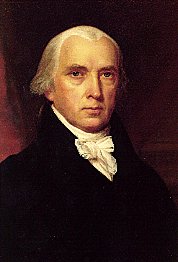
President Jefferson, “small-r” republican to the core, set little store by fancy dress, and while courteous, was generally unimpressed by his diplomatic guest, foisting him off on his Secretary of State James Madison as much as possible. (One could imagine the amused disparity between the six-foot-a-lot Tunisian and the five-foot-not-much Madison!) The Mellimelli’s mission became the talk of the town.

The man was genuinely religious. In one of his first conversations upon arrival, he demanded (via interpreter) of some Creek natives who were also visiting Washington, to know who they believed in: Abraham, Mohammed or Jesus? Through the interpreter he was told that “We worship the Great Spirit without an agent.” “Vile heretics,” sneered Mellimelli ferociously.
When the Secretary of the Navy called on the Tunisian, he found him on his knees, on a prayer rug, facing Mecca and chanting his prayers.
And as a courtesy to the Muslim, Jefferson changed the time of the dinner he was hosting for the new envoy. Told it was Ramadan, a holy observance, instead of dining at the usual three-thirty, he waited until sundown, in accordance with Mellimelli’s religious custom.
It seems like the huge Tunisian got on well with Secretary Madison however. He presented Dolley Madison with a scarlet velvet caftan said to be weighed down with 30 pounds of gold bullion. He had also brought some Arabian stud horses sent by the Bey as a gift to the President.
Sec. Madison had arranged accommodations for Mellimelli and his entourage at Stelle’s hotel, which was undergoing bankruptcy, and delighted to be rented. The Tunisians seemed pleased with their quarters.
Ah, But…Resolving a Couple of Problems
Mellimelli was happy, except there were no concubines. James Madison, a cerebral man by nature, was also a worldly fellow with a wry sense of humor. The services of “Georgia, a Greek” were enlisted so the North African could enjoy all the comforts of home. Madison charged the bill to the State Department, listing her fee under “appropriations to foreign intercourse.”
Then there was the hotel bill that the US agreed to pay. The North Africans were living extremely well. They enjoyed their stay so much that a few of them “broke” Ramadan with strong drink and raucous behavior. It was quickly determined that the “gift horses” (who were enjoying American oats) should be put to good purpose, and a couple of mares were found as quickly as “Georgia, a Greek.”
According to lore, on the night the Madisons hosted a reception for Mellimelli, the Tunisian opened a door to discover “a large fat negress preparing coffee.” The ambassador grinned and threw his arms around her, saying in translated Turkish, “You are the handsomest woman in America!” He insisted she looked like “one of his most expensive wives – a load for a camel!”
He was the hit of the social season and invited everywhere! But the excitement ran its course and died out.
Goodbye Mellimelli
All good things must end. Poor Mellimelli was chagrined that the USA had no intention of paying tribute, and feared that when he returned to Tunis he would be put to an unpleasant death for his failure. He took a very long time to depart the country, making grand appearances in various locales. Some members of his retinue actually chose to remain here permanently.
And within a couple of years, an American fleet of frigates was permanently assigned to the Mediterranean. Goodbye pirates.
SOURCE:
Moore, Virginia – The Madisons: A Biography – McGraw Hill, 1975
Wright, Louis B. and Macleod, Julia H. – MELLIMELLI: A Problem for President Jefferson in North African Diplomacy – The Virginia Quarterly Review, Vol. 20, No. 4 (Autumn 1944),
 Presidential History Blog