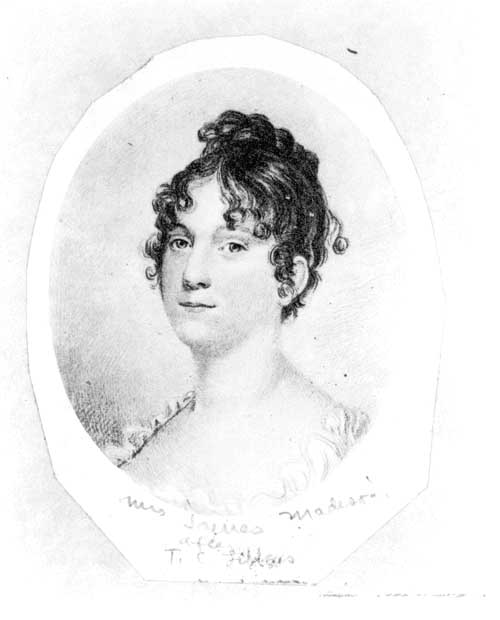
In many ways, Dolley Payne Todd Madison had a (1768-1849) charmed life. A loving childhood, her essential wants and needs met, and an exposure to the excitement of Philadelphia – the largest and most cosmopolitan city in the USA.
John Todd, who she married at twenty-one, may not have been her beau ideal. All indications are that she was fond of him, but did not love him. He was a fairly prosperous Quaker attorney and had been kind to her family in their time of need. It was her father’s dying wish that she marry him. He loved her however, and was very good to her.
When she lost her infant son and her husband to cholera, it was a rough time, but Dolley still had her mother and siblings, and many friends. John Todd had left her financially comfortable. And she had her little toddler, John Payne Todd. She was devoted to him, perhaps excessively. He was all she had of “her own.”
A few months later, the Widow Todd met Congressman James Madison, seventeen years her senior, already well known and light years ahead of her in education. He too, like her first husband, was no Adonis. He was a couple of inches shorter, slight of build, and reticent – until he got to know you. He fell in love with Dolley from the outset; it took her a little longer, but she did grow to love him dearly, and the marriage was happy and very successful for both.
Little Payne
James Madison was 43 when he married Dolley and became stepfather and “kind protector” of her little boy, who was only two and a half when his mother remarried. He knew no other father, called him “pappa,” and received only kindness and affection, albeit more grand-fatherly.

There is a letter handed down from the Hite family (Madison’s sister Nelly married a Hite), indicating that after the wedding between JM and Dolley, the newlyweds did not “enjoy” a honeymoon for a while. Little Payne was accustomed to sleeping with his mother, and it took some time to wean him to his own bed.
Then the newlyweds hired a coach to take them from what is now West Virginia (where they were married in Dolley’s sister’s home) to Montpelier, Madison’s family home in central Virginia. Along with Jemmy and Dolley and little Payne, were Anna Payne, Dolley’s teenaged sister, and Harriot, the kid sister of George Steptoe Washington, Dolley’s brother-in-law. It would be several days before Mr. and Mrs. Madison had any time alone.

Naturally a toddler needs attention and care, one additional reason for Anna Payne joining their household. Dolley, ten years older, was her sister-mother, and had been since she was born. Now Anna would help to raise Payne.
From the start, Payne was cute as a button and a charmer like his mother, but a handful. Eighteenth century parents were seldom indulgent; child rearing was a serious business. Educating them (particularly a boy) was even more serious. Basic lessons started at three or four.
When George Washington declined a third term in 1796, Congressman Madison decided to retire as well – at least for a while. Thus Payne’s early childhood was spent at Montpelier, a sprawling and thriving plantation in Virginia’s Blue Ridge, not far (in today’s transportation) from Jefferson’s Monticello. JM channeled most of his energies into the plantation, including a major house renovation, adding a separate wing for his aging parents (who were delighted that their eldest son had finally married), and plenty of room for himself, his new bride and “their” son, which included the hope that brothers and sisters would join Payne in the nursery.

One of their biggest disappointments was that their own family did not expand.
Medium Payne
It became obvious soon enough that Payne Todd did not like studying. Period. He was much happier running free on the grounds, particularly down in the slave-quarters, where he played with little children his age. They liked him. He liked them. He did not like books and lessons. He didn’t like them when him mother tried to teach him, or his Auntie Anna, or even when his patient stepfather took on the tutoring responsibilities himself.

Meanwhile, his stepfather’s many plantation activities also included high level political and social activities. Little Payne was surrounded by elegant and important people from the beginning. He learned to make courtly bows and charm everyone. But since the Madisons entertained frequently and their social obligations increased, it likely eroded the attention and time to spend with Payne.
When Payne was about eight, Thomas Jefferson was elected President and sent for Madison, his closest political and personal friend. Jemmy and Dolley were thrilled to move to the new Washington City and stay at the uncompleted White House for a brief time. Between buying a new house for themselves, the moving, the responsibilities of Secretary of State, helping Widower Jefferson with occasional social events, hosting their own frequent social events, the parents Madison had even less time (and perhaps inclination) to devote to Payne.
Nevertheless, his education was becoming essential. Madison had hopes of sending him to the College of New Jersey (Princeton) in due time. It was his alma mater, and his memories of those days were not only happy, but vital to the man he became.

They were advised that St. Mary’s Academy in Baltimore might be the perfect boarding school for a likable but lazy and inattentive student. While it was a Catholic school, and the Madisons were not Catholic, it was not an obstacle. Both Quaker Dolley and Episcopal James Madison were ecumenical in religion. Boarding schools were commonplace for young men of means. Baltimore was not that far from Washington. And a Catholic school education was always considered excellent.
Both Madison and Dolley believed that Payne could benefit from a peer atmosphere, hoping that their diligence and good habits would rub off on their son.
It was wishful thinking.
Sources:
Gerson, Noel B. – The Velvet Glove: The Life of Dolley Madison – Thomas Nelson Publ., 1975
Mattern, David B. and Shulman, Holly C. (Eds) – Selected Letters of Dolley Payne Madison, University of Virginia Press, 2003
Moore, Virginia – The Madisons: A Biography, 1979, McGraw Hill
http://www.whitehouse.gov/about/first-ladies/dolleymadison
http://rotunda.upress.virginia.edu/dmde/bio-intro.xqy
https://www.womenshistory.org/education-resources/biographies/dolley-madison
 Presidential History Blog