
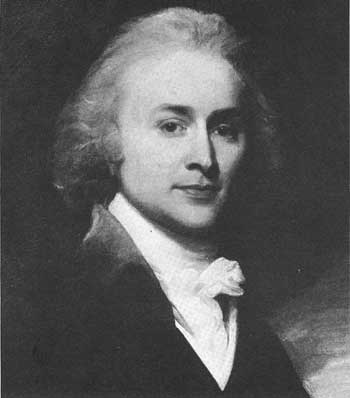
John Quincy Adams was fourteen years old and incredibly bright.
First…Naming Rights
It has been fashionable lately to name one’s offspring as if it came out of a Scrabble box. But for centuries many people considered it a time-honored tradition to name one’s children in honor/memory of someone who was dearly beloved or admired. Perhaps they believed that their child might be blessed with the stellar qualities of the deceased.
When John Quincy Adams married Louisa Catherine Johnson, having a family was a given, and something to be awaited with pleasure. Unfortunately, while Louisa found it easy to become pregnant, it was very hard for her to stay pregnant. She had fifteen conceptions, and only four live births; the last baby living only a year.
Her first son, born in 1799, was named George Washington Adams, for the old General and First President of the USA who died within the year. Nevertheless, President Washington had been duly impressed with young Adams, and set him on the diplomatic role that later led to his presidency.

His second son, was named John Adams II, (no Quincy) in honor of his father.
His youngest son was named Charles Francis Adams. The Charles-part was for JQ’s younger brother who he loved dearly, and whose misfortunes culminated with dissipation and an early death. The Francis-part was for Francis Dana, who was also instrumental in preparing a young John Quincy for his eventual greatness.
The Young Traveler
John Quincy Adams was only ten when he accompanied his father to Europe in 1778. The exceptionally gifted student with an inquisitive mind was placed in the best schools available, and disappointed no one either in academics or behavior. Happily, one of his better talents was an ear for language. He mastered French within six months, and eventually would be fluent or conversant in several others.

The Adams father-and-son returned to Boston in late 1779, rather dejected – and rejected. Expecting to retire to his long-neglected law practice, he was recruited by his fellow citizens to help draft a constitution for their new state. Within a few months, JA was re-recruited by Congress to return to France as part of a commission to negotiate the terms of peace with Great Britain, ostensibly ending the long War for Independence.
John Adams accepted the assignment with alacrity, and this time brought along young JQ and his brother Charles, younger by three years.
Francis Dana
On the ship that carried Adams and Sons back to Europe in late 1779, they were accompanied by a fellow Massachusetts attorney, about eight years younger than the senior Adams. Francis Dana came from a distinguished family, was an ardent patriot and member of the Sons of Liberty, and had been elected to Congress in 1777, and was now sent to join the Peace Treaty Commission as its secretary.

While the sea was calm on this journey, their sailing vessel was awash with leaks and structural disrepair, forcing the passengers to help “crew” the ship to land at the first safe port they could reach in Europe – in a remote part of northern Spain. The Adamses and Dana then hired carriages to take them 1000 miles across the Pyrenees in the dead of winter.
The long haul gave Adams a chance to assess Dana, and gave Dana a fine opportunity to assess the younger Adams.
Preparation for Diplomacy
The Peace Treaty Commission was unsuccessful for Adams. The French diplomats did not like him. The “commissioners” themselves did not get along well due to incompatible personalities, styles and dispositions.

With the boys in school, and the commission going nowhere, John Adams made a crucial decision: he would go on his own recognizance (i.e. no Congressional appointment or credentials) to Holland, a republic and commercial powerhouse. There he would attempt to gain not only recognition for the USA, but some financial loans to help establish the young wannabe nation.
He took the boys with him, and placed them in another school. JQ, at thirteen, already fluent in French, both written and oral, came to learn sufficient Dutch to get by, and in time, would master German fluently. He had also learned Latin, classic literature and history, both ancient and modern. And his close companionship with his father during the last three years exposed him to a basic understanding of law. His temperament was diligent, careful and detailed.
He had developed fine penmanship. Unlike the large unwieldy scrawl of his father, JQ’s writing was small, clear, and envied by most.
The eventual success of the Senior Adams to secure favorable loans from the Dutch was one of his crowning achievements. But while in Holland, he also championed the nomination of Francis Dana to become the Minister to Russia, which Congress acceded to in the summer of 1781.

Dana’s French (the international language of diplomacy) was mediocre at best, and he recruited young JQA to accompany him as his secretary-translator. At fourteen, he was far too young for any official post, but thrilled for the opportunity to serve – and learn. John Adams was pleased for his son, and charged Dana with finding appropriate continuation of JQ’s education.
Dana’s mission was unsuccessful. Catherine the Great did not accept his credentials due to some convoluted prior naval treaty arrangements and other complications. Nevertheless, JQA remained in St. Petersburg for fifteen months – sufficient time for him to learn a fair amount of Russian. Then he traveled on his own, to rejoin his father in the Netherlands.
Epilogue
Frances Dana had a successful legal and business career, and became Chief Justice of the Supreme Court of Massachusetts.
John Quincy Adams returned to Russia nearly thirty years later as the senior American diplomat in Europe with solid diplomatic credentials. He stayed in Russia for five years. He later became Secretary of State under President James Monroe, and President of the USA in 1824.
Sources:
Kaplan, Fred – John Quincy Adams: American Visionary – Harper Collins, 2014
Unger, Harlow Giles – John Quincy Adams – DeCapo Press, 2012
https://millercenter.org/president/jqadams/life-before-the-presidency
https://founders.archives.gov/documents/Hamilton/01-03-02-0236
 Presidential History Blog