
Harry Truman was not a popular president in his own time.
Disdain for Harry
Harry S Truman (1884-1972) was a midwestern farm boy with neither pedigree, education, money or talent to recommend him. Having served commendably as Captain Harry in WWI, he returned to Independence, MO, had a short-lived partnership in a haberdashery that failed, and was at loose ends. He came to the attention of Tom Pendergast, the political boss in western Missouri and Harry ran for, and was elected Country Supervisor. Twice. Then, according to Missouri statute, he was ineligible for a third term.
Again at loose ends, he ran for US Senator in 1934 – as 3rd or 4th or 5th choice of the MO politicians. HST was only an unknown local official. His surprise victory was due to his own intrepid campaigning and maybe a little luck.

President Franklin D. Roosevelt had little regard for “the Senator from Pendergast,” as he called him. Still, HST made friends, served diligently and enjoyed the position. During WWII he chaired a committee to investigate and correct problems with US war production, i.e. waste, inefficiency, corruption and profiteering. The “Truman Committee” made headlines – and was considered a great success.
But he was still “small potatoes” to the political powers that were or wanted-to-be. As a candidate for VP in FDR’s 4th election campaign, he was again the 3rd or 4th or 5th choice. FDR didn’t care.
But when Roosevelt died ten weeks after his inauguration, the shocked and saddened country was definitely concerned that Harry Truman would not measure up, even somewhat. But nobody, not even bitter opponents, could deny that Truman would face a catalog of monumental problems and situations during the next years.
Leftovers of WWII
In a nutshell, everything was a leftover from WWII. The Atomic Bomb and its aftermath – and frightening potential. A new map of Europe. And Asia. Rebuilding Europe. And Asia. The Cold War. And Korean crisis. Return and readjustment of US veterans. Health care, civil rights and education. Continual labor strikes. A huge influx of new immigrants. Communism. And maybe an election for a term of his own. Etc.

The newly created United Nations, a project dear to FDR’s heart (and a leftover of WWI’s League of Nations), was established to help ameliorate many international problems.
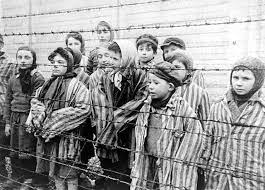
One of those problems concerned the fate of perhaps a million European Jews who managed to survive the savagery and butchery of the Nazi concentration camps. The six million who perished no longer could be helped.
A homeland for the diaspora of Jewish people in the Biblical “Promised Land” had been a dream of Zionists since the late nineteenth century. By the end of WWI, things began to look more promising. By the end of WWII, and the discovery of the horrors of the Holocaust, action was required. The United Nations batted the situation back and forth between much support, no support, and general indifference. But they finally determined to partition Palestine between the Palestinians and a new nation of Israel. It would be a land happy to accept the “tired and poor” remnants of European Jewry.
Another leftover of WWII was the US State Department, whose diplomats waffled and smirked, but were basically anti-Semitic and always had been.
Eddie Jacobson
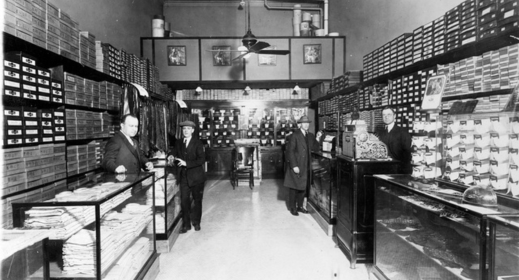
Eddie Jacobson (1891-1955) and Harry Truman knew each other casually in Independence, but were tasked with running a canteen for a while during WWI. It was a huge success and the two men became friends. At the end of the war, they became partners in a men’s clothing shop. For a few years it did well, but there was an economic downturn, and few fellows were buying shirts and ties and cuff links. The store closed, but the men remained friends.
The friendship was primarily between Harry and Eddie; not The Trumans and The Jacobsons. Later biographers and historians stress that Eddie and his wife were never invited to the Truman house for dinner. Most of them claim Bess Truman was anti-Semitic. She was likely polite, but cool.

The Trumans lived with Madge Wallace, Bess’ mother, in her house. She was basically an ecumenical bigot. She didn’t like anybody. But nobody liked her either. Ergo, nobody was invited for dinner other than family.
Eddie, Harry and Israel
Eddie Jacobson was never overly religious, but was always active in his Jewish community and passionate about creating a homeland for his Jewish brethren. He corresponded with and visited his old pal Harry Truman on occasion to gently lobby for US support. He reminded HST that “he had never asked any favors of Harry as Senator, or even now as President,” but this one was important.
HST was deeply torn. The State Department, headed by well-respected Sec/State (and former General) George Marshall, was firmly opposed. He believed that an independent Israel would be surrounded by millions of violently angry Arabs, and would be unable to protect themselves. Nor could a depleted US military support them. There were a few other valid reasons, but that was one that could not be denied or waffled away.
Many Jewish leaders, religious and otherwise, had been applying enormous pressure, and HST was visibly annoyed, despite his early claim that “Today – not tomorrow – we must do all that is humanly possible to provide a haven and a place of safety…”

Eddie had been honest about “never asking for any favors” in the past, which HST had always appreciated. But now, at Eddie’s fervent plea, a grudging HST agreed to meet with the elderly Chaim Weizmann, one of the founders of the Zionist Movement. USA support was forthcoming.
Some time later, when Rabbi Yitzhak Herzog told the President that he was put in his mother’s womb to help create the State of Israel, it is said that Harry Truman had tears in his eyes.
At 12:11 A.M. on May 14, 1948, the USA became the first country to recognize the State of Israel.
Sources:
McCullough, David – Truman – Simon & Schuster, 1992
Truman, Harry S – Memoirs by HST: Years of Decision – Doubleday, 1955
Truman, Harry S – Memoirs by HST: Years of Trial and Hope – Doubleday, 1956
https://www.archives.gov/education/lessons/us-israel
https://www.americanheritage.com/i-hardly-know-truman
 Presidential History Blog