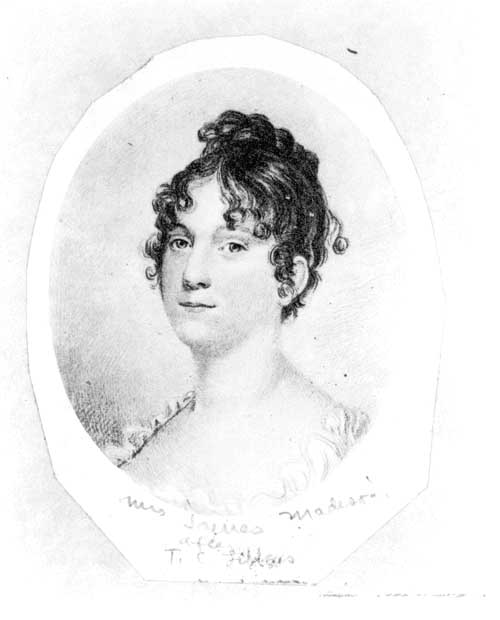
The Quaker Girl
Dolley Payne (1768-1849) was born into a family who had converted to the Quaker religion. Like many who “choose” their faith, her father was strict in his observances. Dolley wore the Quaker gray gowns and bonnets, no jewelry, never learned to dance. Their house was functional, rather than decorative.
Notwithstanding, the Paynes owned a fairly prosperous plantation – with perhaps ten slaves. This was a troublesome matter to John Payne, since Quakers were strong abolitionists.
As the oldest daughter in a family of eight children who survived, Dolley (her real name, by the way), was primarily home-schooled to read, write and do sums. And cook, sew, and help with the babies who kept coming along. Blessed with better-than-most good looks (blue eyes and dimples) and an even better personality, she would later write that her family was a loving one, but not particularly merry.
Philadelphia
When Dolley was around fifteen, her father made the difficult decision to manumit his slaves, at great financial cost to him. He bought a large house in Philadelphia, a Quaker city, where he would have friends. He also purchased a starch factory to support his family.

Dolley loved Philly! She had never been in a big city before, and wrote that in a half-hour in Philadelphia she saw more people than she had seen in her entire life put together. She made friends, enjoyed the atmosphere, and was quick to appreciate the colors, the fashions, the culture, the noise and hustle and bustle of the most cosmopolitan city in the American Colonies.
There is a story (probably apocryphal) that old Benjamin Franklin, recently returned after a decade in Paris, was being carried in his sedan chair when he passed the unknown-to-him Dolley Payne. He stopped his carriers, summoned the young miss, and told her that he had seen many beauties in Paris, but she was prettier than them all. Or something like that. Ol’ Ben has an historic reputation of appreciating feminine pulchritude, and he was reputed to have said “something like that” to several Philly fillies.

Anyway, the story was appreciated by Dolley throughout her life, and she reportedly enjoyed telling it.
Enter John Todd, Lawyer
Naturally the Paynes were regular attendees at their Quaker Meeting House, although Dolley later remarked several times that she did not believe she “had the soul of a Quaker.” A few years after they moved to Philadelphia, John Payne’s starch business failed and he suffered severe financial losses. Threatened with losing their home, Dolley’s mother took in boarders to meet their expenses.
Meanwhile, the Quakers turned from John Payne, which devastated him further. He had given so much for his new faith, and was now being shunned. His health deteriorated, he became despondent, and took to his bed.
One of the Quakers who did not shun him was a young attorney named John Todd. He lived fairly close to the Paynes, and knew the family. He was enchanted with Dolley (most people were), and wanted to marry her. He also believed that “courting her family” was a good way to help his cause. He was right.
Dolley liked Mr. Todd, but she was not attracted to him. She turned him down. More than once. According to lore, he was plain looking and heavy-set. No Adonis. But in the 18th century, looks were far down on the Marital Happiness Requirements List. He was prosperous. He owned his own house. He looked after his parents. He was kind and truly cared for Dolley. That was more important. The Family Payne encouraged the match.
So despite the fact that she did not love him, she acceded to her father’s dying wish, and she married John Todd, Esq. And in the expected time, she had two sons. They were happy.
Dolley Todd, Widow
Three years later there was a severe epidemic of yellow fever in Philadelphia. A quarter of the population died. John Todd was one of the victims. Dolley’s infant son also died. She became very ill and nearly died. Taking her two-year-old son, she rented her house, and returned to her mother’s boarding house – to help out.
Philadelphia had become the temporary capital of the new USA by then, and a few months later, Senator Aaron Burr, one of their boarders, advised The Widow Todd that Congressman James Madison wanted to meet her. She was overwhelmed. Madison was very well known, having been a key participant in drafting the Constitution of the United States. He was also seventeen years her senior, shorter than she was, and slight as well. No Adonis.
Madison had also seen Dolley shopping in the street markets, and was totally enchanted. At 41, he had suffered through a couple of disappointing romances years earlier, and had resigned himself to a lonely bachelorhood. But when he came to call on her, he couldn’t help but fall in love with the uber-personable and charming widow. He wooed. And pursued. And brought toys and treats for her little boy.
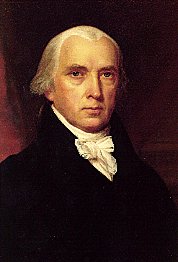
Dolley liked Madison. But she didn’t love him, nor was attracted to him. Nevertheless she accepted his invitations to dinners and local events and carriage rides. And he called on her regularly.
A few months later he proposed. She gently turned him down, saying “it was much too soon.” Her husband had only died a few months before.
Dolley Madison… The Alass part…maybe
After a wretched day licking his wounds from another romantic failure, Madison (a cerebral man) realized that Dolley had not said “no.” She merely said “not yet.” There is a difference. He continued his wooing and pursuing. She continued accepting the invitations.
Some time later, she checked her Marital Happiness Requirements List, which now included being a kind protector and stepfather to her son. Madison was also wealthy and could/would provide handsomely for them. And, she later wrote, “their hearts understood each other.”

Nevertheless, on her wedding day, she sent a letter to her friend Eliza Collins, signing it “Dolley Madison…alass, alass.”
Perhaps the 26-year-old widow was saying goodbye to whatever hopes she may have dreamed of having a passionate “Prince Charming” romance.” Just a thought.
But her new marriage would be happy. Very happy.
Sources:
Allgor, Catherine – A Perfect Union – Henry Holt & Coo., 2006
Gerson, Noel B. – The Velvet Glove: The Life of Dolley Madison – Thomas Nelson Publ., 1975
https://rotunda.upress.virginia.edu/dmde/bio-intro.xqy
https://www.librarycompany.org/women/republicancourt/madison_dolley.htm
https://www.historicamerica.org/journal/2022/2/2/dolley-and-james-opposites-attract
 Presidential History Blog