
The War of 1812 was seminal for James and Dolley Madison.

The Unlikely Commander-in-Chief
James Madison (1751-1836) was one of the most unwarlike men to serve as President of the United States, and thus Commander-in-Chief of the military. Following in the huge footsteps of George Washington, who at 6’2” literally towered over most of his contemporaries, the “great little Madison” as he was called, was anywhere between 5’ and 5’6” (depending on sources you espouse). He was also a slight fellow. No source claims more than 125 pounds. And he was also no youngster. He was past 60, and while he lived to be 85, always considered frail.
Madison was an intellectual, philosophical man, and likely the best formally educated of all our Founding Fathers. He received the equivalent of a masters degree in political science from the College of New Jersey (Princeton).
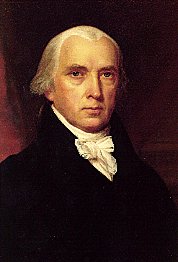
When he assumed the Presidency in 1809, there was growing antagonism between the US and its former “mother country” Great Britain. The British were (as usual) engaged in a huge war with France, and the centuries-old enmity between those countries was not helped by Napoleonic ambitions for European domination. The US, in many ways, was caught in those crossfires.
Madison tried vainly to prevent armed hostilities.
Admiral Cockburn:
Sir George Cockburn (pronounced Co-burn), was not only Admiral of the British Fleet, but a Scottish Baronet of lineage and nobility. He was born in 1772, shortly before the British closed the port of Boston and ignited the American Revolution, and thus only a small boy when General Cornwallis surrendered to George Washington at Yorktown in 1781.

By the 1790s, George Cockburn was one of Admiral Horatio Nelson’s young, promising captains, just as Napoleon was coming to power in France.
By mid 1814, Napoleon had been forced to Elba, and peace in Europe was potentially at hand, so Cockburn, now in his early 40s, was tasked with spanking King George’s ex-colonies. He had gained a reputation for brutality during his raids on coastal Virginia towns and villages, setting them ablaze and causing heavy casualties. The US had placed a huge price on his head, and reportedly offered $500 for each of his ears.
Sir George obviously believed that a whirlwind raid on Washington would be just the strike to win praise at home, humiliate the Americans, and maybe recapture its erstwhile territory abroad. And a spiteful spit in the face from John Bull would not be hard to take either. The British fleet sailed into the mouth of the Chesapeake Bay, and marched the rest of the way.
So Why Attack Washington?
There was absolutely no good reason to attack Washington DC in 1814 other than to tweak their former nemesis, the old, dead General whose name was permanently attached to the U.S. capital.

What they wanted was Baltimore, only 40 miles away. In 1814, it was the third largest city in the country with a magnificent port and harbor at the mouth of the Chesapeake, the gateway to the Southern states. It’s industry was thriving. Washington was still a sleepy little village with a few up and coming nice buildings.
President Madison was a good man, albeit no warrior, but his attractive and personable wife Dolley had earned worldwide acclaim as a quintessential hostess, whose parlor and table attracted one and all, high brow and low. It was she who was famous – and had been for more than a decade.
It was not a huge surprise. The British fleet had been sighted causing havoc in the Chesapeake Bay as far south as North Carolina, and seemed to be making haste for the capital city. Practically everyone in Washington was evacuating for an imminent attack. Wagons and carriages had been clogging the street for days, carrying residents and officials out of town – with their most prized possessions.

President Madison, guardian of the Declaration of Independence, the Constitution and the Bill of Rights (among other documents), had packed up all the state papers and treasures. He had dispatched them via trustworthy friends and associates to places of safekeeping.
As Commander-in-Chief, Madison was following in the huge footsteps of President/General George Washington. While none could credit him with great military knowledge or skill, they would not find him wanting in courage. He decided to go to Bladensburg, MD (where actual fighting was taking place) – and rally the troops in person.
Taking Aim on the White House
When President Madison left for Bladensburg, he had instructed his wife to finish packing up their important belongings, and wait for further word from him. He also had advised her, if necessary, to vacate and meet him at a pre-arranged safe place in Virginia.
Dolley Madison had scheduled a luncheon for August 24. The table had been set and the food prepared. She ran to the roof with her spyglass every hour, hoping to see a rider en route with a message from her husband.
Messengers had been coming for Mrs. Madison all morning – to cancel their luncheon invitations, and offer to take the “Presidentress” to safety. She had declined, pending word from Mr. Madison…. Finally she no longer could remain. The British army, partially led by a British Admiral, was close at hand.

The Capitol Building was torched first. Cockburn and his soldiers paraded into Congress, gleefully passed a mock-bill, took a mock-vote, vacated, and proceeded to torch the building. Then they burned what was then the Library of Congress. A new one was built afterwards.
Then they arrived at the White House at 11 p.m. that night. The doors were unlocked and no one was there. But they could smell cooked meats, and having had nothing to eat for twelve hours or more, helped themselves to the party. That included bottles of fine wines, too good to waste.

Then they commandeered souvenirs. A mantel filled with ornaments was distributed to the partygoers; one soldier took a sword, another appropriated one of President Madison’s shirts.
Admiral Cockburn personally confiscated Madison’s hat along with a velvet cushion, smirking that it would remind him of Mrs. Madison’s “seat”. After all, she was the most famous woman in America.
Then they set fire to the draperies and the upholstery.
There have been many sources describing the purloined hat and cushion, but alas, there is no indication of where either of them are today.
Sources:
Allgor, Catherine – A Perfect Union – Henry Holt, 20006
Cook, Jane Hampton – The Burning of the White House – Regnery History, 2016
Hugh, Howard – Mr. and Mrs. Madison’s War – Bloomsbury Press, 2012
https://www.nps.gov/people/george-cockburn.htm
https://www.battlefields.org/learn/articles/burning-washington-dc
 Presidential History Blog