
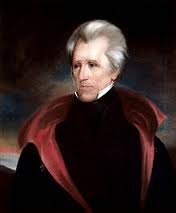
General/President Andrew Jackson
Andrew Jackson (1767-1845) was a wild boy, devoid of blood relatives by his teens, self made into a frontier attorney, further self made into a gambler, speculator, planter, brawler, duelist, legislator, and finally soldier, became a household word after his technically-too-late victory in New Orleans during the war of 1812. But the battle itself had great ingenuity, merit, gallantry, and a victory is a victory.
For the next dozen years after New Orleans, AJ continually sought a general’s star in the regular Army, to no avail. He returned to political life and appointed office, but again, to little consequence – since his well-known penchant for disregard of regulation and disobedience of orders made him powerful enemies who blocked his desired ends.

Faults and all however, none could deny that he was charismatic, charming when he chose, and unquestionably a man of great leadership.
When the Presidency missed his lap in 1824, Jax cried “foul,” stamped his feet, complained to anyone who would listen, and plotted for a rematch. He also collected a growing cadre of young enthusiasts who flocked to his banner, prepared to put one of their own “westerners” in the White House by hook or by crook. They needed neither. By 1828, the country had grown enormously, and rough and tumble was rapidly replacing staid and stodgy. Jackson won handily.
But his eight years in office were a mixed bag.
Gifting from the Hoi Polloi
It has been a practice (or tradition) for millennia. The lowliest and often the poorest people have given opulent gifts to those who don’t need it: kings, emperors, and assorted big shots. Whether it is from fear or coercion, in hope of gaining favor or recognition (or forgiveness), or even for sincere affection and loyalty, the lowest of the low have scrimped to provide their very best gifts to the highest of the high. Sometimes gifts are given for publicity to benefit the giver.

Gifts are not always of high monetary value, although few kings or queens have turned down a jewel for the crown. Sometimes the gift is one of craft or talent or skill, the only thing they have to give.
When George Washington was General, and later President, gifts of various sorts were commonplace. It was also widely understood that a) GW was a wealthy man and obviously did not need the additional largesse; and b) was an honest man who could/would not have his honesty or integrity impugned.
Subsequent Presidents have tried to emulate those virtues; some have done it better than others.
Today there are stringent laws for a POTUS/FLOTUS accepting gifts. Most of our recent heads of state are gracious, and some donate said gift to their presidential library or museum, considering it a gift-of-state.
Personal gifts, of course, are somewhat different. A President certainly can accept a nifty birthday present from a close relative/friend. When sitting President and Mrs. William Howard Taft celebrated their 25th (Silver) Wedding anniversary, an arsenal of silver trays, urns and related objects were given by some 4,000 guests. Customary then (and “cheesy” today), those objects were displayed for all to see in a special room at the White House. The traffic was heavy.

Nominal presents however, i.e. books or flowers, or homemade gifts of craftsmanship or skill, are usually accepted gracefully, and a thank you letter from the POTUS or FLOTUS is something to be treasured.
Thomas Meacham, Farmer
“Colonel” Thomas Meacham (the “colonel” part was honorary) was a dairy farmer in upstate New York at a time where the completion of the Erie Canal, linking the Hudson River to the Great Lakes, had resulted in enormous prestige and prosperity for the region. Meacham’s property was extensive, and his dairy farm, to include cows, milking facilities and a factory for producing cheese, was said to be the largest in the area.
In 1835, Meacham had a brilliant thought. He would produce the largest wheel of cheese ever made, and send it to President Andrew Jackson in the White House. He believed the associated hoopla would ensure his fame and maybe even his fortune.

He built a special structure with hoops and frames lined with cheesecloth, and a press to hold the curd. For days, milk from 100 cows was poured in. The whey was squeezed out every day, and finally an enormous wheel, 4′ in diameter, weighting 1400 pounds was ready.
Of course this enterprise garnered huge publicity. Friends and neighbors came to gawk. Inspired by the clamor, Meacham had a special wagon made and appropriately painted and decorated, hitched eight horses, and carted the cheese to Port Ontario, to be loaded onto a ship bound for Washington – and the White House. Needless to say, the crowds went wild for the spectacle, including cannons, bells and whistles. Everywhere along the way, more crowds came to see the huge cheese.

Disposing of the Gift
In due course, the half-ton-plus cheese reached President Andrew Jackson, who kept it in the White House vestibule for nearly two years. (Perhaps he wanted it to age. Perhaps it was just too heavy to move.)
But on George Washington’s Birthday in 1837, shortly before Jax was due to retire from office, word went out that free cheese was to available to any and all. Come to the WH and partake! Hundreds of citizens did exactly that. They showed up, knives and forks and knapsacks – to eat cheese, and perhaps take home a souvenir.

Most people know that when a cheese is cut into, it releases a pungent odor from the pent up- gases and microbes now released. And so it was with the Jackson cheese. To no surprise, many guests were overcome by the noxious fumes. Pieces of cheese were ground into the carpets and upholstery. Newly elected POTUS Martin Van Buren had his staff picking out remnants for weeks.
But the penetrating stench of cheese was said to permeate the mansion for many months. Or more.
Sources:
Brands, H.W. – Andrew Jackson: His Life and Times – Doubleday, 2005
James, Marquis – The Life of Andrew Jackson: The Border Captain; Portrait of a President – Bobbs Merrill, 1937
Meacham, Jon – America Lion: Jackson in the White House – Random House, 2008
https://www.whitehouse.gov/about-the-white-house/presidents/andrew-jackson/
https://npg.si.edu/blog/big-cheese-presidential-gifts-mammoth-proportions
 Presidential History Blog
BORN March 15, 1767 – DIED June 8, 1845–Your first paragraph dates are WRONG.
Thanks! Klutzy old fingers. Immediately fixed!