The Whig Party was a brand new national entity in 1840.

…And Tyler Who?
The Whig Party, originally formed around 1836, was an amalgam of sectional and factional differences, basically centered on their dislike for President Andrew Jackson, whether it be his policies or his personality. Knowing they were bound to lose in ‘36, they fielded four different Presidential candidates, depending on geography. Their reasoning was that perhaps a “front runner” might appear for 1840.

That front runner did appear, in the person of aging General William Henry Harrison of modest War of 1812 fame. His victory at Tippecanoe was “out west” – in the Ohio Territory – and could be considered mere skirmishes at that. Nevertheless, victory is victory, and Harrison’s name (and family history) was a known quantity. He was also very happy to accept the nomination.
The choice for Vice President was a headache for the new Whigs. There were some who believed the position itself was superfluous, and indeed it was a tack-on during the Constitutional Convention. Very little was known of our “founders” intentions regarding the VP, and besides, they were all dead. James Madison, last of them to die (in 1836), left a treasure in his annotated diaries of the Convention, but it had yet to be purchased/published by the government, and was thus unavailable for research.
Then of course, the Democrats had nominated President Martin Van Buren for a second term – with NO Vice President on the ticket. The sitting VP, Richard M. Johnson, had become heartily scorned for his scandalous personal life, and no other candidate was forthcoming.

Despite the fact that the aristocratic Harrison was born only a few miles from Tyler in Virginia, he had spent his adult years “out west,” and was considered a “westerner.” The Whigs needed an easterner, and preferably a southerner, to balance the Whig ticket. Ergo “Tippecanoe and Tyler too.” It had a ring to it.
So What Was the Problem?
Nobody wanted to be Vice President, despite the honor and the sumptuous $5000/year salary (the average man made $500/year). But the position had no real purpose other than to preside over the Senate. Any politician with even a smattering of ambition knew it was a dead-end route to oblivion.
John Tyler, at 50, enjoyed a fine upbringing and education. An attorney, like his father, who had been Virginia’s Governor, he had acquired substantial property, fair wealth and prominence in his native state. And, like his father, he had been a states-rights Jeffersonian Democrat forever.
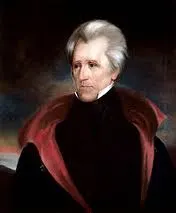
But he developed a strong antipathy to Andrew Jackson, and indeed, was considered a maverick. By 1836, he was persuaded to run for his Senate seat on the Whig ticket (which he won), making him an on-paper-at-least Whig, and somewhat beholden to the party. This, of course, sowed distrust among the Whigs. Would he support their platform on a national bank, internal improvements and higher tariffs?
But they obviously didn’t care. After all, nobody expected William Henry Harrison to die.
But He Did…
William Henry Harrison, POTUS for exactly one month, died. He was 68, and while his health had been good, 1840s medicine could not successfully treat his pneumonia – or perhaps cholera.
Interestingly enough, Harrison’s cabinet, solid Whigs all, recognized that Harrison was failing rapidly about a week before his demise. When they met, they also recognized that Vice President Tyler might be called to fulfill his term. They drafted a letter to the Vice President, advising him of the imminent situation, and once WHH breathed his last, dispatched a fast rider to Tyler’s home in Williamsburg, VA with the news.
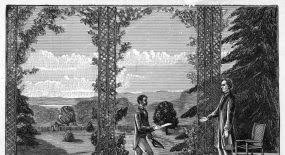
Tyler immediately left for Washington, anxious to demonstrate his effectiveness in his new (and unsought) position. There were six cabinet positions then: State, Treasury, War, Navy, Attorney General and Postmaster General. Under Harrison’s administration (and in line with Whig policy), each member had one vote, and that included the vote of the President. The cabinet expected that policy to continue.
Tyler had other ideas, and first and foremost was the way he was to be addressed.
Entitlement
There was no question about the Constitution’s clause regarding the Vice Presidency: in the event of “vacancy” the tasks of the President would devolve upon the Vice President. The big question however, was what they would “call” the new VPOTUS-turned-POTUS. Everyone in a prominent position requires a “title” of some kind.
The Cabinet and other members of Congress leaned toward calling the new Chief Executive “the Vice President acting as President.” Perhaps they would call him “Acting President.” Tyler’s adversaries called him “His Accidency.” Some even called him “Usurper.”
Even though he readily agreed to take the formal Oath of Office and speak to a special joint session of Congress, his critics were not mollified.
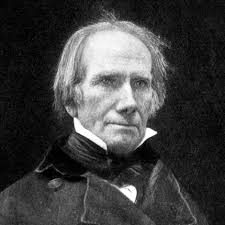
Accident or not, the new President was not the pushover many (including the towering figure of Henry Clay) had expected. He believed that if the “powers and duties of the President” fell to him, he should “be” the President. That included the Presidential salary and the privileges and perks of living in the White House.
For the rest of his term, any letter addressed to Tyler in any way other than as President would be returned to the sender unopened. His stubbornness/courage set a precedent that would be carried through for 125 years, through the deaths of Taylor, Lincoln, Garfield, McKinley, Harding, Franklin D. Roosevelt and Kennedy.

From the outset, Tyler firmly announced to his cabinet that he would do things his way, saying “I am the President, and I shall be held responsible for my administration. I shall be pleased to avail myself of your counsel and advice. But I can never consent to being dictated to as to what I shall or shall not do.” Then he added, “When you think otherwise, your resignations will be accepted.”
In six months, with the lone exception of Secretary of State Daniel Webster, his cabinet all resigned.
Sources:
Cohen, Jared – Accidental Presidents: Eight Men Who Changed America – Simon & Schuster, 2019
Craypol, Edward P. – John Tyler: The Accidental President – UNC Press, 2006
Seager, Robert III – And Tyler Too, McGraw Hill, 1963
https://www.whitehouse.gov/about-the-white-house/presidents/john-tyler/
https://www.whitehousehistory.org/john-tyler-and-presidential-succession
 Presidential History Blog
Reblogged this on .