
Held his nose and away he run…
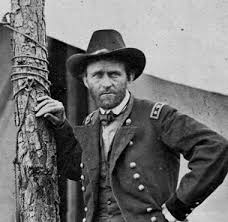
Jesse Grant, Tanner
Jesse Root Grant (1794-1873) was Pennsylvania-born, but migrated to southern Ohio as a small child. He had a decent education for his time and station in life, but possessed a strong desire to get ahead, and a fair aptitude for business.

As an adult, he became a tanner. He bought horse and cow carcasses, processed them in vile-smelling chemicals to make them pliable, and sold the leather to saddle makers, shoemakers, harness makers, and anyone else who worked with leather. Occasionally he sold those finished goods in his store.
By his late twenties, he was considered a prosperous middle-class businessman, with several holdings. He had sufficient means to begin a family, and courted and married Hannah Simpson, also Pennsylvania-born, but migrated to Ohio as a young woman.
The two were polar opposites. Jesse was bombastic opinionated and dominating. Hannah was silent and deeply religious. Perhaps the only thing they had in common was their strong antipathy toward slavery.
In the expected period of time, the Grants had six children, Hiram Ulysses being the eldest. The next five followed about three years apart.
Their home in Georgetown, Ohio was a fine brick house, with ample room for their growing family. The tannery was nearby, perhaps at a sufficient distance to keep the reek from permeating the house itself.
The Tanner’s Eldest
The first born son to Jesse and Hannah Grant, was named Hiram Ulysses, better known to history as Ulysses S. (for Simpson) Grant. Nobody ever called him Hiram. Quiet and taciturn like his mother, Ulysses was a diligent enough student, brought up to mind his manners. Like most children of the early 19th century, he was also expected to do household chores. Or help in the family business. Young Grant hated the tanning business, with its stench and blood.

Fortunately for him, at a very young age he showed a distinct affinity for horses. Some said he liked horses better than people. Others merely indicated that he ”had a way” with horses. Whatever those gifts were, by the time he was eight, his father trusted him enough to drive a team eight or ten miles away – on his own.
As long as he could pick up and deliver goods, and escape the nauseating atmosphere of the tannery, Ulysses was happy to help out. It is also likely that Jesse Grant sensed his son’s aversion, and permitted him to be useful on his own terms.
Since the elder Grant was a man of reasonable means and definite ambition for his offspring, Ulysses was sent to a Kentucky boarding/prep school while in his mid-teens. At seventeen, however, it was his father who took a hand in directing his future. He arranged for his eldest son to receive an appointment to West Point. It was free, and despite the reasonable means, Jesse was a thrifty man.
Ulysses Simpson Grant (now his official name, since his Congressman-sponsor knew nothing about the Hiram part, and assumed the traditional middle naming of an eldest son with his mother’s maiden name), did not wish to attend West Point or become a soldier, and said so. His father, always dominating, said his son would go, and learn to like it. Ulysses S. Grant would not stand up to his father until he was past forty.
So he went, and liked it well enough to fit in, and graduate mid-class. His academics were average, and he showed ability in mathematics and drawing. But he excelled in horsemanship.
Once graduated from the Academy, he had no fears of being expected to work in his father’s tannery.
Ten Years Later and Then Some…
The tannery business was the furthest thing from Lt. Grant’s mind during the next ten years. He was sent to St. Louis MO for his first assignment, where he wooed and wed Julia Dent, the sister of his West Point roommate. The wooing was easy; the wedding took four years of devoted waiting while USG served ably, including service in the Mexican War. His marriage and subsequent deployments were comfortable enough, and his marriage thrived and was fruitful.
But when Ulysses and Julia were separated, he assigned to California/Oregon territory, and she to return to St. Louis to have their second son, he fared poorly. Boredom, financial disappointment and most of all, homesickness for his beloved ones, led him to the all-too-convenient whiskey barrel. That led to a “requested” resignation from the army, embarrassment on many fronts and severe depression.
He finally had to wire his father for enough funds to return to St. Louis. He was thirty years old. His father was livid, but he sent the money.
Back to the Tannery
For the better part of seven years, former Captain Ulysses S. Grant fought his own losing battle of the wilderness, trying to find suitable work and means of supporting his family in St. Louis.
By 1860, things were so bad that Grant was forced by necessity to write to his father begging for a job in one of his tanneries. It may have been the hardest letter USG every wrote. But Jesse Grant grudgingly obliged, and sent his son-and-family to Galena, IL, where he had a partnership in a tannery, now being managed by USG’s younger brothers.

Knowing his aversion to the blood and stench of the business, USG was usually assigned clerking and/or delivery duties, although one source indicates that the former army captain was a strong physical specimen, and loaded the heavy carcasses down the chute into the vats of boiling, stinking chemicals. All sources claim that he scrubbed down in a makeshift outdoor shower before Julia would let him in the house.
Less than a year later, when the Civil War began, and Grant, the only citizen of Galena with military experience, was asked to train a company of ”volunteers,” he accepted with alacrity.
And he never set foot in the tannery again.
Sources:
Chernow, Ron – Grant – Penguin Press, 2017
White, Ronald C. – American Ulysses: A Life of Ulysses S. Grant – Random House, 2016
https://millercenter.org/president/grant/life-before-the-presidency
 Presidential History Blog
Reblogged this on Practically Historical.