
 Everyone knows John Adams and Thomas Jefferson, VPs 1 and 2. Some know Aaron Burr, VP 3. But George Clinton?
George Clinton’s Qualifications
George Clinton (1739-1812) was a New Yorker from upstate, considered among our Founding Fathers (perhaps minor, but still worthy) who performed excellent service to both his country and to New York.

Gov. Clinton hosted GW’s first dinner as President.
Having served in the French and Indian War, he returned to Ulster County, read law, and began a career in public service. By his mid-thirties, he was elected to represent New York at the Continental Congress in Philadelphia, where he met George Washington and formed a lifelong friendship.

No hat – but different uniform!
By 1777, he was elected Governor of New York – one of seven terms, still a NY record. Despite serving in his gubernatorial capacity, he had another hat, as a Brigadier General in the Continental Army, and remained on active service throughout the Revolutionary War.
It was/is not easy being Governor of New York. In 1777, the state was extremely vulnerable, not merely because of its strategic importance as a major port, but because there was a large Tory faction which was always dangerous and needed to be taken into account. But George Clinton was an ardent advocate of independence, solidly anti-Tory, although by the mid-1790s, was a leader of the emerging Democratic-Republican party.
He was definitely considered a viable Presidential (or at least Vice Presidential) candidate in 1792, 1796 and 1800. He had chops, and he had a solid following. And New York was/is an important state.
So….?

#1 VP Adams

#2 VP Jefferson
So the Constitution originally declared that in a Presidential election, the winner of the most electoral votes (vitally important in those days) became President, and the first runner-up became VP. Both John Adams and Thomas Jefferson, as Vice Presidents, had mega-political talents and character qualities sufficient for them to assume the Presidency when their “time” came. But the newly-designed Constitution assigned the VP solely to the task of presiding over the Senate, with no participation in debate, and a vote only in case of a tie. It was an honorable position, but toothless. As Vice Presidents, both Adams and Jefferson bemoaned the insignificance of the office, and their Presidents seldom sought their counsel.

#3 VP Burr
The election of 1800 (Adams-Jefferson) was acrimonious, and predicated a serious Constitutional crisis because NY’s Aaron Burr, presumed a candidate for Vice President, polled the same number of electoral votes as Thomas Jefferson. Adams was a distant third. So Burr decided to switch gears, declare for the Presidency, throwing the decision into a tizzy in the House of Representatives.
After days of wrangling, the House voted for Jefferson. As might be expected, Aaron Burr, first runner-up, became Vice President, and very non-grata to Jefferson. And, as a result of this runner-up-being-VP situation, the 12th Amendment was quickly passed to avoid a repeat of the debacle.
And, no surprise, when Jefferson ran for re-election in 1804, Burr was summarily dropped from the ticket.
Enter George Clinton

#4… and #5 VP George Clinton
Now it gets a little fuzzy. George Clinton was sixty-five in 1804, and there is some indication that those who knew him well, believed he was showing some signs of dementia. He himself, had expressed his wish to retire. But then again, he was still a big name – especially in New York, where factions always ran high. Clinton was popular. Seven terms as Governor is not to be sneezed at!
Jefferson turned to Clinton as his VP candidate. They were generally like-minded, although the differences between Virginia political philosophy and New York political philosophy are also not to be sneezed at. But Jefferson believed that Clinton was “old” and would therefore be no threat to TJ’s good pal, James Madison, who he was grooming for the next election. Clinton was amenable.
Alas, all his experience and skills were in the executive branch. He knew nothing about Legislatures, let alone how to preside, his one Constitutional function. It wasn’t personal, but many of the Senators considered Clinton “a fish out of water.”
John Quincy Adams was a Massachusetts senator at the time. In his usual vitriolic way, he confided to his diary his dislike for VP George Clinton, criticizing his poor judgment and ignorance of basic Senate procedure. He especially lambasted him for asking senators to warn him when they planned to make a long speech so he could turn over his presiding duties to another and “take the opportunity to warm himself by the fire.”
As expected, President Jefferson had little use for Clinton, and never consulted him. The position itself had become practically superfluous, and would remain so for about 150 years.
Nevertheless…
… by 1808, Clinton (perhaps in his dotage) believed he should be President himself. After all, both Adams and Jefferson were Vice Presidents who moved up. By 1808, the old Federalist Party was nearly moribund.
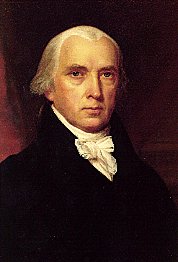
James Madison got the POTUS nod in 1808.
But there were many who were not Jefferson enthusiasts, and it was Secretary of State James Madison, a longtime friend of Jefferson, who was poised for the position. He was ably supported by his socially talented wife, and they wined and dined and “politicked” everyone. Poor George Clinton. He still had a small following, but his wife had died several years earlier, and, when he was in Washington, he lived alone in a boarding house. No parties.
But James Madison was in need of a Vice President. George Clinton was available, and there was no reason not to allow him to continue in the generally empty position. If his health was failing, sobeit. It did not matter. They never even asked him if he was amenable.
They just nominated him and placed him on Madison’s ticket. Clinton, perhaps with few friends in Washington, and flagging energies, acquiesced.
He served for three years under Madison, the first VP to serve under two presidents, thus accounting for #4 and maybe #5. Then he died in office (another first). He was 72. He was not replaced.
But New York still holds him in high regard!
Sources:
Barzman, Sol – Madmen & Geniuses: The Vice-Presidents of the United States – Follett Publishing, 1974
Witcover, Jules – The American Vice Presidency: From Irrelevance to Power – Smithsonian Books – 2014
https://www.senate.gov/about/officers-staff/vice-president/VP_George_Clinton.htm
 Presidential History Blog
Reblogged this on Practically Historical.