Robert Lincoln was twenty-one when he became man of the family.
Young Mr. Lincoln
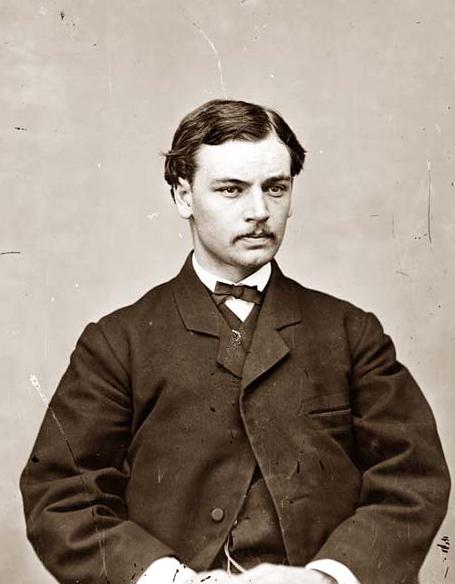
Young Robert Todd Lincoln.
Abraham Lincoln died intestate: he had not made a will. Thus, by law, his estate would be divided into thirds: a third to his widow, and a third to each of his two remaining sons.
Robert Todd Lincoln (1843-1926) was a Harvard graduate and had begun some law studies when he joined the Union Army toward the end of the Civil War. With his father’s approval, he planned to return to Harvard once he was discharged.
Abraham Lincoln’s assassination changed everything. The Army expedited his discharge so he could attend to his numerous family concerns. His mother, overwhelmed with shock and grief, was little help. His young brother Tad was twelve. He was no help. And Robert knew he needed help.
He asked (presumably with his mother’s agreement) Judge David Davis, one of Abraham Lincoln’s oldest friends, to be the executor of his father’s estate.
Judge David Davis
David Davis (1815-86) was born to wealthy and prominent Marylanders. His fine education included Yale University. He became an attorney, moved to Bloomington, IL, married, and began a successful law practice-cum-mild-politics.

Portly David Davis was a long time friend of Abraham Lincoln.
Early on, he became acquainted with a struggling lawyer six years his senior, and his polar opposite on many fronts: financially poor, no family position whatsoever, and totally self-educated. Then there was the physical side: Davis, very short and very rotund; Lincoln, very tall and very lanky.
The two men became friends and mutual admirers. They were guests in each others’ homes. Their spouses were pleasantly acquainted. About the time Lincoln was a Congressman, Davis was appointed Judge on Illinois’ Eighth Circuit. After Lincoln’s single term in Congress, he resumed his law career, and rode that Eighth Circuit with Judge Davis and a cadre of other lawyers, soliciting legal business.

Judge Davis was one of only a few Lincoln friends offered a federal appointment.
Lincoln, the Republican candidate for President in 1860, made Judge Davis his campaign manager. Once elected, he offered only a few minor positions to his Illinois colleagues. In 1862 however, when a vacancy opened, he appointed David Davis to the Supreme Court.
David Davis: Robert’s Second Father
Throughout his long life, Robert Todd Lincoln referred to David Davis as a “second father,” the man who stepped in to fill the void that (according to RTL) was never quite completely filled by Abraham Lincoln himself.
Robert needed guidance and mentoring. He needed to “read” law, still acceptable for a legal education. Davis could steer him toward the best law firms in Illinois.

Young attorney Robert T. Lincoln.
Shortly after his family moved to Chicago, Robert found that living in close boarding house quarters with his still-babyish brother and his still-overwrought mother made concentration on his studies impossible. Davis understood the situation. He was happy to advance Robert sufficient funds so the young man could move out on his own.
The Lincoln Estate
Perhaps because he had so little money for most of his life, the sixteenth President was very casual in handling it. His needs were relatively few. When he married and had a family, he opened accounts with various Springfield merchants. When the bills came, if they seemed right, he paid them.
He was married for nearly ten years before he achieved middle class status. In 1860, the year he was elected POTUS, he earned $6000. Comfortable, but hardly opulent.
As president, Lincoln’s housing was “on the house,” including servants, maintenance and traveling. His out-of-pocket expenses for food and entertaining was moderate. He regularly forgot to cash his monthly paychecks from the Treasury. A few unopened envelopes were found in his desk.
Judge Davis had a difficult time trying to make an accurate accounting of Lincoln’s finances. What he did learn early on, was that Mary Lincoln had incurred huge debts, unbeknownst to the President. Merchants had been eager to grant Mrs. L. unlimited credit; now they wanted payment. She was panicked.
It took Davis two years to resolve whatever needed resolving, during which time the family was put on allowances, considered more than ample for most people, but nowhere near what Mrs. Lincoln required. She considered the $25,000 she received from Congress paltry and wanted a great deal more – including a pension.
Lincoln’s estate was finally valued at around $90,000. Congress believed that even divided three ways, it was a considerable sum. But Congress did not like Mrs. Lincoln, and more money was not forthcoming. A moderate pension took nearly five years to pass.
Robert and the Judge: The Hard Call

Said to be the last photo of the Widow Lincoln – with the doctored “ghosting” of Lincoln behind her.

Robert Lincoln around the mid 1870s
David Davis had known Mrs. Lincoln for many years, and never cared for her. Now he liked her even less, perhaps realizing she was a “loose cannon” vis-a-vis the Lincoln Reputation. He also learned through Robert, circumspect though he was, what a serious headache and embarrassment she had become to her only surviving son. (Tad had died in 1871 at only 18.) While Davis sincerely sympathized with the Widow Lincoln’s many losses, his primary concern was keeping the Lincoln name unsullied.
In 1875, Robert, who was disinclined to bare his soul, finally confided to his “second father” that his mother was exhibiting very bizarre behavior – even for her. He couldn’t work, his marriage had become strained, and his own health was compromised. He was beside himself with anxiety. Judge Davis suggested that perhaps the Widow Lincoln might be insane – a somewhat catchall phrase that covered a myriad of psychological disturbances. And if that were the case, perhaps she needed to be protected from herself. Then of course, there was the Lincoln “name.”
Nearly a century would pass before Robert Lincoln’s private correspondence was discovered, indicating that whenever wise counsel was needed, he turned to Judge Davis. He likely knew that whatever his “second father” suggested would always be in the overall best “Lincoln” interest.
Sources:
Emerson, Jason – Giant in the Shadows: The Life of Robert T. Lincoln – Southern Illinois University Press, 2012
Emerson, Jason – The Madness of Mary Lincoln – Southern Illinois University Press – 2007
http://rogerjnorton.com/Lincoln66.html

 Presidential History Blog
Reblogged this on Practically Historical.
Another excellent write up on some lesser-known Presidential history 🙂 I really enjoyed reading this. So much tragedy in the Lincoln family…
This was good news in the midst of the whole Lincoln tragedy. I’m so glad to learn that Robert had a mentor and rescuer.