
Louisa Catherine Adams: A Brief Medical History

Louisa Catherine Adams (1775-1852), London born and Paris educated, was raised to be exactly what she would become: a perfect consort for a man of distinction. John Quincy Adams was the US minister to the Netherlands and the son of the Vice President of the United States when he met and married her. His potential distinction was certain, but marital felicity was not. JQ was a cold, controlling man. Emotional stress always takes its toll.
Add to this low-grade strain was Louisa’ fifteen pregnancies. She miscarried chronically, sometimes fairly late in her term. There was a stillborn. Another died before she was a year old. Only three sons would be born and live to maturity. It took its toll as well.
When Louisa was in her late thirties, she spent the better part of five years in St. Petersburg, Russia, where her diplomat husband served as Minister Plenipotentiary. Russian winters, then as now, are legendary. The cold and dampness in poorly heated accommodations took its own toll. Louisa would blame her subsequent chronic “rheumatism” on the horrible Russian weather.
Then there was her “unmentionable” problem.
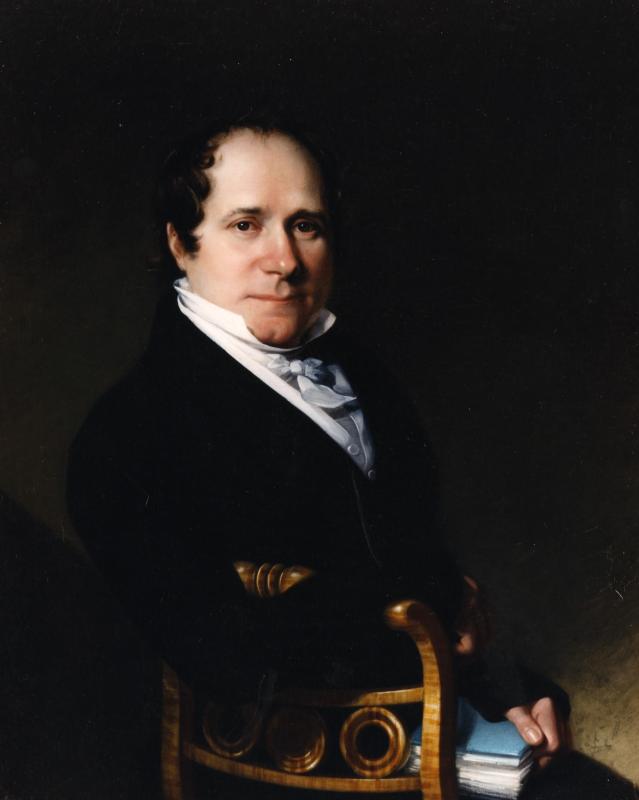
Dr. Philip Syng Physick
Philip Syng Physick (1768-1837) was a Philadelphia doctor, whose prominent family had sent their promising young son to London and Edinburgh, Scotland for his medical education, said to be the finest in Europe. Then he returned to Philadelphia to begin a medical and surgical practice, which included teaching at the University of Pennsylvania.

In those early decades of the nineteenth century, anesthesia was still in the distant future. So was general sanitation. Bleeding was still a time-honored cure-all. If a doctor, and particularly a surgeon, was to enjoy high distinction, it would be because of his skill and adeptness with the knife. Sharp instruments were a plus; so was the surgeon’s speed in repairing or removing the affected problem.
Dr. Physick’s practice was varied and far-reaching for its time. He designed and crafted any number of surgical instruments and scalpels himself, in various sizes and shapes, to be used for specific anatomical purposes. He experimented with medicines and potions, and is said to be the first to use carbonated water for medicinal purposes (soda pop!). His approach was far ahead of his time.

Although he was a cold man of regimented habits, he was still considered the finest doctor in the country, albeit eccentric, anti-social and perhaps downright peculiar.
The “Unmentionable” Louisa Connection
Louisa Catherine Adams shared an “unmentionable” problem with her brother Thomas Johnson – a private ailment usually spoken of in whispers: “piles,” or hemorrhoids, which are essentially varicose veins of the rectum. It may well have been a genetic or familial condition, since there is evidence that several in the Johnson family were afflicted. In Louisa’s case, it was undoubtedly exacerbated by her fifteen pregnancies. In addition to the discomfort and often severe pain from this condition, it could be seriously complicated by an impacted bowel and inability to evacuate.
In extreme cases there was only one treatment: surgery. It was a completely new approach being pioneered by Dr. Physick. It was a complicated procedure, particularly since there was no anesthesia. Ether and chloroform were still decades away. Topical and/or alternative measures were a century away. So was basic hand-washing or instrument boiling.
Nevertheless, Louisa Adams, her brother and her fifteen-year-old niece made the trip to Philadelphia in 1821, where the surgeon confirmed that Thomas Johnson was in dire need of surgery. Discovering that Mrs. A. had the same “delicate condition,” she was advised to undergo the surgery as well. But Thomas Johnson’s problem was far more intense, so he became the guinea pig.
At Dr. Physick’s recommendation, Louisa and her niece rented rooms at a boarding house to prepare him for his surgery, and to help him recuperate. The doctor insisted on arduous attention to his food preparation, chopping and grinding and boiling a particular kind of moss into a bad-tasting-but-supposedly-therapudic soup which he needed to eat for several days prior to surgery. In those days before food processors and blenders, its preparation took hours. It would be weeks before he was ready for his operation.
Louisa Adams Goes Under the Knife
When Thomas Johnson recovered completely, he was thrilled with the outcome. The quality of his life had vastly improved. Thus encouraged, Louisa decided to subject herself to the same procedure. Once again she and her niece checked into the boarding house that Dr. Physick recommended (and where he performed the surgery, by the way) and prepared herself to go under the knife. She and her niece chopped and ground and boiled the moss-soup for her to drink for several days prior to the operation.
For delicacy’s sake, Mrs. Adams was not required to completely undress. She merely removed the necessary clothing. Then her hands and feet were tied down, and she laid on her side exposing the particular orifice, in this case, her derriere. In lieu of any anesthetics, she was given a hefty dose of laudanum (a strong opiate), and steeled herself for the pain that would follow. She remained awake, albeit “la-la’d” throughout the operation.
Dr. Physick was experienced in this type of surgery; Louisa Adams’ problem was also not as severe as her brother’s. The ordeal did not take as long, nor was the recovery period as lengthy. And happily for her, she enjoyed the same results of her “unmentionable” surgery. She was so pleased that she asked her husband to pay Dr. Physick $100 above what his bill called for.
Sources:
Nagel, Paul C. – Descent from Glory – Oxford University Press, 1983
Shepherd, Jack – Cannibals of the Heart – 1980, McGraw Hill
http://www.archives.upenn.edu/people/1700s/physick_philip_syng.html

 Presidential History Blog
Hi Feather! It’s amazing what people went through back then. Although there are definite problems and complaints about medical practices today, at least we have anesthetics. I enjoy your blog. You are an excellent historian.
Interesting history both about the Johnson/Adams family and the surgical procedures. Thank you for this “personal” look at one of our first ladies.
Loved it. Left a comment. sd
Feather, from one writer to another I think you are a great story-teller. Knowing that you have done much research and your writing is accurate and informative, I have to say your writing also makes for entertaining reading. I am hoping you will write specifically about the great love and devotion between these U.S. Presidents and their First Ladies: Andrew and Rachel Jackson; George and Martha; Sarah and James Polk; Julia and U. S. Grant. .
My own limited research also suggests great love and devotion between these presidents and their wives: James Garfield; Rutherford Hayes.
Frankly, I do not believe that type of great love describes any 20th century U.S. President and First Lady except perhaps for Ronald and Nancy Reagan.
Best,
Roberta (Sandler)
Great piece, Feather.
Reblogged this on Practically Historical.