
Andrew Jackson was a 62-year old widower when he was inaugurated in 1829.
Jackson’s Road to the White House:
The road to the White House was a long one for Andrew Jackson. His laborer father was killed in an accident only weeks before Andrew’s birth in the Carolina wilderness. His mother raised him the best she could, but he was a wild child, preferring sports and games to studying. His education was spotty at best.
By the time he reached his later teens, however, with a little time out for American Revolution (scouting, messenger service and imprisonment), he managed to “read law.” With a law book, some basic legal forms and two saddle bags, Jackson migrated to Nashville, Tennessee when he was twenty. He became an instant success.
Within a decade, he practiced law, became a judge, owned businesses, speculated in land acquisition, owned property ( including his own large plantation), served in Congress, resigned, was elected to the Senate, resigned, raced horses, fought several duels, made and lost fortunes and was beloved throughout the state.
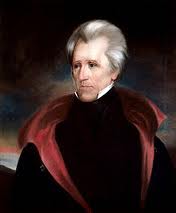
Andrew Jackson as he appeared about the time of his inauguration. He was sixty-two years old.
When he was elected General of the Tennessee Militia, (an honorary position rather than military), he found his true calling and never practiced law again. He took his militia duties seriously, and made a name for himself as a vicious Indian fighter. At the technically-too-late Battle of New Orleans in early 1815 he became a bona fide hero, and a force to be reckoned with.
He first ran for the Presidency in 1824, and led the popular vote in a four-way race. But after Congressional maneuvering, the election went to John Quincy Adams. Screaming “unfair,” Jackson began campaigning for the election of 1828. That time he won in a walk.
Andrew Jackson’s “Jacksonians”
Andy Jackson was nicknamed “Old Hickory” for his toughness. He was not a man to inspire neutrality. One either loved him or hated him. Thomas Jefferson once called him “the most dangerous man in the country.” To the educated and sophisticated Easterners, Jackson was a violent-tempered, illiterate backwoodsman, despite his assiduously cultivated charm and manners. To most Tennesseans, however, he was not merely Tennessee’s Favorite Son, he was Tennessee.
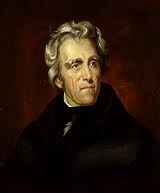
Andrew Jackson personified “The Hero.”
Jackson had acquired a strong cadre of young admirers during the early 1820s, all of whom brought energy and conviction to electing their hero to the presidency. His campaigns are usually considered the beginning of the two-party system as we know it today. After their loss in 1824, the Jackson followers redoubled their efforts via one of the nastiest political campaigns (both sides) in history, coupled with a lackluster performance by the acerbic and unpopular John Quincy Adams.
So in 1828, Andrew Jackson, tall, emaciated, toothless, riddled with disease and dueling bullets, was now President of the United States.
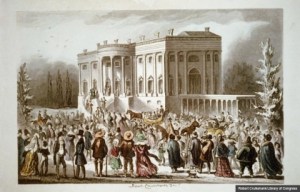
Throngs of people flocked to Washington DC to see General Jackson inaugurated as president. They came from hundreds of miles away for the festivities.
March 4, 1829:
Andrew Jackson came to his inauguration wearing a mourning band. His beloved wife Rachel had died only a few weeks earlier, and he was deeply grieving. The trip from Nashville to Washington had been a long one and he was exhausted. It is said that in those pre-amplification days, his voice was so low his inaugural address could barely be heard.
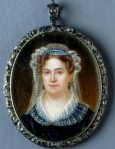
Andrew Jackson wore a miniature of his beloved wife Rachel hung from a silver chain around his neck.
But “Old Hickory” was a man of “The People,” and as such, armies of “The People” came to Washington to see one of their own take his place in the White House. Outgoing President John Quincy Adams, who loathed the hotheaded president-elect, did not attend. He did not want to shake Jackson’s hand. It was a bitter cold March 4, and the sixty-two year old Jackson, in chronically poor health, delivered his inaudible speech.
Then he proceeded a mile down Pennsylvania Avenue from the Capitol to the White House, with thousands of enthusiasts in his wake. Those followers would range from the polished and urbane New York politician Martin Van Buren to the rank-and-file of the great unwashed. Nevertheless, all thronged to the White House for a grand party.
The White House Inaugural Festivities:
The White House was thrown open to the public for Jackson’s inaugural festivities. It was wall-to-wall Jacksonians. His supporters, who believed that as taxpayers they had a part-ownership of the president’s house, descended on the Executive Mansion like vultures. They jammed themselves into the downstairs rooms, top hats merging with coonskin caps, satin waistcoats next to buckskin and coarse overalls. No matter, all were welcome.
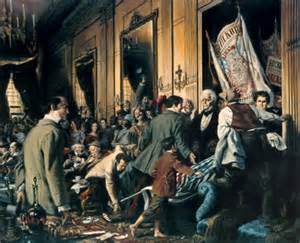
An artist rendering of the crowd-gone-wild at the White House following Jackson’s inauguration.
The usual libations were on hand: coffee, tea, and punch (probably liberally spiked with rum) and assorted cakes and sweets. With such mayhem and overcrowding, punch was generously spilled in all directions and on all people. So was tobacco spittle. Cake was ground into the carpets. Souvenir swatches were cut from the draperies. Cups, saucers and glassware was broken. People climbed on the chairs and tables, hobnail boots and all, to get a better look at their Hero – or to find a passing tray of punch. Cobbler-nails from rough boots tore the upholstery beyond repair. Fist fights broke out spontaneously among those clamoring for a better vantage point, or another cup of punch. It became a free-for-all. “Ladies fainted, men were seen with bloody noses and such a scene of confusion took place as is impossible to describe,” according to an eye-witness.
Andrew Jackson was exhausted and in poor health. Whatever festivities he might have enjoyed had been deadened by his bereavement. Indeed, one of his first acts as President was to plant a magnolia tree on the White House lawn in Rachel’s memory.
Instead, rather than elbow his way through the throng, Jackson simply climbed out of a second-story window to escape the hordes. Then he went back to the boarding hotel where he spent the previous night, and checked in again.
Sources:
http://www.eyewitnesstohistory.com/jacksoninauguration.htm
Burstein, Andrew – The Passions of Andrew Jackson – Borzoi/Knopf, 2003
Meacham, Jon – America Lion: Jackson in the White House – Random House, 2008

 Presidential History Blog
Another great story. I knew about the White House mob and Rachel’s passing. I didn’t realize he was ill at inauguration and the acrimony with JQ Adams. sd
Jackson had chronically bad health! How he made it to 78 is a wonder!
Pingback: Old Hickory’s Inaugural Brawl – The Crow's Nest